BACKGROUND: LAW FIRMS AS KNOWLEDGE BUSINESSES
In advance of examining the changing roles within the law firm knowledge sphere, it is important to understand the importance of knowledge to a law firm and why such an organisation should be considered a ‘knowledge business’. If such importance is acknowledged, then roles in the area to facilitate and develop knowledge become paramount. Attempting to meet knowledge needs is certainly not a new concept; in 2010, the vast cost of meeting these requirements in similar organisations in a post-recession economy was noted by Moon and DesouzaFootnote 1 :
‘Many organisations spend millions, if not billions, on knowledge management. Tools, processes, techniques, programs and even technologies for knowledge management are in abundance today’.
So what exactly makes knowledge so important to a law firm and why would they spend heavily on it? BaterFootnote 2 provides a succinct answer:
‘…at the core of legal services was the knowledge that constituted the intellectual capital of the firm that clients were willing to pay for’.
ParsonsFootnote 3 goes further:
‘In every advice, in every transaction, in every call of a colleague to share an opinion or critique an idea, in every training session, in every practice team meeting, and in every work-related break room conversation, lawyers have been building and sharing knowledge’.
Whilst a particular law firm may have numerous advantages for a particular client, the knowledge of its lawyers has to supersede virtually any other benefit. There may well still be a place for ‘additional extras’ such as training, corporate hospitality, seminars and secondments, but the knowledge of a firm is fundamental. If this is what clients are paying for, then it is easy to understand why such value is placed upon it.
We may assume that the knowledge of a firm and its lawyers is knowledge of the law and its interpretation, but this is not always true. Knowledge of a market, environment, culture, transaction or previous experience is vital too; so is the knowledge of a firm to position itself in the market and the appropriateness of the services it offers. This may involve the packaging of legal services or processing bulk work in the most efficient manner, certainly valid leverage of a firm's market knowledge. Where knowledge is considered critical in a firm, the opportunity for those involved with the area can have a fundamental impact on the development, and even strategy, of a firm. Surely this involvement is a large draw for any knowledge professional?
An important note should be made here – the knowledge within a firm is often apportioned to an individual lawyer. However, it should be acknowledged that a client instructs the firm, as opposed to the lawyer. Whilst a client may contact an individual based upon previous experience or relationships, the knowledge held by that lawyer intrinsically belongs to the firm and the challenge is to commoditise both explicit and tacit knowledge into a storable and retrievable format. This may include use of systems and social networking tools, which again is an opportunity for an individual with skills and experience here to play a useful role. Additionally, IT teams will usually be involved, although this may be more loosely as facilitators – restrictive systems can no longer be an excuse for poor treatment of knowledge.
THE CHANGING ROLE OF INFORMATION AND KNOWLEDGE PROFESSIONSAL IN LAW FIRMS
The fundamental importance of knowledge within a law firm has therefore never been greater. But what effect does this have on knowledge or information individuals within law firms? It is now the case, for example, that anybody with the word ‘knowledge’ in their title must become expert in all document and matter information involving their firm's transactions regarding, say, Venezuelan wind farms? The answer is obviously ‘no’, but the opportunity to be involved in knowledge and make a difference has never been greater and it is the role of knowledge professionals to ensure that lawyers have access to the specific knowledge they require.
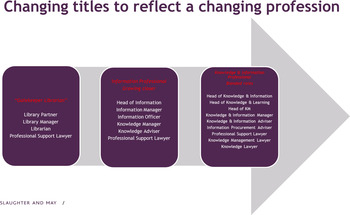
First a comment on the role of an individual within a law firm under the ‘knowledge’, ‘library’, ‘research’ or ‘information’ umbrella. Recent investigations (AshdownFootnote 4 ) provide a diverse array of job titles that relate to knowledge and information within law firms, as illustrated by the sample, in the diagram below, taken from actual recent job specifications.
These titles can have vastly different meanings dependent on the firm in question, so whilst discussion here is around ‘knowledge professionals’, it is acknowledged that such a title may not fit with every firm's naming conventions.
However, as Bradbury'sFootnote 5 diagram indicates, the change in job titles does reflect the changing profession.
It is certainly not the view that there is no place any longer for more traditional library skills and whilst opportunities grow for involvement in other knowledge areas, this may not be the need or the desire of every single firm. However, as knowledge systems become more mature and lawyer expectations as to knowledge access increase, so do such opportunities. We look at these new opportunities later in this paper.
In addition to the changing skills and roles of knowledge professionals, we are also experiencing a change in the strategic positioning of the role within law firms. For a number of years, business development (BD) and marketing teams have positioned individuals within specific practice groups (PGs) to gain greater knowledge of an area and in turn apply their experience to provide related solutions and facilitate good practice (this may still be reporting to a central BD or marketing individual, or directly into a senior member of the PG). Historically this has not been the case with knowledge individuals, although this may be changing with the positioning of such roles within PGs, not too dissimilar to the way a professional support lawyer (PSL) may operate. Similar to the BD teams, it is hoped that this change will provide many benefits and a flexibility not necessarily experienced from a centralised resource.
Job titles relating to knowledge and information management.

Changing job titles reflecting a changing profession.

THE ROLE OF THE PROFESSIONAL SUPPORT LAWYER
With the potential change involved for knowledge professionals, based on opportunity and firm requirements, it may also be presumed that the role of the PSL is also evolving. Indeed, the two roles are intertwined and one would assume that the changing landscape would have an effect. Previous experience of the relationship between PSLs and knowledge professionals is drastically varied from firm to firm.
The actual role of the PSL will be dependent on the firm and the physical job description which they are given. Roles of the PSLs can differ hugely, but one of the fundamental principles (and one which can be the source of much consternation with knowledge professionals) is that a PSL should not carry out work which can be undertaken by a non-lawyer. During the economic crash several years ago, PSL roles were potentially targeted where there was a question mark over the actual value they added to a firm. . This value was much more difficult to prove when they were undertaking non-specialised work and it has largely led to a more targeted role in relation to their skillset. BradburyFootnote 6 outlines the core skills usually associated with a PSL which should be leveraged, these being:
-
• Understanding legal & transactional issues
-
• Analysis
-
• Judging relevancy
-
• Application of law to facts
-
• Risk avoidance
-
• Explaining
-
• Advising
-
• Drafting
Indeed, in addition to the unique nature of a PSL's offering, there are still a number of business drivers for a firm to employ PSLs. HumphriesFootnote 7 outlines these as follows:
-
• Busy lawyers cannot keep up to date with the pace of changing law without having a human filter to identify what is relevant;
-
• It is no longer practical for busy transaction lawyers to know all they need to know without PSLs. Without PSLs they would struggle to provide a quality service to clients;
-
• PSLs free up fee-earners' time to fee-earn;
-
• PSLs' output saves fee-earners time;
-
• The development of know-how by PSLs help the firm manage its risk;
-
• With fee-earning responsibilities, it is impossible to ensure that know-how gets done as well;
-
• PSLs, acting as in-house counsel, can provide partners with a second opinion and act as a sounding board. This can save firms from the expense of going to counsel;
-
• PSLs have time to support trainees and more junior lawyers; and
-
• PSLs are the glue that holds fee-earners together.
It is certainly evident that PSLs do still have a fundamental benefit to a firm, even if this is not due to any monetary income that they may provide. Examining the role closely allows us to understand the importance for a firm to have a clear role for PSLs and also for knowledge professionals.
Analysing the PSL's role and dividing work into a two-tier structure (with tier 1 being ‘basic’ KM and tier 2 ‘advanced’) may be helpful. Tier 1 could be areas that also include input from non-PSLs and may even have no input from a PSL whatsoever. Alternatively, tier 2 would largely include work where the majority of the input (or at least the management and approach) would be defined by a PSL.
Tier 1 (“basic” KM) may look something like the following:
-
• Maintaining intranet pages;
-
• Basic market/company research;
-
• Basic legal research;
-
• Ensuring transaction bibles are prepared and submitted along with other knowledge documents into KM systems;
-
• Defining taxonomies;
-
• Promoting knowledge repositories;
-
• Centralising best practice and approaches to knowledge;
-
• Managing post-deal closing matter information gathering, entering data into systems; and
-
• Organising historical matter and document updating.
Whilst tier 2 (“advanced” KM) may include:
-
• Creating and maintaining standard forms, drafting notes, and deal checklists;
-
• Deal term analysis, market trend tacking;
-
• Drafting legal content of client presentations, publications, pitches;
-
• Research/analysis of regulatory frameworks/sectors to prepare partners and firm initiatives (e.g. industries);
-
• Ad hoc research on legal topics for lawyers on matters, billable work;
-
• Organisation of legal training for group, delivering training to new joiners;
-
• Mentoring/advising young associates on legal work;
-
• Legal updates for group;
-
• Liaison with KM team and input into firm KM projects e.g. automation; and
-
• Oversight/ownership of basic KM processes in group.
KNOWLEDGE HOT TOPICS
The following are some prominent examples of current trends which illustrate the rapidly changing scope of the knowledge and information field.
Modes of Delivery of Current Awareness
It is only thirty years or so since library staff would take scissors and paste to the morning's newspapers to produce a photocopied news bulletin which would then be circulated from desk to desk, but now we have a range of online and internal digital resources which were undreamed of in the 1980s. The rate of flow of new information increases every day, and the technology used to disseminate that new information is also evolving quickly. Vast news databases draw content from tens of thousands of newspapers, trade journals, news services, websites, broadcasters and social media and amalgamate the information into a whole which can be searched and fed into alerts. A range of current awareness services are available which are geared towards providing a tailored flow of both external and internally-generated news. Intranets can serve the same purpose, usually with more emphasis on internal news.
This creates various challenges for the information specialist: primarily, how to ensure that end users are kept up to date with relevant breaking news and legal developments, without being overwhelmed by a torrent of information; how to separate the quality information from idle speculation or badly-researched blogs; how much control of the flow to put into the hands of the end consumer, and how much to manage from the centre; and how to combine this external flood with the valuable internal news, the new knowledge being generated continuously within the organisation itself?
Front-line lawyers need to be kept informed on the wide range of topics which they need to master to do their jobs well: not “just” legal information, but business matters, client news, news about the work of their colleagues; from political and economic context, all the way down to office gossip – here is another blurred frontier between information and knowledge management.
The delivery of current awareness to lawyers is an interesting example of work which very often spans the role of both PSL and the knowledge or information professional. A fairly standard division of this area may often be for internal and external purposes, with the latter being prepared for clients, sectors, in-house teams and media reproduction. But where does the responsibility for current awareness reside?
Unfortunately there is once again no definitive answer and whilst some firms approach this with a very loose internal/external division, this is not particularly logical. The area is a prime example of work where combined skills are required in knowledge gathering, filtering, packaging and distribution of content. These skills will probably not reside in a single individual and so it is preferable that information and knowledge teams, PSLs, and possibly BD and Communication teams work together to achieve the aim of providing informative, professionally presented, targeted and relevant information both internally and externally.
Modes of Delivery of Knowledge: Knowledge Repositories, Search
Many early “knowledge management” projects around the early 1990s involved the task of converting rooms full of bulging lever arch files – precedents, sample letters, technical notes, policies and procedures, pro forma documents – into digital databases. Papers were scanned, images run through Optical Character Recognition software, the results proof-read and organised into searchable databases stored on designated servers which were then searchable by endusers. The information professionals who had previously catalogued, maintained, and helped users navigate the room of lever arch files gradually found themselves in a rather different, technology-based role which is still evolving today. Modern law firms use digital knowledge repositories and enterprise search systems which more or less instantly enable the user to search vast collections of documents, from know-how sets curated by PSLs to more freestyle searches of all matter folders. Lawyers have access to enterprise search facilities which enable them to run instant searches for any words or phrases over tens of millions of documents produced by their colleagues. The results might include a variety of items, from a client advice letter sent from another office abroad some years ago, to an email sent by a colleague along the corridor a few hours ago. The design and rollout of these systems has usually fallen into the scope of the information team's work, even though – since it is overwhelmingly “internal” content – this could be regarded as “knowledge” work. Again, the boundary has been extended and blurred, as information professionals have the right skills to tackle these projects and dovetail them with external information projects.
Process Mapping, Drafting Tools, Document Automation
Legal services firms are increasingly looking to use automation to lower costs and reduce risks. This is not a new phenomenon but is taking on more importance at a time when clients demand efficiency and increasingly resist paying high fees for routine legal work which they are aware can be done at least partly by using automated processes such as document building and checking software. Clients increasingly adopt these systems themselves to reduce the need for their legal advisers and indeed to check the documents being created for them. In this scenario it has become essential for law firms to deploy and exploit these software products, and this has provided another opportunity for information professionals to move into a new but related field of work – mapping repetitive legal processes, creating step-by-step procedures for building contracts and other legal documents, and running checks.
Future Technology: Artificial Intelligence (AI), Big Data…
Plenty has been written elsewhere on the potential impact of technological advances such as AI, big data, analytics, machine learning and data visualisation on the legal profession. For the purposes of this article we can simply state that these developing fields are inevitably going to bring changes to the information profession. For example, AI requires a feed of information and knowledge to be able to carry out analysis and data-driven decision-making, and big data and visualisation offer entirely new ways of navigating and using legal information. There is huge potential for information and knowledge professionals to become involved in the development of new applications and processes using these technologies. Alex Smith, the Platform Innovation Lead at LexisNexis, envisages the emergence of new roles, skillsets and organisational structures over the coming years to match this progress. Job titles of the future, he says, might include legal knowledge engineer, data scientist, trend analyst, agile product manager; even, with tongue slightly in cheek, lean law evangelist or curation ninja…! “New world, old skills”, says Alex, pointing out that the traditional skills covering language, accuracy, taxonomies, logic, testing and learning will still applyFootnote 8 .
Mobile Devices and Applications
The days of the large physical library of books, journals and looseleafs are coming to an end at most law firms. Lawyers now access the vast majority of their information sources through their desktop PC and, increasingly, their mobile devices, primarily tablets and smartphones. As “the library” increasingly becomes a portable service rather than a room in a building, there is a consequent radical change in the role of the librarian, who must now be able to support users by being familiar with the mobile devices themselves and also apps for e-books, online resources, alerts and all the office software and communications systems which enable the modern lawyer to operate efficiently from home, abroad, a client's office or the back of a cab.
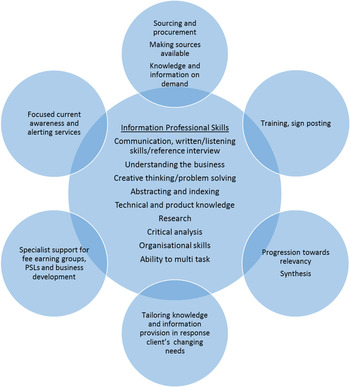
The expanding role of the information specialist.

OPPORTUNITIES FOR LIBRARY, KNOWLEDGE AND INFORMATION PROFESSIONALS
Rise of the Blended Role
In the light of the above we can clearly see the role of the information professional developing out of its traditional sphere and into the arena of knowledge management. The effect of this on many individuals and teams is that their work is morphing into a “blended” role which overlaps both fields. We see this reflected in the job titles listed by Anne Ashdown above. Some knowledge specialists work in information services, and conversely, information specialists sometimes sit within Knowledge teams. Other roles such as enterprise search specialist or content collaborator do not easily fit into one camp or the other and indicate progress into new fields of activity.
Transferable Skills
The expanding role of the information specialist is a chance to apply established skills to new or different activities. The diagram below shows, in the central circle, a list of skills possessed by all competent information professionals – communication skills, problem solving, research, analysis, organisational ability and so on. The outer circles contain examples of evolving areas of work to which those skills can be applied: support for professional support lawyers and business development, alerting services, knowledge on demand, and so on.
These skills are ripe for transfer from traditional information roles to new, expanded roles in knowledge projects. (“For an information professional,” says Bradbury, “KM is in the blood.”) They can also be applied to process improvement, research and development and other roles elsewhere; and a variety of as yet unknown roles will appear over the coming years as new technologies take hold. The skills are also transferable not just within a current legal organisation but beyond – to consultancies, accountants and other professional services firms, for example, or to technology companies, publishers and information providers.
Knowledge and Leadership Roles
There is the potential for non-PSL knowledge roles within firms to be restricted and worse still become extremely static. PSLs, even with the previous discussion on the focus required for their roles, can still monopolise knowledge work. Nevertheless, Bradbury [9] not only outlines the potential use of knowledge skills in leadership roles, she also outlines how such skills may help an individual thrive within a knowledge leadership role:
Leadership roles in knowledge-general skills
-
• Leadership and managing people
-
• Communications and influence
-
• Setting the direction
-
• Budgeting and account management / negotiation
-
• Drive
-
• Networking - internally and externally
-
• Upholding standards
Can you thrive in a knowledge leadership role without transactional and practice experience?
-
• Critical importance of building experience and understanding
-
• Understanding firm
-
• Ability to navigate politics of a partnership
-
• Ability to reach out to lawyers to understand requirements
-
• Importance of relationship building
-
• Systems - ability to translate lawyer requirements into clear solutions, ie. structuring of databases
-
• Documentation - more difficulty with standard documents, precedents etc when no PSLs.
SUMMARY
Knowledge is undoubtedly becoming strategically more important to law firms. Opportunities are arising for new roles in the area and not only for knowledge professionals to assist, but also to develop and drive processes, systems and best practice.
We are experiencing a period of great change and opportunity for library, information and knowledge professionals. Working at the intersection of knowledge, technology and client service, each of which is going through a period of dramatic and rapid development, opportunities abound for library, information and knowledge professionals to exploit their transferable skills and experience, and create challenging careers at the leading edge of legal and other professional services.