

Introduction
Health services integration is essential to well-functioning and effective health systems. It has the ability to increase care quality, quality of life, and patient satisfaction. Integration is especially relevant for older patients and those living with chronic disease as they often experience problems with access, fragmentation, continuity, and quality of care (Coleman, Min, Chomiak, & Kramer, Reference Coleman, Min, Chomiak and Kramer2004; Gulliford, Cowie, & Morgan, Reference Gulliford, Cowie and Morgan2011). As the population ages and the proportion of individuals living with one or more chronic diseases continues to grow, it is important to document their journey across program and organizational boundaries. Patient stories can potentially inform strategies to improve and integrate health care services.
Background
Integration
There is growing momentum to create and/or strengthen integrated health systems. Integration has been identified as having the potential to address many current issues in health care. These include access, fragmentation of services, continuity of care, quality, efficiencies, and sustainability (Kodner, Reference Kodner2009). Integration is often described on a continuum, where various components of the health care system are more or less integrated and depend on service delivery models (i.e., the structure, function, and inter-relationships of health care providers in providing care for patients) and specific initiatives (e.g., electronic health record).
Unfortunately, integration is not well-defined in the literature. A recent systematic literature review (Suter et al., Reference Suter, Oelke, Adair, Waddell, Armitage and Huebner2007) concluded that while many definitions exist, no consensus has been reached to achieve a single common definition. However, further review of the literature does suggest that there are common elements that are characteristic of integration. For example, Suter, Oelke, Adair, and Armitage (Reference Suter, Oelke, Adair and Armitage2009) identified 10 key principles to achieve a fully integrated health system. These include (a) comprehensive services across the care continuum; (b) patient focus; (c) geographic coverage and rostering; (d) standardized care delivery through interprofessional teams; (e) performance management; (f) information systems; (g) organizational culture and leadership; (h) physician integration; (i) governance structure; and (j) financial management.
In addition, Murray (Reference Murray2009) has proposed four key change strategies central to integration: providing people-centered care; reducing clinical variance; organizing the care continuum; and process improvement. Furthermore, Kodner (Reference Kodner2009, p. 7) has conceptualized integration as “designed to create coherence and synergy between various parts of the health care enterprise in order to enhance system efficiency, quality of care, quality of life and consumer satisfaction, especially for complex and multi-problem patients or clients.” For the purposes of this article, we will focus on three components of integrated health systems: coordinated care across the continuum; standardized care through clinical care pathways and interprofessional team collaboration; and a philosophy of patient-centered care.
Coordination of Care across the Continuum
Coordination of care across the care continuum refers to services from primary through tertiary care as well as cooperation among health and social agencies (Suter et al., Reference Suter, Oelke, Adair and Armitage2009). Many patients, particularly older patients and those living with chronic disease, interact with multiple providers while accessing services across a variety of health and social service settings over extended periods of time. Seamless care is a term often used in describing coordinated, integrated health care. It refers to care that is delivered in such a way that transitions from one component of care to another or between different components are seamless – there are no interruptions and no gaps in information or follow-up, and continuity of care for the patient is maintained (Bodenheimer, Reference Bodenheimer2008; Parnaby & Towill, Reference Parnaby and Towill2008; Spragins & Lorenzetti, Reference Spragins and Lorenzetti2008). Seamless care is an ideal characteristic of a fully integrated health care system. Despite the rhetoric of seamless provision of care across service boundaries, numerous reports released in Canada during the past decade (Commission on the Future of Health Care in Canada, 2002; Fyke, Reference Fyke2001; Health Council of Canada, 2005) have highlighted the need to improve access to coordinated health care services. Lack of coordination coupled with poor communication result in ineffective care, risks to patient safety, increased hospital readmissions, and heightened patient feelings of powerlessness (Hellesø & Fagermoen, Reference Hellesø and Fagermoen2010).
Standardized Care Delivery and Interprofessional Team Collaboration
Another key component of integration that we address is standardized care delivery and interprofessional team collaboration. Integrated care is facilitated by the use of care pathways, clinical guidelines, and decision-support tools based on best-practices evidence. While these shared protocols contribute to standardized care, they also facilitate the effective functioning of interprofessional team collaboration. However, barriers to collaboration continue to exist. One of the main barriers is communication – in particular, communication among providers (Suter et al., Reference Suter, Oelke, Adair and Armitage2009), between components within the health care system, and between sectors (e.g., health, social services, justice, education).
Patient-Centered Care Philosophy
The rationale for an integrated health system lies in the patients and their needs, rather than the desires and needs of providers (Rogers & Sheaff, Reference Rogers and Sheaff2000). Patient-centered care is seen as an enabler of system integration. Patient and family-centered care is a multifaceted concept that includes respectful and responsive care to patient needs, preferences, and values to guide all decisions about their care (Institute of Medicine, 2001). Furthermore, it is characterized by shared understanding and an equitable partnership for the patient’s care journey (Epstein & Street, Reference Epstein and Street2007). Patients and families desire equitable care, comprehensive and coordinated care, ease of navigation, timely access to convenient services, effective communication between providers and themselves and between the multiple providers caring for them, timely information, and information technology that supports transfer of appropriate information so they do not have to tell their story over and over again (Lewis, 2009; Saskatchewan Ministry of Health, 2009; Spragins & Lorenzetti, Reference Spragins and Lorenzetti2008).
A patient-centered system considers the patient’s needs and interests first and foremost. Among other things, it ensures that transitions between providers, programs, and health care settings are respectful, coordinated, efficient, and effective. Despite the longevity of the concept of patient-centered care, health care remains provider-centric and system-focused, designed around providers rather than patients (Leatt, Pink, & Guerriere, Reference Leatt, Pink and Guerriere2000; Saskatchewan Ministry of Health, 2009; Spragins & Lorenzetti, Reference Spragins and Lorenzetti2008). Although the number of frail elderly and people with chronic conditions and disabilities continues to grow, the system retains an acute, episodic biomedical orientation (Kodner, Reference Kodner2009), focusing on the needs of providers as opposed to the needs of patients and their families.
Patient Experience
Understanding patient experience is critical to achieving patient-centered care (Jenkinson, Coulter, & Bruster, Reference Jenkinson, Coulter and Bruster2002; McKeever, Reference McKeever2004) and enhancing the quality of care (Aharony & Strasser, Reference Aharony and Strasser1993; Sutherland & Leatherman, Reference Sutherland and Leatherman2010; Wasson & Baker, Reference Wasson and Baker2009). In particular, it is important to assess the patient experience from the perspective of the continuous journey rather than as distinct episodes of care received from a specific program, service, or provider (Richardson, Casey, & Hider, Reference Richardson, Casey and Hider2007). Unfortunately, the experiences of patients in their health care journeys are not always well understood, yet patient experience through the care trajectory can have significant application to improving health system integration and ensuring quality of care.
The Journey
This study was grounded in concepts of integration and patient-centered care. Coordination of care across the care continuum, standardized care through interprofessional collaborative practice, and a patient-centered philosophy were key components of our theoretical framework and guided our research. This article describes the journey of four individuals who were followed for several months after discharge from hospital with a view to informing the development of more integrated approaches to service delivery and improving the quality of care.
Methods
Multiple case study methods (Yin, Reference Yin2003) were used to understand the patient journey of each participant as well as common themes across each case. Case study methodology facilitated in-depth analysis of each participant’s journey through rich, thick description including contextual information. Each participant’s journey was treated as a separate case. Cases were bounded by hospital discharge date (start of the case) and the three-month follow-up period. The theoretical underpinnings outlined in the literature review directed the data collection and analysis of the multiple cases we studied.
A convenience sample of four individuals with chronic obstructive pulmonary disease (COPD) was followed for a three-month period following hospital discharge. Participant selection criteria included a primary or secondary diagnosis of COPD, discharge to home or seniors’ housing, and fluency in English. Participants were recruited for the study by the nurse clinician on an acute-care nursing unit during admission. Patients who met the criteria for participation were provided information about the study and asked if they would like to participate. Once they agreed, contact information was shared with the research team. The research assistant then contacted the participant, reviewed the study, and confirmed their consent to participate. Although it was hoped that five participants would be recruited, recruitment challenges resulted in only four patients being recruited during the study’s time frame. Recruitment of research participants was not always the priority of clinicians given their busy daily schedule of caring for patients. Ethical approval for this study was obtained through the Conjoint Health Research Ethics Board at the University of Calgary.
Data collection occurred over a three-month period after participants were discharged from a general medical unit of a large tertiary care hospital in Calgary, Alberta.
The semi-structured interviews we conducted were focused on participants’ experiences in managing their health and on the contacts they had with the health care system over the three-month period. Three interviews were conducted with each participant (and any family members present) in their home. A follow-up interview (approximately six months following the completion of the initial set of interviews) was conducted with three participants to validate that the analysis and interpretation of data accurately reflected their patient journey. The fourth participant did not participate in a follow-up interview as the research team was unable to contact that individual. Data from all four participants were included in the analyses. All interviews were audio-recorded and transcribed.
Each participant was invited to complete a log in order to augment data captured during interviews. Participants kept track of their contacts with the health care system, using a template developed by the research team. The logs provided relevant information such as date, time, type of contact (phone or visit), provider contacted, reason for contact, contact outcome, and other comments deemed relevant by the participant.
We conducted data collection and analysis with an iterative process whereby initial data collection activity informed future data collection and analysis within each case. Themes for each case were explored and recurring patterns identified (Morse & Richards, Reference Morse and Richards2002). Our thematic analysis was conducted using QRS International’s N6 software. Once the analysis of each case was completed, we conducted a cross case analysis to identify common themes among the four cases. To ensure trustworthiness of the data, two research team members reviewed four transcripts following coding and analysis by the research assistant. Attention was paid to themes arising from each of the reviewed transcripts, and where discrepancies existed, the findings were discussed in meetings with the research assistant and the two team members. Overall, there were few discrepancies in the themes identified by the research assistant and team members. Themes were also validated through a presentation of preliminary results to providers on the acute-care nursing unit where study participants were recruited.
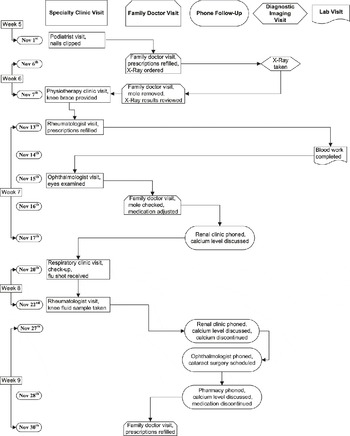
In addition to thematic analysis, each participant’s journey was mapped to afford a visual depiction of his or her journey. In so doing, we highlighted their care trajectory and identified the number and type of encounters participants had with the health care system over the three-month period. These maps were returned to participants at the final interview to validate their course of care and experience. These maps, along with the interview data, helped us to identify common integration and quality-of-care issues that all participants raised.
Results
Three females and one male ranging in age from 57 to 81 years participated in the project. Two individuals lived alone while the other two lived with one or more family members. Incomes ranged from under $25,000 to $55,000 per year. Participants typically had several co-morbidities (i.e., heart disease, stroke, osteoporosis, glaucoma, sclerodermas, lung cancer, kidney cancer, and asthma) in addition to COPD. Length of hospital stay ranged from 3.7 to 17.7 days with an average of 10 days. Informed by the participant logs, the visual maps (see Figure 1) showed that in the three months following hospital discharge, each participant experienced multiple visits to specialists and/or specialty services and clinics. Most also received multiple visits from home care and/or visited their primary care physician or walk-in clinic numerous times. Other health care contacts included community pharmacies, laboratory or X-ray services, in-home oxygen services, and suppliers of equipment to support activities of daily living (see Table 1).
Patient map: A snapshot in time

Health Care Contacts

a None of the four participants had visits to emergency or readmission to hospital during the three months of study follow-up
Three overarching, interrelated themes emerged from the data: (a) social support, (b) system navigation, and (c) access. These themes are closely linked to the principles of health system integration.
Social Support
Social support was a strong theme in each participant’s journey. The presence of family and friends enhanced quality of life as well as the quality of interactions with the health care system. Social support was categorized into four sub-themes: physical support; informational support; emotional support; and instrumental support.
Physical Support
Physical support – that is, assistance by friends and family with activities of daily living and management of medications – enabled participants to maintain day-to-day activities that would otherwise have been difficult to sustain. One participant noted that familial support was critical in managing crises: “One day I did fall. But the phone was right there and I phoned my daughter, and her husband came over and got me back up on my feet.”
Informational Support
Informational support enhanced the participants’ interaction with the health care system. Participants noted that family and friends often accompanied them to appointments with health care providers to assist with understanding and remembering care instructions, scheduling appointments, and providing information as necessary. As corroborated by the visual maps, most participants were required to make several visits to health care providers, and the support offered by family and friends was especially important for these participants. One participant emphasized that the presence of a family member was crucial during appointments to help overcome memory problems and to serve as an advocate to ensure that the participant’s health needs were met. Furthermore, the presence of a friend or family member decreased participants’ anxiety when interacting with various providers.
Emotional Support
Participants also emphasized the importance of emotional support. Supportive relationships improved participants’ ability to cope with their chronic conditions. Emotional support was most often attributed to the presence of family and neighbours, although one participant identified a member of the clergy as a source of support. One participant had limited ability to interact with friends and family because of reliance on portable oxygen. This contributed to feelings of isolation and depression, which further reduced this participant’s interest in leaving the house:
I feel really isolated now. I’ve got friends who live across the city, but now that I’m on oxygen, that’s a long way to go … I’m getting the mind-set, I suspect it’s depression, where I just sit here and watch TV for three days straight, without doing anything.
Lack of access to emotional support left this participant totally responsible for managing a complicated chronic condition alone, and the lack of support contributed to the frustration and depression experienced. None of the health care providers involved in the care of this individual recognized the social isolation or associated depression.
Instrumental Support
Instrumental support was also discussed by participants. The importance of a supportive environment, transportation, and attention to financial situations were highlighted. For one participant, transportation was a barrier to accessing his social support system, thereby contributing to social isolation and depression. Interestingly, this participant’s visual map revealed less-frequent health care encounters and many of the encounters were described in his log as related only to prescription medication refills. For other participants, assistance from family and others for transportation to health care appointments, shopping, and accessing other services was essential to their ability to successfully address their health needs. Although none of the participants explicitly described concerns about income, it was apparent that income assistance programs and third-party coverage for certain services were critical to these participants’ obtaining effective health care.
System Navigation
Navigation of the health care system was described by participants as complex and, at times, frustrating. This contributed to feelings of system fragmentation. The visual maps pictorially validated the complexity of participant journeys by highlighting the number of providers involved with their care, the number of health care encounters, as well as the flow of these encounters (e.g., for one participant, one week would involve four to five encounters while the next week would involve no health care encounters). One participant wrote in the log after three days of different health care encounters and a particularly long clinic visit: “Took approx. 4 hours – very tired afterwards”. Participants spoke to three sub-themes that were important contributors to successful system navigation. These were (a) effective patient-provider communication, (b) effective provider-provider communication, and (c) previous system experience.
Effective Patient-Provider Communication
Effective communication between providers and participants was identified as a sub-theme that was an important contributor to successful navigation of the health care system. Participants often described how difficult it was to obtain appropriate and sufficient information from providers: “I’ve gotten to that point where if I want something, I have to ask him [the provider], because he doesn’t say anything.” When asked if care providers had listened to concerns and actually addressed them, another participant responded, “We’ve never actually discussed them [my concerns].” Participants also noted a frequent lack of opportunity to ask questions, in particular with family physicians and medical specialists: “She was in and out so fast, I didn’t have time to ask a question.” This lack of open information exchange between the participant and health care provider resulted in unmet patient needs, such as the unrecognized isolation and depression noted earlier.
Emerging from the stories of all participants was a lack of knowledge about what they should ask providers in order to help better manage their condition. They wondered whether there was more that providers could have told them that would have improved their capacity for self-care. In one situation a participant was sent home with a leg cast but not given any instructions regarding cast care or how to manage at home. When complications occurred (i.e., mobility issues and swelling related to a tight cast) shortly after discharge from emergency, the participant became anxious and was readmitted to hospital with exacerbated COPD-related symptoms later the same day. Although it was difficult to determine if the readmission could have been prevented, it was possible that information about cast care – including what to do and who to call when signs of complication appeared – could potentially have decreased anxiety and averted the exacerbation of COPD symptoms.
Participants clearly associated the quality of their provider relationships with their ability to move smoothly (or not) through the system. Providers who treated participants as an individual rather than “just a number” and who did not have their “hand on the door” during the visit were perceived as more caring. Participants also emphasized the importance of good interpersonal skills among providers as key to high-quality interactions with the health care system.
Effective Provider-Provider Communication
The second sub-theme of provider-provider communication highlighted the lack of effective communication between providers. Participants simply did not know if information had been communicated to other providers as evidenced by the following interaction between one participant and the interviewer. In response to the question, “Now are any of the home care providers in contact with the doctors that you deal with at the clinic or even at the [hospital]?” The participant replied, “I don’t know.” Other participants commented openly about the lack of communication between providers:
Oh, they knew I was coming. It just seems to me that they’re not told enough about me. Because every time I go to see a doctor, I’ve got to start from day one; the day I was born, just about.
What was clearly evident is that the patient often becomes responsible for updating providers about changes to their treatment, or to remind providers they need to send a report to another provider. Communication to the specialist from a primary care physician was clearly made upon referral and communication back from the specialist following one participant’s initial appointment, but it was unclear whether there was ongoing communication and follow-up. Clearly, the communication between providers could be improved to ensure that providers have all the relevant information they need to care for patients.
Previous Experience with the Health Care System
The third sub-theme, previous experience with the health care system, also played an important role in helping people subsequently navigate the system; it allowed participants to anticipate what services might be available. Most often, participants used the collective experiences of family and friends as well as their own past experience to understand and guide their journey. “I knew what they [home care] offered, because I had them when my husband was alive.” Previous experience influenced expectations and use of the system, improved understanding of what the service offered, and increased satisfaction when expectations were met. Unfortunately, not all participants had an understanding of available services that could potentially meet their needs. As well, lack of prior knowledge of a particular service sometimes contributed to unmet expectations.
There was a bit of a communication breakdown. I said I needed help in my apartment, but what I needed was help with the vacuuming and cleaning. She [home care worker] was there for personal care; help in the shower or for medications and stuff like that.
Access
Access to health care services was another theme that emerged from the data. Access to care can be multidimensional and for the participants of this study, two sub-themes were identified: physical access and health human resource access.
Physical Access
Several participants were physically restricted in accessing needed health care. Having to rely on portable oxygen made it difficult for one participant to keep appointments and created anxiety when the waiting time to see a provider was longer than anticipated. In one case, several health care professionals (primary care physician, lab technician, and home care nurse) provided service in an assisted-living facility making it easier for that individual with mobility restrictions to receive needed care. Although receiving services in their home community made it easier for this participant to access certain services, access to outside providers such as specialty physicians or clinics continued to be difficult.
Health Human Resource Access
Participants discussed access to health human resources and, in particular, access to a primary care physician. Three participants had access to a regular primary care physician while one used a walk-in clinic for episodic care. In three cases, primary care physicians managed patient care and were responsible for initiating referrals to specialists. Two of these participants described strong linkages between the primary care physician and themselves and expressed a high degree of satisfaction with their primary care. The participant without a regular primary care physician described feelings of depression and social isolation not discussed with the walk-in clinic physician. Hence, there was a lack of holistic care for this participant.
The visual maps validated the primary care physician as a key stakeholder in the health care journey for two of the participants as evidenced by the frequency of contact. Another participant’s most frequent contact was with home care although it should be noted that it was not always the same home care provider involved with each encounter. Unfortunately, data were not specifically collected related to the strength of each participant’s relationship with each provider.
Discussion
Participant logs were found to be a tremendous addition to the interview process because they enabled participants to tell their stories effortlessly. Since they were completed by participants at the time of each health care encounter, they contained details such as reason for the visit that may otherwise have been forgotten by the time of the interview. The logs also informed the development of maps that visually depicted each participant’s journey. These powerful visual representations highlighted how many appointments and how many different providers each participant encountered as well as the timing of each.
As mentioned earlier, one participant had fewer health encounters while another participant experienced multiple encounters in one week and no encounters the next. While one might anticipate more encounters shortly after hospital discharge, possibly the nature of these participants’ chronic disease as well as their age might have contributed to the steady frequency of their encounters. Clearly, mapping, along with interview data, provided the researchers with a broad participant perspective and an in-depth understanding of each participant’s entire three-month journey. Maps drew attention to the complexity of care journeys, particularly among participants who lived with more than one chronic condition. They saw multiple providers in a variety of settings which added layers of complexity to care coordination (Bodenheimer, Reference Bodenheimer2008), highlighting the need for effective communication between providers, consideration for case management, and attention to care transitions from one area to another.
The data were helpful in identifying strategies for service improvement (which we address in the Limitations discussion). In addition, the maps were extremely helpful in showing opportunities for the integration of care, at least for the type of patient population that was the focus of this study. For example, while it is acknowledged that all health care providers have responsibility for collaborating with other providers involved with their patients’ care, the maps identified potential key providers who could have responsibility for case management (e.g., home care nurse or primary care physician) or where provider and program communication and/or collaboration needs to be strengthened (e.g., primary care physician and specialist). As identified by Bodenheimer (Reference Bodenheimer2008), referrals from primary care physicians to specialists often lack information whereas reports from specialists to primary care physicians are often less than adequate.
The results of this study suggest that social support, navigation of the health care system, and access to health care services are important elements of integration and high-quality care from the older patient’s perspective. Care across the continuum focuses on access to health and social services. Multiple access points (Suter et al., Reference Suter, Oelke, Adair and Armitage2009) are needed to address the often complex needs of the older adult with multiple health issues. Given the complex care needs and physical limitations of participants in this study, it is perhaps not surprising that ability to access health care services emerged as a major concern. Access to a regular primary care physician was important to participants, and it plays a key role in providing holistic and coordinated care, thereby contributing to integration.
Coordination of health care across the continuum, including intersectoral collaboration (Murray, Reference Murray2009; Suter et al., Reference Suter, Oelke, Adair and Armitage2009), was an issue that participants highlighted as being important to meet their varied needs (e.g., income stability, transportation, and social isolation) that are not the sole responsibility of the health care system. Those participants with a higher degree of social support were better able to cope physically and emotionally with their chronic illnesses (COPD and other co-morbidities) and often had a key person or advocate that assisted in the management of their care needs. For providers, this highlights the need to assess for the existence or absence of patient support systems and the importance of including family members or significant others when planning care (e.g., discharge planning). In particular, as supported by Sharp and Lipsky (Reference Sharp and Lipsky2002), it was clear that social isolation is a risk factor for depression and providers must be sensitive to this when conducting patient assessments, especially for older adults and patients living with chronic disease. Furthermore, older adult mental health screening assessments and care planning are most comprehensive when conducted using an interprofessional collaborative approach (Registered Nurses Association of Ontario, 2003).
As we outlined earlier, one of the principles of successfully integrated health care systems is a philosophy of patient-centered care (Murray, Reference Murray2009; Suter et al., Reference Suter, Oelke, Adair and Armitage2009). Health care systems must be driven by a patient/family-centered philosophy (Murray, Reference Murray2009; Saskatchewan Ministry of Health, 2009). The results of this study suggest we have additional work to do to ensure a patient-centered focus in our health care systems. Study participants were sometimes unsure what they should be asking providers and were unaware of information that would facilitate self-care. Communication barriers are often exacerbated by physical limitations associated with aging (Richardson et al., Reference Richardson, Casey and Hider2007). Patients and family members appreciate providers who are interested in what they have to say, who offer sufficient time for discussion, and who anticipate their needs by providing them with teaching and information without being prompted. Providers should act as coaches for patients and families (Harrison & Verhoef, Reference Harrison and Verhoef2002). Patients should not be expected to “learn the ropes” each time they have an encounter with the health care system. Instead, they should be given specific instructions and help in navigating the system and improving their capacity to manage their care effectively. Self-care and patient-centered care are facilitated by patient engagement (International Alliance of Patients’ Organizations, 2007; Sidani, Reference Sidani2008) – that is, involving the patient in planning, implementing, and evaluating their care.
Navigation of our complex health systems is extremely difficult, particularly for older patients and those with limited experience with the health care system. When health systems are well integrated, navigation should be seamless for patients and families (Linenkugel, Reference Linenkugel2001). Findings from this study also suggest that patients may require additional support if they have no previous experience with the system; this is an important aspect of preparing patients for self-care. In addition, it was reported that relationships characterized by compassionate and caring communication between providers and patients were important in enabling patients to more effectively navigate the system. Patients and their families need information and, at times, direction. They must be free to ask their questions and communicate their concerns. They must understand their health needs, next steps, and their responsibilities. In turn, providers must recognize that patients have unique insights about their health and a desire to share decision making related to their care. Patient-centered care places responsibility for important aspects of self-care and monitoring in patients’ hands – along with the tools and support they need to carry out that responsibility. The interpersonal and interactional aspects of care appear to be central to patients’ experiences and enhancing integration: patients want a patient-centered system.
“Standardized care delivery through interprofessional teams” is key to successful integration (Suter et al., Reference Suter, Oelke, Adair and Armitage2009, p. 19) and the improvement of patient outcomes (Murray, Reference Murray2009). Each health care provider offered a component of care to address a health issue for participants, but rarely was that care provided by a collaborative team or guided by shared protocols or an integrated plan of care to minimize clinical variance (Murray, Reference Murray2009). Unfortunately, it was clear that communication structures and processes among providers (e.g., acute care, family physician, home care, and community pharmacist) were often less than ideal, contributing to fragmentation in care delivery and repetition for participants in having to tell their health history multiple times.
Providing interprofessional collaborative care across settings has become more challenging as care is provided in multiple settings and for increasingly shorter lengths of stay (Parry, Coleman, Smith, Frank, & Kramer, Reference Parry, Coleman, Smith, Frank and Kramer2003). However, by improving interprofessional collaboration across the network of services, there is a greater opportunity to enhance the health and well-being of the older adult (Beattie, Whitelaw, Mettler, & Turner, Reference Beattie, Whitelaw, Mettler and Turner2003). Standardized care that is coordinated, complementary, and seamless between providers and across care settings could be facilitated by integrated interprofessional assessments and plans of care.
Leaders within the health care system must take responsibility and support integration at all levels. They must incorporate a vision for integration by creating a supportive organizational culture. What is required is attention to policies and procedures, structures (e.g., model of service delivery), and processes (e.g., communication) to foster integration in health care service delivery. Providers must also take responsibility for supporting integration by collaborating with other providers and other health care organizations in the delivery of care. Attention to communication, a holistic assessment, an integrated care plan, coordination of care, and shared decision making with the patient and family can facilitate clinical integration.
Limitations
Several limitations should be noted. These case studies were exploratory in nature – facilitating a better understanding of the experiences of participants with COPD following discharge from hospital. The data gathered are not necessarily generalizable to the broader population but inform our theoretical propositions of integration (Yin, Reference Yin2003). By providing a rich, thick description of each participant’s health care journey and through the triangulation of data sources, validity of the results is increased (Yin, Reference Yin and Yin2005). Health care providers were not interviewed, so we are unaware of their perception of patient concerns as well as their care processes (e.g., the medium and effectiveness of communication between a specialist and the primary care physician). Nonetheless, when early findings from this research were shared informally with nurse educators and other “users” of the health care system, there was acknowledgement that the findings “resonated” with their experience. A final limitation of the study is that we did not explore income or financial assistance in detail, yet this is of central importance to health.
Conclusion
There is convergence and commonality among the themes that emerged in this study with other literature (Change Foundation, 2008; Lewis, 2009; Saskatchewan Ministry of Health, 2009; Spragins & Lorenzetti, Reference Spragins and Lorenzetti2008). Providers might think they are delivering patient-centered care, but, as the participants indicated in this study, there are improvements to be made. Furthermore, findings from this study highlight that providers are not delivering patient-centered care in an integrated fashion.
Issues that are relevant to patients are rooted in the presence or absence of an integrated health care system. By focusing on improved provider-patient and provider-provider communication and information sharing, comprehensive holistic assessments, an integrated plan of care, coordination of care, and patients’ involvement in the development of their plan of care, it is believed that progress will be made in creating an integrated health care system. Consideration should be given to prioritizing the development, implementation, and evaluation of an integrated plan of care as this strategy has the potential to facilitate comprehensive assessment, interprofessional communication and collaboration, coordination of care, and patient involvement. However, achieving what patients perceive as an integrated and effective system will require time and commitment by health care providers and leaders.