

The East-West health divide in Europe
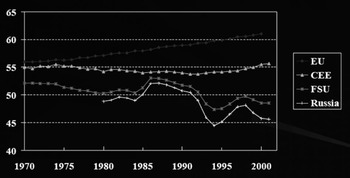
In the last four decades, a huge health gap has developed in Europe. Consider two similar countries, very near each other and with related populations, cultures and languages: Estonia and Finland. At the turn of the millennium they differed in life expectancy by more than seven years, in spite of now having similar social systems. Their neighbours on each side, Sweden and Russia, differed by an astonishing 20 years in life expectancy for men. It is clear that ‘the European Health Divide’ of today is in large part an effect of history. The dramatic, but little known, story of Russian, Soviet and East European health during four decades is in sharp contrast to the much more gradual and positive change of population health in Western Europe. In fact, during the last four decades, a European health divide has opened up, first driven by the inner logic of the two political/economic blocs that stood against each other in Europe for a large part of the 20th century, and later by the collapse of the Soviet system and the following ‘troubled transition’ (Figure 1).
Life expectancy at birth in the European Union (EU), Central and Eastern Europe (CEE), Former Soviet Union (FSU) and Russia

However, the divide goes back at least a century. In 1910, infant mortality rates in those countries that were eventually to become the communist bloc were distinctly higher than in the countries of Western Europe.Reference Caselli, Meslé and Vallin1 This old pattern is being partly reproduced in the present historical circumstances. At the same time, as we shall show below, a long period of converging health trends is being replaced by one of divergence, and most recently a shifting of the European health divide eastwards.
In the aftermath of the Second World War, up to around 1968, a clear convergence of health trends took place across Europe, if one measures health as life expectancy. Thus, in 1969, Central and Eastern Europe were only around two years behind Western Europe in life expectancy. Russia, which in 1895 had a ten-year lower life expectancy than France, had almost caught up with France at this time.Reference Meslé, Shkolnikov, Hertrich and Vallin2, Reference Patterson3 One important factor behind this convergence was a successful reduction of child mortality from infectious disease all over Europe. The knowledge about how to prevent such disease was shared and could be translated into political and social action, often coercive, in both systems.
In contrast, applying knowledge of how to prevent circulatory and other chronic diseases among adults is a more complex task, which cannot rely solely on the state. The success or failure in controlling adult chronic disease is one of the main factors driving East and West European countries apart in health terms after 1968. This is well illustrated by the opposing trends for circulatory disease mortality, the main cause of death in developed countries, when one compares Poland and Russia with France and Britain.Reference Meslé4 In 1965, Poland and Russia had about the same level of mortality as France and Britain respectively. Thereafter, France and Britain experienced a strong long-term decrease in circulatory disease mortality while Poland and Russia went through three or four decades of increasing mortality.
A note on the importance of knowledge could be added here. Medical knowledge knows no national borders. Knowledge about cardiovascular risk factors, such as smoking and a sedentary lifestyle, has increased year by year. But changes in circulatory disease mortality in developed countries (from generally rising trends after 1945 to falling trends two, three or four decades laterReference Barker5) do not seem to follow the diffusion of medical knowledge across countries. Finnish circulatory mortality (for males) peaked in the mid 1970s, then fell, presumably under the influence of new and more healthy habits, but in Sweden this turn took place almost ten years later.Reference Baker, Vågerö and Illsley6 Circulatory disease mortality in Finland was higher than in Sweden, thus the new knowledge may have fallen on more fertile soil in Finland and therefore had an earlier impact. In the communist part of Europe, this knowledge had little impact; it hardly percolated down to the common man and had little influence on national policies for health. Russia (like Ukraine, Belarus and Moldova) has not yet reached that stage of the epidemiological transition in which circulatory disease mortality is beginning to be controlled. Control of circulatory disease mortality is most likely to take place when individuals act to change their behaviour, and governments simultaneously act to introduce policies to make this easier. In both instances, open access to new knowledge, public discussion of this knowledge and a concern for the health problem in question seem to be necessary conditions for change. The stagnation period in the Soviet system lacked all of these.
The stagnation of the Soviet system can be said to start in the aftermath of the events of 1968. The five-country occupation of Czechoslovakia and the resistance to this across Europe throw Soviet and East European leadership into a bunker mentality. Repression increased in Eastern Europe. As early as 1970, Andrei Sakharov warned against the stagnation of Soviet society.Reference Brown7 Stagnation is an appropriate characterisation of the whole period from 1968 to 1984, also in terms of life expectancy and health, in spite of falling infant and child mortality rates. There was a slowly increasing mortality (men) or a stand-still (women) over the whole 1970–1984 period in almost all the communist-led countries in Europe and in each of the republics of the Soviet Union, including the largest, Russia. It was a system-inherent problem, tied to the way the system was managed. Men were hit harder than women, adults more than children and working-age men most of all. The disease was eating itself into the heart of the Soviet power structure.
In 1985, as one of his first measures as the new general secretary of the Communist party, Michael Gorbachev set in motion the last big Soviet-style campaign, a campaign to curb alcohol-drinking. It was a forceful and ruthless campaign, which included the promotion of juice drinking; price rises on vodka and the uprooting of century-old vines in Georgia, amounting in fact to semi-prohibition. Very soon afterwards, he set in motion two further campaigns that were, however, different from what had been seen in most previous Soviet-style campaigns. They became known as Perestroika (change) and Glasnost (openness). Perestroika meant it was possible to challenge party views in all fields, and glasnost meant that it was possible to report more honestly what was going on in the country. These changes electrified the country and broke the long period of stagnation. The impact was great across the whole of Eastern Europe.
The vitalisation of the system resulted in a rapid improvement of life expectancy. The combination of the anti-alcohol campaign, perestroika and glasnost, is in all likelihood the explanation for the surge in life expectancy that took place from 1985. In 1987, life expectancy in Russia was 65 for men and 74 for women. It has never in Russian history, before or after, been higher. Alcohol consumption in 1987 was back to the level of the 1950s.
The collapse of the system in 1989–91 was followed by an almost unprecedented fall in life expectancy, by seven years between 1987 and 1994 for men in Russia. Walberg demonstrated that those regions (oblasts) that had the highest labour turnover during the first years of the new system also had the sharpest fall in life expectancy in 1990–94.Reference Walberg, McKee, Shkolnikov, Chenet and Leon8 In Russia, as well as in the 14 other republics of the former Soviet Union, mass poverty, uncertainty about the future and excess drinking were driving forces in this development. Drinking was facilitated by the market reforms of 1992, when the alcohol market was totally deregulated in ways that would have been unthinkable in any West European country. For those who could not afford vodka at its market price, cheap surrogate alcohols were widely available. They could be presented as medical tinctures or eau-de-colognes, but were in fact concentrated ethanol.Reference Leon, Saburova, Tomkins, Andreev, Kiryanov, McKee and Shkolnikov9
In Central and Eastern Europe, the aftermath to 1989 brought new social and public health crises. All the ex-communist countries (except East Germany) experienced a shorter or longer decline in population health as the old system was replaced by the new; least so in the Czech Republic and worst in the ex-Soviet Union republics, in particular Russia itself. In 2004, a Russian boy aged 15 had about a 50–50 chance of surviving to the age of 60; this was much worse than many so-called developing countries, for instance Pakistan, India and Bangladesh.
The new transition governments had other priorities than the health of their populations. That was one of the problems. It was aggravated by government policies of disease prevention coming under attack as illegitimate interventions in people’s private lives all over Europe, but especially in the East, where these interventions were most needed.
The immediate causes of the East European health crises of the 1990s, such as poverty, uncertainty or alcohol, are now being examined in specialist journals. The more long-term causes may be equally important, yet have received considerably less attention in medical journals. Considering Russia and the countries that it has dominated, a plausible hypothesis is that their 20th century history of wars, civil wars, revolutions, starvation periods, food shortage and massive repression has created an unusually vulnerable population, in which large segments are prone to unhealthy behaviours, circulatory disease and death from violent causes. For instance, it is known today that the 900-day long blockade of Leningrad gave rise to the so-called ‘Leningrad blockade hypertension’ among survivors, visible several decades after the blockade, as well as to an increased risk of circulatory and breast cancer mortality.Reference Sparén, Vågerö, Shestov, Plavinskaja, Parfenova, Hoptiar, Paturot and Galanti10, Reference Koupil, Plavinskaja, Parfenova, Shestov, Danziger and Vågerö11
Today it is clear that countries in Central and Eastern Europe are moving forward along different paths. Those countries that are already in the EU have seen a more favourable health development than countries such as Russia, Ukraine, Belarus and Moldavia. It seems that realignment from one sphere of influence to another has already paid off also in terms of health. Of particular interest are Estonia, Latvia and Lithuania. For decades they closely followed mortality trends in Russia. This was true during the stagnation period, during perestroika when health improved rapidly, and during the shock therapy crisis of the first years of the new social system. In terms of life expectancy, 1994 was the worst year for Russia, as well as for Estonia, Latvia and Lithuania. From 1994 on, mortality trends in all the Baltic Republics and in Russia, for both men and women, became more favourable. Life expectancy improved from that year until 1998. This was taken as a sign of a positive adjustment to new circumstances. However, in August 1998 the ‘Asian Flu’, spreading from Thailand and the Asian ‘tiger economies’, hit Russia and the rouble collapsed. The rouble crisis in Russia led to immediate loss of income, savings and employment for many. Life expectancy in Russia fell again from 1998 onwards, largely driven by a new rise in circulatory disease, this time in spite of the economic upturn as of 2000. In contrast, all three Baltic Republics have improved their life expectancy (although modestly) since 1998. The Asian flu hit their economies too, but its impact was less and health improvements continued. This break between the close paths of Russia and the Baltic republics is quite significant. It shows the vulnerability of the Russian population to externally imposed economic shocks, while it suggests that all three Baltic republics have now managed to build up a minimum of control against such impacts. Whether this really is the case will become evident in 2009 and 2010, as the present financial crisis bites harder.
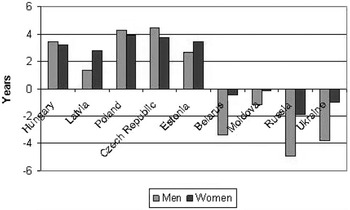
The present health divide in Europe has historical causes but has, simultaneously, been exacerbated by the immediate effect of the social transformation of Eastern Europe. During its first two decades this transformation distanced (in health terms) in particular Russia, Belarus, Ukraine and Moldova from the rest of Europe (Figure 2). Political, economic and social divisions between different parts of Europe are to some extent driven by the EU and Russia as the two main poles. This includes health divisions – a Europe divided in health may be the consequence of European social, economic and political divisions, but at the same the health divide may reinforce the political and economic divide. The existence of a ‘divide’ will in itself give rise to a number of social, economic and political processes. This can be witnessed at any border between countries. These processes could be largely integrative, or alternatively create something like a vicious circle of mutual exclusion and distance. Perhaps it is the awareness of this that has created the irresistible pull towards the European Union on a large number of countries in Central and Eastern Europe.
Changes in life expectancy during 1990–2005 (in years)

Whether or not the East/West health divide in Europe is going to persist, be reinforced, or gradually disappear, is an open question. The dividing line certainly seems to be shifting eastwards. Of specific importance is the ability of governments in Russia, Ukraine, Belarus and Moldova to grasp the causes of their long-standing public health problems and to respond with adequate policies. So far they have remained rather passive.
The outcome is also dependent on the larger political and economic developments inside and outside Europe. At the time of writing, March 2009, it is already clear that the financial crisis of 2008/2009 is hitting the populations in Eastern Europe harder than those in the West. Being within the EU is only a partial protection. EU solidarity seems to have its limits. In Latvia, Hungary, Moldova and Ukraine the banks’ crises have turned into severe political and economic crises, with falling production and massive unemployment. Russia, Belarus and other countries are also feeling the strain. It would be surprising if we saw no effect on population health and life expectancy in 2009 and the following years.
Social inequalities in health in Eastern and Western Europe
To judge the health performance of a country and its government, it is not sufficient to look at average life expectancy at birth, or some other indicator that shows average health achievement in the country. The Commission on Social Determinants of Health12 took the view that benchmarks for good governance should include the general improvement of health, a fair distribution of health across all segments of the population (‘health equity’) and finally a concern that negative social and economic consequences of ill health should be reduced. In fact, health and health equity are equally or more relevant as measures of a country’s development and success than are traditional economic measures, such as GDP/capita.Reference Sen13
Health inequalities exist in all countries, rich and poor, East and West, North and South. Such inequalities emerge in every new generation, driven by the differences in how people grow up, live, work and age. If privileged groups in a country have a longer life expectancy than groups at a social disadvantage, this also demonstrates that the potential for improvement is there. In general, a policy of sharing resources and power more equally among citizens will usually result in improved living conditions and better education for the majority of the population and offer the best health outcome for those at a social disadvantage.
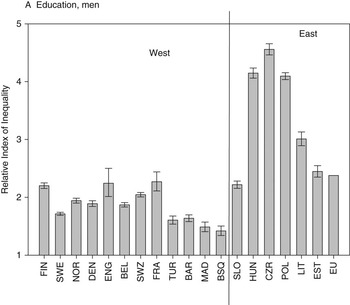
A large number of studies over the last decade have compared the extent of health inequalities in different countries. A recent such study looked at health differences by education in 12 countries and regions in Western Europe and six countries in Eastern Europe.Reference Mackenbach, Stirbu, Roskam, Schaap, Menvielle, Leinsalu and Kunst14 The most striking finding was the much larger inequality in the east (=post-communist) than in the west (Figure 3). A reasonable interpretation of this is that a much more comprehensive and universal system of social protection exists in Western Europe than in Eastern Europe.
Mortality differences among men by education. Relative index. Comparing 12 west and 6 east European countries (Source: Ref. 14, calculated from Figure 1A)

Furthermore, even before 1990, mortality differences by education or by manual/non-manual class seemed larger in those countries in Eastern Europe for which comparable data were available, for instance Hungary and the Czech Republic, than they were in Western Europe.Reference Kunst15 This was a somewhat unexpected finding, considering both the more narrow income distribution in the communist countries and the egalitarian rhetoric of its leaders.
As income distributions became more unequal in Eastern Europe in the 1990s, health inequalities there also widened. Data from Russia and Estonia on mortality differences by education show that educational differences in mortality widened sharply during the 1990s and into the new millennium. Furthermore, in Russia as well as in Estonia and Lithuania, the growing health gaps were driven by a fall in life expectancy for those without university education,Reference Shkolnikov, Leon, Adamets, Andreev and Deev16–Reference Leinsalu, Stirbu, Vågerö, Kalediene, Kovács, Wojtyniak, Wróblewska, Mackenbach and Kunst19 a phenomenon that should have been worrying for any government. In Poland and Hungary, the widening health gap, in contrast, meant that low-educated groups were lagging behind high-educated groups, but still were able to enjoy some improvement in absolute terms. Poland and Hungary therefore resembled a common development in several countries in Western Europe, where health inequalities were growing, even as modest improvements could be noted for those at disadvantage.
For many countries in Europe there are no data on trends in health inequalities. If one, nevertheless, were to draw a conclusion based on those countries that do provide data, it must be this: for the last two decades there has been a tendency for health inequalities to grow within European countries. This tendency persists today. It is quite remarkable that health differences between countries should be growing in Europe even as health inequalities within those countries are growing. Furthermore, we know that global health inequalities have also been on the increase for the last two decades.Reference Moser, Leon and Shkolnikov20 The global economic development seems to have spread its fruits very unevenly across the globe. One could speak about a globalisation of inequalities, including health inequalities. The financial crisis of 2008/2009 and the climate crisis suggest strongly that this development was not sustainable.
Conclusions
Looking more closely at Europe we have seen that the targets once set by the WHO,21 aiming to reduce health inequalities in the region, have not been met. On the contrary, country differences in mortality/life expectancy have increased, especially after the collapse of the Soviet system. Four countries in Europe – Russia, Belarus, Ukraine and Moldova – are increasingly lagging behind. Socio-economic mortality differences within countries have also increased in general, both in western and eastern parts of Europe. In the former Soviet Union, the increase represents a particularly dangerous and unsustainable development, as it is based on large segments of the population in fact moving backwards, experiencing falling life expectancy.
European policies have not been very strong in the health field. So far the arena for collective action has usually been local community politics or national politics, but there are also concerns that have become global policy issues. Again, global anti-tobacco politics may be a model for what might happen in other areas later on. In Europe, an obvious candidate for a common public health policy would be the prevention and control of alcohol-related disease. Alcohol is an immediate cause of the European health divide; it contributes importantly to country differences within the European UnionReference Rehm, Sulkowska, Mańczuk, Boffetta, Powles, Popova and Zatoński22 and to social differences in health within countries.Reference Hemström23, Reference Mäkelä, Valkonen and Martelin24
The Commission on Social Determinants of Health called for the ‘closing of the gap in a generation’. This was specified to mean that mortality rates in all countries and in all socio-economic groups should be halved before the year 2040. In Europe, this would represent a major improvement of health in general and a reduction of inequalities, measured as number of deaths per 100,000 persons, both between countries and within.
The present economic crisis could be an opportunity to change developmental priorities across Europe by putting health, health equity, sustainability, climate conservation and social cohesion top of the agenda. It would demand collaboration between countries, not only in the EU, but across the whole European region and, indeed, globally.
Denny Vågerö is Professor of medical sociology in Stockholm. He is a member of the Royal Swedish Academy of Sciences, and of its standing committee on health. He is Scientific Advisor to the Swedish National Board of Health and Welfare. From 2001–2007 he was Vice-President of the European Society of Health and Medical Sociology. During 2005–2008 he was a member of the Commission on Social Determinants of Health, appointed by the head of the WHO, to advise on new ways of tackling global health problems, in particular how to overcome the large health inequalities in the world.
Vågerö was one of the founding fathers behind CHESS (Centre for Health Equity Studies), a distinguished research institute owned jointly by Stockholm University and the Karolinska Institute. He was its director for nine years, 2000–2008. Vågerö was also the coordinator of the Stockholm Centre for Health of Societies in Transition at Södertörn University College 1997–2007.
Dr Vågerö’s research focuses on health inequalities and on their reproduction across generations. The ongoing Russian public health crisis, and its historical roots, is another of his research interests. He has written extensively in leading sociological and medical journals.