

The US is rare among democratic countries in having a mostly “opt-in” voter registration system. Compounding this, it is common for states to close registration weeks before Election Day. Some argue that this burdensome registration system helps explain why the US’s voter turnout rate lags behind that of most other advanced democracies (Powell Reference Powell1986; Wolfinger and Rosenstone Reference Wolfinger and Rosenstone1980)—an idea rooted in Downs’ (Reference Downs1957) rational choice theory of voting, which posits that citizens consider whether the costs of participation outweigh the potential returns. Some have proposed that states can dramatically reduce, if not virtually eliminate, registration costs by allowing same-day registration (SDR), a reform that collapses what are normally two acts—registering and voting—into one. At the time of this writing, 21 states provide for SDR in some form. All but one of those states permit Election Day registration, a variant of SDR that effectively nullifies voter registration deadlines.Footnote 1 Academic research has validated the claims of SDR’s proponents, consistently demonstrating that the reform increases voter turnout (see, e.g., Larocca and Klemanski Reference Larocca and Klemanski2011).
The two major parties, however, are not equally enthusiastic about the prospect of increased electoral participation. This is reflected in their opposing positions on voting rights: Whereas the Democratic Party, especially in recent years as the party’s conservative Southern wing has declined, has become supportive of reforms aimed at encouraging participation, Republicans argue that existing laws are not restrictive enough to prevent fraud. Critics on both sides of the partisan divide maintain that their opponents’ position, far from being principled or sincere, is rooted in an urge to tilt the electoral rules in their favor. For example, in response to US House Democrats’ introduction of the For the People Act of 2019, also known as H.R.1, then-Senate Majority Leader Mitch McConnell (Reference McConnell2019) branded the bill, which would have provided for SDR and other convenience voting measures, the “Democrat Politician Protection Act” and accused the new Democratic majority of attempting to orchestrate a “power grab.” Democratic politicians and liberal commentators were quick to dismiss McConnell’s comments, which they argued were tantamount to an admission that concerns over the electoral ramifications of higher turnout, and not simply voter fraud, were at the core of the GOP’s opposition to making voting easier.
Partisan conflict over voting rights is not unique to the US Congress. In the years preceding the introduction of H.R.1, Democratic-led attempts in state legislatures to experiment with SDR were commonly met with fierce Republican resistance. Leveraging states’ varying political conditions, this study examines the influence of partisan electoral considerations on the legislative enactment of SDR. In doing so, I depart from most extant research on SDR, which has sought to ascertain its electoral consequences rather than explore the antecedents of reform.
Using discrete-time event history analysis (EHA), I seek to explain state adoptions of SDR from 1973 to 2019. The results are consistent with the argument that strategic dynamics, especially as they relate to the legislature, inform the approaches of both parties on this policy issue. While I find a moderate degree of support for the conventional view that the presence of a Democratic legislature makes adoption more likely, the evidence that the switch to a Democratic legislature has this effect is more persuasive. The greater tendency of states with new Democratic legislatures to enact SDR highlights the significant degree to which the party regards the reform as a tool for maintaining political power. Likewise, I then show that Republican control of the legislature reduces the probability of adoption only once the Black share of the population reaches a certain threshold. In fact, in the states with the smallest Black populations, the presence of a GOP-run statehouse has the opposite effect. This conditional relationship indicates that the GOP’s opposition to SDR is motivated, in part, by the fear that it would help mobilize this loyal Democratic voting bloc. Despite Latinos’ general preference for Democrats, however, I find conflicting evidence that Republicans are more resistant to SDR in states where this group’s size presents a greater political threat to the GOP. All in all, this study demonstrates that, in practice, the commitment of political elites to their party’s stance on voting rights issues is often not absolute, but instead contingent on whether said stance is perceived to materially serve their electoral interests.
The Electoral Consequences of SDR
As mentioned above, existing research on SDR focuses almost exclusively on ascertaining its electoral effects. The findings, especially with regard to voter turnout, help underscore the importance of understanding the factors leading to its adoption in the first place. The scholarly consensus is that SDR, particularly when allowed on Election Day, stimulates turnout, though estimates of the magnitude of the increase vary (Brians and Grofman Reference Brians and Grofman2001; Burden et al. Reference Burden, Canon, Mayer and Moynihan2014; Fenster Reference Fenster1994; Knack Reference Knack2001; Larocca and Klemanski Reference Larocca and Klemanski2011; Neiheisel and Burden Reference Neiheisel and Burden2012). The reform is thought to produce this effect both by lowering the costs of voting (Downs Reference Downs1957) and giving unregistered voters the opportunity to translate their heightened interest in politics during the final days of the campaign into electoral participation (Francia and Herrnson Reference Francia and Herrnson2004). Collectively, the findings of these studies buttress the argument that registration rules present an impediment to voting in US elections (Burden and Neiheisel Reference Burden and Neiheisel2013; Piven and Cloward Reference Piven and Cloward1988; Powell Reference Powell1986). That scholarly analyses consistently find a positive effect of SDR on turnout sets it apart from two other popular convenience voting reforms: early voting and no-excuse absentee voting (Burden et al. Reference Burden, Canon, Mayer and Moynihan2014; Gronke, Galanes-Rosenbaum, and Miller Reference Gronke, Galanes-Rosenbaum and Miller2007).
Other studies seek to determine whether and to what extent SDR has a partisan effect on election outcomes. On the whole, this research offers only mixed support for the popular view that SDR benefits Democrats (Brians and Grofman Reference Brians and Grofman2001; Burden et al. Reference Burden, Canon, Mayer and Moynihan2017). In fact, Neiheisel and Burden’s (Reference Neiheisel and Burden2012) natural experiment finds that Wisconsin’s adoption of SDR in 1975 served to decrease the Democratic share of the two-party presidential vote in the following year’s election. They attribute this finding to the fact that individuals of higher socioeconomic status, who have historically voted Republican, are more likely to take advantage of SDR. Considering that highly educated voters are increasingly identifying with the Democratic Party, however, the applicability of this finding to present-day politics is questionable (Sides, Tesler, and Vavreck Reference Sides, Tesler and Vavreck2017).
A final stream of research investigates how SDR affects the electorate’s demographic composition. As some reformers predicted, SDR appears to increase the share of the electorate composed of younger people—a demographic group infamous for its low turnout rate (Grumbach and Hill, Reference Grumbach and HillForthcoming; Knack and White Reference Knack and White2000). The reform is likely not, however, the panacea for political inequality that some hoped it would be. Indeed, researchers have reached conflicting conclusions as to whether SDR reduces the electorate’s class and educational biases (Brians and Grofman Reference Brians and Grofman1999, Reference Brians and Grofman2001; Hanmer Reference Hanmer2009; Rigby and Springer Reference Rigby and Springer2011).
The Role of Strategic Context in the Establishment of SDR
Absent from the extant literature on SDR is a systematic and comprehensive assessment of partisan strategy’s role in its proliferation—an approach scholars have applied to voter ID (Biggers and Hanmer Reference Biggers and Hanmer2017; Hicks et al. Reference Hicks, McKee, Sellers and Smith2015; Hicks, McKee, and Smith Reference Hicks, McKee and Smith2016b; McKee Reference McKee2015). Existing scholarly examinations of SDR’s establishment are too limited in scope to offer such an assessment. Hanmer (Reference Hanmer2009), whose main focus is on the electoral effects of registration reform, provides a qualitative account of SDR’s origins in several early adopting states. The author’s review of Minnesota’s and Wisconsin’s legislative records, in particular, reveal that SDR has divided legislators along party lines since reaching the agenda in the early to mid-1970s—an era otherwise marked by its relatively low levels of partisan polarization. Moreover, even then, the potential electoral implications of the reform were clearly at the forefront of legislators’ minds. For instance, despite attempts by Minnesota Democrats to frame the proposal in valence terms, Republicans alleged that it had a more nefarious purpose: ensuring long-term Democratic control of the legislature.Footnote 2 As an extension of their analysis of voter ID adoptions, Rocha and Matsubayashi (Reference Rocha and Matsubayashi2014) use EHA to find that the existence of unified Republican government, unconditional on racial and ethnic context, makes it less likely that a state will enact SDR. Their inquiry, though, suffers from both its failure to consider the strategic motivations of the main proponents of the reform—Democrats—and the fact that the observation period (1980–2011) misses about half of the adoptions that have occurred to date.
A large body of scholarship suggests it is plausible that Democrats have promoted SDR out of a desire to tilt electoral rules in their favor. Political parties have long demonstrated a willingness to pursue institutional reforms thought to improve their short-term electoral prospects (Smith and Fridkin Reference Smith and Fridkin2008), and elections themselves have not been off limits. In his seminal treatise on political parties, Schattschneider (Reference Schattschneider1942) argues that major voting rights expansions have occurred when the governing party had an electoral incentive to enfranchise the latent voting bloc at issue. American history is replete with such examples. In the antebellum era, Jeffersonian Republicans and their Jacksonian successors promoted universal white male suffrage as they sought to expand their coalitions beyond Southern slaveholders (Bateman Reference Bateman2018). Similarly, women’s suffrage more quickly spread to electorally competitive states where majority-party legislators believed they could mobilize the women’s vote to their advantage (Teele Reference Teele2018).
Conversely, the parties have also sought to restrict the franchise when they thought doing so would serve their electoral interests. The aforementioned Jeffersonian and Jacksonian efforts to extend voting rights to all white males were paradoxically paired with measures to disenfranchise Blacks, who were aligned with the Federalists (Bateman Reference Bateman2018; Polgar Reference Polgar2018). Arguably, the multilayered disenfranchisement regime that existed in the Jim Crow South was, too, partly a product of partisan politics, as it had become evident during Reconstruction that ex-slaves posed a threat to one-party Democratic rule (Key Reference Key1949; Kousser Reference Kousser1974). More recently, Republicans in general, but especially those faced with a viable Democratic opposition, have turned to voter ID laws in the hope of stifling Democratic turnout (Biggers and Hanmer Reference Biggers and Hanmer2017; Hicks et al. Reference Hicks, McKee, Sellers and Smith2015).
The general finding that politicians view electoral reform as a means of securing a partisan advantage is consistent with the argument that political parties are strategic actors with a primary interest in gaining and maintaining power. Following from the conception of parties as “teams” controlled by election-minded politicians (Aldrich Reference Aldrich1995; Lee Reference Lee2009), this perspective proposes that party elites are not wedded to any particular ideology or set of policies, but rather pursue the agendas that they feel will yield maximum electoral dividends (see, e.g., Key Reference Key1949). The strategic electoral motives of parties should be readily apparent in the area of voting rights. Through voting reform, politicians can regulate the costs of voting and, in doing so, impact the likelihood that a voter who is sensitive to these costs will turn out (but see Berlinski and Dewan Reference Berlinski and Dewan2011). Put another way, unlike other policies aimed primarily at influencing how people vote, voting laws are uniquely suited to affecting which people vote. In the current era of highly polarized politics, which features relatively few swing voters, reforms geared toward mobilizing the base—or demobilizing the opposition—are likely more appealing to lawmakers than those aimed at persuasion. To be sure, lawmakers may promote a voting reform for reasons other than to advance their party’s electoral interests, but for election-minded politicians, the opportunity to alter the costs of voting in a way that could disproportionately help or hurt one party represents arguably the strongest incentive to modify existing law.
Conventional wisdom holds that convenience voting measures, and the higher turnout elections they are thought to produce, advantage Democrats at the ballot box. This belief is based on the premise that nonvoters and low-propensity voters, whose likelihood of participating should be most sensitive to the costs of doing so, share demographic traits typically associated with Democratic voters—such as being young, nonwhite, or poor (Fraga Reference Fraga2018; Leighley and Nagler Reference Leighley and Nagler1992). While some notable scholarship casts doubt on the claim that broader participation, including that induced by SDR, necessarily benefits Democrats (DeNardo Reference DeNardo1980; Neiheisel and Burden Reference Neiheisel and Burden2012; Shaw and Petrocik Reference Shaw and Petrocik2020), politicians of both parties seem to have internalized the view that turnout has a partisan bias. This point is made evident by the fact that interparty competition increases Democratic resistance to, and Republican enthusiasm for, voter ID laws, which are commonly believed to reduce turnout (Biggers and Hanmer Reference Biggers and Hanmer2017; Hicks et al. Reference Hicks, McKee, Sellers and Smith2015; Hicks, McKee, and Smith Reference Hicks, McKee and Smith2016b). Given SDR’s purported ability to bolster Democratic turnout in particular, then, it is likely that Democrats (Republicans) have embraced (rejected) the reform not solely out of principle but also as part of a broader strategy to gain or retain political power.
Public opinion research supports the notion that partisans are highly sensitive to the perceived electoral ramifications of voting reforms, including SDR specifically. Partly as a result of elite messaging on the partisan effects of convenience voting measures, Democrats favor, and Republicans oppose, SDR by wide margins (Alvarez et al. Reference Alvarez, Hall, Levin and Stewart2011). Identifiers with both parties, however, are willing to modify their attitudes upon being presented with information that contradicts this narrative, suggesting that perceptions of SDR’s partisan effects are a main determinant of views toward it (McCarthy Reference McCarthy2019). While the survey experiment that reached this conclusion was not conducted on elites specifically, the findings are in keeping with those from studies of legislative behavior in the area of voting rights (see, e.g., Hicks et al. Reference Hicks, McKee, Sellers and Smith2015).
SDR serves as a particularly appropriate test case for the theory that parties support or oppose voting reforms for strategic electoral reasons. As previously alluded to, whereas the changes brought about by some other convenience voting measures are too marginal to have an effect on voter turnout (Burden et al. Reference Burden, Canon, Mayer and Moynihan2014; Gronke, Galanes-Rosenbaum, and Miller Reference Gronke, Galanes-Rosenbaum and Miller2007), SDR removes what is arguably the most serious barrier to voting in the US—the requirement that citizens register on a separate date before voting (see, e.g., Powell Reference Powell1986). The drastic nature of the reform means that the parties are likely to feel they have a significant stake in whether it becomes law. The same partisan dynamics may not be at work when it comes to more modest reforms, such as online voter registration (OVR), which preserves registration as a separate act from voting and, perhaps as a result, has been relatively uncontroversial among lawmakers of both parties (Hicks, McKee, and Smith Reference Hicks, McKee and Smith2016a).Footnote 3
The Importance of Isolating Switches to Democratic Control
If Democratic lawmakers’ efforts to enact SDR are driven by strategic electoral considerations, and not simply a principled commitment to expanding access to the franchise, then they are likely to prioritize the reform immediately after capturing control of the legislature. As Biggers and Hanmer (Reference Biggers and Hanmer2017) argue in their evaluation of state adoptions of voter ID laws, a legislative party that has newly gained majority status tends to be apprehensive about losing power. In the minds of its members, the fact that the body recently changed hands may be an indication that it is liable to do so again in the near future. This insecurity gives new majorities an impetus to pass laws that not only distinguish themselves from their minority-party opponents on key legislative matters (Hinchliffe and Lee Reference Hinchliffe and Lee2016) but also to institute electoral reforms that they hope will solidify their rule by shifting marginal legislative races in their favor (Biggers and Hanmer Reference Biggers and Hanmer2017).
Mohr’s (Reference Mohr1969) theory of organizational innovation, which others have applied to the study of state policy change (Berry and Berry Reference Berry and Berry1990; Whitaker et al. Reference Whitaker, Herian, Larimer and Lang2012), provides a framework for understanding the tendency of states to adopt SDR following a Democratic takeover of the legislature. According to this theory, innovation has a higher chance of occurring when there exists both the motivation to innovate and the resources needed to overcome any obstacles that may arise. New Democratic legislatures satisfy both conditions well. Indeed, although new and continued Democratic majorities are equally equipped to overcome the chief obstacle to reform—Republican opposition—the latter tend to be more complacent in their power and thus have less motivation to attempt to increase turnout through modifications to election law. Secure, long-time Democratic majorities, in fact, are arguably disincentivized from making any such modifications, because to do so would unnecessarily, in their view, introduce a new level of electoral uncertainty (Teele Reference Teele2018). To be sure, the motivation to gain a competitive edge should be high among Democrats who recently lost their majority status as well. As members of the minority party, however, they cannot further this end without cooperation from the GOP.
Underlying lawmakers’ motivation to seek an electoral advantage is their distaste for serving in the minority. Minority-party lawmakers routinely fail to advance their policy goals and end up on the losing side of roll-call votes—experiences that likely take a psychological toll on them (Smith Reference Smith2021). Moreover, the party and committee leadership positions reserved for minority-party members are less prestigious. To make matters worse, minority-party incumbents also tend to have more difficulty raising campaign funds (Kim and Phillips Reference Kim and Phillips2009)—a task that most lawmakers find unpleasant even under more favorable circumstances (Smith Reference Smith2021). The downsides of being in the minority should be particularly evident to legislators who recently escaped that predicament. Given the widely held view that convenience voting measures benefit the Democratic Party, Democrats belonging to new legislative majorities may believe SDR can help them avoid returning to their former status.
Similarly, SDR may also have an elevated chance of being enacted after the shift to a Democratic governor. In addition to having the ability to sign or veto legislation, governors serve as agenda-setters, encouraging lawmakers to sponsor bills through their state of the state addresses and other communications with the legislature (Kousser and Phillips Reference Kousser and Phillips2012). Democratic governors who have succeeded Republicans may push more forcefully for the legislature to take up SDR legislation, believing that their hopes of winning reelection depend upon increasing turnout. Democratic legislators may be more committed to passing SDR legislation following the switch to a Democratic governor as well, since their ability to achieve their policy goals depends on a Democrat occupying the governor’s mansion.
Democrats’ general embrace of convenience voting measures makes it logical to expect that SDR is more likely to be enacted in states where the party is in power. The existence of an effect of the transition to Democratic control independently from that of Democratic control itself, though, would lend credence to the notion that this embrace is motivated, at least in part, by the desire to gain an electoral advantage. I test this possibility using the hypothesis below.
Hypothesis 1: Democratic legislature and governor switches will increase the probability that SDR will be adopted.
The Interactive Effects of Racial and Ethnic Diversity and Republican Control
It is possible that expectations regarding SDR’s partisan effects contribute also to the GOP’s opposition to the reform. Republican politicians, though, are often reluctant to admit as much, instead couching their criticisms of these proposals in concerns about voter fraud. When it comes to SDR specifically, conservatives typically argue that the reform denies election officials the opportunity to fully vet prospective voters, thereby exposing states to nonresident, noncitizen, and double voting (Hanmer Reference Hanmer2009). Far from inviting such illegal voting, they claim, states should commit themselves to cracking down on the fraud that already occurs by instituting voter ID laws and other restrictions. Despite the scholarly consensus that in-person voter fraud is rare even in SDR states (see, e.g., Minnite Reference Minnite2011), as a consequence of this messaging from Republican elites, Republican voters have come to regard it as a major problem (Bowler and Donovan Reference Bowler and Donovan2016)—a misperception that likely helps explain their opposition to SDR (Alvarez et al. Reference Alvarez, Hall, Levin and Stewart2011; McCarthy Reference McCarthy2019). However, just as the eagerness of Democrats to increase turnout probably does not stem exclusively from a steadfast commitment to democratic principles, I suspect that the resistance of Republican elected officials to SDR cannot be attributed solely to the concern that it will encourage electoral misconduct.
In order to test the claim that the GOP’s resistance to SDR is grounded, in part, in the belief that it will harm the party’s electoral chances, I propose examining how the propensity of Republican-controlled institutions to accept the reform changes in relation to the size of two key Democratic-leaning minority groups—Blacks and Latinos. Following the party realignments spurred by the New Deal and, later, the Civil Rights Movement, Blacks emerged as a reliable Democratic voting bloc, regularly supporting the party at rates eclipsing 90% in federal and state elections (see, e.g., Schickler Reference Schickler2016). In the minds of many, being African American has become synonymous with being a Democrat (White and Laird Reference White and Laird2020). A surefire way to shrink the Democratic vote share, therefore, is to suppress the Black vote. Some research confirms that the GOP has adopted this strategy: Biggers and Hanmer (Reference Biggers and Hanmer2017) and McKee (Reference McKee2015) find that Republican legislators are more supportive of voter ID laws in states with high concentrations of Blacks, who are less likely to possess the required government-issued photo identification than whites (Hajnal, Kuk, and Lajevardi Reference Hajnal, Kuk and Lajevardi2018; but see Hood and Bullock Reference Hood and Bullock2012). I similarly expect that Republicans, guided by the popular but perhaps incorrect belief that convenience voting measures disproportionately increase turnout among Democratic constituencies in general and Blacks in particular (Neiheisel and Burden Reference Neiheisel and Burden2012), will be especially reluctant to make SDR law in states where the political threat this racial group poses to their party is greater.
Hypothesis 2: In states with larger Black populations, Republican control of the legislature and governorship will have stronger negative effects on the probability that SDR will be adopted.
I anticipate that Republicans presiding over heavily Latino states will view SDR in a similarly negative light. While it is possible that unfounded concerns about undocumented immigrants exploiting lax registration rules to cast unlawful ballots are heightened among such Republicans, they also likely fear the potential electoral ramifications of increased participation among Latinos, who usually support the Democratic Party (DeSipio Reference DeSipio1996) and, according to conventional wisdom, may particularly benefit from lowered voting costs. At the same time, though, there is reason to believe that Republicans do not view the specter of higher Latino turnout as a serious cause for worry. In comparison to Blacks, the Latino community is more fragmented, making its voting behavior more heterogeneous. For example, unlike Puerto Ricans and Mexican-Americans, Cuban-Americans have tended to identify with the Republican Party (Alvarez and Bedolla Reference Alvarez and Bedolla2003). Relatedly, Latinos have not had the same historical relationship with the Democratic Party as Blacks, who united behind the party following its embrace of civil rights and racial liberalism more generally (Black Reference Black2004). Thus, Latinos have consistently supported Democrats by smaller margins than Blacks, and whereas the GOP has largely written off the Black vote as unwinnable, it has at times aggressively courted the Latino vote, with some success (Nuno Reference Nuno2007). Mirroring the disagreement within the GOP on whether to actively work to incorporate Latinos into its coalition, scholars have reached conflicting conclusions as to whether the party is more likely to favor expanded or restricted voting access in higher-Latino population states (Bali and Silver Reference Bali and Silver2006; Biggers and Hanmer Reference Biggers and Hanmer2017). Nonetheless, since the norm has been for the median Latino voter to support the Democratic Party, there is sufficient basis for this final hypothesis.
Hypothesis 3: In states with larger Latino populations, Republican control of the legislature and governorship will have stronger negative effects on the probability that SDR will be adopted.
Data and Methods
To assess whether initial state adoptions of SDR can be traced to strategic partisan behavior, I employ EHA. Since Berry and Berry’s (Reference Berry and Berry1990) seminal research on the diffusion of the lottery, EHA has been the preferred modeling approach for the study of state policy adoptions (see, e.g., Duxbury Reference Duxbury2021; Traut and Emmert Reference Traut and Emmert2003). The main advantages of EHA over alternative methods lie in its ability to both handle time-varying covariates and account for right-censoring, which occurs when a subject does not experience the event before the end of the observation period (Allison Reference Allison2014). EHA estimates the hazard rate—that is, the probability that a given subject will experience the event at time t, provided the subject remains “at risk”—but the observed dependent variable is dichotomous, in this case recording whether the state legislatively adopted SDR for the first time during the year.
The data are arranged in binary time series cross-sectional form, with the state-year as the unit of analysis.Footnote 4 When time is measured in such large units as years, discrete-time models are preferable to their continuous-time counterparts (Allison Reference Allison and Leinhardt1982, Reference Allison2014; Box-Steffensmeier and Jones Reference Box-Steffensmeier and Jones2004; Mills Reference Mills2011). Therefore, following common practice in the event history literature, I utilize logistic regression (Biggers and Hanmer Reference Biggers and Hanmer2015, Reference Biggers and Hanmer2017; Hicks et al. Reference Hicks, McKee, Sellers and Smith2015; Whitaker et al. Reference Whitaker, Herian, Larimer and Lang2012). Compared to the popular Cox model, which is typically reserved for continuous-time data, logistic regression produces more easily understandable results and is less restrictive in that it is not subject to the proportional hazards assumption.Footnote 5 I correct for the repeated observations within each state using robust clustered standard errors. Once a state has legalized SDR, it is dropped from the dataset for subsequent years.Footnote 6 The analysis covers the period between 1973, the year Maine and Minnesota became the first states to enact SDR, and 2019.
Figure 1 displays the year of each state’s adoption. Although the first adoptions occurred nearly 50 years ago, it was not until relatively recently that the reform became commonplace. Indeed, nearly two-thirds of the states to have instituted SDR did so after 2004. Thus far, there have been three distinct periods of reform. Efforts to enact SDR originally gained traction in the wake of President Richard Nixon’s historic landslide victory over Senator George McGovern (D-SD) in the 1972 election, when Democrats were searching for new ways to mobilize their narrowing coalition. The reform then reemerged on states’ agendas in the 1990s, as states sought to avoid being subject to the National Voter Registration Act of 1993’s (NVRA) “motor voter” requirement—from which states that permitted registration at polling places were exempt (Hanmer Reference Hanmer2009). The most recent reform cycle came about in the aftermath of the 2000 presidential election, which both highlighted the need for states to modernize their election systems and heralded an era of intensified partisan warfare over voting laws (Bali and Silver Reference Bali and Silver2006). To account for temporal dependence, I specify the models with linear and quadratic terms for year.Footnote 7 In addition, I capture the unique influence of the period immediately preceding and following Congress’ enactment of the NVRA with a dummy variable for 1993 and 1994, after which non-SDR states would be forced to implement the law.Footnote 8
Legislative adoptions of same-day registration by year.
Note. Data obtained from Hanmer (Reference Hanmer2009), the Council of State Governments’ Book of the States, and the National Conference of State Legislatures. Oregon and Ohio subsequently abolished the reform. Michigan is excluded because it adopted SDR via a 2018 direct initiative.

To test the argument that the shift to Democratic control increases the chance that a state will enact SDR, I construct a dummy variable that denotes whether a switch to a Democratic legislature occurred during the year.Footnote 9 An additional, similar variable indicates the transition to a Democratic governor. To be sure, shifts in party control of either institution are rare events, but they occur frequently enough for these indicators to provide meaningful variation (for the summary statistics, see Supplementary Material). Because the effects of these variables may be confounded by Democratic control itself, the models also include a pair of dichotomous variables that represent, respectively, the presence of a Democratic legislature and governor. I obtained the data used to create all partisan variables from Klarner’s (Reference Klarner2003) updated partisan balance dataset and the National Conference of State Legislatures.
Also of interest is states’ racial and ethnic makeup. I collected data on the Black and Latino shares of states’ populations from the US Census Bureau. It is unclear what, if any, impact the percentage of Blacks or Latinos in a state will independently have on the decision to establish SDR. Indeed, while legislators in diverse states may see a greater need for convenience voting due to the relatively low participation rates of minority groups (Fraga Reference Fraga2018), it is also the case that these groups have historically, and continue to be, targeted by restrictive voting measures (see, e.g., Hajnal, Kuk, and Lajevardi Reference Hajnal, Kuk and Lajevardi2018). As suggested by my theoretical expectations, it is more likely that the effects are conditional on Republican control of government. I thus separately interact the two racial and ethnic demographic variables, both of which I grand-mean centered in order to reduce multicollinearity, with dummy variables for Republican legislatures and governors.Footnote 10
I evaluate several alternative explanations for the enactment of SDR. Besides Black and Latino population size, another crucial demographic variable could be the share of the population composed of interstate migrants, who should particularly benefit from expanded registration opportunities. Relying on US Census and American Community Survey data, I measure a state’s rate of in-migration as the percentage of the population born out of state. The next explanation centers on the role of public opinion. Survey results presented by Alvarez et al. (Reference Alvarez, Hall, Levin and Stewart2011) and McCarthy (Reference McCarthy2019) strongly imply that liberals are more supportive of convenience voting measures than conservatives. When considered together with the decades of research demonstrating that state policy is responsive to opinion (see, e.g., Erikson, Wright, and McIver Reference Erikson, Wright and McIver1993), these data make evident the importance of controlling for public liberalism, measured here using an updated, one-year lagged version of the citizen ideology scores introduced in Berry et al. (Reference Berry, Ringquist, Fording and Hanson1998). Additionally, I indicate the existence of a statewide voter registration requirement with a dummy variable, which enables me to account for states that established SDR as part of their transition to a modern registration system.
Further, a growing body of research demonstrates that state governments have varying capacity for policy innovation, suggesting that reform is not guaranteed to come to fruition even where the political will for it exists (Berry and Berry Reference Berry and Berry1990; Kim, McDonald, and Lee Reference Kim, McDonald and Lee2018). In particular, more professional legislatures’ longer session lengths and larger staffs result in them being better equipped to propose and pass legislation (Kousser Reference Kousser2005). I control for legislative professionalism using Bowen and Greene’s (Reference Bowen and Greene2014) two-dimensional measure.Footnote 11 States’ economic health, operationalized in this case as US Department of Commerce estimates of gross state product (GSP) per capita, serves as a proxy for other elements of state capacity. This predictor is likely to be positively related to adoption, since prosperous, better resourced states can more easily cover the expenses incurred from implementing SDR. The well-established finding in the comparative politics literature that economic development leads to increases in democracy provides additional reason to consider the effect of a relevant macroeconomic indicator (see, e.g., Burkhart and Lewis-Beck Reference Burkhart and Lewis-Beck1994).
I also weigh how two well-studied institutional factors—whether a state imposes term limits on legislators and permits ballot initiatives—could affect lawmakers’ calculus when it comes to the decision to allow SDR. While term limits have had the effect of deprofessionalizing legislatures (Kousser Reference Kousser2005), they seem to actually spur innovation in the area of voting rights, because lawmakers denied the opportunity to enjoy long careers in the institution are more willing to incur the risks associated with changing the very electoral rules under which they were successful (Bali and Silver Reference Bali and Silver2006). I use a binary variable to distinguish states with legislative term limits.Footnote 12 Similarly, my decision to create an indicator for initiative states was informed by the vibrant literature arguing that direct democracy incentivizes lawmakers to adopt popular legislation that they otherwise would not (see, e.g., Caron Reference Caron2021b). Despite not being a particularly salient policy issue, SDR is popular with the general public (McCarthy Reference McCarthy2019). Lawmakers, who likely want to exert maximum control over the contents of election legislation, may therefore see a strong need to preempt threats to institute the reform via the initiative.
Finally, the models incorporate a pair of commonly used geographic variables: a South dummy and a count of the neighboring states to have previously adopted SDR. The purpose of the former variable, which denotes the 11 states that constituted the Confederacy, is to test whether Southern lawmakers have been particularly resistant to SDR—a strong possibility given that an area’s historical legacy can have a profound impact on modern-day political attitudes and, presumably, public policy (see, e.g., Acharya, Blackwell, and Sen Reference Acharya, Blackwell and Sen2016).Footnote 13 The inclusion of a South dummy also ensures any effect of Black population size is not specific to a region of the country typically associated with racial conflict and oppression. The other geographic variable captures the role of regional diffusion. Acknowledging the tendency of states to emulate one another (Walker Reference Walker1969), proponents of regional diffusion theory argue that lawmakers pay particular attention to the policy decisions of surrounding states (see, e.g., Berry and Berry Reference Berry and Berry1990).Footnote 14 The implication, then, is that a state will become more open to modifying its voting laws to permit SDR as the number of contiguous neighbors to have previously done so increases.
Results
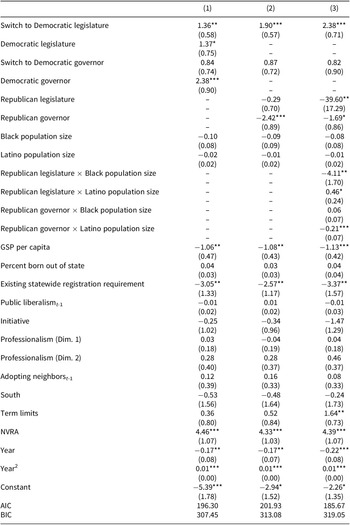
The logistic regression estimates are presented in Table 1. I generally find, at best, limited support for many common explanations for policy change. Most notably, the effect of Democratic control of the legislature, despite being in the expected positive direction, achieves significance at only the 0.1 level in Model 1 (p = 0.07). By contrast, the similarly sized coefficient for the Democratic legislature switch variable easily attains significance at the conventional .05 level (p = 0.02), and this finding is robust to the alternative specifications used in the other two models. To gain a handle on the substantive size of the effect, I generate predicted probabilities. Depending on which of the three models is used for interpretation, the switch to a Democratic legislature increases the probability of enacting SDR by as little as 2.1 percentage points or as much as 4.5 percentage points, all else equal. Given how rare policy adoptions are, occurring in only 1.1% of state-years, this effect is not only statistically but substantively significant as well (Kreitzer Reference Kreitzer2015). In short, then, there is ample evidence to conclude, at minimum, that the switch to Democratic control of the legislature exerts an effect above and beyond that of Democratic control itself.
Event history models of same-day registration adoption, 1973–2019

Note. N = 1,915. The models are logistic regressions where the dependent variable denotes the legislative adoption of same-day registration. Robust standard errors clustered by state in parentheses. *p < 0.1, **p < 0.05, ***p < 0.01. Two-tailed tests.
The evidence that strategic context surrounding the governorship similarly informs adoption decisions is less compelling. Indeed, Democratic control of that office itself appears to be more strongly related to the establishment of SDR than the switch to Democratic control. Model 1 projects that Democratic-led states have a statistically significant, two percentage point higher chance of adopting SDR in a given year, while the shift to a Democratic governor has a null effect (p = 0.19). Taken together, these findings suggest that Democratic governors are less strategic in promoting SDR than their legislative counterparts, possibly because chief executives’ shorter time in office—a result, in part, of the prevalence of gubernatorial term limits—leads them to be less concerned about securing an advantage in future elections. It also may simply be that legislators, focused on winning their own reelections and protecting their party’s majority status, often fail to prioritize retaining control of an institution in which they do not serve. If this is the case, it would speak to the one problem all governors face as political actors outside the legislature: their inability to introduce legislation. This limitation of the office means that governors’ policy agendas are at the mercy of legislators, who are free to ignore their demands (Kousser and Phillips Reference Kousser and Phillips2012).
Before analyzing how the probability of adoption differs for GOP-controlled states with Black and Latino populations of varying size, I assess the independent effect of each of these variables of interest. According to Model 2, when considered in isolation, neither the percentage of Blacks nor Latinos in a state has any bearing on whether it will institute SDR. These results are largely in line with Biggers and Hanmer’s (Reference Biggers and Hanmer2015) research on the origins of other convenience voting reforms. More surprisingly, the negative coefficient for Republican control of the legislature is small in magnitude and not even marginally significant (p = 0.68), calling into question the popular narrative that GOP rule tends to forestall the enactment of pro-voting rights reforms. The independent effect of the presence of a Republican governor, however, does align with this conventional wisdom, reducing the probability of adoption by about two percentage points.
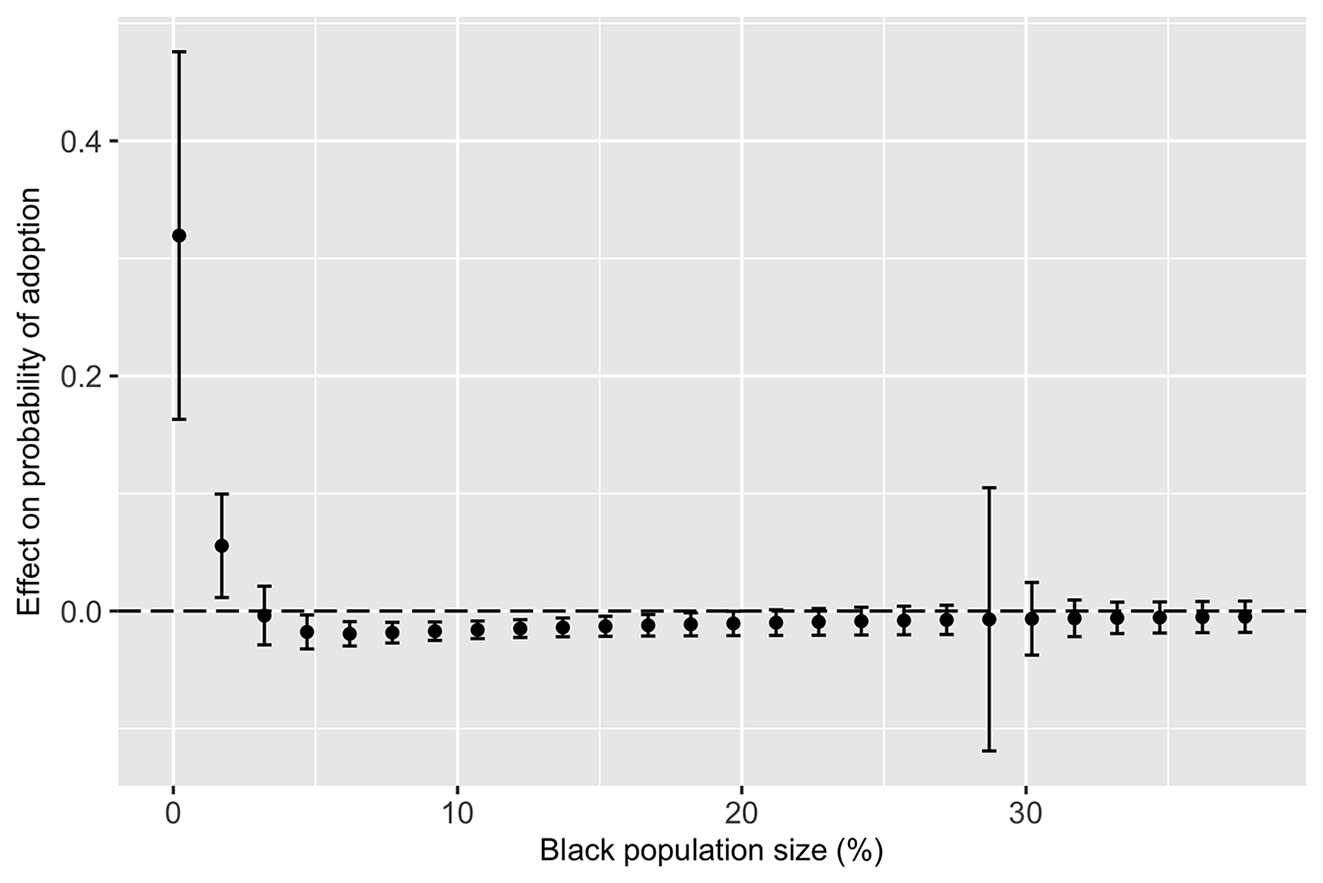
Model 3 introduces the interaction terms testing whether Republicans, too, are strategic in their policy-making decisions related to SDR. Although I find no evidence that the resistance of GOP governors to SDR is conditional upon the Black share of the population, the large joint effect of Republican control of the legislature and Black population size is in accordance with expectations. To facilitate interpretation of this statistically significant interactive relationship, I plot the marginal effects of the presence of a Republican legislature across the range of Black population size. As displayed in Figure 2, in states with miniscule Black populations, GOP control of the statehouse actually increases the probability that SDR will be adopted. For example, when Blacks compose 1.7% of the population, a state with a Republican legislature has a six percentage point higher chance of enacting the reform in a given year than an otherwise identical state with a Democratic or split legislature. With relatively small increases in Black population size, however, the sign of the effect reverses to be negative. By the time Blacks constitute just 4.7% of the population, the decrease in the probability of adoption induced by the presence of a Republican legislature is distinguishable from zero, signaling that GOP-run institutions become resistant to SDR once the political threat posed by Blacks becomes remotely detectable. It is important to note, though, that at Black population sizes of about 21% and higher, the confidence intervals are too wide for the marginal effects to be statistically meaningful.
Marginal effects of Republican control of the legislature by Black population size.
Note. Marginal effects derived from Model 3. Error bars are 90% confidence intervals.

The findings regarding the impact of Latino population size under different political conditions are at odds with each other (see Figure 3a,b). On the one hand, as the Latino share of the population rises, the effect of Republican control of the legislature changes from being negative to positive in direction. The combined effect of these two variables runs directly counter to my hypothesis, but, critically, the general finding that the GOP is more likely to support measures that facilitate voting in the presence of substantial Latino populations has precedence in the literature (Bali and Silver Reference Bali and Silver2006). On the other hand, and as expected, provided the Latino share of the population is high enough, the presence of a Republican governor has a large, negative, and often statistically meaningful impact.
Marginal effects of Republican control of the legislature and governorship by Latino population size.
Note. Marginal effects derived from Model 3. Error bars are 90% confidence intervals. Effects provided separately for states with Republican legislatures and governors.

In a further sign that the policy issue has come to be defined by strategic partisan dynamics, most of the control variables fail to consistently yield statistically significant effects. One exception is the indicator for the existence of a statewide registration requirement, which shares a negative relationship with adoption. In addition, the results repeatedly validate Hanmer’s (Reference Hanmer2009) observation that states turned to SDR in the 1990s as a means of bypassing the NVRA and demonstrate, unexpectedly, that states with smaller economies are more likely to enact the reform. The evidence that term limits encourage legislators to institute SDR is more mixed.
Conclusion
Even though SDR exists in nearly half the states, and its electoral effects are well understood, previous research fails to fully unpack the determinants of its adoption—a void this study fills. Despite the insistence of some politicians to the contrary, there is little reason to believe that either party’s position on SDR is entirely genuine. Even when Democratic control itself is accounted for, states in their first year of a Democratic legislature have a higher probability of enacting the reform. This serves as a sign that legislative Democrats are often able to overcome the recalcitrance of Republicans who, upon being relegated to minority status, may be especially motivated to block electoral reforms perceived to benefit the opposition. Further, complicating the narrative that there exists a clear partisan divide on voting rights, I found that the presence of a Republican legislature makes adoption more likely, provided the political threat posed by Blacks, as measured by their population share, is virtually nonexistent. At higher Black population sizes, however, this threat is no longer negligible, and accordingly, the effect of GOP control of the legislature is negative. The results also revealed that larger Latino populations discourage adoption under Republican governors but have the opposite effect in states with Republican legislatures. While the cause of these discrepant findings is unclear, they are reflective of two opposing electoral strategies—one designed to appeal to Latinos and another that effectively concedes the Latino vote by placing a heavy emphasis on anti-immigrant messaging—upon which Republican politicians commonly rely.
The findings presented here complement those from similar studies on voter ID laws (Biggers and Hanmer Reference Biggers and Hanmer2017; Hicks et al. Reference Hicks, McKee, Sellers and Smith2015). As is the case with voter ID, Democrats’ position on SDR is informed, in part, by the conventional view that the party’s electoral success hinges on whether it can mobilize sufficient numbers of minority, young, and poor voters, who are thought to be disproportionately affected by reforms that impact the costs associated with voting. Believing these voters to be out of reach for the party, and confident that their core supporters will turn out regardless of the electoral rules in place, Republicans have embraced the opposite strategy of supporting laws that serve to impose barriers to the ballot box—whether they be in the form of photo ID requirements or strict registration laws. While SDR is a less salient policy issue than voter ID, research on the determinants of SDR policy is arguably more consequential, as whether voter ID actually serves its intended purpose of lowering minority, and by extension, Democratic turnout is subject to debate (see, e.g., Highton Reference Highton2017; Hood and Bullock Reference Hood and Bullock2012).
This study represents a departure from the dominant understanding of how partisan strategy affects voting access in contemporary times. Scholars, journalists, and the popular discourse tend to focus on how Republicans have turned to restrictive voting laws in an effort to advance their electoral goals (Biggers and Hanmer Reference Biggers and Hanmer2017; Hicks et al. Reference Hicks, McKee, Sellers and Smith2015; Skelley Reference Skelley2021). As my findings make evident, however, strategic electoral considerations inform both parties’ agendas as they relate to convenience voting as well. From a normative perspective, it is concerning that this is the case, given that sins of commission—that is, the adoption of restrictive voting laws—can have the same net effect on citizen participation, which is integral to the health of democracy, as sins of omission—that is, the failure to facilitate access to the franchise.
The finding that higher Black population states with Republican legislatures are less likely to enact SDR has two important implications. First, it suggests that a racial group that was historically excluded from the electoral process is, at present, being systematically denied access to one of the few convenience voting measures demonstrated to increase voter turnout. That increased Black presence is also, at least under certain conditions, associated with the adoption of voter ID laws (Biggers and Hanmer Reference Biggers and Hanmer2017), the existence of restrictive felon disenfranchisement laws (Preuhs Reference Preuhs2001), longer wait times at polling places (Pettigrew Reference Pettigrew2017), and so-called “lower-quality” precincts (Barreto, Cohen-Marks, and Woods Reference Barreto, Cohen-Marks and Woods2009) means that the barriers Blacks in particular face in accessing the franchise are multifold. Second, in contradiction of theories of representation (see, e.g., Yates and Fording Reference Yates and Fording2005), the finding implies that increased Black electoral strength can discourage, rather than promote, government responsiveness to group interests if the policy at hand has the potential to alter the racial and, by extension, partisan makeup of the electorate in a way that is disadvantageous to the party in power.
Supplementary Materials
To view supplementary material for this article, please visit http://doi.org/10.1017/spq.2021.32.
Data Availability Statement
Replication materials are available on SPPQ Dataverse at https://doi.org/10.15139/S3/EW9BBO.
Funding Statement
The author received no financial support for the research, authorship, and/or publication of this article.
Conflict of Interest
The author declared no potential conflicts of interest with respect to the research, authorship, and/or publication of this article.