Introduction
An emerging body of studies has attempted to establish the link between human resource management (HRM) practices and innovation, which ultimately contribute to enhanced organizational performance (Laursen & Foss, Reference Laursen and Foss2003; Selvarajan, Ramamoorthy, Flood, Guthrie, MacCurtain, & Liu, Reference Selvarajan, Ramamoorthy, Flood, Guthrie, MacCurtain and Liu2007; Walsworth & Verma, Reference Walsworth and Verma2007; Jiménez-Jiménez & Sanz-Valle, Reference Jiménez-Jiménez and Sanz-Valle2008; Zanko, Badham, Couchman, & Schubert, Reference Zanko, Badham, Couchman and Schubert2008). However, these initial efforts to understand the relationship of HRM and innovation tended to borrow general high-performance work practices as predictors. Little research has been done to understand the types of HRM systems organizations in emerging economies nations employ (Miah & Bird, Reference Miah and Bird2007), and the effects of specific HRM systems in predicting innovation (Zhou, Hong, & Liu, Reference Zhou, Hong and Liu2013).
It must be noted that human resource (HR) practices are related to organizational culture because culture crates routes for everyday practices (Vadi & Vereshagin, Reference Vadi and Vereshagin2006). For instance, O’Reilly, Chatman, and Caldwell (Reference O’Reilly, Chatman and Caldwell1991) suggested the link between organizational culture and HR practices when analyzing person and organization fit. A critical dimension of cultural values is individualism versus collectivism (Chatman, Polzer, Barsade, & Neale, Reference Chatman, Polzer, Barsade and Neale1998; Li, Tan, Cai, Zhu, & Wang, Reference Li, Tan, Cai, Zhu and Wang2013). Specifically, there is greater emphasis on meeting a shared standard to maintain harmony in one’s relationship to the group in collectivistic cultures (Wink, Reference Wink1997). Also, collectivistic value orients team members toward common goals, which have been shown to increase the number of ideas generated in groups (Paulus & Dzindolet, Reference Paulus and Dzindolet1993). In line with this trend, we posited one of a culturally specific HRM, namely collectivism-oriented human resource management (CHRM) to evaluate its effect on innovation performance under Chinese context.
Research showed that teams and workgroups are often the primary unit of an organization for innovation activities (Kozlowski & Bell, Reference Kozlowski and Bell2003; DeShon, Kozlowski, Schmidt, Milner, & Wiechmann, Reference DeShon, Kozlowski, Schmidt, Milner and Wiechmann2004). Given the increasing prevalence of teamwork in organizations, this study highlights the importance of understanding the process of teamwork in predicting innovation. In other words, we proposed two mediating factors (i.e., team reflexivity and team psychological safety) as the team process variables to illustrate the relationships between CHRM and innovation performance.
In our current study, we aimed to theorize the relationship between CHRM and innovation performance at the team level. Although there is empirical evidence for an association between team reflexivity and innovation (e.g., Widmer, Schippers, & West, Reference Widmer, Schippers and West2009; Schippers, West, & Dawson, Reference Schippers, West and Dawson2015), as well as between team psychological safety and innovation (e.g., Kark & Carmeli, Reference Kark and Carmeli2009; Carmeli, Reiter-Palmon, & Ziv, Reference Carmeli, Reiter-Palmon and Ziv2010), a more comprehensive framework that integrates these linkages is called for to disentangle the complex dynamics among CHRM, team reflexivity, team psychological safety, and innovation performance.
We organize this paper as follows: the next section briefly reviews the related theoretical underpinnings and develops the hypotheses. The research methodology is then presented, including information about the data collection, the sample, the measurements, and the results of data analyses. This paper concludes with a discussion of the implications of the findings, the limitation of this research, and the directions for future study.
Theory Development and Hypotheses
CHRM and innovation performance
According to the research (e.g., Li & Murray, Reference Li and Murray1992; Heine, Lehman, Markus, & Kitayama, Reference Heine, Lehman, Markus and Kitayama1999; Brickson, Reference Brickson2005, Reference Brickson2007; Li, Zhang, Yang, & Li, Reference Li, Zhang, Yang and Li2014), CHRM can be regarded as a set of HR policy/practice cultivating collectivistic cultural value in organizations, which can be observed in East Asian societies where many organizations stress collectivism in every dimension of HRM, including recruitment, training, evaluation, reward, compensation, and promotion. For instance, with CHRM, rewards are given mainly to teams of individuals rather than single individuals, employee training and development stress teamwork rather than individual performance and promotion priority goes to those who can work well with other people (Li, Tang, Wang, Yan, & Liu, Reference Li, Tang, Wang, Yan and Liu2012). This HRM system also includes team/group-related ability and mechanisms, which enable members to communicate and coordinate with each other in order to earn the respect of their coworkers and being recognized as outstanding members (Wright, Berrell, & Gloet, Reference Wright, Berrell and Gloet2008). As teamwork is an important social component where employees can feel a sense of contribution to the group (Andreassi, Lawter, Brockerhoff, & Rutigliano, Reference Andreassi, Lawter, Brockerhoff and Rutigliano2014), CHRM uses teams as a means of not only increasing employees’ sense of collective belongings to the group, but also of getting innovative work done.
Take a research-oriented team as an example. It can be observed that many large-scale research projects today require researchers to work as team. Generally, research-oriented teams have set widely accepted goals for innovation, aiming at specific targets such as filling some research gap generated by a new theory, technology, or products. In these teams, innovation is expected, and the expectations are backed by strong norms for achievement in the particular context to meet that standard. Hence, it is possible that CHRM provides additional environmental support for such an object (Goncalo & Staw, Reference Goncalo and Staw2006). In teamwork, CHRM helps to develop a sense of collective identity among team members, which in turn motivates members to work harder for the common goal of their team (House, Hanges, Javidan, Dorfman, & Gupta, Reference House, Hanges, Javidan, Dorfman and Gupta2004; Brickson, Reference Brickson2007). As Ngo, Jiang, and Loi (Reference Ngo, Jiang and Loi2014) pointed out, HR practices with a long-term employment tend to promote collective innovation and risk-taking behaviors at the team level. In fact, CHRM characterized by stressing long-term relationship between employees and organizations increases the collective interests of employees and their willingness to seek cooperation, and contribute toward team performance (e.g., Brickson, Reference Brickson2007). Thus, we proposed the following hypothesis:
Hypothesis 1: CHRM is positively related to innovation performance.
Team reflectivity and team psychological safety as mediators
As organizations focus on acquiring, developing, and utilizing employee competencies to maximize performance (Wright, Kroll, Pray, & Lado, Reference Wright, Kroll, Pray and Lado1995), there is considerable evidence that HRM–performance relationship is mediated by the skills, attitudes, and behaviors of employees (Delery, Reference Delery1998; Teo, LeClerc, & Galang, Reference Teo, LeClerc and Galang2011). In light of this, we suggested two mediating indicators, namely team reflexivity and team psychological safety to investigate their effect on the HRM–performance relationship.
First, team reflexivity refers to a team’s joint and overt exploration of work-related issues including team goals, strategies, and processes because of environmental changes (Sicotte & Langley, Reference Sicotte and Langley2001). Reflexivity activities consist of attention, awareness, monitoring, and evaluation of the object of reflection (West, Reference West1996; West & Richter, Reference West, Patterson and Dawson2008). Team reflexivity may vary widely across teams in organizations and may be affected by contextual indicators like organizational culture.
In many organizations with collectivistic cultural value, an individual wants to belong and enjoy being part of the group (Oyserman, Coon, & Kemmelmeier, Reference Oyserman, Coon and Kemmelmeier2002). Under this circumstance, a harmonious and friendly organizational climate created by CHRM can motivate team reflexivity as teammates are willing to stay in the team and contribute to team outcomes. Given that the tasks of research-oriented teams are more complex, difficult, and ambiguous, they depend on external environment for information, resource, and support (Liu, Schuler, & Zhang, Reference Liu, Schuler and Zhang2013). Feeling free to question current issues and speak up is the key to one’s involvement in raising novel ideas and providing new suggestions (Kark & Carmeli, Reference Kark and Carmeli2009). Team reflexivity promotes innovation by making it easier for team members to learn from one another’s views on work processes, adopt their own views when necessary, and create a shared understanding that can guide team processes and outputs more effectively (Reiter-Palmon,Wigert, & De Vreede, Reference Reiter-Palmon, Wigert and De Vreede2012). Thus, we established the following hypothesis:
Hypothesis 2: The relationship between CHRM and innovation performance is mediated by team reflexivity.
Second, team psychological safety is defined as a shared belief among work unit members that it is safe for them to engage in interpersonal risk taking (Edmondson, Reference Edmondson1999). Members who experience a team environment that is psychologically safe are free to engage in risk-taking behavior that is necessary for innovation (Dollard & Bakker, Reference Dollard and Bakker2010). Clearly, team psychological safety is a psychological state that emerges as a result of team-building efforts, as well as other environmental factors (Faraj & Yan, Reference Faraj and Yan2009).
Third, as CHRM emphasizes cultivating collectivism orientation, teams consistent with this identity orientation influence members’ psychological attachment to the team, as well as enhance their sense of belonging (Sluss & Ashforth, Reference Sluss and Ashforth2008). In this case, CHRM helps team members develop a shared sense of psychological safety by creating a cohesive internal environment where members trust and share resource with one another. One of the reasons is that a work environment that values teamwork and job security is more likely to cultivate a sense of ‘public good’ or collectivity (Ibarra, Kilduff, & Tsai, Reference Ibarra, Kilduff and Tsai2005), which invites individuals to trust the organization, share knowledge, and embody innovative behaviors without personal concerns (Moran, Reference Moran2005). Moreover, broad ideas, new suggestions, and divergent perspectives are not only permitted in psychological safety climate, but also encouraged (Bardley, Postlethwaite, Klotc, & Hamdani, Reference Bardley, Postlethwaite, Klotc and Hamdani2012), stimulating members to jointly assess and collectively learn from task feedback (Hackman, Reference Hackman2002). According to the team adaptation theory, team psychological safety is beneficial to innovation for it helps design a team plan, facilitates plan implementation, and improves team-learning ability (Burke, Stagl, Salas, Pierce, & Kendall, Reference Burke, Stagl, Salas, Pierce and Kendall2006). Therefore, we predicted the following hypothesis:
Hypothesis 3: The relationship between CHRM and innovation performance is mediated by team psychological safety.
Traditionally, Chinese culture, where people tend to avoid conflicts and protect social faces (Morris et al., Reference Morris, Williams, Leung, Larrick, Mendoza, Bhatnagar, Li, Kondo, Luo and Hu1998; Chen, Liu, & Tjosvold, Reference Chen, Liu and Tjosvold2005), was regarded as a threat for team members to discuss and interact openly and directly (Liu, Schuler, & Zhang, Reference Liu, Schuler and Zhang2013). In this situation, people are reluctant to be involved in team reflexivity activities. However, team psychological safety, which represents an emergent state of the team, plays a significant role in facilitating team reflexivity. We followed the argument that emerging states are a function of team actions and processes that drive subsequent processes and outcomes (Cohen & Bailey, Reference Cohen and Bailey1997; Faraj & Yan, Reference Faraj and Yan2009). This could be explained in light of Tjosvold and Sun (Reference Tjosvold and Sun2003) findings that Chinese people tend to interact and communicate openly and directly at least when skillfully and respectfully conducted. Specifically, when team members dare to openly express their ideas and are willing to contribute toward team success, they provide more inspiration to their coworkers, who can pick up these ideas, elaborate upon them, and increase their originality (Bechtoldt, Choi, & Nijstad, Reference Bechtoldt, Choi and Nijstad2012). Consequently, we argued that team reflexivity would highly benefit from team members who feel that they can safely speak up, seek help from others, and express their ideas without fearing negative interpersonal consequences:
Hypothesis 4: Team psychological safety has a positive effect on team reflexivity.
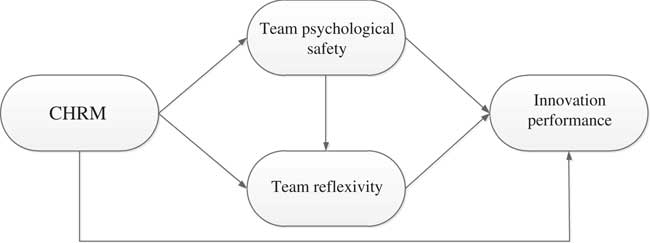
Based on the above discussion, Figure 1 presents a conceptual model of the relationships among CHRM, team reflectivity, team psychological safety, and innovation performance.
The conceptual model. CHRM=Collectivism-oriented HRM

Methods
Sample and procedure
Consistent with the guidelines provided by Podsakoff, Mackenzie, Lee, and Podsakoff (Reference Podsakoff, Mackenzie, Lee and Podsakoff2003), this paper gathered data from research-oriented teams in Chinese universities with a time lag of 3 months to minimize the potential threat of common method bias. In this regard, an on-site survey at an average 3-month interval conducted from March 2014 to June 2014. At Time 1, supervisors rated the questionnaires testing team-level CHRM, innovation performance, and provided basic information about their teams. At Time 2, members responded to items testing team reflexivity, team psychological safety, and demographic information.
Of the 295 teams that participated in our survey, 231 teams returned completed team-supervisors and team-member surveys, yielding a sample of 231 leaders and 904 members. To reduce potential aggregation biases due to the use of a small sample (Bliese & Halverson, Reference Bliese and Halverson1998), teams with fewer than three respondents and <50% response rates (i.e., the percentage of respondents among all formal members in the team) were excluded, which resulted in a final sample of 200 supervisors and 832 members in both Time 1 and Time 2 surveys.
The average size of the 200 teams, ranging from three to 10 members, was four. The average age (team established time) of the teams was 6.05 years. The average response rate of the participating teams was 78.0%, and the maximum and minimum response rates were 100 and 50%, respectively. The average age of the team members was 38.4 years, and 39% of the members were women. Their average tenure in their current team (joined team time) were 3.9 years. The average age of the supervisors was 46.2 years, and 35% of the supervisors were female. On average, the supervisors had worked for their current team for 4.72 years. The participating teams varied in discipline areas: business (22.5%), education (14.5%), engineering (42%), science (10.5%), art (7%), and others (3.5%).
Measures
Our survey instrument was constructed based on those used in prior studies. The participants were asked to rate their degree of agreement to the statements, except for control variables, on a 7-point scale (1=‘strongly disagree,’ to 7=‘strongly agree’). As the theories and variables are largely grounded in Western literature while data are collected in China, a forward–back translation approach was adopted to ensure the accuracy of the meanings (Brislin, Reference Brislin1980). Then the inconsistencies of the Chinese translation of the original items were revised through comparison.
CHRM
We administered the six-item survey of CHRM from House et al. (Reference House, Hanges, Javidan, Dorfman and Gupta2004), which has already been translated into Chinese version. The validity of the test was supported by Li et al. (Reference Li, Tang, Wang, Yan and Liu2012) with Cronbach’s α of 0.80. Typical items include ‘The pay and bonus system in this organization is designed to maximize collectivism;’ ‘In this organization, the majority of employees have a long-term employment contact;’ ‘In this organization, leaders encourage group loyalty, even if individual goals suffer;’ ‘In this organization, personal influence depends on contributions to the organization;’ and so on. Coefficient α reliability in our research was 0.78.
Team reflectivity
The nine-item scale of team reflection was adopted from previous research of Carter and West (Reference Carter and West1998), as well as West, Patterson, and Dawson (Reference West and Richter1999). This scale predicts how the employees thought about their objectives and working methods, which includes items such as ‘The methods used by the team to get the job done are often discussed;’ ‘The team often reviews its objectives.’ The validity of the test was supported by Tjosvold, Tang, and West (Reference Tjosvold, Tang and West2004) with Cronbach’s α of 0.88, and the α reliability in our study was 0.87.
Team psychological safety
The scale for team psychological safety was done from a previous questionnaire done by Edmondson (Reference Edmondson1999). The seven-item scale explains individuals’ perceptions of the consequences of taking interpersonal risks in their work environment. Some of the items used include ‘Members of this team are able to bring up problems and tough issues;’ ‘It is safe to take a risk on this team.’ The coefficient α reliability for this study was 0.87.
Aggregation of team-level variables
As individuals were nested within teams, both the team reflexivity and team psychological safety scores were derived by averaging individual scores within each team. The viability of creating an aggregated measure of team variables was checked following the method of James, Demaree, and Wolf (Reference James, Demaree and Wolf1984) and Kozlowski and Hults (Reference Kozlowski and Hults1987). On this bias, the within-group agreement (r wg), intraclass correlation (ICC1), and reliability of the mean (ICC2) were computed. For team reflectivity, results implied that the mean value of r wg was 0.88, ICC1 was 0.25, and ICC2 was 0.79. For team psychological safety, results implied that the mean value of r wg was 0.96, ICC1 was 0.12, and ICC2 was 0.63. Both of these variables were well above the acceptable levels (Bliese, Reference Bliese2000). As a consequence, team reflectivity and team psychological safety were justified for aggregation to group-level variables.
Innovation performance
Innovation performance was tested with two dimensions and seven items from Lovelace, Shapiro, and Weingart (Reference Lovelace, Shapiro and Weingart2001). Two dimensions contains innovativeness and constraint adherence, with coefficient α reliability of 0.86 and 0.87, respectively. Innovativeness includes the innovativeness of the team’s product, the number of innovations or new ideas introduced by the team, the team’s overall technical performance, and the team’s adaptability to changes. Constraint adherence includes the team’s progress compared with the managers’ initial expectations or cost performance, adherence to schedules, and adherence to budgets. Considering the characteristics of university research-oriented teams, academic value cannot be ignored in measuring innovation performance. Most universities use indicators such as the publication of academic papers and books, fulfillment of scientific research projects, and invention patents to evaluate faculties’ innovative outcomes. For this reason, we added a new dimension of academic value with four items to indicate innovation performance for Chinese universities. Sample items include ‘Our team has published papers in international journals;’ ‘Our team has conducted national natural science fund projects or national social science fund projects’; ‘Our team has conducted Provincial Scientific Research Project or National Scientific Research Project;’ ‘Our team has applied for invention patents.’
Exploratory factor analysis was used to test the construct validity. The data were verified by removing items and grouping the dimensional composition of the measurement. We used principal component and varimax as a method of rotation to perform exploratory factor analysis. An item is to be dropped sequentially when the cross-loading on a second factor has a value of 0.30 or greater, or if the difference between the primary and secondary loading is <0.20 (Hair, Anderson, Tatham, & Black, Reference Hair, Anderson, Tatham and Black1998). The exploratory factor analysis results confirmed that the Kaiser–Meyer–Olkin was 0.86 and the χ2 of Bartlett’s test was significant. Besides, the total reliability rate of the scale was 0.88, with 0.83, 0.79, and 0.74 in each dimension. Consequently, all 11 items were retained in the final analysis.
Control variables
To rule out alternative explanations, we included control variables at team levels as suggested by prior creativity research. All control variables were collected at Time 1. Prior research claimed that the number of members in the team is one of the important factors that affect team performance (Brewer & Kramer, Reference Brewer and Kramer1986). Also, the team established time and average jointed time are significantly related to team members’ interaction and performance (Pelled, Eisenhardt, & Xin, Reference Pelled, Eisenhardt and Xin1999). Therefore, this article controlled for the team number, team established time, and average jointed time for the following empirical analysis (measured in years).
Common method bias
According to Podsakoff et al. (Reference Podsakoff, Mackenzie, Lee and Podsakoff2003), one of the most widely used techniques to address the issue of common method variance is Harman’s one-factor (or single-factor) test. This paper used this technique as well. It loaded all the variables into an exploratory factor analysis and examined the unrotated factor solution to determine the number of factors that are necessary to account for the variance in the variables. Results displayed that there was no single factor account for the majority of the covariance among the measures (<50%), which indicates that potential common method variance does not constitute a serious threat.
Confirmatory factor analysis
Because several constructs in our study are related conceptually, we performed a series of confirmatory factor analysis to verify the constructs’ distinctiveness before testing the hypotheses. As shown in Table 1, all the indicators were independent in the six-factor model. In the four-factor model, three dimensions of innovation performance were combined into one factor, and in the one-factor model, all four factors were bound into one overall factor. It reveals that both four-factor model and one-factor model exhibit significantly poorer fit than the baseline model, as can be seen from the model fit indexes, which means the baseline model is superior to the competitive models (Schumacker & Lomax, Reference Schumacker and Lomax1996). Additionally, the Akaike information criterion of the baseline model was smaller than the alternative models, which means there is no same variance among different variables, reflecting good discriminant validity (Akaike, Reference Akaike1987).
Comparison of measurement models for main variables

Note. AIC=Akaike information criterion; AV=academic value; CA=constraint adherence; CFI=comparative fit index; CHRM=collectivism-oriented human resource management; IN=innovativeness; NNFI=nonnormed fit index; PS=team psychological safety; RMSEA=root mean square error of approximation; TR=team reflexivity.
Research Results
Descriptive statistics
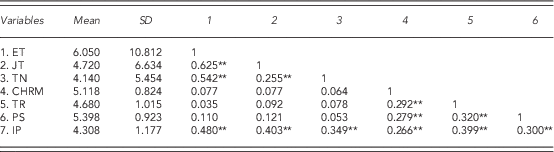
Table 2 reports the means, standard deviations, and correlations among the study variables. It is apparent that CHRM is related to innovation performance (β=0.266, p<.01), team reflectivity (β=0.292, p<.01), and team psychological safety (β=0.279, p<.01), respectively. Both team reflectivity and team psychological safety are positively related to innovation performance (β=0.399, p<.01; β=0.300, p<.01), respectively. Additionally, team psychological safety is positively related to team reflectivity (β=0.320, p<.01). To test for potential problem in multicollinearity for subsequent regression analysis, we calculated variance inflation factors (Neter, Wasserman, & Kutner, Reference Neter, Wasserman and Kutner1990). Result showed that all the variance inflation factors were below 10, indicating that multicollinearity is not a serious concern in our research.
Means, standard deviations, and correlations among variables

Note. CHRM=Collectivism-oriented HRM; ET=established time; IP=innovation performance; JT=average jointed time; PS=team psychological safety; TN=total number; TR=team reflexivity.
**p<.01 (two-tailed tests).
Hypothesis testing
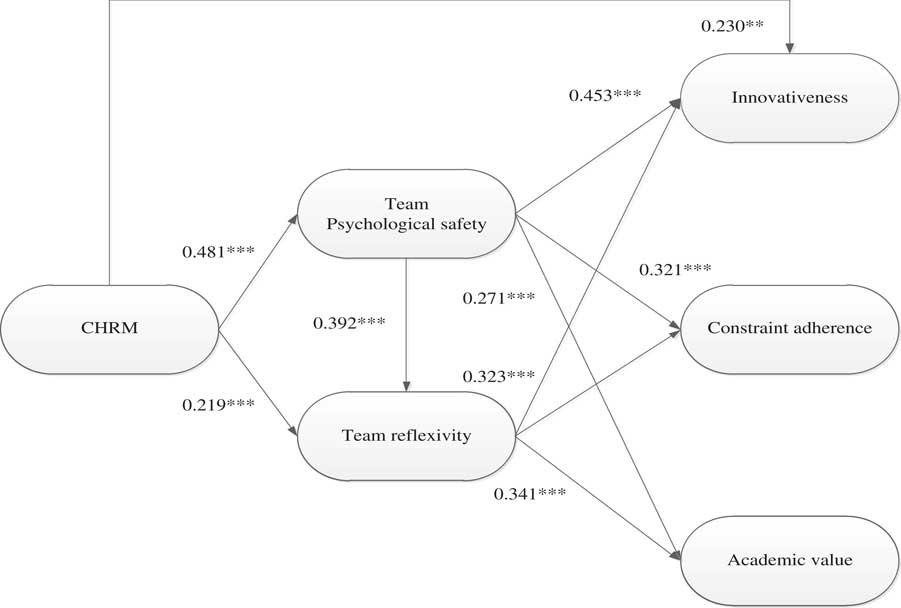
The four hypotheses were tested via structure equation modeling, and the steps to test moderate effect were based on Baron and Kenny (Reference Baron and Kenny1986). This paper established a baseline model (full mediation) and two alternative models (partial mediation and modified partial mediation), trying to find the best-fit model through comparison. Results in Table 3 demonstrate that there is a significant difference between model 1 (baseline model) and model 2 (alternative model) (Δχ2 (Δdf=3)=8.160, p<.05). We chose model 2 because it has more paths and has better fit index according to Lin and Hau (Reference Lin and Hau1995). Meanwhile, we deleted some paths that were not significant and formed model 3. When model 2 was compared with model 3, we found that the difference is not significant (Δχ2 (Δdf=3)=3.288, p>.05). Consequently, we chose model 3 as the best-fit model because it has less paths. Figure 2 shows the modified partial mediate model. First, the direct path from CHRM to innovation performance (innovativeness) is positive (β=0.230, p<.01). CHRM positively affects innovation performance (constraint adherence and academic value) via the indirect effect of team reflectivity. CHRM positively affects innovation performance (innovativeness, constraint adherence, and academic value) through the indirect effect of team psychological safety. Second, the direct paths from team psychological safety to innovation performance (innovativeness, constraint adherence, and academic value) are positive (β=0.453, p<.001; β=0.321, p<.001; β=0.271, p<.001). Team psychological safety positively affects innovation performance (constraint adherence and academic value) via the indirect effect of team reflectivity. Lastly, the direct paths from team reflectivity to innovation performance (constraint adherence and academic value) are positive (β=0.323, p<.001; β=0.341, p<.001). Overall, Hypotheses 1, 2, 3, and 4 are supported.
Modified partial mediate model. CHRM=Collectivism-oriented HRM; **p<.01; ***p<.001 (two-tailed tests)

Results of model comparisons

Note. Model 1 was baseline model; model 2 added path from collectivism-oriented human resource management (CHRM) to innovativeness (IN), constraint adherence (CA), and academic value (AV) based on model 1; model 3 reduced path from CHRM to CA and AV, as well as path from team reflexivity to IN.
CFI=comparative fit index; IFI=incremental fit index; NNFI=nonnormed fit index; RMSEA=root mean square error of approximation.
Discussions
The relationship between CHRM and innovation performance is part of relationship between HRM and performance. Prior research has obtained competing evidence of this relationship. Our current study contributes by showing that there can be a positive relationship between CHRM and innovation performance for research-oriented teams in Chinese universities. As CHRM provides a strong link between organizational goals and individual goal, team members are likely to perceive an alignment with the values of their teams/organizations. Consequently, there can be more innovative outcomes under CHRM practices.
Second, the relationship between CHRM and innovation performance is significantly mediated by team reflexivity and team psychological safety, implying that CHRM influences innovation performance through these two variables. Past research has mainly focused on a general unidimensional structure of team process improvement (De Dreu, Reference De Dreu2002; Schippers, DenHartog, Koopman, & Wienk, Reference Schippers, DenHartog, Koopman and Wienk2003). The present study expands the knowledge and provides empirical evidence for a two-dimensional team improvement process model distinguishing the dimensions of team reflexivity and team psychological safety. Findings from this study offer evidence for the construct validity and predictive validity of the two-dimensional structure of team process improvement.
Finally, although previous research has found the links between team reflexivity and performance in firm teams (Tjosvold, Hui, & Yu, Reference Tjosvold, Hui and Yu2003), health care teams (Schippers, West, & Dawson, Reference Schippers, West and Dawson2015), as well as the links between team psychological safety and performance in small industrial firms (Baer & Frese, Reference Baer and Frese2003), medical care units (Tucker, Nembhard, & Edmonson, Reference Tucker, Nembhard and Edmonson2007), our results demonstrate that the impact of team reflexivity and psychological safety also deemed important to research-oriented teams.
Theoretical implications
It is of interests that our current study found a significant and positive effect of CHRM on innovation performance. This finding supports the need to further study the effects of environmental factors on the relationship between a given HR system and its usefulness for innovation. Innovation is a complicated process and innovative outcomes can be relevant to both individuals and team/organizations. How should HRM systems help improve innovation in a highly dynamic and competitive environment should be an important issue for future study.
Additionally, our finding suggests the need to further study the relationships among HRM, job design, and organizational design. In other words, future study should further consider the issue of how HRM, job design, and organizational design should be conducted in a consistent and comprehensive way. In particular, future research should address the issue of how a manager should select an appropriate HR system to provide an environment motivating employees to take part in reflexivity activities so that they make much contribution to organization performance.
Finally, as our data suggest, different HRM systems may work well in different cultural environments. Therefore, greater efforts should be made in the future to conduct cross-cultural research to understand the effects of culture on HRM systems and organizational innovation. More information on this issue would allow HR managers to improve their performance in different cultures and achieve synergy in their teams/organizations. The information could also help understand the external validity of the findings of our current study. In other words, although our current study documented some interesting evidence on the relationship between CHRM and innovation performance, it remains unclear whether the same is true in other cultures, including other collectivistic cultures.
Practical implications
According to the findings of our current study, CHRM has direct and significant positive effects on innovation performance. This finding is consistent with the empirical data from other studies (e.g., Edgar, Gray, Browning, & Dwyer, Reference Edgar, Gray, Browning and Dwyer2014). Thereby, it would be useful to develop an HRM system according to the cultural values of a given society. The reason is that these cultural values may influence the effectiveness of a given HRM system. For instance, in a society with a collectivistic culture, it would be helpful to adopt CHRM and build an organizational culture matching the societal culture. In this sense, the findings from this research provide useful knowledge for managers to improve the quality of HRM.
Moreover, the mediating effects of team reflexivity and team psychological safety shed light upon the issue of how to improve innovation performance. The implication here is that supervisors may motivate team reflexivity by enhancing the level of psychological safety within teams/organizations. When supervisors allow team members to learn through making mistakes, accepting differences between team members, and thinking, the team members would have a higher sense of environmental safety (Schein, Reference Schein1993; Pearsall & Ellis, Reference Pearsall and Ellis2011), which should help improve collective creativity in their teams. On the other hand, to enhance team reflexivity, supervisors should ensure open and constructive meetings and encourage their subordinates to speak openly about their previous work, which is an approach also supported by results from several past studies (e.g., West, Reference West2000; Edmondson, Reference Edmondson2002). All these managerial interventions should lead to more collaborative behaviors of employees to improve the level of innovation in teams.
Limitations and Future Research
Admittedly, this paper still has a number of limitations. First, note that the measure of variables in this study was based on team leaders and members’ perceptions (i.e., the self-report questionnaire data). The validity of this measure should be assessed in future studies against more objective data, such as data on the number of innovative products, academic papers, and patent for invention. Second, the measurement scales of the variables were from Western societies, which may influence the external validity of results when the scales are applied in Asian cultures (i.e., power distance and risk avoidance may affect individual’s perception). Future research should consider further the cultural difference when designing the contextual scale. Finally, we only investigated two mediators between CHRM and innovation performance. Further research should develop a more comprehensive model with more variables.
Conclusion
Beyond the limitations of this study lies a set of values of our findings for organizations in general and for HRM in research-oriented teams in particular. The purpose of this study is to investigate the effect of CHRM on innovation performance and the pathway through which this effect is generated. Results suggest that research-oriented teams in Chinese universities, being influenced by elements of CHRM, can have better performance in terms of collective innovation and creativity. Specifically, CHRM helps to enhance teams’ innovation performance through the path of team psychological safety and team reflexivity. Moreover, team psychological safety is beneficial to team reflexivity. Here the relationship between a specific HRM system and innovation can be contingent to a number of team process factors, such as team psychological safety and team reflexivity. All these findings have important academic and practical implications.
Acknowledgements
This work is financially supported by “the Fundamental Research Funds for the Central Universities” (Grant no. 2014-yb-012). The authors would like to thank the two anonymous reviewers for their helpful comments.