Introduction
During studies of crustose Physciaceae from Guatemala (Giralt et al. Reference Giralt, van den Boom, Mayrhofer and Elix2014), we examined an interesting corticolous lichen with lobaric acid, filiform conidia and large, roughly ornamented ascospores. This lichen has proved to be a new species that we include in Amandinea M. Choisy ex Scheid. & H. Mayrhofer and a formal description is given in this paper. In the process of attempting to identify this new taxon, mainly using the monographs of tropical and subtropical species of Buellia s. lat. by Malme (Reference Malme1927) and Marbach (Reference Marbach2000), we realized that quite a number of corticolous species shared the diagnostic characters of filiform conidia and large, strongly ornamented ascospores. Thus, although the emphasis of this paper is to describe the new species, we also attempt to reappraise all those corticolous Buellia s. lat. species, mainly included in Amandinea and possessing large ascospores with markedly ornamented walls. These species include five taxa placed here within the Amandinea incrustans group: A. crassiuscula Giralt & Etayo (Giralt et al. Reference Giralt, Etayo and Gómez-Bolea2000), A. incrustans (J. Steiner in A. Zahlbr.) Marbach (Zahlbruckner Reference Zahlbruckner1926; Marbach Reference Marbach2000), A. langloisii Imshaug ex Marbach (Imshaug Reference Imshaug1951; Marbach Reference Marbach2000), A. montana (H. Magn.) Marbach (Magnusson Reference Magnusson1954; Marbach Reference Marbach2000) and A. submontana Marbach (Marbach Reference Marbach2000); A. leucomela (Imshaug) P. May & Sheard (Imshaug Reference Imshaug1955; Marbach Reference Marbach2000), A. mediospora Marbach, A. megaspora Marbach (Marbach Reference Marbach2000), A. subduplicata (Vain.) Marbach (Vainio Reference Vainio1890; Marbach Reference Marbach2000), and Buellia hypothallina Aptroot (Aptroot et al. Reference Aptroot, Diederich, Sérusiaux and Sipman1997). Despite these taxa clearly being morphologically heterogeneous, a fact that strengthens our belief that the genus Amandinea does not constitute a monophyletic group, as already indicated by several phylogenetic studies (e.g. Grube & Arup Reference Grube and Arup2001; Blaha Reference Blaha2002), we prefer to retain them in Amandinea (except for Buellia hypothallina) until additional genetic data are available, as all are characterized by filiform conidia (except for A. montana where conidia have not been observed) and ascospores with weak or no inner wall thickenings and clearly ornamented outer walls.
Material and Methods
This study is based on the type and additional material from institutional and private herbaria (B, BCN, CANB, FH, STU, W, WIS, hb. v.d. Boom and hb. Etayo). Spore measurements were made on material mounted in water at ×1000 to a precision of 0·5 µm. Only free ascospores lying outside the asci were measured for which mean length and width values ( $\bar{x}$
), standard deviation (SD) and the mean length/width ratio were calculated. In the text and in Tables 1 and 2 the results are given as (minimum value observed–)
 $\bar{x}$
−SD–
 $\bar{x}$
+SD(–maximum value observed);
 $\bar{x}$
, SD, n (the total number of ascospores measured) and the mean l/w ratio are also given.
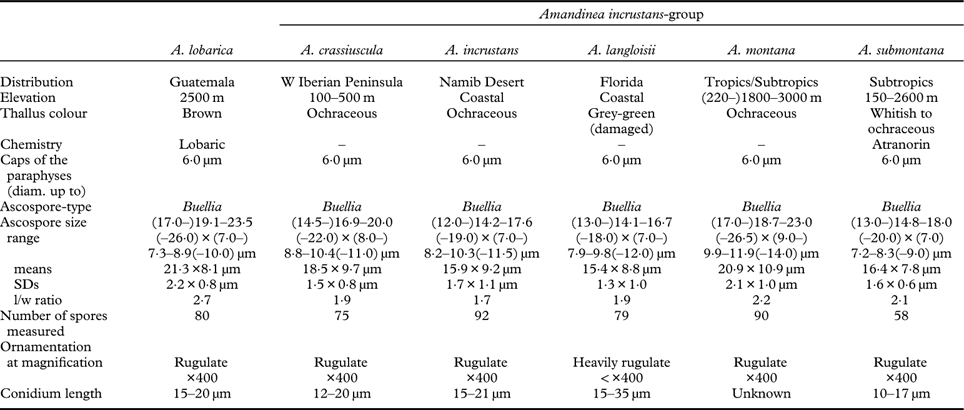
Comparison of the distribution, elevation, chemistry (mainly based on literature) and the main morphological characters (based on our own observations) of the new species Amandinea lobarica and the five species of the A. incrustans group which are all corticolous and with large and clearly ornamented ascospores.

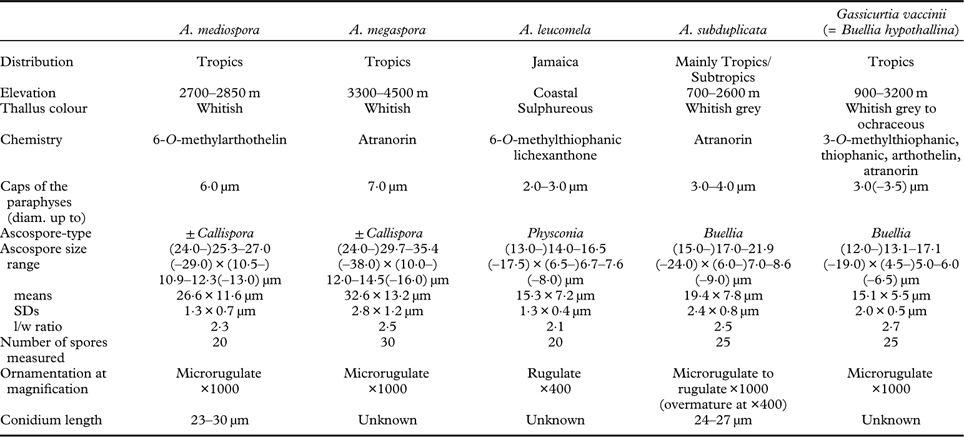
Comparison of the distribution, elevation, chemistry (mainly based on literature) and main morphological characters (based on our own observations) of additional corticolous Amandinea species (and Gassicurtia vaccinii) with large and clearly ornamented ascospores.
Chemical constituents were identified by standardized thin-layer chromatography (TLC) (Orange et al. Reference Orange, James and White2001; Elix Reference Elix2014).
Results and Discussion
The new species
Amandinea lobarica Giralt, van den Boom & Elix sp. nov.
MycoBank No.: MB 811038
Thallus corticolous, brownish, smooth to granulose, containing lobaric acid. Apothecia lecideine, small, 0·1–0·5 mm diam., disc becoming strongly convex and emarginate, black. Proper exciple poorly developed, brown, N−. Hymenium without oil droplets. Epihymenium brown, N−. Ascospores Buellia-type, (17·0–)19·1–23·5(–26·0)×(7·0–)7·3–8·9(–10·0) µm; walls strongly rugulate (ornamentation visible at ×400). Conidia filiform, curved, 15–20×c. 1 µm.
Type: Guatemala, Quezaltenango, S of Quezaltenango, S of Llano del Pinal, N slope of Volcano Santa María, path among small agricultural fields with small forests, shrubs, trees and outcrops along path, 14º47·1'N, 91º32·9'W, 2500 m, on lower part of trunk of a mature Quercus, 23 July 2004, P. & B. v. d. Boom 32943 (BR—holotype; hb. v. d. Boom—isotype).
Amandinea lobarica Giralt, van den Boom & Elix (holotype). A, thallus with apothecia; B, Buellia-type ascospores with strongly ornamented walls (rugulate) and slight constrictions at the septa. Scales: A=0·5 mm; B=10 µm.
Thallus corticolous, episubstratal, discontinuous, thin, smooth to granulose, greyish brown to dark brown; algal cells chlorococcoid, 7–15 µm diam. Prothallus absent. Medulla not amyloid, I−.
Apothecia lecideine, adnate to sessile, (0·1–)0·2–0·3(–0·5) mm diam. Proper margin thin, not persistent; disc black, flat, becoming strongly convex, epruinose. Proper exciple poorly developed, up to 30 µm thick, outer part brown, inner part colourless, N−. Hymenium colourless, not inspersed with oil droplets, 100–120 µm high. Hypothecium 90–120 µm deep, brown, in young apothecia upper part brown-olivaceous, N−. Epihymenium brown, N−. Apical cells of the paraphyses up to 6 µm wide, with brown caps. Asci Bacidia-type (Rambold et al. Reference Rambold, Mayrhofer and Matzer1994), 8-spored. Ascospores Buellia-type, (17·0–)19·1–23·5(–26·0)×(7·0–)7·3–8·9(–10·0) µm, ( $\bar{x}$
=21·3×8·1 µm; SD=2·2×0·8 µm; n=80; l/w ratio=2·7), narrowly ellipsoid, straight or slightly curved, walls strongly rugulate (ornamentation visible at ×400), constricted at septum when mature.
Conidia filiform, curved, 15–20×c. 1 µm.
Secondary chemistry
Thallus K+ dirty yellow (deep yellow under the microscope): lobaric acid (major) and unknown (traces) detected by TLC.
Etymology
The epithet refers to the major chemical compound occurring in this species.
Ecology and distribution
Amandinea lobarica is known only from the type locality which is in a mountainous area at 2500 m, influenced by human activities. Many low rock outcrops are present in the area. The only tree in an open area was a mature Quercus, with a poorly developed lichen community. Accompanying species included Japewiella tavaresiana (H. Magn.) Printzen and two sorediate crusts, one with all negative spot tests and one which reacts C+ orange. This latter resembles Lecanora jamesii.
Notes
The new species is characterized by the thallus chemistry (lobaric acid), the small, strongly convex, epruinose and emarginate apothecia with a poorly developed proper exciple, the large, narrowly ellipsoid and strongly rugulate Buellia-type ascospores, 17–26×7–10 µm, and the filiform conidia. As a consequence of the latter character, we have included this species in Amandinea. Other crustose genera in the Physciaceae with filiform conidia include Orcularia (Malme) Kalb & Giralt, Fluctua Marbach and Sculptolumina Marbach. All possess ascospores with strong inner wall thickenings (see Kalb & Giralt Reference Kalb and Giralt2011, Marbach Reference Marbach2000 and Giralt et al. Reference Giralt, Paz-Bermúdez and Elix2009, respectively) so can be readily distinguished from Amandinea.
The external morphology and the large, narrowly ellipsoid ascospores of A. lobarica resemble those of the genus Chrismofulvea Marbach (Marbach Reference Marbach2000). However, this genus is mainly separated from other crustose buellioid genera of Physciaceae by containing the fumarprotocetraric chemosyndrome. Unfortunately, the conidia of Chrismofulvea have not yet been described.
Among the known corticolous species of Buellia s. lat., only the sorediate Amandinea efflorescens (Müll. Arg.) Marbach var. efflorescens, the isidiate Gassicurtia clathrisidiata Aptroot, G. bellardii (Sipman) Marbach, G. coccifera Marbach & Kalb, Sculptolumina serotina (Malme) Marbach and Tetramelas regiomontanus Marbach contain lobaric acid. The first two taxa are distinguished by their vegetative propagules, G. bellardii and G. coccifera by much smaller ascospores, 9–12×5–6 µm and 8–11×4·5–5·5 µm, respectively, S. serotina by rinodinoid ascospores of the Pachysporaria-type and T. regiomontanus (Marbach Reference Marbach2000) by larger ascospores (25–31×9–11 µm) with subapical wall thickenings.
Other Amandinea species with ascospores as large as those of A. lobarica include A. mediospora, A. megaspora and A. montana (Fig. 2). However, the ascospores of the two former species are larger than those of A. lobarica (24–29×10–13 µm and 24–38×10–16 µm, respectively), possess weak inner subapical and septal wall thickenings (±Callispora-type) and are less strongly ornamented (ornamentation visible at ×1000) while those of A. montana are much broader (17·0–26·5×9·0–14·0 µm). They also differ chemically since A. mediospora contains 6-O-methylarthothelin, A. megaspora contains atranorin and A. montana lacks lichen substances.
Comparison of ascospore length and width of the five species of the Amandinea incrustans-group (●), the new species A. lobarica (▲), the two species A. mediospora and A. megaspora (○), A. leucomela (△), A. subduplicata (□) and Gassicurtia vaccinii (■) Points plotted are mean values ± 1SD (see also Tables 1 & 2).
Additional differences between A. lobarica and the other species mentioned above are summarized in Tables 1 and 2.
Species of the Amandinea incrustans group
The species in the Amandinea incrustans group include Amandinea crassiuscula, A. incrustans, A. langloisii, A. montana and A. submontana. All are corticolous, characterized by robust, smooth, glossy, ochraceous to olivaceous thalli with well-developed epinecral and cortical layers, the latter composed of ±rounded-cells (see Giralt et al. Reference Giralt, Etayo and Gómez-Bolea2000: Fig. 2A: 524); an absence of secondary metabolites (except A. submontana which contains atranorin); juvenile apothecia covered by a thin thalline veil and mature apothecia with plane discs and thick proper margins (see Giralt et al. op. cit.: Fig. 1: 523), which usually become convex and emarginate; a brown proper exciple (paler within) composed of ±isodiametric cells; rather large, broadly ellipsoid (l/w ratio=c. 2), Buellia-type ascospores with a strongly rugulate ornamentation clearly visible at ×400 magnification (see Giralt et al. op. cit.: Fig. 3: 525); paraphyses with large apical cells (up to 6·0 µm diam.) with brown caps; and filiform conidia (not yet seen in A. montana). Leaving aside A. submontana which contains atranorin, the other four taxa of the A. incrustans group could be regarded as conspecific since they differ from one another mainly in the size of the ascospores (see Fig. 2 and Table 1). Nevertheless, until more material is collected to confirm whether the divergences among species in ascospore size, ecological requirements and distribution patterns are constant or not, it seems most appropriate to conserve them as valid taxa.
Amandinea crassiuscula Giralt & Etayo
Giralt et al., Lichenologist 32: 522 (2000); type: Iberian Peninsula, Spain, Andalucía, Cádiz, Jerez de la Frontera, canuto del Caballo, carretera de Alcalá de los Gazules a Puerto Galiz km 16, 30STF6347, 420 m, on Quercus suber, 1994, Casares, Etayo, Gómez-Bolea & Hladun (BCN—holotype!; hb. Etayo—isotype!).
Notes
This species has ascospores of intermediate size within the A. incrustans group, smaller than A. montana and longer than those of the other three taxa (Fig. 2, Table 1). It lacks secondary metabolites.
Amandinea crassiuscula seems to be restricted to the western Iberian Peninsula where it occurs in Mediterranean woods of the mesomediterranean belt, with a humid and hyperhumid ombroclimate (Giralt et al. Reference Giralt, Etayo and Gómez-Bolea2000).
Additional specimens examined. These are listed in Giralt et al. (Reference Giralt, Etayo and Gómez-Bolea2000) and Paz-Bermúdez & Giralt (Reference Paz-Bermúdez and Giralt2010).
Amandinea incrustans (J. Steiner in Zahlbr.) Marbach
Biblioth. Lichenol. 74: 75 (2000).—Buellia incrustans J. Steiner in Zahlbr., Bot. Jahrb. 60: 550 (1926); type: Namibia, “Deutsch-Südwestafrika, Haifischinsel an der Lüderitzbucht”, W. Finke; A. Zahlbruckner, Lichenes rarioris exsiccati N 260 [WU 41358—lectotype, designated by Marbach Reference Marbach2000: 75 (as ‘holotype’); W 1927–1063 & W 1920–718—isolectotypes!].
Taxonomic note
Şenkardeşler (Reference Şenkardeşler2010: 443, sub Buellia incrustans) mentioned erroneously the specimen W 1927–1063 as the lectotype and the specimen WU 41358 as one of the isolectotypes.
Notes
Amandinea incrustans and A. langloisii have the shortest ascospores within the A. incrustans group. In addition, A. langloisii has longer conidia than A. incrustans. Amandinea submontana, with ascospores of similar length, differs from both of these species by possessing narrower ascospores and containing atranorin (Fig. 2, Table 1).
All material of A. incrustans examined (the type included) contained two Amandinea taxa growing together. One species has broadly ellipsoid ascospores, 12·0–19·0×7·0–11·5 µm (l/w ratio=1·7); and the other narrowly ellipsoid ascospores, 11·0–16·5×5·5–7·5 µm (l/w ratio=2·3). According to the protologue (J. Steiner in Zahlbruckner Reference Zahlbruckner1926), A. incrustans (sub Buellia incrustans) has ascospores 14·0–18·5×9·0–11·0 µm, so A. incrustans s. str. corresponds to the species with the broadly ellipsoid ascospores. The second taxon, with narrowly ellipsoid ascospores, corresponds to A. extenuata (Müll. Arg.) Marbach. Besides the smaller ascospores, A. extenuata differs from A. incrustans in having a thinner, warty to verrucose-areolate thallus, smaller apothecia, and Physconia-type ascospores with weak inner septal wall thickenings (when young) and microrugulate outer spore walls (ornamentation visible at ×1000) rather than rugulate (ornamentation visible at ×400).
The description of A. incrustans given in Wirth (Reference Wirth2010, sub Buellia incrustans) is likely to refer to A. extenuata and not to A. incrustans, since the size given for the ascospores is 11–15×6–7 µm.
Amandinea incrustans is endemic to the Namib Desert (Marbach Reference Marbach2000).
Additional specimens examined. Namibia: Omaruru, c. 2 km N of Cape Cross, Namib Desert, gravel plain c. 5 km E of the road, on branchlets of Arthraerua leubnitziae shrubs, 25 m, 1986, Sipman 19722 (B); Swakopmund, gravel flats in central Namib Desert, c. 10 km E of Swakopmund, along road to Namib-Naukluft Park, near power station, on scattered low shrubs, c. 50 m, 1986, Sipman 19661 (B); Karas Region, 200 m, 2009, R. & V. Wirth 42030 (STU).
Amandinea langloisii Imshaug ex Marbach
Biblioth. Lichenol. 74: 80 (2000).—Buellia langloisii Imshaug, The lichen-forming species of the genus Buellia occurring in the United States and Canada: 114 (1951), nomen nudum; type: Florida, Sanford, on old tree trunk, 1918, Rapp 619 (FH—holotype!).
Notes
Amandinea langloisii clearly differs from the other species of the A. incrustans group by the more strongly rugulate ornamentation of the ascospores and the longer conidia (Table 1). It lacks lichen substances (see also under A. incrustans).
The thallus of the holotype of A. langloisii was described as “smooth and ochraceous” by Imshaug (Reference Imshaug1951), like all species of the A. incrustans group, but as dark greyish green by Marbach (Reference Marbach2000). Our study of the type material established that the thallus has been damaged over the years with a hyphomycete and black soil present on it. The thallus of A. langloisii is thinner than that of the other members of the incrustans group but it still possesses the typical epinecral layer and the cellular cortex.
Amandinea langloisii was considered conspecific with A. leucomela by Harris (Reference Harris1988) and Sheard & May (Reference Sheard and May1997). However, a study of the respective type materials showed this to be incorrect, as pointed out by Marbach (Reference Marbach2000). The thallus and apothecia of A. leucomela contain xanthones, it has smaller ascospores (of Physconia-type when young) and the apical cells of the paraphyses are weakly enlarged (2·0–3·0 µm diam.).
According to Marbach (Reference Marbach2000), A. langloisii is known only from the type locality in Florida. However, additional records from Louisiana listed by Imshaug (Reference Imshaug1951) and from Florida and Louisiana by Harris (Reference Harris1988) and Sheard & May (Reference Sheard and May1997) under A. leucomela, could actually refer to A. langloisii.
Amandinea montana (H. Magn.) Marbach
Marbach, Biblioth. Lichenol. 7: 93 (2000).—Buellia montana H. Magn., Bot. Not. 1954(2): 199 (1954); type: India, United Provinces, Nainital, Chine Peak, 2100 m, on bark, 1949, Mehra 14 (UPS, not seen).
Notes
Amandinea montana has the largest ascospores of those species included in the A. incrustans group (Fig. 2, Table 1). According to Kalb & Elix (Reference Kalb and Elix1998), A. montana contains myeloconone D1, but it actually lacks lichen substances. Myeloconone D1 is a synonym of unknown SV-1 (Culberson Reference Culberson1972), a chlorophyll or xanthophyll derivative originating from the photobiont.
Amandinea montana is known from the type locality in India (Magnusson Reference Magnusson1954), Kenya (Marbach Reference Marbach2000), Australia (Elix & Kantvilas Reference Elix and Kantvilas2013) and from Guatemala (present record) where it typically occurs at high elevations in the mountains of subtropical to tropical regions. In the Guatemalan locality the species was growing on Quercus, with a rather well-developed lichen community, accompanied by macrolichens such as Canoparmelia carneopruinata (Zahlbr.) Elix & Hale, Heterodermia albicans (Pers.) Swinscow & Krog, H. diademata (Taylor) D. D. Awasthi, H. magellanica (Zahlbr.) Swinscow & Krog, Leptogium cochleatum (Dicks.) P. M. Jørg. & P. James, Pannaria malmei C. W. Dodge, and Parmotrema chiapense (Hale) Hale. Well-developed crustose specimens from that locality included Glyphis cicatricosa Ach., Graphis barillae van den Boom & Sipman, Graphis furcata Fée, Haematomma collatum (Stirt.) C. W. Dodge, Jamesiella perlucida (Vězda & Hafellner) Lücking et al., Phaeographis dendritica (Ach.) Müll. Arg., Phlyctidia boliviensis (Nyl.) Müll. Arg. and Pyrenula pyrenuloides (Mont.) R. C. Harris.
Additional specimens examined. Guatemala: NE of Antigua Guatemala, park Florencia, mature and small young Quercus trees, on a mature Quercus, 14°34·1' N, 90°42·1' W, 1800 m, 2004, P. & B. van den Boom 33622 (hb. v. d. Boom).—Kenya:Central Province: Nyeri district, Strasse zwischen den Aberdare-Region und Nyeri, 1985, Kalb & Schrögl 13746 (WIS).
Amandinea submontana Marbach
Biblioth. Lichenol. 74: 105 (2000); type: Kenya, Central Province, Nanyuki District, zwischen Naro Moru und Nanyuki, Wälder zwischen dem Bantu und den Mao Mao Grotten, 2050 m, 1985, Kalb & Schrögl 28776 & 13355 (WIS—holotype! & isotype!, respectively).
Notes
This species differs from the other members of the A. incrustans group by possessing the narrowest ascospores (Fig. 2), the shortest and rarely curved conidia and the presence of atranorin in the thallus (Table 1). According to Marbach (Reference Marbach2000), this species may sometimes contain norstictic acid or lack lichen substances.
It seems to be the most common species of the A. incrustans group, occurring in subtropical and warm-temperate regions from low to high elevations (Marbach Reference Marbach2000). It has recently been reported from the coastal plain of Virginia (USA) (Hodkinson & Case Reference Hodkinson and Case2008).
Additional species
Amandinea leucomela (Imshaug) P. May & Sheard
Sheard & May, Bryologist 100: 162 (1997).—Buellia leucomela Imshaug, Farlowia 4: 496 (1955); type: Jamaica, N slope of Portland Ridge, Parish of Clarendon, 200 ft., 1952, Imshaug 13269 (FH—holotype!; CANB—isotype).
Notes
The thin sulphurous to yellowish thallus well delimited by a black prothallus, the presence of lichexanthone and 6-O-methylthiophanic (not 6-O-methylarthothelin as stated in Marbach Reference Marbach2000), the small (up to 0·4 mm diam.), persistently plane apothecia and the rather small, Physconia-type ascospores with weak inner septal wall thickenings (13·0–17·5×6·5–8·0 µm), clearly distinguish A. leucomela from the other species treated. The conidia have not yet been observed (see also comments under A. langloisii and Table 2).
It is known with certainty only from the type locality in Jamaica (Marbach Reference Marbach2000). The record of A. leucomela (sub Buellia leucomela) from the Sonoran Region (Bungartz et al. Reference Bungartz, Nordin and Grube2007) is doubtful since the species is described as possessing larger apothecia (up to 1 mm diam.) and larger ascospores (16·0–21·5×8·0–10·0 µm), which furthermore are of Buellia-type.
Amandinea mediospora Marbach
Biblioth. Lichenol. 74: 81 (2000); type: Ecuador, Azuay, c. 35 km S von Cuenca, Waldestre in einem Grasparamo, 3200 m, 1987, Kalb 18365 & 18360 (WIS—holotype! & isotype! respectively).
Notes
This taxon is characterized by the whitish to beige, rimose to warty thallus containing 6-O-methylarthothelin; apothecia with persistently plane discs, prominent and persistent proper margins and hypothecia inspersed with oil droplets; large, often curved ascospores (24·0–29·0×10·5–13·0 µm) with weak subapical and very weak septal inner wall thickenings when young (±Callispora-type), with pointed and paler apices, some with an additional pseudoseptum per cell when mature and with walls showing microrugulate ornamentation (visible at ×1000).
Amandinea mediospora is very closely related to A. megaspora but the latter taxon contains atranorin and has larger ascospores of 24–38×10–16 µm (Table 2).
The species is known only from a few tropical localities in Ecuador and Venezuela where it occurs at high elevations (Marbach Reference Marbach2000).
Additional specimens examined. Ecuador: Tungurahua, Aufstieg zum Zumbahua, etwa 20 km westlich von Baños, 2750–2850 m, 1987, K. & A. Kalb 18499 & 18477 (WIS); Pichincha, zwischen Nono und Nanegal, nord-westlich von Quito, 2700 m, 1987, K. & A. Kalb 16641 (WIS).—Venezuela:Mérida: Distr. Rangel, zwischen Santo Domingo und Apartaderos, an abgestorbenen Blättern und Ästen von Espeletia, 8°55'N, 70°45'W, 2500 m, 1989, K. & A. Kalb 25829 (WIS).
Amandinea megaspora Marbach
Biblioth. Lichenol. 74: 84 (2000); type: Ecuador, Napo, zwischen Quito und Baeza, etwa 50 km von Baeza, in Paramovegetation, 4000 m, 1987, K. & A. Kalb 18665 (WIS—holotype!).
Notes
The presence of atranorin rather than 6-O-methylarthothelin and the larger ascospores distinguish this species from A. mediospora (see previous species and Table 2).
Amandinea megaspora has been reported from the tropical mountains of South (Ecuador) and Central America (Costa Rica) where it occurs at high elevations in the paramo vegetation (Marbach Reference Marbach2000).
Additional specimen examined. Costa Rica: Cartago, Cordillera de Talamanca, Cerro de la Muerte, Cerro de la Asunción, subalpine Regen-Paramo-Stufe, 9°3'N, 83°46'W, 3300–3396 m, 1978, Kalb & Plöbst 28651 & 28652 (WIS).
Amandinea subduplicata (Vain.) Marbach
Biblioth. Lichenol. 74: 84 (2000).—Buellia subduplicata (Vain.) Kalb, Lich. Neotrop. Fasc. 8: 4 (1984).—Buellia disciformis var. subduplicata Vain., Acta Soc. Fauna Fl. Fenn. 7: 166 (1890); type: Brazil, Rio de Janeiro, 1885, E. A. Vainio 96, Lichenes Brasiliensis Exsiccati (M—isotype, not seen).
Notes
Amandinea subduplicata is characterized by a whitish grey thallus containing atranorin; young apothecia being immersed, surrounded by a thalline veil and with concave discs and mature apothecia with a proper margin which is often paler than the disc; a colourless inner proper exciple; a pale brown hypothecium, which is hyaline in the upper part; a pale brown epihymenium with crystals (epipsamma); paraphyses with slightly enlarged apical cells (up to 3–4 µm diam.); and ascospores 15–24×6–9 µm with wall ornamentation visible at ×1000 (ornamentation on some overmature ascospores visible at ×400). It differs from the other taxa treated in this contribution by the external morphology of the juvenile apothecia and the hyaline inner part of the proper exciple and upper hypothecium (see also Tables 1 and 2).
A species mainly occurring in subtropical and tropical regions of South America where it grows at mid to high elevations. It has also been reported from Asia, Australia and North America (Marbach Reference Marbach2000; Elix Reference Elix2011).
Selected specimens examined. Ecuador: Tungurahua, zwischen Baños und Ulba, am Rand eines steilen Bergregenwaldes, 1850 m, 1987, K. & A. Kalb 18557 (WIS).—Brazil:Minas Gerais: Fazenda Bela Vista bei Camanducaia, an einem freistehenden Baum, 1100 m, 1980, K. Kalb 28643 (WIS); São Paulo, Serra Mantiqueira, Campos do Jordão, etwa 45 km nördlich von Taubaté, 1978, Kalb & Plöbst 28644 (WIS).
Gassicurtia vaccinii (Vain.) Marbach et al.
Marbach, Biblioth. Lichenol. 74: 247 (2000).—Buellia vaccinii Vain., Philipp. J. Sci. Sect. C 8(2): 211 (1913); type: Philippines, Mindanao, Davao, summit of Mt. Apo, ±9500 ft, on stems of Vaccinium villarii, 1904, Copeland 1154 (TUR—holotype, not seen).
New Synonym. Buellia hypothallina Aptroot in Aptroot et al., Biblioth. Lichenol. 64: 31 (1997); type: Papua New Guinea, Morobe, Huon Peninsula, Honzeukngon village S of Derim in Timbe valley, Saruwaged Range, 6°14'S, 147°06'E, 1950 m, 1987, Aptroot 17938 (B—holotype!).
Notes
The type specimen of Buellia hypothallina is characterized by the whitish grey to ochraceous, granulose thallus which contains thiophanic and 3-O-methylthiophanic acids as major substances, together with traces of arthothelin (HPLC, J. Elix ined.); the lecideine apothecia up to 0·65 mm diam., with plane to subconvex discs and well-developed and persistent proper margins; the thick proper exciple (c. 70 µm) containing many crystals which dissolve in K+ to form a yellow solution; the red-brown epihymenium with epipsamma; the only slightly enlarged apical cells of the paraphyses [up to 3·0(–3·5) µm diam.] and the narrowly ellipsoid Buellia-type ascospores of 12·0–19·0×4·5–6·5 µm, with a microrugulate ornamentation visible at ×1000 (Table 2).
Precisely the same morphological and chemical characters are diagnostic for Gassicurtia vaccinii (cf. Vainio Reference Vainio1913, sub Buellia vaccinii; Kalb & Elix Reference Kalb and Elix1998; Marbach Reference Marbach2000). The conspecificity of these two taxa is established here.
Gassicurtia vaccinii occurs at mid to high elevations in tropical mountains (Aptroot et al. Reference Aptroot, Diederich, Sérusiaux and Sipman1997; Marbach Reference Marbach2000).
The authors are indebted to K. Kalb, J. Etayo and the herbaria of B, BCN, CANB, FH, STU, W and WIS for the loan of herbarium specimens. A. Şenkardeşler is gratefully acknowledged for providing important data on Amandinea incrustans. The second author wishes to thank Bern v. d. Boom for her important fieldwork and Roselvira Barillas for her support and assistance during his stay in Guatemala.