In the overnight hours of December 10–11, 2021, a deadly tornado outbreak produced catastrophic damage and 90 fatalities across portions of the central and southern United States. 1 While severe tornado outbreaks can broadly affect an entire community, natural hazards do not impact all individuals equally. Historically, persons with disabilities have been disproportionately affected by natural hazards, including tornadoes, as persons with disabilities have various functional needs that can limit their ability to seek protective action. For example, during a tornado warning, the publicly recommended protective action is to shelter in an underground area, such as a basement or storm cellar. However, getting to an underground area most likely involves using stairs, which presents a significant barrier to seeking protection for individuals with mobility issues or ambulatory disabilities. Reference Stough and Mayhorn2 Furthermore, people with disabilities disproportionately experience poverty and a lack of social support, which limit their access to life-saving resources during a disaster. Reference Elisala, Turagabeci and Mohammadnezhad3 As a result, individuals with disabilities are more likely to die in disasters, be separated from family members, and suffer injuries or health-related complications. Reference Stough, Ducy and Holt4 Taken together, these factors may disproportionately place this population at increased risk for life-threatening situations during tornado hazards.
According to the Centers for Disease Control and Prevention (CDC), 5 disability is defined as a state where a person experiences challenges in performing certain activities due to physical or mental impairments that impact the individual’s ability to engage and interact with their environment, resulting in restrictions in daily life. One in 4 American adults, or 61 million people, live with a disability that impacts major life activities, including hearing, vision, cognition, mobility, self-care, and independent living. Reference Okoro, Hollis and Cyrus6 While prior research has examined the evacuation process of individuals with disabilities during hurricanes, Reference Elisala, Turagabeci and Mohammadnezhad3 very little empirical research has focused on persons with disabilities facing tornado hazards. Reference Stough and Mayhorn2 The current study examined factors hypothesized to influence protective actions among a sample of participants with disabilities who experienced tornado threats on December 10-11, 2021. This understanding can provide important insight into tornado warning reception and response recommendations that can more effectively target this growing population group and develop equitable resilience-building strategies for life-saving actions during future tornado threats.
Background Literature
Across many prior studies, research indicates that the protective actions people make during hazard situations (eg, tornado, flood, hurricane) are impacted by a variety of factors, including cognitive and psychological factors that influence decisions, the availability and effectiveness of resources available, and the role of risk communication sources. Reference Morss, Lazo and Demuth7–Reference Sherman-Morris9 The protection motivation theory (PMT) Reference Rogers10 and the Protective Action Decision Model (PADM) Reference Lindell and Perry8 are theoretical models that aim to predict protective behaviors at the individual level. These models propose that when individuals become aware of a potential hazard, it triggers an evaluation of risk perception, which then influences their behavioral response. For instance, the PADM, by Lindell and Perry (2012), Reference Lindell and Perry8 is a framework that presents the hazard protective decision-making process as a multi-stage model that involves a sequence of responses, including paying attention to warnings and environmental cues, perceiving personal threat and coping capabilities, and ultimately engaging in behaviors and actions such as gathering information and taking protective actions like seeking shelter or evacuating. First and foremost, effective reception of warning messages or hazard cues is critical. This includes ensuring that warnings are clear and concise, using multiple methods to disseminate the warning (such as television, radio, and social media), and providing specific instructions for how to take protective action. Reference Liu, Fraustino and Jin11–Reference Ripberger, Silva and Jenkins-Smith13 Prior research has found that receiving credible, accurate information from multiple sources or channels is a significant motivator for taking a behavioral protective response. Reference Lindell and Perry8,Reference Hoekstra, Klockow and Riley14 Furthermore, different warning information sources can extend the reach and accessibility. Research has shown that relying on a single warning source can lead to delays in receiving timely and accurate information, and therefore “multi-channel” avenues for receiving emergency messaging are recommended. Reference Egnoto, Svetieva, Vishwanath and Ortega15,Reference Perreault, Houston and Wilkins16
Other factors that can influence protective action can include the perceived severity of the hazard and likelihood of the hazard occurring. Reference Bockarjova and Steg17,Reference Nagele and Trainor18 Tornado risk perception refers to an individual’s subjective interpretation of the likelihood of a tornado occurring and the potential personalized consequences of a tornado hazard. For example, individuals are more likely to take action in response to a tornado warning if they believe that the tornado hazard is a severe threat likely to occur and potentially inflict harm to the individual or loved ones. Reference Lindell and Perry8,Reference Hoekstra, Klockow and Riley14,Reference Senkbeil, Scott and Guinazu-Walker19 Furthermore, hazard risk perception can also be seen as a mediating factor, influencing or contributing further to the relationship between hazard warning information and hazard protective action. Reference Guo, An and Comes20 In the context of tornado hazards, for instance, First et al. Reference First, Ellis and Strader21 found that risk perception further mediated the relationship between tornado hazard warning information and protective action in a sample of adults exposed to tornado and flash flood hazards in the Southeast United States. Reference First, Ellis and Strader21 However, these relationships between warning sources, risk perception, and protective action have not yet been examined in the context of persons with disabilities facing tornado threats.
Lindell and Perry’s (2012) Reference Lindell and Perry8 PADM is a useful conceptual framework for analyzing persons with disabilities protective decision-making process during a potential tornado hazard. Reference Lindell and Perry8 While the PADM has been widely used and validated through various research methods, most hazard studies have used single equation models that are not able to analyze the multivariate relationships between information sources, risk perception, and hazard adjustment. Reference Cruddas22 Structural equation modeling (SEM) is a statistical technique used to analyze multivariate relationships among variables, including latent variables and their indicators. It is particularly useful in examining theoretical models and assessing the goodness of fit between the model and the observed data. Reference Kline23 The primary objective of the current study is to investigate and understand the decision-making process of individuals with disabilities when it comes to protective actions during tornado events using SEM analysis. In this present study, the focus is not to replicate every element of the PADM through empirical means, as such a comprehensive endeavor is better suited for future research projects. However, there is a significant gap in the understanding of protective action perceptions, particularly in the context of tornadoes in the United States, and specifically for individuals with disabilities. Consistent with applications of the PADM, the following hypotheses were formulated related to information resources, risk perception, and protective behaviors:
H1: For persons with disabilities during the December 10-11, 2021, tornado outbreak, more tornado information sources will be associated with (a) tornado risk perception and (b) protective behavioral actions.
H2: More tornado risk perception (a) will be associated with protective behavioral actions, and (b) will mediate the relationship between tornado information sources and protective behavioral actions.
Furthermore, according to the PADM, situational barriers and resources play a significant role in shaping the decision-making process. Reference Lindell and Perry8 Previous disability and disaster studies have found that persons with disabilities are less likely to receive timely warnings before a disaster event and often find shelter options challenging to access or even inaccessible due to barriers within the environment. Reference Quail, Barker and West24 For example, among persons with disabilities who experience blindness or limited vision, lack of access to visual information (eg, geographic maps of areas of impact) related to hazards creates a barrier that impacts the receiving emergency information. Reference Sherman-Morris, Pechacek and Griffin25 Likewise, deaf or hearing impaired individuals may experience a delay in receiving tornado warning information (eg, reading and processing text information). Reference Senkbeil, Scott and Guinazu-Walker19 In addition, individuals with cognitive disabilities may not understand technical warning information or experience anxiety or confusion in response to emergency alerts. Reference Kailes and Enders26 Beyond encountering situational barriers to receiving warnings, persons with disabilities may also encounter barriers in taking behavioral actions during rapid-onset hazards like tornadoes. For example, building designs that require descending stairs to seek protective shelter have been found to impact individuals with mobility issues. Reference Christensen and Salmi27 In addition, many persons with disabilities may have reductions in their ability to drive and transport themselves to a safe location. Reference Stough and Mayhorn2 This is particularly concerning for persons with disabilities who live in mobile homes Reference Blake and Simic28 and may need to evacuate their homes for safe shelter. Reference Strader, Ash and Wagner29 Thus, a significant factor in behavioral response for persons with disabilities during tornado threats may be related to situational barriers that create conditions of vulnerability to hazards. Reference Morss, Lazo and Demuth7,Reference Tierney30,Reference Wisner, Blaikie, Cannon and Davis31 Overall, situational barriers can impede persons with disabilities’ ability to perceive the threat, access relevant information, process it effectively, and take necessary protective actions. Conversely, situational resources can facilitate each stage of the PADM, enhancing persons with disabilities’ capacity to engage in effective protective behaviors. Drawing from the literature summarized in this section, the following hypotheses related to situational barriers and resources are posed in the current study:
H3: Encountering more situational (a) barriers will be negatively associated with protective behavioral actions, and (b) resources will be positively associated with protective behavioral actions.
Methods
Survey Design and Instrument
The design of the survey instrument used in this study was informed by previous research that has been discussed earlier, focusing on hazard communication, the decision-making processes related to protective actions (PADM), and the intersection of disability and disasters. To construct the survey, the current study’s authors incorporated several survey questions and validated instruments from their previous hazard studies. Reference First, Ellis and Strader21,Reference First, Danforth and Frisby32,Reference First, Ellis and Held33 Before implementation, the survey was programmed online using Qualtrics’s online platform. The survey questions underwent a pretest phase involving 43 participants with disabilities. Based on the analysis of pretest data, it was determined that the survey was ready for full-scale implementation. The target population was adults (age 18 years and older) and who identified as living with a disability and living in one of the counties affected by the tornado outbreak that occurred on December 10–11, 2021.
Data collection procedures were approved by the authors’ Internal Review Board (IRB-22-06947-XM). The Qualtrics panel aggregator was chosen as the online data collection platform, which provides researchers with access to research panels and monitors the data collection procedure and controls for issues such as duplicate responses or unreasonably quick completion times. Participants were invited by Qualtrics panels to participate in the study based on their zip codes. Participants were first asked to confirm that they lived in one of the areas impacted by the December 2021 tornado outbreak and, second, whether they identified as having a disability. If the participants answered “yes” to both questions listed above, they were provided with an online consent form outlining the purpose of the survey. The consent form assured anonymity and confidentiality of participants’ responses, that the data were secure, and that participation was voluntary and that participants could withdraw from the study at any time. Following reading the consent form, participants were required to click the button, “I consent to participate in this research survey,” and were then provided with a link to the online survey.
Data were collected during May 20–30, 2022, approximately 5 months following the tornado outbreak and focused on the 64 cities of 28 counties of 4 states in the Midwest and Southeast of the United States—Tennessee, Kentucky, Illinois, and Arkansas—where tornado outbreaks occurred on December 10 and 11, 2021. The response rate for the survey was 39.9% with 523 participants beginning the survey and 314 exiting before completing the survey, resulting in a final sample of 209 participants who completed the survey. Participants who completed the survey were compensated for their participation with incentives through Qualtrics’s incentive program, which offers various cash incentives and rewards.
Measures
Tornado hazard information
Tornado hazard information sources were assessed by asking participants what sources of information they used during the December 10–11, 2021, tornado warnings in their area (eg, TV, commercial radio, outdoor warning sirens, family and friends, wireless emergency alerts). Reference Liu, Fraustino and Jin11 Response options were “not at all” (0), “a little” (1), “somewhat” (2), and “a great deal” (3). The scores of all items were summed to create a manifest variable (M = 17.2, SD = 4.27).
Tornado risk perception
Tornado risk perception was assessed with 6 items assessing the degree to which the respondent perceives tornado hazard situations as a threat (eg, tornadoes are likely to happen, cause major damage, injure family members or me) scored on a 5-point numeric scale from 1 (“strongly disagree”) to 5 (“strongly agree”) to create a latent variable.
Barriers
Based on prior research, Reference Stough and Mayhorn2,Reference Ton, Gaillard and Adamson34 the survey included questions that were developed to identify potential barriers experienced by persons with disabilities in their physical and social environments that could impede action for tornado protection. Participants answered “no” (0) or “yes” (1) related to 6 situational protective barriers during the December 10–11, 2021, tornadoes: no Internet or power to receive alerts, did not hear sirens or alerts, medical or mobility issues when sheltering, not having physical access to shelter, lack of transportation, and not having assistance to be able to shelter. The items were summed to create an observed variable (M = 2.31, SD = 1.41).
Resources
Based on prior research, Reference Stough and Mayhorn2,Reference Ton, Gaillard and Adamson34 the survey included questions that were developed to identify potential resources in participants’ physical and social environments that could assist in facilitating action for tornado protection. Participants answered “no” (0) or “yes” (1) related to 5 protective resources. Questions asked involved whether they were able to access any of the following resources during the December 10–11, 2021, tornadoes: having access to emergency financial resources, having access to transportation, having family and friends for assistance, having a safe place to go during a tornado, and confidence in the ability to seek protection. The resource items were summed to create a manifest variable (M = 2.45, SD = 1.05).
Protective behavioral actions
Tornado protective action was measured by 3 items related to the December 10–11, 2021, tornado outbreak, to create a latent variable. These items asked about searching for more information, seeking confirmation of the tornado threat, and taking protective shelter (getting to a basement or storm shelter, etc). Each item was scored on a 5-point numeric scale from 1 (“strongly disagree”) to 5 (“strongly agree”).
Analysis
SEM was used to examine and model the protective behavioral actions among persons with disabilities during the December 2022 tornado outbreak. Data analyses were completed using R statistical software and the Lavaan Package. 35 First, a confirmatory factor analysis (CFA) of the measurement structure between latent variables and indicators was conducted. In a CFA for latent variables, lambda (λ) or loadings refer to the coefficients that represent the strength and direction of the relationship between indicators and the underlying latent variables. Lambda loadings above 0.40 or 0.50 are commonly regarded as acceptable and indicative of a strong relationship between the indicator and the latent variable. Reference Kline23
Once the measurement model was established, a structural model was analyzed to investigate the direct and indirect relationships between the independent and dependent variables using multiple regression. Within the structural model, standardized coefficients, also known as beta values (β), indicate the magnitude and direction of the relationship between the independent variables and the dependent variables. Reference Kline23 The beta values represent the change in the dependent variable for a 1-unit change in the corresponding independent variable while holding all other independent variables constant. Reference Kline23 In hypothesis testing, researchers set a significance level, commonly denoted as α (alpha), which is typically 0.05. If the P value is less than the significance level (P < α), the relationship is considered statistically significant. To ensure the hypothesized SEM models fit the sample data, this study followed Little’s Reference Little and Card36 guidelines for goodness of fit indices for the estimated models, including the root mean square error of approximation (RMSEA values of < 0.08), standardized root mean square residual (SRMR values of < 0.08), Tucker-Lewis Index (TLI values of > 0.90), and comparative fit index (CFI values of > 0.90). After testing the hypothesized relationships of variables in the structural model, this study further tested the indirect effects of the mediating pathway using Preacher and Hayes’s (2008) Reference Preacher and Hayes37 recommended procedure of bootstrapping to ensure the indirect estimate’s confidence intervals do not contain zero.
Results
Of the 209 participants, frequency distributions found the majority of participants had difficulty with cognition (n = 164, 78.5%), followed by independent living (n = 82, 39.2%), difficulty with walking or stairs (n = 49, 23.4%), blind or visual impairment (n = 60, 28.7%), and deaf or hearing impairment (n = 18, 8.61%). A majority of participants were female (84.1%) and white (n = 145, 69.4%). The age of participants ranged from 18 to 69 years and older, with 18- to 29-year-olds at 76.1% (n = 159), 30- to 49-year-olds at 15.8% (n = 33), and 50- to 69-year-olds at 8.13% (n = 17). Over half of all participants had less than US $29 999 in income at 66.6% (n = 95), and the majority of participants had a high school degree or higher (n = 162, 75.5%). Demographic information for the study is provided in Table 1.
Descriptive statistics of participants

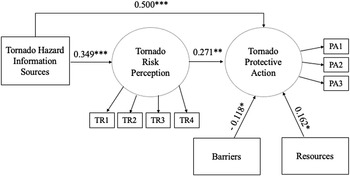
SEM was employed to test both the measurement model and the hypothesized structural models. The measurement model was found to exhibit acceptable fit: χ Reference Stough and Mayhorn2 (85) = 185.286, P < 0.001, RMSEA = 0.072, CFI = 0.910, TLI = 0.901, SRMR = 0.075. See Table 2 for the CFA of latent variables for the measurement model. After establishing the measurement model, the hypothesized structural relationships between variables were analyzed and the structural model achieved acceptable fit: χ Reference Stough and Mayhorn2 (135) = 1917.624, P < 0.01, CFI = 0.912, TLI = 0.905, RMSEA = 0.079, SRMR = 0.070. For the relation between tornado hazard warning information and risk perceptions, results found that having access to more tornado warning information was found to increase tornado risk perception among persons with disabilities (β = 0.349, P < 0.001; H1a was confirmed). Multiple sources of tornado warning information were also found to have a significant positive influence on protective behavioral actions (β = 0.500, P < 0.001; H1b was supported) among persons with disabilities.
Confirmatory factor analysis of latent variables for measurement model

N = 209, Model Fit statistics χ2(85) = 185.286, P < 0.001, RMSEA = 0.072, CFI = 0.910, TLI = 0.901, SRMR = 0.075.
For the associations between tornado risk perception and protective behavioral actions, results found that H2a (risk perceptions will be positively related to increased protective behavioral actions) was confirmed. Results also found that tornado risk perception increased protective behavioral actions (β = 0.271, P < 0.01). H2b proposed that tornado risk perception would mediate the relationship between tornado hazard information and protective behavioral actions. H2b was also confirmed when tornado risk perception was found to positively mediate the relationship between tornado hazard information and protective behavioral actions (β = 0.043, P < 0.05 [CI 95%: 0.015, 0.088]) based on the 95% confidence interval from 1000 bootstrapped resamples, and the CIs were found to exclude zero. Reference Preacher and Hayes37 These results indicated that tornado risk perception has a significant mediating effect between the relationship of receiving tornado hazard information and taking protective action.
Finally, this study examined how different situational barriers and resources may impact tornado protective action among persons with disabilities. The study predicted that (H3a) situational barriers would be negatively related to tornado behavioral actions, and (H3b) situational resources would be positively related to tornado behavioral actions among persons with disabilities. Results found that persons with disabilities encountering more situational barriers were inversely related to tornado behavioral actions (β = -0.118, P < 0.05; H3a supported), and persons with disabilities with access to more resources were positively related to protective behavioral actions (β = 0.162, P < 0.05; H3b confirmed). See Table 3 and Figure 1 for regression pathways and estimates of model fit.
Structural model estimates

N = 209, Model Fit statistics: χ2(119) = 1438.879, P < 0.01, CFI = 0.91, TLI = 0.90, RMSEA = 0.08, SRMR = 0.07; *P < 0.05, **P < 0.01, ***P < 0.001.
Diagram of structural model. N = 209, Model Fit statistics: χ2(119) = 1438.879, P < 0.01, CFI = 0.91, TLI = 0.90, RMSEA = 0.08, SRMR = 0.07; *P < 0.05, **P < 0.01, ***P < 0.001.

Limitations
Despite this study’s contributions, there are several limitations and opportunities for future research. First, due to the sample size of participants, this current study was unable to conduct statistical testing of the variables across different subgroups of disability (eg, mobility, cognitive, chronic health). The sample was also primarily white and were young people (ages 18–29) with disabilities. Due to these limitations, it will be important to replicate this work with larger, diverse samples in the future. This study also utilized a survey questionnaire and respondents may have provided socially desirable answers, which may introduce bias that may have affected the survey results. Finally, this study was a cross-sectional survey in design and, therefore, the data cannot make claims of causal order.
Discussion
Focusing on the December 2021 tornado outbreak across portions of the Midwest and Southeast United States, this study surveyed 209 persons with various disability types (eg, mobility, vision, hearing, cognition, mobility, and self-care). The current study’s results indicate several main findings. First, results indicate the likelihood of persons with disabilities taking protective behavioral action was higher for those who received multiple sources of tornado warning information during the December 10–11, 2021, tornado outbreak. As results show, persons with disabilities who received more tornado hazard information via multiple information sources (eg, television, commercial radio, websites, wireless emergency alerts) were found to increase their likelihood of protective behavioral action (eg, seeking confirmation, sheltering safely). These findings are consistent with prior research Reference Lindell and Perry8,Reference Liu, Fraustino and Jin11,Reference Mason, Ellis and Winchester12 that highlight the importance of risk communication and receiving multiple alerts for tornado warnings to initiate protective actions. In addition, this finding further illustrates the need for tornado alert systems and products being fully accessible and to have access to appropriate communication tools, such as a text-to-speech device or a portable speaker that can amplify alerts. Reference Sherman-Morris9,Reference Senkbeil, Griffin and Sherman-Morris38
Second, results found that persons with disabilities who received tornado warning information during the December 10–11, 2021, tornado outbreak from multiple sources increased their perceived risk of the threat for tornadoes and the risks associated with them. Prior research has shown that tornado risk perception is an important factor in determining an individual’s response to tornado warning information and the likelihood of that person taking protective action. Reference Lindell and Perry8,Reference Senkbeil, Scott and Guinazu-Walker19 Furthermore, results found that tornado risk perception served as a mediating role between tornado information and tornado protective actions during the December 10–11, 2021, event for persons with disabilities. These findings support prior research on the mediating role of hazard risk perception in the protective decision-making process Reference Lindell and Perry8,Reference Guo, An and Comes20 and further extend our understanding of the information processing stages among persons with disabilities during hazards.
Finally, as indicated by the SEM results, situational barriers impeded protective action for persons with disabilities, whereas resources in the environment contributed to protective action. Together, these findings highlight a multitude of barriers encountered by persons with disabilities that negatively impacted their ability to seek protection from tornado threats on December 10–11, 2021. Barriers included not having Internet or power to receive alerts; not hearing sirens or alerts, medical, or mobility issues when sheltering; not having physical access to shelter; lack of transportation; and not having assistance to be able to shelter. In addition, this study captured and identified resources for persons with disabilities that were found to contribute to their ability to seek protection. These resources included having access to emergency financial resources, having access to transportation, having family and friends for assistance, having a safe place to go during a tornado, and having confidence in the ability to seek protection. Overall, these findings illustrate that during hazards (eg, tornadoes), the implementation of a protective behavioral response does not solely depend upon a person with a disability’s intention to take protective action, but also on conditions in that person’s physical and social environment. Reference Stough and Mayhorn2,Reference Ton, Gaillard and Adamson34 In other words, there can be situations in which persons with disabilities are able to access warning information and perceive a tornado as a risk and therefore want to seek protective action, but they encounter barriers and/or a lack of resources to get to a safe shelter. Reference Sherman-Morris, Pechacek and Griffin25 Thus, a crucial means for persons with disabilities to reduce their vulnerability during tornadoes is by having access to tornado protective resources such as a safe shelter and/or assistance to get to a safe shelter. In terms of implications, these findings highlight the need for mitigation policies, programs, and services that support equitable access to protection for persons with disabilities during tornado threats.
Conclusions
This study provided several key findings that advance understanding of protective decision-making during tornado hazards among persons with disabilities. By identifying several significant factors that support or prevent protective actions, these findings highlight the need for equitable access for the protection of persons with disabilities during tornado threats. However, throughout the planning and implementation of any policies and practices, persons with disabilities should always be included. The phrase “nothing about us without us” is a slogan that has been used by disability rights activists to ensure that persons with disabilities are actively involved in the design and implementation of policies, programs, and services that affect them, rather than being left out or excluded. Reference Charlton39
Author contributions
All authors contributed to the study conception and design. Material preparation, data collection, and analysis were performed by the listed authors. The first draft of the manuscript was written by the first author, and all authors commented on previous versions of the manuscript. All authors read and approved the final manuscript.
Funding statement
This research is based on work supported by the University of Tennessee Graduate Office, Research Awards Committee.
Competing interests
The authors declare that they have no conflicts of interest.