The library of St. Benedict’s Abbey at Peramiho in the very southwest of Tanzania holds a glossy brochure showing the photograph of a monk in the centre of a group of about fifty to sixty children on the front envelope.Footnote 1 His white habit and complexion, a long white beard, and the height of an older man, as well as his central position in the picture, give him enormous presence among the black children. The monk is Fr. Joseph Damm (1878–1956), “apostle of Ubena, Upangwa, Maguu,” as the book title reveals. Fr. Joseph, who worked as a missionary in Tanzania from 1901 to 1956, is credited with enormous missionary zeal and strength by his biographer, with most outstanding results in conquering large areas of southern Tanzania for Catholicism, and with founding hundreds of schools. The 2003 brochure presents a heroic narrative, with Fr. Joseph at the centre of attention. However, at second glance, another character becomes ever more visible. It is the biographer himself, Fr. Gregory Mwageni, who was baptized by Fr. Joseph and frequently evokes his connections to him.Footnote 2 By the end of the booklet, we know at least as much about the conversion of Fr. Gregory and his subsequent career as we do about the life of Fr. Joseph. Mwageni was the prior of the Benedictine Abbey at Hanga in Ubena and is one of the first African leaders of Catholicism in the area. In the end, Mwageni presents a well-crafted plot of European-African interaction, of a teacher-student relation that resolves in the maturity of the grateful, but self-reliant student and, in a wider sense, in the Africanization of the Benedictine monastic idea.Footnote 3 The entangled biographies of Fr. Gregory and Fr. Joseph are indicative of two narratives that unfold from the study of mission education in the age of imperialism: One tells the story of a complex web connecting teachers, students, missionaries, village elders, and colonial officials in a place that may best be called the mission school;Footnote 4 another recounts European, metropolitan representations of missionary education work, mostly transmitted by the missions themselves for the purpose of fund-raising and recruiting. This article will ask how these stories were entangled and, perhaps more strikingly, where they fell out of touch.
To study the (dis-)entanglement of metropolitan and colonial narratives on mission education, I concentrate on East African mission teachers, their role and agency in founding and developing the early education system of Tanzania, their self-fashioning, and their representation in European missionary media.Footnote 5 I argue that African teachers were the key actors of missionary expansion in the first half of the twentieth century. Missionary narratives seldom give due credit to the vital and self-reliant role of African mission personnel.Footnote 6 Overcoming the bias and the silences of the colonial archive to some extent requires reading the available sources against the grain, often from a variety of different perspectives.Footnote 7 Mission teachers left their traces in government reports, in legal records, and in mission correspondence and propaganda. Taken together, the variety of documents and perspectives renders the colonial gaze on African teachers fractured and decentred—in other words open to study and alternative interpretation.
This article focuses on the teachers and schools of the German Catholic Missionary Benedictines in Tanzania from the 1890s to the 1940s. The mission field extended over the Southern Highlands and the southern coastal zone before 1918, but was reduced to today’s Ruvuma, Mtwara, and Lindi regions thereafter. The Benedictines arrived at the Tanzanian coast in 1887 and followed German military conquest of the East African mainland during the 1890s, erecting mission stations in the southern half of what today is Tanzania.Footnote 8 At the time, the religious layout of the mission field was highly competitive, even belligerent. German Lutherans (the Leipzig Mission in the north, the Bethel Mission on the coast, and the Berlin Mission in the Southern Highlands) and Moravians (lake zone) arrived in Tanzania together with the Benedictines and the German colonial army.Footnote 9 The German empire was able to consolidate colonial rule only after violent conquest and three colonial wars—the so-called “Arab rising” on the Swahili coast in 1888–89, the Hehe War of 1892–96, and the Maji Maji war in 1905–1906 in the south. World War I, with a succession of skirmishes between British and German colonial troops, marauding armies, hunger, and the Spanish flu epidemic—proved yet another profoundly disruptive period.Footnote 10 In 1919, the United Kingdom took over the Tanganyika Territory as a mandate of the League of Nations until independence in 1961.
Other Catholic missions had arrived on Lake Victoria (White Fathers) and on the coast (Holy Ghost Fathers) during the 1860s and 1870s. At about the same time the Anglican London Missionary Society arrived in Ujiji (northwest), the Church Missionary Society at Moshi/Kilimanjaro and the Anglo-Catholic Universities’ Mission to Central Africa (UMCA) established missions along the shores of Lake Nyasa and on the island of Zanzibar. The competition of various Christian missions was mirrored by the simultaneous expansion of Islam along the trade routes and facilitated by the predominantly Muslim African corps of the German colonial army (the Askari).Footnote 11 As the prominent case of the Prophet Kinjikitile Ngawale highlights, local cults could also reach a large regional following during this period. Kinjikitile provided a common religious and political ideology to the Maji Maji fighters.Footnote 12 The fierce competition, in particular among Catholic, Anglican, and Lutheran missions resulted in the massive expansion of mission education and provided the platform for thousands of mission teachers to establish themselves as a new African intellectual class from the 1920s to 1950s.
The decisive turning points of the area’s educational history in the age of imperialism were the arrival of missions in the late nineteenth century, the renewed focus on education after the Maji-Maji War, and the professionalization of colonial educational policy after 1927. By the end of the 1950s and during decolonization, the heyday of mission schools slowly came to an end. The new leader of Tanzania, Julius Karambarage Nyerere, himself a former Catholic mission school student and teacher, offered co-existence to missions and churches, but marked out the postcolonial state’s prerogative in educational matters by exerting control over how schools were run, including the syllabi, and transferring management and ownership of publicly funded schools to the state.Footnote 13
Mission teachers worked and lived within a colonial environment and a changing organisational establishment that they were to some extent part of creating. The social role and the self-representations they were able to carve out corresponded to this changing environment. My argument will therefore develop in four steps. The first two sections discuss the organisational framework of colonial mission teaching; the third examines the social role and agency of mission teachers; the fourth seeks out the traces of self-representation mission teachers left in missionary publications; and the fifth focuses on the representation of mission teachers in European missionary propaganda.
Mission schools in Southern Tanzania: organisation and strategy
The Benedictines started mission work in 1887 with the intention of building central monasteries and local Christian communities around them. Several of these monastic complexes still exist in southern Tanzania, including Peramiho Abbey (established in 1896), Ndanda Abbey (1906), and Hanga Abbey (1957). Mass conversion, however, was brought about in the thousands of outstations and “bush schools” founded after 1900. The Benedictine mission stations had been destroyed twice almost completely, first during the so called “Arab Rising” in 1888–89, and a second time during the Maji Maji War. As a consequence, the Benedictines and other missions concentrated on village schools after 1907, a policy that gained increasing momentum during the 1920s, fuelled by the competition of the various Christian denominations and the policies of British colonial government. A particularly fierce race to found so-called “bush schools” took place in the south of Tanzania, where the main contenders were the Benedictines, the UMCA, and, before 1918, the Berlin Lutheran Mission. The respective traditions speak of a “school war.”Footnote 14 The Benedictine Bishop Thomas Spreiter ordered in 1908: “[A]s Catholic missionaries we are obliged to conquer…. Found schools, no matter if they can’t be visited often enough…. Find good catechists, for they are our main assistants in the fight.”Footnote 15
Missions erected thousands of “bush” and village schools.Footnote 16 “Bush schools” were non-standardized and remote institutions with a clear emphasis on teaching the catechism, reading in Kiswahili—a foreign language to most pupils in the Benedictine mission area, but the general language of instruction in Benedictine schools, plus simple calculation (1 to 100) and writing. The vast majority of East Africans—with the exception of those in the coastal area—spoke local and regional languages. Even Kiswahili-speaking Europeans, therefore, largely relied on interpreters. Catechisms and teaching materials before the 1920s were written in Kiswahili in most cases, translated from European models in collaboration with African mission teachers.Footnote 17 Village schools, in contrast, provided elementary education in Kiswahili in the more formal way the Education Ordinance for Tanganyika Territory of 1927 delineated—a largely secular curriculum, standardized syllabus, text books, and regular supervision by a mission’s education secretary and officials of the district’s education department.Footnote 18
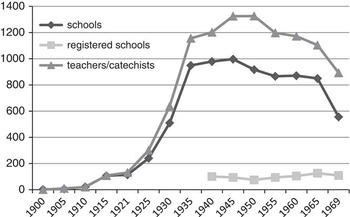
TheFootnote rise of mission schools in Tanzania began slowly before World War I, but rapidly gained momentum in the 1920s and reached its apex in the 1940s. Overseeing the western half of the Benedictine mission, Peramiho Abbey alone employed up to 1,400 teachers (1948) teaching 38,000 pupils in about a thousand schools (fig. 1)—roughly 15 times more than in 1913 when Peramiho had maintained 80 schools and employed 91 teachers for 6,000 pupils.Footnote 20 Of all the schools, about 11 to 20 percent were registered by the government and thereby eligible to receive grants.Footnote 21 The first Peramiho school had been founded in 1898 and the first African teacher employed in 1900. A handful of European missionary teaching staff was supposed to oversee hundreds of schools, each manned with an African teacher and several of them supervised by African head teachers. One of the first Christians of Peramiho, for instance, Kilian (Chibolyile) Luoga bin Namgana, born 1891 and baptized 1901, became the head catechist for the whole schooling area of Peramiho after 1923.Footnote 22
Mission schools and teachers, Peramiho (Abbatia Nullius), 1900–196919

After visiting East Africa in 1912, Benedictine Archabbot Norbert Weber freely admitted that the African missions’ “success would be tiny without the black assistant teachers, as the missionaries themselves could not be everywhere in the wide mission field and the future of mission lay for the greatest part in schooling.”Footnote 23 Nonetheless, the general attitude of European missionaries towards African mission teachers was sceptical, even derogatory; many deemed the expansion of schooling carried out by African teachers as “overly hasty,” though indispensable in the face of competition. Mission leader Bishop Thomas Spreiter announced in 1915: “Most of our catechists lack a religious basis, a sound religious conviction . . . and the inner strength.”Footnote 24 This statement has to be read against the background of a deep-rooted cultural conflict in the southeastern part of the Benedictine mission field, where European Catholic (sexual) morale encountered socio-cultural institutions of the Makua, Mwera, and Yao, such as ritual initiation or traditional marriage. Many of the teachers did not abandon these traditions that missionaries interpreted as abuse, concubinage, or prostitution.Footnote 25 In general, mission teachers were confronted with the institutional racism of mission organisations, which clearly segregated European monastic personnel from African workers and assistants. Often this aligned with cultural prejudice against African lifestyles (marriage, initiation, and child-rearing), which differed greatly from the practice of Central European Catholics and were seen as deficient, scandalous, evil, sometimes even devilish, by many European missionaries during the first half of the twentieth century.Footnote 26 There are, however, exceptions to this generalisation. Individual missionaries saw Africa as a refuge threatened by European liberalism and materialism and developed a profound knowledge of and romantic empathy for African lifestyles.Footnote 27
When choosing teachers, however, the Benedictine emphasis clearly lay on European-centred, Catholic moral standards, rather than sophisticated theology. This was motivated by the perception of African culture as prone to moral instability as much as by the moral crusades lead by the Catholic Church in Europe. Early African mission teachers would be employed if they were deemed devoted to Catholicism and knowledgeable of the catechism, if they were skilled readers and writers in Swahili, and if they were prepared to lead a monogamous Christian marriage, that is, to be guided by “moral education and strength of character.”Footnote 28 The vast majority had been educated, baptized, and trained at Benedictine mission stations. A talent for cultural translation was valuable, since teachers were to transfer religious concepts into the respective vernaculars of their schooling places without distorting what missionaries perceived as the inherent truths. Village teachers like Cassian Homahoma Gama were praised for their ability to provide “practical explanation” for the “truths” of the sacraments. Others, for instance Pauli Meli (ca. 1885–1921), a teacher in Kurasini near Dar es Salaam, translated on a more formal level. He was appreciated by missionaries for his “advice and help” in making “language and style” of the first Swahili catechism and prayer book of the Benedictines “palatable to the simplest people,” as it was “most difficult for Europeans to express religious matters adequately in a language the concepts of which are very foreign.”Footnote 29 The explicit goal of the Benedictine mission in later years was to train “lay helpers for the mission work who later on will be able to supervise the Christians and perform other duties connected with the post of a catechist—or to be in charge of a village school—or both, i.e., being leaders of the Christians and school teachers at the same time.”Footnote 30 In addition, village teachers by the late 1930s were expected to provide inspiration to the “general betterment of the community” by raising not only the standard of education, but also agriculture and hygiene, and to work with other official institutions in this respect.Footnote 31
Colonial education policies and mission schools
Education was a central field of colonial policy and the fact that the overwhelming majority of schools in colonial Tanzania came under the flag of missions provided a continuous source of concern for the German and later the British administrations. Catholic missions, in particular, anxiously but increasingly unsuccessfully defended their independence from government interference. The German government had sought to establish a secular system of primary education throughout the colony with the aim of providing a workforce for plantation and other menial labour as well as a certain amount of intermediate administrative personnel.Footnote 32 This was a major point of contention for Catholic missions who recalled the culture wars of the nineteenth century and saw the debate on the “Konfessionsschule” (schools managed by the church) looming ahead.Footnote 33 British administration pragmatically, not least for financial reasons, relied on the existing mission schools, but exerted increasing control over organisation, syllabi, and teacher qualifications.Footnote 34 The instrument to ensure compliance was financial assistance to professional mission schools.Footnote 35 A major stage in the colonial government’s education policy was the visit and subsequent report by an American think-tank, the Phelps Stokes Fund in 1924. It emphasized the need for a coherent education programme that included and even favoured the mission schools.Footnote 36 The Phelps Stokes Report demanded primary education including vocational training in crafts and agriculture and argued against an allegedly premature introduction of higher education. The British Advisory Committee on Native Education, which drafted the policies of the Colonial Office in London, followed most of these adaptive and racialist lines urging a push for Swahili language instruction rather than English, and putting the emphasis on basic agricultural rather than academic skills.Footnote 37 Government grant programmes, for which mission schools could apply, and requiring a teacher’s diploma, were measures to ensure professionalization. The mission took up this lead and founded teachers’ training centres and employed their own professional staff for supervision after 1927, the year of the Education Ordinance for Tanganyika Territory. European mission teachers (male and female Benedictines) who were employed in secondary education, that is, central schools and teachers’ training centres, had received a British teaching diploma, often at the London Day Training College or in South Africa. African teachers working in primary education were educated in the teachers’ training centres and had to pass standardized examinations administered by the colony’s Education Department. The reports of the Education Department for those schools that received funds from the government’s grants-in-aid scheme after 1927 show that the Benedictine mission education secretary visited village schools two or three times a year. This trend to professionalization certainly included an intensification of control over teachers’ work and brought new expectations for teachers to meet. Government inspection reports reveal, for instance, how much weight British officials put on physical education (football) and instruction in intensive agriculture.Footnote 38
Taken altogether, three conflicting trends are identifiable in the area of study during the first half of the twentieth century: a continuous entanglement of secular and religious functions of mission teachers and schools; a trend towards professionalization of education by government policies without dismantling of mission organisation of schools; and a massive expansion of mission education in both the so-called bush schools and the formal education sector. The following section focuses on the question as to how teachers fared and navigated within this framework.
Mission teachers’ agency and social practice
African teachers fulfilled a variety of social roles within the framework of mission strategies and colonial education policies. Sometimes they expanded this framework.
Spearheads, scouts, and intermediaries
Often teachers spearheaded expansion into new mission areas, since schools increasingly became the footholds for evangelization in Tanzania in the period from 1907 up until the 1930s. Missionaries had always relied on intermediaries—informants, interpreters, caravan leaders, and carriers who forwarded local knowledge on the nature and society of a prospective mission field. Mission teachers, however, increasingly became independent founders of Christian communities. A local school often constituted the nucleus of mission work, so much so that the 1920s and 1930s became known as the era of “kusoma christianity”Footnote 39 —kusoma meaning “to read” in Swahili—and “mwanafunzi” (pupil/student) was used as a synonym for catechumen, that is, aspirants for baptism.Footnote 40 While missionaries had relied on colonial and often simply the “white man’s” authority during German colonialism, the British doctrine of “indirect rule” afforded the consent of the chiefs and of a significant proportion of the population, if permission for a school was to be granted. Attracting a sizable crowd of pupils, gaining the consent of the headmen and chiefs, securing property rights, building permissions, and official recognition as a village school from district offices, the land office, and the education department required a joint effort of African teachers and European missionaries. The Benedictines followed what might be called a “guerrilla tactic” in what they perceived as a “school war.” Mission teachers would go to a community, try to gain support and pupils, erect simple huts, and occupy suitable plots granted by local elites, possibly negotiating bribes. Only later would missionaries seek official permissions and recognition.Footnote 41
The veteran mission teacher Pauli Holola, for instance, was an experienced traveller and most likely skilled in the art accommodating himself to circumstances. Born around 1885 in Mozambique, he and his family had followed their king across the Ruvuma River into German East Africa, where they settled, and Holola came into contact with the Lukuledi mission in 1898. He followed a missionary to Dar es Salaam, where he received training to become a teacher in the Benedictine school at Kurasini. After two years on the coast he returned to Lukuledi. In 1912, he is described as head teacher of a mission school in Lionja with 200 pupils.Footnote 42 Over the years he worked in a dozen schools throughout southern Tanzania. At one point he oversaw thirty-two schools. After three decades as a teacher he acquired a government diploma in 1930. Pauli Holola became the mission’s man for difficult environments. His last know assignment was to prepare the ground for a mission in the Lupaso-Lipumburu area (in today’s Tunduru district). Here, some villages had a considerable number of Christians who received hardly any pastoral care because of the distance to Ndanda, the Benedictine’s regional mission center. Pauli Holola was appointed to found enough schools in the area so as to justify the establishment of a new mission station.Footnote 43 At Lupaso, Pauli Holola seems to have gathered a significant following among his own family and neighbouring clans. Lupaso lay in the centre of a UMCA mission focus and the district officer at Newala only reluctantly granted authorization for a school after having been petitioned in person on several occasions by up to seventy men. A mission station headed by a European missionary was finally erected in 1939.Footnote 44
Once schools were established, teachers stood in the front line of mission work. Teachers (sometimes violently) negotiated attendance of pupils, fended off claims of other mission societies, local religious leaders, Muslim dignitaries, and other spiritual leaders, and they identified potential converts as well as candidates for secondary education and further careers to be sent the mission centres Peramiho, Ndanda, or Kigonsera, where central schools, teacher-training centres, training hospitals for nurses and dressers, and seminaries for priests were located. Interconfessional and ethnocultural conflicts were common, as were disputes with parents about educational matters. Often these conflicts represented a dynamic colonial situation and were instrumental in negotiating social roles for a variety of actors. This is exemplified by an incident in 1912, near Kilimatinde. Benedictines and Lutherans were both pushing into Ugogo, a mission field with a population renowned for their aversion to “cultural accommodation.” The incident was brought before the local military office. Father Joseph Damm and the Catholic teacher Konradi came into conflict with the Wagogo Sultan (mtemi) Kusenta, a Wagogo headman named Mwendi, parents, and a teacher of the Protestant Berlin mission. Father Joseph and Konradi obviously had maltreated parents and Kusenta ordered the school building to be burned down. The sultan had also enraged the mission by announcing that his ten-year-old son would be installed as teacher of a new school, thus making a mission school redundant.Footnote 45 The immediate matter was resolved—after intervention by the district office at Kilimatinde—by Kusenta’s rebuilding the school and Father Joseph and Konradi being replaced by another missionary and teacher. The conflict, however, was far from finished. It comprised at least five parties with conflicting interests, the Wagogo Sultan Kusenta, the Catholic and the Lutheran mission represented by their teachers, both of whom were accused of maltreating parents and pupils on several occasion, the Wagogo parents and elders who hitherto had controlled the education of the young, and the district officers who viewed the work of missions with suspicion when jurisdictional matters were concerned (for example, enforcing attendance at school) and feared upheaval among the colonial population.Footnote 46
Mission school conflicts that were brought to the district offices and so called native administration courts yield some more information about the central role of African teaching staff. Teachers of different Christian denominations, as well as Muslims, often came into conflict with each other, with the village headmen and elders, or with the parents, and struggled and competed for authority (depending on the formations of local actor-networks).Footnote 47 These conflicts were probably not always violent or verbally abusive in outcome, but the ones that were brought before the colonial authorities tell of quite intense and sometimes physical arguments.Footnote 48 Some of the conflicts may have had their cause in cultural divergence of teachers and communities, as when teachers from the matrilineal contexts of the Lindi area were sent to Ungoni, Uhehe, or Ubena.Footnote 49 Conflicts were often attributed to the disruptive effect of missions on local communities,Footnote 50 but this interpretation rests on a reification of “traditional society” in the vein of colonial policies of indirect rule. It negates the colonial situation, in which “native authorities” played their own distinctive role and competed with an emerging intellectual class.
Brokers of African Christian faith
Being educated in schools was an idea largely unknown in most parts of southern Tanzania when the Benedictines arrived. However, some people who had previous experience with mission schooling like Mputa Gama—later to become king (nkosi) of the Ngoni people—welcomed missionary initiatives, anticipating some of the changes brought about by German conquest.Footnote 51 Education itself—quite naturally—was not unknown to East African society before missionaries arrived. All ethnic groups had varying ways of educating the young in social behaviour, in crafts, in the arts of warfare and hunting, in agriculture and household practices, in religious ritual and belief. As a result, school teachers found themselves in competition with other forms of education and socialisation. In 1908, for instance, the mission teacher Innocent Hatia triggered a process that nearly brought about the complete failure of Catholic mission in the Ndanda area. He informed the Ndanda missionaries about the local rite of initiation, called Unyago. Before that, missionaries had regarded Unyago as a harmless ritual, to be overcome by patient pastoral work. Innocent Hatia’s account made Unyago look different in the eyes of the missionaries. It became a “devilish practice” that mainly focused on the sex education of adolescent girls and boys. The reaction was panicked. The Ndanda fathers tried to suppress the practice immediately and completely. This drove the local population from the mission altogether or into secrecy. The broker of the secret of Unyago not only was a mission teacher, but also a son of chief Hatia IV, the leader (mwenye) of the people (Makua and Mwera) around Ndanda. Innocent Hatia did not break with his community or his family, and succeeded his father as a chief in later years, while remaining a pillar of Catholic faith throughout his life.Footnote 52 Teachers were go-betweens that not only worked for the evangelisation of Africa, but also towards the Africanization of Christianity.Footnote 53 They tried to educate the hierarchically superior European missionaries with respect to local traditions and culture, if only to explain the difficulties and conflicts that arose in their profession. Thirty years after the initial clash of cultures and the period of suppression that followed, the mission decided to negotiate a Christian counterpart to the traditional Unyago practices, which was supervised by veteran teachers of the mission. The teachers were selected by a newly founded lay organisation, the Catholic Action, presided over by Innocent Hatia.
The liminal position of teachers will have afforded creativity in the reading of the catechism and adaptability to circumstances. However, not a lot is known about teachers’ own individual readings of Catholicism. An instance reported by a missionary in 1935 gives an impression of how teachers adapted Catholic imaginaries and African ritual without seeking official recognition.Footnote 54 According to Fr. Heribert, mission teachers among the Matengo routinely presided over the “heathen” burial celebration involving sacrifice to spirits, dances, and feasting. The burials were enriched by stage drama that had God sitting on a throne above sending the able dancers to heaven and the poor performers to hell. As rumours had it, the play was created by a former student of Peramiho Central School. The father’s account voices fears that god might be ridiculed by this folkloric rendering of Judgement Day. One may, however, read the practice as the teachers’ creative and necessary adaptation of Catholicism in an environment where they competed for spiritual leadership with a number of other claimants.
Wartime leaders and defenders of the church
Cassian Homahoma Gama (ca. 1890–1963) was one of very few Africans who received the papal order pro ecclesiae et pontifice in the early twentieth century. The aftermath of World War I put a spotlight on catechists and teachers like Cassian Homahoma. They took charge of the missions and parishes after Europeans left the field (fleeing or being sent into detention). While Europeans—in the vanity of their supposed mastery—interpreted the actions of teacher and catechists as loyalty and devotion either to Christianity or to particular missionaries, one may well read them as attempts to secure valued cultural identifications, esteem, and positions within the local society that originated from the mission work.
In Manda-Ngawi, a village on the eastern shore of Lake Nyasa/Malawi, a teacher named Cassian (“a glorious, but humble man”) gave regular religious lessons to 40 adult men and 126 women, and seemingly assembled a large share of the village folk for prayer every morning and evening before World War I. According to a visiting missionary, his self-assured teaching style was the key to success: “First, religious education. Teacher Kassian teaches the catechism very nicely. He addresses the questions even to the older students. Most give apt answers, even though the sacrament lessons are not really easy. One notices the good memory of the negro children. The understanding of the truths is induced by the practical explanations, that Kassian knows how to provide.”Footnote 55 Other subjects taught were reading, writing, maths, singing, and physical education, all in Kiswahili, a new language for almost all the pupils in many regions (Wananyasa being the mother tongue in this particular area). Eight years later, Cassian Homahoma had obviously become the leader of the Catholic Church on the eastern shore of Lake Nyasa and also held shauri (negotiations and trials), “much like an Akida’s” which was “common knowledge on the lake shore.”Footnote 56 In the missionary journals, he is praised for his “leadership as the first catechist” of the region, for “having kept the small flock of Christians together and even increased it” and for having “kept the spirit of Christianity alive and fended off the incursions of Protestant sects.” Cassian Homahoma preached and baptized the sick and the children; he checked plundering; he motivated the re-erection of the church of Lituhi, which was burnt down twice during the war; and he won a lawsuit filed against him by a Anglican priest before the military administration.Footnote 57 He lead the mission station “just like a priest,” as the station’s chronicle stated.Footnote 58 World War I brought terrible hardship, hunger, and epidemic disease to East Africa. German missionaries were deported and replaced by only two French “White Fathers” who administered to the whole Peramiho mission field. War also increased the visibility of certain charismatic African mission leaders whose work would have gone unnoticed in Europe otherwise.
Teachers’ self-fashioning in a new field
To a large extent, becoming a school teacher must have been a daunting enterprise in the early periods of mission work in Tanzania, and an experiment in carving out and occupying a viable social role under fluid and challenging circumstances. At later stages and certainly during the booming years of mission education it will have provided the option of a promising career, while from the 1950s and 1960s a state school career may have been the more attractive alternative.Footnote 59 Role models for school teachers were hardly available at the beginning, since missionaries demanded ostentatious distance from traditional education, but also denied African mission teachers the status and the insignia of the European missionary. Before this background, the question as to how mission teachers represented themselves seems pressing , however rarely these representations are documented. The few texts that are available have undergone editing and translation by European missionaries. Still, they reveal some of the aspirations and strategies of self-fashioning that mission teachers employed.
Spiritual leaders
The accounts of the work of Innocent Hatia, Pauli Holola, or Cassian Homahoma have already indicated that many teachers transgressed from the educational to the spiritual field. The Benedictine mission encouraged this, even though they did not acknowledge the full extent of teacher’s evangelical and pastoral work. Teachers were seldom only secular educators, but taught the catechism, presided over the Sunday prayer, prepared children for baptism, administered this sacrament in cases of urgency, and buried the dead.Footnote 60 The teacher Pauli Holola, who over three decades had many different teaching posts in the Benedictine mission field, established very clearly that he had baptised many dozens through the years in an autobiography in 1935, and when and where he had done so.Footnote 61 In his account, Pauli Holola voiced his early call to priesthood and a monastic life that had been discouraged by missionaries at the time. Only then did he marry and continue his career as a teacher. Teachers not only performed rituals in the absence of a priest, but they also reigned over the sacred places. If a village had no church, the school room contained simple altars that were intended for the mass of the visiting father, but also enhanced the sacral aura of the educational space, as did the large wooden crosses and bell towers that the missions erected at the schools.Footnote 62 In the 1930s, schools often had small chapels added to the main building. On feast days, teachers would wear long white tunics (kanzu), much like a Benedictine monk’s tropical habit (except the white hood, the red girdle at the waist, and the pith helmet) but also that of the Muslim mwalimu (teacher). By the end of the 1920s, however, certified (cheti) teachers would sport civil attire, ironed trousers, shirts, even pith helmets.
Many a teacher would not be seen in public without counting the beads of his rosary, a gesture that clearly illustrated the theological difference between the Benedictines and their rival Anglican and Protestant rivals. The conflicts of Catholic teachers with their Anglican or Lutheran counterparts indicate strong identification with the respective denomination. In 1920, the teachers of Lituhi on the western shore of Lake Nyasa/ Malawi urgently demanded that a priest cater for their spiritual and ritual needs. They had been four years without a priest, due to the war, and emphasized that already fifty Christians had died without the last sacrament having been administered on them. In particular, they hinted at “the Protestants who rejoiced in seeing that we have no Catholic priest”; “they only become nervous when a priest visits to hear our confessions, but show relief when he leaves again.”Footnote 63
Becoming part of the Catholic community
From an early stage, mission teachers reached out to the missionary media channels both in Tanzania and in Germany, and positioned themselves as part of the regional, even transregional, Catholic mission community. In 1910, Antonin Hasani of Ilonga Mission in Ukaguru (central Tanzania) reported in the Benedictine Swahili journal Rafiki [friend]:Footnote 64
The teachers of Ilonga dwell far from the mission, two days, even 3 days. They dwell to teach the people, well! These teachers and the people who can read are very happy to hear of the Rafiki and all have paid the 36 HellerFootnote 65 for a year’s subscription. We have decided to send our news, every man according to his number, to see them printed in the Rafiki. Today I begin, Antonin Hasani. I am the teacher of Unone. . . . Since I came here, it is four years. Especially at the beginning many people were stubborn (in respect to religion). I heard much evil talking of witchcraft and they complained about me. But through the grace of god they have learnt better, and those, who have been baptized first, have received the first Holy Communion these days. They have received understanding. They know more to read and write than others who are proud to keep their (heathen) freedom.Footnote 66
Antonin Hasani represents himself and his fellow teachers as orthodox and devout Catholics. He emphasizes the success of his evangelical work in addition to the secular faculties of reading and writing. He voices his aspiration to be part of a transregional Catholic community, while drawing a clear line between teachers and local superstition and paganism.
Asymmetrically entangled biographies
In 1914 the Benedictine mission journal in Germany reprinted a translation of a three-page letter to the editor of Rafiki. The author, Mwalimu Petri of Mgegera, relates his memories of the late Fr. Maurus Hartmann, who had died in 1905. Much as in Fr. Gregory Mwageni’s 2003 biography of Fr. Joseph Damm, the story is one of asymmetrically entangled lives. Petri narrates a teacher-student relationship and the text is to some extent the self-representation of the author, rather than merely an account of Fr. Maurus’ last days. While the text was edited by several hands and translated into German, the mental map and the aspiration to become part of a transregional network are still evident. While recounting the departure of Fr. Maurus, Petri touches on his own role as teacher of a school of thirty pupils, one of eleven schools governed by Madibira mission station. At the end of the letter he wishes to see his account in print in Rafiki, but also to have it sent to Europe: “Send the message to Europe as you promised, and back quickly. Do not be angry, I only beg: I want the message to return (printed in Rafiki) in the months October, November, or December. When the Whites read the message, they will be happy and thank me. They may pray for me, their companion in faith, that I may grow in my love for God. Him I will thank by leading a good life.”Footnote 67 Teachers presented their life stories with frequent reference to particular missionaries whose arrivals, actions, withdrawals, and deaths worked as markers of temporal or autobiographical change and as a means of reconnection to the imagined reader, just as the reference to external historical events does in other life stories.
Petri’s narrative of Fr. Maurus’ death may be read as a tactical move to advance his own career in the mission. Veteran teacher Pauli Holola’s autobiographical piece, however, displays a more holistic, retrospect take. He included critical periods in his life and career as a teacher-evangelist, also times of withdrawal and exhaustion. He is self-critical, but always emphasizes his own initiative—in relation to family, clan, and European missionaries. Even the grave disappointment that he felt, when his call to monastic vows were disregarded in 1905, is presented openly in the narrative: “I felt deep pain in my heart. And then I let go of my desire to become a brother. I had not approached the abbot directly. This was my fault.”Footnote 68
Pauli Holola, Cassian Homahoma, and Innocent Hatia may have been exceptions in their long-standing, intense engagement. Others will have had a more instrumental, tactical relation to the profession. Victor, the teacher at a village school in Ubena, freely admitted that he exercised a profession to earn a living and to gather the bridewealth for his marriage. According to his narration, he jumped at the opportunity in order to escape the patronage of the family by being able to provide the money for the bride himself without “lifelong repayments and debt.” By no means did he intend to break with his origins, but sought to return as a self-reliant man and head of his own family. Still, he presented himself to his interviewer, Fr. Meinulf Küsters, as a good Catholic fearing purgatory worst of all.Footnote 69
Metropolitan Representations
The self-representations of African mission teachers may or may not have been lost on a European audience. Still, they were disseminated widely—the Benedictine mission journal had just under 180,000 subscribers at the beginning of World War I—and narratives of “noble converts” such as Pauli Holola were increasingly popular in the journal after 1900 and evoked empathetic reactions of European Catholics.Footnote 70 Teachers’ stories, however, were framed in a way that makes it seem rather unlikely that a European audience would have perceived them as self-reliant mission actors.
Not surprisingly, the portrayal of the relationship of European missionaries and teacher-catechists was deeply tinged in the master narrative of European colonialism, the civilizing mission: African teachers were presented as objects of missionary work rather than as evangelists or as professional educators themselves. They were examples of a mission’s success in the field and the augury of a more extensive conversion of the African population. A book that reported Archabbot Norbert Weber’s visitation of the East African mission to a German audience presented about a dozen teachers along the way, each with a photograph and a few tropes. Of the teacher Petri Mkakosia, who taught in village school near Lukuledi, he wrote: “If we think of the blacks as children, with all the good and bad traits, Petri is a child in the best sense of the word, humble, diligent, true; besides that an extraordinary marksman.” Pauli Holola and his colleague Sales, who taught at the court of Chabruma, a notorious Ngoni leader, at the time were characterized as “quite brave people who take their religion and task seriously.”Footnote 71
Trustworthiness and steadfastness in faith were characteristics that became even more pronounced during and after World War I. The interim leaders of the local parishes like Cassian Homahoma, Hildebrand of Madibira, or Innocent Hatia were now portrayed more extensively in missionary media. Their role in retaining the mission was acknowledged to a certain extent, even put under the spotlight. The portrayal of independent agency on behalf of the mission was, however, reined in by the interpretation of their motives: the teachers were devoted to Catholicism, to the mission, even to individual missionaries—thereby agency became transformed into an effect of the institutional success, or the individual personality of a European missionary. Missions’ media work over the decades produced its own genre rules and teachers featured as stock characters in the narratives that connected field work and European audiences. In 1938, for instance, the Swiss filial of the Missionary Benedictines called for short, lively articles for the yearbook and gave directions about what they expected: “Of the teachers. My black teacher; a pillar to the mission in his village (in other places there will be problems).”Footnote 72
Conclusion
Mission historiography, contemporary missionaries, and colonial administrators all have emphasized the deficits of early mission teaching and African teachers in Tanganyika. Secular European educational institutions, schedules, and knowledge system have invariably provided the background for criticism. The reasons given for the defects were lack of European teaching staff for supervision, premature extension of the educational system due to competition among denominations, and a lack of training, of will, of talent, or of moral stability on the part of African mission teachers. In the one extensive study of early Catholic mission education in Tanzania, teachers and catechists are hardly mentioned at all, or in a negative manner.Footnote 73 Later mission historians have acknowledged the importance of catechists and teachers for the mission. However, the narratives speak of their dedication and devotion to the mission, the strength of their faith, or the vital role in assisting the “actual” missionary, which is invariably European in the era under study here.
Reading missionary publications against the grain enables us to put together the bits and pieces of information on individual teachers that are in the text despite the genre rules of mission propaganda. This reading needs to look out for the cracks in the brittle surface of the missionary narrative. And it must re-examine missionary anxieties about African mission activists, namely as the manifestation of the latter’s’ self-reliant agency. Adding the reconstruction of social practices from mission and government archives, and a discussion of teachers’ self-fashioning—however rudimentary the documentation—produces a somewhat different story. Admittedly, teachers were bothered by economic need and political insecurity, also by their liminal position of go-between of European colonial and African societies. They lacked traditional role models, since the missions demanded distance to allegedly pagan ritual and lifestyle. They were stopped in their career paths by the obvious colour bar of the Benedictine mission organisation, which closed the paths to priesthood and monastic vows until the 1940s and 1950s. Surely, they were confronted with hidden, everyday forms of cultural racism typical of the “civiliser” who needed to keep the evolué (as the local elites in the French colonies were termed) at bay;Footnote 74 all the more so, “in real life” mission teachers carried out an essential share of mission work, leading the vanguard into new territories, negotiating schools as footholds of mission work in the twentieth century with local elites, and securing the existence of a school by fighting claims of competing missions and religious authorities.
World War I put the spotlight on certain charismatic figures who lead parishes when German missionaries left the country for several years and were replaced by only a handful of priests from other European nations. The period from 1925 to 1960 may be seen as the heyday of mission education. Fuelled by the competition of Catholics, Anglicans, and Lutherans, and the cooperation policy of British administration in Tanganyika, missions engaged in a scramble for schools, occupying territory in quite an aggressive spirit. This competitive quest to close the mission frontier gave thousands of mission teachers manoeuvring space to carve out a place in the rapidly changing society of late colonial East Africa and to give faith and the Bible their own reading along the way to an African Christianity. Taken together, they constituted an intellectual class in the making that would become even more central to East African history than teachers were in nineteenth- and twentieth-century European history, where they competed with other bourgeois and better educated classes.Footnote 75
Some outstanding mission teachers were portrayed in European missionary propaganda quite extensively; others were at least mentioned in passing in descriptions of the mission work. These narratives, however, were framed in such a way that a European reader without much experience of mission work would hardly have been able to spot the vital and self-reliant role of these actors. To the contrary, teachers were presented as passive examples of successful missionary evangelism. Fr. Gregory Mwageni’s account of Fr. Joseph’s work as a missionary and educator mentioned at the beginning of this article reverses this tendency, employing the biographical text to criticise European missionaries’ attitude to African religious self-reliance. Toward the end of the booklet, Mwageni reminisces about a dream he had in 1957, in which the late Fr. Joseph entered the dormitory of the black monks because he preferred the company of Africans to his European colleagues. In the dream Fr. Josef had black, shining feet and Mwageni recalls King Solomon’s words: “I am black but nice, oh, Daughters of Jerusalem!”.Footnote 76