Introduction
In most developing countries, particularly among the poorest and most vulnerable sections of the population, child malnutrition remains a widespread problem. The problem is commonly the result of a combination of inadequate intake of nutrients and infection, which weakens the body's ability to absorb or assimilate food (O'Donnell et al., Reference O'Donell, Doorsslaer, Wagstaff and Lindelow2008). Anthropometric indicators, which measure health and nutritional status, have also shown that these countries suffer from poor child health status. However, according to Smith & Haddad (2000), the causes of malnutrition are much more complex and inter-related than just lack of sufficient food. These causes range from national factors such as political instability to those as specific as diarrhoeal disease. The solutions proposed are also diverse and wide-ranging. As a result, there is a debate among policymakers and researchers on which of the many causes of malnutrition are the most important, and which areas of intervention will be most successful in alleviating the problem.
The adverse economic and social consequences of malnutrition and poor child health have been explained by a number of studies. For instance, Aturupane et al. (Reference Aturupane, Deolalikar and Gunewardena2008) argue that malnutrition during infancy and childhood substantially raises vulnerability to infection and disease, increases the risk of premature death and weakens cognitive ability while decreasing labour productivity during adulthood. As a result, improving the health and nutritional status of children is among the central objectives of most developing countries. Similar to other developing countries, the prevalence rate of child mortality and malnutrition is very high in Ethiopia. One in every thirteen Ethiopian children dies before turning one year old, while one in every eight does not survive to their fifth birthday. The level of malnutrition is large with nearly one in two (47%) under-five children being stunted (short for their age), 11% being wasted (thin for their height) and 38% being underweight (Central Statistical Agency & ORC Macro, 2006). Despite an improvement in underweight rates (33%), recent data confirm that the number of children suffering from stunting (51%) and wasting (12%) have slightly increased (see UNICEF, 2011).
Reducing child malnutrition and improving child health status, through appropriate interventions, requires better understanding of the main socioeconomic determinants. To this end, a large number of empirical studies have examined a range of socioeconomic factors. Despite methodological divergence, in numerous country-specific studies, the major determinants of child health and nutrition include household income, parental health, maternal health care and nutrition knowledge and maternal education (Sahn & Alderman, Reference Sahn and Alderman1997; Kebede, Reference Kebede2005; Block, Reference Block2007; Burchi, Reference Burchi2010). However, in many empirical studies two major shortcomings have been observed. First, less attention has been paid to the endogeneity problem. For instance, due to the presence of an omitted variable and measurement error, maternal schooling as well as mother's health and nutrition knowledge are likely to be endogenous. Second, the studies focused on estimating the mean effect of socioeconomic factors. However, since socioeconomic variables and policy interventions may influence child health and nutrition differently at different points of the conditional health and nutritional distribution, the mean estimate may mask differential effects of some socioeconomic variables. In this study, these problems are addressed through employing instrumental variable (IV) and quantile regression (QR) methods.
The main objective of this study is to examine the role of maternal characteristics in the health and nutritional status of under-five children in Ethiopia, using height-for-age (HAZ) and weight-for-height (WHZ) Z-scores. The Z-scores measure long-term and short-term or current child health and nutritional status.
Background
A growing amount of empirical evidence shows that there are various socioeconomic determinants of child health and nutritional status. Depending upon the nature of the data set, the literature varies in methodology as well as in choice of variables. In the cross-sectional data set, a large number of studies have been carried out using ordinary least squares (OLS) and/or instrumental variable (IV) regression (Hazarika, Reference Hazarika2000; David et al., Reference David, Moncada and Ordonez2004; Christiansen & Alderman, Reference Christiansen and Alderman2004), and others have employed binary models (Pal, Reference Pal1999; Girma & Genebo, Reference Girma and Genebo2002; Silva, Reference Silva2005). The methodologies of the former studies and other similar studies are criticized for focusing only on estimating the mean effect of covariates on the response variable, while critics of the binary model approach point out the potential loss of information during the transformation of the continuous regressand into a binary variable.
The foremost shortcoming of the mean estimate is that it may mask the impact of some socioeconomic factors on child health and nutrition. The estimations fail to show whether the effect is the same for all children. For instance, if policymakers are interested in improving the health of the least-healthy children, but the effect is more pronounced in the upper tail of the distribution, then an intervention on child health and nutrition programmes based on the mean effect may overstate the effect of such an intervention. The quantile regression (QR) approach can be employed to mitigate the drawbacks of the mean effect estimates (see Borooah, Reference Borooah2005; Aturupane et al., Reference Aturupane, Deolalikar and Gunewardena2008; Burchi, Reference Burchi2010).
Looking at empirical evidence in Ethiopia, Almedom (Reference Almedom1991) analysed the inter-relationships between feeding, health and growth of infants employing mixed longitudinal data. In the study, among others, it is found that the timing of weaning is not influenced by culturally prescribed norms. Girma & Genebo (Reference Girma and Genebo2002) explored determinants of nutritional status of children using 2000 Demographic and Health Survey data. They found that education of parents and mother's access to health services play a considerable role in child nutrition. Using the same data set, Silva (Reference Silva2005) found that mother's height, household wealth and mother's education are crucial determinants of child malnutrition. The impact of mother's education, however, on reducing the probability that a child is malnourished is found to be relatively small. In another study, Kebede (Reference Kebede2005) demonstrated the correlation between child health and parental health. The correlation, however, is found to be strongly influenced by genetic endowments. A study by Christiansen & Alderman (Reference Christiansen and Alderman2004) also revealed that household resources, parental education and food prices are essential determinants of malnutrition. These empirical studies are also criticized either for their exclusive concern for the mean effect estimate or for being less focused on the endogeneity issue. The present study, thus, aims to bridge this gap by employing quantile regression and instrumental variable methods.
Methods
The study employs the 2005 Ethiopian Demographic and Health Survey (EDHS) data set. It is the second comprehensive survey conducted in the country as part of the worldwide Demographic and Health Surveys (DHS) project, which is carried out by the Central Statistical Agency (CSA) of Ethiopia and ORC Macro. It is a nationally representative survey of 14,070 women with ages ranging from 15 to 49 and 6033 men with ages from 15 to 59 across all eleven geographic (administrative) areas (nine regions and two city administrations) of the country. Moreover, anthropometrical outcomes of mothers and children under five years of age are also collected. During the survey, 5280 under-five children were identified in the households. Nevertheless, 5% of children had missing information on height or weight, 8% had height or weight out of the range of their ages, and around 1% had incomplete age information. After cleaning the data to remove children with missing values and outliers the sample is narrowed down to 3873 children.
Estimation strategy
The basic framework to examine determinants of child health is that of Grossman's (Reference Grossman1972) economic model. Based on the human capital theory of Becker (Reference Becker1965), Grossman formulated the model as individuals producing health using both medical care and their time. Individuals are assumed to continue investing in health production until the marginal cost of health production equals the marginal benefits of improved health status. This health status is assumed to affect utility directly by increasing labour income and indirectly by improving health status (Gerdtham et al., Reference Gerdtham, Johannesson, Lundberg and Isacson1999).
Following Grossman's (Reference Grossman1972) theoretical framework, a number of empirical studies have modelled anthropometric outcomes as a function of child, parent and environmental characteristics. These determinants have been examined either by estimating a health production function, which represents the technology available to the household to transform inputs into health, or using a reduced-form demand equation. Estimating the production function requires detailed information on inputs into the production process and identifying a range of instruments for endogenous variables in the equation, if there are any. As a result, a large number of empirical studies, including the present study, have chosen to estimate a reduced-form child health function (Thomas et al., Reference Thomas, Strauss and Henriques1991; Handa, Reference Handa1999).
The theoretical framework underlying the empirical analysis of the present study builds on previous models suggested mainly by Glewwe (1991), Thomas et al. (Reference Thomas, Strauss and Henriques1991) and Medrano et al. (Reference Medrano, Rodríguez and Villa2008). In these models, the household preference is characterized by a utility function, which depends on consumption of market-purchased goods and home-produced goods such as child health and leisure. The household faces a budget constraint, a time constraint and a health production function. The last constraint depends on market-purchased nutritional inputs and health services, health endowment of the child and household and environmental characteristics.
A large number of studies have revealed the positive impact of maternal schooling on child health and nutrition. Nevertheless, Thomas et al. (Reference Thomas, Strauss and Henriques1991), Glewwe (Reference Glewwe1999), Handa (Reference Handa1999), Block (Reference Block2007) and many others treated schooling as exogenous, while in some studies, such as Medrano et al. (Reference Medrano, Rodríguez and Villa2008), it was determined endogenously. The justification for the latter study rests on the assumption that potential omitted variable bias exists. The authors argue that schooling can be directly correlated with an unobserved maternal health status, which in turn affects child health. In this case, the least-squares estimate of the schooling effect is expected to be biased upwards since schooling captures both its effect and the effect of other factors such as unobserved maternal health status, which are correlated with mother's schooling but not included in the estimation. In this study, however, this problem is mitigated by controlling both long-term and current mother's health status. The proposed solution, though, is not enough to solve the endogeneity problem. This is because other omitted variable biases, such as time preference, could lead the least-squares estimate to be biased upward (Doyle et al., Reference Doyle, Harmon and Walker2005). Put differently, although maternal schooling is expected to improve the status of child health and nutrition, schooling is endogenous if unobserved characteristics of mothers such as time preference are correlated with both maternal schooling and the child's health and nutritional status. Hence, the instrumental variable approach is called for to correct the endogeneity problem.
The OLS model is used as a benchmark for the 2SLS and QR models. Based on a reduced child health production function, the model used for estimation is specified in a linear form as follows:
 $$H_i=\gamma_0 + \gamma_1 X_i + \gamma_2 {\rm MS}_i + v_i$$
The dependent variable (Hi) in the above equation refers to the health and nutritional status of child i, which is measured by the anthropometric outcomes of HAZ and WHZ scores. The HAZ score is the difference (expressed in standard deviations) of a child's height-for-age from the median height of children of the same age and sex of the USA reference population as recommended by the World Health Organization (WHO). The WHZ score is the difference of a child's weight-for-height from the median weight of children of the same age and sex of the reference population (WHO, 1995). As pointed out by Almedom (Reference Almedom1991) the reader should note that assessing growth performance by using the USA reference population is inappropriate because the data are drawn from predominantly formula-fed (modified non-human milk) infants whose growth performance is different from breast-fed infants. Although employing international reference data is inappropriate, researchers often lack alternatives. In Ethiopia, Almedom (Reference Almedom1991) used Ethiopian data as the reference for anthropometric/growth performance. This should be encouraged and the building up of a local database in the country is to be commended.
The variable Xi stands for a vector of child, maternal (excluding MSi), household and environmental exogenous characteristics for individual i. The term MSi is mother's schooling for mother i, and υi is a random error term. The error term is assumed to be identically and independently distributed (iid) and contains the unobserved health endowment effect (εi) of child i. The OLS estimation of the model offers the effects of anticipated change in maternal characteristics and other exogenous factors on the conditional mean of child health and nutrition. Nevertheless, as noted earlier, the potential problem of the OLS estimation is that MSi may be endogenous to the model. Failure to account this endogeneity problem, if there is any, leads to a biased coefficient estimate of the parameters.
Description and summary of variables
In order to control for heterogeneity at the individual level, child and parental characteristics are controlled. At the child level, variables such as age, multiple of birth and sex of child are included. With regard to parental characteristics, all potential variables that influence child health and nutrition are included in the model. In this case, mother's age, health and nutrition status, level of education and employment status are controlled. Mother's long-term and current health status are captured by HAZ score and body mass index (BMI), respectively. Silva (Reference Silva2005) suggested that mother's height can proxy child genetic endowment, and hence a tall mother is likely to give birth to a tall child (Burchi, Reference Burchi2010). Controlling mother's HAZ in the model enables this genetic effect to be captured and it may also reduce the bias created by correlation of unobserved child health endowment with observed variables (Glewee, Reference Glewwe1999). Moreover, mother's and partner's year of schooling are also controlled in the model. As in other empirical studies in developing countries, partner's schooling is treated as exogenous to the model. In a country such as Ethiopia where the role of child caring is almost entirely on the shoulder of mothers, partner's schooling is less likely to be influenced by child caring. Finally, employment status of mothers is included, and a value of 1 is given if a mother was employed at the time of the survey or before the last 12 months of the survey.
At the household level, variables such as wealth index, sex of the household head, birth order and size of the household are included in the model. Birth order is controlled so that mother's age effect reflects mainly child caring experience. In the 2005 EDHS, no income or expenditure data were collected and hence the wealth index is employed to represent permanent household income. Some religions and cultural practices may adversely affect or enhance child health and nutrition (Chiswick & Mirtcheva, Reference Chiswick and Mircheva2010). In order to capture these effects, religion and ethnicity dummies are used. Finally, area of residence is captured in the model, and thus a value of 1 is given if a household resides in an urban area.
The average child age in the sample is around 30 months and the majority of children are in the upper age cohort. There is an equal sex representation, and the average Z-scores for HAZ (−1.7) and WAZ (−1.5) are about the prevalence rates of stunting and wasting threshold, which is −2 SD. It is also observed that rural children are more disadvantaged than their urban counterparts. Of the total rural children, 40% and 35% have lower HAZ and lower WAZ scores, respectively, as compared with 3% disadvantaged urban children in both cases. One explanation for this disparity could be better access to, and availability of, health facilities and related infrastructures in the urban areas.
The disaggregation of the sample data by sex shows that boys have lower health and nutritional status than girls. It is also observed that the prevalence rate of stunting is higher than that of wasting, but both rates decline considerably across the wealth quintile. Looking at the maternal characteristics, average mother's age shows that there are many young mothers in the sample. Similar to their children in the sample, the long-term health status of mothers as measured by height-for-age is very low. However, the average BMI score of 20 reveals that their current health status is better. Concerning educational level, average mother's schooling level (1.2 years) is almost half the average level of their partners (2.4 years).
Results
Ordinary least squares results
The OLS is employed as a benchmark for both the IV/2SLS and QR models. Before conducting the estimation, relevant statistical tests such as normality, functional form and hetroskedasticity tests are examined. The HAZ and WHZ models reflect the long- and short-term (current) health and nutritional status of children, respectively. The OLS result shows that child and maternal characteristics are crucial determinants of child health and nutritional status in both models.
In the two models, i.e. the HAZ and WHZ, relative to the base category (age less than 6 months), all child age cohorts are found to be significant. However, the decline in the magnitude in the latter model shows that a child in a higher age cohort has lower health and nutritional status than a child in the base cohort. One explanation for this could be that as children grow older they are more exposed to poor health and lack of nutrition because of weaning and less access to breast milk (Kabubo-Mariara et al., Reference Kabubo-Mariara, Ndenge and Mwabu2008).
Controlling other factors, boys are found to have lower health and nutritional status than girls. On average, the HAZ and WHZ scores for boys are found to be lower by 0.15 and 0.08 standard deviations, respectively. Moreover, twins have lower long- and short-term health and nutritional status than singletons. In conformity with Kabubo-Mariara et al. (Reference Kabubo-Mariara, Ndenge and Mwabu2008), a possible interpretation of this finding could be the fact that twins, on average, have a lower birth weight. Moreover, insufficient breast-feeding and competition for nutritional intake might affect children of multiple births more than singletons.
As expected, a strong association between maternal characteristics and child health and nutritional status is observed. The OLS result also indicates that long-term maternal health status, measured by mother's HAZ score, has a larger impact on long-term and current child health and nutritional status. However, short-term (current) mother's health status, measured by BMI, considerably affects only short-term child health and nutritional status. The former result demonstrates the presence of a genetic effect and the influence of family background characteristics on child health and nutrition (Silva, Reference Silva2005). In both models, the results suggest that children with employed mothers are worse off in terms of health and nutritional status. This result points out a trade-off between earning income and child caring. However, since around 86% of mothers are either employed by family members or self-employed and 52% of them are unpaid workers, the result could be explained more by factors other than this trade-off.
Moreover, mother's schooling is found to be significant in both models (although at 10% in the HAZ model). It is expected that mother's education is likely to improve health and nutritional status of children through better use of health facilities and better child care practices. It is noted that an additional year of schooling increases the current health and nutrition status of children by about 0.04 deviations. One striking finding from this estimation, however, is that the sign of mother's age is found to be negative in both models. This result contradicts the argument that mature and older mothers are better at child care than younger mothers. The OLS regression results reveal that maternal characteristics play a significant role in child health and nutritional status. However, the estimation and analysis are employed based on the assumption that all the independent variables are exogenous. As noted earlier, maternal schooling is suspected to be endogenous to the model, and with the aim of handling this issue the analysis is extended by employing the instrumental variable approach, which is commonly applied to address the endogeneity problem.
Instrumental variable results
As discussed earlier, omitted variables and measurement error are possible reasons for mother's schooling being endogenous in the model. This problem can be handled using external instruments, and these are good if they are correlated with mother's schooling and are orthogonal to the unobservable error term. Empirical studies on returns to schooling employ family background such as parental education to instrument education. Recently, attention has shifted in favour of using institutional features of the education system (Lemke & Rischall, Reference Lemke and Rischall2003). These authors used quarter of birth, college proximity and parental education as instruments for education to estimate returns to schooling. In other empirical studies, supply-side variations such as minimum school leaving age, tuition costs and schooling reform have also been used to instrument education (see Card, Reference Card2001). In the area of child health and nutrition, Medrano et al. (Reference Medrano, Rodríguez and Villa2008) used exposure to mass media to instrument parental education, while Doyle et al. (Reference Doyle, Harmon and Walker2005) employed minimum school leaving age.
Finding excluded instruments
In the EDHS data set, the common variables used to instrument education such as parental education, birth order or distance to school are not available. For this reason, in the present study it is opted to instrument mother's schooling by education reform and abduction (forced marriage).
The first instrument used in the study is education policy reform. Previously, Amharic (the official language) was used as the medium of instruction in all primary schools throughout the country. In 1994, with the aim of facilitating expansion of primary school participation in the country, the government introduced mother tongue language as a medium of instruction (Ministry of Education, 2002; World Bank, 2005). In general, this policy reform has increased school enrolment rate and hence the instrument is expected to be correlated with maternal schooling. The instrument is constructed such that the value of 1 is given if the mother has lived more than 19 years in the same area and if she was of primary school age (7–15) in 1994. The second instrument used in the present study is abduction, i.e. forced marriage. Admassie (Reference Admassie2002) argues that early marriage, religion and fear of abduction are among the most important factors for low school enrolments and high school-drop-out rates for girls in rural Ethiopia. Similarly, as shown in the World Bank (2005) research, the possibility of abduction for unwanted marriage in rural Ethiopia is among the factors that reduce school registration rate. In the 2005 EDHS sample, around 8% of mothers (12% in the present study sample) were married by abduction. Marriage by abduction is a traditional practice that still exists in Ethiopia. Therefore, schooling is also instrumented using abduction and a dummy variable is used for mothers who are married without abduction.
Test of instrumental variables
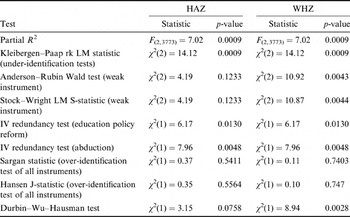
The relevance and validity of the two instruments are examined using formal statistical tests. Correlation of the instruments with the endogenous regressor is investigated in the first stage of 2SLS and the result reveals that the excluded instruments are strongly significant (not reported). However, the explanatory power (partial R 2) of the two instruments for mother's schooling is found to be below (F=7.02) the rule-of-thumb threshold of Staiger & Stock (Reference Staiger and Stock1997), which is F-statistics-10 (see Table 1). In the presence of weak instruments, IV/2SLS estimators cannot be an improvement over OLS in terms of bias (Nichols, Reference Nichols2007).
Tests on instrumental variables

As can be seen from Table 1, the statistical tests suggest the validity of the instruments, and mother's schooling is confirmed to be endogenous to the models. Both the Sargan and Hansen J-tests failed to reject the null hypothesis that the instrumental variables are uncorrelated with the error term in the structural equation. Further, the Durbin-Wu-Hausman test rejects the null hypothesis of exogeneity of mother's schooling but it is marginally significant in the HAZ model. The Durbin-Wu-Hausman test explores the null hypothesis that mother's schooling is exogenous by checking for a statistically significant difference between the OLS and 2SLS estimates of the schooling coefficient (see Staiger & Stock, Reference Staiger and Stock1997).
The under-identification test of the Kleibergen–Paap test shows that the models are correctly identified. However, even if we reject the null of under-identification a weak instrument problem can exist if any of the instruments is found to be uncorrelated with mother's schooling.
Despite the lower first-stage F-test result (=7.02), the Anderson–Rubin Wald test and the Stock–Wright LM test reject their null hypothesis and conclude that the instruments are not weak in the WHZ model. However, both tests fail to reject their null hypothesis in the HAZ model. In the presence of redundant instruments, the large-sample efficiency of the estimation is not improved. Since a large number of instruments can cause the estimator to have poor finite sample performance, dropping redundant instruments may lead to more reliable estimation (Baum et al., Reference Baum, Schaffer and Stillman2007). As indicated in Table 1, in both models, the IV redundancy test suggests that the instruments are not redundant.
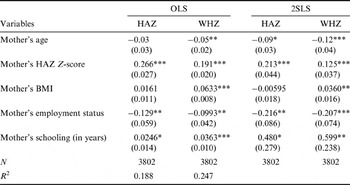
Therefore, based on the statistical test results, the 2SLS is preferred over OLS regression, particularly in the WHZ model. However, the bias and size distortions of 2SLS estimates relative to OLS need to be examined. As can be seen from Table 2, the results of 2SLS reveal that the effects of maternal characteristics on current and long-term child health and nutrition are found to be significant. In the 2SLS estimation, the magnitude of the coefficient of mother's schooling is found to be much larger than the OLS results. An additional year of mother's schooling is found to improve long-term child health and nutrition by 48%, which is much higher than the OLS result. Similarly, current child health and nutrition is improved by 60% due to one more year of mother's schooling. This demonstrates that the OLS results are downward biased around 45 and 56 percentage points in the HAZ and WHZ models, respectively, compared with the 2SLS results.
Results of OLS and 2SLS regression on selected variables

Standard errors are given in parentheses.
Significance levels: *1%, **5% ***10%.
Although the magnitude of the bias is large its direction is in line with a number of studies that suggest that OLS is biased downwards due to measurement error in schooling. However, Card (Reference Card2001) argued that in a situation where the reliability of self-reported schooling is about 85–90%, the downward bias is expected to be 10–15%. Since Ethiopia is a developing country, self-reported data collection in the EDHS might affect the reliability of schooling. In this regard, the coefficient of schooling in the IV estimates is expected to be much bigger than in the OLS estimates.
In addition to measurement error, the larger IV estimates can be attributed to heterogeneity in marginal returns to schooling or differences in marginal cost of schooling. For instance, the response of individuals to education policy reform may be heterogeneous. As a result, the new policy is more likely to be an incentive to increase school enrolment for some individuals than in others. The marginal effect of education for these individuals could be very high and it may be reflected in the IV estimates (Card, Reference Card2001; Ahmed & Iqbal, Reference Ahmed and Iqbal2007). The difference between IV and OLS estimates is also justified by the argument that the instrumental variable affects schooling only at the lower end of the schooling distribution, i.e. a local average treatment effect interpretation of IV estimates. In this regard, the IV is measuring the returns to education for those individuals who change educational attainment based on their marginal cost (see Fersterer & Winter-Ebmer, Reference Fersterer and Winter-Ebmer2003).
At this point it is worth discussing the bias that arises from 2SLS estimator relative to the OLS estimator. Since weak instruments lead to biased IV estimators and affect hypothesis tests with large size distortions, it is imperative to examine the extent of the problem in the spirit of Stock & Yogo (Reference Stock, Yogo, Andrews and Stock2005). It is observed that the 2SLS bias relative to OLS might be less than 15%, while the size of the Wald tests on mother's schooling that the present study specifies as 5% could be around 25% (not reported).
In the HAZ model, the presence of weak instruments can produce large bias and distortions. Therefore, finding better excluded instruments or transforming the existing instruments could be a solution. However, in the sample, both options are less likely to be feasible. Another option is to estimate the model using a continuously updated generalized method of moments (CUE) or limited information maximum likelihood (LIML). In the presence of weak instruments, both estimators perform better than two-step GMM and IV estimators (see Nichols, Reference Nichols2007; Baum et al., Reference Baum, Schaffer and Stillman2007). Moreover Angrist & Pischke (Reference Angrist and Pischke2009) suggest that LIML is less biased than 2SLS. However, the estimation results based on LIML are almost consistent with the 2SLS results (not reported).
Quantile regression results
The previous analysis has relied on the mean effect estimation. In these estimations, some important correlates of child health and nutrition at different points of the HAZ and WHZ distributions could be masked. This problem can be handled by employing quantile regression (QR). The QR offers the opportunity to examine the size of the coefficients of parameters over the entire conditional distribution as well as to test whether the size differs in the estimated coefficients between different quantiles. Moreover, in a country where child health and nutrition problems are severe, assessing the impact of maternal characteristics on the low tail of the health and nutritional status has much more policy relevance than the mean effect. The following section further analyses the health and nutritional status of children employing the QR method.
Koenker & Basset (Reference Koenker and Bassett1978) have introduced the quantile regression model by extending the concept of ordinary quantile in a location model to a more general class of linear models. The theoretical underpinning of QR regression is employed following Cameron & Trivedi (Reference Cameron and Trivedi2009) as well as Imbens & Wooldridge (Reference Imbens and Wooldridge2007).
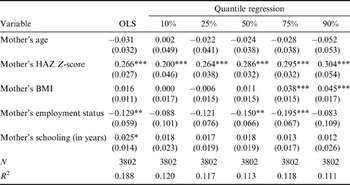
Table 3 displays the standard QR estimation results of the HAZ model. Similar to the OLS estimation, mother's schooling is treated as exogenous. In the HAZ model, it turns out that mother's long-term health status significantly matters for long-term child health and nutrition at all estimated quantiles. As noted already, this close association could be attributed to the considerable role of genetics and family background. It can be observed that the result is consistent with the OLS result and the magnitude of the estimated coefficients increase across quantile. For instance, at the upper quantile the effect increases (30%) compared with the lower quantile (20%). However, the differences between the estimated coefficients across quantiles need to be confirmed using formal tests. In doing so, equality of estimated coefficients is assessed employing both graphical inspection and formal tests at the end of this section.
Results of OLS and QR estimates for HAZ model on selected variables

Robust and bootstrap standard errors are given in parentheses.
Significance levels: *1%, **5% ***10%.
It is also noted that mother's age and mother's schooling are insignificant at all estimated quantiles. This finding is nearly consistent with the OLS estimation result, which reveals a less-significant average impact of mother's schooling (significant at 10%) and insignificant role of mother's age. A notable result in the study is that, contrary to the OLS result, current mother's health status (BMI) markedly affects long-term child health and nutrition at the upper quantile distribution (75th and 90th). This entails that OLS estimation masked the role of current mother's health on child health and nutrition, which might mislead policy intervention. Table 3 also shows that, at the median and upper quantile distribution (75th), a child with an employed mother is worse off in terms of long-term health and nutrition.
Looking at the QR estimation results of the WHZ model, nearly all the maternal characteristics are observed to influence current child health and nutrition (not reported). Similar to the HAZ model, long-term mother's health status affects current child health and nutrition at all estimated quantiles. However, the magnitudes of the estimated coefficients are slightly lower than the result found in the HAZ model. Unlike the results obtained in the long-term child health and nutrition status (HAZ model) estimation, mother's age, current health and schooling are found to be significant in the WHZ model.
In sum, maternal characteristics are found to play a crucial role in child health and nutrition. The impact, however, varies between long-term and current child health and nutritional status. Before leaving this section, equality of coefficients on mother's health and mother's schooling variables will be examined further. The QR result shows that these variables significantly influence child health and nutritional status. The results, however, need to be confirmed using equality of coefficient tests as well as graphical inspection to assess the extent of the effect across quantiles.
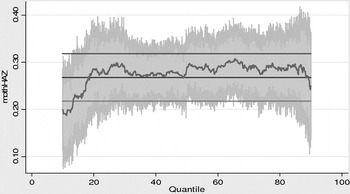
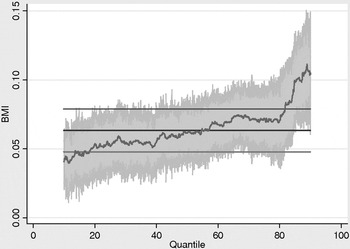
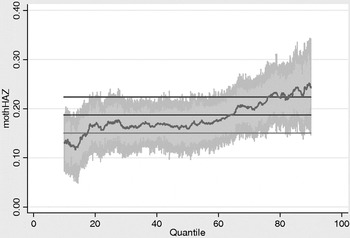
As can be seen from Fig. 1, the slopes of the estimated coefficients of the mother's HAZ variable at different quantiles do not deviate markedly from the OLS estimates. The pair and joint equality test of coefficients reports similar results (not shown). Looking at mother's health indicators in the WHZ model, as reported in Figs 2 and 3, the slopes of estimated coefficients at different quantiles are seen to be deviating from the OLS estimate, which is an indication of parameter heterogeneity across quantiles. Therefore, the impacts of the two variables on child health and nutritional status across quantiles are diverse. The pair and joint equality test of coefficients also confirm the graphical result.
QR and OLS coefficients and confidence intervals for mother's HAZ as quantile varies from 10% to 90% in the HAZ model.

QR and OLS coefficients and confidence intervals for mother's BMI as quantile varies from 10% to 90% in the WHZ model.

QR and OLS coefficients and confidence intervals for mother's HAZ as quantile varies from 10% to 90% in the WHZ model.

In all of the estimates, child health and nutritional status is found to worsen as the age of the child increases. This is in conformity with other empirical studies such as Girma & Genebo (Reference Girma and Genebo2002) and Sahn & Stifel (Reference Sahn and Stifel2002). These authors argue that stunting is a cumulative effect over a period of several bouts of insufficient nutrients or illness, which lead to a continued deterioration in growth relative to age. With regard to sex difference, the results suggest that boys have lower health and nutritional status than girls. This is consistent with previous empirical findings reported in the literature. For instance, Christiansen & Alderman (Reference Christiansen and Alderman2004) found that malnutrition among boys is consistently greater than in girls among Ethiopian children. Kebede (Reference Kebede2005) also demonstrated a similar result for Ethiopian children and he suggested that the faster growth of females in earlier life could be an explanation for the difference. Similarly, Sahn & Stifel (Reference Sahn and Stifel2002), using 25 Demographic and Health Surveys (DHS) from fourteen African countries, found that girls have higher height-for-age Z-scores than boys. The authors proposed three possible reasons for the difference: first, that there is some problem in sex-specific standard in African society; and second, that girls are genetically more robust than boys; and finally, that there is greater investment in young girls than boys.
In the estimations, among maternal characteristics, the impacts of mother's employment status and schooling on health and nutrition are found to differ between boys and girls. One reason for the schooling effect could be sex preference by parents. In an empirical study of fourteen African countries, Sahn & Stifel (Reference Sahn and Stifel2002) argued that mothers prefer investing in girls than in boys. Using household data from the USA, Brazil and Ghana, Thomas (Reference Thomas1994) also found that parents invest different amounts of resources in the human capital of their children. Mothers allocate more resources to their daughters, while fathers do so to their sons. In this regard, girls are likely to benefit from the positive schooling outcomes of their mothers.
Finally, child health and nutritional status is on average likely to decrease with mother's age. This is an unexpected result and also inconsistent with previous empirical studies in the area. For instance, Kabubu-Mariara et al. (Reference Kabubo-Mariara, Ndenge and Mwabu2008) and Burchi (Reference Burchi2010) found that nutritional status improves with the age of mothers among Kenyan and Indonesian children, respectively. The unexpected result is investigated further, following Sahn & Stifel (Reference Sahn and Stifel2002), by controlling birth order so that the age effect only represents experience in child caring (nurturing) but the basic results do not change significantly. Thus, difference in media exposure among women could explain the unexpected result. In the survey, because of their relative higher level of education, young women under 25 years of age are found to be more exposed to mass media than older women. This access to information could enhance child caring and nurturing knowledge among young mothers. Moreover, although information on family background is not available in the sample data, given the Ethiopian way of life the potential support of grandparents in child caring for young mothers could also explain the result.
Conclusions
The government of Ethiopia has made great strides in improving the health and nutritional status of under-five children over the past two decades. However, performance measured by some indicators shows that several challenges remain to be addressed. The prevalence rates of child mortality and level of malnutrition are still high. A better understanding of the main socioeconomic determinants of child health and nutrition is imperative to address these problems.
In the present study, an attempt is made to explore the role of maternal characteristics in the health and nutritional status of under-five children using the 2005 EDHS data. The study has shown that maternal characteristics, notably long-term maternal health status, are crucial determinants of child health and nutritional status. Long-term maternal health status captures genetic and family background impact. Therefore, the findings presented in this study point to the conclusion that the government of Ethiopia needs to give a higher priority to ensure better health and nutrition status of girls oven their life cycle, so that child health and nutrition can be improved. Another possible intervention area to improve child health and nutrition could be promoting health and nutrition education.
There are, however, some caveats in this study. First, the anthropometric measurements of children in the Ethiopian DHS are compared with an international reference population, rather than Ethiopian reference data, which would better reflect local infant feeding and weaning practices and growth patterns. In future research in Ethiopia, the use of Ethiopian reference data for anthropometric/growth performance should be encouraged. Second, although the 2005 EDHS data set is employed, due to lack of exclusion, the sample selection problem is not treated. In addition, though largely consistent with other empirical studies in the area, the policy implications of this study are drawn based on the estimated coefficients. Therefore, with the availability of a large sample, the most interesting avenue for further research would seem to be employing policy simulation to examine the potential impact of policy variables.
Acknowledgments
The author is grateful to Michael Chebud for his support in improving the paper. He would like to thank Professor Astier M. Almedom for her assistance in giving access part of her DPhil thesis. He also thanks the Editor and anonymous reviewers of the Journal of Biosocial Science for their invaluable comments and suggestions. The usual disclaimer applies.