Introduction
In Florida strawberry [Fragaria×ananassa (Weston) Duchesne ex Rozier (pro sp.) [chiloensis×virginiana]] production, broad-spectrum PRE herbicides applied under plastic mulch are desirable for reducing the need for in-season weed control measures. Fomesafen, a diphenylether herbicide, inhibits the protoporphyrinogen oxidase (Protox) enzyme that catalyzes the conversion of protoporphyrinogen IX to protoporphyrin IX as part of the tetrapyrrole biosynthesis pathway (Duke et al. Reference Duke, Lydon, Becerril, Sherman, Lehnen and Matsumoto1991; Scalla and Matringe Reference Scalla and Matringe1994). Tetrapyrroles, such as heme and chlorophyll, serve as cofactors in many essential enzymatic and signaling processes in plants, including light harvesting, nitrogen fixation, oxygen transport, respiration or phosphorylation, and quenching of free radicals (Beale and Weinstein Reference Beale and Weinstein1990; Grimm Reference Grimm1999). PRE application of fomesafen has become an important component of broadleaf weed control programs in agronomic crops due to the rapid expansion in the southern United States of weeds resistant to herbicides with other mechanisms of action (Shaner Reference Shaner2014; Sosnoskie et al. Reference Sosnoskie, Kichler, Wallace and Culpepper2011). Fomesafen has the potential to be used as an alternative mechanism of action for broadleaf and nutsedges (Cyperus spp.) control in Florida plasticulture production (Miller and Dittmar Reference Miller and Dittmar2014; Monday et al. Reference Monday, Foshee, Blythe, Wehtje and Gilliam2015). However, fomesafen may persist in the production system for the entire production cycle. This may dissuade producers from using the herbicide to avoid limitations on crop rotations for fear of carryover injury.
Fomesafen can degrade rapidly under anaerobic, low-redox potential, and sunlight conditions (Shaner Reference Shaner2014). Li (Reference Li2014) reported that lab-incubated fomesafen had minimal degradation by soil microorganisms, and biological degradation is unlikely to be a major pathway for fomesafen dissipation under aerobic conditions in the field. Fomesafen open-field half-life varies substantially with different soil types and conditions. For example, fomesafen half-life was 28 to 66 d following applications of 0.18 kg ai ha−1 alone or 0.09 followed by 0.18 kg ha−1 with residue still detectable 350 d after treatment (DAT) in a Madalin silty clay loam (fine, illitic, mesic Mollic Endoaqualfs) (Rauch et al. Reference Rauch, Bellinder, Brainard, Lane and Thies2007). Mueller et al. (Reference Mueller, Boswell, Mueller and Steckel2014) reported that fomesafen half-life over 3 experimental years on a loam soil averaged 46 d. Li (Reference Li2014) reported that the half-life of fomesafen at 0.28 and 0.56 kg ha−1 was 6 and 4 d, respectively, for Tifton loamy sand (fine-loamy, kaolinitic, thermic Plinthic Kandiudults), and was not detectable past 28 d.
Soil properties influence pesticide persistence and bioavailability. Fomesafen is a weak acid with increased sorption at low pH. Fomesafen soil bioavailability is affected by pH, with a solubility of 50 mg L−1 at pH 7, less than 1 mg L−1 at pH 1, and a logarithmic acid dissociation constant of 2.7 (Shaner Reference Shaner2014; Weber 1993a, Reference Weber1993b). Weber (Reference Weber1993b) suggested that for weak acids like fomesafen, adsorption occurs by physical force near neutral pH and by hydrophobic bonding or precipitation at low pH. Guo et al. (Reference Guo, Zhu, Shi and Sun2003) reported that organic matter and pH were significantly correlated to fomesafen adsorption. Rauch et al. (Reference Rauch, Bellinder, Brainard, Lane and Thies2007) observed greater fomesafen carry-over injury when sweet corn (Zea mays L.) was grown in areas with higher organic matter and lower pH. Weber (Reference Weber1993b) reported that fomesafen exhibited higher mobility in the soil with greatest sand content when irrigated.
Florida small fruit and vegetable crops are generally grown on sandy soils with low organic matter content, which may favor fomesafen soil mobility. However, Florida producers apply PRE herbicides on top of a formed bed after fumigation and before laying plastic mulch. The use of plastic mulch may increase fomesafen persistence. Plastic mulch can influence pesticide persistence by limiting sunlight, reducing leaching from rainfall, and affecting biological activity (Bond and Walker Reference Bond and Walker1989; Jensen et al. Reference Jensen, Kimball and Ricketson1989). Linuron, pendimethalin, chlorobromuron, and flurochoridone dissipation was reduced when applied PRE before laying plastic mulch compared with bare-soil applications (Bond and Walker Reference Bond and Walker1989). The S-metolachlor 50% dissipation time (DT50) increased from 2 to 4 d when soil was covered with plastic mulch compared with bare ground (Grey et al. Reference Grey, Vencill, Mantripagada and Culpepper2007). While such increases are not an immediate concern for production, they do demonstrate that plastic mulch may alter herbicide dissipation dynamics. For fomesafen, plastic mulch may reduce sunlight and rainfall exposure, thus reducing dissipation. Investigation into herbicide dissipation in plasticulture systems is needed to determine best management practices.
Currently, only terbacil, oxyfluorfen, napropamide, and flumioxazin are labeled for PRE residual control in Florida strawberry production (Whitaker et al. Reference Whitaker, Boyd, Peres and Smith2015). These herbicides carry concerns regarding soil persistence and damage to subsequent vegetable crops that are grown using multicropping techniques. Identification of additional safe PRE herbicides that provide weed control during strawberry establishment but do not persist to injure rotational or relay cropping is essential to integrated weed management in strawberry production. Once identified, a registration label could be sought for special local needs under Section 24(c) of the Federal Insecticide, Fungicide, and Rodenticide Act in the United States. The objectives of this research were to evaluate fomesafen crop safety, persistence, and movement in raised beds during Florida strawberry production systems.
Materials and Methods
Field experiments were conducted at the University of Florida Gulf Coast Research and Education Center (GCREC), Balm, FL (27.76°N, 82.23°W), from September 2014 to February 2015 and August 2015 to March 2016, to investigate fomesafen persistence and movement in soil in Florida strawberry production systems. Soil was a Myakka series fine sand (sandy, siliceous, hyperthermic Aeric Alaquods) with 1.5% organic matter, pH of 6.5, and sand, silt, clay content of 96%, 3%, and 1%, respectively.
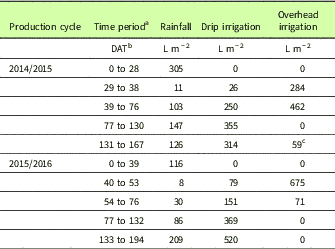
To prepare fields, beds (0.3-m high by 0.7-m wide) were formed on 1.2-m centers, drip tape was laid (0-cm depth), and beds were covered with black plastic mulch. As beds were formed, fumigant was injected 0.3-m deep with a three-shank fumigation rig (Kennco Manufacturing, Ruskin, FL) delivering Telone® C-35 (Dow AgroSciences, Indianapolis, IN) and a combination of 63.4% 1,3-dichlopropene and 34.7% chloropicrin at 336 kg ha−1. Herbicide treatments were applied, and beds were covered with virtually impermeable film (Berry Plastics, Evansville, IN). Treatments included two rates of fomesafen (Reflex® 2L Liquid Herbicide, Syngenta Crop Protection, Greensboro, NC) at 0.42 and 0.84 kg ai ha−1. A nontreated check was included for comparison. Fomesafen at 0.42 kg ha−1 is the registered usage dose for pepper (Capsicum annuum L.) and tomato (Solanum lycopersicum L.) in Florida. Applications were made with a CO2-pressurized backpack sprayer (Bellspray, Opelousa, LA) calibrated to deliver 187 L ha−1 with a single DG 8002EVS flat-fan nozzle (TeeJet®, Spraying Systems, Wheaton, IL) on September 4, 2014, and August 27, 2015, to the top of beds. Fertigation was applied through a single drip tape in the center of the bed with emitters every 0.3 m and a flow rate of 0.95 L min−1 per 30.0 m (Jain Irrigation, Haines City, FL). Rainfall and drip irrigation amounts are listed in Table 1. Rainfall data were acquired from the University of Florida Institute of Food and Agricultural Sciences Florida Automated Weather Network from a weather station located at GCREC (27.75998°N, 82.22410°W). Production and pest management practices were in accordance with industry standards and University of Florida Institute of Food and Agricultural Sciences recommendations (Whitaker et al. Reference Whitaker, Boyd, Peres and Smith2015). Experimental design was a randomized complete block with four replications. Plot size was 6.1 m by 0.7 m contained within a single bed, with 1.5-m buffers between plots.
Rainfall, drip irrigation, and overhead irrigation between soil sampling dates during the strawberry tolerance to fomesafen field experiments for the 2014/2015 and 2015/2016 production cycles in Balm, FL.

a Five time periods for each production cycle follow soil persistence samplings and are: 1) from the day of application to just before strawberry transplanting, 2) from just before transplanting to mid-establishment period (overhead and drip irrigation ongoing), 3) from the mid-establishment period to the end of the establishment period, 4) from the end of the establishment period until the start of harvest, and 5) from the start of harvest until the end of harvest.
b DAT, days after treatment.
c Overhead irrigation used for strawberry freeze protection.
Bare-root transplants of ‘Strawberry Festival’ were planted in two rows per bed with 0.4-m plant spacing within rows on October 9, 2014 (35 DAT), and October 8, 2015 (42 DAT). Transplants received overhead watering during daylight hours for 14 consecutive days after transplanting to aid in establishment. This is standard industry practice to prevent desiccation of transplant leaves, reduce temperature of shoot meristems, and ensure adequate soil moisture levels in the root zone. Strawberry injury ratings were taken at 2, 4, and 8 wk after transplanting and were visually rated on a percent scale where 0 equaled no damage compared with the nontreated and 100 equaled complete desiccation. Strawberry marketable yield was taken biweekly in the 2014/2015 and 2015/2016 production cycles, with berry counts only taken in the 2014/2015 production cycle.
Soil Sampling and Analysis
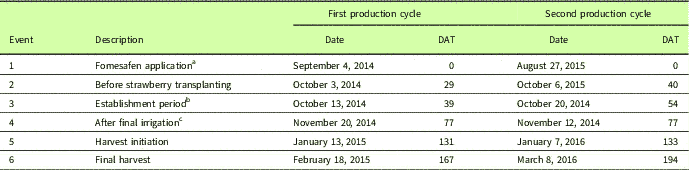
Three 0.3-m soil probe samples were collected in each plot treated with fomesafen at 0.42 kg ha−1 on six sampling dates (Table 2). Soil probe samples were collected in the center of the bed next to the drip tape. The three probe samples were divided into three 0.1-m depth increments of 0.0 to 0.1 m, 0.1 to 0.2 m, and 0.2 to 0.3 m. The soil probe had a 2.0-cm diameter, resulting in each subsample having a volume of 31.4 cm3. For each plot, the three subsamples at each depth were combined into a single sealable plastic bag and mixed to form a single homogeneous sample for analysis. Holes made in the plastic mulch were sealed with tape after sampling. Samples were frozen at −20 C until analysis.
Calendar dates and associated days after treatment (DAT) for soil sampling dates to determine fomesafen dissipation in Florida strawberry plasticulture production in Balm, FL.

a Soil samples were taken immediately following fomesafen application.
b Establishment period refers to the period for strawberry plant establishment after transplanting when both overhead irrigation and drip irrigation are used.
c After final irrigation refers to the day after the overhead irrigation is turned off.
Sample extractions and high-performance liquid chromatography (HPLC) and mass spectrometry analyses were conducted based on protocols for determining residues of fomesafen in soil (Leung Reference Leung1997; Lin Reference Lin2009) and were detailed in Reed et al. (Reference Reed, Boyd, Wilson and Dittmar2018). Extraction was performed on 10 g of air-dried soil sample. Analysis was performed using the Surveyor HPLC System (Thermo Fisher Scientific, Waltham, MA). For mass spectrometry detection, the electrospray ionization source was operated in the negative-ion mode and run with Xcalibur v. 2.0 software (Thermo Fisher Scientific, Waltham, MA). Recoveries from fortified nontreated soil samples indicated that recovery was 85±4%. The limit of detection for fomesafen was approximately 2.5 parts per billion (ppb).
Soil Moisture
Soil moisture samples were taken in the nontreated control plots on the same day as persistence sampling using the same-sized soil probe. Three soil samples were taken at four placements of 0.0, 0.1, 0.2, and 0.3 m from the center of the bed and divided into three subsamples at three depth increments of 0.0 to 0.1 m, 0.1 to 0.2 m, and 0.2 to 0.3 m. Each subsample was weighed and then oven-dried at 60 C for 96 h, and the dry weight was taken to determine gravimetric water content. Soil moisture measurements (FieldScout® TDR 100 Soil Moisture Meter, Spectrum Technologies, Aurora, IL) were taken on the day of treatment, with three measurements taken in each nontreated plot randomly throughout the bed at a 0.2-m depth to determine volumetric water content. Soil bulk density in the bed was 1.51 g cm−3, and water content from day of treatment was converted to gravimetric water content.
Strawberry tolerance data were analyzed in SAS® v. 9.4 (SAS Institute, Cary, NC) using the mixed procedure with block as the random factor. Data were checked for normality and constant variance before analysis. Means were compared using the least-squares means statement in SAS with the Tukey adjustment at P=0.05. Berry yields collected on multiple dates were analyzed using the repeated statement.
Fomesafen concentration data for 0.0- to 0.1-m depth in soil were described with nonlinear regression as performed with SigmaPlot v. 13.0 (Systat Software, San Jose, CA) using a three-parameter logistic function
 $$y{\equals}a\,/\,\left[ {1{\plus}\left( {x\,/\,x_{0} } \right)^{b} } \right]$$
where y is fomesafen concentration; x is days after treatment; a is the initial value of the response variable when x is zero; x 0 is the inflection point where curvature changes direction; and b is the slope of that curve at the inflection point. Water-based erosion tends to demonstrate a logistic-type curve (Ambrosio et al. Reference Ambrosio, Di Gregorio, Gabriele and Gaudio2001), so a simplified equation was selected. The DT50 was calculated by substituting a/2 for y, which equated to 164 and 167 µg kg−1 for the 2014/2015 and 2015/2016 production cycles, respectively, then solving for x.
Results and Discussion
Strawberry Tolerance
Treatment by production cycle interaction was not detected for strawberry weights (P=0.8585), so data for both years were combined for analysis. Harvest date by treatment interactions were not significant, and total yields are presented. Fomesafen did not injure strawberry in either production cycle (unpublished data). Fomesafen did not affect strawberry yield compared with the nontreated check. Strawberry counts in 2014/2015 were similar across treatments (P=0.7257), averaging 589,401±21,511 berries ha−1. Total strawberry yield was similar across treatments (P=0.8155) and averaged 11,894±799 kg ha−1.
Results indicated that fomesafen applied to the bed top at 0.42 and 0.84 kg ha−1 is safe on strawberry plants. Findings are consistent with previous literature. McGuire and Pitts (Reference McGuire and Pitts1991) demonstrated established matted-row strawberry plant tolerance to applications of fomesafen at 0.28 kg ha−1 following bed renovation. The authors found that fomesafen treatments caused foliar injury within 3 d after application with no injury symptoms evident at 21 DAT due to new foliage development and no reduction in yield the following year. Boyd and Reed (Reference Boyd and Reed2016) reported that fomesafen applied PRE to the bed top at 0.42 and 0.84 kg ha−1 did not cause injury or reduce yields of ‘Strawberry Festival’ and ‘WinterStar’ cultivars in the Florida production system. Fomesafen, when applied through drip irrigation at 1, 7, 15, and 30 d before transplanting at 0.42 and 0.84 kg ha−1 and at 7 and 14 d before transplanting at 0.57 kg ha−1 did not reduce Strawberry Festival yields (Boyd and Reed Reference Boyd and Reed2016; Yu and Boyd Reference Yu and Boyd2017).
Broadleaf weeds emerging during crop establishment are problematic in Florida strawberry production, as only clopyralid is registered for use POST (Anonymous Reference Anonymous2011). While clopyralid efficacy on target broadleaves is high (Sharpe et al. Reference Sharpe, Boyd and Dittmar2016), there is limited spray penetration through the strawberry canopy to reach the target weeds emerging from the planting hole, reducing control (Sharpe et al. Reference Sharpe, Boyd, Dittmar, MacDonald, Darnell and Ferrell2018). Results demonstrate that fomesafen is an additional safe PRE herbicide for use in Florida strawberry production. The utility of this herbicide depends on its ability to provide persistent control during crop establishment while not persisting to injure rotational or relay crops.
Fomesafen Persistence and Movement
Herbicide persistence is often modeled using exponential decay functions (Grey et al. Reference Grey, Vencill, Mantripagada and Culpepper2007; Mueller et al. Reference Mueller, Boswell, Mueller and Steckel2014) under the assumption of enzyme-mediated microbial degradation (Herman and Scherer Reference Herman and Scherer2003). This assumption is not valid, as minimal aerobic fomesafen degradation was found in laboratory settings (Li Reference Li2014), and the current data set would not fit an exponential decay function.
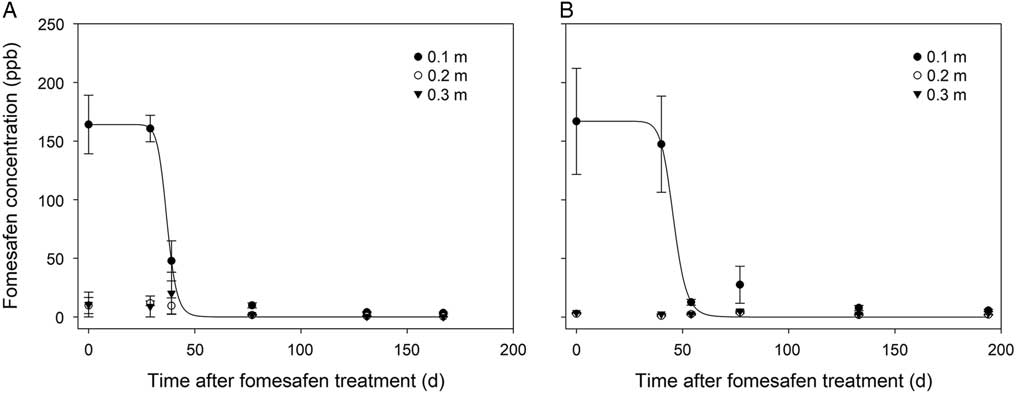
Fomesafen dissipation at 0.0- to 0.1-m depth followed a logistic curve in both production cycles (Figure 1). Fomesafen concentration on the day of application averaged 164 and 167 ppb at 0.0- to 0.1-m depth for the 2014/2015 and 2015/2016 production cycles, respectively (Table 3). Fomesafen concentration decreased at 0.0- to 0.1-m depth after transplanting when overhead and drip irrigation was initiated to aid in establishment. The fomesafen DT50 values were 37 and 47 for the 2014/2015 and 2015/2016 production cycles, respectively (Table 3). Differences between production cycles may be due to the timing of the end of establishment period measurement, which was 7 d later in the 2015/2016 production cycle than in 2014/2015. Increased measurement frequency within the establishment period would likely reveal leaching pattern similarity between years, though further study is required.
Fomesafen concentration at three depths in soil from strawberry plasticulture field experiments for the (A) 2014/2015 and (B) 2015/2016 production cycles at Balm, FL. Error bars represent standard error of the mean. Data described by the three-parameter logistic model and parameter estimates for fomesafen concentrations in soil at the 0.0- to 0.1-m depth are listed in Table 3.

Parameter estimates of fomesafen concentration in soil at 0.0- to 0.1-m depth from within beds for strawberry plasticulture field experiments for the 2014/2015 and 2015/2016 production cycles in Balm, FL.Footnote a

a Three-parameter logistic f(x)=a/[1+(x/x 0) b ] was used for regression, where y is fomesafen concentration; x is days after treatment; a is the initial value of the response variable when x is zero; x 0 is the inflection point where curvature changes direction; and b is the slope of that curve at the inflection point.
b SEM, standard error of the mean.
c DT50, days required for 50% fomesafen dissipation. This was calculated by substituting a/2 for f(x), then solving for x.
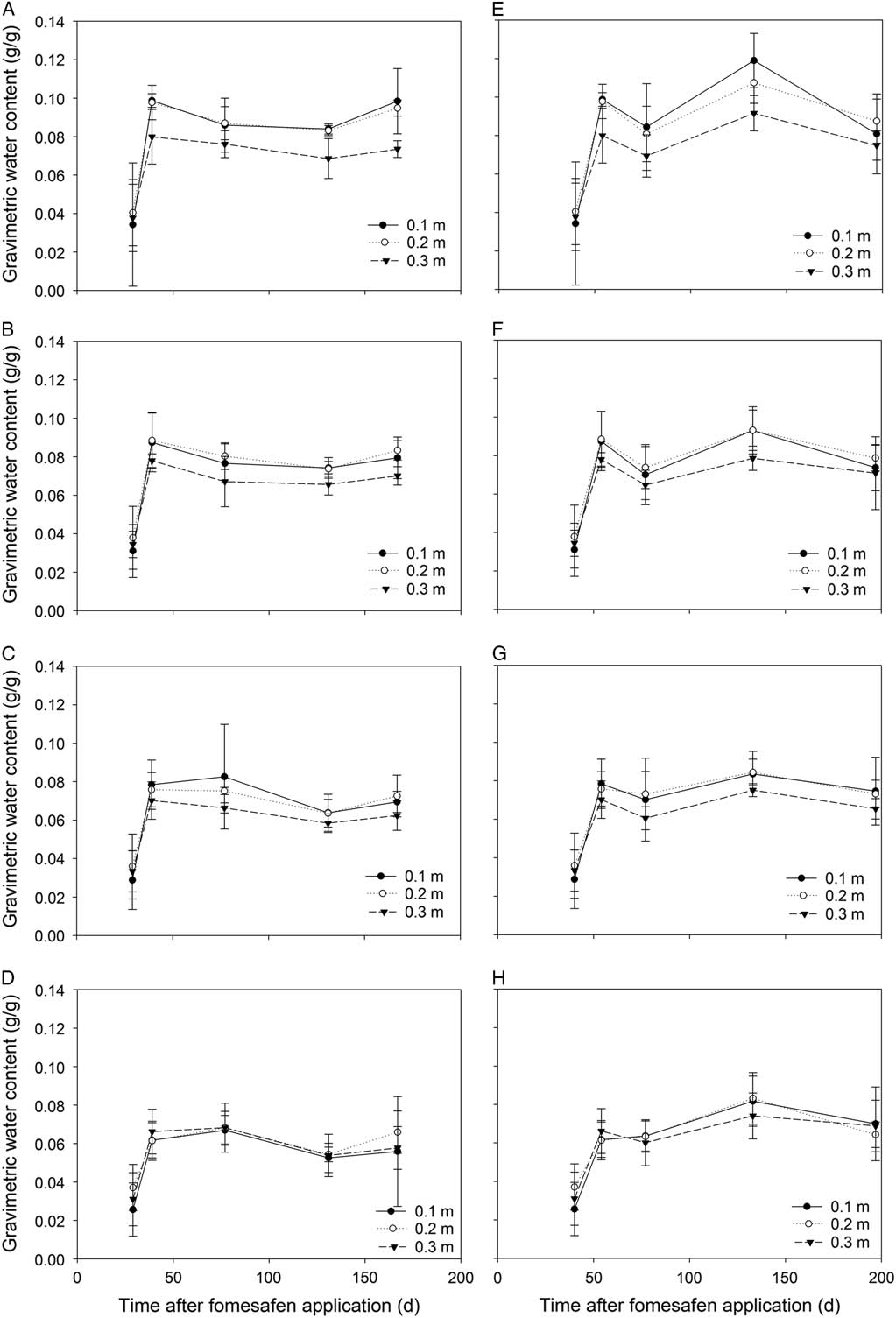
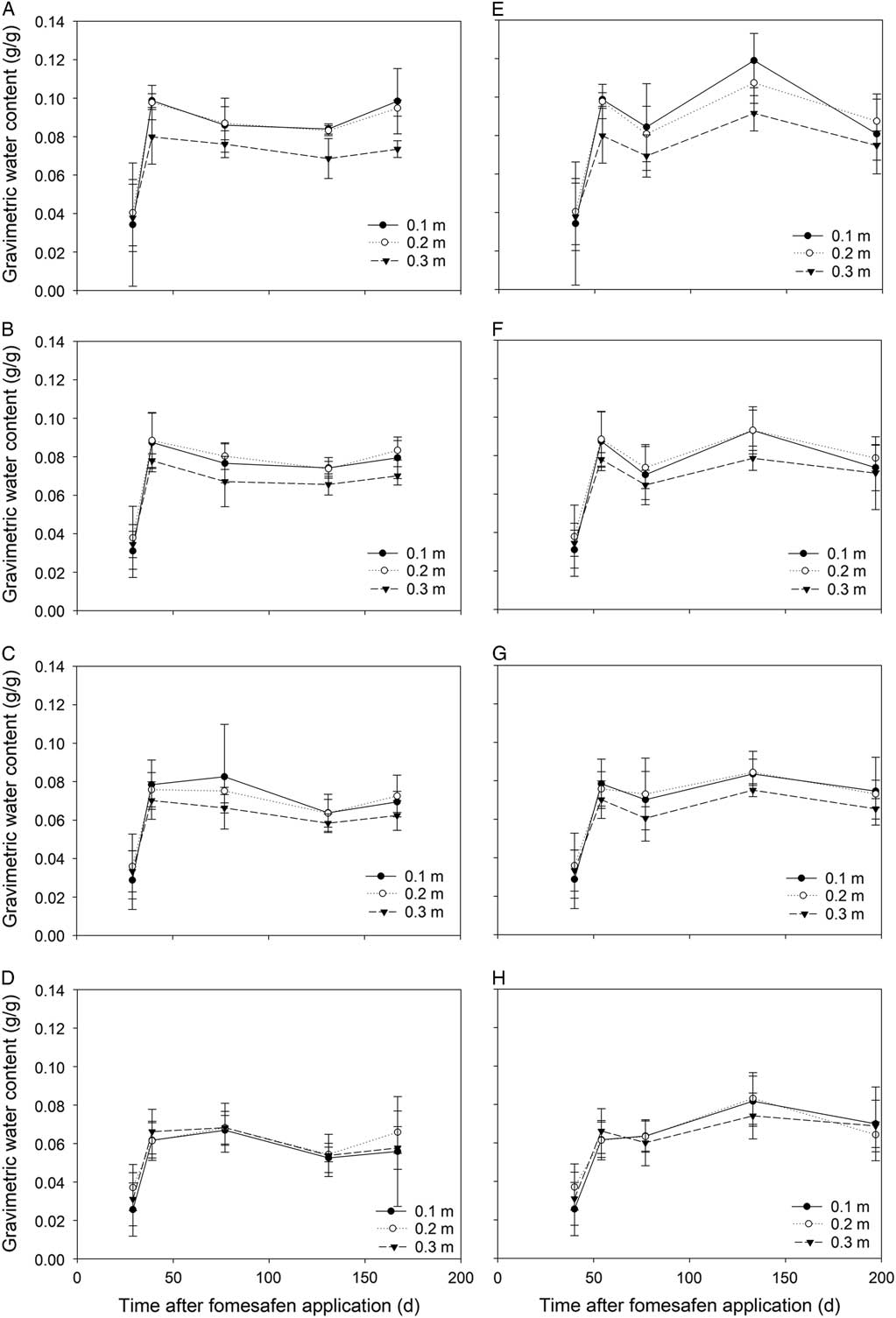
The strawberry establishment period was between 35 and 77 DAT and 42 and 77 DAT for the 2014/2015 and 2015/2016 production cycles, respectively. When the establishment period ended, fomesafen concentration was less than 30 µg kg−1 at the 0.0- to 0.1-cm depth (Figure 1). Approximately 1,000 L m−2 of water was irrigated from before transplanting soil sampling to after establishment (Table 1), and gravimetric water content throughout the bed was at least twice as great at sampling dates with irrigation compared with moisture levels before irrigation (Figure 2). Fomesafen was detected at concentrations less than 10 µg kg−1 in the 0.0- to 0.1-m soil depth at 167 and 194 DAT in the 2014/2015 and 2015/2016 production cycles, respectively. Fomesafen concentration was less than 25 µg kg−1 on any sampling date for 0.1- to 0.2-m and 0.2- to 0.3-m depths.
Gravimetric water content at four sampling distances from the center of the raised strawberry plasticulture bed at five sampling dates within the nontreated control plots for the 2014/2015 and 2015/2016 production cycles at Balm, FL. Gravimetric water content was measured at three depths at each sampling distance (A) 2014/2015: 0.0m; (B) 2014/2015: 0.1m; (C) 2014/2015: 0.2m; (D) 2014/2015: 0.3m; (E) 2015/2016: 0.0 m; (F) 2015/2016: 0.1 m; (G) 2015/2016: 0.2 m; (H) 2015/2016: 0.3 m. Error bars represent 95% confidence interval for the mean.
Volatilization and surface runoff are unlikely dissipation pathways, given the use of plastic mulch and the persistence of fomesafen between the first two dates, with leaching the most probable alternative (Carter Reference Carter2000). The majority of fomesafen may have leached out of the sampling zone during the irrigated establishment period, even though greater herbicide concentrations were not determined at 0.1- to 0.2-m and 0.2- to 0.3-m depths on sampling dates after transplanting. Perhaps the sampling frequency was not adequate to detect fomesafen at greater depths before it moved beyond the sampling zone. Fomesafen potential for leaching in sandy soils has been established (Weber Reference Weber1993b). Deeper dissipation of fomesafen does raise concerns for crops rotated with strawberry, when tillage may bring treated soil closer to the surface.
Soil moisture content can influence herbicide dissipation in the soil. Gravimetric water content at 0.2-m depth on day of application averaged 0.07 for both the 2014/2015 and 2015/2016 production cycles. Gravimetric water content throughout the bed increased after irrigation commenced, with water content the greatest at the center of the bed, where fomesafen concentration samples were taken. Typically, rates of herbicide loss increase with greater moisture (Bond and Walker Reference Bond and Walker1989). However, at the depth sampled, fomesafen concentration observed over time is greater than reported in previous research conducted on sandy soils in open-field production (Li Reference Li2014). Fomesafen dissipation instead was similar to silt- or clay-based soils in open-field production, even with rapid concentration decline after strawberry transplanting (Cobucci et al. Reference Cobucci, Prates, Falcão and Rezende1998; Mueller et al. Reference Mueller, Boswell, Mueller and Steckel2014; Rauch et al. Reference Rauch, Bellinder, Brainard, Lane and Thies2007). Surface runoff may have pooled fomesafen-treated sand to the bed edges, but further research is required. Alternatively, due to the prolonged water inputs from drip and overhead irrigation, anaerobic degradation may be ongoing if the water level exceeds field capacity, as fomesafen is known to degrade more rapidly in anaerobic conditions (<3 wk) compared with aerobic conditions (6 to 12 mo) (Shaner Reference Shaner2014). Further study is required to determine the effect of fumigation on the microbe community, the extent of degradation, and the field capacity of the soils.
Decreased fomesafen dissipation in plasticulture compared with open-field production is consistent with findings by Reed (Reference Reed2017) in a study conducted in vegetables. It appeared that reduced sunlight and rainfall in plasticulture had the greatest influence on increasing fomesafen persistence. In Florida vegetable production, 10% of applied fomesafen persisted to harvest (124 d after application), but no overhead irrigation was used in the system (Reed et al. Reference Reed, Boyd, Wilson and Dittmar2018). Rapid dissipation during the establishment period due to overhead irrigation may limit fomesafen effectiveness as a PRE herbicide in strawberry production.
Overhead irrigation during strawberry establishment represents a major obstacle for use of PRE herbicides in integrated weed management programs. The fomesafen DT50 in each production cycle (37 and 47 DAT, respectively) (Table 3) corresponds to a mid-establishment period, when the overhead irrigation had been running but drip irrigation was minimal (Tables 1 and 2). Overhead irrigation runs for 12 h d−1 for the first week, then 6 h d−1 in subsequent weeks. This equates to approximately 71 and 35 L m2 d−1. While the water is a necessity for crop establishment during the higher-temperature planting period, the consequence of running overhead irrigation results in water continually moving through the planting holes. Water-mediated dissipation may be an eventuality due to drip irrigation, but the necessity of overhead irrigation and the large volume of water deposited early in the production cycle reduces fomesafen concentrations to unacceptable levels well before strawberry establishment. Given the relative persistence of fomesafen in vegetable beds (Reed et al. Reference Reed, Boyd, Wilson and Dittmar2018), overhead irrigation is a necessity for production but a hurdle for fomesafen utility in Florida strawberry production.
Fomesafen dissipation early in the study period (0 to 28 DAT) was minimal, because holes had not yet been punched in the plastic mulch, so rainwater was unable to penetrate and drip irrigation was minimal during this time (Table 1). Greater than 90% of fomesafen dissipated from the top 0.1 m of soil, and concentrations decreased rapidly after transplant during the 2-wk crop establishment period. Fomesafen residues persisted throughout the production cycle, but low herbicide concentrations following transplanting may limit weed control. Strawberry yields were unaffected by fomesafen dose compared with nontreated checks; however, herbicide exposure may have been limited posttransplanting. Additional research is warranted to further determine fomesafen dissipation throughout the entire bed and evaluate environmental and crop rotation concerns surrounding potential fomesafen leaching.
Acknowledgements
The authors would like to acknowledge the technical assistance of Mike Sweat and Nicole Billera. This research was funded in part by the Florida Strawberry Research and Education Foundation. No conflicts of interest have been declared.