Introduction
Awareness that the dominant food system has not delivered on its proponents’ promises that it will eradicate hunger in the world, mitigate rural poverty, and promote rural development is growing internationally. Instead, this model of food production, based on large-scale monocultures and intensive use of agrochemicals, is generating environmental and social impacts that undermine its sustainability and is leading to increasing recognition that agricultural processes based on environmentally-friendly techniques and carried out by peasant and family farmers should be the basis of a food system that helps to solve these problems (De Schutter, Reference De Schutter2010; Altieri and Toledo, Reference Altieri and Toledo2011; IPES-Food, 2016; FAO, 2018; Giraldo and Rosset, Reference Giraldo and Rosset2018). What is needed to support this needed change is empirical studies on the conditions that provide sufficient incentives for a substantial number of small-holder farmers to transition to organic production systems.
Within this context, the Brazilian Food Acquisition Program (PAA), with its series of initiatives promoted by the public sector, is a case study that can provide some insights. Despite Brazil being widely known for its emphasis on industrialized and export-oriented agriculture, it also stands out for having developed and implemented a set of policies explicitly directed to family and peasant agricultureFootnote 1 that were intended to foster agroecological and organic production systemsFootnote 2 (Petersen et al., Reference Petersen, Mussoi and dal Soglio2013; da Costa et al., Reference da Costa, Souza, Júnior, Comin and Lovato2017; FAO and IFAD, 2017; Candiotto, Reference Candiotto2018).
These policies were results of a historical push for change by various social actors (e.g., leadership from rural social movements, academics, researchers, extension workers, NGOs, and farmers). These actors have been working to promote an ecologically-based agriculture that, among other factors, eliminates the use of synthetic chemical inputs, does not include large-scale monocultures, and includes the interests of family farmers in rural development agendas. Thus, networks for promoting a more sustainable agriculture were established and multiplied at different spatial levels (local, regional, and territorial). Dialogue between actors in these networks and public authorities was promoted (Petersen et al., Reference Petersen, Mussoi and dal Soglio2013; Schmitt, Reference Schmitt2016; da Costa et al., Reference da Costa, Souza, Júnior, Comin and Lovato2017; de Moura, Reference de Moura, Sambuichi, de Moura, de Mattos, de Ávila, Spínola and Silva2017).
The demands of these networked groups gained traction on the national political agenda when, in 2003, a center-left coalition was elected and assumed control of the Brazilian federal government. In that context, the PAA was developed and implemented with the goal of promoting food security of socially-vulnerable people through establishing more localized food systems based on family farming (Rocha, Reference Rocha2009; Maluf et al., Reference Maluf, Burlandy, Santarelli, Schottz and Speranza2015). PAA is simultaneously agricultural and social policy. It establishes an institutional market for foodstuffs (conventional and organic) produced by peasant and family farmers and, through food pantries, social welfare institutions, and other means, makes these foods available to people facing food and nutritional insecurity in the same territory where these foods are produced. Therefore, PAA generates mediated markets based on a public procurement mechanism (Bergamasco et al., Reference Bergamasco, Borsatto and de Souza-Esquerdo2013; Maluf et al., Reference Maluf, Burlandy, Santarelli, Schottz and Speranza2015; Perez-Cassarino et al., Reference Perez-Cassarino, Michelato, Triches, Porto, Bezerra and Perez-Cassarino2015; Menezes et al., Reference Menezes, Porto and Grisa2016; Wittman and Blesh, Reference Wittman and Blesh2017). Under the PAA, the Brazilian government buys foodstuffs directly from family farming organizations, paying them prices equivalent to those paid on regional markets. The farmers actually deliver their produce to local social welfare organizations charged with distributing food to food- and nutritional-insecure people. A price incentive for certified organic products was introduced into PAA's rules, a provision allowing at least a 30% premium for certified organic foods over the local prices of similar conventional products. Although the primary objective of the program was not encouraging a transition to organic agriculture, policymakers expected that this incentive would foster increased organic production among low-income family farmers.
Despite the growing interest in the role of public procurement programs in supporting changes in the food system and despite little doubt that the PAA has been an important instrument for both the productive inclusion of poor small-holder farmers and for confronting food and nutritional insecurity, there are still doubts about the effectiveness of policies based on public procurement combined with organic premiums for bringing about a large-scale transition to organic agriculture among small-holder farmers. The research study presented here addressed the issue of the impacts of policies, such as the PAA, on promoting organic production. We have scrutinized the impact of the PAA on a specific Brazilian region, aiming to understand the constraints of this public procurement and price incentive program in supporting transitions to organic agriculture among small-holder farmers.
The role of policies in scaling-out organic transition
In recent years, different countries have implemented policies for fostering more environmentally-friendly production and consumption of food, and a common feature among different experiences is the use of public procurement as a tool to achieve this goal (Løes and Nölting, Reference Løes and Nölting2011; Sambuichi et al., Reference Sambuichi, Galindo, de Oliveira, de Moura, Sambuichi, da Silva, de de Oliveira and Savian2014; Sabourin et al., Reference Sabourin, Patrouilleau, Le Coq, Vasquez and Niederle2017; Lundberg and Marklund, Reference Lundberg and Marklund2018). However, there is still a dearth of studies in which the effectiveness of these policies in fostering organic production among an increasing number of farm families and over increasingly larger territories (i.e., scaling-out) has been assessed.
While we do not question the importance of establishing an institutional framework (e.g., institutional markets, research funding, and policies) for supporting a scaling-up of organic agriculture, the use of public procurement with price incentives to create demand for organic foods has yet to be shown to have much impact on increasing production of organic food at the local level and among small-holder farmers (Sambuichi et al., Reference Sambuichi, Galindo, de Oliveira, de Moura, Sambuichi, da Silva, de de Oliveira and Savian2014; Braun et al., Reference Braun, Rombach, Häring, Bitsch, Braun, Rombach, Häring and Bitsch2018; Lundberg and Marklund, Reference Lundberg and Marklund2018).
What diverse empirical evidence has pointed out so far is that policies supporting organic and agroecological transition have had limited impacts on scaling-out organic production, even when these policies result from social pressure (Catacora-Vargas et al., Reference Catacora-Vargas, Piepenstock, Sotomayor, Cuentas, Cruz and Delgado2017; Herrera et al., Reference Herrera, Domené-Painenao and Cruces2017; Sabourin et al., Reference Sabourin, Patrouilleau, Le Coq, Vasquez and Niederle2017). Our review of the literature suggests at least two hypotheses for this low impact. The first hypothesis is that public purchases only indirectly encourage organic production; a direct subsidy to the farmers for organic transition is likely to be more effective (Lundberg and Marklund, Reference Lundberg and Marklund2018). The second is that, generally, these policies coexist with other policies supporting the industrial model of agriculture with significantly more resources (Vergara-Camus and Kay, Reference Vergara-Camus and Kay2017; Bellon and Ollivier, Reference Bellon and Ollivier2018). The support of industrial agriculture situation unveils an apparent disinterest or incapacity of governments for modifying the dominant food system, at least a lack of understanding of the structural change needed for promoting adoption of more sustainable practices.
Successful experiences in scaling-out environmentally friendly techniques among a significant number of small-holder farmers suggest that these processes depend on the presence and conjunction of many factors, including intense participation of farmers' organizations (Altieri and Nicholls, Reference Altieri, Nicholls and Lichtfouse2012; Rover et al., Reference Rover, de Gennaro and Roselli2016; Rosset and Altieri, Reference Rosset and Altieri2017; Toledo and Barrera-Bassols, Reference Toledo and Barrera-Bassols2017; Khadse et al., Reference Khadse, Rosset, Morales and Ferguson2018; Mier y Terán et al., Reference Mier y Terán, Giraldo, Aldasoro, Morales, Ferguson, Rosset, Khadse and Campos2018). In their assessment of five success cases in scaling-out agroecology among small-holder farmers, Mier y Terán et al. (Reference Mier y Terán, Giraldo, Aldasoro, Morales, Ferguson, Rosset, Khadse and Campos2018) identified eight key drivers present in all cases: (1) recognition of a crisis motivating the quest for alternatives; (2) social organization; (3) constructivist learning processes; (4) effective agroecological practices; (5) mobilizing discourses; (6) external allies; (7) favorable markets; and (8) favorable policies. Specifically, regarding the role of policies, the authors concluded that no specific policy emerged as being essential in the cases they studied. Policies played a secondary role in creating an enabling environment for the adoption of agroecological practices on a broader scale.
The Food Acquisition Program (PAA)
Despite being a major exporter of agricultural commodities, most of which are produced on large farms using high technology, the Brazilian agriculture sector is also characterized by a remarkable presence of family-based agriculture. There are around 4.3 million farmer families in this category. This group corresponds to 84.4% of the Brazilian agricultural units, occupies 24.3% of the nation's production area, accounts for 48% of the national agricultural revenue, and produces most of the food consumed in the country (Kageyama et al., Reference Kageyama, Bergamasco and de Oliveira2013).
Throughout Brazilian history, policies aimed at fostering agricultural activities and rural development rarely had family farming as their beneficiary (de Wanderley, Reference de Wanderley2014; Grisa and Schneider, Reference Grisa and Schneider2015). On the contrary, many of the policies carried out by the Brazilian state were inimical to the family farming sector (de Wanderley, Reference de Wanderley1995). Significant changes in this situation occurred beginning in 2003 when a center-left coalition was elected, and themes like family farming and hunger eradication gained momentum in the Brazilian political agenda. In this context, a set of policies and programs aimed at family farming emerged, including, besides the PAA, rural Extension, food procurement for school feeding, increased access to financial credit, and incentives to supply biofuel industries (Grisa and Schneider, Reference Grisa and Schneider2015; FAO and IFAD, 2017).
The PAA was drafted under the umbrella of ‘Fome Zero’ (Zero Hunger), which was a major and priority national strategy for eradicating hunger in the country. Inside Fome Zero, debates and ideas related to food sovereignty and food security were translated into policies and programs (Mendonça and Rocha, Reference Mendonça and Rocha2015; Menezes et al., Reference Menezes, Porto and Grisa2016; Wittman and Blesh, Reference Wittman and Blesh2017).
Through the PAA, the Brazilian state started to use public procurement as a tool to foster more socially-efficient markets, involving mechanisms such as pre-defined prices, conditions on suppliers, guaranteed purchase quotas, and conditions on the production system and products (Rocha, Reference Rocha2007; Belik and Fornazier, Reference Belik and Fornazier2017; Guerra et al., Reference Guerra, Blesh, Schmitt Filho and Wittman2017; Wittman and Blesh, Reference Wittman and Blesh2017). At its peak, between 2011 and 2014, PAA benefited an average of 135,000 family farmer families/year, operated in 2200 municipalities/year, and distributed food to 16,000 social agencies/year (Cavalcanti et al., Reference Cavalcanti, Marjotta-Maistro and Montebello2017).
As a public policy innovation, PAA represented a paradigm shift in government procurement in Brazil (Hespanhol, Reference Hespanhol2013; Porto, Reference Porto2014; Maluf et al., Reference Maluf, Burlandy, Santarelli, Schottz and Speranza2015). Through the program, (a) the government buys, directly and with little bureaucratic constraint, foodstuffs from family farming organizations, land reform settlements, quilombolas (communities of descendants of escaped or freed slaves), and indigenous communities; (b) the prices paid for non-organic foods are equivalent to those paid in regional markets of the locality; and (c), because the program was intended to stimulate the production and consumption of organic food, price paid for any certified organic food includes a compulsory incentiveFootnote 3 of at least 30% over the local price of a similar conventional product.
The food acquired under PAA is distributed through social agencies (e.g., shelters, asylums, public hospitals, and orphanages) to those in food insecurity; is used in government food programs such as food pantries, communal kitchens, and school meals; or is directed to replenish strategic public stocks.
Although PAA is not a mandatory program and its success across regions of Brazil has been uneven, the PAA's relevance in being a pioneering policy for breaking with the strictly sectorial character of previous Brazilian agricultural policies is undeniable. The program objectives explicitly include themes such as family farming, food security, incentives to organic production, and territorial development (Table 1).
PAA's objectives

Source: Decree 7775, 2012.
Research has shown that the PAA achieved a number of its objectives. For instance, it promoted income generation and price support for the most impoverished family farmers, it mitigated food and nutritional insecurity in urban and rural populations, it encouraged diversity in production systems, and it slowed the rural exodus (Triches and Schneider, Reference Triches and Schneider2010; Grisa et al., Reference Grisa, Schmitt, Mattei, Maluf and Leite2011; Agapto et al., Reference Agapto, Borsatto, de Esquerdo and Bergamasco2012; Batista et al., Reference Batista, Ribeiro, Santos, Araújo, Ribeiro, Priore, della Lúcia, de Lana and Gasparoni2016; de Assis et al., Reference de Assis, Priore and do Franceschini2017; Bánkuti et al., Reference Bánkuti, Guimarães, Culti, de Cezar and Pinto2017; Resque et al., Reference Resque, Coudel, Piketty, Cialdella, Sá, Piraux, Assis and Le Page2019).
On the other hand, there is a knowledge gap about the PAA's effectiveness in promoting a transition to organic agriculture among small-holder farmers. One of PAA's objectives is ‘to promote and enhance biodiversity and the organic and agroecological production, and to encourage healthy eating habits at local and regional level’ (Table 1). The 30% price incentive for certified organic products was introduced into PAA's rules as a result of the influence of civil society organizations interested in promoting agroecological and organic production systems. The policymakers' expectation was that this incentive would foster greater organic production among low-income family farmers and that by 2015 at least 5% of the PAA's budget should have been used for the acquisition of organic products (CIAPO, 2013; Porto, Reference Porto2014; Sambuichi et al., Reference Sambuichi, Galindo, de Oliveira, de Moura, Sambuichi, da Silva, de de Oliveira and Savian2014; de Moura, Reference de Moura, Sambuichi, de Moura, de Mattos, de Ávila, Spínola and Silva2017).
Compared to similar programs, PAA's acquisitions involve little bureaucracy. The prices paid for the goods under the PAA are comparable with those in the respective regional markets. Both fresh and processed foods can be marketed through the program. To participate in the program, a family farmers' organization must submit a proposal describing its participating farmers, the foodstuffs to be delivered, their respective quantities, the organizations that will receive the donations, and the delivery period. Once a proposal is approved, the resources are made available to the farmer organization's banking account upon confirmation of delivery of the products. The organization then pays its participant farmers according to their sales. The program specifies a flat monetary annual quota per farmer, so the amount of food that a farmer can sell through the program is limited. In the modality we have studied, each farmer can sell up to U.S. $2300 worth of food per year.
Methodology
Study area: geographical and socioeconomic context
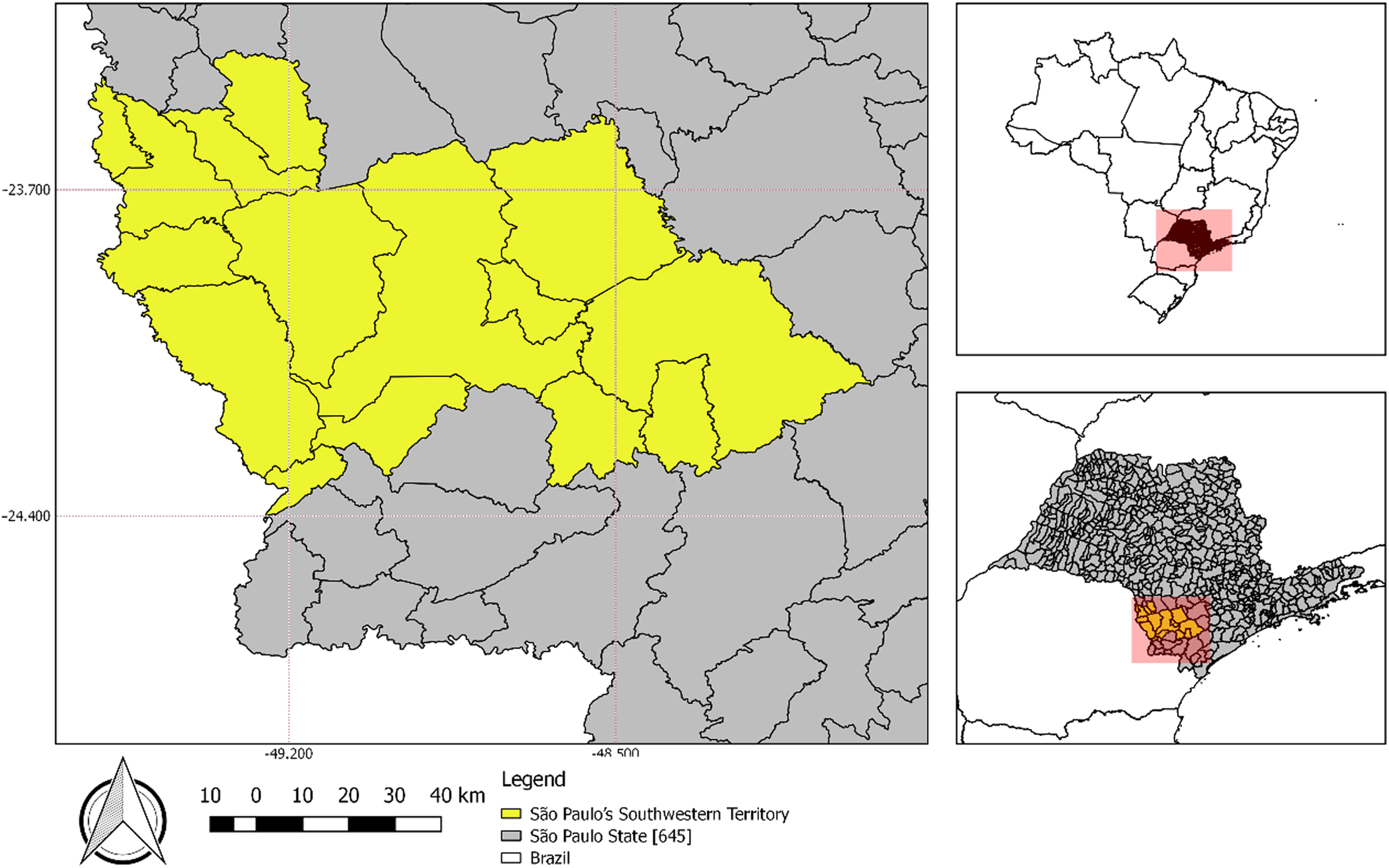
We did our study in São Paulo's Southwestern Territory. It comprises a group of 15 municipalities with similar profiles and social-cultural cohesion (Fig. 1). The region is also known as ‘Hunger Branch’ since their municipalities exhibit a low Human Development Index—a composite index of life expectancy, education, and per capita income indicators. A notable characteristic of this territory is the presence of a significant number of undercapitalized family farmers with diversified production systems (mainly grains, milk, and vegetables) coexisting side by side with highly-specialized industrial agriculture (Matheus, Reference Matheus2016).
Geographic localization of São Paulo's Southwestern Territory, São Paulo, Brazil.

According to the 2010 census, 312,063 people were living in the territory, 21.6% of them in rural areas. Furthermore, a significant percentage of this rural population lived under extreme poverty, reaching in some municipalities up to 70%. The territory had 7208 units managed by family farmers, of which 415 were in rural settlements; additionally, there was one black farmer's community (quilombo) and two indigenous territories.
Data and methods
The first step of our research was a longitudinal analysis of archival data on the operation of the PAA in São Paulo's Southwestern Territory. The data on volumes of conventional and organic products sold through the program were analyzed. The available data, covering six years (2010–2015), were obtained from the PAA's Public Transparency dataset, which stores national data from the PAA since 2010 (CONAB, 2017).
The second step was collecting information about organic production in the territory. For this purpose, we used the National Registry of Organic Farmers held by Ministry of Agriculture, Livestock, and Food Supply (MAPA, 2017). From this dataset, we identified the farmers with organic certification in the territory, as well as the municipality of each farm on the list and the kind of certification they had (audit or participatoryFootnote 4).
To complement the secondary data and obtain a better understanding of the impacts and limitations of PAA on fostering the organic production, we conducted in-depth interviews with administrators of five of the 29 farmers' organizations that delivered products to the PAA during the study period. Our goal for these interviews was identifying the main factors restricting the transition to organic systems by local farmers, the actions necessary for more farmers to start transition processes, and how they supported their members in adopting more sustainable production systems.
Results
During the study period, more than 31,000 tons of food was marketed through the program. Social welfare networks in the territory distributed most of this food in the form of baskets to people with food insecurity or used it to provide school feeding.
Secondary data show that farmers from all the 15 municipalities traded part of their production through the PAA during the study period. Of the 7208 family farmers identified by the last census in the territory, 3840 (≈53%) delivered their products to the program at least once. This ratio evidences the relevance of the program for the local family farming, promoting its productive inclusion, and consequently, supporting the farmers' incomes.
Past studies have shown that the PAA promoted diversifying production among family farmers (Agapto et al., Reference Agapto, Borsatto, de Esquerdo and Bergamasco2012; Bergamasco et al., Reference Bergamasco, Borsatto and de Souza-Esquerdo2013; Resque et al., Reference Resque, Coudel, Piketty, Cialdella, Sá, Piraux, Assis and Le Page2019). The price incentive was expected to stimulate farmers to begin a transition process; thus the share of organic food marketed via the program should have increased over time. However, the results of our data analysis indicate that the price incentive offered through PAA has contributed little to foster an organic transition by small-scale farmers and our results suggest that the conversion to organic production systems is a step that depends mainly on other drivers. When we stratify the volume of conventional and organic foods sold through the program in the territory (Table 2), from 31,000 tons of food marketed between 2010 and 2015, the share of organic production was a modest 0.8% (≈266 tons).
Volumes of conventional and organic food purchased by PAA in São Paulo's Southwestern Territory (2010–2015)

Source: CONAB (2017).
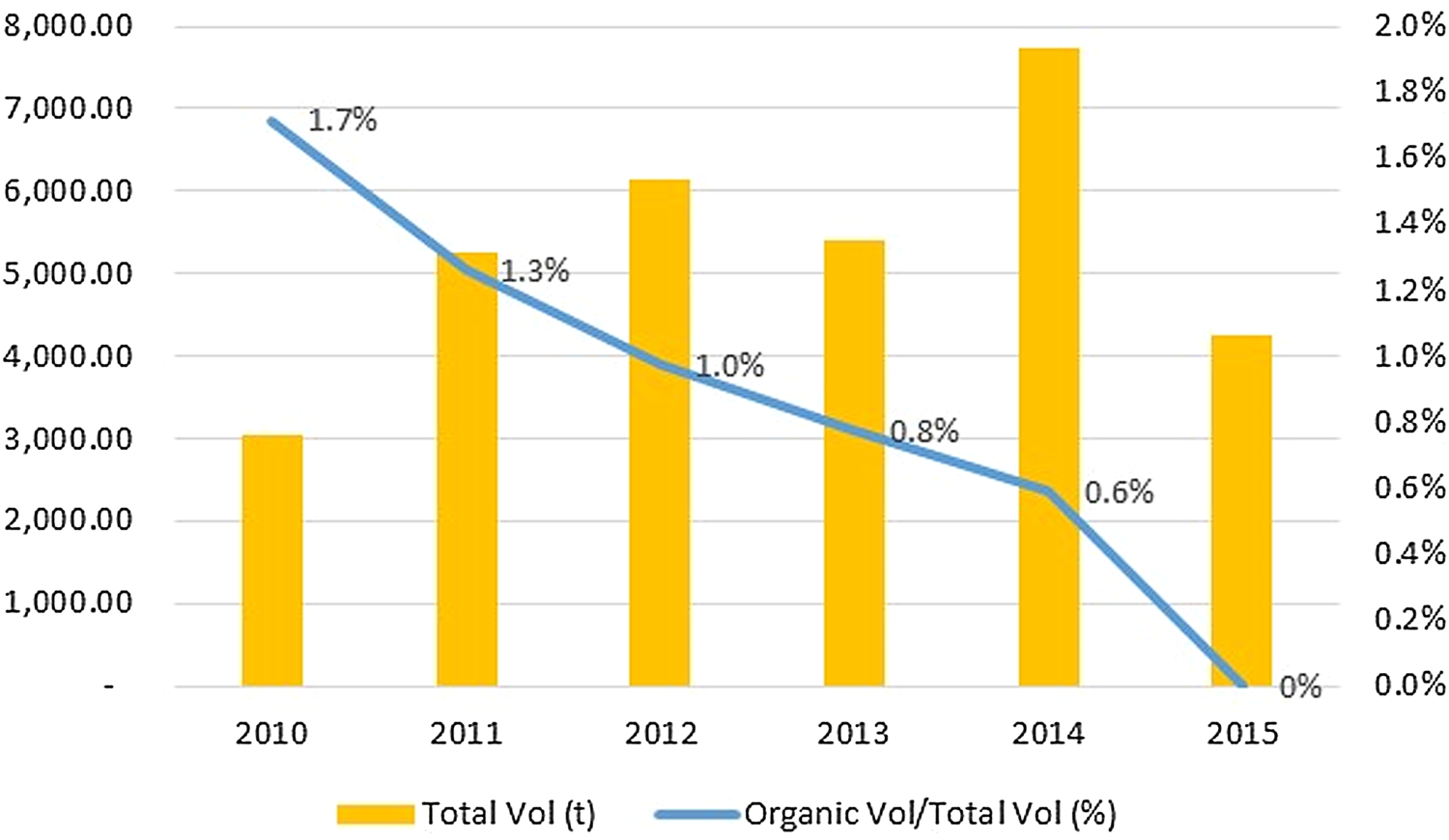
As expressed in the National Plan of Agroecology and Organic Production (Planapo), policymakers expected that at least 5% of the PAA's budget by 2015 should have been used for acquiring organic products (CIAPO, 2013). However, the secondary data indicate that the share of organic food traded through the PAA decreased during the time. In 2010, the share was 1.7%, and the share declined until 2015 when no organic food was sold through the program (Fig. 2).
Volume of food commercialized through the PAA and participation of the organic products per year in the São Paulo's Southwestern Territory (2010–2015).

Our findings are consistent with those of Sambuichi et al. (Reference Sambuichi, Ávila, de Moura, Mattos, Spínola, Sambuichi, de Moura, de Mattos, de Ávila, Spínola and Silva2017) for the national level. Their research revealed that the purchases of organic food through the PAA were lower than expected and had not advanced through time.
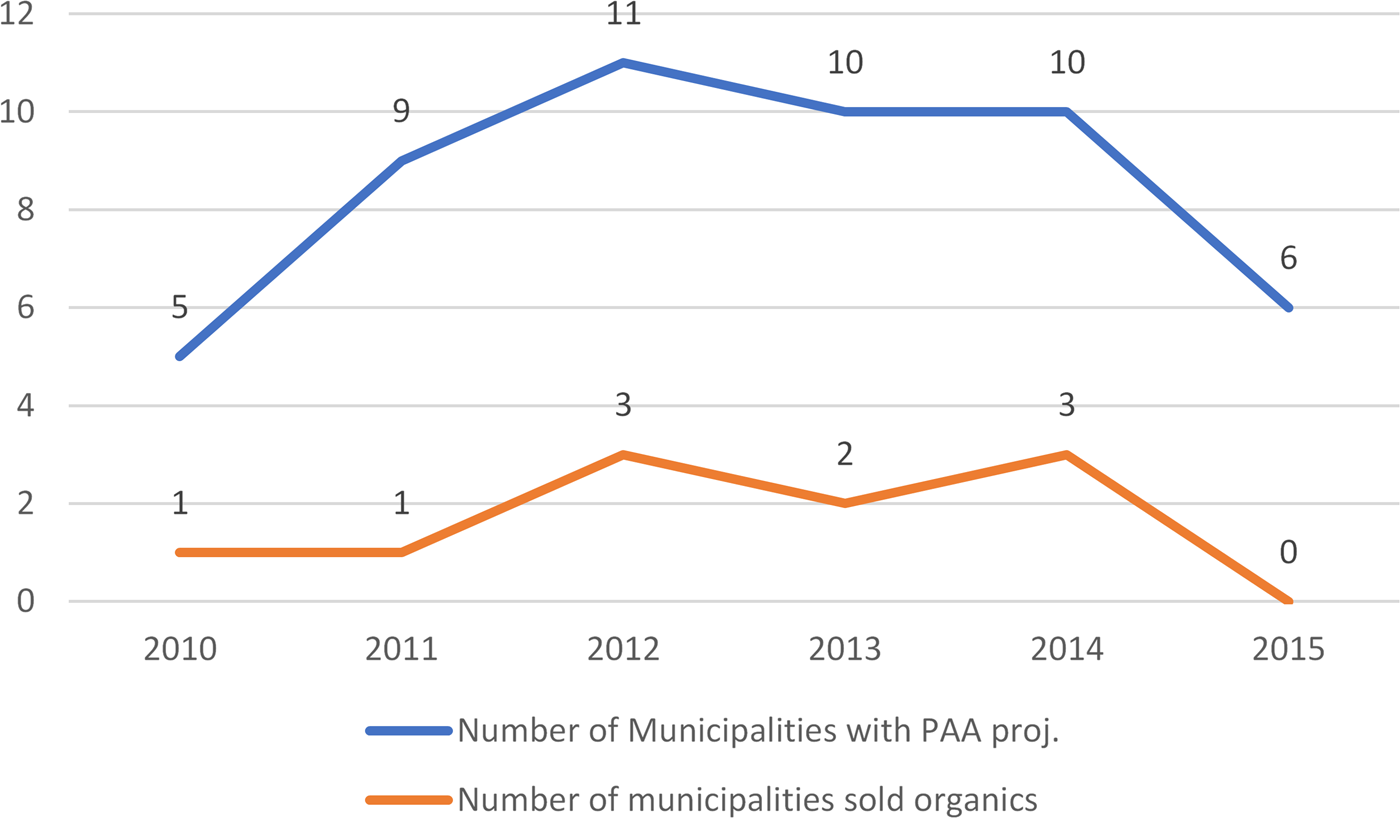
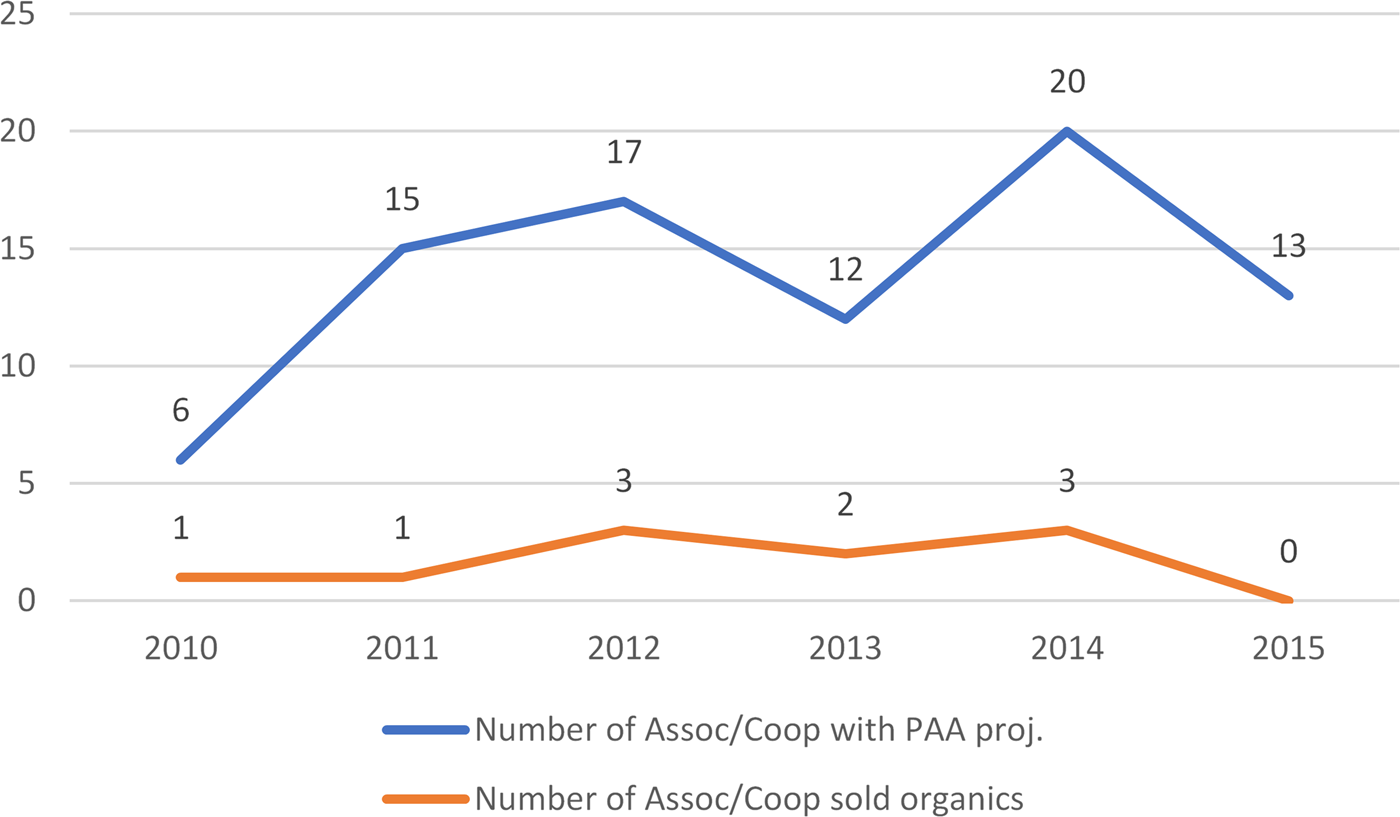
When we break down the secondary data by municipalities, our analysis shows that farmers' organizations from 11 different municipalities sold food through the program, but only organizations from four of these municipalities sold organic products (Fig. 3). We observed a similar pattern when the data were broken down by farmers' organizations. PAA acquired products from 30 different associations/cooperatives, and most of these organizations (80%) sold their produce at various times in different years. However, only four of these organizations sold organic products (Fig. 4).
Number of municipalities in the São Paulo's Southwestern Territory that had family farmers' organizations participating in the PAA (2010–2015).

Number of family farmers' organizations in the São Paulo's Southwestern Territory that participated in the PAA (2010–2015).

These data illuminate the challenges faced by the PAA program in successfully promoting organic transitions through the territory. We observed that the PAA had a very limited impact on motivating farmers to convert their production systems to organic. Our findings suggest that only those who already were involved or interested in developing more sustainable production systems benefited from the price incentive and that the premium price incentive under the PAA was not enough to attract new producers of organic food.
From the dataset of the National Registry of Organic Farmers (MAPA, 2017), we identified 120 certified organic farmers in the territory. While this subset represents ≈1.3% of the farmers of the region, it is considered to be a significant number.
We crossed-referenced the names of the certified organic farmers on the registry list with the names of the farmers who delivered organic products to the PAA. Only 28 of these farmers (23.33%) had marketed their products through the program at least once. Of those, only 15 (1250%) sold for a second time, and just three for a third time.
We can infer two interesting trends from these data. First, they reveal that most of the organic farmers choose other markets over the PAA. Second, the mediated market established by PAA has not gained the loyalty of organic farmers.
The information obtained during the in-depth interviews conducted with the administrators of five family-farming organizations helped us to better understand the situation we observed in the secondary data. There was a consensus among the interviewees that the price incentive offered by PAA was insufficient to encourage farmers to initiate organic transition processes.
According to the administrators, farmers saw no point in changing their production systems so that they could access a market that they considered small. As described before, the program specifies a flat monetary annual quota to each farmer. In the case of organic production, the purchased volume ends up being reduced proportionately since the farmers earn 30% more money for their products. Thus, the amount of produce that can be marketed through the program is insufficient to stimulate change in the farmers' production systems.
The interviewees also pointed out that, in their case, price incentives for organic food already existed independently of the PAA because the region is close to urban centers that not only offered attractive markets for organic produce, but having had demand that was much larger, more stable, and less bureaucratic than under the PAA. Guerra et al. (Reference Guerra, Blesh, Schmitt Filho and Wittman2017) studied a similar Brazilian policy based on public procurement, the School Feeding Program, which also pays a price premium of 30% for organic products, but in a more isolated region of the country. They observed that, while this policy was relevant in supporting farmers interested in starting a transition process, like with the PAA in São Paulo's Southwestern Territory, the School Feeding institutional market could absorb only a small share of production.
The respondents also stated that policies based on institutional markets (in their case PAA and School Feeding) are relevant to support family farming, but they did not offer sufficient incentives to encourage farmers to take the risks of converting their production systems to organic (including, e.g., decreases in production, lack of knowledge to deal organically with pests and diseases, and demand for more labor). According to them, in addition to guaranteed markets for organic produce, essential would be policies that would provide rural extension services and offer credit to start organic transition processes. The interviewees also stated that several farmers showed interest in initiating organic transition processes; however, these farmers did not feel confident about abandoning conventional production systems. The interviewees explained that these farmers had already mastered conventional production processes and knew the risks of that system and did not feel comfortable changing to another system in which they would have to assume the challenges linked to a transition.
Another identified factor limiting the scaling-out of organic transition processes was the lack of a more cohesive social fabric that united farmers around common goals (Rosset and Altieri, Reference Rosset and Altieri2017; Home et al., Reference Home, Indermuehle, Tschanz, Ries and Stolze2018). The interviewees affirmed that the participation of the farmers in their organizations followed an instrumental logic, that is, they were not involved in organizational discussions and management processes, rather the farmers considered their respective organizations to be just another market intermediary for their produce.
The interviews confirmed that most of the organizations we studied were not created by the farmers themselves; instead, actors in local public sectors were the chief mobilizers of the farmers. Representatives of the municipalities have encouraged and supported these associations during the last two decades, with the narrow objective of accessing federal policies focused on family farming (including the PAA). Research on the family-farming organizations of this territory indicated that this is a typical situation in the region (Fornazier, Reference Fornazier2014).
In short, our results indicate that the PAA, which is a program centered on public procurement and price incentives, provided insufficient incentives for farmers to transition to organic production systems.
Conclusions
Our main conclusion is that the PAA-supported development of institutional markets that paid premium prices offer insufficient incentives for scaling-out organic production practices among peasant and family farmers in São Paulo's Southwestern Territory. In line with other studies (Gonzalez de Molina, Reference Gonzalez de Molina2013; Perez-Cassarino and Ferreira, Reference Perez-Cassarino and Ferreira2016; Rover et al., Reference Rover, de Gennaro and Roselli2016; Gregolin et al., Reference Gregolin, Gregolin, Triches and Zonin2017; Guerra et al., Reference Guerra, Blesh, Schmitt Filho and Wittman2017), our findings suggest that public procurement programs that involve premium prices for organic products do not necessarily create sufficient incentives and mobilizing power for getting large numbers of farmers to change their conventional systems to organic ones. One lesson should be that a simple strategy of creating demand through programs that only open institutional markets for organic food may well be insufficient to get a scaling-out of organic practices among small-holder farmers. A key reason is that under the PAA farmers who established organic production systems and became certified could also access markets that they found more advantageous than limited public procurement with the 30% price incentive. These other markets already offered similar incentives for organic production (e.g., better prices, guaranteed purchase, little bureaucracy, etc.).
If public procurement policies are to be effective in changing production practices among low-income family farmers, we think that such policies must not only prescribe attractive premium prices but must also include provisions for supplying credit for organic transitions, rural Extension, relevant research, and educational programs supporting transition. Success also depends on a certain degree of organization among farmers and a social context in which organic practices are encouraged and information about them disseminated. Thus, for public procurement policies to be effective also requires high levels of social mobilization.
Another lesson we can draw from the Brazilian experience is that people and institutions interested in increasing both the number of farms and geographic area on which more sustainable processes of food production are used, especially if based on small-holder farmers, should not rely exclusively on state intervention to achieve their objectives. In this case, even with great success in promoting organic practices among peasant and family farmers, this would not transform Brazilian agriculture because the policy emphasis on increased sustainability is dwarfed by subsidies to conventional practices (such as the widespread use of chemical pesticides) in the hegemonic agrifood system.
Furthermore, the Brazilian experience shows that a change in government can suddenly disrupt or discontinue policies aimed at promoting more sustainable practices among small-holder farmers. The political crisis in Brazil circa 2015, the ensuing seizure of power by a political group ideologically committed to favoring the agro-export sector, and the election of a right-wing president have all negatively impacted implementation of policies aimed at supporting more sustainable production practices among family farmers. As a result, programs such as PAA are undergoing huge budget cuts, limiting, even more, their potential to foster any significant transformation.
A better understanding of the constraints of policies such as PAA have in promoting more sustainable processes of food production among small-holder farmers is required. The research about the Brazilian PAA provides only a snapshot of this issue but suggests that the incentives provided by public procurement and price incentive policies would be not enough to scale-out organic production systems to more farms and larger production areas.
Acknowledgements
We would like to thank the administrators of the family-farming organizations for sharing information with us. And thank you to the anonymous reviewers for their thoughtful suggestions for ways to add clarity and coherence to the article. The authors have no words to express their gratitude to the associate editor for their careful final revision of the manuscript.
Financial support
This research was funded by the grant#427726/2016-6, National Council for Scientific and Technological Development (CNPq)—Brazil. Ricardo S Borsatto was supported in this research by the grant#2017/04577-1, São Paulo Research Foundation (FAPESP).