Introduction
Fungal rhinosinusitis is an often-overlooked diagnosis when managing a patient with chronic rhinosinusitis. It is usually diagnosed after reviewing classical signs in a computed tomography scan or through the biopsy of fungal isolates within the sinuses. Clinical signs are often subtle and may be masqueraded by other diseases. In fungal rhinosinusitis, extranasal symptoms such as ocular or intracranial signs may present as early manifestations.
Fungal rhinosinusitis was classified by Bent and Kuhn as non-invasive and invasive.Reference Bent and Kuhn 1 Non-invasive fungal rhinosinusitis is further sub-classified into two subdivisions: allergic fungal rhinosinusitis and mycetoma. Invasive fungal rhinosinusitis is sub-classified into three entities: acute fulminant fungal sinusitis, chronic fungal rhinosinusitis and chronic granulomatous fungal rhinosinusitis.Reference Bent and Kuhn 1
Both varieties often require surgical intervention as part of the treatment. In acute fulminant fungal rhinosinusitis, patients often present with symptoms of less than one month in duration, with an associated history of immunosuppression. In such cases, surgical intervention may be lifesaving.
In this study, we evaluated the clinicopathological and mycological manifestations of fungal rhinosinusitis in a tropical setting.
Materials and methods
This study was conducted at Tengku Ampuan Rahimah Hospital. This is an 864-bed tertiary hospital located in the south of Klang, Malaysia, which has a tropical climate, with significant rainfall throughout the year.
Following a review by the Malaysian Research Ethical Committee (National Medical Research Register number: 16-1692-32476), the records of patients who presented from July 2009 to July 2016, who were clinically diagnosed with fungal sinusitis, with fungal growth and histopathological evidence, were compiled and analysed retrospectively. Information obtained from records was indexed based on age, gender, clinical presentations, symptom duration, clinical signs and mycological growth.
Results
Patient overview
Eighty samples obtained from the sinuses of patients who presented from July 2009 to July 2016 were analysed. Twenty-seven of the 80 samples (33.75 per cent) were positive for fungal growth and were included in the study. Fifty-six per cent were from non-invasive fungal rhinosinusitis cases and 44 per cent were from invasive fungal rhinosinusitis cases.
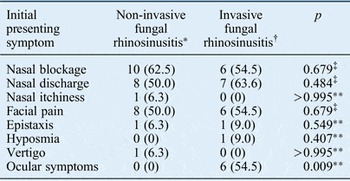
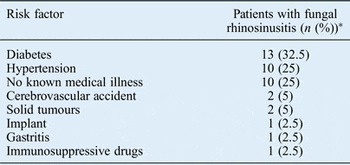
Eighty-eight per cent of all patients had undergone surgery as part of the fungal rhinosinusitis treatment, and 12 per cent had opted for conservative medical treatment. Of those individuals who were operated on, 16.7 per cent required repeated surgery. The mean age of presentation was 49.8 years, with a range of 33 to 67 years. The male-to-female ratio was 1:1.25. Patients had presented with a myriad of symptoms, but the commonest was nasal blockage (22 per cent; Table I). The underlying risk factors in all fungal rhinosinusitis patients are listed in Table II.
Relation of fungal rhinosinusitis to initial presenting symptoms

Data represent numbers (and percentages) of patients, unless indicated otherwise. *n = 16; † n = 11. ‡Chi-square test; **Fisher's exact test
Relation of underlying risk factors to fungal rhinosinusitis as a whole

*Total n = 27
Non-invasive rhinosinusitis
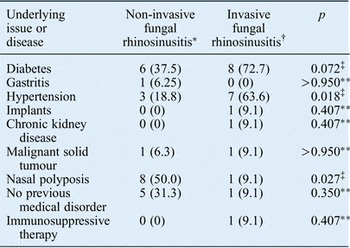
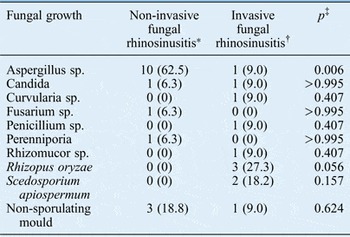
The average duration of symptoms prior to presentation was 154 weeks (3 years). The majority of patients with non-invasive fungal rhinosinusitis had diabetes (37.5 per cent); 31.1 per cent of patients had no previous medical disease (Table III). The commonest fungal growth obtained was aspergillus sp. (62.5 per cent), followed by non-sporulating moulds (18.8 per cent) (Table IV). Significantly more non-invasive than invasive fungal rhinosinusitis patients had nasal polyposis on presentation (p < 0.05). In contrast, significantly more invasive than non-invasive fungal rhinosinusitis patients had ocular symptoms (p < 0.05). All patients with non-invasive fungal rhinosinusitis had survived and are under long-term follow up.
Relation of fungal rhinosinusitis to various underlying medical disorders

Data represent numbers (and percentages) of patients, unless indicated otherwise. *n = 16; † n = 11. ‡Chi-square test; **Fisher's exact test
Relation of fungal rhinosinusitis to various isolated organisms

Data represent numbers (and percentages) of patients, unless indicated otherwise. *n = 16; † n = 11. ‡Fisher's exact test
Invasive rhinosinusitis
The average duration of symptoms prior to presentation at the clinic was one month. The commonest medical disorder associated with invasive fungal rhinosinusitis was diabetes (73 per cent); one patient had a history of chronic steroid intake for nephrotic syndrome and one had sinonasal malignancy (Table III). The commonest symptoms in acute invasive fungal rhinosinusitis cases were ocular symptoms (e.g. eye swelling, blurring of vision) (54.5 per cent). The commonest fungal pathogen isolated was that of mucorales sp. (36.4 per cent) (Table IV), followed by Scedosporium apiospermum (18 per cent). The mortality associated with acute invasive fungal rhinosinusitis was 67 per cent. Compared to non-invasive fungal rhinosinusitis, invasive fungal rhinosinusitis was significantly associated with hypertension (p < 0.05) (Table III).
Discussion
Fungal rhinosinusitis is a well-defined disease of the sinuses. It is linked to the pathogenesis of chronic rhinosinusitis, especially in resistant cases.Reference Goh, Gendeh, Rose, Pit and Samad 2 The incidence of fungal sinusitis has been reported to be increasing, especially in immunocompromised individuals.Reference Kontoyiannis, Marr, Park, Alexander, Anaissie and Walsh 3 This trend is also seen in patients on long-term broad-spectrum antibiotics.Reference Singh 4 More than 50 fungal pathogens have been isolated as agents of fungal rhinosinusitis, including aspergillus, rhizopus, alternaria, bipolaris and curvularia.Reference Schell 5 Warm and humid climates tend to foster fungal proliferation, particularly of dematiaceous fungus. These organisms are ubiquitous in nature, and can occur in soil, wood and decomposing plants.Reference Brandt and Warnock 6
Fungal rhinosinusitis can be classified broadly into two categories: invasive and non-invasive. Invasive fungal rhinosinusitis, in its acute form, can present as a fulminant and highly destructive clinical entity, which is potentially fatal and difficult to treat. These cases typically present with an underlying immunocompromised state and require aggressive debridement to ensure full eradication of the offending fungal agent.Reference DelGaudio and Clemson 7 Despite aggressive treatment, the prognosis of acute invasive fungal rhinosinusitis patients remains poor, with mortality rates ranging from 50 to 80 per cent.Reference Valera, do Lago, Tamashiro, Yassuda, Silveira and Anselmo-Lima 8 In our series, the mortality rate of acute invasive fungal rhinosinusitis patients was 66 per cent, which is comparable to data reported in mainstream journals.
The pathological spectrum differs from one area to another, suggesting that different climates and environmental factors play a role in fungal growth propensity. A study by Granville et al. reported an incidence of non-invasive fungal sinusitis of over 90 per cent compared to invasive fungal sinusitis.Reference Granville, Chirala, Cernoch, Ostrowski and Truong 9 A study by Das et al. from India reported a 60 per cent incidence of non-invasive fungal sinusitis in comparison to invasive fungal sinusitis.Reference Das, Bal, Chakrabarti, Panda and Joshi 10 Similarly, Soontrapa et al. observed a 60 per cent incidence of non-invasive fungal sinusitis in Thailand.Reference Soontrapa, Larbcharoensub, Luxameechanporn, Cheewaruangroj, Prakunhungsit and Sathapatayavong 11 Our study demonstrates a pattern of clinical presentation similar to that observed in Thailand and India, whereby 56 per cent of patients with fungal growth in the sinuses were diagnosed as non-invasive versus 44 per cent as invasive. These findings suggest an almost equal distribution of non-invasive and invasive fungal rhinosinusitis in Malaysia.
-
• There was an almost equal distribution of invasive and non-invasive fungal rhinosinusitis, as in some other tropical countries
-
• Invasive fungal rhinosinusitis, slightly more uncommon than the non-invasive form, is potentially life threatening
-
• Early and extensive surgical debridement is required for invasive fungal rhinosinusitis treatment
-
• Invasive and non-invasive fungal rhinosinusitis were associated with nasal polyposis and ocular symptoms, respectively
-
• Fungal rhinosinusitis is challenging for otorhinolaryngologists in terms of diagnosis and optimal treatment
Fungal isolates were more predictable in non-invasive fungal rhinosinusitis. Aspergillus was consistently found in fungal isolates of non-invasive fungal rhinosinusitis cases, whereas unconventional and rarer forms of fungal growth were found in invasive fungal rhinosinusitis cases. This pattern has been observed consistently in other studies conducted worldwide.Reference Montone, Livolsi, Feldman, Palmer, Chiu and Lanza 12 Aspergillus fumigatus and Aspergillus flavus were the commonest subtypes of aspergillus isolated in the form of fungal balls in the sinus. This finding shows a similar worldwide distribution, despite the variation in geographical locations.Reference Challa, Uppin, Hanumanthu, Panigrahi, Purohit and Sattaluri 13 – Reference Panda, Sharma, Chakrabarti and Mann 15
In our experience, surgical debridement was the cornerstone of treatment for both forms of fungal rhinosinusitis. Surgical debridement led to the resolution or improvement of symptoms in fungal rhinosinusitis patients, as only 16.7 per cent of patients under our care required repeated surgical intervention. This suggests that the inflammatory reaction of the fungal material is related to symptom severity, as suggested by some authors previously.Reference Ebbens and Fokkens 16 , Reference Ebbens, Georgalas and Fokkens 17 Most patients in our series who had undergone multiple surgical debridement of the sinuses suffered from acute invasive fungal rhinosinusitis, and the treatment was mainly aimed at preventing further extension of fungal growth. Treatment of acute invasive fungal rhinosinusitis was often complemented with antifungals such as amphotericin B, posaconazole and voriconazole as adjunctive therapy, but this was eventually futile.
Acknowledgements
The authors would like to acknowledge the operating team of the Department of Otorhinolaryngology, Department of Pathology and the Clinical Research Centre of the Tengku Ampuan Rahimah Hospital for their contributions to the realisation of this manuscript.