In recent years, earthquakes have occurred frequently all over the world. Numerous studies have traditionally focused on the acute phase currently, Reference Basu, Ghosh and Jana1 but studies concerning the subacute phase after an earthquake were very limited.Reference Tamariz, Cely and Palacio2 In fact, the same attention as the emergency period should be paid to the subacute phase. Because it could be seen from the related studies that more people were involved in this stage, large numbers of survivors need to be properly and timely rescued. Moreover, diseases were more complicated in the subacute period.Reference Ning3 All kinds of diseases, such as respiratory disease, digestive disease, skin disease, gynecological and pediatric disease, common and chronic diseases, occurred in this period, as well as injuries that were not cured at an early stage.Reference Slama, Kim and Roglic4–Reference Kobayashi, Hanagama and Yamanda6 Therefore, in a manner of speaking, the subacute phase after the earthquake was the second critical period connecting the past with the future. So, the medical relief needs to go beyond focusing the acute phase to include subacute and chronic phase that are essential for maintaining the continuity of the medical assistance.Reference Achour, Pascale and Price7 It is gratifying to note that the idea of launching rehabilitation and reconstruction operations has been gradually agreed by rescue experts, so that a variety of possible and unpredictable medical problems could be solved effectively.
However, there were many issues that need to be further elucidated. First, subacute-related concepts were still in disorder, the concepts used in different literatures and books were not unified, and the differences between the concepts were not precisely expounded, such as post-disaster recovery, post-disaster rebuilding, post-disaster redevelopment, and so on. Second, there was no uniform standard for dividing the post-disaster recovery and reconstruction phase. For example, was the period of medical relief based on the spectrum of disease or the ability of rescue or something else? Third, the medical relief targets were not clearly defined. For example, who should be given priority? What were the needs of different groups, such as children, women, the elderly, the chronic patients, and so on? This series of problems need to be studied further in order to improve the efficiency of medical relief and avoid the waste or uneven distribution of resources.
Based on the previous analysis, this paper discussed the definition of each phase and target population, and analyzed the main types of disease, to provide the vital information to decision-making departments for future medical relief planning.
METHODS
Search Strategy
Relevant articles were selected from the electronic databases of the PubMed Database, Science Direct, Springer Medical Specialty Collection, ISI Web of Knowledge, China National Knowledge Infrastructure (CNKI), and the Cochrane Library. The search terms were “earthquakes and diseases,” “earthquakes and illness,” “earthquakes and disease pattern,” and “earthquakes and disease spectrum.” The retrieval period was from 2008 to 2018. In addition, manual searches of any references cited in all relevant original and review articles were conducted. For articles with unclear information, we contacted the authors by e-mail to ensure accuracy. The studies published in Chinese or English were included in our study.
Inclusion and Exclusion Criteria
The articles included must meet all of the following criteria: First, the articles described the type of disease caused or aggravated by the earthquake. Second, the proportion of different types of disease within 7 days and 8–30 days after the earthquake could be calculated from the data that the articles provided, respectively. Third, diseases were classified according to the International Classification of Diseases, Tenth Revision.
The exclusion criteria of studies were as follows: First, the articles described a specific disease only or a specific group of people, such as respiratory disease only or children only. Second, the articles did not report clearly the number of patients or percentages of each disease (eg, studies that reported symptoms only or disease ranking only). Third, the articles did not indicate clearly the times that patients visited medical institutions or the times they were diagnosed more than 30 days after the earthquake. Last, articles were not published in Chinese or English.
Statistical Analysis
The proportion of each type disease within 7 days and 8–30 days after the earthquake was based on the number of patients and the total sample size of each study, which were analyzed by Microsoft Excel 2010.
RESULTS
Division of Medical Relief Period After the Earthquake
The task of medical relief was different in different periods after the earthquake, so the clear division of medical relief stage had an important implication for determining the priority of medical aid and allocating medical resources scientifically.Reference Wang, Sun and Ouyang8–Reference Liu, Wang and Liu9 At present, 1–7 days after the earthquake was basically considered as the emergency period. However, there has not yet been a unified standard for the subacute phase, so the definitions of each phase were made by the respective research purposes.Reference Tominaga, Nakano and Hoshino5–Reference Kobayashi, Hanagama and Yamanda6, Reference Nufer, Wilson-Ramirez and Shah10 Accordingly, the duration of the subacute phase was different.Reference Kobayashi, Hanagama and Yamanda6, Reference Ugawa11 Nufer et al. defined the subacute phase as 8 or more days after the earthquake.Reference Nufer, Wilson-Ramirez and Shah10 Liu et al. defined 8–30 days as the subacute phase by studying the disease spectrum, which was the most scientific method of division at present.Reference Liu, Wang and Hao12 Although various definitions of each phase after the earthquake might be made, we defined 7 days as the acute phase and 8–30 days as the subacute phase. But what needs to be realized is that the duration of each phase should be adjusted flexibly according to the different factors of the earthquake, such as the severity of the earthquake, local rescue environment, integrated rescue capability, and so on.
Definition of Medical Relief Targets After the Earthquake
In order to know more about the need for medical services and allocate health resources more reasonably, it is vital to define clearly the targets of medical relief. In China, the main targets of medical relief were generally the severely affected groups, who were called disaster victims. In recent years, attention has been gradually paid to the rescue professionals and postulant as well. However, many other countries had a relatively clearer and wider definition of the medical relief targets. For example, Germans defined all victims as the targets of medical relief, including the persons who went to a hospital for emergency care, or those who firmly believed they were victims, or those who have received compensation from an insurance company, or those who were physically or mentally affected by the disaster.Reference Lang, Schwoebel and Diène13 Dutch scholars believed that all persons affected, such as those who lived in the affected areas, as well as the rescue professional, field researchers, and volunteers should be rescue objects.Reference Dominey-Howes14, Reference Bentley and Levine15 In short, we believed that all concerned populations should be targeted for medical assistance, not just those who were seriously injured. More importantly, needs studies were badly needed to identify priority groups, such as the elderly, children, pregnant women, patients with chronic diseases, so that targeted medical services could be carried out according to their different requirements.Reference Allison, Zachary and Rachel16–Reference Ren, Chiang and Jiang20 Eventually, everyone in need can get reasonable and appropriate help.
Main Types of Diseases After the Earthquake
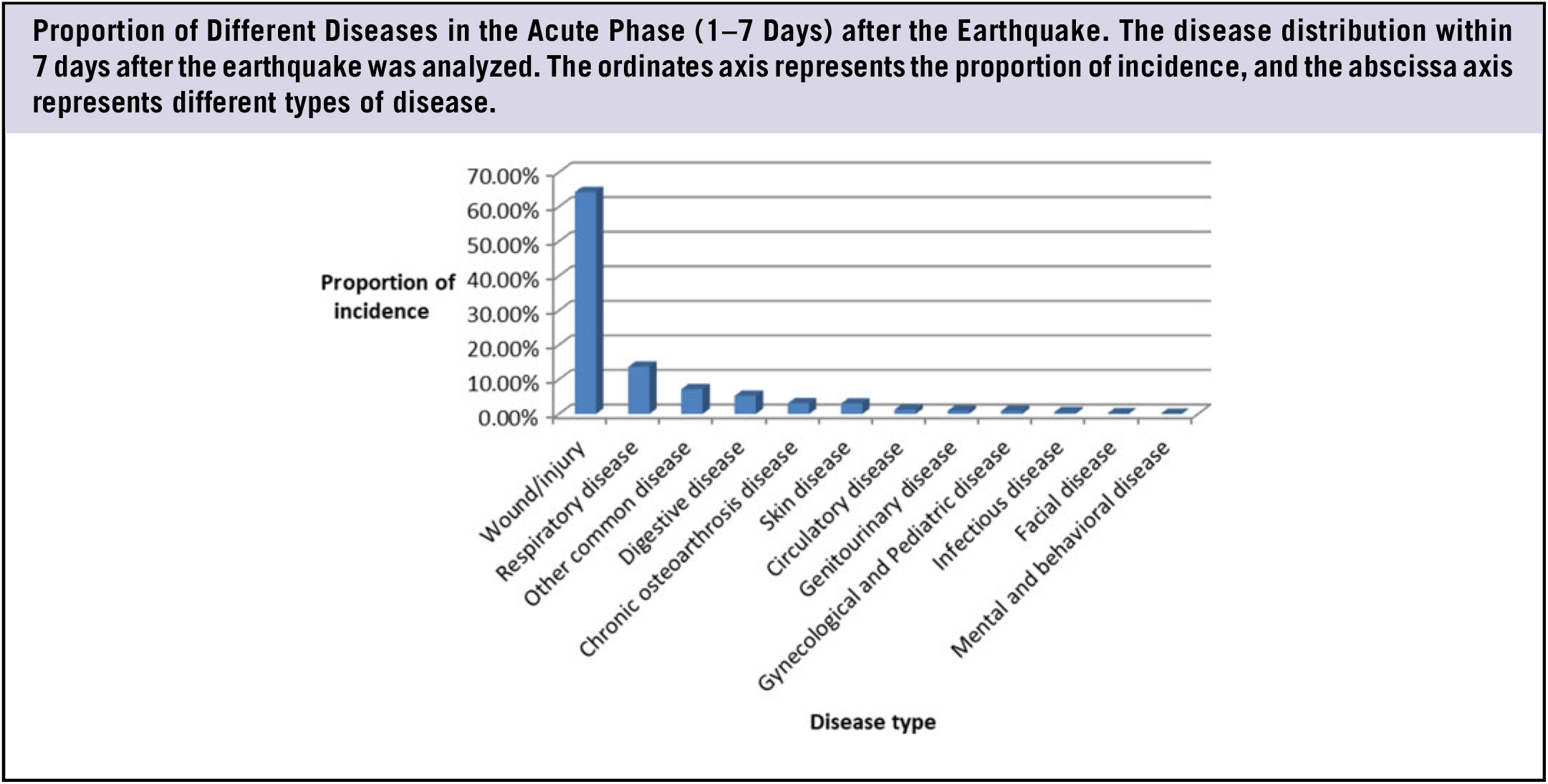
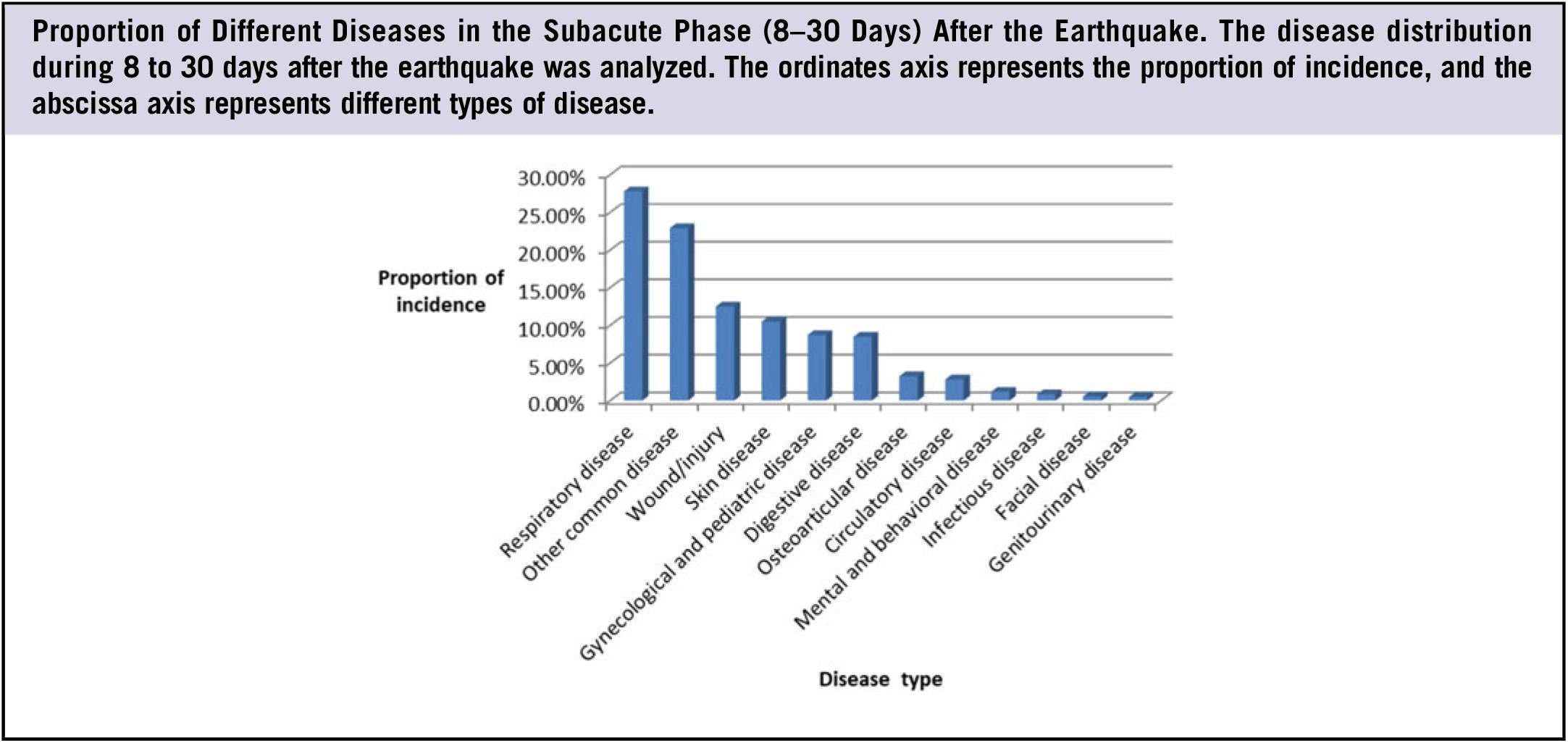
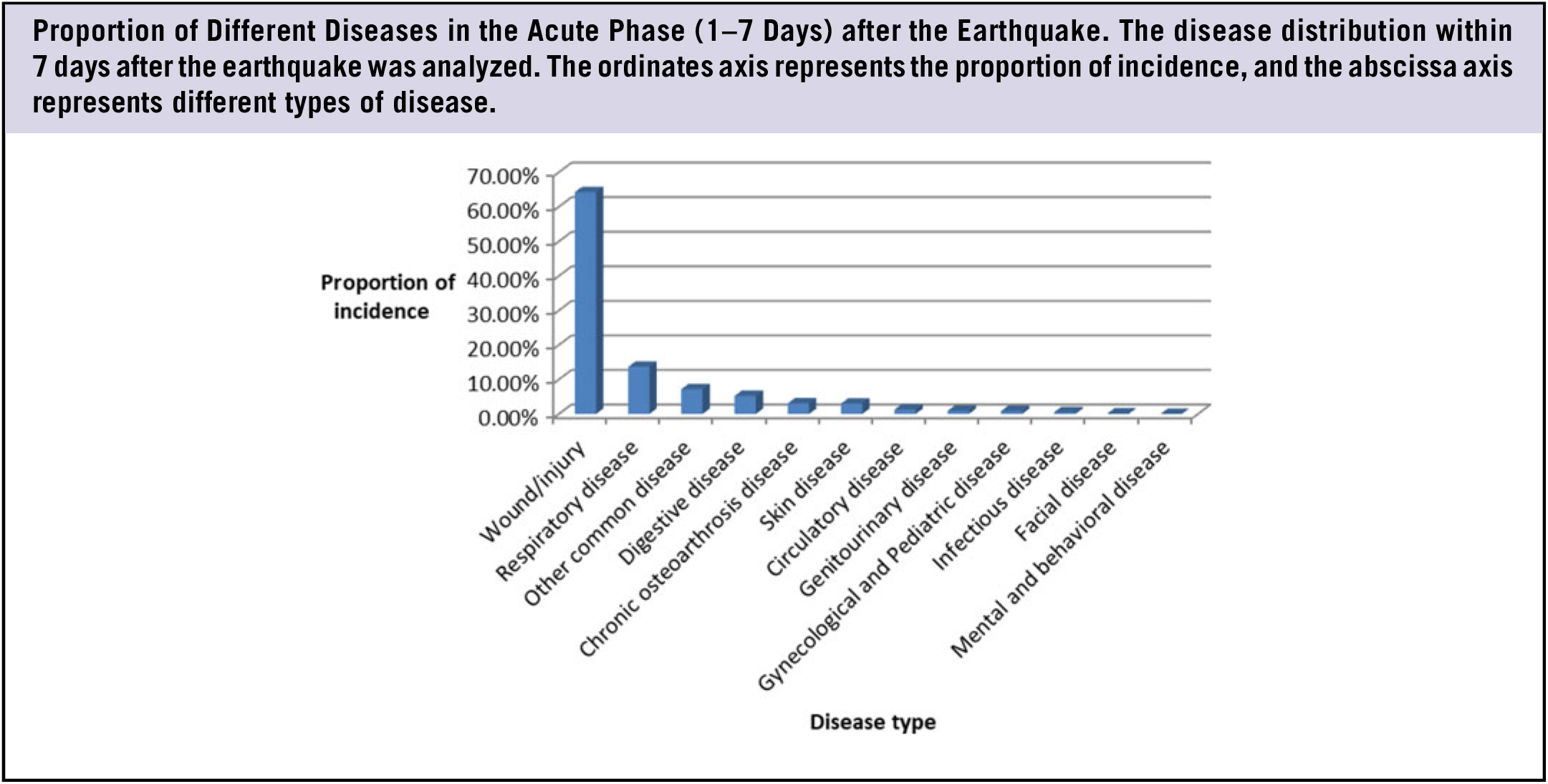
Sixteen related published articles were selected from the electronic databases according to the inclusion and exclusion criteria.Reference Ning3, Reference Liu, Wang and Liu9, Reference Liu, Mao and Wu21–Reference Hung, Lam and Chan34 The proportion of injury and disease during the emergency period (1–7 days) and subacute period (8–30 days) after the earthquake was analyzed respectively. The results indicated that wound/injury (64.22%), respiratory disease (13.63%), other common disease (7.18%), digestive disease (5.22%), chronic osteoarthrosis (3.09%), and skin disease (3.03%) were the first 6 diseases during the emergency period (Figure 1). In the subacute period, respiratory disease (27.79%) which accounted for the largest proportion, other common disease (22.90%), wound/injury (12.49%), skin disease (10.49%), gynecological and pediatric diseases (8.72%), and digestive disease (8.48%) were the first 6 diseases (Figure 2).
Proportion of Different Diseases in the Acute Phase (1–7 Days) after the Earthquake. The disease distribution within 7 days after the earthquake was analyzed. The ordinates axis represents the proportion of incidence, and the abscissa axis represents different types of disease.
Proportion of Different Diseases in the Subacute Phase (8–30 Days) After the Earthquake. The disease distribution during 8 to 30 days after the earthquake was analyzed. The ordinates axis represents the proportion of incidence, and the abscissa axis represents different types of disease.
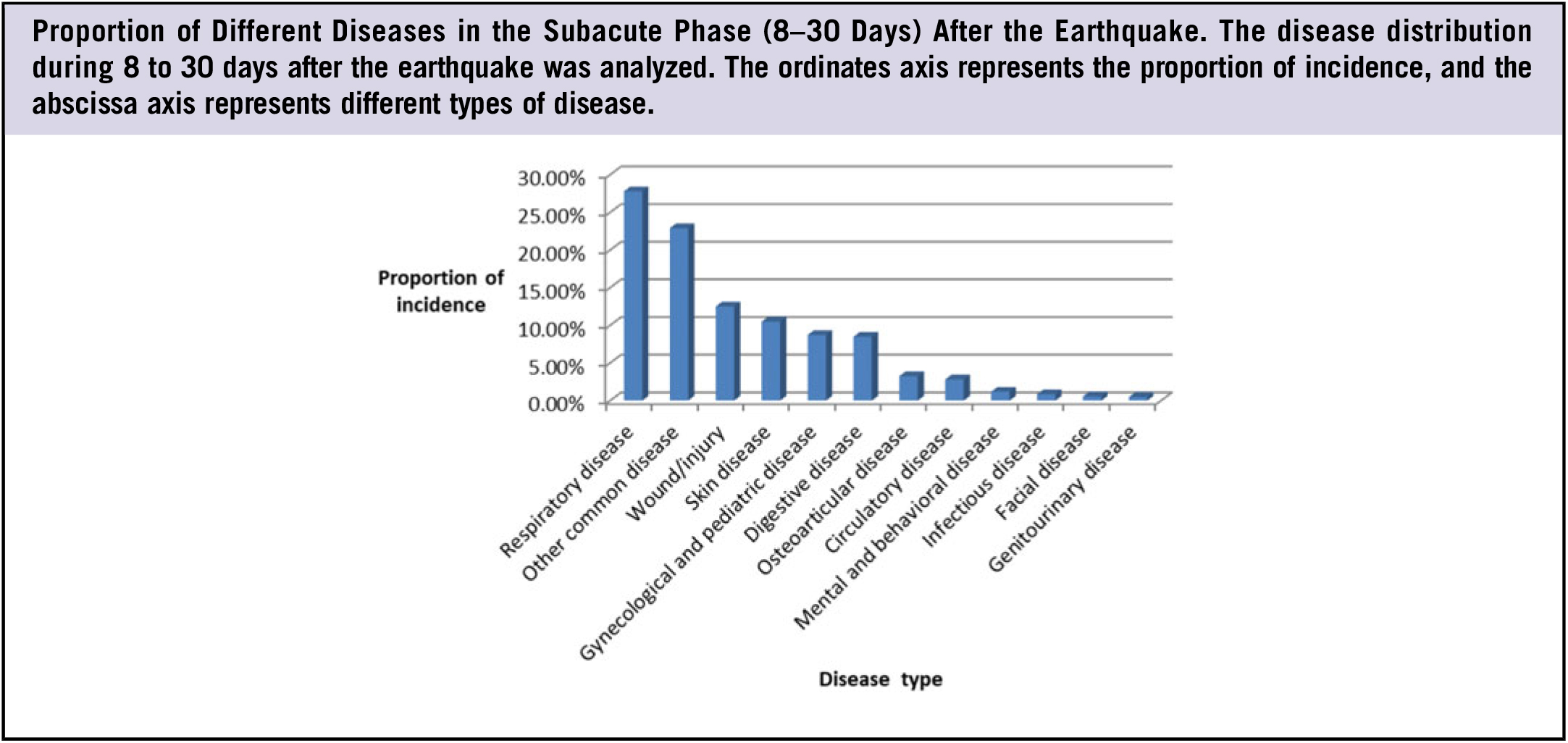
It can be seen from the results that wound/injury accounted for the largest proportion in the acute phase. The focus of medical rescue in this period was “injury” in this period. However, in the sub-acute stage, trauma decreased sharply, and instead respiratory disease, other common diseases, skin disease, gynecological and pediatric diseases, and digestive disease increased rapidly instead. The focus of medical relief in this period was disease. However, further refinement study of the type of disease included in each system was needed for providing a theoretical basis for drug requirements in the future.
Focus of Medical Relief in the Subacute Period After the Earthquake
In accordance with the proportion of different diseases in the subacute phase after the earthquake, the key tasks of medical relief in this period should revolve around routine medical assistance, epidemic control, and psychological assistance.
Routine Medical Assistance
More kinds of disease appeared after the acute phase, so attention must be returned quickly to the track of “regular medical assistance” and not stay in the “emergency rescue status” too long.Reference Gu, Shu and Shen35 What’s more notable was that many chronic diseases were aggravated or worsened due to the interruption of routine treatment, insufficient drug supply, increased pressure, and other reasons.Reference Ren, Chiang and Jiang20, Reference Ding, Fan and Lv36, Reference Murakami, Sasaki and Pascapurnama37 These chronic diseases can reduce quality of life and affect emotional stability of the victims, although they were not life-threatening for the time being. Therefore, special treatment, such as rehabilitation training and prevention of complication, were imperative for these patients with chronic illnesses and the improperly handled injured in the early phase.Reference Slama, Kim and Roglic4, Reference Ohkouchi, Shibuya and Yanai38, Reference Bartels and VanRooyen39 In addition, in view of the substantial number of people involved and the long duration of the period, the needs of the population should be studied in depth. For example, the affected children, women, especially pregnant women, the elderly, the chronically ill patients, and those not seriously injured – all of these special groups should be screened and given the appropriate routine medical care according to their respective conditions.
Epidemic Control
Infectious disease outbreaks generally resulted secondarily from exacerbation of the risk factors, such as odious dwelling conditions, overcrowded living environment, lack of basic resources, interruption of ongoing health care delivery, and excessive psychological stress.Reference Tokuda, Kunishima and Gu40, Reference Kouadio, Aljunid and Kamigaki41 The results of this paper showed that the percentage of infectious disease was 0.50% within 7 days and 0.85% during 8–30 days. Kouadio et al. reported that infectious diseases gradually increased over time.Reference Kouadio, Aljunid and Kamigaki41–Reference Furin and Mathew43 Akbari et al. strongly proposed that preventing infectious disease was the most important task within 1 month after the earthquake.Reference Akbari, Farshad and Asadi-Lari44 Therefore, prevention and control of infectious disease was the medical focus after the acute phase. China attaches great importance to the prevention and control of the infectious disease after an earthquake; in recent years, there has been no occurrence of a major infectious disease. There were, of course, many potential risk factors, such as a vaccination not covering all high-risk populations, insufficient attention not being paid to the prevention of tuberculosis, poor food hygiene, and a lower health literacy of people. In order to achieve the goal of not having a major epidemic after a major disaster, we must have a profound study and learn from other countries at the same time.Reference Asokan and Vanitha45, Reference Wiwanitkit46
Psychological Assistance
Psychological problems, such as posttraumatic stress disorder, depression, and anxiety gradually became apparent in the subacute phase after the earthquake.Reference Cheng, Wang and Wen47, Reference Dai, Chen and Lai48 The results of this paper showed that the percentage of mental and behavioral disease increased significantly in the subacute phase (1.18%) compared with the acute phase (0.02%). In fact, psychological assistance was a permanent need after the earthquake. More and more attention has been paid to psychological problems after the earthquake, and more effective experience was obtained.Reference Jia49, Reference Zhang, Liu and Li50 However, the following key issues remain to be further addressed. First, the differences between the concepts of psychological rescue, psychological assistance, and psychological service have not yet been accurately defined. Second, the targets of psychological assistance should be further expanded and identified. On the one hand, in addition to the victims, other people, such as relief workers and volunteers, especially health care staff, were also in need of medical attention. The medical staffs played a direct and leading role in dealing with diseases and providing the appropriate health needs to others, so their health problems could not be ignored. Achour et al. reported that health care personnel tend to be under great pressure, so all kinds of measures were needed to resolve their confusion.Reference Achour, Munokaran and Barker51 On the other hand, not all affected people needed psychological assistance; most people had the ability to heal themselves. Also, not all mental problems needed medical attention; some of them were normal mood swings. Third, long-term cohort studies and the innovative methods of psychological assistance need to be conducted. Jia and Ye put forth the relatively new idea that psychological problems could be solved by solving their actual life problems.Reference Jia49, Reference Ye52 For example, the solution of the problems of food and housing would be more effective than the 1-to-1 psychological counseling.
CONCLUSIONS
We believe that the subacute phase after the earthquake was an even more important period than the acute phase, because more people and more types of diseases were involved in this stage. The focus of medical relief of the acute phase was basically injury, but the subacute phase included disease. Hence, the medical relief needs to go beyond focusing on the acute phase to include the subacute and longer phase, to maintain the continuity of the medical assistance and improve the efficiency of treatment, thus promoting social stability as well.Reference Achour, Pascale and Price7 Decision makers were expected to be fully aware of the importance of medical relief in the subacute phase. However, due to the limited available studies, the included articles perhaps did not reflect the actual proportion of each type of disease. More studies are needed to better understand the proportion of various diseases in each phase of the earthquake, for rational preparation and allocation of health resources in the future.
Acknowledgments
We thank JoLynn Montgomery for providing language help, and we also thank Ya-Di Yang for her assistance during the materials search.
Funding
This study was supported by the National Key R&D Program of China, grant number 2017YFC0806400.