The devastating 2014-2016 Ebola epidemic led to enhanced clinical and infection control best practices within global health care systems pertaining to Ebola virus disease (EVD). There have been minimal efforts to determine non-health care worker, industry-specific needs regarding highly infectious diseases (HIDs). Aircraft rescue and fire fighting (ARFF) is a category of fire fighting and emergency services mandated by The Federal Aviation Administration (FAA) for US airports. ARFF capabilities include: emergency response, hazard mitigation, and passenger evacuation and rescue; ARFF can also play a critical role in suspected disease response and containment in aircraft at US airport facilities. Despite a history of HID exposures on aircrafts, no national ARFF HID standards exist; only the Bloodborne Pathogens Program. 1 Global mobility is highlighted by air travel, which saw ~1.92 million daily worldwide travelers in 2016. 2 HIDs can spread from one passenger and one location to the next; viral hemorrhagic fevers, multi-drug- and extensively drug-resistant tuberculosis, and other HIDs have been identified via air travel contact tracing.Reference Gilsdorf, Morgan and Leitmeyer 3 - Reference John, King, De Jong, Bodie-Collins, Squires and Tam 5 Hence, ARFF personnel are at an elevated occupational exposure risk.
An ARFF industry-specific gap analysis survey was administered to collect information on current HID training, resources, preparedness, along with self-reported comfortability and willingness to encounter HID scenarios.
METHODS
This survey’s format was adapted from the European Network for HIDs vetted checklists to assess high-level isolation units’ capabilities.Reference Fusco, Schilling and Puro 6 Subject matter experts from the Aircraft Recue and Fire Fighting Working Group (ARFFWG) evaluated the diction and content of the survey before distribution to ensure industry relevance.
In July 2016, two electronic surveys were administered via Qualtrics Software Version 2016.17© (Provo, UT, USA) (IRB IU KC #1605983959): one survey at the Worker/Member/Frontline Responder (Frontline) level and the second survey at the Supervisor/Lead/Management level (Supervisor). Both surveys had 44 questions and were sent via e-mail using the ARFFWG member e-mail list as an anonymous URL link to 698 individuals at the Supervisor level and 532 individuals at the Frontline level (N=1230 total). The difference between the two surveys was the diction utilized in second section (ie, “Do you …” for Frontline and “Do your workers …” for Supervisor). Two follow-up emails soliciting participation were sent; responses were collected over 30 days. Participation was restricted to those within the United States and only once per IP address.
Survey contained 3 sections: (1) Demographics (8-questions), (2) ARFF-specific on comfortability and willingness to encounter HIDs, policies, and procedures (12-questions), (3) levels of training, education, knowledge, resources, and personal protective equipment (PPE) (24-questions). The survey was single or multiple-select responses, with qualitative response options where appropriate. All questions were voluntary and skip patterns were used. Descriptive statistics were analyzed in Microsoft Excel. Although the option for qualitative response collection, within the survey, was presented to participants, not enough respondents took advantage of the option for to conduct an effective qualitative analyses.
RESULTS
In total, 82 Frontline-level surveys were initiated and collected, and 163 at the Supervisor-level for a total of N=245. At a 95% confidence level this lends a margin of error of 5.6%. Due to the ability to skip questions and skip patterns, question response rates varied from 2.44% to 95.12% at the Frontline Responder level and 3.07%-94.48% at the Supervisor level, with a final question response rate of 43.90% and 53.37%, respectively. Survey respondent demographics are detailed in the Online Supplement.
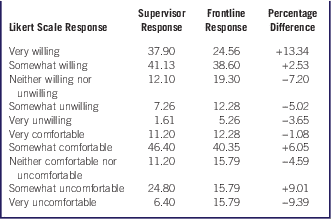
When respondents were asked whether they had ever been trained on how to screen or provide services to someone that might have a HID, 88.80% at the Supervisor level and 80.70% at the Frontline level reported “Yes;” however, an average of 78.69% of respondents stated that they only received re-training annually. Notable differences were found when respondents were asked to mark Frontline members’ levels of willingness to encounter HIDs. Overall, Supervisors perceived Frontline to be more willing than Frontline indicated; Supervisors also thought that Frontline would be more comfortable encountering HID scenarios than Frontline indicated (Table 1).
Percentage Differences in Supervisor-Level Perceptions of Frontline Level Versus Frontline-Level Self-Reported Percentages of Willingness and Comfortability to Encounter Potential Highly Infectious Disease Scenarios

When asked whether their organization has an effective relationship with the local public health department or CDC Quarantine Station, 78.86% and 50.88% at the Supervisor and Frontline Level, respectively, said “Yes.” When asked to describe the relationship between the organization and public health, the recurring open-ended responses were: monthly meetings, joint table top exercises, continuing education/training, and regular communication via e-mail.
Most frequently marked response for the level at which mandatory infectious disease reporting is conducted was “Agency level” (25.64% Supervisors, 37.74% Frontline), with the second most frequent being “County level” at 24.79% marked by Supervisors and “I don’t know” at 30.19% by Frontline. Nearly two-thirds of Supervisors (63.25%) reported their organization maintains its own Communicable Disease Emergency Response Plan (CDERP); less than half of Frontline members (35.19%) were aware of the CDERP and 37.04% of Frontline individuals indicated “I don’t know.” When asked whether their organization had standard operating guidelines (SOG) or standard operating procedures (SOP) in place for a HID response, 76.92% of Supervisors responded “Yes,” whereas 51.85% at the Frontline level reported “Yes” and 11.11% “I don’t know.” The majority of respondents reported the SOG/SOP had been revised in light of the Ebola outbreak (78.65% Supervisors, 62.96% Frontline). In addition, in reporting whether there were protocols that detail proper donning and doffing for PPE while conducting a screening, the majority reported “Yes” (76.07% Supervisors, 61.11% Frontline).
Infectious Disease Knowledge, Resources, and Training
The majority of respondents utilized government websites (i.e. CDC) (67.31% Supervisors, 42.31% Frontline) or their industry’s primary national organization’s website (i.e. ARFFWG) (50.96% Supervisors, 48.08% Frontline) to receive up-to-date information about HIDs and outbreaks. Supervisors (35.58%) also utilized external agency alerts and memos. When asked to select how HIDs are transmitted, 29.47% of Supervisors and 27.50% of Frontline incorrectly marked Anthrax as transmissible by human-to-human contact; 33.33% of Supervisors and 48.78% of Frontline incorrectly marked EVD as airborne; 30.00% of Supervisors and 75.00% of Frontline incorrectly marked Marburg virus as airborne.
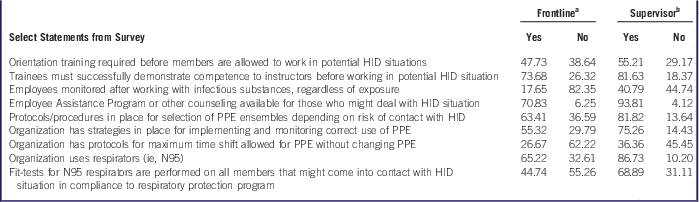
There were discrepancies on the existence of HID orientation and skills demonstration, employee health resources, and PPE policies and procedures, ranging from 7.48% to 24.13%, more Supervisors self-reporting “Yes” compared with the Frontline on policies, procedures, and resources (Table 2). The most commonly reported time frame for periodic re-training and continuing education was “Annually” (86.79% Supervisors, 70.59% Frontline), followed by “Bi-Annually” (7.55% Supervisors, 5.88% Frontline). Less than half of respondents reported their organization performing just-in-time (JIT) training before encountering an HID scenario (43.18% Supervisors, 31.11% Frontline) with 17.05% and 35.56% at the Supervisor and Frontline level, respectively, unaware of whether their organization conducts JIT. More than two-thirds of Supervisors indicated N95 fit-tests being performed (68.89%) but less than half for Frontline (44.74%).
Percentages of “Yes” and “No” Responses From Frontline-Level Versus Supervisor-Level Responses

Abbreviations: HID, highly infectious disease; PPE, personal protective equipment.
a For Frontline responses, “Yes” and “No” percentages do not add to 100% because those who marked “I don’t know” were not reported on this table.
b For Supervisor responses, “Yes” and “No” percentages do not add to 100% because those who marked “I don’t know” were not reported on this table.
DISCUSSION
ARFF are the frontline personnel for landed aircraft and facilities in US airports who have the potential to mitigate and manage infectious diseases carried and/or spread by passengers, as they are the first responders to these scenes. Moreover, ARFF can be under public scrutiny when managing suspected or confirmed cases of infectious diseases or bioterrorism. Hence, due to these circumstances and results of this survey, it suggests ARFF personnel would benefit from increased industry-specific HID education and training on HID mitigation and management. ARFF receives mandates on operations from the FAA, but ARFF does not have a national governing body, and only limited HID guidance relevant to ARFF infection control and occupational safety and health programs is offered within National Fire Protection Association consensus standards. 7 Hence, engaging airport leadership in formalizing HID education and training programs for ARFF workers by utilizing existing national resources could foster uniformity across the industry. 8 Moreover, delivering education and trainings that consist of substantial HID content more frequently than on an annual basis reinforces critical education and skills.
Noteworthy differences were found when respondents were asked how willing and comfortable they would be to encounter an HID scenario. Supervisors perceived Frontline to be more willing and comfortable to address these situations than the Frontline members self-reported. This suggests Frontline feel less prepared for HID situations than their Supervisors assumed, and/or Supervisors are more confident in workers’ abilities.
A large discrepancy in awareness of relationships with external stakeholders and partners was also identified with Supervisors being more cognizant of whether their organization had an effective relationship with the local public health department or CDC Quarantine Station. A greater percentage of Frontline, upwards of 30%, did not know what level mandatory infectious disease reporting was conducted and whether their organization maintained its own CDERP. Only half of Frontline were aware of their organization’s SOG/SOP, highlighting the lack of knowledge about reporting, emergency response plans, and SOG/SOPs. As HID events in this industry rarely have notification or foresight, it would benefit all to be aware of CDERP, SOG/SOPs, and mandatory reporting requirements. 9 Furthermore, greater communication is needed between the Supervisor and Frontline level so all individuals at an organization are aware of all HID resources available.
Approximately 25% more Supervisors accessed government websites and 10% more Supervisors utilized their organization’s primary national website to receive information about HIDs and outbreaks. More Frontline respondents incorrectly marked routes of transmission for viral hemorrhagic fevers, like EVD, as airborne. However, a greater percentage of Supervisors did not know the correct routes of transmission for Anthrax. Deficiencies in knowledge in occupational health and safety programs might be due to non-existent HID training components, underscoring the need for ARFF to improve overall knowledge of HIDs and potential exposures through enhanced education programs and more in-frequent trainings and skill practice; this could also bolster frontline personnel’s willingness to encounter such scenarios.
Lastly, in terms of HID orientation and skills demonstration, employee health resources, and PPE, large discrepancies were found (range: 7.5%-25%) with Supervisors marking “Yes” more frequently and/or having greater awareness of existing policies or procedures. More Supervisors (Table 2) reported having orientation training and demonstration of competence before allowed to encounter potential HID situations, that employees were monitored after potential exposure, employee assistance programs (EAP) were available, that protocols/procedures were in place for selecting appropriate PPE ensembles, and that there were strategies in place for monitoring appropriate usage for PPE. The greatest differences in responses between Supervisors and Frontline were in regard to whether employees were monitored after working with infectious substances, with more Supervisors marking “Yes.” When asked whether fit-tests were performed with N95 respirators, more Supervisors marked “Yes.” These findings highlight either the lack of knowledge at the Frontline level of these resources and protocols, and/or Supervisors over-reporting the availability. This also suggests re-training or more frequent training on proper donning and doffing of PPE ensembles and respiratory protection is necessary. Several studies have emphasized the importance of infectious disease orientation and skills demonstration, EAPs, and having consistently implemented PPE and respiratory protection protocols in place.Reference Campbell, Coffey and Lenhart 10
Study limitations include that the survey was voluntary, introducing possible self-selection bias. Furthermore, the lower participation rate may influence the utility of this data. The survey being created and distributed by an external entity, rather than ARFFWG, could have led to non-response error. The demographics of the ARFF members may not be generalizable to all ARFF workers in the ARFFWG. Lastly, because the survey did not force respondents to answer all questions, this led to skipped questions and varying response rates per question.
CONCLUSIONS
There are deficits in the knowledge, skills, and abilities around potential HID exposure to be addressed in order to enhance member safety, health, and well-being. This study illustrates the need for training and education, and initiatives to eliminate the perception gaps between frontline members and supervisors, and a need for further investigation. As ARFF consensus standards and governing regulations do not thoroughly address HIDs, stakeholders should proactively formalize consistent and regularly delivered education and training programs related to HIDs, and formalize protective programs and practices across the industry.
Acknowledgments
The authors would like to express our gratitude to our collaborators at the ARFFWG. The authors would also like to thank Sean Buehler for assistance with cleaning the data. In addition, the authors would also like to acknowledge the National Institute of Environmental Health Sciences (NIEHS) Worker Training Program (WTP) Ebola Biosafety and Infectious Disease Response Training (5UH4 ES027055). Grant funding did not contribute directly to the development or distribution of this survey, but the program did help highlight the need to conduct a gap analysis in this population. Lastly, the authors would also like to thank our consortium members in the Biosafety and Infectious Disease Training Initiative (BIDTI) at the University of Texas Health Science Center at Houston (UTHealth) School of Public Health: Dr Janelle Rios, Dr Robert Emery, and Dr Scott Patlovich and at Harvard T.H. Chan School of Public Health: Dr Paul Biddinger for their partnership and support.
Funding
No financial support to report.
Supplementary Material
To view supplementary material for this article, please visit https://doi.org/10.1017/dmp.2017.142