INTRODUCTION
This article examines religiosity and trust in religious institutions in Armenia, Azerbaijan, and Georgia. Specifically, it investigates the determinants of trust in religious institutions among societies with low levels of religiosity. The analysis employs data from the Data Initiative Project (2007) — a nation-wide survey conducted by the Caucasus Research Resource Centers (CRRC) regarding an array of social, political, and economic issues in Armenia, Azerbaijan, and Georgia.Footnote 1 The article differs from more common literature regarding trust in political and democratic institutions in post-communist countries, by exploring trust in religious institutions — an often neglected area and frequently the second most trusted type of institution in the post-communist region after the army. In addition, the article tests a cultural theory of interpersonal trust and evaluates recent reformulated secularization theories related to trust in institutions.
Does a high level of religiosity within a society imply that that society also has high trust in religious institutions? This analysis will show that Armenia, Azerbaijan, and Georgia exhibit low levels of religiosity as measured by attendance, prayer, and fasting, similar to many countries in Western Europe. However, all three countries have high levels of trust in religious institutions although they experienced peculiar forms of assertive state-sponsored modernization and secularization during the Soviet Union.Footnote 2
This peculiarity may be one of the reasons why Armenia, Azerbaijan, and Georgia present an unusual puzzle for two different forms of secularization theory.Footnote 3 These are all countries that would be considered secular under earlier versions of secularization theory that focused on declining religious practices. However, these countries would be considered non-secular with respect to the more recent adaptations of secularization theory that concentrate on declining religious authority (sometimes by trust in religious institutions).
The fact that trust in religious institutions is not a function of religiosity as measured by religious practice in the South Caucasus also indicates that we need to better understand the explanatory value of the term religiosity. This study uses two different measures of this multidimensional concept. First, religious practice is defined by attendance at religious services, prayer, and fasting. Second, we consider the subjective importance of religion in daily life.
Similarly, the European Values Survey characterizes religiosity in two dimensions: intrinsic and external religiosity.Footnote 4 External religiosity refers to an individual's adherence to a particular religious denomination or religious beliefs and practices. This includes attendance at religious services and participation in religious rituals. According to the European Values Survey, intrinsic religiosity refers to self-identified religiosity such as a belief in God, regular prayer, the subjective importance of God, and whether or not religion is considered to provide comfort and strength. I shall, however, classify prayer as a religious practice and include it as a form of external religiosity because it is a form of outward behavior such as attendance at religious services and participation in religious rituals.
My aim in this article is threefold. First, it is one of few analyses to test theories of institutional trust specifically in Armenia, Azerbaijan, and Georgia — part of the post-Soviet region that is known for having low trust in institutions compared to other regions of the world. While the military is often the most trusted institution in many post-communist countries, no work has been done on the second most trusted institution in this region — religious institutions. Second, the article utilizes a different view of religiosity that takes into account the “privatization of religion.” Therefore, it seeks to shift the focus of much of the literature on politics and religion from religiosity as defined by religious practice to a more nuanced understanding of religiosity that incorporates practices, belief, and the subjective importance of religion into consideration. Third, I shall argue that many bodies of secularization theory have inadequately operationalized religiosity only as practice or as declining religious authority.
The first section discusses literature related to religiosity and secularization. The second examines trust and religiosity in the South Caucasus. The third section provides theoretical perspectives relevant to trust in religious institutions as well as the operationalization of included variables and their associated hypotheses. The fourth segment explains the methodology of the Data Initiative (DI) survey and includes an analysis and discussion of the findings.
RELIGIOSITY AND SECULARIZATION
Since the 1960s, the religious landscape of many countries has undergone a variety of changes. Western Europe has experienced declining levels of church attendance and religious affiliation. The first wave of autochthonous leaders of many post-colonial states was composed of self-proclaimed secularists. These developments, among others, seemed to provide support for secularization theorists such as Dobbelaere (Reference Dobbelaere1985) and Wilson (Reference Wilson1982), who, despite their different interpretations of secularization theory, argued that the process of secularization was indeed taking place, and that religious practices, beliefs, and institutions were losing their social significance.
Nevertheless, global developments that demonstrated the durability of religion as a social force overshadowed these ostensible successes of secularization theory. These include, among other events, the 1979 Iranian Revolution, the rise of the religious right in the United States particularly since the mid-1980s, the increasing political prominence of the Hindutva movement in India, and the religiously-infused political violence of the early 21st. century.
Moreover, the nature of religiosity itself appears to have changed in many societies over time. Much of Europe has transformed toward more individualized religious beliefs with a concomitant decline of religious practice and attendance.Footnote 5 Increasing numbers of people who “believe without belonging” or claim membership in a religious faith without practicing any of its rituals evinces this shift toward a privatization of religion. For example, this form of privatization (e.g., the subjective importance of religion and denominational membership) is quite high in Armenia, Azerbaijan, and Georgia although levels of attendance, prayer, and fasting in these countries are similar to those found in many Western European states.Footnote 6 According to the Data Initiative Project (2007), the percentage of people who claim a religion or denomination is 96.7% in Armenia, 99.6% in Azerbaijan, and 98.7% in Georgia.
This shift in the nature of religiosity demonstrates that religion and its influence would not disappear, but rather transform. These changes motivated many secularization theorists to modify the concentration of their theories from a decline in religious attendance, practices and beliefs (Bruce Reference Bruce1995; Greeley Reference Greeley1989) to a decline in religious authority (Chaves Reference Chaves1994; Dobbelaere Reference Dobbelaere1989).Footnote 7 Moreover, this shift has enabled some of these theorists to account for societies in which religious practice and adherence have not dwindled, yet religious authority has (e.g., the United States).
Chaves (Reference Chaves1994) is one of the main proponents of the notion that secularization is better understood as diminishing religious authority, rather than declining religion (i.e., practice).Footnote 8 In his view, trust is a measure of legitimacy in religious authority and there are three key ways in which secularization affects religious authority. First, societal institutions become disjoined from religious institutions. Second, the structure and nature of religious institutions approaches that of secular institutions. Third, religious practices and beliefs decline. Hoffmann (Reference Hoffmann1998) remarks that this reformulation of secularization theory helps to reshape the traditional monolithic view of secularization and allows for a more complex interpretation in which secularization can occur in many different ways. Similar to Chaves, Wilson (Reference Wilson and Philip1985) argues that secularization is a process in which religion has “lost its presidency over other institutions.”Footnote 9 Thus, this reformulation of secularization theory helps to account for societies with high levels of religiosity including prayer and attendance, but low levels of religious authority.
This brand of secularization theory, however, does not account for the existence of societies with low religious practice and high legitimacy in religious authority as measured by trust. In the traditional view, the three main populations of the South Caucasus could be considered secular due to similar rates of religious practice as in Western Europe. However, more contemporary understandings would not indicate secularization, due to a high level of trust in religious institutions in these three countries.
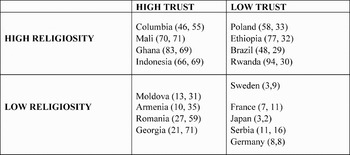
In order to explore the determinants of trust in religious institutions in Armenia, Azerbaijan, and Georgia, we must understand that religiosity is a multidimensional and complex concept such that religious practice does not necessarily translate into trust in religious institutions. Figure 1 shows a typology of religiosity in selected countries as measured by attendance at religious services once a week or more and trust in religious institutions.
Religiosity and Trust in Religious Institutions (% church attendance, % trust in religious institutions). Source: WVS 2005–2008 wave. Church attendance (i.e., religious service attendance) was used as a form of religiosity to compare across countries rather than rates of prayer and fasting because WVS includes both rates of church attendance and levels of confidence in religious institutions for more countries in the world. Church attendance is measured by percentage of attendance once a week or more. Countries were selected to illustrate ideal types in each category. Low trust refers to less than 30–33% trust in religious institutions. High trust refers to more than 30% trust in religious institutions. Low religiosity is defined as 30% or less religious service attendance once a week or more. High religiosity is defined as 40% or more religious service attendance once a week or more.

The high religiosity-high trust category shows a few countries in which the percentages of church attendance at least once a week and trust in religious institutions are both high (i.e., over 50% of the population). The high religiosity-low trust group presents select countries with a high percentage of church attendance at least once a week, but a significantly lower percentage of trust in religious institutions. The low religiosity-low trust set of countries are those in which a small percentage of the population attends religious services at least once a week and a small percentage trusts in religious institutions. Finally, the low religiosity-high trust category displays some countries in which a small percentage of the population attends religious services at least once a week or more, and yet a large percentage has trust in religious institutions. This complex relationship between religiosity and trust in religious institutions indicates that we need to better understand why the latter is important and what this means for the legitimacy and authority of those bodies.
RELIGIOSITY AND TRUST IN INSTITUTIONS IN ARMENIA, AZERBAIJAN, AND GEORGIA
I am particularly interested in countries where trust in religious institutions is much higher than trust in any political or democratic institution. Trust is important for many types of institutions to function and consistent levels of low trust in political and democratic institutions can easily challenge regime legitimacy (Miller and Listhaug Reference Miller, Listhaug and Pippa1999). Moreover, sustained high trust in religious institutions indicates that such institutions are considered more legitimate than political institutions. This has political implications for any type of regime, especially those that are transitioning, newly democratic or “hybrid democracies” such as Armenia, Azerbaijan, and Georgia.Footnote 10
Examining trust in religious institutions is a difficult enterprise, especially in a region where religion and ethnicity are closely associated and the term religious institutions can have various meanings.Footnote 11 Moreover, the nature of religious institutions may have an influence on trust in religious institutions. For example, in Georgia the Georgian Orthodox Church is dominant and has a religious monopoly. By contrast, the Armenian Apostolic Church exists alongside quite old Catholic and Protestant communities in Armenia. In Azerbaijan, the Muslim religious hierarchies are more dispersed in nature.
In Armenia, 94.7% of the population belongs to the Armenian Apostolic Church.Footnote 12 In Azerbaijan, approximately 93.4% of the population identifies as Muslim out of which 65% are Shi'a and 35% are Sunni.Footnote 13 In Georgia, approximately 83.9% of the population identifies as a member of the Georgian Orthodox Church (GOC) and roughly 10% of the population identifies as Muslim.Footnote 14
The association between religion and ethnicity in Armenia, Azerbaijan, and Georgia is also evident in the relationship between religion and each state. The constitutions of these countries provide for the separation of church and state; yet each of these states has a high level of engagement with religion which includes the existence of government ministries that oversee religious affairs.Footnote 15 Thus, the term religious institution can have multiple meanings in each country.
First, this phrase could refer to governmental ministries such as the Department of Religious Affairs and National Minorities in Armenia or the Caucasian Muslim Board (CMB) in Azerbaijan. The CMB is a hierarchical state body and a Soviet-era institution that deals with religious issues.Footnote 16 For Sunni Muslims, the term religious institution may best refer to their specific mosque, masjid or madrasa.
The term religious institution may also refer to the religious denominations and associated institutions to which Armenians, Azerbaijanis, and Georgians specifically belong. These include the Armenian Apostolic Church, mosques, masjids or madrasas, or the Georgian Orthodox Church, respectively. To a certain extent the states of the South Caucasus strengthen the position of these religious institutions by providing privileges exclusively to these groups and by creating religious monopolies. For example, although both the Armenian constitution and the 1991 Law on Freedom of Conscience and Religious Organizations (amended in 1997 and 2001) provide for the freedom of religion and establish a separation of church and state, the constitution recognizes “the exclusive mission of the Armenian Church as a national Church in the spiritual life, development of the national culture, and preservation of the national identity of the people of Armenia.” Moreover, the document gives the Armenian Church official status as the national Church.Footnote 17 In addition to the constitution and the Law on Freedom of Conscience and Religious Organizations, the 2007 Law on Relations of the Republic of Armenia and the Armenian Church functions as a concordat between the state and the Armenian Church and provides benefits exclusively to the Armenian Church.Footnote 18
Similarly, the Georgian constitution guarantees freedom of religion and religious practice while recognizing the unique role of the GOC in the country's history. The 2002 concordat between the government and the GOC gives the patriarch immunity, provides GOC clergy exemption from military service, allows only the GOC the right to staff the military chaplaincy, and grants the GOC a consultative role in government.
In Azerbaijan, the state and Islam arguably have a more intricate relationship than the state and religion in Armenia and Georgia. The purpose of this article is certainly not to explain Islam with regard to Azerbaijan, but partially to examine determinants of high trust in religious institutions in the country. The CMB in Azerbaijan is a state-created muftiate inherited from the Soviet era that monitors sermons, appoints clerics to mosques, and administers Islamic education. The board is predominantly composed of Shia members; however, there are a few seats allotted for Sunni participants. In fact, the existence of the CMB helps to continue the ambiguous boundary between the Soviet peculiarity of “parallel Islam” in which there is a theoretical division between state-sanctioned “official Islam,” and unsanctioned “unofficial Islam” such as popular Muslim rituals and activities.Footnote 19 Thus, in Azerbaijan the term religious institution may refer to (1) the CMB, (2) specific mosques, masjids or madrasas, or (3) Islam as a whole.
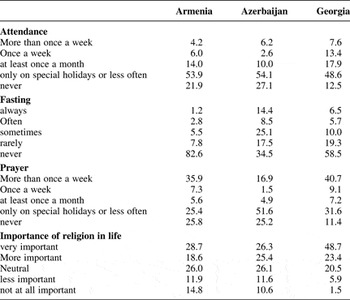
Trust in religious institutions is high despite low rates of religiosity (as measured by religious practice) in Armenia, Azerbaijan, and Georgia regardless of whether the term religious institution refers to government-established bodies or Christian and Muslim places of worship. Table 1 displays rates of attendance, fasting, prayer as well as the percentage of people who consider religion to be important in their daily lives for each of these countries.
Religious Practice and the Importance of Religion (%)

Source: DI 2007.
The DI measures attendance, prayer, and fasting using the following questions: “Apart from special occasions such as weddings and funerals, about how often do you attend religious services nowadays?” “Apart from when you are at religious services, how often, if at all, do you pray?” Both of these questions were measured on a 1 to 7 scale from “every day” to “never.” The scale was reversed so that lower scores connote lower attendance and higher scores indicate higher attendance in order to provide a more intuitive understanding of the variable. The DI question for fasting reads: “How often do you fast when required by your religious traditions?” Frequency of fasting was measured on a 1 to 5 scale from “always fast” to “never fast.” This scale was also reversed.
The presented levels of religious practice are similar to those in Western Europe and much of the industrialized world.Footnote 20 For example, 10.2% of people in Armenia, 8.8% in Azerbaijan, and 21% in Georgia attend religious services once a week or more, compared to 12.1% in Switzerland, 17.3% in Great Britain, and 24.6% in Canada.Footnote 21
The frequency of fasting is similarly low, while rates of prayer once a week or more are somewhat higher. By contrast, a high number of respondents in all three countries claimed that religion was “more” or “very” important in their daily lives (47.3% in Armenia, 51.7% in Azerbaijan, and 72.1% in Georgia). It seems that while religiosity as measured by religious practice is low throughout the region, the level at which people consider religion to be important in making decisions in their daily lives (i.e., the subjective importance of religion) is quite high. This incongruity between religious practice and the subjective importance of religion suggests that the former is not strongly correlated with trust in religious institutions. Therefore, different aspects of religiosity are important to examine and understand.
To more easily compare rates of religious practice with trust in religious institutions in the region, a religiosity index was created using an average of individual scores for attendance, fasting, and prayer.Footnote 22 The index captures the participatory aspect of religiosity. The original seven-point scale used to measure attendance and prayer was collapsed into a five-point scale to make these two variables amenable to indexing with fasting that was coded on a 5-point scale. The religiosity index ranges from lowest average participation at 1 to highest average participation at 5.Footnote 23
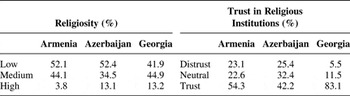
Table 2 shows percentages of high, medium, and low religious participation compared to percentages of distrust, neutrality, and trust in religious institutions in the three countries. What is striking is that while the results show low levels of religiosity in all three countries, over half of the groups also trust their religious institutions in each country. For example, 13.2% of people have a high level of religiosity in Georgia; yet 83% of them trust their religious institution. Even in Azerbaijan, which Gallup listed as one of the 11 least religious countries in the world in 2009, 42.2% of people trust their religious institution although only 13.1% of respondents have a high level of religiosity.Footnote 24 Similarly, only 3.8% of people have high religious practice in Armenia, while 54.3% of them trust their religious institution.
Religiosity and Trust in Religious Institutions

Source: DI 2007. The 5-point religiosity index was collapsed to a 3-point scale. “Very religious” (5) and “somewhat religious” (4) was assigned 3 for high religiosity. “Neutral” became 2 indicating medium religiosity. “Less religious” (2) and “not religious at all” (1) were assigned 1 for “low religiosity.” Trust in religious institutions is originally measured in the DI using a 5-point scale where “1” means “fully distrust,” and “5” means “fully trust.” The original 5-point scale has been collapsed to 3 categories in a similar manner as the religiosity index to provide a more straightforward illustration of trust, neutrality and distrust.Footnote 25
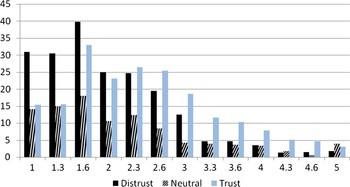
Figure 2 presents a cross-tabulation of religiosity (indexed) and trust in religious institutions. As the figure shows, the levels of both distrust and trust decrease as the level of religiosity increases. Lower levels of religious practice are more commonly associated with lower levels of trust in religious institutions in many other countries, while higher levels of religious practice are associated with higher levels of trust in religious institutions.Footnote 26 This more familiar pattern results in an x-shaped figure that is quite different from the one obtained from the South Caucasian data. Appendix A provides a list of 54 countries by religious attendance and trust in religious institutions from the 2005–2008 World Values Survey (WVS).Footnote 27
Religiosity and Trust in Religious Institutions (%). Source: DI 2007.

The table illustrates that rates of attendance and trust are relatively similar for most countries in Western Europe and elsewhere. However, as noted in Figure 1, Armenia, Azerbaijan, and Georgia (in bold) are members of a small group of countries throughout the world in which there is low religiosity, yet high trust in religious institutions (along with Romania, Chile, Ukraine, and Moldova). Moreover, the European Social Survey and European Commission's Eurobarometer Survey (2004) also indicate that there is a small group of countries with extremely high levels of trust in religious institutions and low levels of weekly church attendance (e.g., Denmark, 74% trust and 3% weekly attendance) although both religiosity (i.e., church attendance) and trust in religious institutions are low in most of European Union member states.Footnote 28
In addition to this seemingly odd relationship, religious institutions have an unusual status in post-communist region. They are often among the three most trusted institutions in the region, while political institutions are frequently the least trusted. For example, Sapsford and Abbott's (2006) examination of trust in government and societal institutions in eight post-communist countries reveals that respondents expressed the least trust in governmental institutions such as the national government, parliament, regional governors, and political parties.Footnote 29
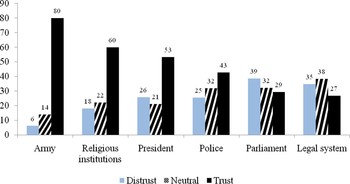
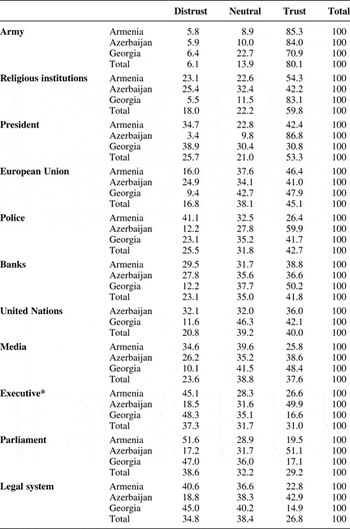
This result is consistent with findings from the South Caucasus. Table 3 provides the percentage of trust in different types of institutions for Armenia, Azerbaijan, and Georgia. Similar to many other post-communist countries, the army, religious institutions, and the president are the most trusted institutions in these three countries. State institutions such as the parliament, legal system, and executive are the least trusted.Footnote 30 This finding is also graphically displayed in Figure 3. Azerbaijan has the highest trust in legal institutions, parliament, executive, president, and police out of the three countries.Footnote 31 Moreover, it also has the lowest trust in religious institutions (42.4%) in the region, while Georgia stands out with 83.1% trust in this institution. Armenia stands in between these two countries with 54.3% trust in religious institutions.Footnote 32
Trust in Institutions (%, countries combined). Source: DI 2007.

Trust in Institutions (%)

Source: DI 2007. *Executive refers to the prime minister and ministers.
Why would these three post-Soviet countries have such low levels of trust in state and political institutions in favor of religious institutions? Sapsford and Abbott (Reference Sapsford and Abbott2006) put forth three arguments to explain the lack of trust in state institutions in post-communist countries. First, they claim that the political oppression of the Soviet regime delegitimized state institutions among the populace, thus resulting in low levels of trust. Second, they maintain that generally low levels of trust are due to the tumultuous nature of post-communist transition.Footnote 23 Finally, Sapsford and Abbott contend that low levels of trust in state institutions resulting from the breakdown of communist institutions have been replaced by a resurgence of traditional cultural values.
This hypothesized resurgence of cultural values may help to explain why religious institutions have frequently garnered such a high level of trust in a region generally considered heavily secularized due to the modernization policies and official anti-religious ideology of the former Soviet regime.Footnote 34 Analysis of the data is needed to evaluate the determinants of trust in religious institutions in these countries.
THEORIES, VARIABLES, AND HYPOTHESESFootnote 35
The dependent variable is trust in religious institutions. The DI measures trust in the religious institutions that the respondent specifically belongs to with the following question: “I will read out a list of social institutions. Please, assess your trust toward them (e.g., the religious institution that you belong to) on a 5-point scale, where “1” means “fully distrust,” and “5” means “fully trust.”Footnote 36
Mishler and Rose (Reference Mishler and Rose2001) identify two key theoretical perspectives to explain differing levels of trust in institutions. The performance-based theory maintains that trust in institutions is determined by how well individuals think institutions perform. For political institutions specifically, individual-level trust in institutions will be higher the better individuals think institutions perform economically and politically.
The culture-based theory supposes that higher levels of interpersonal trust translate into higher levels of trust in other spheres (e.g., institutions). Mishler and Rose (Reference Mishler and Rose2001) find support for the notion that trusts in people is an indicator of trust in institutions using data from the New Democracies Barometer for 10 post-communist countries.Footnote 37 Similarly, several other scholars (Lane Reference Lane1969; Almond and Verba Reference Almond and Verba1963; Inglehart Reference Inglehart1997; Putnam Reference Putnam1992; Reference Putnam2000) have used cultural explanations to argue that individuals who trust each other more tend to have more trust in institutions.Footnote 38
In this article, I consider only the role of the cultural-based theory because there are no tangible factors that measure performance of religious institutions that lend themselves to quantitative analysis. To measure interpersonal trust, the DI posed the following question: “People have different opinions whether others are trying to take advantage of them or whether they try to be fair. Using this scale, please tell me with which of the opinions expressed here do you agree, and to what extent?” The scale provided ranges from 1 to 10 where 1 denotes “people would try to take advantage of me” and 10 denotes “most people would try to be fair.”
Hypothesis 1:
The more an individual trusts other people, the more he/she will trust religious institutions.
In addition to interpersonal trust, trust in state institutions may have an important relationship with trust in religious institutions. Similar to Chaves and Wilson, Sommerville (Reference Sommerville1998) argues that secularization assumes a loss of religious authority since religious authorities and institutions must share (or yield) authority with secular entities. That is, less trust in religious institutions implies higher trust in secular (e.g., state) institutions.
I assess the relationship between trust in religious institutions and trust in five different state institutions: army, police, parliament, the legal apparatus, and the president. The DI measures trust in state institutions with the following question: “I will read out a list of social institutions. Please, assess your trust toward them on a 5-point scale, where “1” mean “fully distrust,” and “5” means “fully trust.”
Hypothesis 2:
Individuals who have high trust in the army will have low trust in religious institutions.
Hypothesis 3:
Individuals who have high trust in the police will have low trust in religious institutions.
Hypothesis 4:
Individuals who have high trust in parliament will have low trust in religious institutions.
Hypothesis 5:
Individuals who have high trust in the legal apparatus will have low trust in religious institutions.
Hypothesis 6:
Individuals who have high trust in the president will have low trust in religious institutions.
SOCIOECONOMIC CONTROL VARIABLESFootnote 39
In addition to trust between individuals and trust in state institutions, several socioeconomic control variables often associated with institutional trust have been added to the study. I use dummy variables to include religious denomination and account for people who identify as Armenian Apostolic, Orthodox, or Muslim.Footnote 40
Hypothesis 7:
Members of religious denominations will have more trust in religious institutions than individuals who are not members of specific denominations.
Similar to religious denomination, age, sex, location, education, monthly household expenditure, and perceived economic rung have also been included. While there is no common understanding of the impact of age and education on trust in institutions, these two variables have been associated with trust in institutions in many different contexts (Cole Reference Cole1973; Norris Reference Norris and Norris1999; Mishler and Rose Reference Mishler and Rose2001). Age is measured in years and age squared has been entered into the model in order to induce linearity.
Usually older individuals are expected to be more religious and have higher trust in religious institutions than younger individuals. However, in the post-communist context, older individuals may have less trust in religious institutions if they were socialized in the Soviet Union and experienced the varying Soviet policies toward religion over time. Norris and Inglehart (Reference Norris and Inglehart2004) argue that if the policies of Soviet atheism were effective, then religiosity should be higher in younger generations that grew up after the collapse of the Soviet Union, and in older generations that grew up in pre-Communist societies. Thus, middle-aged individuals would exhibit the lowest levels of religiosity. However, Need and Evans' (Reference Need and Evans2001) comparison of age groups in 10 post-communist countries finds that younger people displayed lower levels of religiosity (i.e., attendance) due to more urbanization and higher levels of education.
Hypothesis 8:
Older individuals will have more trust in religious institutions than younger individuals.
Education is measured using a 1 to 9 scale that captures increasing levels of education from “no primary education” to a “post-graduate degree.” This variable is treated as a continuous variable in the model since it has many levels and is measured on an increasing scale.
Hypothesis 9:
More educated individuals will have less trust in religious institutions than less educated individuals.
Sex is included as a dummy variable with male coded 1 and female coded 0. Location is also included as a series of dummy variables with residence in the capital or urban area, each coded 1 and 0 for otherwise.Footnote 41 Here rural residence is the baseline category. Monthly household expenditure has been included as a proxy for income since respondents often give more accurate responses regarding household expenditure than personal income. Monthly household expenditure was measured using the relevant national currency.Footnote 42 I converted these currencies to dollars using the average exchange rate for 2007 in order to compare across countries. Finally, to measure subjective economic status (i.e., perceived economic rung), the DI asked respondents to rank their perceived economic position relative to the rest of their society on a 1 to 10 scale where 1 denoted “lowest rung” and 10 denoted “highest rung.” This is also treated as a continuous variable.
Hypothesis 10:
Women will have more trust in religious institutions than men.
Hypothesis 11:
Individuals who reside in the capital or urban locations will have less trust in religious institutions than those living in rural areas.
Hypothesis 12:
Individuals with higher household expenditures will have less trust in religious institutions.
Hypothesis 13:
Individuals who rank themselves high on the perceived economic rung will have less trust in religious institutions.
RELIGIOSITY INDICATOR
In addition to theories of trust and socioeconomic determinants, both modernization and older secularization theories have maintained that the significance of religion would fade due to changes brought about by education, literacy, urbanization, and economic growth.Footnote 43 I question the notion that traditional measures of religiosity (e.g., attendance, fasting, or prayer) are sufficient for measuring the impact of religiosity on political and social phenomena. Furthermore, I refrain, in this article, from assuming that low religious practice is proof of secularization and modernization. Therefore, I have included another variable used to exemplify a different dimension of religiosity — the subjective importance of religion.
To capture this the survey asks: “To what extent do your own religious beliefs help you to make decisions in daily life on a 5 point scale where “1” means that your own religious beliefs are not at all an important influence on your decisions in daily life, and “5” means that your own religious beliefs are a very important influence on decisions in your daily life.” Whereas, traditional measures of religiosity often pertain to religious participation or a combination of intrinsic and extrinsic factors, the subjective importance of religion presents a way to better examine “privatized religiosity” as an explanatory variable.
Hypothesis 14:
Individuals who believe religion to be personally important in their lives have a higher level of trust in religious institutions.
METHODOLOGY
This study uses data from the 2007 DI that employed multistage cluster sampling with preliminary stratification on nine geographically defined units in Armenia, Azerbaijan, and Georgia.Footnote 44 The number of primary sampling units (PSUs) was defined in proportion to the number of households within each assigned stratum. Based on the sampling frame, the countries were divided into PSUs with an average PSU size of 500 households in Armenia, 400 in Georgia, and 500 in Azerbaijan. Fifty households on average were randomly sampled in each PSU for an interview.Footnote 45
Both a household and an individual interview were conducted in each household (HH) to obtain general HH data as well as information regarding individual social and political attitudes.Footnote 46 In Armenia, 2,514 HH, and 2509 individual interviews were conducted. In Georgia 2,148 HH and 2,146 individual interviews were carried out. Finally, in Azerbaijan 3,392 HH and 3,354 individual interviews were completed. The unit of analysis for this article is the individual since we are concerned with levels of trust at the individual level. Therefore, only data from the individual interviews have been examined.
ANALYSIS AND DISCUSSION
Trust in religious institutions is an ordered categorical variable with a 5-point scale. However, it is treated as a continuous variable in this analysis and OLS regression is used. The regression uses the following model and the key independent variables are grouped into three categories: socioeconomic control variables, trust variables, and a religiosity indicator.Footnote 47
Trust in religious institutions = α+ β1(sex) + β2(age) + β3(educational level) + β4(urban residence) + β5(capital residence) + β6(Orthodox religion) + β7(Islam) + β8(economic rung) + β9(household expenditure) + β10(interpersonal trust) + β11(trust in army) + β12(trust in police) + β13(trust in parliament) + β14(trust in legal) + β15(trust in president) + β16(importance of religion) + ɛ.Footnote 48
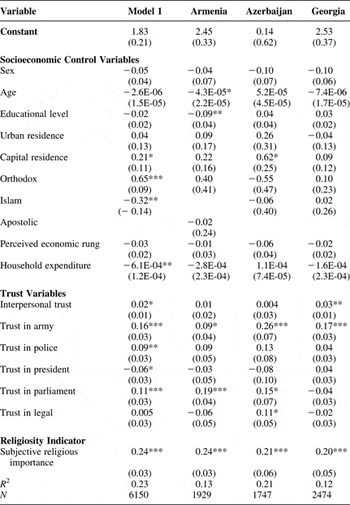
Table 4 presents the multivariate analyses. The first column provides the fully specified model for Armenia, Azerbaijan, and Georgia combined. The other columns show results for each country separately. In the combined model, Orthodox religion, Islam, capital residence, and household expenditure are significant socioeconomic control variables.
Trust in religious institutions regressed on hypothesized determinantsa

*p<0.05; **p < 0.01; ***p < 0.001.
a Entries in this table are unstandardized regression coefficients with standard errors in parentheses.
The sign on the Orthodox coefficient indicates that individuals who declare Georgian, Russian, or Ukrainian Orthodoxy as their religion have more trust in their religious institution than those who are Armenian Apostolic (i.e., the baseline category). In fact, this variable has the strongest impact on trust in religious institutions (β = 0.65) for the region as a whole. This implies that those who identify as Orthodox in the region have higher levels of trust in religious institutions than others in general.
In contrast to the Orthodox variable, the negative coefficient for Islam indicates that people who identify as Muslim have lower trust in their religious institution than the baseline category, Armenian Apostolics. This is consistent with the notion that Azerbaijanis are less “involved” with Islam and its associated “institutions” than the other two groups. This negative association may also reflect the relationship between religion (or a religious institution) and the state. In contrast to Georgia and Armenia, since independence Azerbaijan has actively sought to bring Islam under state control by creating the CMB, controlling religious sermons and the flow of religious literature as well as by monitoring the use of mosques and religious groups.Footnote 49 Unlike the prior two states, Azerbaijan has not promoted a particular religion and for the most part only the symbols of Islam have been utilized publicly (e.g., the crescent moon and taking the oath on the Quran). Therefore, the level of type of state engagement with a particular religion may affect trust in religious institutions. However, this is a topic for further research.
Besides the relationship between religious denomination and trust in religious institutions, the sign of the coefficient for household expenditure is in the expected direction. For a one unit increase in household expenditure, trust in religious institutions decreases when all other variables are held constant. Surprisingly, the coefficient for residence in the capital is positively significant while urban residence is not. This could possibly be explained in the Azerbaijan model below. Age, sex, educational level, location of residence, and perceived economic rung have no significant impact.
With regard to the trust variables, interpersonal trust and trust in the army, police, and president are significant predictors of trust in religious institutions. An increase in trust in these four variables indicates an increase in trust in religious institutions. Trust in the president is also a significant indicator of trust in religious institutions; however its negative coefficient indicates that trust in religious institutions decreases as trust in the president increases. Finally, for the region as a whole, the subjective importance of religion is significant at the 99.90% confidence level, and indicates that the more important individuals believe religion to be in their daily lives, the more trust they will have in religious institutions. This is the case even though levels of religiosity indicated by attendance, prayer, and fasting are low throughout the region.
In Armenia, age and educational level are both negatively associated with trust in religious institutions. This indicates that younger people and individuals with higher levels of education have less trust in these types of institutions. The other socioeconomic variables are not significant. Unlike the combined model, the Armenia model shows that trust in other persons, the police, and the president are not significant predictors in Armenia. However, similar to the combined model, trust in the army and the parliament, and the importance of religion in daily life, also have a positive and significant impact on trust in religious institutions.
There may be two possible reasons for the connection between trust in the army and in religious institutions. First, perhaps the army in Armenia is viewed as an uncorrupted entity unlike the president, the police, and legal institutions. Second, the army may be viewed as a protector of the Armenian nation in a similar way as the Armenian Apostolic Church.Footnote 50 With respect to the importance of religion in one's daily life, the presence of a specific national and historic church that helps to set Armenians apart from many other nations may help to explain trust in religious institutions.Footnote 51 That is, trust in the Armenian Apostolic Church may be related to perceptions of the Armenian nation itself.
In Georgia, none of the socioeconomic control variables or other state institutions are significant. However, Georgia is the only country in which interpersonal trust is a significant indicator of trust in religious institutions. That is, the more people think others are trying to be fair, the more trust they have in religious institutions. Thus, Georgia is the only case that provides some support for cultural theories of interpersonal trust. Similar to the other two countries, trust in the army and religious importance are both positively correlated with trust in religious institutions and at the 99.9% confidence level. Similar to Armenia, the Georgian army may be perceived as the defender of the Georgian nation, especially in light of territorial and political disputes with Abkhazia, South Ossetia, and Russia.
Besides the army, the nature of Orthodoxy itself may be one reason why the subjective importance of religion is a determinant of trust in religious institutions in Georgia even though religious practice is not. For example, Titarenko (Reference Titarenko2008) maintains that the nature of Orthodoxy in Russia, Belarus, and Ukraine (similar to Georgian Orthodoxy) is related to low levels of church attendance. Similarly, other scholars such as Tomka (Reference Tomka2006) claim that official Orthodox norms and practices are more disconnected with each other than in Western Christianity, and that individuals who identify as Orthodox are not obliged to attend religious services. According to this argument, attendance should not be understood as an indicator of religiosity in the same way it is in the West, because Orthodox religiosity is centered on self-identification rather than religious practice. This may help to explain why Georgians claim that religion is important in their daily lives much more than they participate in religious practices.
In addition to possible denominational differences, the presence of a religious figurehead may be another explanation for why the importance of religion is associated with trust in religious institutions. As in Armenia, Georgia has a national and historical church that is closely linked with Georgian national identity. The patriarch of the Georgian Orthodox Church, Ilya II, is one of the most trusted and respected leaders in Georgia.Footnote 52 He is viewed as the representative of the Church and above the disarray that confounds much of Georgian politics. Moreover, Ilya II has been a significant authority in much of Georgian society and politics. As confirmation of the patriarch's status, both President Saakashvili and major opposition leaders prayed together with the patriarch before mass demonstrations intended to oust the president on April 9, 2009. Moreover, recent negotiations between the Georgian government, opposition leaders, and foreign diplomats have occurred at the behest and arbitration of the patriarch. Thus, Georgians may associate trust in their religious institution with trust specifically in the patriarch since Ilya II is perceived to be an uncorrupt leader whose personage is closely connected with the GOC.
In Azerbaijan, residence in the capital is the only significant socioeconomic control variable. This relationship between residence in the capital and trust in religious institutions may be related to demographics as well as the notion that the CMB is perceived to be a Shia-dominated organization.Footnote 53 Valiyev (Reference Valiyev2005) notes that Shi'a Muslims are predominantly located in the capital Baku and the suburbs; whereas, Sunni Muslims mostly reside in the northern and western regions of Azerbaijan.
Additionally, the relationship between residence location and trust in religious institutions may be related to ethnicity. Some ethnic minorities in Azerbaijan such as Lezgins and Avars who make up less than 3% of the total population are generally Sunni and live in the northern part of the country bordering the North Caucasus. Therefore, the relationship between regional location, ethnicity, and religion along with the notion that Sunnis do not have “religious institutions” in the same way that Shia Muslims or Christians do may help to explain the correlation between capital residence and trust in religious institutions in Azerbaijan.
As in the other models, trust in the army is positively associated with trust in religious institutions. The army may be seen as the protector of the Azeri nation within Azerbaijan, especially due to the protracted conflict over Nagorno Karabagh.Footnote 54 Trust in the army and trust in religious institutions may be related because both are perceived as important forms of cultural or ethnic identification with the Azeri nation in Azerbaijan. In addition to the army, trust in both parliament and legal institutions are also positively correlated with the dependent variable. Moreover, Azerbaijan is the only country in which the latter variable is significant. Finally, as in the other models, the subjective importance of religion is a significant indicator of trust in religious institutions.
Trust in the parliament is strongly associated with trust in religious institutions in all cases but Georgia. Finally, only trust in the army and the importance of religion in daily life are significant in all four models. The importance of religion in daily life has the strongest impact on trust in religious institutions in all models (combined model β = 0.24, Armenian model β = 0.24, Georgia model β = 0.20) except in the Azerbaijan model where residence in the capital (β = 0.62) has the strongest impact.
The results of the analyses show mixed results for the culture-based theory of interpersonal trust since it is only significant in the combined model and in the Georgia model. In terms of the reformulated version of secularization theory, both the high level of trust in religious institutions and the number of people who consider religion to be important in their daily lives show that religious institutions are considered legitimate in the South Caucasus. This is most likely due to the fact that in all three countries, religion is an integral part of national identity, history, and cultural heritage as previously mentioned. Even in Azerbaijan, the association with Islam may be based more on culture and ethnicity, rather than on religion. More specifically, the results indicate that trust in religious institutions may be a proxy for trust in the nation. This may also help explain why Azerbaijan has the lowest level of trust in religious institutions compared to Georgia and Armenia. That is, Islam is not an Azeri religion, whereas Armenian Apostolism and Georgian Orthodoxy are Armenian and Georgian religions, respectively. Furthermore, many religious institutions in these countries are seen as social institutions instead of strictly religious institutions.
The results also indicate that the two different measures of religiosity have different relationships with trust in religious institutions. The subjective importance of religion (i.e., intrinsic religiosity) is a significant determinant of trust in religious institutions, while religiosity as measured by religious practice (i.e., external religiosity) is not. Moreover, high trust in religious institutions suggests that religious institutions are considered legitimate by society — much more than many state institutions. The fact that “privatized religiosity” has increased in many countries over time helps to discredit previous secularization theories that claimed that religion and its importance would diminish. Furthermore, the existence of high trust in religious institutions casts doubt on later secularization theories that predict a decline of religious authority.
CONCLUSION
In this article, I have analyzed the determinants of trust in religious institutions in the South Caucasus. The article has moved from a discussion of religiosity based on religious practice to a more nuanced understanding of religiosity that incorporates the impact of “privatized religion.” The analysis has shown that although religious practice as measured by attendance, prayer, and fasting are low in all three countries, religious institutions are the second most trusted in Armenia and Georgia after the army, and the third most trusted in Azerbaijan. The results demonstrate that religious practice does not determine trust in religious institutions, but rather how important people consider religion to be in their daily lives is a significant predictor of trust in all three countries. There are also differences among the three countries. Georgia is the only country in which interpersonal trust is a significant indicator of trust in religious institutions. Residence in the capital is only significant in Azerbaijan and it provides the strongest impact on trust in religious institutions in this model. Additionally, Armenia is the only country in which both education and age are significant predictors of trust in religious institutions.
This analysis has used OLS regression to test two theories related to factors that constitute trust in religious institutions. First, cultural theories of interpersonal trust prove ambiguous in the region as a whole. Second, the relationship between religiosity and trust in religious institutions challenges reformulated secularization theories that predict a decrease in religious authority.
Finally, the results of this analysis also reveal the complex nature of religion in the South Caucasus. It is well known that Apostolism, Islam, and Orthodoxy are closely associated with Armenian, Azerbaijani, and Georgian national identity, respectively. More specifically, the results show that trust in religious institutions may be a proxy for trust in the nation. As a result, the notion of religion clearly extends beyond religious feelings and practices in this region. Rather, many people in these countries think institutions associated with these religions play a positive role in society. This is especially the case due to the failures of economic and political transition in the region and perhaps in this respect, Sapsford and Abbott's claim of a resurgence of cultural values in the post-communist world makes sense.
APPENDIX A: RELIGIOUS ATTENDANCE AND CONFIDENCE IN RELIGIOUS ORGANIZATIONS

aSource: World Values Survey 2005–2008. Whereas the DI asks respondents about specific “trust” in institutions, WVS uses the term “confidence” to assess the same underlying concept. The WVS question regarding confidence in church institutions reads as follows: “I am going to name a number of organizations. For each one, could you tell me how much confidence you have in them: is it a great deal of confidence [1], quite a lot of confidence [2], not very much confidence [3],or none at all [4]? The churches.”
APPENDIX B
Cross-tabulation of church attendance and trust in religious institutions (Germany).
Source: World Values Survey 2005–2008. The German case provides a classic example of a cross-tabulation between church attendance and confidence in religious institutions in countries with low religious practice. The figure shows lower levels of church attendance associated with higher levels of confidence in religious institutions and higher levels of church attendance associated with lower levels of confidence in religious institutions.

APPENDIX C: VARIABLE CODING

1Attendance and prayer were originally coded as follows: 1 = every day; 2 = more than once a week; 3 = once a week; 4 = at least once a month; 5 = only on special holidays; 6 = less often; 7 = never. Categories 1 and 2 were collapsed into one category “once a week or more” and categories 5 and 6 were collapsed into one category “only on special holidays or less often”. Then, the scale was reversed so that higher numbers indicate more frequent attendance and prayer.
2Fasting was originally coded as follows: 1 = always fast; 2 = often fast; 3 = sometimes fast; 4 = rarely fast; 5 = never fast. The scale was reversed.
APPENDIX D: DESCRIPTIVE STATISTICS FROM THE DI 2007