Introduction
Water quality factors such as pH, hardness, and turbidity are variable depending on the geographic location and source. Research studies have reported that spray water pH is an important factor that can negatively affect herbicide performance (Devkota and Johnson Reference Devkota and Johnson2016a; Devkota et al. Reference Devkota, Spaunhorst and Johnson2016b; Green and Cahill Reference Green and Cahill2003; Sarmah and Sabadie Reference Sarmah and Sabadie2002). Acidic or alkaline water pH can negatively influence herbicide performance by affecting the solubility of herbicide product or hydrolysis of the active molecule (Deer and Beard Reference Deer and Beard2001; Green and Cahill Reference Green and Cahill2003; Roskamp et al. Reference Roskamp, Turco, Bischoff and Johnson2013b). Green and Hale (Reference Green and Hale2005) reported that carrier water pH below the logarithm of the acid dissociation constant, pKa, enhanced weak-acid herbicide penetration into the leaf cuticle and cell wall. Alkaline water favors formation of herbicide-cation complex by releasing ionized glyphosate molecule, whereas acidic water pH decreases the availability of ionized glyphosate molecule, resulting in less herbicide-cation binding (Green and Cahill Reference Green and Cahill2003; Green and Hale Reference Green and Hale2005). Buhler and Burnside (Reference Buhler and Burnside1983) reported similar results; in their study, addition of acidifying agents in water (i.e., lowering water pH) increased glyphosate performance up to 30% compared with water used without acidifying agents. The authors also reported that the increased glyphosate performance with the use of acidic agent in the water was due to the reduction of herbicide-cation complex formation at lower pH. In another study, however, efficacy of a sulfonylurea herbicide was enhanced when applied in alkaline compared to acidic water pH, because of higher solubility (Sarmah and Sabadie Reference Sarmah and Sabadie2002).
In cotton and soybean production, foliar fertilizers are often applied to supplement micronutrients or to correct nutrition deficiency symptoms (Garcia and Hanway Reference Garcia and Hanway1976; Oosterhuis and Weir Reference Oosterhuis, Weir, Stewart, Oosterhuis, Stewart, Heitholt and Mauney2010). Growers often coapply foliar fertilizer with POST herbicides because it is a convenient and economical practice. However, some studies highlighted the negative impact of coapplied foliar fertilizers on herbicide efficacy (Chahal et al. Reference Chahal, Jordan, Burton, Danehower, York, Eure and Clewis2012; Devkota and Johnson Reference Devkota and Johnson2016a; Devkota et al. Reference Devkota, Spaunhorst and Johnson2016b). According to Bailey et al. (Reference Bailey, Poston, Wilson and Hines2002), activity of glyphosate was reduced on common lambsquarters (Chenopodium album L.), large crabgrass [Digitaria sanguinalis (L.) Scop.], morningglory (Ipomoea spp.), and smooth pigweed (Amaranthus hybridus L.) when coapplied with a chelated formulation of manganese (Mn) fertilizer. Glyphosate absorption and translocation were reduced on velvetleaf (Abutilon theophrasti Medik.) with the lignin or sulfate formulation of Mn fertilizer but remained unaffected with the ethylenediaminetetraacetic acid (EDTA) formulation (Bernards et al. Reference Bernards, Thelen, Penner, Muthukumaran and McCracken2005b). Chahal et al. (Reference Chahal, Jordan, Burton, Danehower, York, Eure and Clewis2012) reported that nutrisol fertilizer (10% calcium [Ca], 8% magnesium [Mg], and 8% zinc [Zn]) at 2.34 L ha−1 coapplied with glyphosate at 0.95 kg ha−1 reduced glyphosate efficacy. Similarly, glyphosate applied with Mn fertilizer (6% Mn sulfate or 6% Mn EDTA) resulted in lower control of velvetleaf and common waterhemp [Amaranthus tuberculatus (Moq.) J. D. Sauer], as reported by Bernards et al. (Reference Bernards, Thelen and Penner2005a). Effect of Zn2+ cation in the carrier water and its negative influence on glyphosate was reported by Buhler and Burnside (Reference Buhler and Burnside1983) and Nalewaja and Matysiak (Reference Nalewaja and Matysiak1991).
Diammonium sulfate, commonly known as ammonium sulfate (AMS), is a widely used water-conditioning adjuvant with weak-acid herbicides (Hartzler Reference Hartzler2001). AMS is reported to prevent the antagonistic effect of hard-water cations and improve efficacy of the weak-acid herbicides (Nalewaja and Matysiak Reference Nalewaja and Matysiak1993). Glyphosate activity was enhanced by the addition of AMS in spray water consisting of Ca2+ (Nalewaja and Matysiak Reference Nalewaja and Matysiak1991). Zollinger et al. (Reference Zollinger, Nalewaja, Peterson and Young2010) reported enhanced efficacy of tembotrione with the addition of AMS in the spray solution. Although most research indicates AMS enhancement of glyphosate efficacy (Salisbury et al. Reference Salisbury, Chandler and Merkle1991; Young et al. Reference Young, Knepp, Wax and Hart2003), there are few studies those showed no benefit of added AMS to glyphosate (Nurse et al. Reference Nurse, Hamill, Kells and Sikkema2008; Soltani et al. Reference Soltani, Nurse, Robinson and Sikkema2011). Similarly, variable results were observed on assay weed species with the use of AMS for glufosinate application (Maschhoff et al. Reference Maschhoff, Hart and Baldwin2000; Pline et al. Reference Pline, Wu and Hatzios1999).
In recent years, EnlistTM (Corteva Agriscience, Indianapolis, IN) traits have been introduced in corn, cotton, and soybean, enabling the use of Enlist weed control system on these crops. The Enlist weed control system consists of newer choline salt formulation of 2,4-D (Enlist One) and its premixed formulation with glyphosate (Enlist Duo®) herbicides. With the availability of Enlist technology, growers in United States have a new tool for controlling problematic weeds (Davis Reference Davis2012). Moreover, the newer products of 2,4-D and its premixed formulation with glyphosate is likely to be applied on more acreage because of widespread herbicide-resistant weed problems across multiple states (Culpepper et al. Reference Culpepper, Whitaker, MacRae and York2008; Heap Reference Heap2018; Jhala et al Reference Jhala, Sandell, Rana, Kruger and Knezevic2014; Johnson et al. Reference Johnson, Owen, Kruger, Young, Shaw, Wilson and Weller2009; VanGessel Reference VanGessel2001).
Currently, there is a lack of knowledge on the effect of spray water pH, coapplied foliar fertilizer, and use of AMS as a water-conditioning adjuvant on the herbicides labeled for the Enlist weed control system. The information on the influence of these factors on efficacy of 2,4-D and its formulation with glyphosate will be critical as the growers consider applying these herbicides for weed control. This information will be helpful in optimizing efficacy of 2,4-D, and 2,4-D plus glyphosate herbicides by amending issues with spray water pH and coapplied foliar fertilizer. Therefore, greenhouse and field research was conducted to evaluate the effect of spray water pH, coapplied Zn or Mn foliar fertilizer, and AMS on 2,4-D and premixed 2,4-D plus glyphosate efficacy for giant ragweed, horseweed, and Palmer amaranth control.
Materials and Methods
Greenhouse Studies
Greenhouse studies were conducted during fall of 2014 and spring of 2015. Bioassay plants were established using potting medium (Redi-Mix, Sun-Gro Redi-Earth Plug and Seedling Mix, Sun-Gro Horticulture, Bellevue, WA). Horseweed, giant ragweed, and Palmer amaranth seeds were planted and germinated in potting medium in 26 × 26 × 6 cm3 poly-flats. Seedlings at the one to two true-leaf stages were transplanted in 164-cm3 cone-containers (Ray Leach SC-10 Super Cell Cone-tainers, Stuewe & Sons, Tangent, OR) filled with potting medium. Transplants were watered daily and fertilized weekly (Miracle-Gro® Water Soluble All-Purpose Plant Food 24-8-16, Scotts Miracle-Gro Products Inc., Marysville, OH). The greenhouse was maintained at minimum and maximum temperatures of 25 C and 28 C, respectively, and lighting was used to provide a 16-h photoperiod.
Treatments consisted of three-way combinations of water pH, foliar fertilizer, and AMS. Water pH was adjusted at 4, 6.5, or 9 using organic pH buffer salts at 0.1 M concentration in deionized water (DI). Potassium hydrogen phthalate salt (Acros Organics, Geel, Belgium), potassium phosphate monobasic salt (Potassium Phosphate Monobasic Crystals, Avantor Performance Materials Inc., Phillipsburg, NJ), or Tris salt (Tris hydroxymethyl) aminomethane Acros Organics) were dissolved in DI water to adjust water pH to 4, 6.5, or 9, respectively. Each water pH level consisted of no fertilizer or Zn fertilizer at 2.5 L ha−1 (Agrisolutions Citri-Che Zinc 9%, Winfield Solutions, St. Paul, MN) or Mn fertilizer at 3.75 L ha−1 (Brandt EDTA 6% Manganese, Brandt Consolidated, Inc., Springfield, IL). Ammonium sulfate (N-Pak, 34% AMS; Winfield Solutions, St. Paul, MN) was used at 0% or 2.5% vol/vol of total spray solution. Herbicides were applied at the following rates: 2,4-D (456 g ae L−1 formulation of 2,4-D choline salt; GF-2654, Dow AgroSciences, Indianapolis, IN) at 0.28 kg ae ha−1; premix formulation of 2,4-D plus glyphosate (Enlist Duo herbicide; 195 g ae L−1 choline salt of 2,4-D and 205 g ae L−1 dimethylammonium salt of glyphosate; Dow AgroSciences) at 0.266 plus 0.283 kg ae ha−1, respectively. In addition, an untreated check was included for comparison. Treatments were applied using compressed air in a track sprayer at 140 L ha−1 with a TeeJet 8002EVS nozzle (TeeJet Technologies, Louisville, KY) and a spraying speed of 4.8 km hr−1. Giant ragweed was 10- to 15-cm tall, horseweed was at the 6- to 8-cm rosette diameter stage, and Palmer amaranth was 8- to 12-cm tall during treatment application.
Field Study
A fallow field study was conducted in the summer of 2014 and 2015 to evaluate the effect of spray water pH and coapplied foliar fertilizer on efficacy of premixed 2,4-D plus glyphosate. Horseweed was evaluated at the Purdue University Meigs farm near Romney, IN (40°16’11.5” N, 86°52’54.3” W), in 2014, where soil type was a Crosby-Miami silt loam soil (18% sand, 60% silt, 22% clay) with 2.9% organic matter and a pH of 6.9. In 2015, the horseweed site was a grower’s field near Cortland, IN (38°59’03.1” N, 85°56’41.2” W), where the soil type was a Fox-Ockley sandy loam (46.6% sand, 39.6% silt, and 13.8% clay) with 1.9% organic matter and a pH of 6.7. A grower’s field near Winamac, IN (41°06’57.4” N; 86°41’30.6” W) was the site for Palmer amaranth for both years. The soil type at this site was a Maumee loamy fine sand (85% sand, 10% silt, 5% clay) with 2% organic matter and a pH of 6.7. Plant density was 80 to 200 plants m−2 for horseweed and 100 to 350 plants m−2 for Palmer amaranth. Horseweed or Palmer amaranth were 5- to 20-cm tall at treatment application.
Treatments consisted of two-way factorial of carrier water pH and foliar fertilizer. Carrier water pH was maintained at either 4, 6.5, or 9, using organic pH buffer salts (as in the greenhouse study). Foliar fertilizer consisted of either Zn or Mn fertilizer (as in the greenhouse study) at 2.5 and 3.75 L ha−1, respectively. Premixed 2,4-D plus glyphosate was applied at 0.785 plus 0.834 kg ae ha−1, respectively. Treatments were applied using a CO2 pressurized backpack sprayer delivering 140 L ha−1 using a TeeJet XR11002 nozzle (TeeJet Technologies) with a spraying speed of 4.8 km hr−1. In addition, an untreated check was included for the treatment comparison.
Data Collection and Analysis
Greenhouse studies were conducted as a randomized complete block design with five replications and repeated over time. After treatments were applied, plants were evaluated in the greenhouse for 3 wk. Visually assessed percent control was recorded on a 0-to-100 scale (where 0 is equal to no injury or similar to untreated check, and 100 is equal to complete plant death) at weekly intervals for 3 wk after treatment (WAT). At 3 WAT, individual plants were harvested above the soil surface and plants were placed in a forced-air drier at 60 C. Plant shoots were dried for 1 wk and plant biomass was recorded. Data were analyzed separately for each weed species using PROC GLMMIX in SAS, version 9.3 (SAS Institute Inc., Cary, NC). Each weed species was analyzed separately. Percent control and percent biomass reduction data were arcsine square-root transformed to meet the assumption of normality and subjected to ANOVA. In both studies, there was no significant difference (α ≤ 0.05) between experimental runs; therefore, data were combined over experimental runs for additional analysis. Treatment means were separated using the adjusted Tukey test, with P ≤ 0.05 considered statistically significant.
The field study was conducted as a randomized complete block design with four replications and repeated over year for two experimental runs. Prior to the treatment application, a 1-m−2 area was flagged within each plot and initial density of horseweed or Palmer amaranth was recorded. After treatment application, visually assessed percent control was recorded, on a similar scale as used in greenhouse study, weekly for 4 WAT. The number of live plants was recorded at 4 WAT from the flagged area for final density count and aboveground biomass was harvested. The plant biomass was placed in a 60 C forced-air drier for 1 wk and dry weight was recorded. Dry weight was converted to percent biomass reduction and compared with the untreated check. Data were analyzed separately for each species using PROC GLMMIX in SAS, version 9.3. Data were checked for constant variance and normality using PROC UNIVARIATE in SAS, and data were transformed as needed. Percent control, density reduction, and biomass reduction data for both weed species were arcsine square-root transformed and ANOVA was conducted. Year effect was significant at α ≤ 0.05; therefore, data were separated by experiment year for analysis. Treatment means were separated using the adjusted Tukey test with significance at α ≤ 0.05. Mean separation for control rating and biomass reduction data from greenhouse and field experiments was conducted on the transformed data, but back-transformed means are presented in Results and Discussion.
Results and Discussion
Greenhouse Study of 2,4-D Efficacy
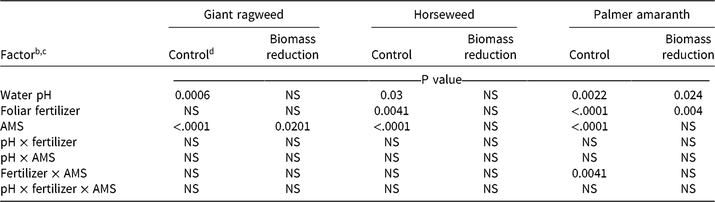
There were no two- or three-way interactions among spray water pH, foliar fertilizer, and AMS on 2,4-D efficacy for weed control and biomass reduction with the exception of Palmer amaranth control (Table 1). ANOVA illustrated an interaction between foliar fertilizer and AMS for Palmer amaranth control with 2,4-D (Table 1). The interaction suggested that Palmer amaranth control with 2,4-D was greater when applied without foliar fertilizer and using AMS, compared with application made with Zn or Mn foliar fertilizer and without AMS (data not shown).
P values for main effects and interactions of carrier water pH, foliar fertilizer, and ammonium sulfate (AMS) for giant ragweed, horseweed, and Palmer amaranth control and biomass reduction at 3 wk after 2,4-D application in the greenhouse study. a

a 2,4-D was applied at 0.28 kg ae ha−1.
b Water pH levels were 4, 6.5, and 9; foliar fertilizer consisted of zinc (2.5 L ha−1), manganese (3.75 L ha−1), or no fertilizer; and AMS was applied at 0% or 2.5% vol/vol.
c Abbreviations: AMS, ammonium sulfate; NS, not significant.
d Control and biomass reduction data for all the weed species were arcsine square root transformed and combined over experiment runs.
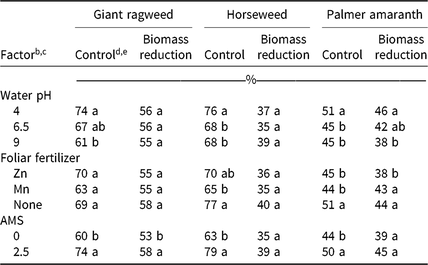
ANOVA revealed that 2,4-D efficacy for weed control was affected by the main effect of carrier water pH, foliar fertilizer, and AMS, with exception of giant ragweed control by coapplied foliar fertilizer (Table 1). Giant ragweed control with 2,4-D was 13% greater with carrier water at pH 4 compared with pH 9 (Table 2). Addition of AMS enhanced 2,4-D efficacy on giant ragweed and resulted into 14% greater control than without AMS. Horseweed control was 8% greater with 2,4-D applied at carrier water at pH 4 compared with pH 6.5 or 9. Coapplied Mn fertilizer reduced 2,4-D efficacy for horseweed control and resulted in 12% lower control compared with application without foliar fertilizer. The addition of AMS increased horseweed control 16% compared with 2,4-D alone. Palmer amaranth control with 2,4-D increased 6% with carrier water at pH 4 compared with 6.5 or 9. Likewise, biomass reduction was 8% greater with 2,4-D applied with acidic spray water compared with alkaline water. Palmer amaranth control with 2,4-D was reduced at least 6% with coapplied Zn or Mn foliar fertilizers, but only the addition of Zn resulted in 5% biomass reduction, compared with 2,4-D applied alone or with Mn fertilizer. Addition of AMS enhanced Palmer amaranth control 6% greater compared with 2,4-D applied alone, but there was no corresponding reduction in biomass accumulation.
Control and biomass reduction of giant ragweed, horseweed, and Palmer amaranth at 3 wk after 2,4-D application as affected by carrier water pH, foliar fertilizer, and AMS in the greenhouse study.a

a 2,4-D was applied at 0.28 kg ae ha−1.
b Water pH was adjusted to 4, 6.5, or 9 using pH buffer salts; foliar fertilizers consisted of zinc (at 2.5 L ha−1), manganese (at 3.75 L ha−1) or no fertilizer; and AMS was applied either 0% or 2.5% vol/vol.
c Abbreviations: AMS, ammonium sulfate; Mn, manganese; Zn, zinc.
d Control and biomass reduction data for all the weed species were arcsine square-root transformed and combined over experiment runs.
e Mean separation within a column among the levels of each factor are based on adjusted Tukey test at α = 0.05.
Results from current study correspond with the previously conducted study by Roskamp et al. (Reference Roskamp, Chahal and Johnson2013a) in which 2,4-D amine efficacy was antagonized with Mn fertilizer. Roskamp et al. reported that horseweed control reduction was 19% with 2,4-D amine coapplied with Mn foliar fertilizer compared to without it. They also reported that use of AMS overcame the antagonistic effect of Mn fertilizer on 2,4-D amine efficacy for common lambsquarters control. AMS enhanced common lambsquarters control at least 13% with 2,4-D amine. In the current study, AMS enhanced 2,4-D efficacy for giant ragweed, horseweed, and Palmer amaranth control. This result illustrates that AMS has a potential to optimize 2,4-D efficacy. Previous studies have reported that AMS enhanced herbicide efficacy by facilitating transcuticular movement and increasing herbicide absorption into the leaf (Gronwald et al. Reference Gronwald, Jourdan, Wyse, Somers and Magnusson1993; Kent et al. Reference Kent, Wills and Shaw1991; Wanamarta et al. Reference Wanamarta, Penner and Kells1989).
Greenhouse Study of Efficacy of Premixed 2,4-D Plus Glyphosate
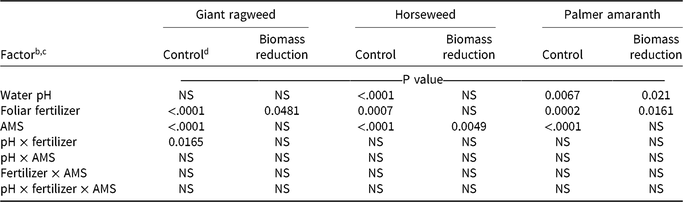
There were no three-way interactions among spray water pH, foliar fertilizer, and AMS on premixed 2,4-D plus glyphosate efficacy for weed control and biomass reduction (Table 3). However, a two-way interaction effect between water pH and foliar fertilizer was observed on herbicide efficacy for giant ragweed control. In this case, 2,4-D plus glyphosate applied at carrier water pH 4 and without foliar fertilizer provided greater control of giant ragweed compared with application made at alkaline water pH and coapplied Zn or Mn fertilizer (data not shown). This result could be attributed to the phenomenon whereby a weak-acid herbicide is deprotonated at higher pH and can bind with the salt cations present in the spray solution, resulting in formation of an antagonistic herbicide-salt complex (Nalewaja et al. Reference Nalewaja, Matysiak and Szeleniak1994). Nalewaja et al. reported that Spray-solution pH and salt-cation interaction resulted in reduced sethoxydim efficacy on oat (Avena sativa L.). The authors reported that the antagonistic effect of sodium and calcium cations were more pronounced when the spray solution pH was 7 or above, due to the antagonistic salt-complex formation.
P values for main effects and interactions of carrier water pH, foliar fertilizer, and AMS for giant ragweed, horseweed, and Palmer amaranth control and biomass reduction at 3 wk after premixed 2,4-D plus glyphosate application in the greenhouse study.a

a Premixed 2,4-D plus glyphosate (Enlist Duo) was applied at 0.266 plus 0.283 kg ae ha−1, respectively.
b Water pH levels were 4, 6.5, and 9; foliar fertilizer consisted of zinc (2.5 L ha−1), manganese (3.75 L ha−1), or no fertilizer; and AMS was applied at 0% or 2.5% vol/vol.
c Abbreviations: AMS, ammonium sulfate; NS, not significant.
d Control and biomass reduction data for all the weed species were arcsine square-root transformed and combined over experiment runs.
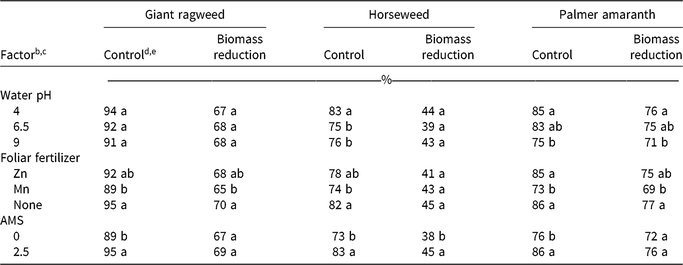
ANOVA showed that the main effect of carrier water pH influenced 2,4-D plus glyphosate efficacy for horseweed and Palmer amaranth control (Table 3). In addition, a significant effect of foliar fertilizer or AMS was observed for 2,4-D plus glyphosate efficacy on giant ragweed, horseweed, and Palmer amaranth control. Premixed 2,4-D plus glyphosate provided 7% and 10% greater control of horseweed and Palmer amaranth, respectively, with carrier water at pH 4 compared with pH 9 (Table 4). Likewise, Palmer amaranth biomass reduction was 5% greater with 2,4-D plus glyphosate applied with carrier water at acidic pH compared with alkaline pH. When considering the effect of foliar fertilizer, coapplied Mn fertilizer had a negative effect on premixed 2,4-D plus glyphosate efficacy for weed control. Giant ragweed, horseweed, or Palmer amaranth control were reduced at least 6%, 8%, and 13%, respectively, with coapplied Mn foliar fertilizer compared with no foliar fertilizer. In addition, giant ragweed and Palmer amaranth biomass was 5% and 8% less, respectively, when 2,4-D plus glyphosate was coapplied with Mn fertilizer compared with no foliar fertilizer. AMS enhanced premixed 2,4-D plus glyphosate efficacy on giant ragweed, horseweed, and Palmer amaranth control. Addition of AMS increased 2,4-D plus glyphosate efficacy at least 6%, 10%, and 10% for giant ragweed, horseweed, and Palmer amaranth control, respectively.
Control and biomass reduction of giant ragweed, horseweed, and Palmer amaranth at 3 wk after 2,4-D plus glyphosate application as affected by carrier water pH, foliar fertilizer, and AMS in the greenhouse study.a

a Premixed 2,4-D plus glyphosate (Enlist Duo) was applied at 0.266 plus 0.283 kg ae ha−1, respectively.
b Water pH was adjusted to 4, 6.5, or 9 using pH buffer salts; foliar fertilizers consisted of zinc (at 2.5 L ha−1), manganese (at 3.75 L ha−1), or no fertilizer; and AMS was applied at either 0% or 2.5% vol/vol.
c Abbreviations: AMS, ammonium sulfate; Mn, manganese; Zn, zinc.
d Mean separation within a column among the levels of each factor are based on adjusted Tukey test at α = 0.05.
e Control and biomass reduction data for all the weed species were arcsine square-root transformed and combined over experiment runs.
Even though there were increases in visual control rating, there were no reductions in biomass accumulation in giant ragweed or Palmer amaranth; however, horseweed biomass reduction was 7% greater with use of AMS compared with no AMS. In this study, horseweed was applied when plants were at the rosette stage (i.e., no visible stem and leaf petiole), whereas Palmer amaranth and giant ragweed were growing upright (with visible stem and leaf petiole). Herbicides were applied at a reduced rate (sublethal rate) for the greenhouse study. The differential response on biomass accumulation among the weed species is not known; however, the sublethal rates of growth-regulator herbicides induced growth of callus tissue on the stem and petiole of Palmer amaranth and giant ragweed plants. Other researchers have reported similar issues when evaluating growth-regulator herbicides, with treatments differences observed for percent control but not the biomass data, because of callus growth (Roskamp et al. Reference Roskamp, Chahal and Johnson2013a). Authors of these studies illustrated results with emphasis on percent control data.
Effect of carrier water pH was observed on glyphosate efficacy for torpedograss (Panicum repens L.) control, with glyphosate performing better at water pH of 6 compared with 8 (Shilling and Haller Reference Shilling and Haller1989). Likewise, glyphosate efficacy was greater with spray solution at acidic conditions compared with alkaline conditions, as reported by Shea and Tupy (Reference Shea and Tupy1984). In the current study, coapplied Mn foliar fertilizer reduced premixed 2,4-D plus glyphosate efficacy for weed control. Bernards et al. (Reference Bernards, Thelen and Penner2005a) reported that Mn-EDTA formulation did not have a negative effect on glyphosate efficacy. However, in our study, Mn-EDTA formulation had potential to negatively influence efficacy of premixed 2,4-D plus glyphosate formulation. The use of AMS has been reported to enhance efficacy of 2,4-D amine (Roskamp et al. Reference Roskamp, Chahal and Johnson2013a) and glyphosate (Thelen et al. Reference Thelen, Jackson and Penner1995; Young et al. Reference Young, Knepp, Wax and Hart2003). In addition, Bernards et al. (Reference Bernards, Thelen, Penner, Muthukumaran and McCracken2005b) reported that addition of AMS to Mn fertilizer mixtures enhanced glyphosate absorption, translocation, and velvetleaf control. Likewise, the current study illustrates that the use of AMS has potential to enhance efficacy of premixed 2,4-D plus glyphosate formulation. 2,4-D and glyphosate are weak-acid herbicides, and AMS enhancement of weak-acid herbicides has been reported in multiple studies (Ramsdale et al. Reference Ramsdale, Messersmith and Nalewaja2003; Roskamp et al. Reference Roskamp, Chahal and Johnson2013a; Zollinger et al. Reference Zollinger, Nalewaja, Peterson and Young2010). According to Thelen et al. (Reference Thelen, Jackson and Penner1995), the basis for AMS enhancement of herbicide is that the sulfate ion of AMS binds with cations such as Ca2+, Mg2+, K+, and Na+ in water, and ammonium ion forms a complex with the herbicide molecule. Moreover, increased glyphosate absorption through the leaf cuticle and cell membrane was reported (Smith and Born Reference Smith and Born1992; Thelen et al. Reference Thelen, Jackson and Penner1995).
Field Study of Efficacy of Premixed 2,4-D Plus Glyphosate
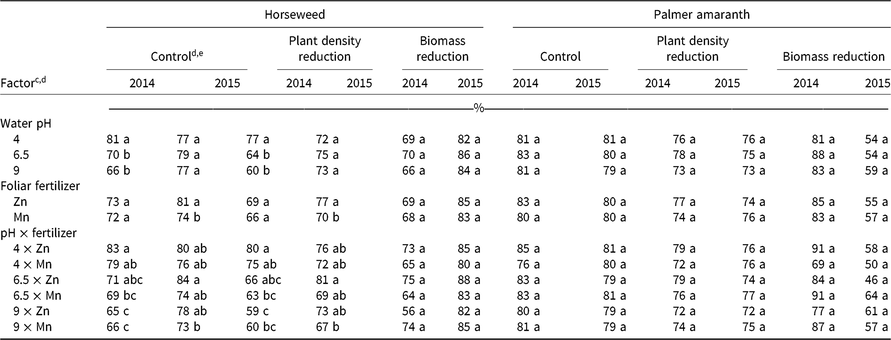
Influence of carrier water pH and foliar fertilizer on premixed 2,4-D plus glyphosate was variable with the study year as well as weed species (Table 5). In 2014, 2,4-D plus glyphosate applied at carrier water pH 4 and coapplied with Zn fertilizer resulted in greater horseweed control and density reduction compared with application made with coapplied Zn or Mn fertilizer and water at pH 9. The difference in 2,4-D plus glyphosate efficacy for control and plant-density reduction with these treatments was 17% and 21%, respectively. There was an interaction of carrier water pH and foliar fertilizer for horseweed control and density reduction in 2015. Horseweed control and density reduction were 11% and 14%, respectively, with premixed 2,4-D plus glyphosate when applied at carrier water pH 6.5 and Zn fertilizer, compared with carrier water at pH 9 and Mn fertilizer. However, interaction of carrier water pH and foliar fertilizer was not observed on premixed 2,4-D plus glyphosate efficacy for Palmer amaranth control across both the study years. Previous studies have suggested the effect of water pH on herbicide efficacy is highly variable depending on the herbicide and weed species (Bridges Reference Bridges1989; Nalewaja et al. Reference Nalewaja, Matysiak and Szeleniak1994). Bridges (Reference Bridges1989) reported that activity of sethoxydim on johnsongrass [Sorghum halepense (L.) Pers.] control remained unaffected with varying pH from 3.5 to 6.5. In contrast, sethoxydim efficacy on oat was influenced by spray-solution pH and cations, as reported by Nalewaja et al. (Reference Nalewaja, Matysiak and Szeleniak1994).
Control, plant density, and biomass reduction of horseweed and Palmer amaranth at 4 wk after 2,4-D plus glyphosate application as affected by carrier water pH, foliar fertilizer, and interaction of water pH and foliar fertilizer in the field study.a, b

a Premixed 2,4-D plus glyphosate (Enlist Duo) was applied at 0.785 plus 0.834 kg ae ha−1, respectively.
b Water pH level consisted of 4, 6.5, and 9; foliar fertilizers consisted of zinc (at 2.5 L ha−1), manganese (at 3.75 L ha−1).
c Abbreviations: Mn, manganese; Zn, zinc.
d Mean separation within a column among the levels of each factor are based on adjusted Tukey test at α ≤ 0.05.
e Control, plant density, and biomass reduction percent of each species were arcsine square-root transformed and separated by experiment year.
In conclusion, the current study illustrates that carrier water pH and coapplied foliar fertilizer have potential to affect 2,4-D and its formulation with glyphosate efficacy for weed control. Efficacy of 2,4-D and 2,4-D plus glyphosate was negatively affected by alkaline carrier water (pH 9). However, acidic carrier water pH (pH ≤6.5) was favorable for the herbicides used in our study. Coapplied Mn foliar fertilizer has potential to negatively affect weed control efficacy of 2,4-D and its formulation with glyphosate. Therefore, coapplying Mn foliar fertilizer should be avoided for optimizing weed control efficacy of herbicides used with the Enlist weed control system. The addition of AMS at 2.5% vol/vol in the spray solution improved efficacy of 2,4-D and 2,4-D plus glyphosate formulation for giant ragweed, horseweed, and Palmer amaranth control. Studies evaluating various mixtures of cotton and soybean insecticides, fungicides, and plant growth hormones with 2,4-D and premixed 2,4-D plus glyphosate and their influence on these herbicide efficacies will be critical for developing weed management guidelines.
Author ORCIDs
Pratap Devkota https://orcid.org/0000-0003-2206-8455
Acknowledgements
The authors would like to express sincere appreciation to the members at Purdue Weed Science Laboratory for their helping hands in this study. The authors are very thankful to the Indiana Soybean Alliance for providing funding support for this study. No conflicts of interest have been declared.