INTRODUCTION
Lentil (Lens culinaris Medikus subsp. culinaris) is one of the major food legumes grown worldwide (Muehlbauer et al. Reference Muehlbauer, Kaiser, Clement and Summerfield1995). Collectively, Bangladesh, India and Nepal are responsible for c. 0·30 of the global production of lentil, which is also the principal pulse of both Bangladesh and Nepal (FAO 2013). Lentil in these areas is grown on residual soil moisture following a crop of monsoonal rice (Ali et al. Reference Ali, Sarker, Rahman and Gahoonia2005, Reference Ali, Singh, Pramanik, Ali, Erskine, Muehlbauer, Sarker and Sharma2009).
In the Eastern Gangetic Plains of Bangladesh, India and Nepal, rice (Oryza sativa L.) cropping systems predominate. The lentil cropping period in Bangladesh and the north-eastern plain of India is relatively brief at ~120 days due to the short winter and use of long-duration (145–150 days) monsoonal rice cultivars. In Bangladesh, the most common rotations for lentils are: lentil–jute (Corchorus sp.)–monsoonal rice (0·29); lentil–mungbean (Vigna radiata (L.) R. Wilczek)–pre-monsoonal ‘aus’ rice (0·21); and lentil–mungbean–monsoonal rice (0·20) (Islam et al. Reference Islam, Miah, Zaman, Hossain, Zaman, Hossain, Khaleque, Ali, Hossail, Haque, Khalaquzzaman, Islam and Hossain2013). Lentil is also sometimes intercropped with other winter species, namely Brassica sp., linseed (Linum usitatissimum L.) and sugar cane (Saccharum officinarum L.) in Bangladesh (Miah & Rahman Reference Miah, Rahman, Erskine and Saxena1993) and in eastern India (Gupta & Bhowmick Reference Gupta and Bhowmick2012). The availability of irrigation has increased over the last 25 years, latterly through escalating numbers of shallow tube wells (Mandal & Parker Reference Mandal and Parker1995). This has allowed the cultivation of irrigated boro rice, grown from February to May, to expand dramatically (FAO 2013) and it is generally grown after monsoonal rice and at a brief fallow period (70–90 days). Consequently, the area of lentil has declined by 40% (BBS 2009; FAO 2013). This drop in production has created a shortfall between supply and demand, and lentil imports in Bangladesh has increased threefold from 50 000 t to over 150 000 t between 2001 and 2010 (FAO 2013).
Lentil sowing dates range from mid-October to December with the optimum in mid-November (Ali et al. Reference Ali, Saraf, Sing, Rewari, Ahlawat, Erskine and Saxena1993; Miah & Rahman Reference Miah, Rahman, Erskine and Saxena1993). The monsoonal rice harvest period is between November and early December, often resulting in a delay in lentil sowing of up to 3 weeks to allow for optimum moisture conditions and land preparation (Ali et al. Reference Ali, Sarker, Rahman and Gahoonia2005). However, as sowing date is critical for successful lentil cropping (Silim et al. Reference Silim, Saxena and Erskine1991; Wang et al. Reference Wang, Gruber and Claupien2013), this delay can result in reduced yields.
It is possible to increase lentil production while maintaining rice production. This could be achieved by decreasing the period of lentils in the field and targeting two cropping patterns, including introduction of lentil into irrigated boro rice cropping areas, where the land is left fallow after rice, and the development of a new cropping pattern consisting of monsoonal rice–lentil–pre-monsoonal aus rice. An additional option is to relay-sow lentil to gain time for vegetative growth and/or for crop duration between the two rice crops. In Nepal, relay sowing of lentil has become widespread: this involves broadcasting primed seed into standing monsoonal rice approximately 2 weeks prior to harvest (Ali et al. Reference Ali, Singh, Pramanik, Ali, Erskine, Muehlbauer, Sarker and Sharma2009). In eastern India, a similar system is a traditional method for the production of grass pea (Lathyrus sativus L.), a waterlogging- and drought-tolerant legume, and more recently for lentil (Ali et al. Reference Ali, Saraf, Sing, Rewari, Ahlawat, Erskine and Saxena1993; Gupta & Bhowmick Reference Gupta and Bhowmick2012). In Bangladesh, grass pea is widely relay sown into monsoonal rice (Malek et al. Reference Malek, Afzal, Rahman, Salahuddin and Knight2000); whereas lentil is traditionally sole cropped and relay sowing is not practised. There is a scope to relay sow ~10 000 ha of lentil into rice in Pabna, Natore, Kustia and Faridpur districts, where the current pattern has transplanted monsoonal rice–fallow–jute/sesame/mungbean.
The objective of the present study was to evaluate short-duration cultivars and relay sowing as options to reduce the growing period of lentil, so that it could be included in double-rice cropping systems. New early-flowering lentil lines were compared with existing cultivars over two winter seasons each in both sole-cropping and relay-sown trials. In the former, lentil crops were grown alone after traditional ploughing and land preparation; whereas with relay cropping the lentil seed was broadcast before the rice was harvested. Relay cropping was also evaluated on farmers’ fields.
MATERIALS AND METHODS
Evaluation of early-flowering lentils in sole cropping
The sole cropping experiments were conducted at the Bangladesh Agricultural Research Institute (BARI) Regional Agriculture Research Station at Ishurdi (24° 9′N; 89° 4′E; 19 m a.s.l.), which is in the major lentil-growing region of Bangladesh. The trials were run over two winter seasons from late October in 2010 and 2011, through to mid-February of the following year. Rice was the preceding crop for all experiments and land preparation was done by tractor ploughing. Trials were located on clay loam soil with pH of 7·5 (1 : 5 soil and water suspension) containing 12 g organic matter/kg (Walkley & Black Reference Walkley and Black1934), 17 mg N/kg, 26 mg P/kg and 300 mg K/kg. Monthly rainfall and temperature records for the duration of the experiment were collected from the nearest weather station (~1 km distance).
In both seasons the basal fertilizer was a mix of urea, triple superphosphate (TSP) and potassium chloride (muriate of potash [MoP]) at the rates of 20 kg N/ha, 40 kg P2O5/ha and 20 kg K2O/ha. The TSP and MoP were broadcast 2 days before and urea was top-dressed 20 days after lentil sowing. Weeding was carried out manually 30 days after crop establishment and when necessary thereafter, to keep the plots weed-free. The fungicide iprodione (Rovral® 50WP) was applied twice starting from the flowering stage to control Stemphylium blight. Lentil root nodulation was good and roots were not inoculated with Rhizobium.
Eighteen early-flowering lines of lentil, LRIL-21-109, LRIL-21-120, LRIL-21-163, LRIL-21-173, LRIL-21-210, LRIL-21-218, LRIL-21-224, LRIL-22-15, LRIL-22-28, LRIL-22-39, LRIL-22-70, LRIL-22-79, LRIL-22-95, LRIL-22-116, LRIL-22-146, LRIL-22-161, LRIL-22-215 and LRIL-22-216 from the International Centre for Agricultural Research in the Dry Areas (ICARDA) and BARI were evaluated and the control cultivars BARI Masur-5 and BARI Masur-6 were both included in 2010, with only the latter cultivar used in 2011. A split-plot design was used with three sowing dates as main plots and genotype as sub-plots with two replications in both seasons. The sowing dates were 26 October, and 10 and 26 November in 2010 and 2, 12 and 22 November in 2011, which were defined as early, optimum and late, relative to ‘farmer practice’, respectively. Early sowing was delayed by 7 days in 2011 to avoid excess soil moisture. Seeding was done by hand in rows 0·4 m apart at 40 kg of seed/ha at a depth of 3 cm. Each plot was 0·8 m (two rows) wide and 2 m in length. Flood irrigation to field capacity was applied after each sowing. Soil crusting was broken where necessary.
Evaluation of lentils in relay cropping
The relay cropping experiments were grown at Ishurdi in the winter seasons of 2011 and 2012. They included six lines from the sole cropping experiment in 2010 (LRIL21-109, LRIL22-15, LRIL 22-70, LRIL22-95, LRIL22-146 and LRIL22-215) along with the control cultivars BARI Masur-3 and BARI Masur-5. A randomized complete block design was used with three replications and plots were 4 × 5 m. The protocol for relay sowing was developed by Ali (Reference Ali2011), where seed was broadcast by hand into a uniform standing crop of monsoonal rice before harvest, when water was only visible as small puddles in the rice field. The lentil seed was primed in tap water overnight (i.e., ~10 h) and the seeds were relay-sown the next day, on 2 November 2011 and 11 November 2012, at the rate of 50 kg seed/ha. Rice was harvested manually 2 weeks after lentil broadcasting to leave ~25 cm of rice straw. The lentil plants had two to three leaves at this stage. Fertilizer and fungicide were applied as described for the sole cropping experiment, with the exception of urea being broadcast 2 days after harvest of the rice.
Evaluation of relay cropping on farmers’ fields
The cultivar BARI Masur-6 was used to compare relay cropping with conventional sole cropping, on 1 ha adjacent plots in farmers’ fields at four sites in 2011, at two sites in 2012 and at four sites in 2013 in two districts (Faridpur, 23°N, 90°E and Pabna, 24°N, 89°E). The sites were selected where farmers typically grow long-season monsoonal rice and lentil sowing was delayed until, after the rice harvest and land preparation. With relay sowing, seed was broadcast before rice harvest between 8 and 27 November, whereas in the conventional sole cropping it was broadcast into ploughed fields between 28 November and 9 December, in all the three seasons. Crop management was carried out by the research staff that was similar to the previously described, for the relay and sole cropping experiments. The only differences were the seed rate (~35 kg seeds/ha), and cow dung was also applied at 1240 kg/ha in sole cropping, as this was normal farmer practice.
Measurements
For the experiments at Ishurdi, time (days) as to when 50% of the plants had opened their first flowers and when 90% pods of plants reached maturity were recorded. At full pod maturity, plants in an area of 1·2 and 12 m2 in the sole and relay experiments, respectively, were uprooted and sun-dried on a concrete floor. They were threshed and winnowed manually and the yield was recorded. For the on-farm assessments, grain yield was determined by collecting three randomly selected samples, covering 100 m2 for both the sole- and relay-cropped lentil fields.
Statistical analyses
Data were analysed using GenStat for Windows statistical software (version 15·2.0.8821 VSN International Ltd). An analysis of variance (ANOVA) of the data was performed, after checking for the assumptions of normality and homogeneity of variances. Factors included in the model for the sole cropping experiment were year, sowing date and genotype, while year and genotype were used in the relay-sowing experiment. Year and crop system (sole v. relay) were the factors in the farmers’ field evaluation. Differences were considered significant at P < 0·05.
RESULTS
Seasonal weather conditions
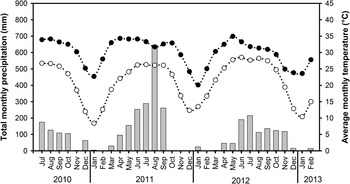
The 2010 season had both the highest seasonal mean maximum temperature (26·5 °C) and the lowest seasonal mean minimum temperature (12·9 °C) during the lentil growing period from 1 November to 28 February (Fig. 1). This season was the warmest because of relatively high November temperatures of 30·2 °C compared with 29·3 °C in the 2011 season and 24 °C in 2012. Furthermore, the average maximum temperatures during the growing season were also high compared with the following two seasons with the exception of January 2013, which was only 0·9 °C warmer. Conversely, the minimum temperatures in the growing season of 2010 were exceptionally cool compared with those of 2011 and 2012, with the lowest mean minimum of 8·4 °C occurring in January (Fig. 1).
Monthly rainfall (bars) (mm), maximum (closed circles) and minimum (open circles) temperature (°C) during the experimental period from 2010 to 2013 for Ishurdi, Bangladesh.

Total growing season rainfall was low in both 2010 and 2011 with 77 and 24 mm, respectively, but high during 2012 with 149 mm. However, lentils grow primarily on residual moisture from the preceding rainfall (1 April to 31 October) – when the monsoonal rice crop is growing – and in these seasons the rice received 824 mm in 2010, 1701 mm in 2011 and 868 mm in 2012 (Fig. 1).
Early-flowering lentils in sole cropping
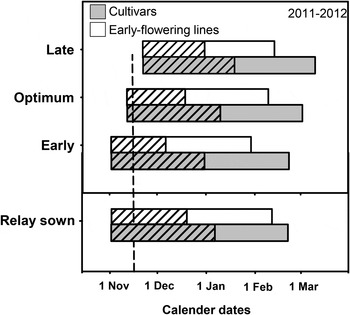
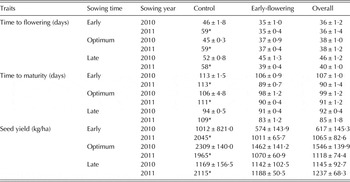
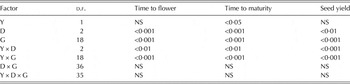
Sowing date significantly (P < 0·05) affected all measured parameters in both 2010 and 2011 seasons (Tables 1 and 2). The average time to flowering for early and optimum sowing dates were similar, with 1 and 3 days’ difference in 2010 and 2011, respectively. Sowing late in cooler conditions, delayed flowering by 8 and 2 days compared with optimum sowing in the respective seasons. Early-flowering lines flowered on an average of 9–17 days earlier than the controls, irrespective of sowing date (Tables 1, Fig. 2). Time to flowering for early-flowering lines sown at the optimum sowing date was 37 days in both seasons. However, with late sowing it was 6 days earlier in 2011 (39 days) compared to 2010 (45 days), because of the 5 °C higher in the January minimum temperature, in 2011. Time to flowering for early sowing date was 36 days in both years (Table 1). The controls took 14 days longer to flower in 2011 compared with 2010.
Calendar dates for sowing, time to flower (lined) and time to maturity (clear) of early, optimum and late-sown sole crops and relay-sown lentil in the 2011 season (November 2011 to February 2012). Mean value of early-flowering lines are shown as open bars. Shaded bars denote controls cultivar (BARI Masur-6) for early, optimum and late-sown crops and the mean of control cultivars (BARI Masur-3 and -5) for relay sowing. Dotted line represents the timing of monsoonal rice harvest.

Average time to flowering, time to maturity and seed yield of 18 early-flowering lines and two controls with sole cropping in 2010 and 2011 at three sowing times (early, optimum and late)

Values are the means of two replicates from two control cultivars (s.e., n = 4, *one control was used in the experiment sown in 2011) and 18 early-flowering lines (±s.e., n = 36), overall (±s.e, n = 40).
Combined ANOVA (Pr > F) for the effect of experimental year (Y), sowing date (D), lentil line and controls (G) and their interactions for time to flower and to maturity (days) and seed yield (kg/ha) in 2010 and 2011 of different lentil control cultivars and early-flowering lines under sole cropping
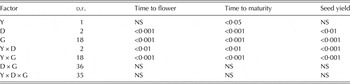
NS, not significant.
At each sowing date, time to maturity for the early-flowering lines was 8–14 days earlier in 2011 compared to 2010 and this effect was significant (P < 0·05) (Tables 1 and 2). Time to maturity differed significantly (P < 0·05) for early sowing among the 18 early-flowering lines and between the controls, but did not differ significantly at the optimum and late sowing dates. Overall, time to maturity for early-flowering lines was consistently quicker than the controls by 3–11 days in 2010 and 24–27 days in 2011, irrespective of sowing date (Table 1).
Across years, the average yields from optimum and late sowing of the early-flowering lentils were not significantly different (Tables 1 and 2). There was, however, a major yield penalty from early sowing, compared to optimum sowing, in both the early-flowering lines and the control in 2010 (Table 1).
Early-flowering lentils in relay cropping
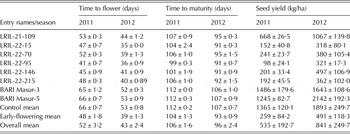
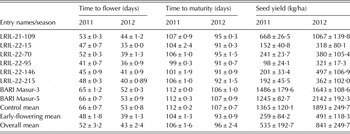
There were significant differences in all the agronomic traits measured in 2011 among the six early-flowering lines and between these lines and the controls (P < 0·001) (Tables 3 and 4). The early-flowering lines flowered c. 17 days (range 41–53 days to flowering) earlier than the control cultivars (Table 3). A similar trend occurred for time to maturity, where the early-flowering lines matured in 104 days, on 14 February, which was about 9 days earlier than the controls (Fig. 2). However, the average grain yield for the early-flowering lines in 2011 was only 258 kg/ha compared with 1486 kg/ha for BARI Masur-3 and 1245 kg/ha for BARI Masur-5.
Average time to flower and to maturity, and seed yield of six early-flowering lines and two controls under relay sowing in 2011 and 2012
Combined ANOVA (Pr > F) for time to flower and to maturity (days), and seed yield (kg/ha) for experimental year (Y) 2011 and 2012 of different cultivars and early-flowering lines (E) and their interactions

In the 2012 season, the six early-flowering lines and control cultivars followed a similar trend as the previous year for time to flowering, time to maturity and grain yield. There was a significant difference (P < 0·05) in all the parameters measured between the two seasons and an interaction between the seasons and genotypes (Tables 3 and 4).
The early-flowering lines flowered 9 days and control cultivars 13 days earlier in 2012 compared to 2011 (Table 3). Time to maturity followed a similar trend with an average of 93 days to maturity (around 11 February) for early-flowering lines, which was 12 days earlier than the controls (Fig. 2). However, grain yield was higher both overall and in the control cultivars in 2012 compared to 2011 (Table 3).
In 2011, both the relay sowing trial and the early sowing date treatment in the sole cropping trial were sown on 2 November, at the same location. Flowering was delayed by 11 days in the early-flowering lines and by 7 days in the controls of the relay compared with the sole cropping trial (Fig. 2).
Relay cropping on farmers’ fields
Sole-cropped lentil in farmer's fields, which was sown from 28 November to 9 December, yielded between 710 and 1149 kg/ha, whereas relay lentil, which was sown earlier from 8 to 27 November, yielded 51–77% more, which was significantly higher (P < 0·05; Table 5).
Seed yield (kg/ha) for relay and sole cropped lentil cultivar BARI Masur on farmers’ fields in 2011, 2012 and 2013

DISCUSSION
Lentil is currently grown in rice-based systems in the Eastern Gangetic Plain only where a single rice crop is cultivated in the annual cropping calendar (Miah & Rahman Reference Miah, Rahman, Erskine and Saxena1993; Islam et al. Reference Islam, Miah, Zaman, Hossain, Zaman, Hossain, Khaleque, Ali, Hossail, Haque, Khalaquzzaman, Islam and Hossain2013). The present study demonstrated the potential to incorporate lentil into the rotation between two successive rice crops, i.e., between monsoonal rice and pre-monsoonal rain-fed aus rice. The date of maturity of monsoonal rice is dependent on the rice cultivar and rainfall pattern, which is variable (Shahid Reference Shahid2010). In turn, the timing of the harvest of monsoonal rice and underlying soil moisture content determine when the land is available to sow the following lentil crop.
Time of sowing is very important for lentil growth to maximize yield (Silim et al. Reference Silim, Saxena and Erskine1991; Miah & Rahman Reference Miah, Rahman, Erskine and Saxena1993; Wang et al. Reference Wang, Gruber and Claupien2013) and it differs with the weather and between locations (Ali et al. Reference Ali, Singh, Pramanik, Ali, Erskine, Muehlbauer, Sarker and Sharma2009). Ali et al. (Reference Ali, Saraf, Sing, Rewari, Ahlawat, Erskine and Saxena1993) demonstrated in multiple lentil sowing-date trials in India that late sowing had a severe yield penalty. Specifically, in the north-eastern plain zone the yield was reduced by 20% when sown in mid-December and by 65% when sown in late December, compared to the optimum mid-November sowing. Khan & Miah (Reference Khan and Miah1986) showed a 34% yield penalty from sowing at the end of November in Bangladesh compared to the optimum sowing in mid-November. Although weather and cropping patterns are similar in the north-eastern plain zone of India and Bangladesh, the deleterious effect of late sowing was more severe in India compared to experiments in Bangladesh. The similar yield found in the optimum- and late-sown crops in the current experiment could not be explained. However, it is hypothesized that current cultivars and lines, which have been selected over the years, are relatively resilient to some delay in sowing, so the cultivars in the current experiment may have exhibited greater yield tolerance to increasing temperature. Furthermore, differences in soil characters and moisture status at sowing probably play a role.
Early-flowering lentils were evaluated as a way to intensify rice-based cropping. No consistent advantage could be identified from their early-flowering habit, because the reduced length of the reproductive period of these lines was previously found to be highly dependent on temperature combined with photoperiod (Erskine et al. Reference Erskine, Hussain, Tahir, Bahksh, Ellis, Summerfield and Roberts1994). However, the earlier maturity of early-flowering lines, compared with current cultivars, meant that they could fit into the rice cropping sequence (i.e., monsoon rice–lentil–rain-fed aus rice), but they failed to achieve an economic yield.
Adequate soil moisture at sowing is crucial to establish the lentil crop. Monsoonal rice harvest must be completed before cultivation and seeding of a lentil sole crop. Often a period of 2–3 weeks post-rice harvest is required for the soil to dry before lentil sowing (Miah & Rahman Reference Miah, Rahman, Erskine and Saxena1993). Relay sowing into the standing rice crop opens a new potential niche for lentil after rice harvested late in mid-November, as it avoids these delays where the land is not dry enough for ploughing in early November and is a simple way to advance the sowing time of lentil following a late rice harvest. The present study demonstrated that the relay sowing of current cultivars in early/mid-November gave yields comparable, or higher, than those achieved with sole cropping of lentils both on-station and on-farm. The on-station data for this comparison was from independent trials of sowing method. The on-farm data were confounded by several factors, such as different sowing dates (~21 days late in sole-sown compared to optimum date), which presumably accounted for the lower yield with sole cropping. Therefore, part of the benefit of relay sowing is attributable to timely broadcast-sowing into standing transplanted rice. Furthermore, relay sowing of lentil has lower cultivation and irrigation costs (with one irrigation less for establishment), which gives it an economic advantage over sole cropping. For lentil sole cropping, farmers use three to four cultivations with a power tiller before seeding (Islam et al. Reference Islam, Miah, Zaman, Hossain, Zaman, Hossain, Khaleque, Ali, Hossail, Haque, Khalaquzzaman, Islam and Hossain2013). Regular tillage, a practice that is ongoing, reduces soil organic matter, lowers soil water-holding capacity and soil fertility, and increases wind and water erosion (Kar & Kumar Reference Kar and Kumar2009). The inclusion of relay lentil into crop rotations may improve soil health, as it is a no-tillage system (Schulz et al. Reference Schulz, Keatinge and Wells1999). Overall, the substitution of lentil for fallow in the rice–fallow–rain-fed aus rice-cropping pattern can be seen as an option to intensify and diversify cropping and improve soil health. This was borne out in practice, as some 300 farmers in the Pabna location spontaneously sowed ~26 ha of relay lentil in 2012, increasing to >70 ha in 2013, following the initial on-farm trial of relay sowing.
CONCLUSIONS
Lentils are grown in the Eastern Gangetic Plain where monsoonal rice dominates cropping; however, the production is declining. The fallow in the monsoonal rice–fallow–pre-monsoonal rice cropping pattern was the focus for increased production of lentils and two approaches were tested. Firstly, sole-cropped early-flowering lentil lines were not considered feasible to replace fallow because of their low yield. The other approach of using relay sowing of lentil into monsoonal rice before its harvest was promising and could be included instead of fallow to intensify the system. This opens a potential rotation niche for lentil between two successive rice crops in the Eastern Gangetic Plain.
The financial support of the Australian Centre for International Agricultural Research in project CIM 2009-038 is gratefully acknowledged. AIM also thanks Australia Award Endeavour Research fellowship.