INTRODUCTION
One of the major challenges facing the animal production industry in developing countries is to improve efficiency of production and to maintain feed utilization. Many attempts have been made by researchers to overcome these challenges, such as including the incorporation of antimicrobials and other natural products into animal feeds (Ahmed et al. Reference Ahmed, Elghandour, Salem, Zeweil, Kholif, Klieve and Abdelrassol2015; Rojo et al. Reference Rojo, Kholif, Salem, Elghandour, Odongo, Montes De Oca, Rivero and Alonso2015; Morsy et al. Reference Morsy, Kholif, Kholif, Kholif, Sun and Salem2016). Feed additives of microbial origin, ionophores and antibiotics have become a common practice in ruminant nutrition; however, most studies have been conducted with lactating cows or in vitro, with few studies on pre-weaned calves. The European Union banned the sub-therapeutic use of antibiotics and ionophores as additives in animal feed since 2006 as it can increase antimicrobial- and antibiotic resistance in bacteria (Langford et al. Reference Langford, Weary and Fisher2003), thus increasing the risk of human infections with antibiotic-resistant bacteria (Phillips et al. Reference Phillips, Casewell, Cox, De Groot, Friis, Jones, Nightingale, Preston and Waddell2004). Moreover, the use of antimicrobials in animal feed may cause the appearance of their residues and metabolites in milk and meat, raising safety concerns for consumers (Russell & Houlihan Reference Russell and Houlihan2003). Therefore, there is an increasing interest in promoting the use of alternative feed additives to modify rumen fermentation and improve feed utilization (Cedillo et al. Reference Cedillo, Vázquez-Armijo, González-Reyna, Salem, Kholif, Hernández-Meléndez, Martínez-González, De Oca Jiménez, Rivero and López2014; Salem et al. Reference Salem, Ryena, Elghandour, Camacho, Kholif, Salazar, Domínguez, Jiménez, Almaraz, Martínez and Mariezcurrena2014).
Saccharomyces cerevisiae live yeast is a microbial alternative to antimicrobial feed additives that could enhance health and performance of young calves (Magalhães et al. Reference Magalhães, Susca, Lima, Branco, Yoon and Santos2008). It has been generally recognized as safe for human consumption, and considered safe when used in animal feed. Saccharomyces cerevisiae added at 20 g/kg dry matter (DM) to cereal grains fed to new-born calves increased grain intake and affected rumen development, but no effects were observed at a rate of addition of 10 g/kg DM of cereal grains (Lesmeister et al. Reference Lesmeister, Heinrichs and Gabler2004). Feeding live S. cerevisiae to new-born lambs has been observed to result in faster establishment of cellulolytic bacteria (Chaucheyras-Durand & Fonty Reference Chaucheyras-Durand and Fonty2001) and ciliate protozoa (Chaucheyras-Durand & Fonty Reference Chaucheyras-Durand and Fonty2002) in the rumen, leading to improved feed intake and weight gain.
Gastrointestinal infections, diarrhoea and dehydration are the main health problems in new-born calves, in particular during the pre-weaning period, and can result in high mortality rates. Feeding S. cerevisiae, with some immunological properties, may be important in young calves to reduce bacterial, viral and protozoal pathogens that cause digestive tract diseases and disorders (Magalhães et al. Reference Magalhães, Susca, Lima, Branco, Yoon and Santos2008). Collectively, feeding S. cerevisiae might increase feed intake and energy utilization, enhance the immune response and reduce the incidence of diseases of young calves.
Therefore, the present study aimed to study the effect of feeding live S. cerevisiae yeast at low and high daily doses to male crossbred Friesian × Baladi calves on performance (intake, digestibility, growth) and health status (blood parameters, faecal shedding of pathogenic bacteria) from birth and through the pre-weaning phase.
MATERIALS AND METHODS
Study location
The study was carried out at Noubaria Experimental Station, Animal Production Research Institute, Agriculture Research Center (Egypt). This area has an annual average rainfall of 22 mm and mean annual temperature between 14 and 32 °C. Calves were cared for and handled in accordance with the Guide for the Care and Use of Agricultural Animals in Agricultural Research and Teaching (FASS 2010).
Calves, feeding and management
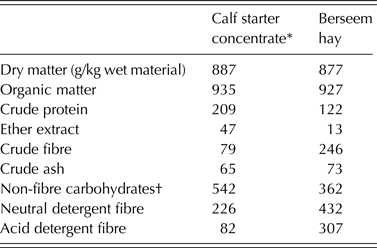
Twenty-four neonatal male crossbred Friesian × Baladi calves (35·5 ± 0·25 kg initial body weight (BW) at birth) with no congenital problems were randomly allocated to three experimental groups with eight calves each. At birth (day 0), calves were weighed and removed from their dams within 1–2 h of calving and randomly allocated to one of the experimental treatments. Calves were identified with ear tags and kept in individual pens with a covered area (2 × 1·5 m2/calf), with identical direction and orientation, and equipped with similar troughs for feed and water. From day 0 to 3, each calf was bottle-fed 4 litres of whole colostrum obtained from its mother at three feeding times. From day 4 until the end of the experiment at day 90, calves were fed whole cow's milk twice daily at 07 : 00 and 18 : 00 h. The daily amount of milk fed was the same for all calves, and was varied weekly throughout the experiment (all values are per calf and per day): 4 litres in week 1, 4·5 litres in week 2, 5 litres in week 3, 5·5 litres in week 4, 6 litres in week 5, 5·5 litres in week 6, 5 litres in week 7, 4·5 litres in week 8, 4 litres in week 9, 3 litres in week 10, 2 litres in weeks 11 and 12, and 1 litre from day 85 until 90. The analysed composition of the whole milk was 113 g of total solids, 31·8 g of protein, 32·0 g of fat, 39·6 g of lactose and 9·7 g of ash per kg of milk. Additionally, calves were offered a starter concentrate feed containing (g/kg): 260 soybean meal, 300 maize, 100 barley, 210 wheat bran, 60 linseed cake, 53 gluten, 15 limestone, 2 minerals and vitamins mixture from day 36 to 90, and fed berseem hay (Trifolium alexandrinum) from day 57 to 90. Chemical composition of the starter concentrate feed and the berseem hay fed to the calves is shown in Table 1. The amount of concentrate fed to each calf was 250 g/day during week 6 and 400 g/day during week 7, and thereafter the concentrate was offered ad libitum until the end of the experiment. Similarly, during weeks 9 and 10 the amount of hay fed was restricted to 100 g/day for each calf, and subsequently the hay was offered ad libitum until the end of the experiment. Starter concentrate and berseem hay were fed twice daily at 08 : 00 and 19 : 00 h, starting with the concentrate feed followed by the hay. During the whole experimental period (i.e. from day 4 until 90), S. cerevisiae daily doses were added to and thoroughly mixed with the whole milk fed in the morning meal. Calves were fed according to the National Research Council (2001) recommendations. Fresh water was offered ad libitum to all the calves. Individual calf feed intake, weight gain and health were monitored.
Chemical composition (g/kg of dry matter unless otherwise stated) of calf starter concentrate and berseem hay

* Calf starter concentrate contained (g/kg): 260 soybean meal, 300 maize, 100 barley, 210 wheat bran, 60 linseed cake, 53 gluten, 15 limestone, 2 minerals and vitamins mixture.
† Non-fibre carbohydrates calculated by difference (1000 − (neutral detergent fibre + crude protein + ether extract + ash)).
Calves were fed milk without S. cerevisiae (Control diet) or with a daily addition of thermostable Yea-Sacc® 1026 live yeast containing a minimum of 5 × 10⁹ colony forming units (CFU) of S. cerevisiae/g DM live yeast (BGY-35, F.L. Emmert Company, Cincinnati, OH, USA). The S. cerevisiae was added to provide daily doses of either 2·5 g (YL diet) or 5 g (YH diet) per calf for the whole duration of the experiment (90 days). Daily intakes of milk, starter concentrate and berseem hay were recorded by weighing the offered amounts of each feed and the refusals from the previous day. For daily weight gain calculations, calves were weighed in a digital multi-purpose platform scale (PS-2000 Platform Scale, Salter Brecknell, Fairmont, MN, USA) at 14-day intervals during the experimental period.
During the last 7 days of the experiment, faecal grab samples were collected from all calves twice daily at 07 : 00 and 15 : 00 h, dried at 60 °C in a forced-air oven for 48 h and pooled by calf (resulting in a composite sample per calf). Acid-insoluble ash was used as an internal indigestible marker, where digestibility coefficients were calculated according to the method of Ferret et al. (Reference Ferret, Plaixats, Caja, Gasa and Prió1999).
Dried feed (starter concentrate and berseem hay), feed orts and faecal samples were ground through a 1 mm screen using a Wiley mill (Arthur H. Thomas, Philadelphia, PA, USA), and analysed according to the AOAC (1997) official methods for DM (method #930·15), ash (method #942·05), N (method #954·01) and ether extract (EE; method #920·39). Neutral detergent fibre (NDF) and acid detergent fibre (ADF) were analysed according to the method of Van Soest et al. (Reference Van Soest, Robertson and Lewis1991). Non-fibre carbohydrates and organic matter (OM) were calculated. Milk samples were analysed for total solids, protein, fat and lactose contents using infrared spectrophotometry (Foss 120 Milko-Scan, Foss Electric, Hillerød, Denmark), while ash content was determined after incinerating a milk sample in a muffle furnace at 550 °C for 8 h.
Sampling and analysis of rumen fluid
As described in Kholif et al. (Reference Kholif, Gouda, Morsy, Salem, Lopez and Kholif2015), on the last day of the experiment (i.e. day 90), ruminal contents were sampled at 0, 3 and 6 h post-morning feeding to determine the pH and concentration of fermentation end-products. About 100 ml of rumen content was collected once at each sampling time from the ventral sac by using a stomach tube, and then the sample taken from each calf was strained through four layers of cheesecloth. The pH of ruminal fluid was measured immediately after collection using a pH meter (Orion™ Star A211 pH Benchtop Meter, Thermo Scientific, Beverly, MA, USA).
A sub-sample of 5 ml was preserved in 5 ml of 0·2 m hydrochloric acid (HCl) for ammonia-N analysis according to the method of AOAC (1997). Additionally, a sample of 0·8 ml of rumen fluid was mixed with 0·2 ml of a solution containing 250 g of metaphosphoric acid/litre for total volatile fatty acids (VFA) analysis. Samples collected at 3 h post-feeding were analysed for the individual VFA concentrations. Total VFA concentration in samples were determined by titration, after steam distillation of a sample according to the method of Annison (Reference Annison1954). According to the method of García-González et al. (Reference García-González, López, Fernández, Bodas and González2008), concentrations of acetic, propionic and butyric acid were quantified using crotonic acid as the internal standard using gas chromatography (model 5890, Hewlett Packard, Little Falls, DE, USA) with a capillary column (30 m length × 0·25 mm internal diameter (i.d.), 1 m phase thickness, Supelco Nukol; Sigma–Aldrich, Mississauga, ON, Canada).
Sampling and analysis of blood serum
On the last day of the experiment (i.e. day 90), blood samples (10 ml) were taken in the morning (4 h after starter concentrate and hay feeding) from the jugular vein of each calf into a clean dry tube, without anticoagulants and centrifuged at 4000 × g at 4 °C for 20 min. Serum was separated into 2-ml clean dried Eppendorf tubes and frozen at −20 °C until the analysis. Blood serum samples were analysed for concentrations of total protein, albumin, urea-N, glutamate-oxaloacetate transaminase (GOT), glutamate-pyruvate transaminase (GPT), glucose, cholesterol and triglycerides using specific kits (Stanbio Laboratory, Boerne, TX, USA) following the manufacturer's instructions. Globulin concentration was calculated by the difference between the total serum protein and their respective albumin values.
Faecal pathogenic bacterial counts
A portion of the faecal grab material sampled from each calf was collected in sterile McCartney's bottle and kept in ice. Faecal bacterial counts were determined using the pour plate technique for total Escherichia coli, Clostridium spp. and Enterobacteria spp. colony counts according to the method of Oxoid (1985). For all determined bacterial species, tenfold dilutions were prepared from each faecal sample in peptone water, and then three empty sterile Petri plates were inoculated by transferring 1 ml from each dilution into the plates. The inoculum was thoroughly mixed with sterile molten agar-containing media, namely chromogenic coliform medium for E. coli, reinforced clostridial medium for Clostridium spp., or Enterobacteria enrichment broth, Mossel medium for Enterobacteriaceae, previously held in a water bath at 50 °C. The agar plates were allowed to be solidified and then incubated at 37 °C for 24 h. Bacterial colonies were counted in plates using an optical counter.
Statistical analysis
The experiment was a completely randomized one-way ANOVA design with three treatments (Control, YL and YH) and eight replicates (each calf was considered as an experimental unit) per treatment. The statistical model included the fixed effect of diet (D i ): y ij = μ + D i + ε ij , where y ij is each individual observation for a given variable, μ is the overall mean, and ε ij is the residual random term. Statistical analyses were performed using PROC MIXED of SAS (SAS Inst. Inc. Cary, NC, USA). The Tukey–Kramer test was used for the multiple comparisons of means, and polynomial (linear and quadratic) contrasts were used to examine the responses to increasing doses of S. cerevisiae. Significance was declared at a level of P < 0·05 and trends when P ⩽ 0·10.
RESULTS
Feed intake and digestibility
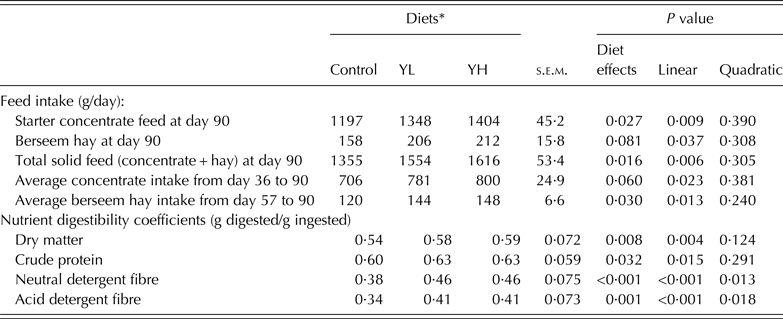
Calves fed YH diet supplemented with S. cerevisiae at the higher level ingested more (P < 0·05) solid feed (concentrate and hay) than calves fed the Control diet, whereas those eating the YL diet showed intermediate intakes (Table 2).
Feed intake and digestibility of diets supplemented with different levels of Saccharomyces cerevisiae to crossbred dairy Friesian calves (n = 8 per each group)

* Saccharomyces cerevisiae added at 0 g/calf/day (Control), 2·5 g/calf/day (YL) or 5 g/calf/day (YH).
Digestibility coefficients were increased (P < 0·05) with S. cerevisiae supplementation to calves. Dry matter (linear effect, P = 0·004), NDF (linear effect, P < 0·001; quadratic effect, P = 0·013) and ADF (linear effect, P < 0·001; quadratic effect, P = 0·018) digestibilities were increased with both YL and YH diets compared with the Control diet. Moreover, with the YH diet CP digestibility was increased (P < 0·05) compared with the Control diet (Table 2).
Ruminal fermentation and blood chemistry
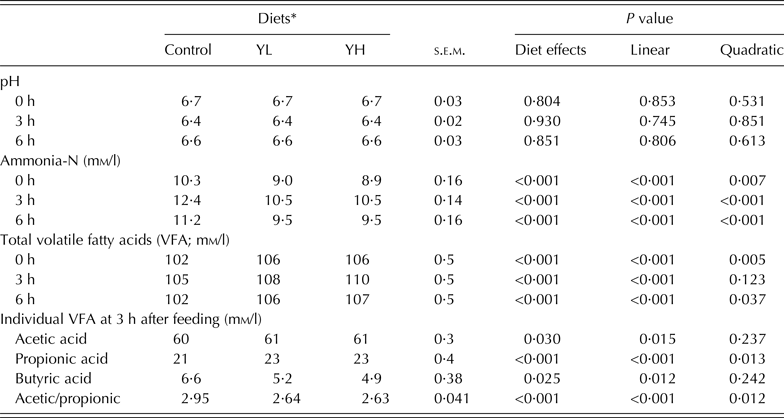
No effect on ruminal pH was observed when calves received S. cerevisiae supplementation either at low or high levels. Compared with the Control diet, with both YL and YH diets ruminal ammonia-N concentrations (P < 0·001) were decreased at different times post-feeding. In contrast, supplemented diets (YL and YH) resulted in increased total VFA concentrations in the rumen at different times post-feeding (P < 0·001) compared with the Control diet. At 3 h post-feeding, ruminal acetate (P = 0·030) and propionate (P < 0·001) concentrations were increased, whereas butyrate concentration (P = 0·025) and acetate to propionate ratio (P < 0·001) were decreased with YH and YL diets compared with the Control diet (Table 3).
Ruminal fermentation in crossbred Friesian calves fed diets supplemented with different levels of Saccharomyces cerevisiae (n = 8 per each group)

* Saccharomyces cerevisiae added at 0 g/calf/day (Control), 2·5 g/calf/day (YL) or 5 g/calf/day (YH).
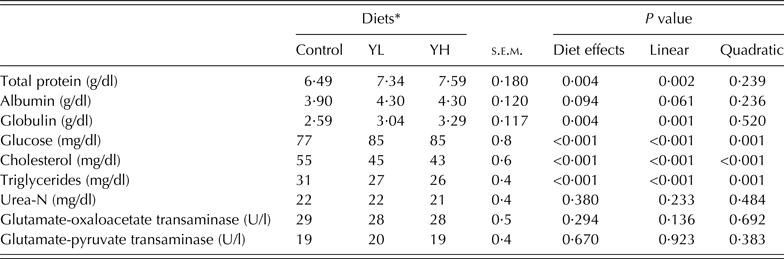
Increased plasmatic total protein (P = 0·004), globulin (P = 0·004) and glucose (P < 0·001) concentrations were observed in calves fed YL and YH diets. On the contrary, cholesterol and triglycerides concentrations in plasma were decreased (P < 0·001) with YL and YH diets. No effect of S. cerevisiae was observed on blood albumin, urea-N, GOT and GPT concentrations (Table 4).
Blood serum parameters in crossbred Friesian calves fed diets supplemented with different levels of Saccharomyces cerevisiae (n = 8 per each group)

* Saccharomyces cerevisiae added at 0 g/calf/day (Control), 2·5 g/calf/day (YL) or 5 g/calf/day (YH).
Growth performance
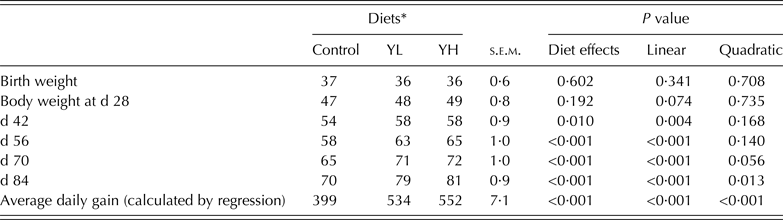
At birth and at 28 days of age, there were no significant differences in BW among calves fed the different diets. After day 42, calves fed YH and YL diets had increased (P < 0·001) BWs compared to those fed the Control diet. As a result, calves fed S. cerevisiae (YH and YL diets) showed increased (P < 0·001) growth rate through the whole experiment compared with those fed the Control diet (Table 5).
Weights (kg) and daily gains (g/day) in crossbred Friesian calves fed diets supplemented with different levels of Saccharomyces cerevisiae (n = 8 per each group)

* Saccharomyces cerevisiae added at 0 g/calf/day (Control), 2·5 g/calf/day (YL) or 5 g/calf/day (YH).
Faecal pathogens profile
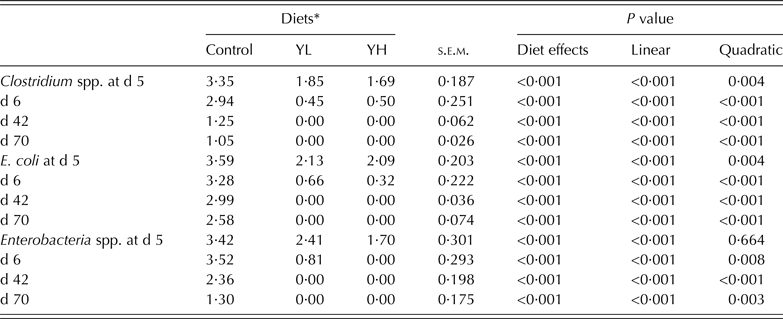
At days 5 and 6 of the experiment, faecal shedding of Clostridium spp., E. coli and Enterobacteria spp. was significantly (P < 0·001) reduced in calves fed the YH diet compared with those fed the Control diet. At days 42 and 70, no pathogens were detected in the faeces of calves fed the YL and YH diets (Table 6).
Faecal pathogenic bacteria (log values) in crossbred Friesian calves fed diets supplemented with different levels of Saccharomyces cerevisiae (n = 8 per each group)

* Saccharomyces cerevisiae added at 0 g/calf/day (Control), 2·5 g/calf/day (YL) or 5 g/calf/day (YH).
DISCUSSION
Feed intake and digestibility
Saccharomyces cerevisiae supplementation increased intake of solid feed by calves by about 15–19% just before weaning (at day 90 of the experiment). Moreover, S. cerevisiae increased the average daily hay intake by 20–23% throughout the last 5 weeks before weaning. Feed intake depends on many factors, including palatability, fibre digestion and digesta flow rate. Saccharomyces cerevisiae may have a flavouring effect and can induce the production of glutamic acid, which can benefit the taste of feed (Newbold et al. Reference Newbold, Wallace and McIntosh1996).
The increased intake may also be due to enhanced rumen fermentation (Newbold et al. Reference Newbold, Wallace and McIntosh1996) and improved fibre digestion, which might decrease rumen fill (Patra Reference Patra2012). Within the rumen, live yeasts (e.g. S. cerevisiae) are metabolically active at least for a short time (Kung et al. Reference Kung, Kreck, Tung, Hession, Sheperd, Cohen, Swain and Leedle1997), thereby affecting ruminal fermentation and stimulating microbial growth (Al Ibrahim et al. Reference Al Ibrahim, Kelly, O'Grady, Gath, McCarney and Mulligan2010). Such changes within the rumen are often associated with increased dietary nutrient (e.g. fibre) digestion (Guedes et al. Reference Guedes, Gonçalves, Rodrigues and Dias-Da-Silva2008). In response to an increased feed intake of S. cerevisiae supplemented diets, animals grew faster from week 6 onwards. At the end of the experiment calves in the S. cerevisiae supplemented groups had reached a greater BW, and thus the increased feed intake at 90 day of age could be attributed to both a possible stimulating effect of the S. cerevisiae and as the consequence of animals with a greater weight eating more feed. The increased intake of solid feed, in particular of forage, in S. cerevisiae supplemented calves at weaning may lead to an increased intake capacity of the growing animal, being able to eat more feed after weaning and thus to grow faster. Galvão et al. (Reference Galvão, Santos, Coscioni, Villaseñor, Sischo and Berge2005) observed increased grain intake by calves when fed live S. cerevisiae during the pre-weaning but not at the post-weaning period.
Fibre digestibility was increased by 18–21% when calves received the S. cerevisiae, supporting the idea of modified and improved ruminal conditions in response to S. cerevisiae supplementation. Saccharomyces cerevisiae has the ability to scavenge oxygen on the surfaces of freshly ingested feeds and reduce the redox potential within the rumen (Chaucheyras-Durand et al. Reference Chaucheyras-Durand, Walker and Bach2008), creating a more anaerobic environment favouring the activity of ruminal microorganisms (Newbold et al. Reference Newbold, Wallace and McIntosh1996). Saccharomyces cerevisiae can provide some soluble compounds, such as organic acids, amino acids, peptides or vitamins that might be essential growth factors for ruminal bacteria, thus stimulating microbial growth (Newbold et al. Reference Newbold, Wallace and McIntosh1996; Chaucheyras-Durand et al. Reference Chaucheyras-Durand, Walker and Bach2008). Feeding S. cerevisiae has been shown to increase the numbers of total bacteria (Koul et al. Reference Koul, Kumar, Sareen and Singh1998) and cellulolytic bacteria (Harrison et al. Reference Harrison, Hemken, Dawson, Harmon and Barker1988) in the rumen.
Ruminal fermentation
Saccharomyces cerevisiae was provided with the milk fed to the calves. Owing to the closure of the reticular groove, in pre-ruminants milk flows directly from the oesophagus to the abomasum, thus bypassing the rumen. It may be expected that during the first weeks of the experiment, when calves were milk-fed, the benefits of the S. cerevisiae can be attributed to their effects on the intestinal microbiota. The functioning of the reticular groove is less efficient with calf age and the transition to solid feed, leading to the development of the rumen and the onset of microbial fermentation. Thus, it is possible that in pre-weaned calves some of the liquid ingested enters the rumen and the S. cerevisiae is incorporated into the ruminal microbiota. Regardless of the way that S. cerevisiae enters the rumen, the results of the current study clearly show that in those calves supplemented with S. cerevisiae, ruminal fermentation was modulated with some beneficial effects on calf performance. With no effect on ruminal pH, S. cerevisiae supplementation at low and high doses increased VFA concentration at different times post-feeding, also in particular the concentrations of propionate and acetate. The ruminal pH of all calves was above 6·0, suggesting the absence of ruminal acidosis. The absence of an effect of S. cerevisiae supplementation on ruminal pH is mainly due to higher ruminal pH above 6·0 during all times post-feeding. Enjalbert et al. (Reference Enjalbert, Garrett, Moncoulon, Bayourthe and Chicoteau1999) and Al Ibrahim et al. (Reference Al Ibrahim, Kelly, O'Grady, Gath, McCarney and Mulligan2010) reported that when ruminal pH is above 6·0, then S. cerevisiae supplementation had little or no effect on ruminal pH. Increased total VFA caused increased propionate and acetate together. The increased concentration of ruminal acetate in the supplemented calves was in agreement with Al Ibrahim et al. (Reference Al Ibrahim, Kelly, O'Grady, Gath, McCarney and Mulligan2010), and may be related to the stimulating effect of S. cerevisiae on growth or activity of fibre-degrading microorganisms in the rumen (Elghandour et al. Reference Elghandour, Salem, Martínez Castañeda, Camacho, Kholif and Vázquez Chagoyán2015). The increased concentration of ruminal propionate may be due to the increased ingestion of concentrate feed when calves received the S. cerevisiae. Guedes et al. (Reference Guedes, Gonçalves, Rodrigues and Dias-Da-Silva2008) observed increased acetate and propionate concentrations in the ruminal fluid of non-lactating cows supplemented with S. cerevisiae.
Decreased ruminal ammonia-N concentrations with S. cerevisiae supplemented diets suggests some changes in the N metabolism of rumen microorganisms. It is plausible that proteolytic bacteria numbers and their activity is reduced in the rumen of animals receiving the S. cerevisiae, as reported in the in vitro study of Chaucheyras-Durand et al. (Reference Chaucheyras-Durand, Masséglia and Fonty2005). With a suitable balance between soluble N and carbohydrate supply, S. cerevisiae could enhance microbial growth and decrease N loss. Moreover, increased ammonia-N incorporation into microbial protein (Erasmus et al. Reference Erasmus, Botha and Kistner1992), which may be the result of enhanced microbial activity (Williams et al. Reference Williams, Tait, Innes and Newbold1991), is another probable reason (Al Ibrahim et al. Reference Al Ibrahim, Kelly, O'Grady, Gath, McCarney and Mulligan2010). The current results are in line with those of Al Ibrahim et al. (Reference Al Ibrahim, Kelly, O'Grady, Gath, McCarney and Mulligan2010).
Blood chemistry
Blood chemistry was affected positively with S. cerevisiae supplementation (Galip Reference Galip2006). Saccharomyces cerevisiae caused increased total protein and globulin concentrations in plasma. This suggests that protein utilization might have been improved with the addition of S. cerevisiae. This can be related to increased dietary CP digestibility, by 4–9% with S. cerevisiae fed at low and high doses, respectively. In his experiment, Galip (Reference Galip2006) observed increased total protein and urea concentrations with decreasing triglycerides and without affecting albumin, cholesterol and liver enzymes with S. cerevisiae supplementation.
The higher serum glucose with S. cerevisiae supplemented calves may be due to greater propionate production in the rumen. Blood glucose concentration depends mainly on energy consumption and utilization by tissues. In calves fed S. cerevisiae, increased intake of the starter concentrate could favour the production of propionate in the rumen thus increasing glucose availability from gluconeogenesis. Galvão et al. (Reference Galvão, Santos, Coscioni, Villaseñor, Sischo and Berge2005) reported an increased glucose concentration in the plasma of calves receiving S. cerevisiae as a result of increased energy intake (Hammon et al. Reference Hammon, Schiessler, Nussbaum and Blum2002).
One important observation was the decreased blood cholesterol and triglyceride concentrations in the plasma of animals receiving S. cerevisiae. Kowalik et al. (Reference Kowalik, Skomiał, Pająk, Taciak, Majewska and Bełżecki2012) obtained similar results. The decreased total cholesterol and triglyceride concentrations in blood could be caused by some positive changes in rumen fermentation and populations of ruminal bacteria and protozoa with S. cerevisiae supplementation. Pysera & Opałka (Reference Pysera and Opałka2001) explained that the change in rumen VFA, particularly propionate, butyrate and valerate acids, is responsible for the decreased synthesis of cholesterol and triglycerides in the liver cells. Moreover, the cell wall of S. cerevisiae is rich in β-glucans content which, according to Nicolosi et al. (Reference Nicolosi, Bell, Bistrian, Greenberg, Forse and Blackburn1999), could reduce blood total cholesterol and triglycerides.
Calf growth performance
The initial BWs of all calves were almost the same with no differences among experimental groups, reflecting the random assignment of the diets to the calves at the beginning of the experiment. Body weight was increased in calves fed the diets supplemented with S. cerevisiae from week 6 and thereafter until the end of the trial. Average weight gain was 34–38% greater in calves fed S. cerevisiae than in those fed the Control diet. Increased growth rate may be due to a more efficient feed utilization and conversion rate in pre-weaned calves supplemented with S. cerevisiae. The increased feed intake and digestibility and the more favourable rumen fermentation with S. cerevisiae supplementation would benefit rumen health and development (Pal et al. Reference Pal, Paul, Bhunia, Pakhira, Biswas and Patra2010), and thus calves are more likely to reach their full growth potential. Issakowicz et al. (Reference Issakowicz, Bueno, Sampaio and Duarte2013) and Kamal et al. (Reference Kamal, Dutt, Singh, Kamra, Patel, Choudhary, Agarwal, Kumar and Islam2013) observed that S. cerevisiae supplementation caused increased daily weight gain in lambs and kids, respectively.
Faecal pathogenic bacteria
Faecal pathogenic bacteria disappeared after 42 days of feeding S. cerevisiae at low and high doses. This is an important outcome of feeding S. cerevisiae to pre-weaned calves with low immunity and high incidence of diarrhoea and mortality rate. The microbial ecology of the gastrointestinal tract impacts health and performance of animals (Agarwal et al. Reference Agarwal, Kamra, Chaudhary, Agarwal, Sahoo and Pathak2002). The effect of yeast may be due to the ability of live S. cerevisiae to produce some substances that are inhibitory for pathogenic bacteria (Bach et al. Reference Bach, McAllister, Veira, Gannon and Holley2003). Yeasts such as S. cerevisiae can eliminate or reduce numbers of undesirable microorganisms (bacteria, protozoa) through competition for sites of colonization in the gut, by production of inhibitory metabolites (Zhao et al. Reference Zhao, Doyle, Harmon, Brown, Mueller and Parks1998), or by favouring specific groups of microorganisms within the gastrointestinal tract that are beneficial to the host (Yoon & Stern Reference Yoon and Stern1995). In addition, S. cerevisiae can be irreversibly bound to pathogenic bacteria such as E. coli and Salmonella due to the presence of lectin sites for mannose-sensitive adhesion in the outer membrane of the yeast cell wall (Gedek Reference Gedek1999). Moreover, S. cerevisiae can reduce numbers of pathogenic bacteria indirectly by improving calves’ immunity status, due to the contents of some cell wall material such as mannan and glucan (approximately 350 g mannan/kg DM and 300 g glucan/kg DM) (Reed & Nagodawithana Reference Reed and Nagodawithana1991). Both of these substances are normally not digested or absorbed in the small intestine (Newman Reference Newman, Lyons and Jacques1994), with an ability for pathogen removal from the digestive system through offering competitive binding site options for Gram-negative and Gram-positive bacteria (Suzuki et al. Reference Suzuki, Tanaka, Kinoshita, Oikawa, Osawa and Yadomae1990) and blocking bacterial attachment to the intestinal epithelium (Newman Reference Newman, Lyons and Jacques1994). Bach et al. (Reference Bach, McAllister, Veira, Gannon and Holley2003) observed that treatment with S. cerevisiae completely eradicated 104 CFU of E. coli/ml in vitro within 48 h of incubation.
Another probable reason is the presence of some soluble products present in S. cerevisiae. Jensen et al. (Reference Jensen, Hart and Schauss2007) showed the ability of these products to inhibit microbial growth and to modulate the immune system. It has been suggested that feeding glucan improves neutrophil chemotaxis and respiratory burst activity (Murphy et al. Reference Murphy, Davis, Brown, Carmichael, Ghaffar and Mayer2007), and this might have enhanced phagocytic activity of neutrophils against pathogenic bacteria (Magalhães et al. Reference Magalhães, Susca, Lima, Branco, Yoon and Santos2008). Feeding S. cerevisiae to dairy calves improved health and survival of calves reducing morbidity and mortality (Magalhães et al. Reference Magalhães, Susca, Lima, Branco, Yoon and Santos2008).
It can be concluded that daily administration of S. cerevisiae at 2·5 and 5·0 g per animal to milk-fed calves increases the intake and digestibility of solid feed (concentrate and hay). Saccharomyces cerevisiae supplementation results in increased weight gain, enhanced ruminal fermentation at weaning and improved health (based on blood chemistry and faecal shedding of pathogenic bacteria) of pre-weaning calves. These effects can be observed with a daily dose of 2·5 g S. cerevisiae per calf, with no further improvement by increasing the daily dose to 5 g per calf.