


Introduction
Cross-linguistic study of motion constructions (i.e. constructions describing motion events) has been a fruitful line of research since first brought to the forefront in the work of Talmy (Reference Talmy and Kimball1975, Reference Talmy and Shopen1985, Reference Talmy1991, Reference Talmy2000). Work in this area has focused on a host of issues in the nature of lexical semantics and its relation to morphology and syntax, including possible verb and adposition semantics, argument realization, lexical semantic typology, and even linguistic relativity. I examine here the different ways that certain participants in motion events can be expressed in a clause via adpositions, an area that touches on argument realization, adposition semantics, and typology. I suggest that there are two types of participant-markers for motion constructions: those that mark participants in motion events and those that mark arguments of motion verbs. Although adpositions from different classes sometimes seem to mark the ‘same’ participant in motion descriptions, careful examination of their behavior shows that this is not in fact the case. This in turn shows that the space of motion-encoding devices is more diverse than typically assumed, something that has ramifications for how motion typologies are constructed.
I take as my case-study adpositions which mark the goal of motion in descriptions of directed motion events. Following Talmy, a directed motion event consists minimally of a moving figure, a manner in which the figure moves (e.g. walking, running, skipping), a path along which the figure moves, and a goal (the end of the path) at which the figure arrives. Descriptions of such events differ in terms of which components are encoded overtly. Focusing on Japanese, I examine the two classes of goal-markers illustrated in (1) by the postpositions -ni and -made.Footnote 2
- (1)
(a) John-wa eki-made/ni itta/modotta. John-top station-until/to went/went-up‘John went/went up to the station.’
(b) John-wa kishi-made/*ni oyoida/tadayotta. John-top shore-until/to swam/drifted‘John swam/drifted to the shore.’
In (1a) the goal may be marked by either -ni or -made, whereas in (1b) only -made is fully acceptable. Intuitively, the difference hinges on the lexical class of the verb. Following Talmy, the verbs in (1a) are path verbs that encode both motion and the path of motion, while those in (1b) are manner verbs that encode both motion and the manner of the motion. As a first approximation, -ni only occurs with path verbs, while -made occurs with both path and manner verbs, though the question remains of why they should differ in this way. Most analyses of data such as (1) focus on the different ways the different components of a motion event are distributed across the clause. For example, Inagaki (Reference Inagaki2002) claims that while -ni and -made both mark locations, -made additionally encodes path semantics and thus when combined with a manner verb can form a complete directed motion description. Conversely, -ni has only location semantics and is only licensed when the verb independently contributes path semantics. Similar analyses have been proposed by others (see Tsujimura Reference Tsujimura, Koizumi and Ura1994, Tanaka Reference Tanaka2002). The key to this analysis is that -made and -ni are to some degree synonymous. The difference primarily concerns where path is encoded in the clause (in the postposition or in the verb).
I present evidence that such analyses are problematic on several grounds. First, I show that even with path verbs -ni and -made differ distributionally, pointing to further semantic distinctions. Second, both -ni and -made have uses outside of motion constructions which are similar enough (though in different ways) to their uses in motion constructions to suggest that neither is truly a goal-marker. Third, the assumption that -made is a goal-marker is problematic when examined in light of the well-known typology proposed by Talmy (Reference Talmy2000) for how languages differ in terms of how path and manner are encoded in a single clause (see also Talmy Reference Talmy and Kimball1975, Reference Talmy and Shopen1985, Reference Talmy1991). The crucial distinction Talmy posits is between S(atellite)-framed languages (e.g. English, Russian), in which manner is characteristically encoded in the verb and path in some satellite to the verb, and V(erb)-framed languages (e.g. French, Japanese), where path is characteristically encoded in the verb and manner in some satellite.Footnote 3 Typically, V-framed languages such as Japanese do not allow S-framed encoding. In light of this, it should be surprising that Japanese allows (1b) at all. While it may be that Talmy's typology breaks down in (1b), the unexpected properties of -made indicate that further factors are at play.
I argue instead for the much more general analyses in (2), in which (i) neither postposition is inherently a goal-marker at all, (ii) they do not share any component of meaning in common, and (iii) they are not even functionally equivalent.
- (2)
(a) -ni marks verb arguments (which for path verbs happen to be goals)
(b) -made marks limits (which for motion events are often path limits)
In essence, -ni is an argument marker (qua dative case; Kuno Reference Kuno1973, Martin Reference Martin1975, Tsujimura Reference Tsujimura1996) that for path verbs happens to mark goals, though it is not inherently a dedicated goal-marker. Conversely, -made (like English until) functions to delimit event participants in some quite general way. It just happens that in a motion description where -made takes a spatial DP complement this amounts to indicating the endpoint on the path (i.e. the goal). Thus the fact that both postpositions mark goals in (1) is an incidental effect. However, this analysis suggests that sometimes two quite different participant-markers, which share no semantics or even core functionality in common, can have overlapping uses, even effectively realizing the same argument of certain verbs. Finally, this analysis is in fact technically consistent with the Talmy classification of Japanese, since -made does not encode path semantics per se. However, it nonetheless shows that languages may exploit wholly motion-independent participant-markers to get around otherwise categorical constraints on how motion is encoded, something not often taken into account in typological work on motion (see Beavers, Levin & Tham Reference Beavers, Levin and Tham2008 for further discussion).
In section 2 I review several previous analyses, most of which attribute goal semantics to each postposition. In section 3 I discuss new data highlighting more subtle differences between -ni and -made in motion constructions, suggesting a more radical difference in their function. In section 4 I discuss uses of -ni and -made outside of motion constructions. I use this evidence to generalize their lexical semantic descriptions and to make explicit how they come to realize the ‘same’ participant. In section 5 I discuss some variation in the acceptability of -ni with manner verbs and propose a way to understand this variation in terms of a class of manner+path verbs. I conclude in section 6, where I incorporate the final generalization back into Talmy's typology, with reference to data in Romance languages. I demonstrate that my account has cross-linguistic viability and furthermore is consistent with Talmy's typology, while at the same time augmenting it.
Background
Most of the literature on goal-marking in Japanese has focused on data like (1), showing that -ni, unlike -made, can only occur with path verbs. Typically these analyses assume that -ni and -made are two different kinds of goal-markers.Footnote 4 Tsujimura (Reference Tsujimura, Koizumi and Ura1994), for instance, claims that -ni realizes the inherent goal of path verbs whereas -made is actually predicative, predicating a result state of the figure. She cites as evidence a class of unaccusative mismatches that occur with manner verbs, where normally unergative manner verbs act more like unaccusative path verbs when they occur with -made, as can be seen from the use of numeral quantifiers as in (3) (cf. Tsujimura Reference Tsujimura, Koizumi and Ura1994: 342, ex. (16), coindexation added).
- (3)
(a) ?*Kodomo-gai [VP inu-to awatete san-nini aruita]. child-nom dog-with hurriedly three-cl walked‘Three children walked hurriedly with a dog.’
(b) Kodomo-gai [VP inu-to awatete san-nini kooen-made aruita]. child-nom dog-with hurriedly three-cl park-until walked‘Three children walked hurriedly to the park with a dog.’
Assuming that numeral quantifiers must be in a mutual c-command relationship with their antecedents (Miyagawa Reference Miyagawa1989: 28–30), (3a) is predicted to be ungrammatical since the unergative subject is base-generated in [Spec,IP]. But (3b) is acceptable, indicating that the subject is instead base-generated in the VP, as is necessary for predication by -made. In other words, aruku ‘walk’ is unergative but -made aruku is unaccusative, ostensibly due to the predicative semantics of -made. Since -ni is not predicative it can only occur with path verbs, which are inherently predicative. However, this analysis does not explain the fact that -made, like -ni, also occurs with path verbs. To account for this Tsujimura hypothesizes a second variant of -made that is a non-predicative goal-marker on a par with -ni.
Inagaki (Reference Inagaki2002) proposes an alternative in which the difference between -made and -ni follows from the semantics incorporated into each lexical item in their syntactic contexts (following Hale & Keyser Reference Hale, Keyser, Hale and Keyser1993, Reference Hale, Keyser, Mendikoetxea and Uribe-Etxebarria1997). Inagaki argues that -ni can only incorporate location semantics, whereas -made can incorporate both location and path semantics. Path verbs likewise incorporate path, whereas manner verbs do not, requiring the presence of some other item to express path in order to form a complete motion event (i.e. with a change of location predicated of the figure in [Spec,VP]; Inagaki Reference Inagaki2002: 224f.). The four combinations are given in (4) (ignoring Inagaki's optional relational N/P positions).
- (4)
(a) Path verb (iru ‘go’)+-made:

(b) Path verb+-ni:
(c) Manner verb (aruku ‘walk’)+-made:
(d) *Manner verb+-ni:

No polysemy for -made is necessary on this analysis since the path semantics is contributed by the Ppath position and not by the path verb or -made per se (which are merely capable of incorporating the path semantics). Tanaka (Reference Tanaka2002) similarly argues that -made has a path semantics lacking in -ni. However, she further argues that -ni marks not just a location but also a theme, such that the distributional differences of -ni and -made correspond to whether or not the verb licenses only a path (manner verbs), or both a theme and a path (path verbs).
What links all of these analyses together is that in each case -made has one use in which it is a goal-marker on a par with -ni. However, as I show in section 3, there is reason to reject this assumption, since even when their distributions overlap goals marked by -ni and -made demonstrate subtle differences that suggest they are not equivalent. In section 4 I argue instead that -ni has no inherent semantics at all, but is instead serving simply as a dative case marker, realizing goal arguments of path verbs. I make this argument on the basis of uses of -ni outside of motion constructions, where the only commonality across all uses of -ni is that the semantic role it indicates is determined solely by the verb it combines with.
For -made the story is more complicated, though a different strand of research sheds light on its semantics. Matsumoto (Reference Matsumoto, Tanaka and Matsumoto1997), like Tsujimura and Inagaki, assumes that -made has a goal-marking use like -ni (albeit with a wider distribution since it is adjunctive). However, he also argues that -made has a second use as a temporal adjunct that delimits motion events by specifying the time at which the event ends. This explains an interesting ambiguity of manner verbs with -made shown in (5) (Matsumoto Reference Matsumoto, Tanaka and Matsumoto1997: 188f.; translations due to Tsuguro Nakamura).Footnote 5
(5) Taroo-wa minato-made sanzyu-pun-kan/de oyoida.Taroo-top port-until 30-minutes-for/in swam‘Taroo swam to the port in 30 minutes.’ (goal-marking -made) ‘Taroo swam for 30 minutes till he got to the port.’ (temporal -made)
On the first reading Taroo swam to the port himself. This reading is supported by the -de ‘in’ temporal modifier (i.e. it took Taroo 30 minutes to swim to the port). On the second reading Taroo was swimming in the swimming pool on a cruise liner headed to the port, and stopped when it reached port. This reading is supported by the -kan ‘for’ temporal modifier (i.e. Taroo had swum for 30 minutes when the ship reached port). Thus what the -made phrase does on the second reading is to implicate a particular time point at which the event ends (i.e. it is equivalent to saying ‘until the ship arrived at the port’), something Matsumoto supposes follows from a more general use of -made as a delimiter of activities and states. This is similar to the analysis of Yoneyama (Reference Yoneyama1986), who assumes no goal-marking semantics for -made whatsoever. Yoneyama instead claims that -made is really a delimiter of states (STAY events in the Jackendoff Reference Jackendoff1983 sense), where he crucially analyzes manner verbs as stative (e.g. oyogu ‘swim’ describes a state of swimming). (Yoneyama does not discuss -made with path verbs, leaving this part of its distribution unclear.Footnote 6)
The idea that -made is delimiting something (e.g. the time course of the event) rather than technically realizing the goal of motion is an intuition I adopt below. However, in section 4 I argue that we can unify both interpretations of (5) under a single notion of delimitation of event participants. In particular, I argue that all -made does in (5) is mark the endpoint of a path. Crucially, in this context there are two different paths -made can mark the endpoint of: the path of Taroo or the path of the ship. Thus there is only one lexeme -made in (5), albeit one that picks up on two different readings of the sentence it modifies. I further extend this analysis to encompass the use of -made with path verbs, where -made again delimits the path of motion and thus is effectively co-identified with the inherent goal argument selected for by the path verb. In this way we can bring all of its uses in motion constructions under a single definition of delimitation, and abandon the notion that it is a true goal-marker. Finally, I generalize this notion of delimitation even further to encompass uses of -made outside of motion constructions, where it marks endpoints of participants other than paths. Thus I argue that -made is not specifically temporal, nor is it restricted to statives or even motion events. Instead, it is a very general limit marker that can apply to many different participants in different types of events.
Goal-marking vs. path-delimitation
Paths, durativity, and salient goals
In this section I examine distributional differences that exist even when -ni and -made combine with path verbs, where their distribution is usually assumed to be equivalent. These differences indicate a much more fundamental distinction between them as regards which participant they each mark in a given motion description. Consider (6), where -made (but not -ni) is unacceptable with the verb hairu ‘enter’ (cf. Tsujimura Reference Tsujimura2002).
(6) [John is just outside the tower.] John-wa too-ni/*made haitta. John-top tower-to/until went. in‘John went into the tower.’
The difference between hairu and the verbs in (1a) is that the latter are accomplishments and hairu is an achievement (see Kindaichi (Reference Kindaichi and Kindaichi1976) and Tsujimura (Reference Tsujimura1996, Reference Tsujimura and McClure2003) on the Vendler aspectual classes in Japanese). Accomplishments are telic and necessarily durative, whereas achievements are telic and punctual. At first blush it appears that -made only occurs in durative predicates (as Kuno Reference Kuno1973 suggests). However, there is evidence that this is not quite correct, and that -made instead occurs in motion constructions in which the path of motion is complex, a slightly different notion than durativity. Path complexity and durativity are of course not unrelated. The aspectual behavior of motion predicates is often analyzed in terms of a homomorphic mapping between paths and events that preserves boundedness and/or some degree of mereological complexity (see in particular Wechsler Reference Wechsler2001, Reference Wechsler, Beermann and Hellan2003, Reference Wechsler, Erteschik-Shir and Rapoport2005 and Beavers Reference Beavers2002, Reference Beavers2006, Reference Beavers, Dölling, Heyde-Zybatow and Schäfer2008; see also Dowty Reference Dowty1991; Tenny Reference Tenny, Sag and Szabolcsi1992, Reference Tenny1994; Jackendoff Reference Jackendoff1996; Krifka Reference Krifka and Rothstein1998; Hay, Kennedy, & Levin Reference Hay, Kennedy and Levin1999). Following Beavers (Reference Beavers, Dölling, Heyde-Zybatow and Schäfer2008), the punctuality of predicates such as (6) correlates with the fact that events of entering typically involve transitional paths, defined as two-place paths consisting only of initial and final points. This is distinct from paths of durative motion events (e.g. crossing a bridge), which include initial and final points as well as middle portions of arbitrary mereological complexity. The contrast is exemplified by the minimal pair in (7).
- (7)
(a) The fugitive crossed the border. (punctual)
(b) The fugitive crossed the desert. (durative)
In (7a) the path is inherently transitional (one side of the border to the other side) while in (7b) it is necessarily complex (one end of the desert to the other via the intervening space). Correspondingly, (7a) is punctual and (7b) is durative.Footnote 7 Crucially, we can reconstrue the event in (6) such that the path is complex, in which case for many speakers the accepability of -made improves considerably.
(8) [John is outside a wall around the perimeter of the tower's area, a short walk from the tower door, and his goal is the chamber inside the tower.] John-wa too-ni/?made haitta. John-top tower-to/until went. in‘John went in as far as the tower’
Thus the length of the path has an effect on -made's acceptability. However, due to the close correlation of path complexity and durativity, it is difficult to tell which factor conditions the acceptability of -made (if it is possible at all to tease these apart). In fact, there are data suggesting that -made is sensitive only to path complexity. In particular, there are certain motion events that, due to the peculiarity of the type of motion involved, are punctual but are still compatible with -made, provided the path of motion is complex. An example is given in (9).Footnote 8
- (9)
(a) [In the context of a digital display going from 5 to 500 in a single change.]Denshikei-ga 500-made/ni agatta. electronic-degree-measure-nom 500-until/to went.up‘The display went up to 500.’
(b) [In the context of a digital display going from 10 to 11, the maximum.] Denshikei-ga 11-ni/?#made agatta. electronic-degree-measure-nom 11-to/until went. up‘The display went up to 11.’
In (9a), a digital readout ‘moves’ over 495 possible readings to a final reading of 500, but does so instantaneously. Thus the event is punctual but the path is still complex. That it is traversed instantly is due to the peculiarity of the type of movement described, which serves to collapse or eliminate the homomorphic relationship between the event and the path. However, if the path complexity is somehow compromised, the acceptability of -made goes down, as in (9b). Thus -made is sensitive to path complexity rather than durativity.
Furthermore, in some cases the acceptability of -made is dependent not on the existence of intermediate locations between the source and goal but instead on the existence of additional locations on the path after the goal, as in (10):
- (10)
(a) [John is on the first floor of a two-story building.] John-ga ni-kai-ni/?#made nobotta.John-nom 2nd-cl.floor-to/until went.up‘John went up to the second floor.’
(b) [John is on the first floor of a ten-story building.] John-ga ni-kai-ni/made nobotta.John-nom 2nd-cl.floor-to/until went.up‘John went up to the second floor.’
Although not entirely unacceptable to many speakers, in the context of (10a) -made is significantly less natural than -ni, but becomes more natural if there are additional floors beyond the second floor, as in (10b). A similar distinction exists in English:
- (11)
(a) [In a two-story building]
John went up to/?#until/?#as far as the second floor.
(b) [In a ten-story building]
John went up to/until/as far as the second floor.
English until/as far as sound better in contexts with a complex path even if some parts of the path play no role in the event, whereas up to is always acceptable. This indicates that -made is sensitive to the complexity of the path after the source point, independent of the path's role in the event. The fact that this often correlates with durativity follows from its homomorphic relationship to the event plus the fact that quite often the ‘extra’ parts of the path come before the goal and thus are implicated in the event.Footnote 9 The postposition -ni is not sensitive to either factor, as seen in all of the data above, where -ni is always acceptable.Footnote 10
Conversely, there are cases where -made but not -ni is acceptable with path verbs, namely when the goal is not the one that is most natural for a given verb in a given context. For expository purposes I call this the ‘salient goal effect’. This distinction is conditioned by the particular kind of path verb being used. Muehleisen and Imai (Reference Muehleisen, Imai, Lee, Sweetser and Vespoor1996) and Tsujimura (to appear) argue that Japanese path verbs can be divided into two classes depending on which aspects of the path are directly encoded by the verb. The first are ground-path verbs, which incorporate constraints on the physical geometry of the ground (the overall path) into their meanings (e.g. koeru ‘cross’, wataru ‘go over’, kuguru ‘pass through’, hairu ‘enter’). Of course, any constraints a verb imposes on the ground/path inherently place constraints on the goal, which must be compatible with the geometry of the path.Footnote 11 Crucially, if the figure does not traverse the entire path described by the verb, but instead only traverses some subportion of it, then only -made but not -ni is acceptable (data similar to this are also discussed by Matsumoto Reference Matsumoto, Tanaka and Matsumoto1997: 187):Footnote 12
- (12)
(a) [John is at one end of a series of bridges.] John-wa hitotume-no hashi-no mukoo gawa-ni/?made watatta.John-top first-gen bridge-gen yonder side-to/until went.over‘John crossed/went over the first bridge.’
(b) [John is at one end of a bridge.] John-wa hashi-no tochuu-made/*ni watat-te hikikaeshita.John-top bridge-gen halfway-until/to went.over-prt return‘Going to halfway along the bridge, John returned.’
Thus -ni in conjunction with a ground-path verb must mark a goal that matches the intrinsic path geometry of the verb (in the case of (12a) the other side of the first bridge). Note that the acceptability of -made in (12b) is significantly helped by the supporting context that the agent only went so far on the bridge before returning, perhaps out of fear. This effect is much like the imperfective paradox of Dowty (Reference Dowty1979: 133ff.), where in a sentence such as We were flying to Paris when our plane was forced to land in New York the underlying predicate refers to a motion event in some possible world of going to Paris, even though in the real world this event did not necessarily occur and the actual goal was instead New York. In this case we have two goals, one implicated by the verb and one actually arrived at, just as in (12b). In section 4 I return to this connection. The important point for now is that -ni is unacceptable unless it marks a goal satisfying the constraints imposed lexically by the verb itself, independent of the actual event.
The second class of verbs identified by Muehleisen & Imai (Reference Muehleisen, Imai, Lee, Sweetser and Vespoor1996) and Tsujimura (to appear) are direction-path verbs, which incorporate some notion of directionality into their meaning (e.g. noboru ‘climb’ or oriru ‘go down’). Interestingly, while these verbs do not encode explicit geometry, some of them may nonetheless show salient goal effects similar to ground-path verbs when certain contextual factors place a restriction on possible goals. For example, consider the following in the context of John being at the bottom of a 20-story tower:
- (13)
(a) [John intends to go to the 10th floor.] John-wa juk-kai-ni/made nobotta/agatta.John-top 10th-cl.floor-to/until went.up/went.up‘John went up to the 10th floor.’
(b) [John intends to go to the top.] John-wa juk-kai-made/?#ni nobotta/agatta.John-top 10th-cl.floor-until/to went.up/went.up‘John went up until the 10th floor.’
Here the figure has certain intentions about the intended goal in the event. When the actual goal is the contextually salient (intended) one, as in (13a), then both -ni and -made are acceptable. When the actual goal is not the salient one, as in (13b), then for many of my informants -made is the only natural way to mark the actual goal. Furthermore, for speakers who get the contrast in (13b), there is one subclass of direction-path verbs for which any type of salient goal effect is largely absent, namely the deictic motion verbs iku ‘go’ and kuru ‘come’:
(14) [John is at one end of a bridge and intends to go across the entire bridge.] John-wa hashi-no tochuu-made/ni itta/kita.John-top bridge-gen middle-until/to went/came‘John went/came until halfway across the bridge.’
Here no context favors one adposition over the other, even in the same contexts that figured in other salient goal effects.
However, not all speakers share the judgments in (13b). One anonymous reviewer finds both -ni and -made acceptable in (13b) in the given context. I also note that the classification of noboru and agaru ‘go up’ is not clear-cut: although Tsujimura (to appear) classifies them as direction-path verbs, Muehleisen & Imai (Reference Muehleisen, Imai, Lee, Sweetser and Vespoor1996) classify them as ground-path verbs. This discrepancy is not surprising; English climb likewise has several meanings, including ‘go upwards’, ‘clamber (in any direction)’, and ‘completely ascend’. Indeed, the same reviewer who rejects the distinction in (13b) also gives the judgments in (15), demonstrating a ground-path salient goal effect:
(15) Hashigo-no tochuu-made/*ni nobotta/agatta.ladder-GEN middle-until/to went.up/went.up‘I climbed up to the middle of the ladder.’
Whether the effect in (13) is found with all speakers or not does not, however, affect my overall conclusion that -ni and -made are distinct regarding salient goals, since it is sufficient to show that there is some distinction between them with some path verbs, as (12) already demonstrates.
In summary, it appears that with certain path verbs the acceptability of -ni (but not -made) is dependent on either (i) a certain path geometry inherent in the verb and/or possibly (ii) contextual factors (of which intentionality appears to be one). Each factor determines a certain set of appropriate (‘salient’) goals, and -ni may not mark any goal not in this set. I do not propose that these two factors are the only ones that may determine when -ni is unacceptable. What is crucial is simply that even among path verbs -ni and -made are not entirely interchangeable: -made is subject to certain constraints on the complexity of the path, while -ni is subject to certain constraints on goal salience.
Event-dependent and verb-dependent restrictions
So far we have seen the following distributional restrictions:Footnote 13
(16)
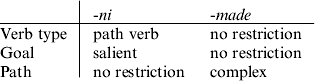
In this section I will reduce these restrictions to one simple contrast: -made realizes participants in motion events, while -ni realizes arguments of motion verbs. I first clarify the distinction I make between motion events and motion verbs (or, more properly, motion predicates). Any given situation in the real world has a range of properties that a specific event-denoting lexeme may or may not encode. For example, an event of John running into the house necessarily involves both a manner and a goal, but three different descriptions of the event might highlight different properties and remain neutral about others. The sentence John went into the house is neutral with respect to manner but imposes a constraint on the goal (its topography and directionality from the deictic center), while John ran is neutral with respect to the goal, but imposes a constraint on the manner (running). John ran into the house encodes both components explicitly.
Distinguishing properties of events from those encoded by the verb, we can classify each restriction in (16) in terms of whether it depends on the event being described or the verb being used. First, the verb-type restriction on -ni is clearly a verb-based restriction, since -ni may only realize the goal of a particular motion event if the verb is a path verb, as shown again in (17) for two different descriptions of an event of John crawling to the station.
- (17)
(a) John-wa (*eki-ni) hatta.John-top station-to crawled‘John crawled to the station.’
(b) John-wa (hatte) eki-ni itta.John-top crawling station-to went‘John went to the station (crawling).’
This suggests that -ni is restricted to occur only with verbs that encode goals explicitly, and not simply in descriptions of events that have goals. Alternatively, one could suppose that -ni is somehow restricted to descriptions of motion events that have goals, but that hau ‘crawl’ and other manner verbs specifically deny the existence of a goal. Thus the combination of -ni with a manner verb yields a contradiction. But this position is clearly not tenable since manner verbs with -made are compatible with goal interpretations, as seen again in (18):
(18) John-wa eki-made hatta.John-top station-until crawled‘John crawled to the station.’
Thus manner verbs are neutral with regard to goal interpretations (though see section 5 for some variation on this) and -ni is restricted to occur only with path verbs. The salient goal constraint of -ni in (16) is likewise a restriction based on the verb rather than the event. This may seem counterintuitive, since this effect seems to be at least partly conditioned by context (i.e. properties of specific events), as the data in (13) show. But as seen in (14), the primary conditioning factor is the verb class: the salient goal effect only shows up with ground-path and (depending on the speaker) non-deictic direction-path verbs, but not deictic motion verbs. Thus it is only with respect to appropriate verb classes that the role of context comes into play for determining exactly what the salient goal is, showing that this is first and foremost a verb-based restriction.
Turning to the path complexity constraint of -made, this is a purely event-dependent property. This should be obvious from the discussion in the previous section. Verbs like agaru, noboru ‘go up’, and even hairu ‘enter’ are all by and large neutral as regards the complexity of the path. The acceptability of -made with any of these verbs is conditioned by the complexity of the path as determined by context. This would suggest that any sensitivity -made has to path complexity is due entirely to whether or not the motion event being described has a complex path, regardless of the verb. Collapsing (16) into two categories, we get a simpler picture of the distributional restrictions on -ni and -made.
(19)

Thus, while -ni is restricted to certain classes of motion verbs regardless of the event, -made is restricted to certain motion events regardless of the verb class. In the next section I present additional data that further validates this distinction but also allows us to generalize it by eliminating the specifically motion-based component.
Beyond motion constructions
Argument-marking vs. participant-delimitation
Both -ni and -made have uses outside of motion constructions, and here the verb-dependent vs. event-dependent contrast is further supported, without reference to motion at all. In general, -ni is often analyzed as an argument-marker, in particular as a dative case (Kuno Reference Kuno1973, Martin Reference Martin1975, Tsujimura Reference Tsujimura1996). Some of its additional uses are shown in (20) (glosses are from original sources; for a more exhaustive catalogue see Sadakane & Koizumi Reference Sadakane and Koizumi1995, based on Martin Reference Martin1975).Footnote 14
- (20)
(a) Mary-ga boku-ni kono hon-o kureta.Mary-nom I-dat this book-acc gave‘Mary gave me this book.’ (dative/recipient)
(b) John-wa Mary-ni hon-o yom-ase-ru.John-top Mary-dat book-acc read-cause-non.pst‘John will make Mary read a book.’ (causee)
(c) Teeburu-no-ue-ni koppu-ga aru.table-gen-top-at cup-nom exists‘There are cups on the table.’ (location in existential) (Kuno Reference Kuno1973: 127–139, 352, exx. (3a), (7), (5a))
(d) E-ga doroboo-ni nusum-are-ta.painting-nom thief-by steal-pass-pst‘The painting was stolen by the thief.’ (logical subject of passive) (Tsujimura Reference Tsujimura1996: 233, ex. (169))
Thus the role of the -ni-marked participant is always determined by the verb, with no unifying semantics common to all such participants that is inherent to -ni (just as nominative/accusative cases carry no semantics).Footnote 15 Rather, we can explain the distribution of -ni in motion constructions in terms of verb class. While all motion verbs entail the existence of a path, manner verbs take only an event argument while path verbs take a goal argument and an event argument, and dative is how goals are marked in Japanese.Footnote 16 (I assume for expository purposes that external arguments are introduced by functional heads; Kratzer Reference Kratzer, Rooryck and Zaring1996.) Sample meaning representations for aruku ‘walk’ and noboru ‘go up’ are given in (21), where e is a motion event in the domain of events U E, p is its path in the domain of directed paths U D, and y∊U D is the final part of p at which the figure arrives at the end of e.Footnote 17
- (21)
(a) [[aruku]]≔λe∃p[walk(e, p)]
(b) [[noboru]]≔λyλe∃p[go.up(e, y, p)]
By contrast, -made serves a range of delimitation functions as shown in (22). In such uses Kuno (Reference Kuno1973: 108) defines -made as ‘continuously until/to X’, and notes that such examples are always durative. In general these uses of -made are similar to its uses in motion constructions: in all cases it delimits some participant in the event/state and imposes some type of complexity constraint.Footnote 18
- (22)
(a) Ohiru-made kore-o shite-kudasai.noon-until this-acc do-please‘Please do this until noon.’ (temporal)
(b) Yuka-kara yane-made nan-meetoru arimasu ka?floor-from roof-until how-many-meters are ques‘How many meters from the floor to the roof?’ (spatial numeral) (Kuno Reference Kuno1973: 108–110, exx. (1a), (6))
(c) Kono hooru-wa nisen-nin-made haireru.this hall-top 2,000-cl.people-until hold‘This hall can hold up to 2,000 people.’ (non-spatial numeral)
(d) Hikooki-ga deru-made tomodachi-to hanashite ita.plane-nom leave-until friend-with talking was‘Until the plane left I was talking with my friend.’ (propositional) (Makino & Tsutsui 1986: 226–228)
Thus the inherent semantics of -made is that it delimits some participant in the event/state (a temporal trace, a path, a numerical range, etc.). It is a matter of pragmatic or lexical semantic inference, based on -made's complement and the event/state being described, which participant it delimits. I sketch a model of this here (following the mereological event semantics of Krifka Reference Krifka and Rothstein1998). We can define a limit as in (23), where g is the limit of some x in event e iff x is a participant in e (i.e. there is a Parsons-style (1990) θ-relation between x and e) and g is the final part of x (i.e. it precedes no other part of x).Footnote 19 This definition places no constraints on the domain of x and g. They may be members of any domain (e.g. the domain U D of directed paths or the domain U T of times). However, since g is a subpart (⩽) of x they must be in the same domain, and furthermore this domain must be one that has a precedence function ≪ defined for it such that one part of x can be said to be ‘before’ or ‘after’ another (specifically g is the ‘last’ part of x).Footnote 20
(23) ∀e∀g∀x[LIMIT(e, g, x)↔∃θ[θ(e, x)∧g⩽x∧¬∃x″[x″⩽x∧g≪x″]]]
(‘g is the limit of x in e iff x is a participant in e and g is a part of x and g precedes no other part of x.’)
I define -made as in (24), where -made takes as its arguments some participant g (i.e. its complement) and the event-denoting predicate P (i.e. the VP it modifies), and says that g is the limit of some participant x in event e.
(24) [[-made]] (Preliminary)≔λgλPλe∃x[P(e)∧LIMIT(e, g, x)]
(‘g is the limit of x in event e described by P.’)
By (23) the participant x -made delimits must be θ-related to the event and from the same domain as g. But since it is existentially bound its interpretation is determined purely by contextually-based inference, giving rise to multiple possible interpretations depending on the event. For example, when -made's complement is a temporal DP or CP (g∊U T) as in (22a), x must be the temporal trace t of e (the only participant in e that is in U T).Footnote 21 This use of -made is available for all predicates, since all events have a temporal trace, even motion events, as shown in (25) (ignoring tense; Fig is the figure thematic role, j is John):
(25) John-ga ohiru-made aruita.John-nom noon-until walked‘John ran until noon.’ ∃e∃x[Fig(e, j)∧∃p[walk(e, p)]∧LIMIT(e, noon, x)] (x=t)
The combination of spatial DPs (g∊U D) and motion events is more complex. Applying (24) to the representations in (21) yields (26) for complement DP X referring to g (assuming that noboru's null goal argument is existentially bound):
- (26)
(a) [[X-made aruku]]=λe∃x[∃p[walk(e, p)]∧LIMIT(e, g, x)]
(b) [[X-made noboru]]=λe∃x[∃y∃p[go.up(e, y, p)] ∧ LIMIT(e, g, x)]
All motion events involve a path p which is eligible to be delimited spatially. For manner verbs this is ostensibly the only appropriate participant, and thus in (26a) x must be p, resulting in an interpretation much like a path verb (cp. (26a) to (21b)), though I discuss an exception to this below. For path verbs, as in (26b), there are more possibilities. The obvious interpretation is again that x=p. However, path verbs also select a goal argument y which must be reconciled with the limit g imposed by -made. The only non-contradictory resolution is that the two are equated (y=g), making it seem that -made is a goal-marker like -ni.
However, recall the salient goal effect, where -made may mark a goal not selected for by the verb. This would be a case where putatively y and g in (26b) are not the same. As it stands this is a contradiction. But, as discussed in section 3.1, we could adopt here an analysis analogous to that of the imperfective paradox. Dowty (Reference Dowty1979: 149, ex. (25)) analyzes the imperfective paradox via an intensional operator PROG, where (informally) PROG φ is true at some interval of time iff φ happens to be true at some appropriate larger interval of time in all ‘inertia worlds’ (worlds minimally different from the real world in relevant ways). A complete discussion of this is far beyond the scope of this paper. However, I tentatively assume that there is some roughly equivalent operator M that relates an event e to a predicate P such that M(e,P) is true iff P is true at some appropriate superevent of e in all inertia worlds. A revised analysis of -made is given in (27). This produces representations such as (28) for (15) (repeated here), where noboru inherently describes an event of going to the top of the path (I is the implicit subject):
(27) [[-made]] (Rev 2)≔λgλPλe∃x[M(e, P) ∧ LIMIT(e, g, x)]
(‘g is the limit of x in e, M-related to P.’)
(28) Hashigo-no tochuu-made/*ni nobotta.ladder-GEN middle-until/to go.up‘I climbed up to the middle of the ladder.’ ∃e∃x[Fig(e, I)∧M(e, λe∃p[go.up(e, top, p)])∧LIMIT(e, middle, x)]
The limit marked by -made in (28) is interpreted as the point at which the figure actually arrives (the middle of the ladder), despite the restriction that in every inertia world the goal is the top. If the goal were realized as tochuu-ni it would be a direct argument of noboru and would thus clash with its lexically-defined constraints that the goal be the top, ruling out -ni.
Of course, as discussed in section 3 salient goal effects only occur with ground-path and possibly non-deictic direction-path verbs. To capture this I assume that (perhaps due to some Gricean conversational maxim) the intensional effects of M only apply when there is some explicit mismatch between the verb's selectional restrictions and those of -made that would otherwise yield a contradiction. Only ground-path and non-deictic direction-path verbs impose (lexical or contextual) selectional restrictions on their goal arguments, thus giving rise to the possibility of a contrast with what is marked by -made. Deictic motion verbs do not impose selectional restrictions on their goal arguments (and for some speakers neither do the rest of the direction-path verbs), and manner verbs do not even select for goal arguments, so that neither verb class gives rise to salient goal effects.
There is also an interesting third possibility inherent in (26b). Since the verb's goal argument y is a member of U D, it is also eligible to be delimited by -made, just like the path p. Of course, delimiting y delimits p, so that there should be no semantic difference between x=y and x=p. However, there is a noteworthy case where it is sometimes possible to get -ni and -made in the same sentence:
- (29)
(a) Gakkoo-ni-wa genkan-made-sika hair-anakat-ta.school-to-top entrance way-until-only enter-neg-pst‘(He) entered the school only as far as the entrance way.’
(b) Sono ana-ni oku-made te-o tukkonda.this hole-to deep-until arm-acc stuck‘(I) put my arm deep into the hole.’ (Tsuguro Nakamura, p.c.)
Crucially, such sentences are only acceptable when -ni describes the goal selected for by the verb and -made adds additional, more event-specific information about this goal, resulting in a case where -made delimits the goal y (i.e. x=y in (26b)) in a meaningful way, rather than delimiting the path p. That this is a possibility is an interesting prediction of this approach, and represents another way that -ni and -made can have different functions even when they cooccur.
Furthermore, even non-motion verbs may take spatial limits, provided the event is contextually construable as involving motion, as in (30) in the context of riding a train (Matsumoto Reference Matsumoto, Tanaka and Matsumoto1997: 188 makes a similar point citing similar data):
- (30)
(a) Nagayo-made bentoo-o tabeta.Nagayo-until meal-acc ate‘(I) had a meal all the way to Nagoya.’
(b) Kyoto-made neta.Kyoto-until slept‘(I) slept all the way to Kyoto.’ (Tsuguro Nakamura, p.c.)
Although taberu ‘eat’ and neru ‘sleep’ are not motion verbs, in a context where the eating and sleeping activities occur on a train, -made is acceptable with a spatial limit on a goal interpretation.Footnote 22 For simplicity's sake we can assume that the predicates in (30) are coerced to interpretations that involve motion and thus involve a new path participant p (as well as a figure and possibly other participants), in which case the definition in (24) can apply to them with x=p.
Matsumoto's (Reference Matsumoto, Tanaka and Matsumoto1997) data in (5) (repeated here) shows a similar effect, wherein there is a reading that Taroo was swimming in the swimming pool on a cruise liner heading to the port. However, this predicate is already a motion predicate, so that there is also the simple reading that Taroo swam to the port.
(31) Taroo-wa minato-made sanzyu-pun-kan/de oyoida.Taroo-top port-until 30-minutes-for/in swam‘Taroo swam to the port in 30 minutes.’ (goal-marking -made) ‘Taroo swam for 30 minutes till he got to the port.’ (temporal -made)
This represents a case of -made with a manner verb where the entity x delimited by -made is not equated with the path p of the verb (an exception to the discussion above). However, assuming that coercion of the sort discussed for (30) is possible even for verbs that already describe motion, we can explain the ambiguity of (31) in terms of the availability of two path participants that might potentially be delimited: that of the swimming event and that of the coerced cruise liner event. Thus the two readings of (31) follow from a single definition of -made, capturing Matsumoto's original insight without assuming separate goal-marking and temporal uses.
Still further, -made can also mark limits of numerical values as in (22b) and (22c). A full account of how measurements are analyzed is again beyond the scope of this paper. However, we could naïvely assume that such stative events have measurement participants that are continuous numerical ranges on the real number line ordered by standard numerical precedence relations such as ‘less than (or equal)’. This makes measurements eligible for having a limit imposed on them, giving rise to another use of -made having nothing to do with either motion or temporality. Thus a single definition allows a range of interpretations for different sorts of events, provided only that the given event participant is compatible with having a limit of the type of the complement of -made.
Finally, as noted in section 3, for many speakers -made imposes a constraint that the participant it delimits is complex. In the case of temporal traces and paths this in turn often determines durativity of the event, where the homomorphic θ-relation relating each participant back to the event preserves mereological complexity (Beavers Reference Beavers, Dölling, Heyde-Zybatow and Schäfer2008). However, recall also from section 3 that the complexity constraint is technically independent of the event: the relevant additional subpart could occur on the path before or after the goal. To capture this we could modify (27) so that x is an initial (INI) subpart of a larger event-independent entity x′ (i.e. x⩽x′ and x and x′ share the same initial point; Krifka Reference Krifka and Rothstein1998: 206, ex. (36a)), where g is the final point on x in e as in (27) and x′ must be a complex object (CO) (i.e. having at least three subparts; Beavers Reference Beavers, Dölling, Heyde-Zybatow and Schäfer2008: 254, ex. (24b)):
(32) [[-made]] (Final)≔λgλPλe∃x∃x′[M(e, P)∧LIMIT(e, g, x)∧INI(x, x′)∧CO(x′)]
(‘g is the limit of x (initial subpart of complex x′) in e, M-related to P.’)
The extra part of x′ other than x may lie before or after g on x′. For example, (33) represents the analysis of (10b), where John traverses a portion of a larger path that has multiple possible endpoints after the goal. Here x is the path from the first to the second floor, while x′ is a complex superpath from the first to the tenth floor. Alternatively, the sentence could occur in the context that x=x′ (presumably the default interpretation), in which case x would have to be complex.
(33) [John is on the first floor of a ten-story building.] John-ga ni-kai-made nobotta.John-nom 2nd-cl.floor-until went.up‘John went up to the second floor.’ ∃e∃x∃x′[Fig(e, j)∧M(e, λe∃y∃p[go.up(e, y, p)])∧LIMIT(e, 2nd.floor, x)∧INI(x, x′)∧CO(x′)]
While this analysis is only a sketch, it is clear that we can infer how the bound is interpreted from the type of bound -made marks and the type of event it modifies. This gives rise to multiple possible interpretations dependent on context, even with a single predicate, something not possible with -ni. Thus this analysis captures the fact that despite the apparent overlap of -ni and -made in motion constructions, they are in fact realizing two entirely different things: one is truly picking up on what happens in the event (the real goal), the other on what the verb highlights about the event (the salient/expected goal). It is only due to the fact that in most cases these two goals are exactly identical that -ni and -made appear to have the same function.
Morphosyntactic evidence
A final question to be asked is whether there is any morphosyntactic correlate to this semantic distinction. Intuitively, the cases where -ni and -made are interchangeable reflect the difference between a syntactic argument and an adjunct. As it turns out, it is surprisingly hard to find evidence for this contrast. First, in motion contexts -ni appears to be an oblique postposition rather than a case-marking postposition, insofar as this can be determined in Japanese. For example, nominative -ga, accusative -o, and recipient -ni are all deletable in some contexts, including clefting constructions and under topic-marking by the topic-marker -wa (Kuno Reference Kuno1973; Miyagawa Reference Miyagawa1989; Dubinsky Reference Dubinsky, Postal and Joseph1990, Reference Dubinsky1994; Sadakane & Koizumi Reference Sadakane and Koizumi1995). Oblique postpositions such as -de ‘at, with’, -kara ‘from’, and -made ‘until’ are never deletable in these contexts (see e.g. Kuno Reference Kuno1973: 357).Footnote 23 In motion constructions, -ni patterns like obliques in that it is not deletable, as shown in (34) under topic-marking by -wa, contra nominative -ga:
- (34)
(a) John-ga eki-ni itta.John-nom station-to went‘John went to the station.’ (no topic marking by -wa)
(b) John-wa eki-ni itta.John-top station-to went‘As for John, he went to the station.’ (-ga deleted under topic -wa)
(c) Eki-ni-wa/*eki-wa John-ga itta.station-to-top/station-top John-nom went‘As for the station, John went to it.’ (-ni not deletable under topic -wa Footnote 24)
Thus -ni here is oblique, so that at best a -ni-marked goal is an oblique argument.
Other tests for argumenthood vs. adjuncthood are likewise of no use. Japanese allows scrambling, so word order tests (e.g. adjuncts occur further from the head than arguments) do not necessarily apply. Optionality also does not help, since Japanese allows massive amounts of pro-drop (nearly any DP or PP is optional). Iterativity (the ability of adjuncts but not arguments to be iterated, e.g. The beautiful green vegetables vs. *Sandy saw Kim a dog; Schütze Reference Schütze1995: 102f.) is of very limited use given the nature of the semantic domain: a motion event may have at most one goal, so it makes little sense to look for multiple goal-phrases per clause. However, with this in mind, recall the data in (29), wherein both -ni and -made can cooccur provided -ni describes the goal selected for by the verb and -made adds additional, more event-specific information about this goal. This certainly suggests that at least one of these postpositions (presumably -made) marks an adjunct. However, without further corroborating evidence it is difficult to tell what grammatical function each PP has, though this is not to say that a syntactic contrast does not exist. Nonetheless, what is crucial is that there is a semantic contrast, as discussed above, demonstrating significant differences between these two postpositions.
Exceptions and variation
In this section I discuss some apparent exceptions to these empirical generalizations that suggest that -ni has some inherent goal-marking semantics after all, contrary to my analysis. However, I argue that in these cases the goal semantics can still be attributed to the verb, although only after recognizing that path verbs can differ in the degree to which they encode path. In particular, Stringer (Reference Stringer2003, Reference Stringer and Saint-Dizier2006) notes that -ni occurs with some manner verbs in some uses:
- (35)
(a) Akira-wa umi-no-naka-ni jampu-shita.Akira-top sea-gen-inside-to jump-did‘Akira jumped into the sea.’
(b) Ishi-ni/ishi-no-tokoro-ni jampu-shita.rock-to/rock-gen-place-to jump-did‘(He) jumped on the rock.’
(c) Soto-ni nigeta.outside-to fled‘(He) fled outside.’
(d) Hidari-ni tobu.left-to leaps‘(He) leaps to the left.’ (cf. Stringer Reference Stringer2003: 46–53, exx. (5), (35))
These examples are not acceptable to all speakers, and some speakers find them more acceptable than others. Likewise, certain contexts, as well as the addition of inherently directional elements as in (35b), help significantly. Nonetheless, it would appear that to the degree these data are acceptable they suggest that -ni perhaps has some goal-marking semantics after all. However, there is in fact a simple explanation for the exceptionality of these data: while these verbs are indeed all manner verbs, they are also to some degree path-encoding (as Stringer argues), indicating or at least implicating some kind of dislocation. Thus we might label them ‘manner+path’ verbs, encoding both semantic components at once. A class of verbs such as this is attested cross-linguistically. Zlatev & Yangklang (Reference Zlatev, Yangklang, Strömqvist and Verhoeven2004) argue that exactly such a class exists in Thai, including verbs such as phlóo ‘pop out’, tók ‘fall’, and lâj ‘chase’. If the verbs in (35) encode some notion of goal it is not surprising that they should be acceptable with -ni, on my analysis.
Another apparent exception is hashiru ‘run’, which does not seem to encode goal yet can be found with -ni in some contexts:
- (36)
(a) Akira-wa umi-no-naka-ni hashitta.Akira-top sea-gen-inside-to ran‘Akira ran into the sea.’
(b) Eki-ni hashitta.station-to ran‘(He) ran to the station.’
(c) Eki-no-naka-ni hashitte-itta/hashitta.station-gen-inside-to running-went/ran‘(He) went running into the station.’ (cf. Stringer Reference Stringer2003: 46, exx. (5), (9), (10))
This is again subject to speaker variability, and context can make a difference in acceptability. However, the exceptionality of this particular verb is also not surprising, since in many languages verbs meaning ‘run’ often serve as bleached motion verbs, acceptable with goal-marking satellites even when other manner verbs are unacceptable with such satellites. Indeed, some of my informants have noted that hashiru in this context means something more like ‘move hurriedly’. Similar data can be found in Italian (Pustejovsky & Busa Reference Pustejovsky, Busa, Bertinetto, Bianchi, Higginbotham and Squartini1995) and English (e.g. I'm gonna run on over to the bookstore, acceptable in a context of driving). So we might dismiss hashiru as a simple motion verb on a par with move that selects for a goal argument (albeit one that perhaps indicates rapidity).
Thus occurrence of the verbs in (35) and (36) with -ni is not unexpected. However, none of this explains the relative unacceptability of (35) and (36) compared to more canonical path verbs. The lower acceptability of verbs of this sort with goal-phrases can be observed in other V(erb)-framed languages as well. As noted by Stringer for French and by Aske (Reference Aske1989) and Martínez Vázquez (Reference Martínez Vázquez2001) for Spanish, the acceptability of goal-phrases marked by à/a ‘to, at’, which are unacceptable with manner verbs but acceptable with path verbs (see section 6), shows mixed behavior with verbs similar to those in (35) and (36) (as well as speaker variability and context-dependence again), suggesting a larger cross-linguistic pattern. The intuitive explanation is that each of these verbs has at least some manner component in it that interferes with its ability to take goal arguments, i.e. they are treated by speakers as simultaneously capable of and incapable of taking goal arguments. Evidence supporting such an analysis comes from two related domains.
First, the idea that motion verbs can be subject to constraints applicable to both manner verbs and path verbs finds some support in the class of manner+path verbs that Zlatev & Yangklang (Reference Zlatev, Yangklang, Strömqvist and Verhoeven2004) argue for in Thai. Zlatev & Yangklang show that in Thai serial verb constructions (SVCs) there is a general ordering constraint that places all manner verbs to the left of all path verbs, such that the ordering of manner and path verbs in (37) is the only possible one:
(37) chán dəən (paj).I walk go‘I am walking (away).’ (Zlatev & Yangklang Reference Zlatev, Yangklang, Strömqvist and Verhoeven2004: 165, ex. (10))
Another way to view this is to decompose the ordering constraint into two components: manner verbs must come to the left of path verbs and path verbs must come to the right of manner verbs. This conceptualization explains an interesting property of Thai manner+path verbs. In SVCs these verbs must be positioned between manner and path verbs, i.e. they are subject to both ordering constraints, so that the only resolution is to come in the middle as shown in (38) for phlóo ‘pop out’.
(38) chán dəən phlóo ₔ
ɔk paj.I walk pop.out exit go‘I popped out, walking.’ (Zlatev & Yangklang Reference Zlatev, Yangklang, Strömqvist and Verhoeven2004: 167, ex. (7a))
 ɔk paj.I walk pop.out exit go‘I popped out, walking.’ (Zlatev & Yangklang
Thus these verbs shows ‘mixed’ properties, subject to two constraints for which, in Thai, there is one solution. Turning back to Japanese on the other hand, if manner+path verbs are constrained to be both acceptable and unacceptable with -ni-marked goals there is no solution. Hence, we expect the sort of muddled acceptability judgments, seen in (35) and (36). Thus manner+path verbs may be a cross-linguistically valid class that shows various types of mixed behavior depending on the particular language.
Second, we also find support for mixed classes and mixed behavior when we look at motion verbs in terms of unaccusativity, in particular regarding the Split Intransitivity Hierarchy of Sorace (Reference Sorace1993, Reference Sorace, Eubank, Selinker and Smith1995, Reference Sorace2000) and Sorace & Shomura (Reference Sorace and Shomura2001). Sorace and her colleagues argue that there is a cline of intransitivity ranging from strongly unaccusative verbs such as change-of-location tuku ‘arrive’ to strongly unergative verbs like controlled non-motional processes such as utau ‘sing’, where manner verbs like odoru ‘dance’ (as controlled motional processes) are very unergative and path verbs like iku ‘go’ (as changes-of-location) are strongly unaccusative (Sorace & Shomura Reference Sorace and Shomura2001: 250, figure 1):
(39) Change of location Unaccusative (least variation)
[Directed motion]↕
Change of condition
Appearance
Continuation of preexisting condition
Existence
Uncontrolled process
[Emission]
[Involuntary reaction]
Controlled motional process
Controlled non-motional process Unergative (least variation)
Verbs at the two extremes tend to show categorical behavior in terms of their acceptability in various canonical tests for unaccusativity, such as auxiliary selection in languages like Italian and Dutch (Burzio Reference Burzio1986, Bresnan & Zaenen Reference Bresnan, Zaenen, Dziwirek, Farrell and Meijas-Bikandi1990, Zaenen Reference Zaenen and Pustejovsky1993, Levin & Rappaport Hovav Reference Levin and Hovav1995) and accusative case deletion and quantifier floating in Japanese (Sorace & Shomura Reference Sorace and Shomura2001). The verb classes in the middle tend to show mixed results, including cross-speaker, cross-dialectal, and cross-linguistic variation regarding accepability with certain diagnostics, variable acceptability depending on context, and relatively muddled acceptability judgments (see Sorace Reference Sorace2000 in particular for a summary of these results). Following on this, we could view the relative acceptability of -ni-marked goals as deriving from a bidirectional verb hierarchy of increasing ‘pathiness’ and decreasing ‘manneriness’ as in (40), where verbs further to the right are more acceptable with -ni than those further to the left. However, (40) is just a subcomponent of the Split Intransitivity Hierarchy in (39), with path verbs as strongly unaccusative and manner verbs as strongly unergative (Tsujimura Reference Tsujimura, Koizumi and Ura1994), and manner+path verbs as in between.
(40) Manner Verbs Manner+Path Verbs Path Verbsodoru ‘dance’ < hashiru ‘run’, tobu ‘leap’ < iku ‘go’, noboru ‘go up’Unergative Unaccusative
Thus acceptability with -ni-marked goals can be reduced to an unaccusativity test specifically for motion verbs. The relative acceptability (as well as the effects of context and cross-speaker variation) simply reflects the gradient behavior normally seen along the Split Intransitivity Hierarchy: -ni is ruled out for the strongly unergative motion verbs, ruled in for the strongly unaccusative motion verbs, and shows mixed behavior with the classes in the middle.
In summary, the fact that -ni-marked goals occur in (35) and (36) is actually expected on the analysis presented here, despite the apparent exceptionality, if we assume that these verbs have path semantics. Furthermore, the muddled acceptability of -ni with these verbs follows if they represent a ‘mixed’ class which share the conflicting constraints of both manner and path verbs. The existence of mixed classes is supported by the presence of comparable classes of motion verbs in Thai and by classes that fall between canonical unaccusative and unergative encoding along Sorace's Split Intransitivity Hierarchy. Thus these apparent exceptions in fact strengthen the analysis of -ni presented here.
Conclusion: revisiting motion typologies
In this paper I have shown that two superficially synonymous ways of marking goals in motion constructions in Japanese, -ni and -made, are in fact quite distinct, on the basis of various distributional differences between them both in and out of motion constructions. The marker -ni is not a goal-marker per se, but is instead a general argument marker (i.e. a dative case), marking goal arguments of path verbs and other arguments of other types of verbs. The marker -made, on the other hand, is a general limit-marker. It marks endpoints of event participants, and in the case of motion predicates it is capable of marking the endpoint of the path of motion. However, it itself encodes no specific path or motion-based semantics. Thus the overlap of two postpositions in what appear superficially to be exactly the same contexts does not necessarily imply any functional or semantic equivalence. Quite the contrary, more subtle investigation reveals dramatic differences.
In this section I return to the question of motion typology, and especially the status of -made. As noted in section 1, work in the tradition of Talmy (Reference Talmy2000) (see also Talmy Reference Talmy and Kimball1975, Reference Talmy and Shopen1985, Reference Talmy1991) has classified Japanese as a ‘verb-framed’ language, along with French, Spanish, and Turkish, in which the characteristic pattern of expressing paths is via path verbs and the characteristic pattern of expressing manner is in a satellite to the verb (see note 3 on the definition of a satellite). Such languages tend to categorically lack path-encoding satellites (e.g. path adpositions). This is as opposed to ‘satellite-framed’ languages like English or Russian where the characteristic expression of path is as a satellite and the verbs are typically manner verbs (cf. Slobin & Hoiting Reference Slobin and Hoiting1994; Wienold Reference Wienold, Egli, Pause, Schwarze, von Stechow and Wienold1995; Slobin Reference Slobin, Shibatani and Thompson1996, Reference Slobin, Strömqvist and Verhoeven2004). Most important for the issue at hand is that satellites in V-framed languages like Japanese typically do not express path semantics. However, attributing path semantics to -made is exactly the analysis proposed by Matsumoto (Reference Matsumoto, Tanaka and Matsumoto1997), Inagaki (Reference Inagaki2002), Tanaka (Reference Tanaka2002), and to a certain degree by Tsujimura (Reference Tsujimura, Koizumi and Ura1994), thus making -made exceptional not only in Japanese but also in terms of this typology.
Similar data is attested in other V-framed languages. French and Spanish allow goal-marking via the preposition à/a ‘to’ or dans/en ‘in’ for path verbs but not generally with manner verbs, as seen for Spanish in (41) and French in (42).
(41) La botella fue/??flotó a la cueva.the bottle went/floated to the cave‘The bottle went to the cave.’ (Spanish)
- (42)
(a) Je suis entré dans la maison (en boitant).I am entered in the house in limping‘I entered (into) the house (limping).’
(b) *J'ai boité dans la maison.I-have limped into the house‘I have limped into the house.’ (French)
However, Spanish and French have prepositions jusqueBonami Reference Bonami, Drewery, Kruijff and Zuber1997, Reference Bonami1999) and hasta (Aske Reference Aske1989; Martínez Vázquez Reference Martínez Vázquez2001) respectively which mark goals with manner verbs just like -made:Footnote 25
- (43)
(a) Juan nadó/flotó hasta/??a la costa.Juan swam until/to the coast‘Juan swam to the coast.’ (Spanish)
(b) J'ai boité jusqu'à/*à la maison.I-have limp until-at/to the house‘I limped to the house.’ (French)
The existence of such markers again constitutes an apparent counterexample to Talmy's typology. However, note that these data are amenable to exactly the same analysis I have proposed for -ni and -made. First, in many Romance languages the à/a preposition serves a variety of functions marking arguments of verbs, such as indirect objects in transfer of possession constructions, direct objects in Spanish for human direct objects, etc., covering many of the uses of -ni in Japanese (qua dative case again). Second, hasta and jusque, just like -made, also have more general delimitation uses, as shown in (44) and (45) respectively.Footnote 26
- (44)
(a) Maria se durmió hasta las diez.Maria 3rd.refl slept until the ten‘Maria slept until ten o'clock.’ (temporal)
(b) ¿Cuantos metros hay desde el suelo hasta el techo?how-many meters exist from the floor until the ceiling‘How many meters from the floor to the ceiling?’ (spatial numeral)
(c) Hasta que el avión llegó, hablé con mi amigo.until that the plane arrived talked.1sg with my friend‘Until the plane arrived, I talked with my friend.’ (propositional)
- (45)
(a) Maria a dormi jusqu'à dix heures.Maria has slept until-at ten hours‘Maria slept until ten o'clock.’ (temporal)
(b) Combien de mètres y a-t-il du plancher jusqu'au plafond?how-many of meters are there from.the floor until-at.the ceiling‘How many meters from the floor to the ceiling?’ (spatial numeral)
(c) J'ai parlé avec mon ami jusqu'à ce que l'avion soit arrivé.I-have spoken with my friend until-at that the-plane is arrived‘Until the plane arrived, I talked with my friend.’ (propositional)
Thus my analysis of -ni and -made seems equally applicable here, such that these data and those in Japanese are all manifestations of the same basic contrast between argument markers and delimiters.Footnote 27
However, this still does not explain the discrepancy vis-à-vis the generalizations made by Talmy. It could of course be that there are more types of languages than the Talmy typology predicts (a point discussed in detail by Beavers et al. Reference Beavers, Levin and Tham2008 and Bohnemeyer et al. Reference Bohnemeyer, Enfield, Essegbey, Ibarretxe-Antuñano, Kita, Lüpke and Ameka2007). This is not an unexpected or necessarily unwelcome conclusion. However, for those interested in maintaining the more constrained notion of the Talmy typology, I would point out that on my analysis of -made there is technically no exceptionality. The proposed definition of -made (and similarly jusque and hasta) is just that it delimits entities, but it does not necessarily carry any path semantics. It is only due to specific contexts of use, as described in section 4, that -made can yield a reading in which it appears to realize a goal as a satellite. In this sense it is outside the domain of Talmy's typology, which does not preclude expressions in languages from realizing boundary points of different sorts of entities. Therefore my analysis is actually consistent with Talmy's typology despite the apparent contradiction.
Nonetheless, the analysis proposed here suggests that Talmy-style typologies as generally conceived are lacking in some way. Although limit-markers are not in and of themselves goal markers, their use in motion constructions shows that they are an available strategy for indicating a goal of motion, and may sometimes mark the same participant a proper goal-marker would. Thus a motion-independent resource in these languages has been co-opted for use in motion constructions. Furthermore, the fact that this seems to occur in other V-framed languages shows that this is a cross-linguistically available strategy for getting around the otherwise categorical constraint against combining motion verbs with path-denoting satellites in V-framed languages. It is noteworthy that few speakers of English (an S-framed language) find until an acceptable goal-marker (cf. #?John strolled/crossed until the other side of the bridge), quite likely due to the fact that English has a whole host of path/goal-denoting prepositions (of which to is the canonical exemplar) and thus has no need for co-opting until.
The idea that putatively V-framed languages may use available motion-independent resources to get around the ban on S-framed encoding has found support in recent work on motion typologies. For example, as Slobin & Hoiting (Reference Slobin and Hoiting1994), Slobin (Reference Slobin, Strömqvist and Verhoeven2004), and Zlatev & Yangklang (Reference Zlatev, Yangklang, Strömqvist and Verhoeven2004) have noted, many languages that generally allow serial verb constructions (SVCs) also permit sequences of manner and path verbs in SVCs to express directed motion, effectively yielding a manner main verb in clauses with path-encoding elements (as seen in section 5 for Thai). Likewise, Japanese has V+V compounds, and among other things it permits manner verb+path verb compounds as in (46) to express directed motion.
(46) John-wa eki-e hashitte-itta.John-top station-to running-went‘John went running to the station’ (Yoneyama Reference Yoneyama1986: 2, ex. (4a))
Slobin (Reference Slobin, Strömqvist and Verhoeven2004) has labeled SVC languages as ‘equipollently-framed’, where both path and manner receive ‘equal’ encoding as main verbs. I see no reason why this could not include compounding languages as well. However, what is interesting about compounding languages such as Japanese is that clauses that do not have compound verbs always follow a V-framed pattern (excepting goals marked by limit-markers). This suggests that Japanese (and presumably other compounding languages) is just a V-framed language that has co-opted the independent process of compounding to get around the constraints imposed on V-framed languages, in exactly the same way that limit-markers have been co-opted. Arguably, neither of these strategies violates Talmy's typology in the narrow sense, since in no case is a satellite expressly encoding a goal or path per se. But they do suggest that the standard S-framed vs. V-framed dichotomy is just one piece of the puzzle, since the wider range of path/manner encoding possibilities across languages also includes resources that are not solely dedicated to motion but may nonetheless be co-opted for expressing motion, introducing further dimensions of variation.


