Introduction
Sources differ in the numbers they consider to be the types or breeds of Turkish livestock and there is considerable confusion in the nomenclature not only outside but also within the country. What is not in dispute is that humpless Bos taurus is the only species of cattle – known as ‘sigir’ in Turkish – raised in Turkey (FAO/UNEP Reference Scherf2000). Several native or indigenous and exotic types and various crosses between these (although some of the crosses have had limited utility and an ephemeral life) are listed by various sources. Thus, according to one authority domestic cattle comprise six varieties but none is identified individually (MARA/FAO, 2001). An earlier publication on Turkish biological diversity identifies six types of cattle (Anon, 1987). A search of one authoritative source (Mason, Reference Mason1996) brings to light several to many more breeds and types of livestock than the previous two sources. The European Association for Animal Production (EAAP, 2007) provides yet another view of the diversity of Turkey's domestic livestock. The breeds’ database of the Food and Agriculture Organization lists 35 cattle although 15 of these are given as extinct (DAD-IS, 2010).
Cattle numbers have decreased steadily from 16.6 million head in 1980 to a little over 10.6 million head in 2009 (SIS, 2009). Production of milk and meat from cattle has remained relatively stable over the 30-year period from 1980 due mainly to changes in breed structure and the use of imported specialist dairy and beef breeds with milk yields per cow increasing by some 50 percent from 1 300 litres to almost 2 000 litres per lactation and carcass weights of slaughter cattle rising threefold from less than 60 kg to more than 180 kg (FAO, 2010). In spite of this, however, the contribution of cattle to the total output of animal products has declined because of the enormous increase in the numbers of poultry and structural changes in poultry production from low input extensive to high input very intensive systems.
In spite of the importance of cattle in Turkey there has been a paucity of recent publications on the species in the international literature. Those that have been published include papers relating to animal health and disease (Cetinkaya et al., Reference Cetinkaya, Ongor, Karahan, Kalender, Lorenzon and Thiaucourt2003; Aslantas et al., Reference Aslantas, Erdogan, Cantekina, Gulacti and Evrendilek2006; Temizel et al., Reference Temizel, Yesilbag, Batten, Senturk, Maan, Mertens and Batmaz2009), production on state farms (Ekerden and Ozkutuk, Reference Ekerden and Ozkutuk1990), some aspects of the biochemistry of milk (Polat, Gencoglu and Turkmen, Reference Polat, Gencoglu and Turkmen2009; Gurcan, Reference Gurcan2011) and reports of small-scale experiments on meat production (Ozluturk et al., Reference Ozluturk, Tuzemen, Yanar, Esenbuga and Dursun2004; Unlu et al., Reference Unlu, Yanar, Esenbuga, Ozluturk, Yuksel and Macit2008; Yuksel et al., Reference Yuksel, Yanar, Turgut, Ozluturk, Kopuzlu and Sezgin2009). The current paper aims to provide information on some of the main cattle populations of Turkey as well as some perceptions of their production and is one of a series (Wilson, Yilmaz and Ertugrul, Reference Wilson, Yilmaz and Ertugrul2011; Yilmaz, Ertugrul and Wilson, Reference Yilmaz, Ertugrul and Wilson2011a, Reference Yilmaz, Ertugrul and Wilson2011b) that will eventually cover all the nation's domestic animal species.
Cattle in the national and household economies
Products – meat, milk, eggs, wool and hides – from the livestock subsector in Turkey contributes 30 percent of total agricultural gross domestic product. Some 96 percent of the country's four million agricultural enterprises are mixed crop–livestock farms. About 65 percent of all farms keep some cattle but the average number per farm is less than four head. Farm sizes are less than 5 ha for 65 percent of holdings which accounts for only 22 percent of the agricultural land whereas the remaining 35 percent of holdings with an individual area of greater than 5 ha occupy 78 percent of the land. An overwhelming proportion of output is for subsistence use with any surplus usually being disposed of through middlemen because of the distance to markets. In spite of the small and fragmented nature of agriculture more than 45 percent of rural income derives directly from agriculture which is the key component of rural household livelihoods.
Poverty levels in Turkey are high. More than one-third of the population relies on the agricultural sector for employment and income generation. The family-owned and -managed farm is the basic unit of agricultural production and family members provide most of the farm labour. Household food security is very important to the impoverished populations of the rural and peri-urban areas and small-scale cattle farms contribute significantly to the nation's food supply and to local economies. Most cattle are still managed traditionally, rely mainly on extensive and low-quality grazing for their nutriments and receive very little in the way of veterinary care. The situation is exacerbated in winter as housing standards are low, feed is often of even poorer quality and cold and crowding produce stress that reduces tolerance to disease. The fragmented nature of traditional agriculture is often accepted as the norm and its sustainability and contribution to national welfare are neglected. Small-scale farms nonetheless contribute to human welfare (especially that of old and infirm people and children), are guardians of the common wealth and work, within their limits, to protect the soil, water and air and maintain and enhance biodiversity in addition to producing essential and often high-quality animal protein for the betterment of everyone. The income derived from small farms is not only used to buy additional items of food but also helps to pay for other and various items including health services, school fees, water and electricity and new assets.
In contrast to small holder subsistence farming, Turkey has a number of large-scale commercial farms including feedlots and several government and university experimental establishments.
Cattle breeds and types
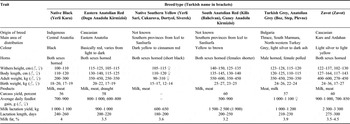
Cattle have been an important part of the economy and in the lives of the people of Turkey for at least 10 000 years (Duru and De Cupere, Reference Duru and De Cupere2003; Zeder, Reference Zeder2008). For many millennia they have provided subsistence meat and milk to mainly small holder farmers yet only limited attention has been paid to this fact (Karakok, Reference Karakok2007). In these circumstances there has been little opportunity to improve individual performance. Even today in modern Turkey most cattle are kept in the traditional production systems and continue to be of a clear local type. Several native lines including Native Black (“Yerli Kara”), East Anatolian Red (“Dogu Anadolu Kirmizisi”) and South Anatolian Red (“Kilis” or “Guneydogu Anadolu Kirmizisi”) have been collectively nominated Anatolian native (Ertugrul, Reference Ertugrul1993; Mason, Reference Mason1996). Distinct breeds and breed groups have been identified on morphological or regional grounds (Table 1) but cluster analysis and genetic distancing studies have shown that several to most of these are not distinctly separate (Ozbeyaz, Yildiz and Camdevsiren, Reference Ozbeyaz, Yildiz and Camdevsiren1999).

Native Black (Yerli Kara)
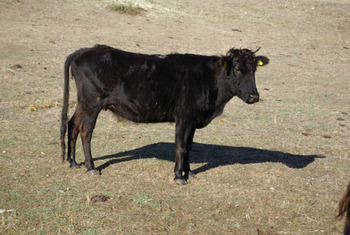
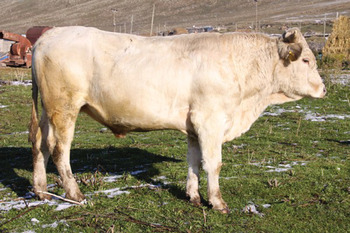
Found mainly in Inner or Central Anatolia the Native Black (Yerli Kara) or Anatolian Native Black (Anadolu Yerli Kara) is a Bos brachyceros type with a long narrow head (Figure 1). As its common name implies it is usually black (Mason, Reference Mason1996), although other sources refer to it as the Anatolian Black Pied (Anadolu Siyah Alacasi) (DAD-IS, 2010). A conservation herd is maintained at the Central Livestock Research Institute at Lalahan some 30 km east of Ankara on the Anatolian Plateau. The breed has a herd book with 49 herds participating in a conservation programme in 1999 (FAO/DADIS, 2010). In 2002, the national population was estimated at between 100 000 and one million – down from five million in 1975 – but the breed was considered to be not at risk although numbers were expected to continue to decrease owing to cross-breeding. The breed is triple purpose for dairy, draught and meat and is able to ‘withstand bad environmental conditions’ (Anon, 1987).
Native Black (‘Yerli Kara’) female.

East Anatolian Red (Dogu Anadolu Kirmizisi)
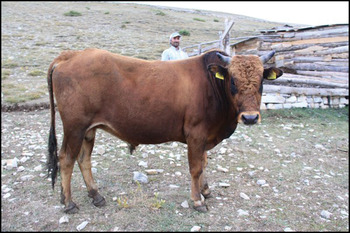
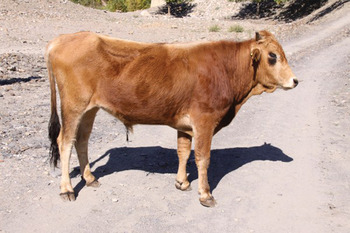
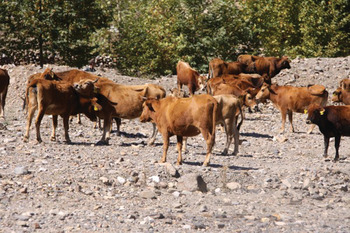
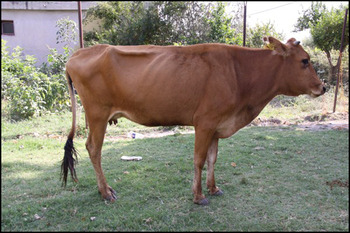
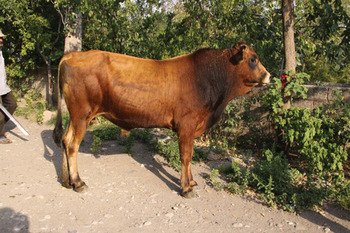
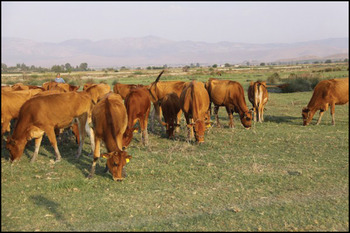
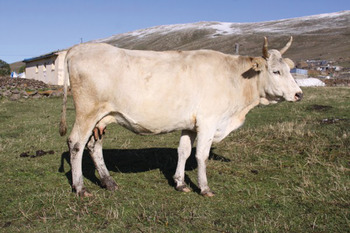
Originally descended from the Caucasian (Mason, Reference Mason1996), the East Anatolian Red (Dogu Anadolu Kirmizisi) or Eastern Red (Anon, 1987) is found mainly in East Anatolia but has the widest distribution of all native breeds after the Native Black. The beast is a narrow-chested descendant of Bos taurus brachyceros (Figures 2–4). A conservation herd is maintained at the Eastern Anatolia Regional Research Station at Erzurum. The population of this type is now thought to be less than one million animals and is considered to be at risk. Recognized varieties of this type are the Cildir and the Gole (Mason, Reference Mason1996; DAD-IS, 2010). The East Anatolian Red has been used in the development of the Turkish version of the Zavot (Aksoy, Kirmizibayrak and Saatci, Reference Aksoy, Kirmizibayrak and Saatci2006). The breed is primarily used for milk production.
East Anatolian Red (‘Dogu Anadolu Kirmizisi’) male.

East Anatolian Red (‘Dogu Anadolu Kirmizisi’) female.

East Anatolian Red (‘Dogu Anadolu Kirmizisi’) group.

Native Southern Yellow (Yerli Guney Sarisi)
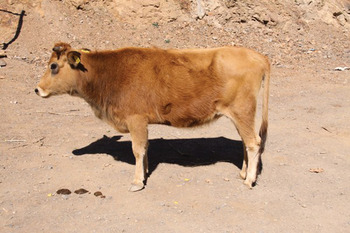
Both Mason (Reference Mason1996) and (DAD-IS, 2010) list the Native Southern Yellow (Figures 5–7) with the former considering this to be a breed of historical importance. South Anatolian Red is sometimes used as a synonym for this type (Mason, Reference Mason1996). Recognized varieties are Cukurova, Dortyol and Siverek. The Cukurova, originally from the Anatolian Black × Aleppo (=Damascus) is extinct (Mason, Reference Mason1996) due mainly to cross-breeding with exotics, the decreasing numbers of farmers and an inability to adapt to regions other than its centre of origin in the southeastern provinces bordering Syria and the Mediterranean (FAO/DADIS, 2010). The Dortyol is a small extinct variety said to be similar to the Baladi of Syria (Mason, Reference Mason1996). Numbers of the Southern Yellow itself are said to be 20 000 and decreasing. This is mainly a dairy animal.
Native Southern Yellow (‘Yerli Guney Sarisi’) male.

Native Southern Yellow (‘Yerli Guney Sarisi’) female.

Native Southern Yellow (‘Yerli Guney Sarisi’) group.

South Anatolian Red (Kilis, Guney Anadolu Kirmizisi)
This animal, mainly a dairy animal, sometimes known in English as the Southern Yellow-Red, is similar to the Damascus (Mason, Reference Mason1996). The estimated population of 70 000 in 1990 decreased rapidly to less than 4 000 by the year 2000 and the breed is considered at risk. A short body, long narrow head and short or sometimes rudimentary horns are its characteristics (Figures 8–10). The type is well adapted to heat and is tolerant of parasites.
South Anatolian Red (‘Kilis’) male.

South Anatolian Red (‘Kilis’) female.

South Anatolian Red (‘Kilis’) group.

Turkish Grey (Boz)
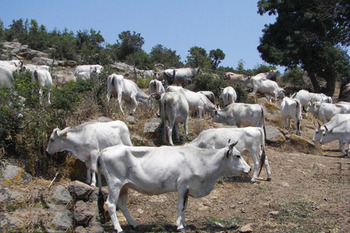
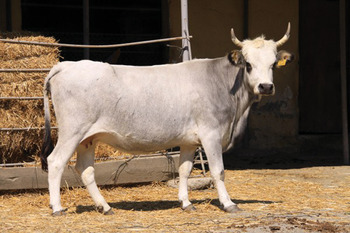
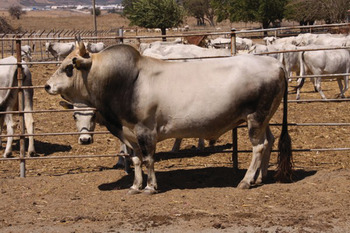
Turkish Grey Steppe (Boz) cattle (Figures 11–13) probably originated from the Iskar or Bulgarian Grey Steppe in the middle of the nineteenth century. It is sometime also referred to as the Anatolian Steppe in English and Step and Plevne in Turkish (FAO/DADIS, 2010). This type is part of the general Grey Steppe group widespread in southeast Europe (Mason, Reference Mason1996). The original descent of the group as a whole is probably from Bos primigenius (Save-Focus, 2005). The Turkish variety is a dual purpose meat and milk animal. Well adapted to harsh environmental conditions and able to survive on low-quality feed, the Boz nonetheless has poor reproductive performance. Numbers declined rapidly from about 930 000 head in 1975 to just over 20 000 head 30 years later.
Turkish Grey (‘Boz’) male.

Turkish Grey (‘Boz’) female.

Turkish Grey (‘Boz’) group.

Zavot (Zavot)
The Zavot is a composite of Simmental and Brown Swiss originally developed in the Russian Caucasus (Russian ‘zavod’ = factory, Mason, Reference Mason1996). The Turkish Zavot (Figures 14 and 15) has been modified by infusions of the East Anatolian (Aksoy, Kirmizibayrak and Saatci, Reference Aksoy, Kirmizibayrak and Saatci2006). The home tract of the Zavot is Kars and Ardahan provinces of eastern Anatolia. In the late twentieth century the population was estimated at a maximum 10 000 animals and decreasing, down from 30 000 some ten years earlier (FAO/DADIS, 2010). Most Zavots are self-coloured grey and are well adapted to the local climate. In one experiment, 18-month-old steers fed for 162 days had a live weight of 348.5 kg, a hot carcass weight of 197.2 kg and a dressing percentage 56.5 (Aksoy, Kirmizibayrak and Saatci, Reference Aksoy, Kirmizibayrak and Saatci2006).
Zavot (‘Zavot’) male.

Zavot (‘Zavot’) female.

Other breeds
Several other breeds are noted but about which little, other than the name, is known. Among these are Anatolian Black Pied, Anatolian Brown, Antakli (also known as Lebanese) which is possibly a variety of the Damascus or a composite of Damascus and Baladi and is found around Hatay, Kurdi which is a mainly black animal that may be present in parts of the Kurdish area bordering on Iraq and Maras (FAO/DADIS, 2010). The Seferihisar is possibly equivalent to the Eskisehir of Izmir province in western Turkey and may be a composite of Simmental and Aleppo (Mason, Reference Mason1996; FAO/DADIS, 2010) but is possibly extinct.
Genetic modification
It is evident from the foregoing section on breeds that there has long been an interchange – traditional and largely informal – of various types of livestock with neighbouring countries including especially Syria, Iraq and the countries of the Caucasus. In the early period of the Turkish Republic at the beginning of the 1920s government institutes and private individuals raised only native cattle breeds. In 1925, however, the first true exotics were imported from Austria and Hungary. An early outcome of this was the development of the Karacabey Brown (Karacabey Esmeri, Karacabey Montafon) – named after the State Farm where it was originally bred – from the local Plevne (Grey) Steppe cattle of northwest Turkey crossed with Austrian (Montafon) Brown Swiss (Felius, Reference Felius1985). Now more commonly known as the Turkish Brown in English (Mason, Reference Mason1996) it is also sometimes called the Cifteler and Karacabey Montafon in English and Karacabey Esmeri in Turkish (FAO/DADIS, 2010). The Eskisehir to which reference has been made in the preceding paragraph may be a varietal name for this type (Mason, Reference Mason1996). The Karacabey is said to be a strong animal for meat and milk with good feed efficiency and resistance to ‘all climatic conditions’. Cows weigh 600 kg and have a milk yield of 4 330 kg – although 6 000 kg is possible – at 4 percent fat (Felius, Reference Felius1985). Simmental cattle were also among the early imports and crossed with native cattle.
Concurrent with live animal imports, Turkey was one of the first countries to attempt to use biotechnology to improve livestock performance. Artificial insemination (AI) was first used in 1925 but lack of early success – conception rates were only 15–20 percent – resulted in the process being abandoned for many years (Ertugrul et al., Reference Ertugrul, Akman, Askin, Cengiz, Firatli, Turkoglu and Yener1993).
Imports continued at a low level from 1925 up to 1958. In 1958, the World Council of Churches provided an eclectic mix of beef (Hereford and Aberdeen Angus), dairy (‘black and whites’ and Jersey) and dual-purpose breeds (Brown Swiss) to Turkey. From 1986, the number of incoming cattle was allowed to increase and it is believed as many as 150 000 head were imported over the next few years (Ertugrul, Reference Ertugrul1993). The commercial success of these imports both for meat and milk production is evident in increased carcass weights and lactation milk yields whereby a considerably reduced number of cattle produce annually for the nation as much meat and milk as far higher numbers of animals did in the past. This success has not been gained without cost, however, and the largely indiscriminate and even uncaring top crossing of exotics on native populations has resulted in drastic declines in the numbers of the latter and the total extinction of many types.
Conservation measures
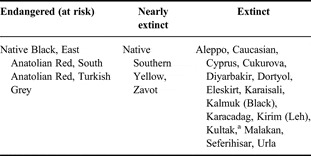
In the mid-1990s the proportion of pure European cattle in Turkey's national herd was about 13 percent and that of European × Native was in the region of 38 percent. Thus, less than half of the Turkish cattle population comprised animals of purely native origin. Cattle imports, cross-breeding programmes and a greater use of AI were not only responsible for a reduction in numbers but also the near disappearance of a number of breeds and the extinction of at least 15 breeds or types (Table 2). Alarmed, perhaps belatedly, by this situation the Turkish government began to apply conservation policies in an attempt to prevent further decline and to preserve Turkish indigenous cattle breeds.
Conservation status of Turkish cattle breeds.

Note: aKultak has possibly a remnant population in Gorum Province.
Source: Ertugrul et al., Reference Ertugrul, Dellal, Elmaci, Akin, Pehlivan, Soysal and Arat2010.
The Scientific and Technological Research Council of Turkey (STRCT), Marmara Research Centre, Genetic Engineering and Biotechnical Institute (GEBI), Gebze, Kocaeli, prepared a project titled the ‘In Vitro Conservation and Preliminary Molecular identification of some Turkish Domestic Animal Genetic Resources (TURKHAYGEN-I)’ in 2005 (Arat, Reference Arat2010). Consequent on several iterations the project was approved by STRCT in March 2007 with a budget of 9.1 million Turkish Lira (about US$ 5.0 million). The implementation period was 4.5 years with the project expected to be completed by the end of 2011 (Arat, Reference Arat2010).
As indicated in the project document its expected outcomes were:
• establishment of DNA and viable cell banks (gametes, embryos, somatic cells and tissue samples) of animal genetic resources through cryopreservation at GEBI and at Lalahan Livestock Central Research Institute;
• genetic characterization and registration of valuable species and breeds; and
• enhancement of the competitiveness of national human resources in the area of animal husbandry and the building of a critical mass of researcher capacity.
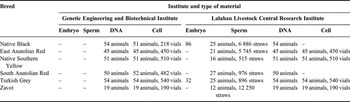
An extensive bank of genetic material has been established for Native Black, East Anatolian Red, Native Southern Yellow, South Anatolian Red, Turkish Grey and Zavot cattle as a result of the project (Table 3). It is expected that this resource will be expanded for preservation, conservation and use of Turkey's native genetic resources in the future.
Genetic material conservation status of Turkish cattle breeds in May 2011.

Source: Arat (Reference Arat2010).
Conclusions
Biodiversity, including livestock biodiversity, is an indication of the genetic and economic wealth of a country. As a natural bridge between Europe and Asia, Turkey has been traversed by traders, travellers, treasure seekers and trespassers for thousands of years. The eclectic mix of species and breeds of domestic livestock within Turkey's boundaries is partially a result of these exchanges. The national patrimony has, however, been greatly diminished in the second half of the twentieth and the first decade of the twenty-first centuries where, indeed, it has not already been lost forever. New and possibly more productive breeds can provide more human food (but at greater cost) than native animals whose adaptation has been to survival rather than to output. Locally developed species are a pool of irreplaceable genetic material of unacknowledged merit and value that must not be lost but must be conserved for possible unknown and unseen future use (Wilson, Reference Wilson2009). Impoverishment of the nation's natural capital is not acceptable under any circumstances but the modest start of conservation measures by government augurs well for the future and for the safeguarding of the country's heritage. Livestock production will remain sustainable only if the nation's gene pool is fully characterized and preserved for use by future generations who will face as yet unforeseen circumstances.
Turkey is a country that is still on the road of development. Livestock production remains an important economic activity but its product is inadequate to supply the nutritional requirements of its people. Native cattle are generally of low output but still constitute a fair proportion of the national herd. Efforts should continue to characterize and improve their productive traits alongside the use of exotic breeds with superior productivity but lower adaptability. Government, universities and the mass of livestock producers and ancillary industries should work together to conserve and improve the native cattle breeds of Turkey.
Statement of Interest: There are no conflicting or financial interests by any of the authors.
Acknowledgements
The photograph of Figure 1 is by R.T. Wilson. All other photographs by courtesy of Oya Akin.