INTRODUCTION
Second only to the Supplemental Nutritional Assistance Program in scope, the Earned Income Tax Credit (EITC) is one of the largest and most influential cash transfer programs in the United States. The EITC has lifted nearly seven million people out of poverty and, in a single year (2012), provided $60 billion in tax benefits to 27 million American households (Maag and Carasso Reference Maag and Carasso2014). This enormous distribution of benefits is driven in large part by the legislative success of the program—being expanded several times since its inception even as other distributive programs have faced retrenchment. For example, even though the EITC aids a vulnerable population similar in makeup to other welfare programs like Aid to Families With Dependent Children (AFDC)/Temporary Assistance to Needy Families (TANF), it was expanded at the same time Congress destroyed AFDC. In 1995, the EITC cost twice as much as AFDC yet it was not included in the “welfare reform” agenda.Footnote 1 Despite the distributional scope and long-term successes of the program, the EITC has only recently gained the attention of scholars as part of a growing interest in non-traditional welfare programs known as the “Hidden Welfare State”.
First advanced by Howard (Reference Howard1997), the hidden welfare state literature argues that the American welfare state includes not only traditional programs like Temporary Assistance to Needy Families or Social Security, but also includes tax expenditures, subsidies, loan guarantees, and some important regulations (Hacker Reference Hacker2002; Howard Reference Howard1997; Howard Reference Howard2008; Mettler Reference Mettler2011). This hidden welfare state includes programs like the EITC in addition to the Home Mortgage Tax Deduction, and the untaxed employer provided health insurance provision.Footnote 2 Accounting for 1.1 trillion dollars in federal spending during 2013 alone, these tax-based programs have exploded in size and scope since the 1970s and represent an extensive redistributive agenda, which has become one of the main ways in which the federal government provides social benefits to American citizens (United States Office of Management and Budget 2013).
Some prominent scholarship exploring the hidden welfare state has argued that the hidden welfare state undermines democracy (Hacker and Pierson Reference Hacker and Pierson2011; Mettler Reference Mettler2011). These scholars point to the fact that hidden welfare state programs, as a whole, disproportionately benefit wealthy Americans and that low income Americans are unaware of this fact. One solution advocated by these scholars to combat this lack of knowledge is to “unearth” these programs by dramatically increasing public awareness of their existence. By increasing public awareness, scholars contend that low-income individuals will increasingly realize they are receiving an unequal share of benefits from the submerged state, will become more politically engaged over hidden welfare state programs, and will attempt to correct the disparity. In short, the goal for Mettler (Reference Mettler2011) and others is to reveal hidden policies to the citizenry in order to ensure democratic accountability.Footnote 3
While we are sympathetic to the democratic concerns these authors raise, we argue that submerged state scholars should be more careful when making claims about the hidden welfare state as a whole. In particular, we believe that even if unearthing programs that disproportionately benefit the rich would be good for democracy, unearthing the entire hidden welfare state as scholars have suggested (including hidden programs designed for vulnerable populations such as the EITC), may lead to policy retrenchment for programs that benefit the poor. Specifically, we contend that if unearthed, hidden programs for vulnerable populations would confront an obstacle that hidden welfare state scholars have yet to grapple with—the racially charged environment in which traditional welfare state programs operate. Existing scholarship consistently demonstrates that the link between race and political attitudes is so strong that it is difficult to explain social policy preferences without considering Americans' explicit and implicit attitudes towards minority racial groups (Federico Reference Federico2006; Gilens Reference Gilens1996; Goren Reference Goren2003; Peffley, Hurwitz, and Sniderman Reference Peffley, Hurwitz and Sniderman1997). Despite the attention paid to the link between traditional welfare programs and race, researchers have not examined the link between race and the Hidden Welfare State. Whereas traditional welfare programs have been the subject of multiple racializing forces for many decades, submerged programs have remained largely hidden from the public and thus have not been subjected to the same racializing forces as traditional welfare programs.
We argue that despite lacking these pressures, race can play a similarly important role for preferences concerning hidden programs for the poor if unearthed. Combining insights from American Political Development (APD) and political behavior, we maintain that if a hidden program that benefits the vulnerable were to be unearthed into the racially charged American polity, it may become susceptible to the same racialization as traditional welfare state programs. Critically, this contention should not be viewed as merely another extension demonstrating the strong link between race and welfare state attitudes. Instead, this study should be seen as the first to analyze whether hidden tax-based programs, which have not been subjected to any of the historical racializing forces as other welfare programs can nevertheless become racially charged. Such a finding would be an important caveat to hidden state scholars' calls for “unearthing” the submerged state and demonstrate that even without the decades of racialization that inexorably tied ADC and other welfare programs to race, policy programs can easily be racialized in a similar manner.
To explore this possibility, we conduct an experiment, which shows that when the ordinarily popular EITC—a prominent hidden welfare state policy for low income workers—is described using traditional welfare stereotypes, support for the program drops substantially. Additionally, we show that when support decreases for the EITC, it is driven by respondents' racial predispositions reacting to the usage of racial stereotypes. While our analysis focuses on the EITC, there are several other tax-based welfare programs for low and middle income people such as the child care tax credit, lifetime learning credit, and the American Opportunity Tax Credit for which our findings should apply. These programs, although a smaller portion of the Hidden Welfare State than programs for the upper-class, are crucial for the people who rely on them for their daily lives. Ultimately, through our analysis we will show that any discussion of the welfare state—traditional or hidden—is incomplete without accounting for the prominent role of race in American society.
THE HIDDEN WELFARE STATE
Emphasizing the role that tax expenditures, loan guarantees, and regulations play in providing social benefits in the United States, the hidden welfare state literature has greatly expanded our understanding of what constitutes American social policy. This growing body of research has begun to show us that the hidden welfare state is one of the most important ways that social policy is administered, with indirect spending often matching and sometimes outpacing discretionary spending by the federal government (United States Government Accountability Office 2005). Perhaps more importantly, this research has raised important questions about democratic accountability.
In particular, recent work has consistently demonstrated that the distribution of benefits is highly unequal, with a disproportionate share of funds going to the rich (Bartels Reference Bartels2008; Gilens Reference Gilens2012; Hacker and Pierson Reference Hacker and Pierson2011; Mettler Reference Mettler2011). That is not to say that the hidden welfare state only benefits the wealthy—in fact, programs under the hidden welfare state provide crucial financial support to those in need—however, the majority of the programs that constitute the submerged state can only be accessed by a select few. More troubling, the public is often unaware not only of the way in which the programs are distributed, but also that they exist at all. Even those programs that benefit the poor suffer from this lack of knowledge, with Mettler (Reference Mettler2011, 38) reporting that a whopping 47% of EITC beneficiaries did not believe that they were benefiting from a government social program. The public's ignorance of the adoption and alteration of these programs is a pervasive feature of the hidden welfare state. Scholars contend that the public's lack of widespread knowledge about these programs as a whole, undermines American democracy as citizens are ignorant of a massive portion of federal spending which disproportionately benefits a select few. Therefore, several researchers have called for the “unearthing” of the hidden welfare state—bringing submerged programs into the light to face the scrutiny of a more engaged mass public. Through this process, these scholars contend that public policy will come to reflect more accurately the needs of the wider public.
This desire to increase democratic accountability is laudable. However, we argue that accounting for the environment into which programs would be thrust is pivotal since programs for the poor are more susceptible to racialization and thus retrenchment (Lieberman Reference Lieberman1998; Skocpol Reference Skocpol, Jencks and Peterson1991). Decades of history and literature suggest that were these tax-based programs, which benefit the vulnerable, to be exposed, they could be subject to the same forces that traditional welfare programs confront—most notably racialization. Even though the EITC has not been exposed to these racial forces, there is little reason to suggest that if exposed to the same conditions as traditional welfare programs, hidden programs for the vulnerable would be able to avoid the process of racialization, which over time has turned countless programs designed to benefit those in need into pariahs known only for their blackness. Using insights from APD and political behavior, we contend that if hidden welfare state scholars' call for unearthing were to be heeded, hidden programs designed to benefit the poor could follow a similar path to traditional welfare state programs for the poor—they will be racialized, popularity for the program will decline, and retrenchment will become more likely.
THE LINK BETWEEN RACE AND SOCIAL POLICY
The core programs that constitute the traditional welfare state were created during the two big bangs of American social policy—the New Deal and the Great Society—and saw Old Age Insurance (now Social Security), Unemployment Insurance, ADC, Medicare, Food Stamps, and Public Housing enacted into law (Howard Reference Howard2008).Footnote 4 The dramatic expansion of the American welfare state during these periods represented a drastic increase in the social commitments of the federal government but more importantly for our analysis, the design of these programs helped entrench the disadvantaged status of African Americans that has persisted to this day. Specifically, many of these key traditional welfare programs were designed in such a way that explicitly allowed race to be forcibly incorporated into the development and administration of these programs, and subsequently altered the way in which Americans viewed the welfare state.
Over a 60-year period race has been one of the most influential factors in the development of the programs underlying the American welfare state. Both administratively and statutorily, African Americans were excluded from receiving benefits because of the efforts of state level administrators and federal occupation exclusions (Lieberman Reference Lieberman1998; Quadagno Reference Quadagno1996). Despite the political efforts to exclude blacks, the structural aspects of the programs – namely that many were designed to benefit the poor and unemployed, who happened to be disproportionately African Americans—created a situation where the recipient pool became increasingly black and over the course of 60 years, African Americans became the face of welfare.
This statutory and administrative exclusion of blacks is perhaps best evident when exploring the passage and subsequent development of ADC.Footnote 5 Arguably, the most recognized welfare program in America, ADC was designed to subsidize existing state level programs for single mothers (mothers' pensions) by giving them a monthly cash stipend to help support the raising of their children. While the federal government helped to fund the program, administering the program was largely left up to states. The decision to design a program in this way had profound implications for potential recipients as states were able to craft eligibility requirements and limit benefits in such a way to exclude “undesirable” groups like African Americans.
Consequently, some program administrators took advantage of the lack of real oversight to administratively exclude African Americans from the rolls. States in the deep south with higher percentages of African Americans, coupled meager benefits with stringent eligibility requirements so as to exclude blacks while states with smaller African American populations had relatively generous benefits and eligibility requirements (Soss Reference Soss2002; Howard Reference Howard2008, ch. 2). As an example, even 3 years after the passage of the Social Security Act of 1935, which included ADC, Mississippi, a state that was 50.2% black had a modal payment per recipient of $0.00 for those on “dependent children” social programs. Contrast this with New York, a state that was 3.3% black, where state administrators spent $1.35 on average per recipient (Bucklin Reference Bucklin1939). In addition to the benefit size inequity, the decision to administer ADC at the state level led to additional issues for African Americans that arose through differential state eligibility requirements. States kept program eligibility requirements deliberately vague and would use these vague requirements to exclude African American families. For instance, even though blacks constituted 15% of the ADC recipients nationally in the late 1930s, only 7% of recipients in the confederate south were African American (Myrdal Reference Myrdal1944, 359).
Even as political elites in the south (and elsewhere) worked to exclude blacks from receiving benefits; another trend was taking hold across the nation. The African Americans who were systematically excluded from receiving welfare benefits were being increasingly (and wrongly) identified as the main recipients of the program. Driven by the combination of negative media portrayals describing blacks as “lazy” and “undeserving” with program design characteristics, which gave power to local leaders and allowed for the exploitation of societal cleavages, a program which might have otherwise aided blacks because of the groups it was intended to benefit (the poor and unemployed) came under continual attack on racial grounds (Gilens Reference Gilens1999). In spite of the administrative efforts to exclude blacks, programmatic design of only targeting certain groups would eventually win out, with blacks in the modern era accounting for a disproportionate share of the program's beneficiaries.
This combined racialization effort of ADC and other traditional welfare programs through program design, administration, and media portrayals had important effects on public attitudes towards these programs; an issue which has been explored in depth by political psychologists. Scholars have found consistent and persuasive evidence that white attitudes towards welfare are inexorably linked to racial attitudes. Specifically, white Americans with negative views towards African Americans oppose welfare spending more than white Americans who do not have negative attitudes towards African-Americans (Federico Reference Federico2006; Gilens Reference Gilens1996; Reference Gilens1999; Peffley, Hurwitz, and Sniderman Reference Peffley, Hurwitz and Sniderman1997). This relationship has been found to be mediated by the so called “deservingness” of the program recipients, with the connection between racial attitudes and welfare views far stronger for programs designed to help the undeserving poor, such as ADC (Goren Reference Goren2003).
Critically for our analysis, scholars have also devoted considerable effort to understanding the way framing influences program racialization. In particular, research has found that even if a program has not been linked to race historically, through careful framing, attitudes towards previously unracialized programs can be racialized by invoking established belief structures towards race (Winter Reference Winter2008). The development of this connection between policy and race is driven in large part by the media and political campaigns, which intentionally (or unintentionally) use racially tinged messaging (Gilens Reference Gilens1999; Mendelberg Reference Mendelberg2001). By placing African Americans prominently in their visual coverage of key social issues, the mass public comes to link attitudes towards programs with previously developed schemas towards blacks (Gilens Reference Gilens1999). While the establishment of this racial connection may be unintentional, the resulting influence on political attitudes is analogous to the influence achieved through old-fashioned racism (Henry and Sears Reference Henry and Sears2002; Mendelberg Reference Mendelberg2001).
Through this literature on APD and racial attitudes, it is clear that there is a strong link between race and the traditional welfare state. Despite the overwhelming evidence of this link in these two literatures, researchers within the hidden welfare state tradition have not yet fully incorporated race into their narratives. Additionally, researchers who deal with welfare attitudes have not yet fully adopted the more expansive understanding of what constitutes the American welfare state into their research. This study represents a first step in both of these directions and to our knowledge; is one of the first to attempt to link the hidden welfare state research to the welfare attitudes literature.Footnote 6 Specifically, we explore the implications of “unearthing” a prominent hidden program for the poor—the EITC- in a racialized environment. Through an experiment, we show that when the ordinarily popular EITC is described using traditional welfare stereotypes, support for the program drops. Additionally, building off of existing work on hidden welfare state program support and racial framing, we test the influence of racial frames on program attitudes based on the amount of information needed to influence program attitudes.
RESEARCH DESIGN
The historical evidence of the link between race and welfare attitudes is overwhelming and consistent; however, one limitation remains—as no hidden programs have been “unearthed” to this point, there is no historical evidence to draw on to suggest whether or not the same fate could befall programs in this subterranean state that benefit the poor and vulnerable. For that reason, this analysis will now turn to the use of an experiment to determine whether or not these programs can be racialized in the same way that other welfare programs have been racialized historically. By drawing on the methodology of the experiments conducted by Suzanne Mettler (Reference Mettler2011) in her 2011 book on The Submerged State and analyzing changing attitudes towards hidden programs for the poor once racial information is added to information prompts designed to “unveil” these programs, we can gain important insight into what might happen if these hidden programs are brought forward into the racially charged political landscape in which traditional welfare programs operate.
In order to explore the role of race in the unveiling process, we chose to focus our experiment on a program universally considered to be part of the hidden welfare state and for which the benefits clearly fall to those who are less well off—the EITC. As a tax-based program, which subsidizes the incomes of the working poor and has many similarities to traditional welfare programs like ADC, the EITC would be a likely target for racialization should submerged programs be brought to the surface and could suffer the same fate as more traditional cash assistance programs. The similarities between these programs are quite striking. Both programs are designed to mediate the relationship between the poor and market forces, both aid constituencies who lack political efficacy, and both programs play an important role in providing social benefits to minority groups.Footnote 7 In fact, over the past few decades political elites have made the explicit link between the EITC and traditional welfare programs. In the years after the 1993 Clinton budget, which included a large increase in the EITC, newspapers began negatively comparing the EITC with other “traditional welfare” programs. In 1997, the San Diego Union Tribune ran an article arguing that it “discourages work, in the same way that other welfare programs do” (Galles Reference Galles1995), and the Orange County Register referred to it as the fastest growing welfare program’ in 1995 (Zaldivar Reference Zaldivar1995). The same can be seen in some conservative leaning think tanks such as the Heritage Foundation, “[t]he Earned Income Tax Credit is the nation's largest means-tested cash welfare program” (Rector Reference Rector2016) and the CATO Institute, which advocates cutting the EITC in tandem with other “welfare” programs (Edwards and de Rugy Reference Edwards and de Rugy2015). This does not just happen in the press or among think tanks. Sen. Don Nichols (R-OK), in a hearing about combating EITC “fraud”, described the EITC as “an income redistribution scheme that the administration has greatly expanded, in my opinion, without looking at costs.” In other words, an expensive welfare program. (See The Committee On Ways And Means House Of Representatives (1997), and especially Goldberg (Reference Goldberg2007, 249–50) for extensive discussion on conservative quotes beginning the “welfarization” the EITC) This is all to say that the link between welfare and EITC has already been made by elites, the similarities between the programs are striking, and it is not out of line to suggest that similar rhetoric to that seen with other welfare programs would grow and intensify if the hidden welfare state were unearthed. Furthermore, as a typical hidden program for the poor, our findings here may generalize to other submerged programs for the vulnerable.
DATA AND METHODS
To evaluate the potential implications of racialization on the EITC, we conducted a survey experiment from May 1 to 9 of 2014 using Amazon's Mechanical Turk platform. The sample contained 1,819 respondents split across a number of different conditions and skewed slightly male, educated, young, and Democratic.Footnote 8 Although we readily acknowledge that MTurk does not provide a representative sample for this analysis, “for experimental research, MTurk provides quick and high-quality data” and furthermore, “provides a closer approximation to a representative sample than many other sources of experimental data” (Buhrmester, Kwang, and Gosling (Reference Buhrmester, Kwang and Gosling2011 in Chen et al. (Reference Chen, Appleby, Borgida, Callaghan, Ekstrom, Farhart, Housholder, Kim, Ksiazkiewicz, Lavine, Luttig, Mohanty, Rosenthal, Sheagley, Smith, Vitriol and Williams2014) pg. 4), Berinsky, Huber, and Lenz (Reference Berinsky, Huber and Lenz2012), Leeper and Mullinix (Reference Leeper and Mullinix2015)).
At the beginning of the survey experiment, before answering any questions, respondents were randomly treated with one of six experimental prompts, which they were asked to read. Building on the work of Mettler (Reference Mettler2011), our first two prompts provided respondents with varying degrees of background information about the EITC.Footnote 9 In the first, which we call the low information environment moving forward, respondents were told that the EITC is a tax benefit for people who work but do not make much money and that through the program; many people pay no taxes or even receive a payment from the government if their income is low enough. In the second condition, which we refer to as the high information environment moving forward, respondents were given the same information as in the low information environment, but were also told that the program benefits those with low incomes and that a large majority of the benefits went to households that made less than $40,000 in 2013.Footnote 10 Both the low and high information environments were included in our analysis to remain consistent with past work on unearthing hidden programs by Mettler (Reference Mettler2011) where she shows that varying amounts of policy information can have important implications for attitudes towards hidden programs.
Our other four conditions replicate the low and high information environment conditions but also add varying amounts of racially charged information similar to that seen in past studies of the welfare state. Specifically, categories 3 and 4, which we refer to as our weak racialization categories, replicate the low and high information environments and add a sentence to the end of the experimental prompts, which note that of those eligible for the EITC, 75% are black. Conditions 5 and 6, which we refer to as our strong racialization categories, maintain this racial breakdown of program recipients while also referring to the EITC as the Earned Income Tax Welfare Credit and noting that program recipients are more likely to be poor, black, unmarried, and have children. In the racialized conditions we chose to exaggerate the racial breakdown of program recipients in order to ensure that the racial information was primed. In reality, around 50% of EITC recipients are minorities (Holt Reference Holt2006). This decision was made to maximize the experimental realism of the manipulation with the existing literature suggesting that officials often take similar liberties with facts when playing the race card (Gilens Reference Gilens1996).Footnote 11 All other features of the information prompts were identical to the low and high information environments, respectively. While our strongly racialized conditions present respondents with intense racialization, we believe that the language used is consistent with existing stereotypes and rhetoric surrounding traditional welfare state programs. Specifically, the EITC is in fact a means-tested program, recipients are necessarily poor, a disproportionate percentage of program recipients are minorities, and benefit size for the program increases dramatically for those with children (Holmes Reference Holmes2012).Footnote 12 Additionally, while the recipient pool for the EITC is only 50% minority, Gilens (Reference Gilens1999) consistently demonstrates that the public overestimates the percentage of minority welfare recipients and we wanted our experiment to reflect the sort of rhetoric that the unearthed program could confront.
After reading one of the six experimental prompts, respondents then took a political survey. Immediately following the prompt, respondents were asked to give their opinion of the EITC using a four-point ordinal approval measure, which will serve as the dependent variable in our analysis. The measure was taken directly from Mettler (Reference Mettler2011) and as was seen in her work, across our conditions we found that the EITC enjoyed widespread popularity, with 82% of the sample at least somewhat in favor of the program and 38% of the sample strongly favoring the program.
As the influence of race on EITC attitudes may hinge on the racial predispositions of the respondents themselves, the next key variable included in our analysis is racial resentment. Racial resentment as articulated by Kinder and Sears (Reference Kinder and Sears1981) is “a blend of anti-black affect” and the feeling that blacks violate the moral values embodied in the Protestant Ethic (Mendelberg Reference Mendelberg2001, 416).Footnote 13 Racial resentment of the respondents was assessed with a scale created from four questions tapping racial predispositions as detailed in Kinder and Sanders (Reference Kinder and Sanders1996) and which has been used in countless other works since. The Online Appendix provides a histogram detailing the distribution of respondents along the racial resentment scale.
In addition to accounting for racial resentment, our choice to focus on a social welfare program necessitated the inclusion of questions designed to capture two core values, which could drive attitudes towards the EITC: economic individualism and egalitarianism. Individualism is important to include because individuals who believe that people should “get ahead on their own” may be less supportive of the EITC regardless of the racial information included about the program (Feldman Reference Feldman1988; Goren Reference Goren2001). Similarly, individuals who believe in egalitarianism may believe in redistributive programs in general, regardless of the racial background of program recipients. Individualism and egalitarianism are captured with scales developed from three question batteries taken directly from Feldman (Reference Feldman1988). The fourth variable is the respondent's income level. With past work suggesting that the wealthy can resent paying for programs that only benefit the poor (Gilens Reference Gilens1996; Jencks Reference Jencks1992; Skocpol Reference Skocpol1990; Reference Skocpol, Jencks and Peterson1991) and that support of welfare is highest among the least wealthy (AuClaire Reference AuClaire1984; Cook and Barrett Reference Cook and Barrett1992; Curtin and Cowan Reference Curtin, Cowan and Strumpel1975; Gilens Reference Gilens1996; Hasenfeld and Rafferty Reference Hasenfeld and Rafferty1989; Kluegel and Smith Reference Kluegel and Smith1986; Williamson Reference Williamson1974), the inclusion of respondent income is necessary for any study of attitudes towards social programs. Even more importantly, existing work on the EITC and other hidden programs shows that providing respondents increasing program information can result in polarizing attitudes across incomes, highlighting further the need for income's inclusion here (Mettler Reference Mettler2011).
In addition to accounting for these important predictors of social welfare program attitudes, this study will also include several standard demographic and political control variables. In particular, this analysis will include party identification, ideology, education, gender, and age. For party identification and ideology, we generally expect to find that more liberal respondents will have more favorable attitudes towards the EITC. Next, given the simple fact that more educated individuals are less likely to receive the tax benefit, we expect more educated respondents to be less supportive of the EITC. We do not have any clear expectations for gender or age however given the slight skew for each variable in our sample we deemed their inclusion necessary.
HYPOTHESES
Through our experimental analysis of race and attitudes towards the EITC, we expect to find that although the EITC enjoys widespread popularity, the addition of racial information to our prompts will result in less favorable attitudes towards the program overall (Hypothesis 1). This finding would comport well with historical evidence and suggest that including race in the discussion of unearthing hidden programs is crucial. Furthermore, we expect that the EITC will be less popular among the racially resentful, but only in the racialized conditions (Hypothesis 2). Evidence in support of this hypothesis would suggest that negative attitudes in the racialized conditions are driven by the racial predispositions of respondents as opposed to other factors. Finally, we expect the role of racial predispositions to be the strongest in the strongly racialized conditions, which present respondents with traditional welfare stereotypes (Hypothesis 3).
RESULTS
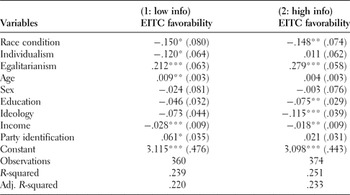
In analyzing the results from our experiment, we find strong support for our first hypothesis. In order to analyze our first hypothesis, we carried out a multivariate analysis on white respondents' attitudes towards the EITC using ordinary least squares regression.Footnote 14 Minority respondents were excluded from the analysis because of our focus on racial attitudes and the different effects our prompts might have across racial groups (Gilens Reference Gilens1996).Footnote 15 Using a dummy variable to account for whether or not the experimental condition was racialized and separate models for each information environment, we find general support for our claim that the racialization of these hidden programs if unveiled could have important implications for program support.Footnote 16 In Table 1, which compares the non-racialized environments with the weak racialized environments while controlling for other predictors of EITC attitudes and standard political variables, we find that providing respondents with additional racially charged information about the program and its recipients significantly decreases EITC support. In the Appendix we also present the results for all of our tables without control variables since it has been suggested that control variables can erode the benefits of randomization. There, we find that our results are generally robust although some measures go from significant at standard measures to just marginally significant. This finding holds across information environments although the finding is only marginally significant in the low information environment.
Influence of weak race condition on EITC support

***p < .01, **p < .05, *p < .10.
Standard errors in parentheses.
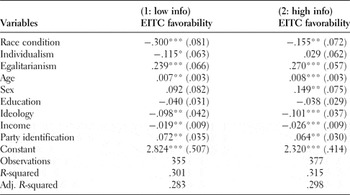
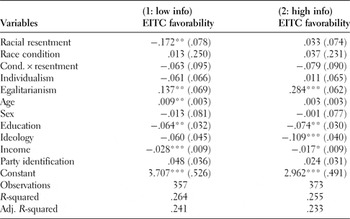
Note: Dependent variable in Tables 1–4 is a four-point ordinal measure capturing increasing support for the EITC. Cell entries are OLS coefficients with standard errors in parentheses. All variables are analyzed on white respondents only.
Based on the results in Table 2, which analyzes the same research question while comparing the non-racialized conditions to the strongly racialized conditions, it appears that this general pattern of results holds regardless of the amount of racialized information included in the prompts. Adding strongly racialized information to the prompts results in a significant decline in EITC support when controlling for other relevant predictors of attitudes and points to the need to include race in the discussion of unearthing the hidden welfare state. This finding once again holds across information environments, although the effect is now significant at standard levels in the low information environment.
Influence of strong race condition on EITC support

***p < .01, **p < .05, *p < .10.
Standard errors in parentheses.
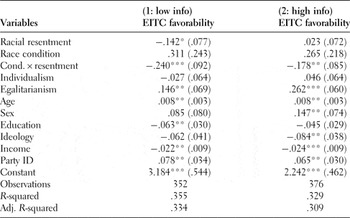
The results to this point suggest that EITC attitudes can be racialized by providing respondents with varying amounts of racial information about the program; however, we do not yet know whether or not the racial predispositions of respondents are driving decreased support. To analyze that question, we also carried out a multivariate analysis of EITC attitudes on white respondents using ordinary least squares regression that accounted for the influence of racial resentment.
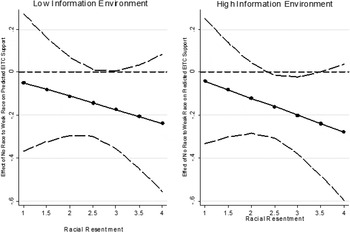
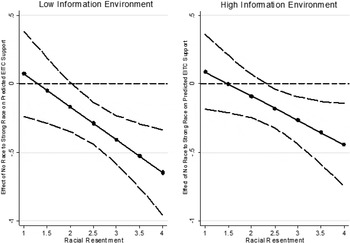
In looking at the results of Table 3, which compare the non-racialized conditions to the weak racialization conditions, the analysis surprisingly finds that the decline in EITC support in the weak racialization conditions is not driven by racial resentment. The insignificant interaction between condition and resentment suggests that informing respondents that the majority of program recipients are black does not decrease EITC support amongst the racially resentful. Instead, it appears that EITC support is driven by attitudes towards egalitarianism and income, with richer and less egalitarian respondents less supportive of the policy program. Figure 1, which graphs this interaction in the low and high information environments shows that although the relationship between condition and resentment is in the expected direction, the confidence intervals almost always overlap with zero.
Racial resentment and EITC support in the weak race conditions

Racial attitudes towards the EITC are not driven by racial resentment in weak race conditions

***p < .01, **p < .05, *p < .10.
Standard errors in parentheses.
While it appears that the racial predispositions of respondents are not driving attitudes in the weak racialization conditions, the strong racialization conditions, which present respondents with traditional welfare stereotypes, tell a different tale. In Table 4, which compares the non-racialized conditions to the strongly racialized conditions, it appears that the interaction between our condition dummy and racial resentment is highly significant and shows that adding racial information has a negative effect on EITC attitudes in the low and high information environments and that effect increases in magnitude as racial resentment increases (Brambor, Clark, and Golder Reference Brambor, Clark and Golder2006).
Racial attitudes towards the EITC are driven by racial resentment in strong race conditions

***p < .01, **p < .05, *p < .10.
Standard errors in parentheses.
Although the condition variable itself is insignificant and the racial resentment variable is only marginally significant, the finding from the interaction supports our second hypothesis and shows that controlling for other relevant factors, providing racial information about the EITC dramatically reduces support for the program amongst the racially resentful. Figure 2 models this relationship to provide additional information and demonstrates that the relationship between condition and resentment goes in the expected direction with the racially resentful who are exposed to racialized information far less supportive of the EITC. Critically, given the distribution of racial resentment detailed in Appendix E, which demonstrates that 40% of the sample scores above the median and 75% of the sample scores a two or higher on the measure, this racialization is impacting large segments of the sample. This finding holds across the low and high information environments. In addition, with Tables 3 and 4 holding the percentage of black recipients constant, it appears that it is the welfare stereotypes only seen in the strongly racialized prompts that drive individuals to rely on their racial predispositions, not specific information about the percentage of minorities who receive benefits.Footnote 17
Racial resentment and EITC support in the strong race conditions

In exploring the other variables from the models in the table, it appears that in addition to our predicted role for race, several other variables prove to be significant predictors of EITC support. Specifically, we find that respondents who are older, Democratic, and egalitarian are all significantly more likely to hold supportive attitudes towards the EITC. In addition we find that richer and more educated respondents are less likely to hold a supportive attitude towards the EITC.Footnote 18
DISCUSSION
Although we readily agree with Mettler (Reference Mettler2011) and others that unearthing hidden programs could help to ensure democratic accountability and provide a normative “good”, our analysis helps to show that the reality is far more complex. Even if providing the public with information about these programs increases support for them, our historical discussion suggests that traditional welfare state programs (especially those that benefit the poor) are often subject to racialization that can inexorably damage their public support. Furthermore, when the same pattern of racialization through stereotypes that has been used on visible programs is applied to arguably the most important hidden welfare state program for the poor (EITC), we find evidence that support for the program drops substantially and is driven by racial predispositions.
In addition to helping to clarify our understanding of the role of race in the hidden welfare state, this analysis provides several important implications for future research in political behavior. Most prominently it shows that hidden welfare state programs for the poor can be subject to the same political forces as traditional welfare state programs and therefore cannot be ignored as they have been to this point by scholars of political behavior. Additionally, research in political psychology has emphasized that deservingness of program recipients is a key moderating factor in determining support levels for welfare state programs (Goren Reference Goren2003). In this analysis however, we find consistent evidence that the EITC (a program for the deserving poor) can be racialized rather easily. Given the fact that in every condition (even those that are racialized), the EITC is described as an “earned” benefit that is only awarded to those who work, this finding is particularly surprising. It suggests that studies on racialization may be able to be extended beyond the “undeserving poor” into other research domains and that the methodology employed by Mettler (Reference Mettler2011) and here may be particularly well suited to delivering policy information to respondents in political experiments. Finally, given the differential role of racial predispositions across the weakly and strongly racialized conditions and the fact that the percentage of blacks receiving benefits does not vary across the conditions, it appears that at least in the context of hidden welfare state programs, racial resentment is only activated in the context of welfare stereotypes.
CONCLUSION
Ultimately it is impossible to gain a comprehensive understanding of the American welfare state without acknowledging and incorporating the role of race. Through our analysis we have shown that when race is considered in discussions of the hidden welfare state, a key policy prescription advocated by scholars of the subterranean state needs to be partially reconsidered. In particular, while we agree that “unearthing” hidden programs to allow for increased democratic accountability is normatively appealing, and may in fact be appropriate for many hidden programs, doing so in the face of an already racially charged welfare state environment could be challenging to poor populations who rely on the benefits provided to support their daily lives.
As important as our study is to understanding the hidden welfare state and the role of race on these programs, our study has several notable limitations that will require further analysis. The first limitation of the existing analysis is its singular focus on the EITC. While the EITC is a crucial program for Americas poor and has an outsized influence on those it impacts as compared with hidden programs for the rich, our analysis provides no information about whether or not the same racialization would be felt with other hidden programs for the poor or with the hidden welfare state more generally. We would expect to see similar findings for other hidden programs that benefit the poor like the Child Tax Credit or home heating assistance but future research is needed to explore this in depth. Another limitation with the existing study is its use of inaccurate information about policy participation by racial minorities. Even as we demonstrate that the exaggerated racial information common in elite rhetoric adversely impacts public support, our experiment is unable to show how accurate information about the number of minorities participating in the program would impact opinion. Similarly, although we focus on black recipients with our manipulations to remain consistent with the large body of literature in political behavior on race and policy attitudes, future research might explore how similar manipulations using Hispanic recipients might alter public attitudes. Research by Fox (Reference Fox2004) and others suggests that black and Hispanic stereotypes can have different effects on welfare attitudes and it remains possible that manipulations using Hispanics who make up a large percent of the EITC population—could alter EITC perceptions in fundamentally different ways. Finally, it is important to note that in our use of Mechanical Turk to carry out our experiment, our results might not perfectly portray attitudes on race and the hidden welfare state. Even as Mechanical Turk is better than many other sources of experimental data, the liberal nature of the sample could artificially inflate support for EITC. Furthermore, with the existing literature suggesting that racial resentment is a better predictor of prejudice among liberals than conservatives, our liberally-leaning sample could be argued to be an “easier” test of our key contention (Feldman and Huddy Reference Feldman and Huddy2005).
In addition to conducting further analysis to overcome the limitations of this project, there are several other extensions of our work that should be carried out to expand our knowledge of the hidden welfare state. First, as we agree with the existing literature that unveiling these programs would be good for democratic accountability, future work should explore ways to reveal hidden programs to the mass public without incurring the racialization backlash that so many visible welfare state programs have faced. Based on the evidence presented here, it would appear that a key condition would be to do so without using the stereotypic language often associated with the traditional welfare state; however, more research should be done to explore this issue in depth. Next, the analysis performed here focused on providing the public with non-attributed policy information in order to follow the preeminent book on hidden welfare state attitudes (Mettler Reference Mettler2011) as closely as possible. With that said, a natural extension of our analysis would be an exploration of similar prompts that are attributed to political elites. Perhaps the findings here would be altered in the context of influence from elites. Finally, we believe that our work opens the door for future behavior-based research on the hidden welfare state. Research to this point has done an excellent job tracing the hidden state's development, detailing the programs that constitute the submerged state, and even how the public sees these programs and yet, the hidden welfare state remains dramatically underdeveloped from a behavioral standpoint. Future research on the behavioral underpinnings of this tax-based welfare state could lead us towards a more comprehensive understanding of these programs.
SUPPLEMENTARY MATERIAL
The supplementary material for this article can be found at https://doi.org/10.1017/rep.2016.26
Acknowledgements
The authors thank Andrew Karch, Paul Goren, Howard Lavine, Larry Jacobs, Joanne Miller, and Suzanne Mettler for their invaluable advice. We also thank The Center for Political Psychology at the University of Minnesota for generously funding the experiment used in this paper. The authors’ names are listed alphabetically. They contributed equally to the manuscript, including any remaining errors.