Introduction
Advances in DNA sequencing (Edwards et al., Reference Edwards, Henry and Edwards2012) make whole-genome sequencing an attractive option for the characterization of plant genetic resources (Henry et al., Reference Henry, Edwards, Waters, Krishnan, Bundock, Sexton, Masouleh, Nock and Pattemore2012). The sequencing of the genomes of plant genetic resources has great potential to support better management of both in situ and ex situ resources.
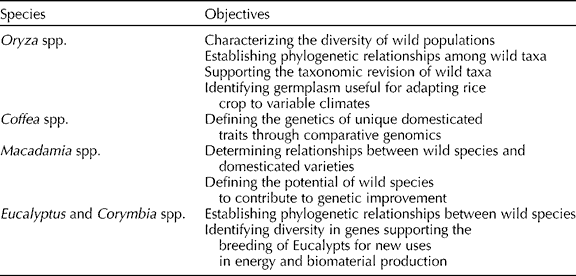
Examples of current applications of whole-genome sequencing to plant germplasm analysis in Australia include rice (Oryza species), coffee (Coffea sp.), Macadamia (Macadamia species) and Eucalypts (Eucalyptus and Corymbia species), Table 1.
Wild plant samples subjected to sequencing

Rice was domesticated in Asia, but it has close wild relatives in Australia. The analysis of the sequences of wild Oryza (Nock et al., Reference Nock, Waters, Edwards, Bowen, Rice, Cordeiro and Henry2011) from Australia aims to define the uniqueness and resulting potential value of the Australian populations as genetic resources for rice crop improvement (Waters et al., Reference Waters, Nock, Ishikawa, Rice and Henry2012). This information is critical to the appropriate management of wild genetic resources for rice in Australia. Poorly characterized wild populations may be under threat, especially if rice production begins on a large scale in Northern Australia.
A redefinition of the coffee genus has included more species. Coffea brassii is a poorly known species found in Cape York in north Queensland. This species provides an opportunity to explore the unique characteristics of domesticated coffee by comparative whole-genome sequencing.
The progenitors of domesticated Macadamia are found in the subtropical rainforests of Australia near Brisbane, but the relatively recent domestication of Macadamia has taken place in Hawaii. The analysis of the sequences of wild Macadamia species will allow us to understand the relationships between the wild species in Australia and the domesticated varieties derived from Hawaii.
Eucalypts cultivated worldwide are derived from material sourced in Australia in the last 200 years. Many recent plantings have continued to rely upon wild or close-to-wild germplasm. The analysis of the sequences of Eucalypts will assist us to understand their relationships and suitability for ongoing domestication for diverse uses, including potential new end-uses such as bioenergy and biomaterial production (Persil-Cetinkol et al., Reference Persil-Cetinkol, Smith-Moritz, Cheng, Lao, George, Hong, Henry, Simmons, Heazlewood and Holmes2012).
Experiences from these examples will guide further development of sequencing tools and strategies for the characterization and utilization of plant genetic resources. The sequencing of wild plants with special traits such as halophytes will provide additional information to support crop improvement.
Rice
The shotgun whole-genome sequencing of wild Australian rice varieties has confirmed the distinctness of the Australian populations. This result indicates that Oryza rufipogon in Australia may need to be recognized as one or more distinct species that represent a diverse source of germplasm for rice crop improvement. The analysis of the variation in genomes in relation to climate in wild populations provides a useful tool to identify strategies for breeding climate-resilient crops (Fitzgerald et al., Reference Fitzgerald, Shapter, McDonald, Waters, Chivers, Drenth, Nevo and Henry2011; Shapter et al., Reference Shapter, Fitzgerald, Waters, McDonald, Chivers and Henry2012). Whole-genome re-sequencing is being explored as a tool for application in rice crop breeding (Gopala Krishnan et al., Reference Gopala Krishnan, Waters, Katiyar, Sadananda, Satyadev and Henry2012), and sequencing of wild relatives will extend our knowledge of allelic diversity available for rice crop improvement. In this research, genome sequences of the parents of hybrid rice populations have been determined to support the search for an explanation of the molecular basis of heterosis in rice and tools to allow the prediction of hybrid performance. The sequencing of wild relatives from Africa is being used to better understand the utility of African wild rice varieties in crop improvement and the evolution of the A genome species of rice across Australia, Africa and South America.
Coffee
C. brassii grows to sea level and may be caffeine free, making this a useful species for the exploration of these traits by comparative genomics. Whole-genome comparative genomics has been established as a powerful tool for understanding key traits in the almond, cherry and peach (Prunoideae, Koepke et al., Reference Koepke, Schaeffer, Harper, Dicenta, Henry, Moller, Sanchez-Perez and Dhingra2013). The sequencing of domesticated coffee by an international consortium will deliver a reference sequence to allow the exploration of variation in wild relatives.
Macadamia
The four wild relatives of Macadamia in Southern Queensland and Northern New South Wales are the clade from which domesticated Macadamia is derived. Domesticated Macadamia is derived from Macadamia integrifolia and Macadamia tetraphylla, the two wild species that have edible fruit. The other two wild species are smaller trees that may be useful for breeding more compact trees. Chloroplast genome sequences have defined phylogenetic relationships within the genus. Further sequencing efforts are directed towards establishing a reference genome sequence for Macadamia as a tool for genetic improvement.
Eucalypts
Eucalypt genome sequencing has been carried out for several species. The re-sequencing of the large number of species in this group is a useful way to study the evolution of this group and to define where useful variation might be found to support genetic improvement of Eucalypts. The use of Eucalypts as a source of biomass to replace oil is being explored because of their ability to grow well in marginal environments where they are less likely to compete with food crops compared with many other species (Shepherd et al., Reference Shepherd, Bartle, Lee, Brawner, Bush, Turnbull, Macdonell, Brown, Simmons and Henry2011). Association analysis of the relationships between bioenergy traits and whole-genome sequences is a strategy to rapidly advance this application (Henry, Reference Henry2012a). The genus Corymbia comprises species that may be of special value as bioenergy crops. Current efforts aim to establish reference genome sequences for this new genus and facilitate the exploration of the variation in genomes in relation to bioenergy traits (Lupoi et al., Reference Lupoi, Singh, Simmons and Henry2013).
Current status of technology for plant germplasm characterization
DNA sequencing platforms are continuing to improve at a rapid pace. The range of applications in plant germplasm characterization is expanding with sequencing becoming cheaper and easier. The ability to multiplex (combine multiple samples in a single lane or well for analysis) promises to make whole-genome shotgun sequencing a routine tool in the characterization of plant genetic resources. Direct comparisons of current DNA sequencing platforms suggest complementary capabilities and likely continuing improvement in suitability for application to the characterization of plant genetic resources. Current platforms and data analysis tools make whole-chloroplast genome analysis a simple starting point providing a cost-effective universal barcode for plant germplasm. This is likely to extend to whole nuclear genomes as the technology improves over the next few years, especially for plants with smaller genomes and for which a reference genome of a close relative is available. The capture of diversity in wild material will be greatly accelerated by selection at the whole-genome level (Henry, Reference Henry2012b). It is reasonable to expect sequencing costs to continue to drop eventually, making the sequencing of entire collections of plant genetic resources a useful tool for effective management of collections.