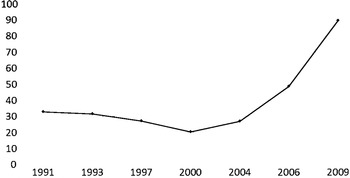
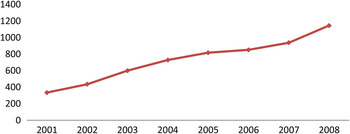
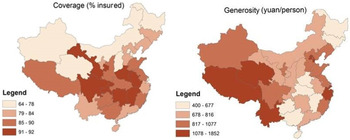
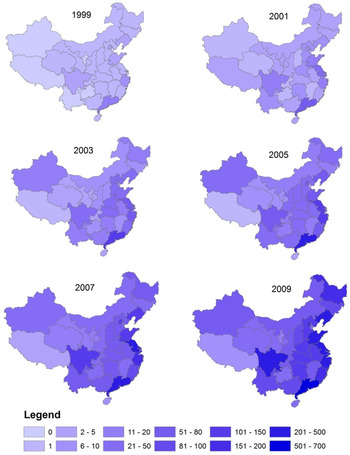
One of the most notable changes brought about by the Chinese authoritarian regime over the past decade has been the expansion of social welfare benefits in the absence of substantial political reform. Programmes such as the Urban Employee Basic Medical Insurance (chengzhen zhigong jiben yiliao baoxian 城镇职工基本医疗保险) (UEBMI hereafter), the New Rural Cooperative Medical Insurance (xinxing nongcun hezuo yiliao 新型农村合作医疗) (NRCMI hereafter), and the Urban Resident Basic Medical Insurance (chengzhen jumin yiliao baoxian 城镇居民医疗保险) (URBMI hereafter), which incorporated not only the working population but also non-working urban and rural residents into the social health insurance system, have resulted in a dramatic expansion of social health insurance coverage (see Figure 1).Footnote 1 By 2010, over 80 per cent of Chinese citizens were covered by social health insurance programmes, up from only 34.4 per cent in 2004. Meanwhile, the increase in generosity (measured by per capita expenditures for social health insurance) is substantial (Figure 2). A closer look at the social health insurance expansion, however, suggests that it is remarkably uneven across regions. Both the generosity and the population coverage have differed dramatically across provinces during the course of expansion (Figure 3). Data on Chinese social health insurance indicate that up to one-quarter of the population in northern provinces such as Qinghai, Shanxi and Heilongjiang is still unprotected by social health insurance, while there is over 90 per cent coverage in the provinces along the Changjiang 长江 (Yangtze River) such as Sichuan, Chongqing and Hunan. In terms of generosity, the per capita expenditure for urban social health insurance in Beijing is 1,852 yuan per person (averaged from 2007 through 2010), more than four times the outlay in Jiangxi province. This study looks at why such notable regional variation exists in China's social health insurance, and what the variation tells us about Chinese social welfare provisions and authoritarianism more generally. These questions are addressed by analysing the political agents and the political economy mechanisms responsible for the regional patterns in social health insurance.
Coverage of China's Social Health Insurance (Percentage of Total Population)

Generosity of China's Social Health Insurance (yuan/person)

Subnational Variation in China's Social Health Insurance (2007–2010)

This paper argues that the regional variation in social health insurance results from the policy choices of central and local leaders. The central leaders, whose priority it is to maintain regime stability, face a trade-off between control and accommodation of local needs. Central leaders control the career incentives of local officials by delegating substantial discretionary power in health insurance reform to accommodate diverse social needs at the local level. With this discretionary power in hand, local officials, mindful of their political careers and wishing to prevent social unrest from jeopardizing their political survival, design and implement social welfare policy in a way that suits local circumstances. Thus, diverse local socio-economic conditions lead to different distributional choices in social health insurance. Specifically, local officials in regions with high social risk tend to enlarge the risk pool of social health insurance, while local officials in regions with high fiscal revenues are likely to enhance the generosity of social health insurance. While officials in regions with favourable risk profiles and high fiscal revenues become pioneers in promoting risk- and income-redistribution by experimenting with social health insurance reform, their counterparts in regions with neither high social risk nor sufficient fiscal resources maintain the status quo of a fragmented and inequitable social health insurance system in their jurisdictions. In specifying the rationale, conditions and patterns of the regional variation in Chinese social health insurance, this paper addresses the more general issue of how authoritarian leaders respond to social needs in designing social policy.
This paper begins with a discussion of existing studies of Chinese social welfare. It then continues by developing a theoretical framework to elucidate the rationale, conditions and policy results of Chinese social welfare provision, and formulates three hypotheses for empirical testing. The following section presents and discusses the empirical findings and evidence. The paper concludes with a discussion of the implications of the findings.
The Political Economy of Chinese Social Welfare: Received Wisdom
Studies of Chinese social welfare in the fields of economics, public policy and political science provide insights to understanding this social welfare system from different perspectives. Scholarly work on China's social health insurance in the fields of health policy and economics usually takes benefits (including the number of people who receive benefits and the level of benefits that people receive) as the starting point. Several problems are commonly identified and discussed in this strand of literature: 1) a pro-rich bias, or inequity in social health insurance benefits across social groups;Footnote 2 2) unequal health insurance coverage between urban and rural areas, as well as between the poor and affluent social classes;Footnote 3 3) inter-regional inequalities in social health insurance benefits;Footnote 4 and 4) fragmentation of risk pooling and management.Footnote 5 Although this literature has contributed to a rigorous evaluation of the socio-economic impact of health insurance programmes, the causes of those outcomes remain understudied.
In the literature on Chinese political economy, some attempts have been made to explore the causes of China's fragmented social welfare provision. The dominant paradigm explaining fragmentation and piecemeal reform over the past decades of the Chinese social welfare system focuses on the transition from a planned economy to a market-oriented one.Footnote 6 Marketization, especially the privatization and reconstruction of the state-owned enterprises (SOEs), is said to have led to a collapse of the “iron rice bowl” (lifetime employment) and the work unit-based welfare system.Footnote 7 Mass labour dislocation, especially the large numbers of layoffs from SOEs that caused popular discontent and a wave of “collective incidents” (jiti shijian 集体事件) such as protests and street demonstrations in the 1990s, prompted the implementation of a social insurance system that moved the risk pooling from individual enterprises to regions.Footnote 8 The state's “retreat” from social protection during the earlier stages of economic reform (before 2003) has been systematically studiedFootnote 9 and criticized by scholars.Footnote 10
Although the impact of the economic transition on China's social welfare system has received widespread attention, the political mechanism underlying the fragmentation of Chinese social welfare provisions is underspecified in those accounts. Jane Duckett challenges the economic reform paradigm and points to changes in the elite leadership and ideology in the late 1970s to explain the collapse of the Rural Co-operative Medical System.Footnote 11 Her earlier work shows how bureaucratic interests within the central government influenced the design and adoption of the UEBMI programme, which provided only for the urban working population and subsidized civil servants, and was administered locally.Footnote 12 In a similar vein, William C. Hsiao attributes the pendulum swings in China's health reform policy, between health care provision through government funding and health care provision through a regulated market, to competing bureaucratic interests in the Ministry of Health and the Ministry of Labour and Social Security. Footnote 13
However, neither the economic reform paradigm nor the bureaucratic politics paradigm can sufficiently explain the remarkable subnational variation in China's social health insurance. Recent scholarship has focused on local leaders – the main providers of social welfare – to understand the political economy of social welfare provision. Two different perspectives emerge from these works. One view focuses on local leaders' economic incentives for social welfare provision. Mark Frazier points to local leaders' zeal for accumulating social security funds in local coffers to account for the rapid establishment of local-based pension systems in urban China.Footnote 14 Yanzhong Huang's research finds that rural leaders with thriving local industrial sectors value their lucrative jobs more highly than do their counterparts and thus are more likely to defer to peasants' welfare demands in order to hold their positions in the community.Footnote 15 The other perspective concentrates on local leaders' political incentives for social welfare provision. Xiaobo Lü and Mingxing Liu, for example, attribute the different patterns of education spending among Chinese counties to local leaders' differential career trajectories and promotion prospects.Footnote 16 In a similar vein, Taiwei Liu contends that ambitious provincial officials – i.e. those who seek to advance their careers at the central level – spend more on education and health and less on social security and welfare than their local-oriented counterparts do, because the former are more eager to impress Beijing and enhance their prospects for promotion.Footnote 17
This paper contributes to the literature on Chinese social welfare in three aspects. First, following the recent scholarship that explores the political economy of Chinese social welfare provision at the local level, this study emphasizes various local constraints that local leaders face in designing social health insurance policy. Second, I make an effort to identify and characterize clearly the regional patterns of social health insurance in China. Although the subnational variation in Chinese social welfare provision is not new to many scholars, the variation has not been delineated in a systematic way. Third, the study theorizes the interplay of the central and local leaders' interests and its impact on the multidimensional design of social welfare policy. Extant studies either focus on the central leadership's interests or emphasize local officials' incentives; few have explicitly studied the interaction of the two. The next section turns to the theoretical analysis of Chinese social welfare provision and its subnational variation.
Social Welfare Provision in Authoritarian China: Theory and Hypotheses
Two features are key to understanding social welfare provision in China: the multidimensionality of its social welfare policy,Footnote 18 and the interplay of central and local leaders' incentives.Footnote 19 Social insurance is the dominant format of Chinese social welfare provision.Footnote 20 The distribution of insurance benefits comprises three different dimensions: generosity, coverage and stratification. Generosity refers to the average level of benefits received among people who qualify for social welfare. Coverage represents the share of the population that has access to the benefits. Stratification captures the inequality in levels of benefits that different groups receive. These three dimensions are correlated in different ways depending on the specific conditions: when the amount of social welfare benefits is fixed, broader coverage might lead to lower generosity, and vice versa.Footnote 21 Moreover, these different dimensions have distinct distributive implications and outcomes. For instance, a high level of stratification of social welfare implies severe inequalities, while broad coverage implies universalism. Politicians at different levels have different policy preferences for these dimensions, depending on their interests and policy options in a specific institutional setting.
The central leaders' top priority in social welfare provision is to maintain regime stability.Footnote 22 As the threats to regime stability can come from both elites and the masses, choosing to distribute rents and goods only to the elites or only to the masses is not an optimal strategy from the authoritarian leaders' perspective.Footnote 23 Instead, authoritarian leaders try to balance the benefits between elites and the masses efficiently so as to maximize their survival prospects.Footnote 24 Of special importance for the political survival of the Chinese authoritarian regime is to maintain particularly privileged welfare provision for the elites, while preserving an essentially modest social provision for the masses. To achieve this, the central leaders face a trade-off between control and accommodation of social needs. On one hand, they attempt to control who gets what, distributing more benefits to the social groups with the most political connections or greater importance for regime stability. The centre's control of the stratification patterns of social welfare works through three mechanisms: social legislation, fiscal transfers and personnel management. Since the 1990s, through a series of legislation and statutes, the central leadership has established a social health insurance system in which social groups are entitled to different programmes with distinct levels of benefits depending on their socio-economic status.Footnote 25 This fragmented social welfare system is conducive to weakening the capabilities of social groups for horizontal mobilization while privileging the groups with political connections or importance to the regime.Footnote 26 Moreover, the centre allocates huge transfer payments to subsidize the health insurance for privileged groups such as Party officials, civil servants and concentrated ethnic minority groups, assuring that they receive higher levels of benefits.Footnote 27 Furthermore, through extensive and centralized personnel control, the centre ensures that local state agents internalize the centre's top political priority – maintaining social order – in all social policymaking and implementation.Footnote 28
However, on the other hand, the central leaders want to accommodate most social groups to some extent in order to avoid creating too large a gap between the haves and have-nots. Since the central leaders have higher information costs and less expertise to distribute benefits among various social groups in a way that maximizes political returns under changing and diverse subnational circumstances, they need to delegate discretionary power to make and implement social welfare policy to local state agents; the centre can do this precisely because it controls the career incentives of local state agents and can control the stratification of social welfare provisions through the aforementioned tools (for example, social legislation and fiscal transfer). Through various administrative regulations, the centre has granted substantial discretion to local officials to specify the policy details that determine the coverage and generosity of social health insurance, such as eligibility requirements, pooling units (for example, county, city or province), reimbursement rates, contribution rates and conditions for premium exemption.Footnote 29
Local leaders are appointed by the centre and, in order to advance their careers, they have to meet a variety of policy targets set by the centre. Along with maintaining social stability in their jurisdiction, local officials are also responsible for economic development and public goods provision. In social welfare policymaking, they face various constraints: political, fiscal and social. First, local officials' policy choices are constrained by the political principles set by the centre. On the surface, local officials manage the majority of the social insurance funds and responsibilities for social welfare provision.Footnote 30 This significantly enhances their power as they have larger budgets, more personnel slots and greater regulatory power. Nevertheless, the performance of local officials is monitored by the centre through top-down personnel control. In addition, local leaders have to abide by the Social Insurance Law, which specifically stipulates the fragmentation and stratification patterns of social insurance.Footnote 31
The second constraint confronting local officials in social welfare provision is fiscal stringency. Under China's fiscal decentralization, or de facto “fiscal federalism,”Footnote 32 local governments are the main providers and sponsors of social welfare: they bear about 70 per cent of the social health insurance financing for the non-working population, including peasants, the elderly, students and children. Some local governments have been faced with substantial budget deficits, meaning that paying the medical bills in full and on time has become a burden on local budgets for these localities.Footnote 33 Thus, local fiscal revenue is an important predictor of the policy choices local officials will make regarding the generosity of social health insurance. Importantly, the degree of fiscal constraint on social welfare provision differs across regions depending on local fiscal resources, including fiscal revenue extracted from local sources and fiscal transfers received from the centre.
Social risk is the third constraint that local officials must manage.Footnote 34 There are three reasons why social risk is a crucial factor shaping the policy choices of local officials. First, the nature of social health insurance is pooling and sharing risk across segments of the population. The performance of social health insurance is thus contingent on the demographic or risk profile of localities. A region with a younger population will face lower risk, for example, than a region with an aging population. Second, the lack of a nationwide risk pooling and redistribution mechanism in China's social health insurance system makes the regions with small populations particularly vulnerable to exogenous shocks such as disease epidemics and natural disasters. Third, and most importantly, the mass migration that has accompanied economic reform has profoundly changed the risk profiles of some regions. Deng Xiaoping's 邓小平 strategy for economic reform and openness in the 1980s was to “let some people (regions) get rich first,” starting with the special economic zones. This has created a domestic labour market in which some inland regions continuously “export” labour to the coastal regions. Labour mobility works as a multiplier of social risk, creating strong preferences for local officials in these regions to enlarge the risk pooling of social health insurance.Footnote 35
In summary, the Chinese central leadership incorporates elements of both control and accommodation in social welfare provision in order to maintain regime stability. On one hand, the centre relies on social legislation, fiscal transfers and personal management to maintain a fragmented and stratified social welfare system that ultimately weakens social groups' capabilities for horizontal mobilization while privileging certain groups over others. On the other, the centre delegates discretionary power to local officials in policy design regarding the coverage and generosity of social insurance in order to accommodate diverse local situations. Local officials who want to survive under the top-down evaluation system attempt to prevent social unrest from breaking out in their jurisdiction by proactively designing and providing social welfare benefits in a manner that suits the local conditions and social needs of their constituents. Since local officials' discretion in social welfare policy lies mainly with the dimensions of coverage and generosity, they have four different choices in distributing social insurance benefits: 1) a generous and inclusive model (i.e. giving more people more benefits); 2) a generous yet exclusive model (i.e. giving certain groups more benefits); 3) a strict yet inclusive model (i.e. giving more people benefits but with meagre provisions); and 4) a strict and exclusive model (i.e. giving certain groups benefits with meagre provisions). The model that local officials choose is determined by the configuration of constraints they face, particularly in terms of fiscal resources and social risk in their jurisdictions.
Several empirical implications can be derived from the theoretical analysis. First, the local distribution of social health insurance benefits will differ importantly along the dimensions of generosity and coverage where the centre delegates substantial authority to local officials. Second, the generosity and coverage of social health insurance will vary with the fiscal and socio-economic conditions that constrain local officials' policy choices. Based on these implications, the following hypotheses are formulated for empirical test.
Hypothesis 1:
The provision of social health insurance will display distinct and systematic regional variation in terms of generosity and coverage.
Hypothesis 2:
Regions with more fiscal resources will provide more generous social health insurance.
Hypothesis 3:
Regions with high social risk will provide broader coverage in social health insurance.
Subnational Variation in Social Health Insurance: Empirical Analysis
This sections aims to elucidate empirically: 1) the regional patterns of China's social health insurance in terms of coverage and generosity; 2) the relations between local socio-economic conditions and regional patterns of social health insurance; and 3) the mechanism through which local socio-economic conditions influence distributional patterns of social health insurance benefits (in terms of shaping local officials' policy choices under the framework set by the centre). Before proceeding further with the empirical analysis, this section first discusses the data and empirical strategy to be used.
In China, all local governments (including provinces, prefectures and counties) manage certain social health insurance programmes.Footnote 36 The province is selected as the unit of analysis for the quantitative component of this study for two reasons. First, so far all available Chinese social health insurance statistics are reported at national or provincial levels. The merit of these statistics is that they cover all provinces and time periods from 1999, when social health insurance was established in China. The drawback, however, is that the statistics are too aggregated to conduct intra-province analysis. Considering these limitations, I use province as the unit of quantitative analysis while complementing it with qualitative evidence drawing from field interviews at other local levels (for example, prefecture and county). Second, for analytical simplicity, the theoretical analysis assumes that the Chinese political structure consists of two levels – the central and the local – and that the logic underlying the interaction between the central and local levels is portable to the relationship between upper and lower levels among local governments. Hence, using province as the unit of quantitative analysis does not undermine the theory, but its limits should be kept in mind when interpreting the quantitative results and the empirical implications.
To test the hypotheses, I constructed a provincial-level panel dataset (1999–2010) using statistics compiled from various sources. The empirical strategy consisted of employing cluster analyses to identify and characterize the regional patterns of social health insurance. I then conducted statistical analysis to evaluate the relations between local socio-economic conditions and social health insurance. As a final step, I complemented the quantitative analysis with qualitative evidence, drawing on 140 field interviews to illustrate how local officials make policy choices regarding health coverage and generosity according to local socio-economic conditions.
Cluster analysis: regional patterns in social health insurance
Cluster analysis is conducted to examine whether it is possible to discern statistically distinct patterns in Chinese social health insurance.Footnote 37 To describe the local distribution of health insurance benefits, I construct two variables, generosity and coverage. Generosity is measured as annual per capita expenditures for social health insurance. Coverage refers to the percentage of the population in a particular location covered by social health insurance. Data come from government statisticsFootnote 38 and are averaged for 2007 through 2010.Footnote 39 All provincial-level units are ranked according to these two variables, and the rank values for each province on both variables are used as inputs for cluster analysis.
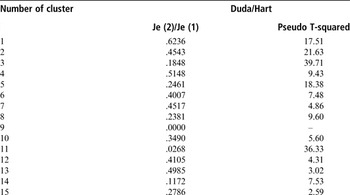
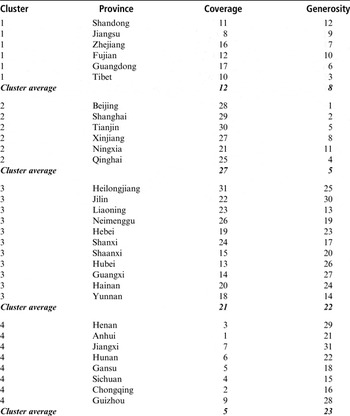
Based on conventional procedures for cluster analysis,Footnote 40 the results (see Table 1) indicate four significantly distinct clusters among Chinese provinces in terms of generosity and coverage. Table 2 reports the province members of each cluster and their ranks on generosity and coverage. Computing the cluster average ranks on these two indicators makes the features of each cluster readily apparent: cluster 2 and cluster 4 are starkly distinct from one another, as provinces in cluster 2 clearly privilege generosity over coverage, all of them having high ranks on generosity but low ranks on population coverage. Provinces in cluster 4 are just the opposite. Moreover, provinces in cluster 1 appear to favour both coverage and generosity, as they rank relatively high on both. In contrast, provinces in cluster 3 have low values on both generosity and coverage. Based on the characteristics of these clusters, provinces in cluster 2 are referred to as the privileged type, because they place an emphasis on health generosity. Provinces in cluster 4 are labelled the risk-pooling type, as they prioritize broader coverage over generosity. Since provinces in cluster 1 favour both generosity and coverage, they are referred to as the dual type. By contrast, average generosity and coverage are both relatively low for provinces in cluster 3, and hence cluster 3 is called the status quo type.
Determining the Number of Clusters Using the Duda and Hart Method

Notes:
Je (1) is the squared errors when one cluster exists and Je (2) is the sum of squared errors within a cluster when the data are broken into two clusters. The conventional rule for deciding the number of groups is to determine the largest Je(2)/Je(1) value that corresponds to a low pseudo-T-squared value that has a higher T-squared value above and below it.
Clustering of Chinese Provinces by Social Health Insurance

Notes:
The cluster analysis results are calculated using cluster linkage command in STATA/IC 12.0 for Windows. Ward's linkage is used as the agglomerative linkage method in this cluster analysis. The stopping rule is Duda/Hart Je(2)/Je(1) index stopping rule. Ranks are rounded to the nearest integer to facilitate comparability.
The cluster analysis results also suggest that the regional patterns of social health insurance correspond to regional socio-economic differences. The northern and north-east provinces are predominantly of the status quo type. Their counterparts in the east coastal regions are mainly of the dual type. The populous provinces along the Changjiang, such as Sichuan, Hunan, Hubei, Jiangxi and Anhui, are of the risk-pooling type. Meanwhile, large cities like Beijing and Shanghai, and the ethnic minority autonomous regions are of the privileged type. Overall, the results from the cluster analysis support the first hypothesis that systematic patterns exist in Chinese social health insurance. Moreover, the clustering of provinces in social health insurance appears to correspond to regional socio-economic differences. The next subsection turns to a more rigorous examination of the correlations between local socio-economic conditions and the distributional attributes (coverage, generosity) of social health insurance.
Statistical analysis: social health insurance and local socio-economic conditions
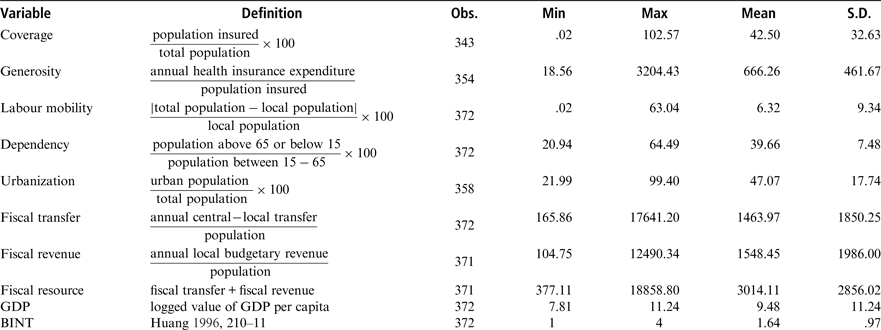
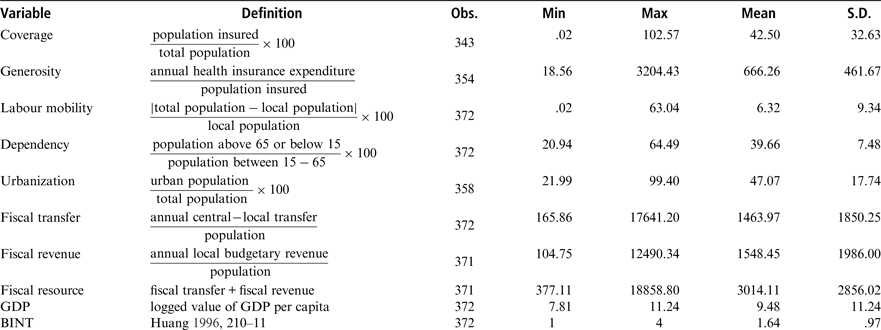
The coverage and generosity variables continue to be used as dependent variables in the regression analysis that follows. The explanatory variables are level of local social risk and fiscal resources. Two factors are used as proxies of social risk. The first is labour mobility, measured by the ratio of migrants to total local population. The measure of migrants, defined as the absolute value of the difference between provincial total population and local population (i.e. population with a local hukou 户口), focuses on the magnitude of province-to-province migration.Footnote 41 The second factor is dependency ratio, measured by the ratio of people aged above 65 or below 15 to the working population (aged 15–65). The other key explanatory variable is local fiscal resources, consisting of local-sourced fiscal revenue measured by per capita local budgetary revenue, and fiscal transfers, measured by per capita central-to-local transfer payments. Based on the above theoretical analysis, the regression results should show that the level of social risk is positively correlated with health coverage, and the level of fiscal resources is positively correlated with health generosity. A number of economic and political control variables are included in the regressions: 1) economic development, using the logarithm of GDP per capita; 2) urbanization, using the percentage of urban residents in the total population; 3) political standing of provincial governors vis-à-vis central authorities, measured by the bureaucratic integration score (BINT) coded according to local leaders' past career trajectories.Footnote 42 The BINT variable controls for local leaders' personal ambitions in politics; and 4) unobserved year- or region-specific situations, using year and province dummies. Summary statistics of all variables are presented in Table 3.
Descriptive Statistics of Variables
Sources:
NBS 2000–2011a; NBS 2000–2011b; NBS and MOHRSS 2000–2009; MOHRSS 2009–2011; MOF 1999–2010a; MOF 1999–2011b.
Notes:
Local population is defined as people holding local residency registration status (hukou). The maximum coverage exceeds 100% because of the problem of duplicate enrolment (i.e. some people are enrolled in more than one social health insurance programme).
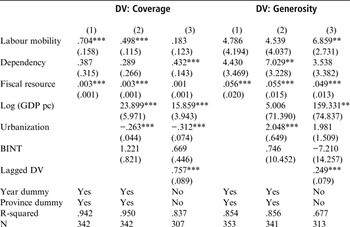
The data cover 31 provinces from 1999 to 2010 to take advantage of the large cross-provincial variation in social health insurance and local socio-economic conditions. Since the data are constructed as a panel dataset, panel-corrected standard errors are applied in the analysis.Footnote 43 The regression results are reported in Table 4. For each dependent variable, Model 1 reports the results of the baseline model that includes only the key explanatory variables; Model 2 presents the results when control variables, including year and province dummies (fixed effects, FE hereafter), are added;Footnote 44 Model 3 reports the results when control variables and the one-year lagged dependent variable (LDV) are included.Footnote 45
Determinants of Social Health Insurance Coverage and Generosity

Notes:
Results are estimated using cross-section-time-series regression model with panel-correction standard errors (PCSEs); standard errors are in parentheses. To economize on space, values of intercept and year/province dummy variables are not reported. ***p < .001, **p < .05, *p < .1.
Overall, the regression results lend support to the main theoretical predictions. The first primary finding is that social risk (measured by labour mobility and the dependency ratio) is significantly and positively associated with health coverage. According to Model 2, all else being constant, moving from minimal to maximal labour mobility increases coverage by nearly 30 percentage points; according to Model 3, likewise, the dependency ratio increases coverage by 19 percentage points. In the FE model (Model 2), the coefficient for labour mobility is larger and more significant than the coefficient for the dependency ratio, indicating that once unobserved year- or province-specific situations are controlled for, labour mobility better captures the effect of social risk on coverage. By contrast, in the LDV model (Model 3), in which a province's previous level of health coverage is controlled for, the dependency ratio better captures the effect of social risk on coverage. In addition, health generosity is positively correlated with labour mobility and dependency ratio in the FE and LDV models, respectively.
The second primary finding is that fiscal resources are significantly and positively associated with the generosity of social health insurance. According to Models 2 and 3, all else being constant, moving from minimal to maximal fiscal resources increases health generosity per beneficiary by 681 yuan and 607 yuan, respectively. These correlations are significant at the 99 per cent confidence level in all model specifications. In addition, the regression results indicate positive correlations between fiscal resources and social health insurance coverage. However, the positive relationship loses statistical significance in the LDV model, indicating that given a province's previous level of health coverage, fiscal resources are no longer predictive of the coverage.
As for the control variables, urbanization is significantly and negatively correlated with health coverage, but is positively correlated with health generosity. These quantitative results are in line with the recent observation that, despite the continuously increasing number of people living in cities (i.e. the high urbanization rate), owing to the rigid household registration system and its anachronistic associations with social entitlements, only a portion of urban residents (usually those with state-sector employment and local urban hukou) have full access to urban social health insurance, which has markedly higher generosity than rural health insurance.Footnote 46 Furthermore, BINT (the measure of provincial governors' prior career trajectories) has no significant impact on social health insurance. By contrast, economic development is significantly and positively associated with health coverage and generosity. In addition, the unobserved year- and region-specific situations (the year and province dummies) account for about 50 per cent of the variation in health coverage and 25 per cent of the variation in health generosity.
In summary, the statistical results indicate significant correlations between local socio-economic conditions and the distributional attributes of social health insurance (coverage and generosity). All other things being equal, regions with higher social risk tend to have greater coverage of health insurance, while regions with more fiscal resources tend to provide more generous health insurance benefits. The next subsection uses qualitative evidence to illustrate the underlying mechanism – how socio-economic conditions, particularly labour mobility and fiscal resources, shape local officials' policy choices and thus give rise to the different regional patterns in Chinese social health insurance.
Evidence from fieldwork research: local choices in social health insurance reform
To complement the statistical analysis, I conducted more than 100 interviews in 16 Chinese regions over three years in order to understand the mechanism underlying local policy choices in social health insurance reform. The fieldwork sites covered the four different types of regions, and interviewees included government officials and health insurance administrators at both the national and local levels. The findings suggest that local officials' priorities and policy choices in social health insurance reform vary markedly with local socio-economic conditions, as the above theoretical analysis proposes. This subsection discusses the supporting evidence collected from the interviews.
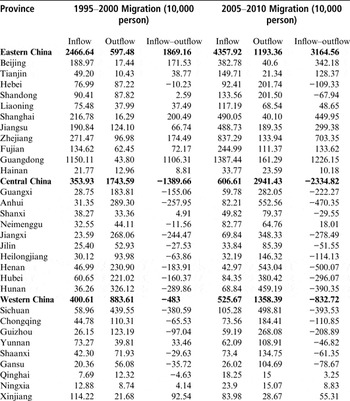
Most local initiatives to expand social health insurance coverage are found in the inland provinces such as Sichuan, Hunan, Hubei and Anhui. In interviews, local officials in these regions often revealed strong concerns about existing or looming deficits in local health insurance funds. These concerns are derived from the large outflow of labour that these regions have witnessed in recent decades. According to the national population census data (Table 5), Henan, Sichuan, Hunan and Anhui are the provinces with the largest labour outflows. Massive outmigration of young labour exerts tremendous pressures on local social health insurance funds because those who remain, especially in the rural areas, are mainly the elderly and children who are more likely to need health care.Footnote 47 As an administrator of social health insurance in Zhengzhou, Henan, put it, “Failure or delay in payments will give rise to public grievances and risks [provoking] collective protests. No local officials dare to take those risks.”Footnote 48 This concern drives local officials in these regions to prioritize the expansion of social health insurance coverage in order to obtain a large risk pool for social health insurance funds. Every year, those officials utilize propaganda and social media such as microblogs and mobile text messages to remind people, and young people especially, to join the social health insurance programme.Footnote 49 On occasion, the requirement of local household registration (hukou) is artificially blurred or ignored in order to get more people to enrol.Footnote 50 Since 2008, an increasing number of migrant workers in their 30s or 40s have returned from coastal areas to the inland. Local officials actively target the returning labourers, making special arrangements (for example, offering lower premiums, or binding work injury, maternity and health insurances together) to encourage them to register for local social insurance. Some local governments go further and negotiate with coastal regions to transfer back the money in their returning migrants' personal health insurance saving accounts that had been opened in the coastal provinces when they were working there.Footnote 51
Chinese Migration by Province, 1995–2010

Notes:
1995–2000 migration data are computed from China's Fifth Population Census (2000); 2005–2010 migration data are from China's Sixth Population Census (2010).
In expanding the coverage of social health insurance, local officials in the inland regions hold conservative and sometimes averse views towards raising the generosity.Footnote 52 This constitutes a stark contrast with the policy preferences in coastal regions, such as Jiangsu, Zhejiang, Guangdong and Shandong, where the generosity of social health insurance has increased as coverage expands. For example, the local government in Dongguan 东莞, a prefectural city in Guangdong province, has since 2008 been generously subsidizing not only the local population but also “outsiders,” such as rural-to-urban migrants and peasant workers, to sign up to local social health insurance. As for the remarkable generosity, Dongguan officials explained that “we receive nothing from the centre for social health insurance, but the prosperous local economy is absolutely sufficient to support [local social health insurance].”Footnote 53 Similarly, when talking about local social health insurance, a local official in Kunshan 昆山, a county-level city in Jiangsu province, commented that “the prosperity of the local economy is impossible without the contributions of the migrant workers [so they deserve the benefits]. But those young people rarely go to hospitals, so [despite high generosity] we have been running a surplus in social health insurance funds for years.”Footnote 54 Indeed, large surpluses have accumulated in the social health insurance funds of the rich coastal regions (see Figure 4). These surpluses contribute to resolving the policy trade-off between coverage and generosity for local officials in these regions.
Surplus of Urban Social Health Insurance Funds by Province (Unit: 100 million yuan)

Like their counterparts in the coastal regions, local officials in the “privileged” regions such as Xinjiang, Ningxia, Beijing, Tianjin and Shanghai, which receive either abundant fiscal transfers or political favours from the centre, are pioneers in raising the generosity of social health insurance. Nonetheless, the generous health insurance benefits in these privileged regions are exclusive and delimited to certain groups such as Party officials, civil servants, formal state-sector employees, or people with local urban hukou in general. During field interviews, local social health insurance administrators in the privileged regions relentlessly stressed that local hukou was a crucial prerequisite for entitlement to social welfare benefits, a stark contrast to the loose enforcement of the local hukou requirement in social health insurance enrolment in inland regions like Hubei and Hunan. There is an apparent lack of incentive to expand health coverage in the privileged regions owing to low or restricted labour mobility. Moreover, the heavy weight of the centre's fiscal transfer in financing social health insurance in the ethnic minority regions further impedes local incentives to broaden coverage.Footnote 55 As a social insurance official in Ningxia province put it, “we receive a lot of fiscal transfer from the centre, and we want to use that money only on the designated groups.”Footnote 56
In the “status quo” regions like Guangxi and Heilongjiang, my fieldwork found that underspending on social welfare was quite common. These provinces have not experienced the mass migration over the past few decades that magnified local social risk and drove local officials to enlarge the risk pooling strategically. Moreover, unlike the privileged provinces, which usually receive fiscal or political favours from the centre, provinces with meagre local revenues receive only moderate fiscal transfers from the centre, which prevents them from overspending on social welfare. During interviews in these two provinces, fiscal straits were often cited as a reason why local officials in these regions took “no action” (wu zuowei 无作为) in social health insurance reform. As one municipal official in Nanning, Guangxi province, pointed out, “some of our local governments cannot even pay their staff's salaries on time, let alone provide generous social health insurance benefits [to people].”Footnote 57 For local officials in the regions with low labour mobility and with dire fiscal straits, maintaining the “status quo” of strict and exclusive social health insurance is a less costly policy choice.
Conclusion
Despite the increasing scholarly interest in China's social welfare, our understanding of the political economy underpinning the distributional patterns of that country's social welfare benefits has remained preliminary. This paper attempts to contribute to the literature by offering a political economy explanation for the regional variation in social health insurance. It starts with the puzzling discovery of remarkable regional variation in social health insurance over the past decade. The explanation is that subnational variation in China's social health insurance results from central and local leaders' policy choices. Central leaders, who care about regime survival and stability, delegate substantial discretionary authority to local state agents to make coverage and generosity policies in social health insurance. They do this in order to accommodate diverse local circumstances while maintaining a hierarchy in social welfare provision that favours groups with political connections and influence. Under the framework set up by the centre, local officials, mindful of their political careers in the centralized personnel system, proactively design and implement social welfare policy according to local socio-economic conditions and to prevent social unrest in their jurisdictions, which could put their career prospects in jeopardy. This results in differing levels of coverage and generosity in social health insurance across regions which reflect the diverse local socio-economic conditions, particularly local fiscal resources and social risk. This paper utilizes a provincial-level panel dataset (1999–2010) to identify the regional patterns of Chinese social health insurance and their correlations with local socio-economic conditions; it also provides qualitative evidence from 140 field interviews to understand the underlying political economy mechanism.
In specifying the rationale, conditions and patterns of the subnational variation in Chinese social welfare provision, the study addresses a more general issue: how political leaders in an authoritarian regime respond to diverse social needs. This paper suggests that a rationale for widespread social welfare provision exists outside of democracies. In non-democracies, politicians' incentives to provide social welfare benefits are different: they originate primarily from the top – the national leaders' interest in maintaining regime stability – rather than from the bottom, as in democracies. Moreover, as this study demonstrates, the role and influence of subnational politicians in authoritarian social welfare provision are interesting and important. Under conditions of political centralization and fiscal decentralization, local officials who owe their political careers to the upper-level authority would proactively adapt to and accommodate local socio-economic conditions when deciding their policy choices. This accommodation of local situations not only accounts for the subnational variation in social welfare provision but also sheds light on the puzzling resilience and flexibility of China's authoritarian regime.