Does similarity between an individual’s first language (L1) and second language (L2) affect the processing and representation of the L2? The issue of cross-language similarity is important because it directly relates to the larger topic of whether the cognitive and neural mechanisms that subserve the representation and processing of the L1 are the same as or different from those that underlie the L2. As a whole, such questions speak to the coexistence of different languages in the bilingual mind and brain and to the respective functional organization of various aspects of language, such as the lexicon, semantics, phonology, and syntax, among others (see Abutalebi, Reference Abutalebi2008; Clahsen & Felser, Reference Clahsen and Felser2006c; Indefrey, Reference Indefrey2006; Stowe & Sabourin, Reference Stowe and Sabourin2005, for recent reviews). The present review addresses the general issue of L2 processing and representation with a focus on the specific consequences of similarity between the L1 and L2.
The goal of this review is to examine if and how similarities and differences between an individual’s two languages exert an influence on L2 morphological or syntactic processing, based on both the location of activated neural tissue and the time course of processing. According to some models of L2 acquisition such as the unified competition model (UCM; MacWhinney, Reference MacWhinney, de Groot and Kroll1997, Reference MacWhinney, Kroll and de Groot2005), the processing and representation of features that are similar in the L1 and L2 rely on common L1 neurocognitive resources to a greater extent than features that are dissimilar. This prediction is based on the UCM’s fundamental mechanisms of online interaction between two languages. Thus, although the UCM is framed mainly in psycholinguistic terms, its predictions can be tested through various measures of behavior and neurophysiology during L2 processing because the model’s predictions pertain to the internal dynamics of crosslinguistic transfer and competition that (naturally) arise from neural mechanisms (see McDonald, Reference McDonald1987, for behavioral evidence for the competition model). Therefore, in this review, the predictions of the (morpho)syntactic arena (i.e., domain) of the UCM are tested within a neurocognitive framework (see Tokowicz & MacWhinney, Reference Tokowicz and MacWhinney2005).
Despite a reasonable number of studies that employ functional magnetic resonance imaging (fMRI) and event-related potentials (ERPs) to examine cross-language similarity, the relevant findings have been reported mostly in their respective separate literatures and have rarely been integrated (but see Kotz, Reference Kotz2008, for a brief overview). The present review seeks to address this gap by contrasting and integrating experimental findings from both methods to provide a more complete picture of the role of cross-language similarity in L2 (morpho)syntactic processing based on both spatial and temporal brain imaging information—thus capitalizing on the strengths of each method. Moreover, the focus is on L2 comprehension rather than production because production can lead to movement artifact that may reduce the data quality of both ERPs and fMRI.
Furthermore, the focus of this review is the similarity of (morpho)syntactic structures across languages (this question can also be addressed at the lexical level; see Yudes, Macizo, & Bajo, Reference Yudes, Macizo and Bajo2010, for ERP cognate effects). The syntactic features examined here include phrase structure and word order at the sentence level, whereas the morphological features examined include subject-verb agreement; number, gender, and case agreement; verb inflection; and tense-marking auxiliary omission. Cross-language similarity is operationalized here as the correspondence (or lack thereof) between specific L1 and L2 linguistic structures based on word-by-word translation. The rationale for this operationalization is based on evidence that suggests that bilinguals’ errors in L2 production are often a result of inappropriate word-by-word translation from the L1 to the L2 (e.g., Benson, Reference Benson2002; Jing, Reference Jing2008).
Language comprehension involves the segmentation of incoming discourse into meaningful units and their combination into more complex structures according to the (morpho)syntactic rules of a specific language. Comprehenders therefore rely on the specific grammatical rules of a particular language to anticipate and project syntactic structure onto an incoming sequence of words (Fodor, Reference Fodor, Gleitman and Liberman1995; Lau, Stroud, Plesch, & Phillips, Reference Lau, Stroud, Plesch and Phillips2006). If L1 processing routines influence L2 processing, a high degree of cross-language grammatical similarity would be expected to facilitate L2 sentence comprehension because the comprehender will likely project the appropriate structures necessary to successfully parse the message. In contrast, adult learners of a L2 may project erroneous L2 syntactic structures if grammatical rules conflict in the L1 and L2, which would lead to a so-called syntactic accent in comprehension and errors in production (MacWhinney, Reference MacWhinney, Kroll and de Groot2005).
It is important to note that the question of crosslinguistic transfer based on similarity is not uncontroversial. Some researchers have argued for few or no transfer effects from the L1 to the L2 (e.g., Clahsen & Felser, Reference Clahsen and Felser2006a, Reference Clahsen and Felser2006b). Others have attributed what is regarded here as specific instances of transfer to the lack of online integrability of certain L2 structures (Jiang, Reference Jiang2004, Reference Jiang2007). Therefore, this review first asks whether cross-language similarity affects L2 processing. Results from studies that investigated the influence of cross-language similarity in L2 (morpho)syntactic processing are examined and then evaluated in the context of two theoretically relevant frameworks—namely, the UCM and the shallow structure hypothesis (SSH; Clahsen & Felser, Reference Clahsen and Felser2006a, Reference Clahsen and Felser2006b). The UCM, in particular, directly addresses the issue of cross-language similarity and transfer mechanisms; thus, its predictions are examined in detail. If cross-language similarity is found to affect L2 processing, then this important finding should inform research on bilingualism as well as educational practice. L2 education may be more effective if linguistic structures that are commonly problematic for learners of specific linguistic backgrounds are emphasized through targeted practice (see Fender, Reference Fender2003). The effect of cross-language similarity is therefore an important avenue for future research.
In this review, the term bilingual refers to L2 speakers from a variety of language backgrounds. Bilinguals are characterized on the basis of higher or lower relative proficiency, such that those with lower proficiency generally exhibited behavioral performance near chance levels. The inclusion of moderate to lower proficiency bilinguals in this review allows a more thorough examination of the full range of learning (and cross-language similarity) effects in L2 processing. Furthermore, the term L1 refers to the native language of bilingual participants; in contrast, the term native refers to a separate group of native speakers of the bilinguals’ L2.
THEORIES OF L2 PROCESSING AND REPRESENTATION
The UCM and Cross-Language Similarity
The idea that similarity between languages can influence L2 processing is not new and has been examined extensively in the past (e.g., Bates & MacWhinney, Reference Bates, MacWhinney, MacWhinney and Bates1989). This issue has been brought back into focus in current bilingualism research (e.g., Chen, Shu, Liu, Zhao, & Li, Reference Chen, Shu, Liu, Zhao and Li2007; Jing, Reference Jing2008; Sabourin & Stowe, Reference Sabourin and Stowe2008; Tokowicz & MacWhinney, Reference Tokowicz and MacWhinney2005), and the UCM posits general neurocognitive mechanisms to account for effects of similarity between a speaker’s two languages. This review focuses only on the specific predictions derived from the (morpho)syntactic domain of the UCM and evaluates these predictions in the context of neurocognitive data.
According to the UCM, adult L2 learners are highly subject to the influence of their L1 linguistic system (e.g., [morpho]syntax, phonology, etc.), which has been learned from an early age and used extensively throughout their lives and has therefore become highly entrenched in the bilingual’s brain. Cross-language similarity—along with L2 age of acquisition (AoA), learning environment, and so on—determines the outcome of this crosslinguistic interaction.
Therefore, the L1 (morpho)syntactic system (e.g., word order, agreement) will likely influence L2 comprehension and production through the transfer of processing strategies. Although general findings on crosslinguistic transfer have also been reported (e.g., Kellerman, Reference Kellerman1995), under the UCM, transfer processes can be investigated in terms of cross-language similarity. Specifically, when an adult learns a L2, two particular outcomes are likely to occur: transfer and competition. Positive transfer takes place when grammatical features are similarly instantiated in the L1 and L2, which thus allows the bilingual to easily and effectively apply the L1 system to the processing of the weaker L2. Negative transfer, in contrast, occurs when linguistic features are present in both the L1 and L2 but are instantiated differently in the L2, thus affecting L2 processing. Such a situation may give rise to online competition—which is likely to be experienced even by highly proficient bilinguals—and to subsequent ungrammatical utterances if the bilingual unsuccessfully uses the entrenched L1 system in the processing of the L2.
The outcome of this competition is ultimately determined not only by cross-language similarity but also by the strength of linguistic cues, which provide surface information about the underlying function of particular linguistic items (e.g., the German determiner der signals the function of masculine gender). Cue strength, in turn, depends on both cue availability and reliability: If the correspondence between form and function is highly available in the L2 input and if the cue is reliable in its prediction of function, cue strength will increase and linguistic items (e.g., words, sentences) associated with the strongest cues will have a processing advantage. Therefore, the UCM’s overarching assumption is that “whatever can transfer will” (MacWhinney, Reference MacWhinney, Kroll and de Groot2005, p. 55). Cross-language similarity between types of cues as well as their relative strengths in the input are seen as crucial factors in L2 acquisition that will determine, in part, how potentially conflicting cues in the two languages are resolved and thus influence L2 comprehension and production.
In this review, cross-language similarity is operationalized in the same manner as in Tokowicz and MacWhinney (Reference Tokowicz and MacWhinney2005), with a focus on similarity between specific (morpho)syntactic features on the basis of word-by-word translation. Within this framework, a given construction can be conceptualized as grammatically similar, dissimilar, or unique to a L2. These categories are exemplified through sentences in English and Spanish, as in (1)–(3).Footnote 1
(1) Similar construction
a. Este chicoes alto.
“This boy is tall.”
b. Estos chicosson altos.
“These boys are tall.”
(2) Dissimilar construction
a. Elchicoes alto.
The-sing boy-sing is tall
“The boy is tall.”
b. Los chicosson altos.
The-pl boys-pl are tall
“The boys are tall.”
c. *El chicosson altos.
The-sing boys-pl are tall
(3) Unique construction
a. El chicoes alto.
The-masc boy-masc is tall
“The boy is tall.”
b. *La chicoes alto.
The-fem boy-masc is tall
A construction is considered similar in the L1 and L2 if the (morpho)syntactic feature exists in both the L1 and L2 and is instantiated similarly in both languages. In this case, translation results in a legal sentence in the corresponding language while retaining its overall meaning. For example, as shown in (1), demonstrative determiner-noun number agreement is instantiated similarly in English and Spanish (which generally follows the same word order) because number is marked on both the demonstrative determiner and the noun (gender effects can be ignored because gender is held constant in the contrasting sentences). In contrast, a construction is considered dissimilar if the (morpho)syntactic feature is present in both the L1 and L2 but is instantiated differently in the L2, as illustrated by the example of definite determiner-noun number agreement in (2). Spanish marks number on the definite determiner and the noun, and so these must always agree in number. In contrast, in English, number is not marked on the definite determiner, and so number agreement is not required between the definite determiner and the noun. Therefore, in this case, word-by-word translation can result in an ungrammatical L2 sentence, as in (2c). Finally, a construction is considered unique to the L2 if it includes a (morpho)syntactic feature that is absent in the L1—for example, determiner-noun gender agreement, as shown by the examples in (3). The outcome in this case is less clear because the bilingual neither benefits from positive transfer nor suffers from competition and negative transfer. The UCM holds that the success of processing this type of construction depends on the strength of the L2 cue such that the bilingual will eventually succeed when the new feature has been acquired (e.g., Hernandez, Hofmann, & Kotz, Reference Hernandez, Hofmann and Kotz2007; Kotz, Holcomb, & Osterhout, Reference Kotz, Holcomb and Osterhout2008).
The SSH
One account that examines the specific mechanisms of L2 syntactic comprehension is the SSH (Clahsen & Felser, Reference Clahsen and Felser2006a, Reference Clahsen and Felser2006b). According to the SSH, adult L2 syntactic comprehension differs fundamentally from L1 comprehension in that L2 speakers build shallower and less detailed grammatical representations than adult native speakers. Furthermore, to compensate for this structure-building deficit, nonnative speakers overly rely on nonstructural, lexicosemantic, and pragmatic information to comprehend sentences in the L2. The SSH specifically claims that adults who learn a L2 after childhood are restricted to shallow online processing because they lack adequate L2 grammatical representations; that is, L2 speakers fail to construct the complex hierarchical structures that constitute the basis for the segmentation and organization of incoming discourse and instead rely on other sources of information to extract meaning. This is not the result of a lack of knowledge of L2 syntactic structures per se but is rather due to incomplete or just fundamentally different internal L2 grammatical representations. Thus, based on evidence from ambiguity resolution (e.g., relative clause attachment) and syntactic dependency processing (e.g., filler-gap dependencies), the SSH predicts that L2 speakers are likely to exhibit differences relative to their L1 (or to native speakers of the L2) during online L2 sentence processing. Clahsen and Felser make an important distinction between the processing of syntax and morphology such that shallow processing applies to syntactic but not necessarily to morphological processing, which rests primarily on local agreement rather than on complex phrase-structure building processes. Moreover, differences between L2 and native speakers of a language are more likely to be observed during online than offline processing because online tasks reduce the availability of explicit L2 grammatical knowledge.
It is relevant to note that the SSH predicts little transfer of L1 syntactic processes to the L2. Because bilinguals are restricted to shallow, underspecified syntactic processing in the L2, they cannot easily apply their sophisticated L1 parsing skills to the processing of L2 structures. Therefore, according to the SSH, transfer from the L1 is only possible indirectly: “Given the processing model […], we would expect L1 transfer to influence L2 processing only as a consequence of one or more of the knowledge sources that feed the processing system being affected by properties of the L1” (Clahsen & Felser, Reference Clahsen and Felser2006a, p. 118). How such transfer effects manifest themselves at the sentence processing level is not entirely clear.
Therefore, the two models discussed thus far make very different predictions with regard to L1 transfer effects. Unlike the UCM, the SSH predicts no (or few) transfer effects at the sentence level (e.g., phrase structure, word order); additionally, L2 speakers are predicted to always differ from native speakers during online sentence-level processing but not necessarily during morphological processing. Therefore, the SSH does not make specific predictions about cross-language similarity effects except that this should not be a relevant modulating factor in L2 processing. In contrast, the UCM predicts that if a grammatical feature is similarly instantiated in the L1 and L2, its neural signature will probably be more nativelike because it will benefit from positive transfer. For example, the Spanish sentence in (4a) would be correctly translated into English following the same subject-verb-object (SVO) order. However, the UCM predicts that the processing of a L2 sentence that follows non-SVO (i.e., dissimilar) word order, as in (4b), will often result in comprehension errors (e.g., “she kisses the boy”).Footnote 2
(4) a. El chico besa a la chica.
“The boy kisses the girl.”
b. La besa el chico.
Her-obj kisses the boy-subj
“The boy kisses her.”
The SSH, in contrast, predicts that the online processing of both the similar and dissimilar sentence types (assuming comparable structural complexity) would be equally underspecified by the bilingual and therefore nonnativelike, regardless of his or her L1.
Furthermore, for unique L2 features, the UCM predicts that if cues are widely available and highly reliable—as they are, for example, in Spanish noun-adjective gender agreement in sentences like those in (5)—it is likely that the bilingual will eventually acquire the unique feature and show nativelike neural signatures during processing.
(5) a. El chico es muy alto.
The boy-masc is very tall-masc
“The boy is very tall.”
b. *El chico es muy alta.
The boy-masc is very tall-fem
In contrast, the SSH predicts underspecified processing of nonlocal (i.e., across phrase boundaries) L2 syntactic features because these cannot be mapped onto fully parsed L1 structures, regardless of how crosslinguistically similar (or unique) the structures are.
NEURAL BASIS OF BILINGUALISM
Physiology-Based Methods: fMRI
Many of the findings from behavioral studies on L2 syntactic processing have been complemented by more recent research with neurocognitive methods. Brain imaging techniques allow the investigation of L2 processing based on physiological markers such as vascular and electrical activity in the brain. Specifically, fMRI involves the acquisition of the blood-oxygen-level–dependent signal, which reflects changes in magnetism caused by the amount of oxygen in the blood in a given area of the brain. fMRI is used as an index of the level of activity of particular brain areas as a result of carrying out specific cognitive tasks. Thus, for example, increased blood flow to Broca’s area (Brodmann areas 44 and 45 of the left inferior frontal gyrus) during a language task as compared to blood flow during rest (or a control task) provides support for the involvement of this particular brain area in language processing. fMRI typically has a spatial resolution of approximately 3 mm3, and experimental results are usually reported in terms of the number of activated voxels (three-dimensional volume elements) in a brain region above a specified statistical threshold as well as the percent blood-oxygen-level–dependent signal change from a baseline or control level.
Despite its relatively high precision in the localization of brain activity related to specific functions, the fMRI technique has some shortcomings—namely, it is a slow, indirect measure of brain activity because it relies on changes in blood flow and oxygenation, which themselves are associated with changes in neuronal signaling. Furthermore, there are issues of variability in the obtained signal. For example, considerable intersubject variability in the activation of brain areas during language tasks exists even among monolinguals (or during L1 processing), irrespective of effects related to gender or handedness differences. Such variability is greater in a L2 than a L1 (Dehaene et al., Reference Dehaene, Dupoux, Mehler, Cohen, Paulesu and Perani1997) and can affect the localization of language-related activation independently of manipulated variables (e.g., Springer et al., Reference Springer, Binder, Hammeke, Swanson, Frost and Bellgowan1999).
It is even more important to note that a large amount of within-subject variability also exists between separate fMRI scans that employ identical tasks and stimuli. As an illustration, Mahendra, Plante, Magloire, Milman, and Trouard (Reference Mahendra, Plante, Magloire, Milman and Trouard2003) had bilingual participants perform word fluency and sentence generation tasks in both their L1 and L2 in two identical but separate fMRI scans. Differences in the extent of activated brain areas while processing a L1 versus a L2 were comparable to those observed due to between-scan (within-subject) variability in each language and for either task. Thus, independently of manipulated variables, some degree of inconsistency in the localization of L1- and L2-related activation within and between experiments examined in this review is to be expected, especially because stimulus materials were necessarily different in the L2 as compared to the L1 and because different tasks were used in different experiments. Therefore, a lack of differences in activation between the L1 and L2 suggests processing that is highly similar crosslinguistically; however, the large amount of variability may limit the ability to detect differences.
Physiology-Based Methods: ERPs
In contrast, the ERP method involves measuring the electrical activity of large populations of neurons in response to internally or externally generated events through electrodes placed on the surface of the scalp. ERPs constitute segments of the continuous electroencephalographic record that are time-locked to the occurrence of such cognitive or motor events. Therefore, ERPs measure internal responses associated with processes like language comprehension, within tens of milliseconds. ERPs consist of specific components associated with a variety of motor and cognitive functions. Components are identified by characteristics such as polarity, latency, and scalp distribution. The components typically observed in (morpho)syntactic processing include the early left anterior negativity (ELAN), the left anterior negativity (LAN), and the P600, each considered an index of a specific aspect of language processing. The ELAN is a negative-going wave measured at left-hemisphere frontal areas of the scalp with a latency of approximately 150–250 ms and is considered to reflect highly automatized syntactic parsing (e.g., Hahne & Friederici, Reference Hahne and Friederici1999). The LAN is a slightly later left-hemisphere anterior negative-going wave with a latency of approximately 300–500 ms; its amplitude increases in response to (morpho)syntactic violations such as errors in subject-verb agreement (e.g., Ojima, Nakata, & Kakigi, Reference Ojima, Nakata and Kakigi2005; Rossi, Gugler, Friederici, & Hahne, Reference Rossi, Gugler, Friederici and Hahne2006). Although both the ELAN and the LAN have been observed during language processing in native speakers (e.g., Hahne, Reference Hahne2001; Hahne & Friederici; Ojima et al.; Rossi et al.), it is often the case that the ELAN is not found (e.g., Allen, Badecker, & Osterhout, Reference Allen, Badecker and Osterhout2003; Frenck-Mestre, Osterhout, & McLaughlin, Reference Frenck-Mestre, Osterhout and McLaughlin2008; Kim & Osterhout, Reference Kim and Osterhout2005; Tolentino & Tokowicz, Reference Tolentino and Tokowicz2010). These two components are observed even less often in L2 speakers (Ojima et al.; Rossi et al.).
The final component relevant to this review, the P600, is a positive-going wave that extends from approximately 500 to 800 ms poststimulus and is centroparietally distributed (Osterhout & Holcomb, Reference Osterhout and Holcomb1992). The P600 has been widely used in L1 and L2 syntactic processing paradigms as an index of brain responses to (morpho)syntactic violations (e.g., Frenck-Mestre et al., Reference Frenck-Mestre, Osterhout and McLaughlin2008; Osterhout & Holcomb; Sabourin & Stowe, Reference Sabourin and Stowe2008; Tokowicz & MacWhinney, Reference Tokowicz and MacWhinney2005).
The degree of temporal precision of ERPs stands in contrast to that of other brain imaging methods, such as fMRI, that rely on slower blood-flow differences. Nevertheless, ERPs, like fMRI, have certain limitations: Current evidence suggests that there is not a one-to-one correspondence between ERP components and underlying cognitive functions, an issue that also applies to fMRI data. For example, modulations of the amplitude of the P600 component can result not only from the processing of syntactic violations but also syntactic ambiguity (e.g., Kaan & Swaab, Reference Kaan and Swaab2003; Kotz et al., Reference Kotz, Holcomb and Osterhout2008), syntactic complexity (e.g., Kaan & Swaab), and music parsing (e.g., Patel, Gibson, Ratner, Besson, & Holcomb, Reference Patel, Gibson, Ratner, Besson and Holcomb1998). Thus, certain ERP components may reflect more general cognitive functions, such as sensitivity to hierarchically structured sequences in the case of the P600 (Patel, Reference Patel2003). Another limitation is that ERP data are typically obtained through multiple levels of averaging over several trials, electrodes, participants, and experimental conditions. Such averaging, if not carefully handled, can obscure relevant data or misshape component waveforms. Finally, ERPs suffer from spatial limitations; it is difficult to map the effects observed at the scalp to any precise neural source.
Such limitations highlight the importance of integrating findings from both physiology-based and behavioral methods, thus capitalizing on the strengths of each. Therefore, although the focus of the present review is on studies that employed physiology-based methods, relevant behavioral findings are also briefly discussed. It is interesting to note that results from behavioral tasks have often been at odds with those obtained with neuroimaging methods. This divergence between behavioral and physiology-based findings has assumed one of two forms: Some studies have reported neural activation indicative of brain sensitivity to grammatical violations or lexical status despite behavioral performance at chance levels (McLaughlin, Osterhout, & Kim, Reference McLaughlin, Osterhout and Kim2004; Tokowicz & MacWhinney, Reference Tokowicz and MacWhinney2005). In contrast, other studies have shown no neural activation indicative of brain sensitivity despite largely above-chance behavioral performance (Chen et al., Reference Chen, Shu, Liu, Zhao and Li2007; Hahne & Friederici, Reference Hahne and Friederici2001; Sabourin & Stowe, Reference Sabourin and Stowe2008).
A combined approach may shed some light on the controversy that surrounds theories of L2 acquisition (e.g., the critical period hypothesis vs. age-related decline), which have relied almost exclusively on behavioral measurements to support their conclusions, despite evidence to suggest that physiology-based methods sometimes demonstrate higher sensitivity in L2 processing (e.g., McLaughlin et al., Reference McLaughlin, Osterhout and Kim2004; Thierry & Wu, Reference Thierry and Wu2007; Tokowicz & MacWhinney, Reference Tokowicz and MacWhinney2005).
Neural Commonalities in L1 and L2 Processing
Findings from an increasing body of literature generally converge on the notion that the neural mechanisms and structures that subserve L2 processing are largely the same as those that underlie L1 processing (see Abutalebi, Reference Abutalebi2008; Stowe & Sabourin, Reference Stowe and Sabourin2005, for recent reviews). Imaging studies have revealed that these structures are primarily located in the left hemisphere of the brain and comprise a network of mainly frontal and temporal areas. The left inferior frontal gyrus (which comprises Broca’s area) and the left temporal lobe (superior and middle gyri that comprise Wernicke’s area) are consistently activated during both (morpho)syntactic comprehension and production (e.g., Hasegawa, Carpenter, & Just, Reference Hasegawa, Carpenter and Just2002; Suh et al., Reference Suh, Hyo, Lee, Chung, Cho and Park2007; Tatsuno & Sakai, Reference Tatsuno and Sakai2005; Vingerhoets et al., Reference Vingerhoets, Borsel, Tesink, Noort, Deblaere and Seurinck2003; Wattendorf et al., Reference Wattendorf, Westermann, Zappatore, Franceschini, Lüdi and Radü2001). Additional areas such as the visual word form area (in the occipito-temporal cortex) have been implicated in specific functions such as reading (e.g., McCandliss, Cohen, & Dehaene, Reference McCandliss, Cohen and Dehaene2003).
Results from ERP studies that examined L1 and L2 processing have yielded a comparable picture to the results from fMRI studies in that several commonalities exist between L1 and L2 processing. In particular, ERP markers of specific linguistic processes are often present in both native and nonnative speakers of a variety of languages (see Mueller, Reference Mueller2005, for a recent review). For example, nonnative speakers often exhibit P600 effects consistent with sensitivity to (morpho)syntactic violations in the L2 (e.g., Frenck-Mestre et al., Reference Frenck-Mestre, Osterhout and McLaughlin2008; Hahne, Reference Hahne2001; Kotz et al., Reference Kotz, Holcomb and Osterhout2008; Rossi et al., Reference Rossi, Gugler, Friederici and Hahne2006; Sabourin & Stowe, Reference Sabourin and Stowe2008; Tokowicz & MacWhinney, Reference Tokowicz and MacWhinney2005; Weber-Fox & Neville, Reference Weber-Fox and Neville1996). Furthermore, L2 speakers sometimes also show particular ERP effects that allegedly reflect highly automatic (morpho)syntactic processing such as the ELAN (e.g., Hahne & Friederici, Reference Hahne and Friederici1999) and the LAN (e.g., Rossi et al.; Weber-Fox & Neville). The presence of specific ERP component effects—in particular, the ELAN and LAN—appears to depend on a variety of factors, including the type of syntactic structure, the parser’s expectations, proficiency level, and cross-language similarity (see van Hell & Tokowicz, Reference van Hell and Tokowicz2010, for a review).
Neural Differences in L1 and L2 Processing
Despite the many commonalities between L1 and L2 processing—and between bilinguals and native speakers—differences are nevertheless often observed. These differences have arisen mainly as a function of proficiency, L2 AoA, and, to a lesser-known extent, cross-language similarity (e.g., Chen et al., Reference Chen, Shu, Liu, Zhao and Li2007; Jeong, Sugiura, Sassa, Haji, et al., Reference Jeong, Sugiura, Sassa, Haji, Usui and Taira2007; Sabourin & Stowe, Reference Sabourin and Stowe2008; Tokowicz & MacWhinney, Reference Tokowicz and MacWhinney2005). Therefore, L2 processing becomes more nativelike and increasingly similar to L1 processing when bilinguals have attained a high level of L2 proficiency (e.g., Ojima et al., Reference Ojima, Nakata and Kakigi2005; Perani et al., Reference Perani, Paulesu, Sebastián-Gallés, Dupoux, Dehaene and Bettinardi1998; Rossi et al., Reference Rossi, Gugler, Friederici and Hahne2006). Additionally, L2 (morpho)syntactic (and phonological) processing is strongly affected by L2 AoA, with poorer performance (Birdsong, Reference Birdsong, Kroll and de Groot2005; Johnson & Newport, Reference Johnson and Newport1989) and nonnativelike brain patterns (e.g., Hernandez et al., Reference Hernandez, Hofmann and Kotz2007; Wartenburger et al., Reference Wartenburger, Heekeren, Abutalebi, Cappa, Villringer and Perani2003; Weber-Fox & Neville, Reference Weber-Fox and Neville1996) being characteristic of later AoAs.
In fact, brain activation differences between L1 and L2 processing are often found using fMRI (as measured by blood-oxygen-level–dependent signal changes) and ERPs (as measured by component changes in latency or amplitude, or both). Of 11 imaging studies that examined L2 (morpho)syntactic comprehension, 9 reported increased L2 activation (mainly in left inferior frontal gyrus and left temporal areas) compared with the L1 or native speakers (Hasegawa et al., Reference Hasegawa, Carpenter and Just2002; Hernandez et al., Reference Hernandez, Hofmann and Kotz2007; Jeong, Sugiura, Sassa, Haji, et al., Reference Jeong, Sugiura, Sassa, Haji, Usui and Taira2007; Jeong, Sugiura, Sassa, Yokoyama, et al., Reference Jeong, Sugiura, Sassa, Yokoyama, Horie and Sato2007; Rüschemeyer, Fiebach, Kempe, & Friederici, Reference Rüschemeyer, Fiebach, Kempe and Friederici2005; Rüschemeyer, Zysset, & Friederici, Reference Rüschemeyer, Zysset and Friederici2006; Vingerhoets et al., Reference Vingerhoets, Borsel, Tesink, Noort, Deblaere and Seurinck2003; Wartenburger et al., Reference Wartenburger, Heekeren, Abutalebi, Cappa, Villringer and Perani2003; Yokoyama et al., Reference Yokoyama, Okamoto, Miyamoto, Yoshimoto, Kim and Iwata2006). The most common explanation for the increased activation associated with processing a L2 is that it reflects greater effort or difficulty—and therefore increased processing demands (e.g., Hasegawa et al.; Hernandez et al.; Indefrey, Reference Indefrey2006; Leikin, Reference Leikin2008; Rossi et al., Reference Rossi, Gugler, Friederici and Hahne2006; Rüschemeyer et al., Reference Rüschemeyer, Fiebach, Kempe and Friederici2005; Stowe & Sabourin, Reference Stowe and Sabourin2005; Vingerhoets et al.; Yokoyama et al.). Indeed, results from fMRI studies by Hasegawa et al. (Reference Hasegawa, Carpenter and Just2002) and Yokoyama et al. (Reference Yokoyama, Okamoto, Miyamoto, Yoshimoto, Kim and Iwata2006) suggested that increased L2 activation reflects greater L2 processing demands because, in these studies, increasing stimulus complexity resulted in increased L2 activation, mainly in left temporal and fusiform areas (see also Just, Carpenter, Keller, Eddy, & Thulborn, Reference Just, Carpenter, Keller, Eddy and Thulborn1996, for similar L1 results).
It is interesting to note that all of the studies that reported increased L2 activation tested late AoA (a range of 6–20 years of age) participants who had achieved moderate to high levels of proficiency (however, measures of proficiency varied widely in these studies). Nevertheless, the only study that directly contrasted different AoAs and proficiency levels was that of Wartenburger et al. (Reference Wartenburger, Heekeren, Abutalebi, Cappa, Villringer and Perani2003), which reported greater L2 than L1 activation in bilateral inferior frontal gyrus (and subcortical structures) in response to agreement violations only in late AoA participants, regardless of proficiency level. Therefore, it appears that increased L2 activation during syntactic processing as compared to L1 is mainly associated with task or stimulus difficulty, or late AoA, or both, and may reflect increased L2 processing effort (but see Perani et al., Reference Perani, Paulesu, Sebastián-Gallés, Dupoux, Dehaene and Bettinardi1998). It may also be that task difficulty and AoA interact with other factors that also increase L2 activation compared to L1, such as the degree of cross-language similarity. Thus, more carefully controlled studies as well as comprehensive reviews of the experimental literature are needed to determine the specific ways in which cross-language similarity may interact with AoA and proficiency level to influence L2 processing.
STUDIES OF CROSS-LANGUAGE SIMILARITY
Before specific experimental results are presented, some details of the operationalization of cross-language similarity and the article search methodology employed in this review will be explained briefly. Cross-language similarity can be operationalized as referring to typological similarity between language families (e.g., Comrie, Reference Comrie1989) or to the way in which a specific linguistic construction is used across languages (e.g., Tokowicz & MacWhinney, Reference Tokowicz and MacWhinney2005). Whereas typological similarity constitutes a coarse-grained level of analysis based on common historical ancestry, similarity in specific constructions constitutes a more fine-grained level of analysis. Current evidence suggests that the operationalization of cross-language similarity at the level of linguistic constructions constitutes a more sensitive approach to identifying shared structure than historical family membership. In particular, results from a fMRI study by Jeong, Sugiura, Sassa, Yokoyama, et al. (Reference Jeong, Sugiura, Sassa, Yokoyama, Horie and Sato2007) that tested L1 Mandarin Chinese and Korean participants who spoke L2 English at similar levels of proficiency suggest that for languages that belong to separate language families, similarity between the way specific linguistic constructions are implemented affects processing. Similarly, Sabourin and Stowe (Reference Sabourin and Stowe2008) showed that L1 Dutch, German, and Romance language speakers’ ERPs during grammaticality judgments to Dutch sentences were more affected by the structure of specific grammatical constructions than by the overall typological proximity of the languages. The authors attributed the results to an effect of cross-language similarity and, more specifically, to the similarity of processing routines (rule application on the basis of abstract features), such that processing routines that are more similar across languages rely on similar neural substrates. Therefore, the operationalization of cross-language similarity in the present review is based on the similarity between instantiations of specific (morpho)syntactic features.
The literature search methodology used in the present review was based on the initial specification of the L2 (morpho)syntactic research domain and the question of the role of cross-language similarity within this domain. Key- and subject-word searches were conducted within relevant databases (e.g., Modern Language Association International Bibliography, Linguistics and Language Behavior Abstracts, PsycINFO, MEDLINE, JSTOR) and Web sites (e.g., Google Scholar) to access relevant articles that contained the following words and word combinations: cross-language similarity, crosslinguistic influence, language transfer, L2 syntactic processing, L2 morphosyntax, L2 and ERP, L2 and fMRI, and fMRI-ERP correspondence. To be included in the main set of studies in the present review (see Tables 1 and 2), a study had to have an experimental design with a main goal of investigating the effect of cross-language similarity of morphological or syntactic structures, using fMRI or ERP methods. Furthermore, due to the relatively small number of studies with the explicit goal of examining cross-language similarity (especially for fMRI), findings from an expanded set of experiments are also summarized. These studies, which were identified by the same search methodology, did not explicitly focus on the effect of cross-language similarity.
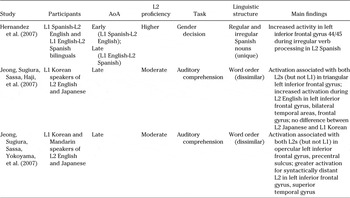
Overview of fMRI studies that examined cross-language similarity during (morpho)syntactic processing in a L1 and L2

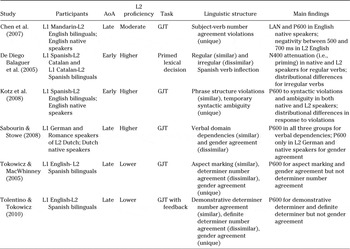
Overview of ERP studies that examined cross-language similarity during (morpho)syntactic processing in a L1 and L2

Note
The abbreviation GJT corresponds to grammaticality judgment task.
It is important to note that experiments included in this review may have inadvertently incurred differences in the relative amount or salience of specific linguistic structures that served as experimental stimuli, leading to exposure confounds that are difficult to disentangle from similarity effects. An effort is made to point out such potential confounds in the studies reviewed here. Additionally, it should be noted that an absence of any behavioral and physiological discrepancies between L1 and L2 processing is highly suggestive of shared neurocognitive resources, particularly in light of the concurrent influence of several variables that can be difficult to control crosslinguistically (e.g., visual or auditory differences in L1 and L2 stimuli). Nevertheless, it should be acknowledged that other issues such as large variability leading to low statistical power can also mask such differences. Finally, the choice of task is of great importance because different behavioral tasks may be associated with differential underlying neural processing.
fMRI Cross-Language Similarity Findings
Results from the restricted set of fMRI studies that directly investigated cross-language similarity suggest an important role of this variable on the neural activation patterns of moderate and higher proficiency bilinguals during L2 (morpho)syntactic processing (see Table 1).
Functional magnetic resonance imaging findings from late AoA, moderate to higher proficiency bilinguals showed increased brain activation relative to the L1 (or to native speakers) during the processing of L2 syntactic features that were dissimilar to the L1 or unique to the L2. Such results point to differences in L1 and L2 brain activation when aspects of (morpho)syntax in the L1 differ markedly from the L2, even in the absence of behavioral differences.
Jeong, Sugiura, Sassa, Haji, et al. (Reference Jeong, Sugiura, Sassa, Haji, Usui and Taira2007) and Jeong, Sugiura, Sassa, Yokoyama, et al. (Reference Jeong, Sugiura, Sassa, Yokoyama, Horie and Sato2007) examined the effect of dissimilar word order employed in English and Mandarin Chinese (canonical SVO), as opposed to Korean and Japanese (SOV). In these two studies, Jeong and colleagues tested L1 Mandarin Chinese and Korean speakers with similar (moderate) levels of L2 English and Japanese proficiency. Despite comparable behavioral performance on an auditory sentence comprehension task in all languages, differences in brain activation as a function of cross-language similarity were observed. Example sentences used in the studies are provided in (6).
(6) a. English
John met the teacher at school.
b. Korean
Chelswu-nun hakkyo-eyse sensayngnimkwa manna-ss-ta.
Chelswu-topic school-at teacher-with meet-past
c. Japanese
Tarou-wa gakkou-de sensei-to a-tta.
Tarou-topic school-at teacher-with meet-past
d. Mandarin
Zhãngsãn zài xuéxiào jiàn-le laoshi.
Zhãngsãn at-school meet-perfect teacher
In Jeong, Sugiura, Sassa, Haji, et al.’s (Reference Jeong, Sugiura, Sassa, Haji, Usui and Taira2007) study, Korean L1 speakers displayed increased activation during L2 English sentence processing relative to the L1, mainly in left inferior frontal gyrus and temporal areas. In contrast, their patterns of activation during the processing of L2 Japanese, which relies on similar word order parameters as the L1, were similar to those displayed in L1 processing; differences in script between Korean and English can be safely ignored because the sentences were presented auditorily. Analogous results were obtained with L1 Mandarin trilinguals who spoke English and Japanese as L2s (Jeong, Sugiura, Sassa, Yokoyama, et al., Reference Jeong, Sugiura, Sassa, Yokoyama, Horie and Sato2007). Nevertheless, it is unclear (a) to what extent such findings would extend to a different task, such as a grammaticality judgment task (GJT), and (b) what the influence of possible confounding factors, such as systematic differences in prosody between the various languages, would be.
In terms of unique L2 features, Hernandez et al. (Reference Hernandez, Hofmann and Kotz2007) reported on a gender decision task in Spanish that consisted of irregular items (ending with the letters e, l, n, r, s, t, or z; e.g., papel “paper”) as well as regular items (ending in o for masculine and a for feminine; e.g., pueblo “town” vs. casa “house”). L1 English speakers proficient in L2 Spanish displayed a greater increase in left inferior frontal gyrus activation in response to the gender-irregular items compared to gender-regular items, relative to native speakers. Once again, these results were obtained despite comparable behavioral performance between L2 and native speakers.
Thus, findings from fMRI studies that examined the role of cross-language similarity in higher proficiency bilinguals using both sentence comprehension (Jeong, Sugiura, Sassa, Haji, et al., Reference Jeong, Sugiura, Sassa, Haji, Usui and Taira2007; Jeong, Sugiura, Sassa, Yokoyama, et al., Reference Jeong, Sugiura, Sassa, Yokoyama, Horie and Sato2007) and gender decision tasks (Hernandez et al., Reference Hernandez, Hofmann and Kotz2007) suggest an influence of cross-language similarity because differences in processing were found mainly when linguistic structures were crosslinguistically dissimilar or unique to the L2, in line with UCM—but not necessarily SSH—predictions. Moreover, the results of Hernandez et al. (Reference Hernandez, Hofmann and Kotz2007) suggest that the effects of L2 stimulus or task difficulty may interact with cross-language similarity. The increased activation observed for gender-irregular as compared to gender-regular items suggests that although L2 gender agreement cues associated with gender-regular items were sufficiently reliable as to allow for the learning of a morphological feature unique to the L2, the processing of gender-irregular items was nevertheless associated with increased processing demands (to a greater extent than in native speakers). The SSH, on the other hand, would predict no cross-language similarity effects during online L2 processing.
Because only a few studies have directly examined cross-language similarity, it can be informative to also examine results obtained in other studies that employed different languages, even if cross-language similarity was not directly controlled or investigated as it was in the main set of studies; cross-language similarity of the linguistic structures was approximated according to Tokowicz and MacWhinney’s (Reference Tokowicz and MacWhinney2005) classification scheme. Findings from this extended set of fMRI studies generally agree with the main set of results: Differences in brain activation were found during the processing of unique (Vingerhoets et al., Reference Vingerhoets, Borsel, Tesink, Noort, Deblaere and Seurinck2003) and dissimilar features in late AoA participants (Hasegawa et al., Reference Hasegawa, Carpenter and Just2002; Wartenburger et al., Reference Wartenburger, Heekeren, Abutalebi, Cappa, Villringer and Perani2003; Yokoyama et al., Reference Yokoyama, Okamoto, Miyamoto, Yoshimoto, Kim and Iwata2006; it should be noted that no similar features were tested in these studies) and therefore are in line with predictions of the UCM for (morpho)syntactic processing within a neurocognitive framework. Early bilinguals, on the other hand, showed no differences or effects of similarity (Wartenburger et al.), in line with SSH predictions of no transfer effects in general.
ERP Cross-Language Similarity Findings
The ERP studies that directly examined the effect of cross-language similarity (see Table 2) covered a wider range of AoAs and proficiency levels than the fMRI studies. The findings indicate that the ERPs of participants with early and late AoAs as well as of participants of various levels of proficiency show differences relative to L1 or native speakers, often as a function of cross-language similarity. The results for moderate and higher proficiency bilinguals are described first, followed by the results for lower proficiency bilinguals.
Moderate and higher proficiency bilinguals. De Diego Balaguer, Sebastián-Gallés, Díaz, and Rodríguez-Fornells (Reference De Diego Balaguer, Sebastián-Gallés, Díaz and Rodríguez-Fornells2005) and Kotz et al. (Reference Kotz, Holcomb and Osterhout2008) examined early, higher proficiency bilinguals and found some differences in L2 processing compared to that of native speakers. De Diego Balaguer et al. reported comparable priming effects during a primed lexical decision task that examined Spanish verb inflection in L1 Spanish-L2 Catalan and L1 Catalan-L2 Spanish bilinguals for regular verbs (i.e., with predictable inflectional suffixes; e.g., ganar “to win,” gano “I win”) but found differential priming effects for irregular verbs (i.e., with deviant inflectional patterns due to stem or root changes; e.g., sentir “to feel,” siento “I feel”). De Diego Balaguer et al. examined the N400 component because although typically associated with semantic processing, the N400 can also be elicited by violations of irregular verb inflection. Results suggested an influence of the differences in inflectional morphology between Catalan and Spanish for irregular verbs only: Irregular verb processing in L2 speakers compared to native speakers was associated with distributional differences in the topography of the N400 priming effect. Regular verb processing, in contrast, was associated with a comparable centroparietal N400 priming effect in both L2 and native speakers.
In contrast, results from Kotz et al. (Reference Kotz, Holcomb and Osterhout2008) showed a comparable P600 effect in native and L2 speakers of English (with Spanish as the L1) during the processing of temporary syntactic ambiguities (based on transitive-intransitive verb use; e.g., The broker persuaded to sell the stock was sent to jail), which is a syntactic feature unique to English. This effect was not found during the processing of phrase structure violations (e.g., *The broker hoped to sell the stock was sent to jail), which follows similar rules in both languages. Whereas both groups exhibited a P600 effect in response to (crosslinguistically similar) phrase structure violations in a GJT, the P600 was right-lateralized in native speakers but left-lateralized in L2 speakers. Nevertheless, Kotz et al. interpreted these differences with caution and suggested that a right-hemisphere P600 effect in L2 speakers may have been attenuated by a preceding negativity observed over posterior sites, thus eliciting the observed distributional differences between the two groups.
Event-related potential differences in the processing of dissimilar and unique features were also observed in studies that examined cross-language similarity in late AoA participants. Chen et al. (Reference Chen, Shu, Liu, Zhao and Li2007) compared the performance of L1 Mandarin Chinese speakers of moderate to higher L2 proficiency to that of native-speaker controls. In particular, they processed sentences with English number agreement violations (e.g., *The price of the cars were too high; *The price of the car were too high), a feature that does not exist in Mandarin. The L2 participants exhibited different ERP patterns in response to these violations during a GJT as compared to native-speaker controls: Whereas native English speakers showed a LAN and a subsequent P600 effect to ungrammatical sentences, Mandarin speakers did not. Similarly, Sabourin and Stowe (Reference Sabourin and Stowe2008) found that whereas L1 Dutch and German speakers exhibited a P600 effect in response to Dutch gender agreement violations, as in (7), L1 Romance language speakers failed to show this effect, despite high L2 Dutch proficiency. This result stands in contrast to the finding in the same study of a P600 effect in all groups in response to Dutch verbal domain dependency violations (i.e., main verb inflection) as in (8), a feature of all three groups of languages.Footnote 3
(7) Dutch gender agreement violation
*De kleine kind probeerde voor het eerst te lopen.
The-com small child-neut tried to walk for the first time
(8) Verbal domain dependency
a. Dutch
Ik heb in Groningen gewoond.
I have in Groningen lived-past.part
b. German
Ich habe in Groningen gewohnt.
c. French
J’ai habitéen Groningen.
“I have lived in Groningen.”
The findings are attributed to the influence of cross-language similarity such that although both verbal domain dependencies and gender agreement are characteristics of all languages examined, gender agreement is implemented differently in Romance languages. Thus, the L1 German speakers could apply a direct conversion algorithm for equating masculine and feminine German words with the common gender in Dutch (with neuter remaining the same in the two languages); however, the Romance language speakers could not rely on any direct mapping and thus had to map a new gender to each specific lexeme. It therefore appears that the presence of a given morphosyntactic feature or system in a L1 does not constitute a sufficient basis for positive L1-L2 transfer; rather, the system needs to be implemented in a comparable—or at least easily predictable—manner for transfer to be beneficial (see Costa, Kovacic, Frank, and Caramazza, Reference Costa, Kovacic, Frank and Caramazza2003, for behavioral results on the functional independence of grammatical gender systems).
Overall, like results from fMRI studies, ERP findings for higher proficiency bilinguals suggest an influence of cross-language similarity in neural activation during L2 (morpho)syntactic processing. Such results were obtained in the context of priming (De Diego Balaguer et al., Reference De Diego Balaguer, Sebastián-Gallés, Díaz and Rodríguez-Fornells2005) and the GJT (Chen et al., Reference Chen, Shu, Liu, Zhao and Li2007; Kotz et al., Reference Kotz, Holcomb and Osterhout2008; Sabourin & Stowe, Reference Sabourin and Stowe2008). Although the distributional differences in the P600 observed for the phrase structure violations in the Kotz et al. (Reference Kotz, Holcomb and Osterhout2008) study seem to contradict the UCM prediction of shared processing of crosslinguistically similar features (and to be more in line with the SSH prediction of no L1-L2 transfer), this particular result should be interpreted with caution.
It is important to note that the N400 effect observed in the De Diego Balaguer et al. (Reference De Diego Balaguer, Sebastián-Gallés, Díaz and Rodríguez-Fornells2005) study has not traditionally been used to assess sensitivity to (morpho)syntactic violations, thus making this particular result difficult to compare across studies. Nevertheless, just as specific ERP components may index more than one particular cognitive function, a given cognitive function may be indexed by more than one ERP component, which may vary with the task employed. For example, at least one study has indicated a longitudinal shift from an N400 to a P600 for L2 morphosyntactic violations (Osterhout, McLaughlin, Kim, Greenwald, & Inoue, Reference Osterhout, McLaughlin, Kim, Greenwald, Inoue, Carreiras and Clifton2004).
Lower proficiency bilinguals. Tokowicz and MacWhinney (Reference Tokowicz and MacWhinney2005) also examined the effect of cross-language similarity in late learners; however, they investigated L1 English speakers who were lower proficiency bilinguals of Spanish (in the first four semesters of university study). Participants exhibited a P600 effect in response to grammatical violations similar in the L1 and L2, such as errors in aspect marking as in (9a), and those unique to the L2, such as grammatical gender agreement as in (9b). However, this effect was not found in response to grammatical violations of constructions that exist in both the L1 and L2 but are instantiated somewhat differently in the L1 and L2, as with determiner-number agreement in (9c).
(9) a. *Su abuela cocinando muy bien.
“*His grandmother cooking very well.”
b. *Ellos fueron a un fiesta.
They went to a-masc party-fem
“They went to a party.”
c. *El niños están jugando.
The-sing boys-pl are playing.
“The boys are playing.”
In a similar study, Tolentino and Tokowicz (Reference Tolentino and Tokowicz2010) also reported a P600 effect in response to violations of crosslinguistically similar constructions (demonstrative determiner-number agreement; e.g., *Este niños están jugando “*This boys are playing”) in a comparable participant population, but, in contrast to Tokowicz and MacWhinney (Reference Tokowicz and MacWhinney2005), they did not observe a P600 effect during the processing of unique constructions (grammatical gender agreement). Instead, a P600 effect was obtained for dissimilar constructions (definite determiner number agreement). It is likely that differences in stimulus set and experimental design (number or type of grammatical constructions, or both; presence of accuracy feedback; etc.) were responsible for the discrepancies between these two studies. Although these two studies directly contrasted cross-language similarity, they did not test native Spanish speaker controls with no knowledge of English, which thus prevented a direct comparison between native and L2 (morpho)syntactic processing; native Spanish speakers with no knowledge of English would be the appropriate comparison group because transfer from the L2 to the L1 is also possible (e.g., Dussias & Sagarra, Reference Dussias and Sagarra2007). (Nevertheless, both studies measured ERPs in response to violations during L1 processing.)
Both Kotz et al. (Reference Kotz, Holcomb and Osterhout2008) and Tokowicz and MacWhinney (Reference Tokowicz and MacWhinney2005) found that participants were sensitive to violations of morphosyntactic features that are unique to the L2, according to ERP measures. This finding is interesting because although the pair of languages examined in the two studies was identical (English and Spanish), the participant population differed in terms of level of proficiency, AoA, and L1. This would seem to indicate that both lower and higher proficiency as well as early and late AoA participants are sensitive to morphosyntactic features unique to the L2. However, the findings from Tolentino and Tokowicz (Reference Tolentino and Tokowicz2010) suggest that this may not always be the case, as indicated by the lack of a P600 effect in response to unique L2 features in that study. Furthermore, additional counterevidence comes from Chen et al. (Reference Chen, Shu, Liu, Zhao and Li2007), a study in which—unlike native English speakers—L1 Mandarin speakers failed to show a P600 in response to number agreement violations in L2 English (e.g., *The price of the cars were too high; *The price of the car were too high). It is unlikely that this result is due to either AoA or proficiency level because participants in this study performed at approximately 88% accuracy on a GJT despite being late AoA participants. One possibility is that although prevalent in English, specific cues associated with number agreement may not be as salient in English as gender agreement is in Spanish, thus making it more difficult for bilinguals to exhibit online sensitivity to this particular feature. Support for this idea comes from additional findings in Chen et al.’s (Reference Chen, Shu, Liu, Zhao and Li2007) experiment, which suggest that Mandarin speakers did not consistently apply number agreement cues in English, at least during online processing: In contrast to the LAN-P600 pattern exhibited by native English speakers in response to ungrammatical sentences, L1 Mandarin speakers showed an N400 followed by a P600 to sentences that were grammatical but number-incongruent based on surface features (e.g., The price of the cars wastoo high). This result suggests that bilinguals were sensitive to number cues in the L2 but perhaps needed stronger cues (or more targeted practice) to exhibit nativelike online sensitivity to this nonnative linguistic system.
In sum, for (morpho)syntactic features that are similar in the L1 and L2, results from these ERP studies are largely consistent and in accordance with predictions of positive transfer made by the UCM. Thus, all of the studies that examined the processing of shared morphosyntactic features between the L1 and L2 found that participants exhibited physiological markers of sensitivity to features as varied as regular verb inflection (De Diego Balaguer et al., Reference De Diego Balaguer, Sebastián-Gallés, Díaz and Rodríguez-Fornells2005), violations of phrase structure (Kotz et al., Reference Kotz, Holcomb and Osterhout2008), verbal domain dependencies (Sabourin & Stowe, Reference Sabourin and Stowe2008), aspect marking (Tokowicz & MacWhinney, Reference Tokowicz and MacWhinney2005), and determiner number agreement (Tolentino & Tokowicz, Reference Tolentino and Tokowicz2010). In contrast, morphosyntactic features that differed in their implementation across languages were generally associated with differences in neural signatures during L2 and L1 processing (or compared with native speakers) or sometimes failed to elicit ERP markers of sensitivity in bilinguals. This was the case for irregular verb inflection (De Diego Balaguer et al.), determiner number agreement (Tokowicz & MacWhinney), and gender agreement (Sabourin & Stowe). These effects of cross-language similarity were obtained despite varying AoAs and L2 proficiency levels. One exception is the presence of a P600 effect in response to dissimilar constructions—although smaller than that for similar constructions—found by Tolentino and Tokowicz (Reference Tolentino and Tokowicz2010). It is possible that the presence of accuracy feedback and the use of two types of number violations, which were distinct features of this study, resulted in a differential increase in cue strength associated with determiner number agreement.
Such comparable processing in a L2 and L1 (or in native speakers) in response to crosslinguistically similar constructions is also largely in accordance with SSH predictions, given that the majority of the studies examined local violations of morphosyntax. However, the results of Kotz et al. (Reference Kotz, Holcomb and Osterhout2008) constitute an exception because they do not support the SSH prediction of differences between L2 and native speakers during the processing of phrase structure violations.
In the case of unique constructions, results were mixed in that whereas two studies (Kotz et al., Reference Kotz, Holcomb and Osterhout2008; Tokowicz & MacWhinney, Reference Tokowicz and MacWhinney2005) found bilinguals to be sensitive to violations of this type of construction, others did not (Chen at al., Reference Chen, Shu, Liu, Zhao and Li2007; Tolentino & Tokowicz, Reference Tolentino and Tokowicz2010). The lack of physiological markers of sensitivity observed in the Chen et al. study in response to number violations and local incongruency could be attributed either to a lack of positive L1 transfer or to a restriction on agreement processing to local domains (e.g., *The price of the cars weretoo high), as predicted by the SSH. However, because participants also did not show a nativelike pattern (or even sensitivity) in response to what would be perceived as local violations (*The price of the car weretoo high), it is not clear that such results support the SSH.
Results from an extended set of ERP studies that did not directly examine the influence of cross-language similarity generally agree with the main set of findings in that the processing of crosslinguistically similar constructions by late, moderate to higher proficiency bilinguals were generally associated with comparable neural patterns in the L2 and L1 (and in native speakers; Rossi et al., Reference Rossi, Gugler, Friederici and Hahne2006). In contrast, the processing of dissimilar constructions was sometimes associated with comparable neural patterns in the L1 and L2 (Isel, Reference Isel2007; see also Isel, Hahne, Maess, & Friederici, Reference Isel, Hahne, Maess and Friederici2007)—and sometimes not (Frenck-Mestre et al., Reference Frenck-Mestre, Osterhout and McLaughlin2008). Furthermore, the processing of unique constructions was generally associated with distinct neural patterns (Hahne & Friederici, Reference Hahne and Friederici2001; Ojima et al., Reference Ojima, Nakata and Kakigi2005).
These results are largely consistent with UCM predictions; effective resolution of L1-L2 competition and the acquisition of a unique L2 feature in part depended on the strength of the cues associated with it (among other factors). For example, L1 German-L2 French bilinguals tested by Frenck-Mestre et al. (Reference Frenck-Mestre, Osterhout and McLaughlin2008) showed a P600 effect similar to that of native speakers during silent reading of phonologically realized inflectional morphology (a dissimilar feature). In contrast, the bilinguals did not show this sensitivity to agreement violations in which the errors were silent, thus constituting weaker cues. Cross-language similarity did not influence lower proficiency bilinguals (Osterhout, McLaughlin, Pitkänen, Frenck-Mestre, & Molinaro, Reference Osterhout, McLaughlin, Pitkänen, Frenck-Mestre and Molinaro2006; Rossi et al., Reference Rossi, Gugler, Friederici and Hahne2006; Weber-Fox & Neville, Reference Weber-Fox and Neville1996), although caution is required in the interpretation of these results because similarity was not explicitly contrasted in these studies.
Results from a few studies in this extended set are worth highlighting because they provide experimental evidence that can be used to evaluate theories of L2 syntactic processing and cross-language similarity effects. In particular, Rossi et al. (Reference Rossi, Gugler, Friederici and Hahne2006) reported that moderately proficient late L1 Italian-L2 German and L1 German-L2 Italian bilinguals exhibited an ELAN effect in response to word category violations that were crosslinguistically similar, as in (10a) and (10b).
(10) a. German:
*Der Junge im singtein Lied
The boy in-the sings a song
b. Italian:
*Il signore nel beveun caffè
The man in-the drinks a coffee
Therefore, like native speakers, L2 speakers exhibited early, automatic sensitivity to phrase structure violations (see also Isel, Reference Isel2007). Relevantly, the purported absence of ELAN or LAN effects in response to syntactic violations is often offered as evidence in support of the SSH, according to which the absence of early syntactic component effects in L2 speakers reflects the fact that they do not use structural information at the same level of detail as native speakers (Clahsen & Felser, Reference Clahsen and Felser2006a, Reference Clahsen and Felser2006b). These results suggest that this may not always be the case, even for moderately proficient bilinguals.
Finally, it is interesting to note that in addition to the main qualitative differences (i.e., presence and distribution of an ERP component, or both) found between groups by Sabourin and Stowe (Reference Sabourin and Stowe2008), quantitative differences (i.e., changes in amplitude or latency of an ERP component, or both) were also observed. Thus, whereas all groups exhibited a P600 effect in response to verbal domain dependency violations, the effect was smaller in amplitude and showed delayed peak latencies in the L2. Furthermore, the P600 effect exhibited by L1 German speakers in response to gender agreement violations was also smaller and delayed relative to that of native Dutch speakers. This grading of responses within and between groups is suggestive of a possible continuum of L2 grammatical sensitivity (see also Rossi et al., Reference Rossi, Gugler, Friederici and Hahne2006; Tolentino & Tokowicz, Reference Tolentino and Tokowicz2010). It could be that the display of an identical P600 effect to native speakers indicates nativelike sensitivity; the presence of a delayed or smaller effect is indicative of near-native sensitivity; and the absence of an effect indicates nonnative sensitivity. However, this is not to be equated with degree of nativeness in behavioral performance. As some of the studies reviewed here have shown, accurate performance can occur in the absence of nativelike neural activation, and neural activation can exist even when overt performance is at chance.
It could be that higher proficiency bilinguals who perform at behavioral levels comparable to native speakers—but who do not display the same indicators of neural sensitivity—may rely on different L2 processing mechanisms that yield the same behavioral output. This concept is referred to as degeneracy, which occurs when the same function or outcome can be achieved through different structural constituents (Green, Crinion, & Price, Reference Green, Crinion and Price2006). This is also in accordance with the idea that functional anatomy prevails over structural anatomy. Hagoort (Reference Hagoort2006) argued that the pattern of input to a specific brain area and its connectivity to other areas, rather than the cytoarchitecture of the tissue, is what determines its cognitive function. It is reasonable to assume that, in most cases, the input pattern of L2 speakers varies considerably from that of native speakers (or from L1 input patterns), mainly due to specific learning settings (e.g., classroom vs. home) and, often, to AoA. This difference in the input could lead to alternate neural patterns in language representation and processing and possibly result in degenerate systems, at least in higher proficiency bilinguals. Cross-language similarity (or the absence of competition) may nevertheless encourage reliance on similar neural generators during processing.
In contrast, the case in which ERP sensitivity is observed despite lower levels of overt performance (Tokowicz & MacWhinney, Reference Tokowicz and MacWhinney2005) could reflect reliance on the same neural mechanisms but at a level below behavioral threshold. In other words, lower proficiency bilinguals may be implicitly sensitive to (morpho)syntactic violations in the L2 but may not be able to access or report their knowledge during a grammaticality judgment or similar task. As noted by Ellis (Reference Ellis2005), bilinguals often have difficulties with L2 functional morphology, for example, because they continue to implicitly rely on L1 processes instead of adopting a more conscious approach necessary for noticing and acquiring nonsalient aspects of the L2. Consistent with this idea, Tolentino and Tokowicz (Reference Tolentino and Tokowicz2010) aimed to improve bilinguals’ ability to rely on their implicit knowledge in making end-of-sentence grammaticality judgments and observed that isolating grammatical violations and providing accuracy feedback were associated with increased brain sensitivity, as measured by ERPs, even for the processing of constructions unique to the L2.
Nevertheless, the possibility remains that results obtained with techniques that are based on physiological markers of sensitivity differ from those obtained with behavioral methods simply because the two types of methods measure L2 processing at different stages. Therefore, whereas fMRI and ERPs continuously track physiological responses (albeit with different temporal resolutions), the most common behavioral methods (e.g., GJT, comprehension questions) rely on global, post hoc judgments that likely involve metalinguistic knowledge.
SUMMARY AND CONCLUSION
Returning to the initial question of whether similarity of the (morpho)syntactic structures of an individual’s L1 and L2 affects the neural location of L2-related activity and temporal processing of L2, the answer seems to be yes. The processing of constructions that involve varying degrees of cross-language similarity generally activated common areas of the neural language network. Nevertheless, the set of fMRI and ERP findings indicate that the processing of crosslinguistically dissimilar or unique (morpho)syntactic features was most often associated with differences in the activation of various parts of this network. Not surprisingly, the effect of cross-language similarity also sometimes interacted with AoA and proficiency level.
Specifically, in terms of fMRI findings, there was a trend for late moderate and higher proficiency bilinguals to exhibit increased activation, mainly in left inferior frontal gyrus and superior and middle temporal areas, during the processing of (morpho)syntactic features that are unique to the L2 or dissimilar in the L1 and L2 but not for those that are similar in the L1 and L2. Early bilinguals generally showed no effects of similarity according to fMRI results; however, this population was investigated less often.
The ERP findings also suggest an influence of cross-language similarity. Differences in L2 processing were mainly associated with crosslinguistically different and unique constructions. Unlike the fMRI findings, differences were observed in both early and late learners; however, the range of ERP studies was greater. Thus, results showed that, generally, both early and late AoA, higher and lower proficiency participants exhibited the same components as in the L1 (or in comparison to native speakers) during the processing of crosslinguistically similar constructions. Dissimilar or unique constructions, however, resulted in conflicting findings: Regardless of AoA or proficiency level, crosslinguistically different (morpho)syntactic features sometimes elicited comparable ERP effects in the L2 and L1 (or in native speakers) and sometimes did not. An analogous situation was also observed during the processing of unique constructions.
The overall picture obtained from the two sets of findings based on different neuroimaging methods is generally in accordance with the predictions of the UCM as they apply to (morpho)syntactic processing within a neurocognitive framework (MacWhinney, Reference MacWhinney, Kroll and de Groot2005). The processing of similar constructions was thus generally associated with a comparable degree of activation of common brain areas involved in (morpho)syntactic processing in the case of fMRI studies and with the presence of comparable (morpho)syntactic components in the case of ERP studies. The observed findings also suggest that (morpho)syntactic structures that exist in both languages but that differ in their specific implementation (i.e., dissimilar constructions) suffered from some degree of crosslinguistic competition and negative transfer. A qualitative analysis of the cue strength of specific (morpho)syntactic constructions (see McDonald & MacWhinney, Reference McDonald, MacWhinney, MacWhinney and Bates1989, for quantitative crosslinguistic likelihood models) suggests that the processing of dissimilar L2 features with relatively low cue strength (e.g., irregular Spanish verb conjugation; De Diego Balaguer et al., Reference De Diego Balaguer, Sebastián-Gallés, Díaz and Rodríguez-Fornells2005) was associated with differences between the L2 and L1, or as compared to native speakers. In contrast, the processing of (morpho)syntactic features with relatively high cue strength (e.g., Spanish number agreement; Tolentino & Tokowicz, Reference Tolentino and Tokowicz2010) showed no differences in the L1 and L2. These results are consistent with the UCM’s prediction that competition will likely be resolved when cue strength is high, thus resulting in comparable L2 and L1 (or native) processing.
Nevertheless, this prediction was not always borne out in the data; in some cases, although cue strength was relatively high (e.g., Spanish definite determiner-noun number agreement; Tokowicz & MacWhinney, Reference Tokowicz and MacWhinney2005), physiological sensitivity in the L2 was not observed. This could be due to additional factors such as late AoA, low proficiency, or salience of the task-relevant cue. For example, although Dutch determiner-noun gender agreement (Sabourin & Stowe, Reference Sabourin and Stowe2008) is highly available and reliable, Dutch grammatical gender is not overtly marked on the noun (Sabourin, Stowe, & de Haan, Reference Sabourin, Stowe and de Haan2006) and thus is not indicated by a very strong cue. It is likewise difficult to tell how relevant the word order cue was for the comprehension task in the studies by Jeong and colleagues (i.e., Jeong, Sugiura, Sassa, Haji, et al., Reference Jeong, Sugiura, Sassa, Haji, Usui and Taira2007; Jeong, Sugiura, Sassa, Yokoyama, et al., Reference Jeong, Sugiura, Sassa, Yokoyama, Horie and Sato2007), as opposed to other sentence cues (e.g., noun animacy, prosody).
In terms of unique constructions, results were consistent with UCM predictions showing comparable processing in the L1 and L2 (or native speakers) when cue strength was high, as with phonological and orthographic cues for Spanish gender agreement (Tokowicz & MacWhinney, Reference Tokowicz and MacWhinney2005; see Teschner & Russel, Reference Teschner and Russell1984, for a description of Spanish phonological patterns), and differences in processing when cues were of relatively lower strength, as in irregular Spanish gender assignment (Hernandez et al., Reference Hernandez, Hofmann and Kotz2007). Nevertheless, late lower to moderate proficiency bilinguals often did not show physiological sensitivity to highly available and reliable cues such as those to Spanish determiner-noun number agreement (Tokowicz & MacWhinney) and, to a lesser extent, English subject-verb number agreement (Chen et al., Reference Chen, Shu, Liu, Zhao and Li2007). However, due to its probabilistic nature, cue strength can be difficult to quantify across experiments because it can be influenced by other factors, such as previous exposure.
In contrast, general findings from the reviewed studies were mostly incompatible with the predictions of the SSH. Specifically, whereas nonnative speakers of various L2s were most often sensitive to L2 morphological violations, which is generally consistent with the SSH, they nevertheless showed physiological sensitivity to violations of syntactic structures such as word order in fMRI studies and phrase structure in ERP studies, which were modulated by cross-language similarity. The overall results therefore contradict the main assumptions of the SSH not only by directly showing that L2 speakers do exhibit early sensitivity to complex syntactic violations, comparable to that of native speakers, but also by suggesting syntactic transfer from the L1. Moreover, research suggests that the presence of early ERP markers to syntactic violations does not determine nativeness because such markers (e.g., ELAN) are often absent in native speakers (e.g., Allen et al., Reference Allen, Badecker and Osterhout2003; Frenck-Mestre et al., Reference Frenck-Mestre, Osterhout and McLaughlin2008; Kim & Osterhout, Reference Kim and Osterhout2005; Tolentino & Tokowicz, Reference Tolentino and Tokowicz2010). Therefore, it appears that the SSH could benefit from refinements of its scope or proposed mechanisms of L2 syntactic processing. This would include postulating specific mechanisms that allow for L1-L2 transfer when appropriate, as well as specifications of precisely which subtypes of L2 speakers (i.e., of different proficiency levels, language backgrounds, AoAs, etc.) and syntactic constructions the theory is intended to encompass.
The studies reviewed here show that behavioral findings often diverge from those obtained with physiology-based methods. Indeed, physiological differences were often observed in the absence of any behavioral discrepancies in the reviewed studies. For example, higher proficiency bilinguals often exhibited comparable behavioral performance in the L2 compared to L1 or to native speakers but nevertheless showed differences based on both imaging methods (De Diego Balaguer et al., Reference De Diego Balaguer, Sebastián-Gallés, Díaz and Rodríguez-Fornells2005; Hernandez et al., Reference Hernandez, Hofmann and Kotz2007; Kotz et al., Reference Kotz, Holcomb and Osterhout2008). The concept of degeneracy, or comparable output based on different mechanisms, could possibly explain such differences.
Nevertheless, differences in behavioral L2 (morpho)syntactic processing as a function of cross-language similarity were found with self-paced reading tasks (Fender, Reference Fender2003; Tokowicz & Warren, Reference Tokowicz and Warren2010) or with lower proficiency participants (Tokowicz & MacWhinney, Reference Tokowicz and MacWhinney2005; Tolentino & Tokowicz, Reference Tolentino and Tokowicz2010). These findings are in agreement with the predictions of the UCM—especially for lower proficiency bilinguals who may not yet have acquired certain L2 features—but are generally incompatible with the SSH, which predicts little or no transfer or competition between the L1 and L2. It could be that higher proficiency is associated with increased L2 resonance (simultaneous activation of reciprocal connections in the bilingual’s language networks). Thus, it seems reasonable that the L2 behavioral performance of higher proficiency bilinguals is largely uninfluenced by cross-language similarity if it is assumed that crosslinguistic competition plays less of a role as the L2 becomes more resonant, possibly overcoming L1 entrenchment (MacWhinney, Reference MacWhinney, Kroll and de Groot2005). The performance of lower proficiency bilinguals may, in contrast, be more influenced by cross-language similarity (e.g., Tokowicz & MacWhinney; Tokowicz & Warren; Tolentino & Tokowicz).
In conclusion, this review explored the role of cross-language similarity in L2 (morpho)syntactic processing, based on the location of language-related brain activation as well as temporal processing information, and the results of the studies examined indicate an influence of this variable. In particular, differential L2 processing, as measured by both methods, was generally associated with crosslinguistically dissimilar and unique (morpho)syntactic constructions but not similar constructions. Furthermore, the effect of similarity interacted with L2 AoA such that its effects were more pronounced in late AoA participants. Such results have important repercussions for language research and education. Cross-language similarity can no longer be ignored in bilingualism studies and should therefore be experimentally controlled for, especially given its interaction with other important variables. Moreover, the results of the studies examined here suggest that adult L2 education may benefit from an approach that takes the L1 into consideration, even when behavioral performance is high, perhaps leveraging learning with more easily processed crosslinguistically similar forms and directly addressing transfer errors.
Nevertheless, these conclusions are based on a limited number of studies that employed an even smaller number of languages and therefore may not generalize to other language pairs or participants. Additionally, it remains unclear to what degree lower proficiency bilinguals are affected by cross-language similarity. Because proficiency level was assessed by different measures in the various studies, including grammaticality judgments, forced-choice verb inflection, and standardized tests of proficiency, it is still unclear to what extent proficiency interacts with cross-language similarity in L2 processing. When available, the use of standardized proficiency measures is preferable due to their cross-study comparability and integrity (see Kempe and MacWhinney, Reference Kempe and MacWhinney1996, for a crosslinguistic measure of vocabulary proficiency).
Future studies that examine AoA and proficiency, contrast more diverse pairs of languages, and compare different stimulus presentation modalities, task requirements, and levels of stimulus complexity should further elucidate the nature of the effect of cross-language similarity. Moreover, studies that investigate fMRI functional connectivity and electroencephalographic coherence patterns (e.g., Dodel et al., Reference Dodel, Golestani, Pallier, ElKouby, Le Bihan and Poline2005), in addition to measuring the activity of isolated brain regions, may further contribute to the understanding of the dynamics of information flow between various brain areas during L2 (morpho)syntactic processing as well as the factors that influence their activity.