1. Introduction
How the rural poor can cope with climate-related disasters is a central issue in climate-adaptation policy (e.g., Adger et al., Reference Adger, Huq, Brown, Conway and Hulme2003). Although the rural poor's limited coping capacity is commonly emphasized, some researchers pay significant attention to their potential for adapting to climate change, making systemic improvements. In particular, those working within a social-ecological resilience framework emphasize the triggering role of disasters (e.g., Pelling and High, Reference Pelling and High2005; Westley et al., Reference Westley, Olsson and Folke2011): ‘In a resilient social-ecological system, disturbance has the potential to create opportunity for doing new things, for innovation and for development’ (Folke, Reference Folke2006: 253). Recent empirical works provide supportive evidence: In an Amerindian community in Honduras, Hurricane Mitch triggered institutional changes in land management, which led to sustained social-ecological improvements (McSweeney and Coomes, Reference McSweeney and Coomes2011); in colonial Mexico, improved adaptation through learning and innovation followed a series of extreme weather events and weather-related events (Endfield, Reference Endfield2012).Footnote 1
These findings on a potential positive consequence of disasters suggest that ‘future interventions should foster local capacities for endogenous institutional change to enhance community resilience to climate shocks’ (McSweeney and Coomes, Reference McSweeney and Coomes2011: 5203). Although this bottom-up approach is an important alternative to conventional external assistance, exactly which policies can foster local capacities is unknown. Some researchers see such potential in the bottom-up nature of community-based resource management; in particular, Tompkins and Adger (Reference Tompkins and Adger2004) emphasize its inclusionary communication/deliberation mechanisms and local institutions for social learning, as well as how it facilitates networks connecting local and external actors. As community-based resource management is a mainstream policy in developing rural areas, this potential warrants systematic inquiry. Using original household survey data in Fiji that capture the establishment of community-based marine protected areas (MPAs) following a tropical cyclone, this paper examines whether and how disaster experience can enhance local coping capacity through community-based conservation.
The paper can serve as a benchmark case for studying the potential role of community-based resource management in fostering climate adaptation because, if it has such potential, we can expect that this would be so for Fiji's MPAs for the following reasons. First, Pacific island states have well adapted their traditional marine resource-management practices to contemporary circumstances; community-based marine resource management is more widespread in Oceania than in any other tropical region in the world (Johannes, Reference Johannes2002). Secondly, as customary marine tenure is well established in Fiji, incomplete property rights that can preclude investments in local public goods (conservation) are unlikely to be a major concern. Thirdly, although cyclones are among the most important climate-related disasters in island states, some researchers criticize the deterioration of islanders' indigenous coping mechanisms; such concerns underlie the recent expansion of MPAs in Fiji (e.g., Veitayaki, Reference Veitayaki2006).
The paper explicitly addresses two lines of major critiques against extensive studies on conditions facilitating successful community- based resource management, such as group size and inequality (e.g.,; Baland and Platteau, Reference Baland and Platteau1996): (1) those studies neither address the issue of identification of causality (omitted variable bias), nor show why and how such conditions matter (Agrawal, Reference Agrawal2001); and (2) they treat the community as a small spatial unit with a homogeneous social structure consisting of common interests and shared norms and do not directly address political economy issues, such as multiple interests/actors within the community, decision-making processes and institutional arrangements (Agrawal and Gibson, Reference Agrawal and Gibson1999).
To illustrate the first critique, suppose that sufficient variations exist across communities in disaster shocks and in the adoption of conservation measures following a disaster. Although a community-level regression analysis to estimate the disaster effects on conservation would involve far fewer identification problems than previous works on group characteristics, such inquiries have been very limited, because disaster experience has not been considered as a facilitating condition for community-based resource management. Identification may be still hampered by unobserved community factors correlated with disaster shocks, such as post-disaster external support for conservation. Although the proposed analysis requires community-level exogenous shock measures, such data are rarely available in practice. Furthermore, even if the disaster's impacts on conservation are identified, such a community-level analysis cannot dissect mechanisms underlying the causality.
How the local political economy matters for community-based resource management depends on specific local institutions. In Fiji's customary marine resource management, building consensus among community members is a primary decision-making process.Footnote 2 In coastal communities on the Solomon Islands, Schwarz et al. (Reference Schwarz, Béné, Bennett, Boso, Hilly, Paul, Posala, Sibit and Andrew2011) find that individual support for collective action is strongly associated with households' perception about their community's capacity to cope with shocks. The paper explores the consensual decision making underlying collective actions by exploiting across-households variations in support for establishing MPAs. I show that a household's exposure to the disaster increases its support for MPAs. This positive disaster effect is identified only when the potential endogeneity of household housing damage is controlled for by using exogenous flood shock as an instrument.
I argue that the positive disaster effect on conservation among households is a result of disaster victims having a greater appreciation of local commons as future safety nets than non-victims. This insurance motive is corroborated by recent findings on a significant role of fishing as insurance in my study area in Fiji (Takasaki, Reference Takasaki2011b): the rural poor rely on local commons not only for self-insurance (e.g., Jodha, Reference Jodha1986; LMMA, 2001; Takasaki et al., Reference Takasaki, Barham and Coomes2004), but also to augment mutual insurance; in particular, households with housing not damaged by the cyclone intensify fishing to help kin-group members with damaged housing for their new house building and housing repair.
The following caveats are noted. First, my survey data collected at the time of the establishment of most MPAs (less than three years after the cyclone) do not allow me to test the insurance motive per se; in particular, I cannot examine how MPAs altered community members' fishing and conservation practices afterwards or whether MPAs helped augment their local safety nets against subsequent cyclones. Next, since my data contain limited community-level data for 33 coastal villages, I cannot conduct the following two lines of community-level causal analysis. The first is on community-level determinants of collective action for conservation; in particular, the data lack villages not damaged by the cyclone, and this precludes me from conducting the type of community-level analysis on the disaster impacts on conservation discussed above. Instead, my analysis focuses on identifying causality at the household level by fully controlling for community heterogeneity. The second is on potential channels for collective action; in particular, I cannot examine whether support for MPAs among community members actually shapes their collective decision, and thus I cannot directly test the consensus channel or the social learning channel. Note that such an analysis would be even more difficult than the first line of analyses on exogenous community-level determinants of collective action, because household support is endogenously determined.
Still, I show that strong support for MPAs among community members is positively associated with their consensual decision making and I provide correlative and indirect empirical evidence that a community decision leads to greater overall support for conservation. These results suggest potential social learning from disaster experience among community members that facilitates their consensual decision making for adapting to climate change through community-based resource management, along the line of adaptive management (e.g., Holling, Reference Holling1978; Walters, Reference Walters1986).
The rest of the paper is organized as follows. Section 2 provides a description of the marine resource institution in Fiji. Section 3 describes the data, MPAs and the disaster. Section 4 presents the econometric specification to identify the disaster effects on conservation and the estimation results, followed by a series of robustness checks in section 5. The last section summarizes the paper's major findings and discusses implications for policy and research.
2. Marine resource institution and management in Fiji
Each native Fijian belongs to a lineage of the vanua-yavusa-mataqali-tokatoka hierarchy: Vanua consists of several yavusa; yavusa consists of several mataqali; and mataqali consists of several tokatoka (Ravuvu, Reference Ravuvu1983). Roughly matching an old district in the administrative unit, vanua ranges over several villages; a village consists of one or a few yavusa, which includes several lower order units, mataqali, and then tokatoka. Fijian customary law guarantees the collective ownership of land and marine resources. First, rural land is communally owned by mataqali (within a village) and is privately used, and by law it cannot be sold (about 83 per cent of the country's total land is communal land). Secondly, the coastal zones across the country are demarcated into over 400 customary fishing grounds (CFG) (locally known as qoliqoli) to which vanua or several yavusa (across several villages) hold customary rights to harvest marine resources; ownership of the foreshore rests with the state (Techera, Reference Techera, Hillerband and Karlsson2008).
Ethnographic studies highlight Fijians' traditional marine resource-management practices, such as ritual protocols, taboos, no-take areas, seasonal bans, and their effective enforcement through social norms and sanctions (e.g., Siwatibau, Reference Siwatibau1984). The national government has been strengthening customary resource management by formalizing its arrangements and integrating them into the contemporary system; examples include registration of CFGs, boundary setting, licensing involving customary owners, and deterrence of poachers (Veitayaki, Reference Veitayaki1998). As such, Fiji's contemporary marine resource management is built on its customary institution of community-based management (i.e., co-management).
There has been an increasing interest across the country in the establishment of MPAs as a result of governments' extension work and non-governmental organization (NGO) activities under locally managed marine area (LMMA) initiatives, which were launched in 2000; MPAs are a central management tool under the initiatives (Techera, Reference Techera, Hillerband and Karlsson2008; Govan, Reference Govan2009). By 2005, 177 villages in Fiji had established LMMAs, which cover 7,010 km2, with 440 km2 of MPAs (LMMA, 2006). Building on the traditional practice of closed areas, establishing a village-level MPA involves consensual decisions among villagers in the village and among villages collectively owning the CFG.Footnote 3 Niesten et al. (Reference Niesten, Gjertsen and Fong2013) offer a case study on MPAs in Fiji; an advantage of small MPAs for enforcement and an increased stock of targeted species in MPAs under LMMA initiatives have been documented (Govan, Reference Govan2009).
3. Data, marine protected areas and disaster
3.1. Study area and data
Fiji is divided almost evenly between native Fijians and Indo-Fijians. My study focuses on native Fijians, who hold customary rights to harvest marine resources. In June–September 2005, I conducted a household survey among 906 households and a village survey in 43 native Fijian villages in Cakaudrove Province in the northern region of the country.Footnote 4 The household survey was conducted mostly with household heads, and the village survey was conducted with village leaders. In each of 16 districts in the province, villages were intentionally chosen to cover distinct environmental and economic conditions, but not cyclone damage, as discussed below, because of a lack of comprehensive village data; specifically, 35 coastal and eight inland villages were sampled. In each village, households were stratified by tokatoka (smallest kin-group unit) and a combination of individual leadership status (defined below) and major asset holdings (e.g., shops) (all tokatoka were sampled); in each stratum, households were randomly sampled (50 per cent of the population in each stratum, on average). The 43 villages in the sample cover 20 vanua, 53 yavusa, 146 mataqali and 234 tokatoka (recall that a village consists of one or a few yavusa in the hierarchical lineage) (an average village consists of 3.4 mataqali and 5.6 tokatoka, and on average, each mataqali and tokatoka consists of 14 and eight households, respectively, in the population).Footnote 5 The sample covers 29 CFGs (out of 32 in the province), and some vanua and yavusa (and thus villages) own more than one CFG.
Each vanua has a paramount chief, and some yavusa and mataqali, but not tokatoka, have sub-chiefs; there are also traditional leaders other than chiefs/sub-chiefs. Village chiefs can be served by chiefs, sub-chiefs or non-chief leaders. Heads of CFGs are either vanua or yavusa chiefs. These hereditary traditional leaders play a major role in local governance within and across corresponding kin groups (Turner, Reference Turner1992). I call households to which those with chief, sub-chief or non-chief leader status belong kin leaders. In the sample, most kin leaders are sub-chiefs or non-chief leaders, as many chiefs, including CFG heads, live in cities.
Virtually all households in the sample employ traditional farming practices, using no mechanized equipment or animal traction to produce taro, cassava, coconut and kava plants. Most households in coastal villages engage in subsistence fishing using lines and hooks, simple spear guns or rudimentary nets, and the more commercially oriented fishermen use boats and engines, along with more valuable nets. At the time of interviews in 2005, the mean monthly total income earned by sample households was F$1,582, or F$288 per capita (F$1 = US$0.60); farming and fishing, respectively, account for 66 per cent and 11 per cent of income earned.
3.2. MPAs and marine resource management
Out of 35 coastal villages in the sample, two had established an MPA before the cyclone in January 2003 (detailed below). The analysis focuses on the remaining 33 coastal villages. At the time of interviews in 2005, 10 villages already had established MPAs, one was establishing an MPA, and nine were considering establishing MPAs (henceforth I call these 20 villages MPA villages); the remaining 13 were not considering the establishment of MPAs (henceforth, non-MPA villages). Most MPA villages established or started to consider MPAs in 2004 or 2005, i.e., at least a year after the 2003 cyclone.Footnote 6
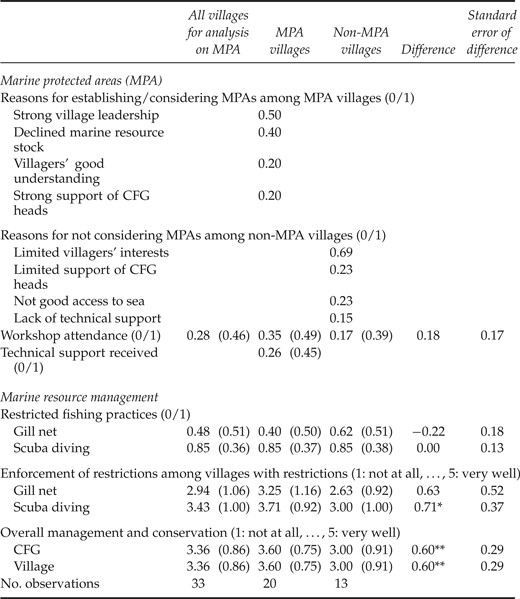
The village survey asked why the village was active about establishing MPAs among the MPA villages (up to three reasons among predefined ones), and why it was not active among non-MPA villages (up to three reasons among predefined ones) (see table 1). Although strong village leadership and declining marine resource stock were more common reasons for establishing MPAs among MPA villages than villagers' good understanding, villagers' limited interest was a dominant reason (about 70 per cent) for not considering MPAs among non-MPA villages, which reflects the non-MPA villages' consensual decision-making process.Footnote 7
Marine protected areas and marine resource management in Fiji

Notes: Standard deviations are shown in parentheses. CFG, customary fishing ground. *10% significance; **5% significance; ***1% significance.
Villages employed various resource-management practices, such as bans on Sunday fishing and poison fishing and restrictions on gill nets and scuba diving, although there is no significant difference in these regulations between MPA and non-MPA villages. Although many of these regulations are set at the CFG level, some of them are employed by individual villages. According to respondents' subjective assessments using a five-point scale measure for enforcement of the regulations (1: not at all; 2: a little; 3: somewhat; 4: well; 5: very well), compliance with gill-net restrictions was lower than that with other regulations, and compliance (for scuba diving, in particular) in MPA villages was higher than that in non-MPA villages. Overall, about three-quarters of villages valued overall management/conservation – at both the CFG and village levels – somewhat or well, and about one-quarter of villages valued it a little (according to respondents' subjective assessments using the same five-point scale measure above); overall management/conservation was better in MPA villages than in non-MPA villages, indicating their positive correlation with involvement in MPAs as a new conservation instrument.
3.3. Household support for MPAs
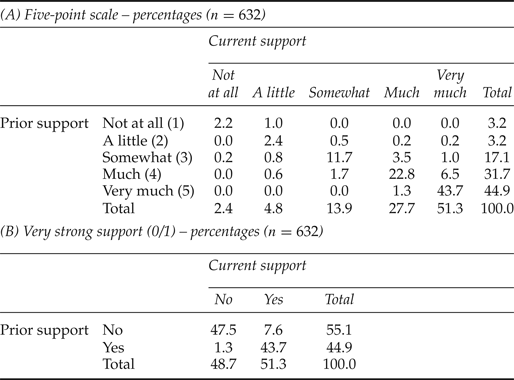
The household-level analysis is based on 632 households in the 33 villages that participated in fishing in the past one year at the time of interviews in 2005. The household survey asked how strongly the household supported MPA at the time of interviews in 2005, using the five-point scale measure (1: not at all; 2: a little; 3: somewhat; 4: much; 5: very much); then the survey asked the level of its support one year before, using the former measure as an anchor to facilitate retrospection (measurement errors in the latter measure are discussed later).Footnote 8 The latter measure (henceforth prior support for MPA) corresponds to the timing when many MPA villages established or started to consider MPAs, thus capturing villagers' support for MPAs that presumably shaped their collective decision; in contrast, the former measure (henceforth current support for MPA) could be altered by the collective decision.
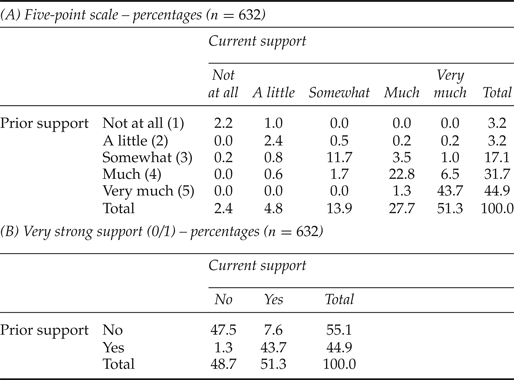
The results are shown in panel A of table 2. Over three-quarters of households show strong or very strong prior support for MPAs. Current support becomes stronger than prior support: over a half of households show very strong support; in particular, although the degree of support does not change among 83 per cent of households, over 12 per cent augment their support and less than 5 per cent decrease theirs. Qualitatively, the same results hold regarding whether or not the household supports MPAs very much (panel B). These results provide correlative evidence that the village's collective decision for MPAs positively alters current household support for MPAs.
Household support for marine protected areas
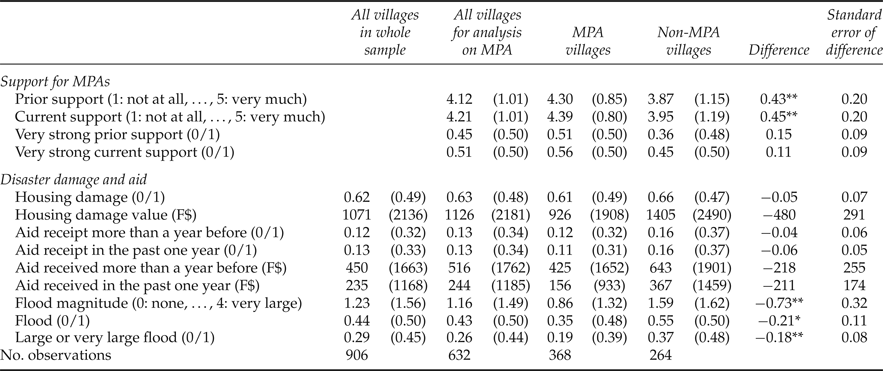
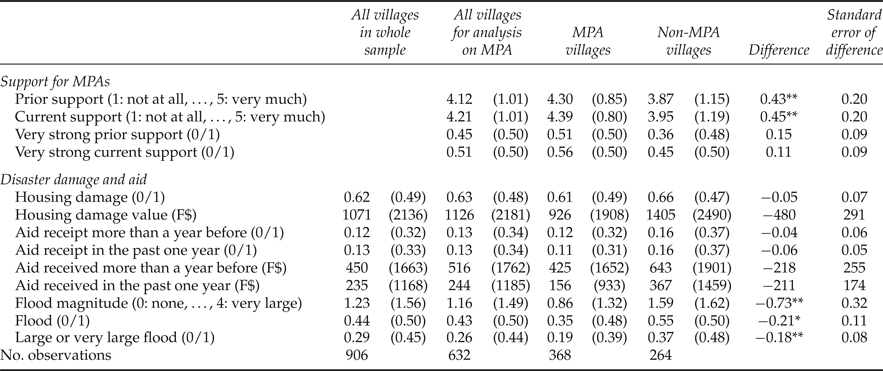
Both prior and current support are stronger in MPA villages than in non-MPA villages; the difference in very strong prior support between them is statistically significant at a 12 per cent significance level (see table 3, where the standard errors of differences are clustered by village). Thus, consistent with consensual decision making, the stronger villagers' prior support for MPAs, the stronger is the community's involvement in MPAs.
Marine protected areas and disaster
Notes: Standard deviations are shown in parentheses. Standard errors of differences are clustered by village. *10% significance; **5% significance; ***1% significance.
3.4. Disaster
On 13 January 2003, Cyclone Ami swept over the northern and eastern regions of the country, including the whole province of Cakaudrove (Ami was the only cyclone in the northern region from 1991 through 2005). All 43 villages in the sample were damaged. The cyclone caused no casualties, and permanent migration was virtually non-existent in its aftermath. According to respondents' subjective assessments, over 60 per cent of residents' dwellings – a main house and/or free-standing units, such as the kitchen, shower and toilet (not all households have such units, as these facilities are often located inside the main house) – were damaged, and the mean value of total housing damage was about F$1,100 (table 3).Footnote 9
The provision of emergency relief was followed by housing reconstruction programs. About one-quarter of households received construction materials, and the mean amount received was about F$700; although almost the same proportions of households received aid more than a year before the interviews in 2005 and in the past one year, the average amount received in the former period was larger than that in the latter period. Although there was at least one disaster victim (with housing damage) in each village, a few villages had no recipients of housing aid. Although almost all aid recipients were disaster victims (i.e., virtually no leakage), about 40 per cent of victims were recipients (i.e., large under-coverage), and aid was strongly targeted on the severity of the damage (Takasaki, Reference Takasaki2011a). These descriptive statistics of damage/aid are very similar to those in the whole sample of 43 villages.
3.5. Disaster, fishing and MPAs
Fijian households intensify fishing to help disaster victims within kin groups (especially tokatoka, the smallest unit), as shown in Takasaki (Reference Takasaki2011b). That previous work captures fishing within a year after the 2003 cyclone based on the household survey conducted in 2003 in nine coastal villages, seven of which are part of the 43 villages covered in the 2005 survey. Among these nine villages, two non-overlapped villages and one overlapped village had established MPAs before the cyclone; four other overlapped villages are MPA villages, and the remaining two are non-MPA villages. Thus, local marine resources served as safety nets, especially in villages with strong involvement in MPAs.
My conjecture is that the formation of MPAs following the cyclone among the 33 coastal villages in the sample was driven by a motive for better managing local resources for future safety nets. In particular, this insurance motive was augmented by villagers' materializing the insurance role of fishing in 2003, which coincided with the LMMA initiatives. Note that prior support for MPAs is (retrospectively) measured in 2004, more than one year after the 2003 cyclone. Then, we would expect to see a positive correlation between disaster victimization and MPA formation. The difference in household-level housing damage/aid between MPA and non-MPA villages, however, indicates their negative correlations, although no difference is statistically significant at conventional levels (table 3; flood measures also reported in the table are discussed later). The village means of the household-level damage measures – proportion of households with housing damaged and mean damage value – are not significantly different between MPA and non-MPA villages, either; when a dummy for MPA villages is regressed on those village-level damage variables without or with other controls, such as population size and market access (n = 33), none of their estimated coefficients is statistically significant (results not shown).
These analyses – along the same line as extant community-level studies on community-based resource management – do not reveal causality, because they do not control for village heterogeneity in factors determining the village's collective decision and vulnerability to disasters, which can be correlated with each other, as shown below. The remaining analyses focus on identifying the impacts of household cyclone damage on its support for MPAs.
4. Empirical analysis
4.1. A naïve ordered model with exogenous housing damage
With a five-point scale measure of household support for MPAs, I start with the following ordered probit specification:
 $$y_1^{\ast} =\alpha _1 +\beta _1 y_2 + {\bi \delta}_1 {\bi x}+{\bi V}+u_1\comma \;$$
where y*1 is the latent indicator of household prior support for MPAs; y 2 is the 0–1 indicator for household housing damage; x is a vector of exogenous household controls (defined below); V is a vector of village dummies; and u 1 is an error term that is assumed to be normally distributed. I consider disaster aid as an additional determinant in the next section. Village dummies fully control for village-level factors affecting household support for MPAs, such as marine resource stock, local regulations/governance/leadership, and LMMA interventions, as well as village-level covariate disaster shocks and aid supply. If a household's exposure to the disaster increases its prior support for MPAs, presumably through the insurance motive for future safety nets, β1 > 0.
Social learning from disaster experience among community members suggests that the collective decision in MPA villages (i.e., establishing MPAs) increases non-victims' support for MPAs. This relationship cannot be tested in my empirical framework focusing on across-households variations within villages (the collective decision is controlled for by village dummies).Footnote 10 A related conjecture is that, if the collective decision increases non-victims' support, strong support for MPAs becomes more prevalent over time (as found in the descriptive analysis above). A simple way to test this conjecture is to estimate equation (1) for current support for MPAs: with augmented support among non-victims, the damage effect on current support should be smaller than that on prior support. Note that this pattern is not necessarily driven by the collective decision, because it can be caused by unobserved factors associated with MPAs. At best, this is an indirect test for potential social learning.
The identification assumption in equation (1) that household-level housing damage is uncorrelated with unobserved household heterogeneity determining its support for MPAs, such as a preference for conservation, may not hold, as follows. With village-level covariate shocks controlled for, whether or not housing is damaged in the village depends on its unobserved quality prior to the disaster, in particular, its durability against cyclone shocks, which is a function of cumulative investments in housing that the household had made, as well as its location in the village. If housing quality is positively (negatively) correlated with say, preference for conservation, i.e., households with housing less (more) vulnerable to cyclones tend to support MPA more (less), then the estimated damage effect will be biased downward (upward).
4.2. Ordered model with endogenous housing damage
My empirical strategy is two-fold. First, since housing location is fixed with mataqali (a village subgroup owing land), it is effectively captured by mataqali fixed effects. Secondly, I endogenize household housing damage by using flood shock as an excluded identifying variable. The household survey asked about the magnitude of flood, not damage caused by the flood, that the household experienced on its land based on a five-point scale (0: none; 1: small; 2: some; 3: large; 4: very large) (measurement errors in this self-reported measure are discussed later); over 40 per cent of households in the sample had experienced a flood, with over one-quarter experiencing a large or very large one (table 3), and at least one household in each village had flood experience. The identification assumption is that household flood shock affects housing damage within mataqali and is uncorrelated with unobserved heterogeneity among households regarding support for conservation. In particular, household housing investments correlated with the household's vulnerability to floods within mataqali, if any, are assumed to be uncorrelated with unobserved household heterogeneity regarding conservation.
If flood shock augments housing damage, and the damage effect on household support for MPAs is positive, flood shock should increase the support. The descriptive statistics show mixed evidence: floods are more common and larger in magnitude among disaster victims (with housing damage) than among non-victims, as confirmed in the regression analyses below, but they are also more common and larger in non-MPA villages than in MPA villages (table 3). Without controlling for land conditions determining vulnerability to flood, however, the latter result is unlikely to reflect the true effect of floods; in particular, flood vulnerability may be negatively correlated with community-level determining factors for MPA formation, such as leadership, resource stock and interventions (the present data do not allow me to show what factors are correlated). Indeed, once land conditions are controlled for by mataqali fixed effects, flood shock does strongly increase household support for MPAs, as shown in the reduced-form analysis below.
The two-equation system is
 $$y_1^{\ast} = \alpha_1 + \beta_1 y_2 + {\bi \delta}_1{\bi x}+{\bi G}+u_1\comma \;$$
 $$y_2^{\ast} = \alpha_2 +\gamma_2 w + {\bi \delta}_2 {\bi x} + {\bi G} + u_2\comma \;$$
where y*2 is the latent indicator of y 2; w is flood shock; G is a vector of mataqali dummies; and u 1 and u 2 are error terms that are assumed to follow a bivariate normal distribution. This two-equation system, which is a non-linear analog of the standard linear model discussed in the next section, can be jointly estimated by a maximum likelihood estimator.Footnote 11 The corresponding reduced-form equation is
 $$y_1^{\ast} =\alpha _1 +\gamma _1 w+ {\bi \delta}_1 {\bi x}+{\bi G} + u_1.$$
If β1 is positive and statistically significant in the two-equation system maximum likelihood estimate, γ1 should be positive and significant in the ordered probit estimate of equation (4).
4.3. Controls
I consider two sets of household controls: the first set includes social status (kin leader), education (secondary education of any adults), and demographics (household size, the proportion of children/elderly, age of household head); the second set adds asset holdings (fishing capital and land holdings) to the first set. Asset holdings capture wealth (stock measure); along with education and demographic factors, asset holdings also determine household permanent income (flow measure). Social status and adult education are fixed effects, and demographic factors a year before and at the time of interviews, respectively, are used for prior and current support; current asset holdings are used for both, although distinct from land holdings, fishing capital may change significantly over the course of a year (information about fishing capital, as well as earned income, a year ago is lacking). Fishing capital can be endogenous, because it is correlated with unobserved household skills and preference for fishing, which determine its support for MPAs; MPAs may also influence household investment in capital. With the lack of a valid identifying variable for fishing capital, I estimate models without and with asset holdings to see the extent to which the remaining estimation results are different.
4.4. Estimation results
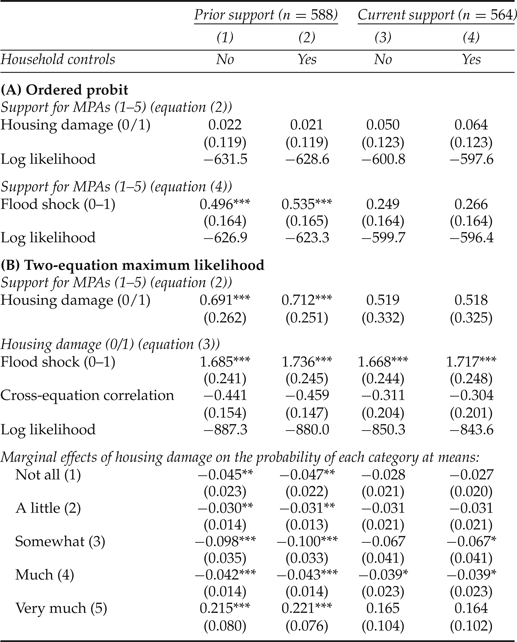
The estimated damage effects are reported in table 4 (results of household controls are discussed in the next section). Mataqali with no variation in support for MPAs across households are dropped, because mataqali dummies perfectly predict the support. The ordered probit estimates of equation (2) – either without or with household controls – show that housing damage has no significant effects on prior or current support for MPAs (panel A). (The results are very similar to each other without and with asset holdings as controls, and only the former results are shown; the ordered probit estimates of equation (1) with village dummies are also very similar.) In contrast, the two-equation maximum likelihood estimates show that the estimated coefficients of housing damage are positive at a 1 per cent significance level for prior support, but not current support, across specificationsFootnote 12 ; flood shock – on a normalized five-point scale with 1 = very large flood – strongly determines housing damage in equation (3) (panel B), and the ordered probit reduced-form results of equation (4) consistently show that flood shock significantly increases prior support, but not current support (panel A). Estimated marginal effects of housing damage on the probability of showing prior support at the means are positive only for very strong support (5th category) (the point estimates are about 0.22) (recall that about 45 per cent of households show very strong prior support, table 2), and its negative marginal effects on the other four categories are relatively similar to each other.Footnote 13 These results indicate that housing damage increases and decreases the probability of showing and not showing very strong support, respectively, by about 0.22. Note the difference in the meaning of the estimated marginal effects on the ordered categories from that on the dummy outcome in the standard linear probability model discussed in the next section. The results for current support are qualitatively the same, with very limited statistical significance at conventional levels.
Damage effects on household support for marine protected areas

Notes: Standard errors are shown in parentheses. Household controls are kin leader (0/1), adult secondary education (0/1), household size (0/1), proportion of children (age 0–14), and proportion of elderly (age 66 or above). Other controls not shown here are mataqali dummies and constant. *10% significance; **5% significance; ***1% significance.
Housing damage is thus endogenous in equation (2); that assuming its exogeneity leads to downward bias in its estimated effects suggests a significant positive correlation of unobserved housing quality and household heterogeneity. The non-significant effects on the dummy for MPA villages of village-level housing damage (constructed from household-level damage measures) in the village-level regressions discussed above are consistent with the ordered probit results and also biased for the same reason; the descriptive results in table 3 do not reflect causality, either.
Housing damage mostly affects whether or not the household shows very strong prior support. Consistent with social learning from disaster experience, this damage effect diminishes following the collective decision made for MPAs.
5. Robustness check
5.1. Linear probability model
As housing damage influences the 1st–4th categories of household support for MPAs in a similar way, we can focus on the binary information about very strong support (5th category), employing the following linear probability model:
 $$y_1 =\alpha _1 + \beta _1 y_2 + {\bi \delta}_1 {\bi x} + {\bi G} + u_1\comma \;$$
 $$y_2 = \alpha _2 + \beta _2 w + {\bi \delta}_2 {\bi x} + {\bi G} + u_2\comma \;$$
where y 1 is redefined as an observed 0–1 indicator for very strong household prior (or current) support (with the remaining four categories as a base). The endogeneity of housing damage y 2 is controlled for by estimating equation (5) using a two-stage least squares (2SLS) estimator with the first-stage equation (6), where w is an excluded instrumental variable (IV) (flood shock). Distinct from the ordered model above, distributional assumptions for error terms are not made.
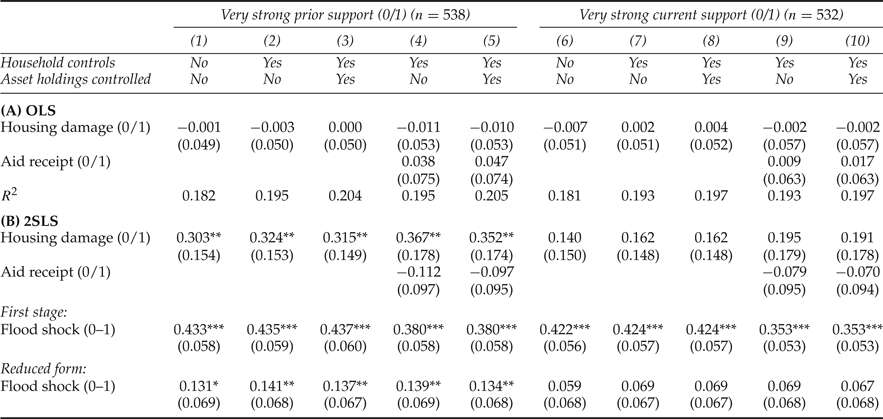
OLS and 2SLS estimation results, respectively, reported in table 5 (robust standard errors are shown) are qualitatively the same as the corresponding ordered probit and two-equation system maximum likelihood results in table 4, suggesting that the latter results are not conditional on the specification assumptions (e.g., normality, homoscedasticity). Specifically, although OLS estimates of the damage effects are not statistically different from zero (panel A), the 2SLS estimates for prior support are over 0.30 at a 5 per cent significance level, and those for current support are positive but much smaller with no statistical significance (panel B). That is, housing damage increases the probability that the household that does not show very strong prior support changes its prior support to a very strong one, by over 0.30, which is comparable to the two-equation maximum likelihood estimates discussed above. The first-stage results are strong – a very large flood augments the probability that housing is damaged by over 0.40 (the F-value of this IV is over 50). In the corresponding reduced-form models (equation (5) with y 2 replaced with w), the results for prior support, but not current support, are statistically significant – a very large flood increases the probability that the household supports MPAs very much, by 0.13.
Damage effects on very strong household support for marine protected areas

Notes: Robust standard errors are shown in parentheses. Household controls are the same as those in table 4. Asset holdings are log of fishing capital (F$) and log of land (m2). Other controls not shown here are mataqali dummies and constant. *10% significance; **5% significance; ***1% significance.
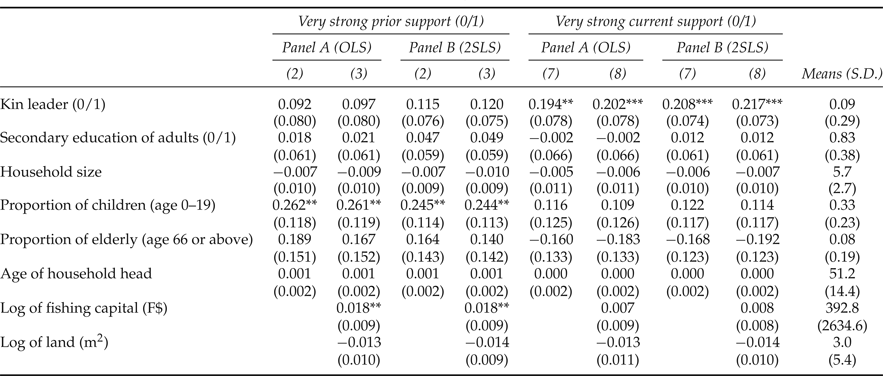
Estimated coefficients of household controls are reported in table 6, along with their descriptive statistics. The results are very similar between OLS and 2SLS estimates, buttressing the exogeneity of these controls; when asset holdings are included as additional controls, none of the remaining results changes significantly, suggesting that the potential endogeneity of fishing capital is not a major concern for identifying the damage effects (interpreting estimated coefficients of fishing capital requires caution, though).
Controls unreported in table 5

Notes: Panels and columns match those in table 5. Robust standard errors are shown in parentheses below estimated coefficients. The last column shows means at the time of interviews; means of fishing capital (F$) and land (acres) are shown; standard deviations are in parentheses below means. *10% significance, **5% significance, ***1% significance.
The following results are consistent with social learning. First, households with more children are more likely to show very strong prior support for MPAs, suggesting that parents prefer to protect marine resources for their children. Along with the diminished damage effect over time, this pattern becomes weaker for current support, suggesting that having a long-term perspective becomes more prevalent among households regardless of their demographic composition. Secondly, in contrast, kin leaders tend to show very strong current support, but not prior support, suggesting that although they are initially neutral about MPAs, they adjust their support to the collective decision. Although this does not tell us anything about their leadership, it is consistent with potential social learning among local leaders, which could lead to more establishment and better management of MPAs in the future.
The remainder of this section checks the robustness of the 2SLS estimates of damage effects to measurement errors, alternative damage measures and omitted disaster aid.
5.2. Measurement errors
Errors in retrospectively measured household prior support for MPAs can be significant, and if they are correlated with housing damage, the OLS estimates of equation (5) are biased; in contrast, the 2SLS estimates are unbiased if such errors are uncorrelated with the excluded IV. Measurement errors in the self-reported flood magnitude in the five-point scale, however, can be significant and may be correlated with those in prior support for MPAs.Footnote 14 My data do not contain a second IV, precluding me from conducting the overidentification test for the validity of IVs.Footnote 15
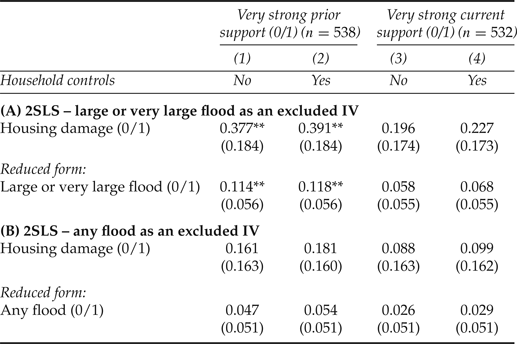
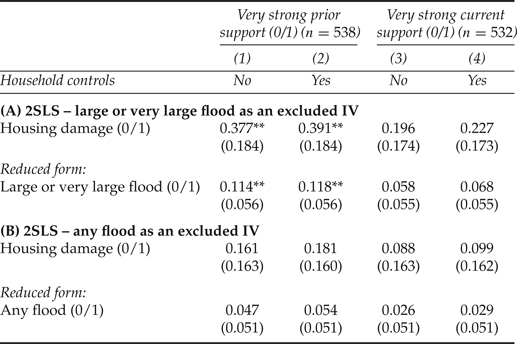
My strategy for the robustness check is to use a dummy for large or very large flood and a dummy for flood with any magnitude separately as an alternative IV. The corresponding 2SLS estimates should be more robust to systematic measurement errors than the original ones, especially because errors caused by misreporting a very large flood as a large one, and vice versa, are irrelevant (although those associated with the misreporting of some-vs.-large flood in the dummy for large or very large flood may be significant). Estimation results are reported in table 7 (those without asset holdings as controls are shown). On the one hand, with the dummy for large or very large flood as an IV, the estimated damage effects – on both prior and current support – are very similar to the original ones (the reduced-form results are also very similar); on the other hand, those for the dummy for any flood are much smaller than the original ones, with no statistical significance at conventional levels. Hence, consistent with the original results, household experience of a large or very large flood shock mainly influences its prior support for MPAs.
Damage effects on very strong household support for marine protected areas: flood dummy measures
Notes: Robust standard errors are shown in parentheses. Household controls are the same as those in table 4. Other controls not shown here are mataqali dummies and constant. *10% significance; **5% significance; ***1% significance.
5.3. Damage magnitude
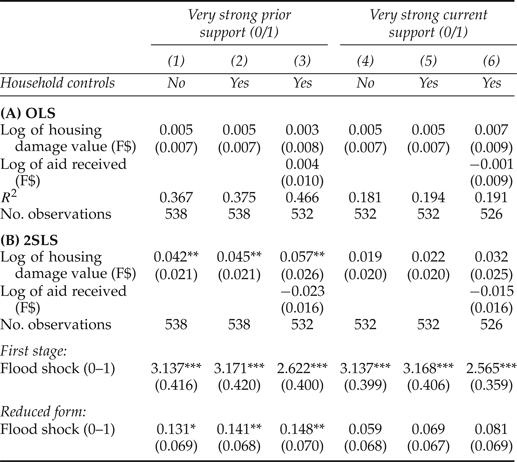
The analyses so far have focused on the incidence of housing damage, ignoring its magnitude. I estimate the damage effect at the margin by redefining y 2 in equations (5) and (6) as housing damage value (log).Footnote 16 Estimation results reported in table 8 are qualitatively the same as those for the damage dummy in table 5 (the results without asset holdings as controls are shown). (The results using the dummy for large or very large flood as an excluded IV are qualitatively the same.) On the one hand, OLS estimates are statistically non-significant across specifications (panel A). On the other hand, according to the 2SLS estimates, a 10 per cent increase in damage value augments the probability that the household shows very strong prior support for MPAs by about 0.005 at a 5 per cent significance level; the estimated coefficients of damage value for current support are smaller, with no statistical significance at conventional levels (panel B).Footnote 17
Effects of damage value on very strong household support for marine protected areas

Notes: Robust standard errors are shown in parentheses. Household controls are the same as those in table 4. Other controls not shown here are mataqali dummies and constant. *10% significance; **5% significance; ***1% significance.
5.4. Disaster aid
So far, disaster aid has not been considered as a potential determinant of household support for MPAs. As housing aid is positively correlated with housing damage (targeting), whether this omitted variable causes bias in the estimated damage effects depends on whether it influences household support. With a lack of valid instruments for housing aid, I estimate models with housing aid as an additional exogenous control to see whether the remaining estimation results change significantly. Adding the dummy for aid receipt – more than a year before the interviews in 2005 for prior support and by the time of interviews for current support – to the models with the damage dummy does not significantly alter the remaining results (columns 4, 5, 9 and 10 of table 5), nor does adding the log amount of corresponding aid received to the models with the damage value significantly change the remaining results (columns 3 and 6 of table 8); and, both aid receipt and amount are statistically non-significant across specifications. (The results using the dummy for large or very large flood as an excluded IV are similar.) Hence, the potential bias caused by omitted disaster aid in the early analyses is unlikely to be significant.
6. Conclusion
Using original household survey data in Fiji on the establishment of community-based MPAs following a tropical cyclone, this paper examined whether and how experiencing climate-related disasters can improve the rural poor's adaptation to climate change through community-based resource management. Controlling for the endogeneity of household-level cyclone damage, as well as community heterogeneity, the analysis revealed that a household's exposure to the disaster increased its support for establishing MPAs, presumably for future safety nets. Evidence suggested that community members' social learning from disaster experience might facilitate their consensual decision making.
Through its inclusionary mechanisms, community-based resource management appears to have the potential to facilitate community adaptation to climate change (as discussed by Tompkins and Adger, Reference Tompkins and Adger2004). In Fiji, the disaster played a triggering role for local systemic improvement, together with external (government/NGO) efforts to promote MPAs integrated with consensual customary resource institutions. Thus, to foster the rural poor's capacities for endogenous institutional change to enhance community resilience to climate shocks (McSweeney and Coomes, Reference McSweeney and Coomes2011), policy interventions can, in principle, complement local institutional mechanisms underlying collective actions, such as those for social learning. Which interventions will be effective depends on the specific institutions and contexts. More research is needed on the potential of community-based resource management for climate adaptation across various locales.
Rich community-level data are needed to conduct community-level analyses on how disasters influence local conservation and to examine which channels underlie collective actions for conservation, as discussed in the introduction; such analyses can complement the paper's household-level analysis on the consensus/social learning channel. That treating disaster victimization exogenously failed to reveal the potential of MPAs for climate adaptation in Fiji exemplifies the critical importance of identifying causality in the disaster–conservation nexus, at both the household and community levels.