INTRODUCTION
It is difficult to overlook how dramatically the world has changed since 2008: the global financial crisis, the rise of populist movements around the globe, and most recently the COVID-19 pandemic. This confluence of events has opened up a significant debate on the prevalence of, and prospects for, a diminution in the interdependence between nations and rising de-globalization (Witt, Reference Witt2019). Although the effects of de-globalization on societies have begun to be studied in the economics and sociology literature (see for example, Hillebrand, Reference Hillebrand2010 or van Bergeijk, Reference van Bergeijk2017), the international business literature has yet to empirically investigate how this evolving phenomenon is affecting organizations in general, and MNCs in particular. Hence, in this contribution, we explore whether, and under which circumstances, de-globalization affects the performance of MNCs. Drawing on ideas from event system theory (Morgeson, Mitchell, & Liu, Reference Morgeson, Mitchell and Liu2015) and institutional theory (Scott, Reference Scott, Scott and Christensen1995), in particular institutional fit (Drazin & Van de Ven, Reference Drazin and Van de Ven1985), we propose and test a model explicating key dimensions of the relationship between environmental context, de-globalization, and MNC performance. More precisely, we reason that multiple domain aspects of context vested in institutional, cultural, and organizational specific endowments moderate the relationship between de-globalization and MNC performance.
In what follows we outline the building blocks of our model. We then explain our measures and describe the data that we have curated and assembled from several different sources. The performance of 283 MNCs from four continents and 20 nations form the core of our empirical test. In conducting our analysis, we engage in multi-level modeling to examine the relationship between de-globalization and performance, and we test the moderating effect of different national and organizational level contextual features on this relationship. Finally, we discuss our results and highlight implications and limitations.
CONCEPTUAL BACKGROUND
The De-Globalization System Shift and MNC Performance
Globalization served to increase market potential, trade, and investment prospects, and the overall resource accessibility of organizations (Czuchry & Yasin, Reference Czuchry and Yasin2001; Hitt, Keats, & DeMarie, Reference Hitt, Keats and DeMarie1998). The presence of fewer trade and investment barriers facilitated organizations in the outsourcing of production to different locations and in the achieving of arbitrage arising from the benefits of location advantage (Chimerine, Reference Chimerine1997; Czuchry & Yasin, Reference Czuchry and Yasin2001; Kogut, Reference Kogut, Aliber and Click1993). Given that de-globalization reduces market potential and increases trade and investment barriers (Bello, Reference Bello2002), it may be inferred that environmental and system shifts away from globalization in favor of de-globalization are likely to curtail MNC performance. In modelling the adverse impact of de-globalization on MNC performance and the potential ameliorating effects of key contextual endowments on this relationship, we draw upon ideas from event system theory (EST) (Morgeson, Mitchell, & Liu, Reference Morgeson, Mitchell and Liu2015). Our proposed conceptual model is presented in Figure 1.
Conceptual model

EST focuses on how events have an impact on organizations. One of the prototypical effects of events on entities refers to a top-down direct effect whereby the environmental systems event subsequently impacts entities operating within that system. In other words, major environmental events can produce change in heretofore stable organization-level behavior. For the purposes of the analysis that we offer here, we reason that de-globalization as an environment event produces top-down effects on organizations as entities operating on the global business landscape.
The Impact of Contextual Endowments
Although, based on EST theory, we assume that de-globalization as an environmental level event will in turn affect organization-level performance, we also expect that this relationship may be contingent on both the degree to which the environment and the organization handle uncertainty, along with the capacities and human capital endowments contained in the system. In other words, not all environments will be impacted in exactly the same manner because aspects of the prevailing environmental context may ameliorate some of the negative effects arising from the systems event shift. Our expectation in this regard is based on arguments by Allen and Raynor (Reference Allen and Raynor2004), who identify two main risks that are brought about by de-globalization, namely uncertainty in the business environment and workforce shortages. Uncertainty encompasses customer, supplier, technological, product, and competition uncertainty (Aragón-Correa & Sharma, Reference Aragón-Correa and Sharma2003). It requires a continuous rethinking of current strategic actions, structures, communication systems, corporate cultures, and asset deployments. Regarding workforce shortages, arguably de-globalization can result in talent shortages, especially in countries in which there is a particular reliance on migrants to fill positions (Chen, Reference Chen2009). Thus, the mitigation of risk and uncertainty, together with the ensuring of a talent pipeline appropriate to the prevailing labor market situation, can potentially lessen the deleterious effect of de-globalization on MNC performance.
In the following section, we explore key contextual variations at the national and organizational level that serve as system endowments which can be drawn upon to lessen the impact of de-globalization. Specifically, at the national level, we focus on institutional and cultural endowments, and at the organizational level, we isolate the capacity for innovation as a key resource. These factors, in combination, help to explicate variations in the perceived degree of uncertainty experienced at the national level, along with variations in the capacity of the workforce to respond to, and deal with, de-globalization as an environmental systems event shift.
National level
From an institutional perspective, organizations need to adapt their practices to the environment in order to gain legitimacy (Marquis & Raynard, Reference Marquis and Raynard2015) because organizations that fit with their environment or national system, and are accepted as such, are more likely to be sustainable than those that do not (Morley, Murphy, Cleveland, Heraty, & McCarthy, Reference Morley, Murphy, Cleveland, Heraty and McCarthy2021). Beyond institutions and institutional fit, Deephouse (Reference Deephouse1999) argues that elements of the ‘general environment’, such as sociocultural, technological, and economic trends, serve to enable or constrain organizations and their practices.
Regarding the effects of de-globalization, in particular the environmental uncertainty generated, scholars have argued that using innovative strategies can lead to better coping on the part of the entity interacting with its uncertain environments. Innovative entities may possess the capacity to identify and adopt new products and processes, which serve as a valuable endowment in minimizing the effects of uncertainty (Russell & Russell, Reference Russell and Russell1992). At the national level, innovation is the ability of a country to produce and commercialize new ideas, and differences in national levels of innovation appear to arise from, among other things, variations in both economic geography and cross-country differences in innovation policy. Thus, we can expect that the extent of the national level of innovation will reduce the risk of uncertainty in the environment associated with de-globalization, thus moderating the effect of de-globalization on MNC performance.
As previously mentioned, an additional mechanism that allows organizations to cope with uncertainty is flexibility. Institutional flexibility refers to the country-specific room for maneuver regarding institutions and practices. Thus, countries with high institutional flexibility have fewer legislative restrictions.
Finally, national workforce capacity represents a significant human capital endowment that may affect the relationship between de-globalization and performance. Human capital is ‘the skills and capacities that reside in people and that are put to productive use’ (World Economic Forum, 2016: 1) and is considered critical to innovation. Therefore, we can expect that high country human capital endowments may, in part at least, ameliorate some of the negative effects of de-globalization on performance.
In parallel with the institutional environment, the cultural context can also potentially affect the relationship between de-globalization and performance. Within the cultural context, the dimension of uncertainty avoidance defined as the degree to which a society refers to rules and formal procedures to bypass any future ambiguities (House, Hanges, Javidan, Dorfman, & Gupta, Reference House, Hanges, Javidan, Dorfman and Gupta2004) relates to formal standards and regulations. Thus, countries high in uncertainty avoidance rely more on formally structured and standardized rules and procedures around their managerial practices (Peretz & Fried, Reference Peretz and Fried2012). Low uncertainty avoidance societies are characterized as less calculating when taking risks, show low to moderate resistance to change, along with an increased proclivity for innovation. Therefore, we reason that the effects of de-globalization on performance may be lessened in societies in which low uncertainty avoidance features as a core dimension of the cultural repertoire.
Organizational level
A primary organizational level endowment that may moderate the effect of de-globalization on performance refers to the rate of innovation at the organizational level. Li, Mitchell, and Boyle (Reference Li, Mitchell and Boyle2016) highlight that innovation is a critical organizational capability linked to sustained competitive advantage, while Oke, Walumbwa, and Myers (Reference Oke, Walumbwa and Myers2012) found that environmental uncertainty moderates the relationship between organization innovation and performance. Thus, organizational innovation is a key element of an organization's armory in the handling of environmental uncertainty, and we can expect that in organizations with higher innovation levels the negative effects of de-globalization on performance may be lessened.
METHODS
Sample
Based on Forbes Global list which ranks the world's 2,000 largest publicly traded companies, we sampled companies located in 20 countries from four different continents. The Forbes list takes into account a range of factors, including the revenue, net profit, total assets, and market value of each company. Each factor is given a weighted rank in terms of importance when considering the overall ranking (Forbes, 2018). The criterion for selecting countries for our study centered on (a) representing maximum variation in relation to de-globalization and contextual endowments; and (b) the availability of data on a range of relevant cultural and institutional variables (see below). In each country we filtered the data based on industry representativeness, along with the availability of R&D intensity data which was central to our enquiry (see below). Our final sample comprises 283 MNCs distributed throughout the following countries: Australia (8), Brazil (7), Canada (11), China (20), Germany (20), Hong Kong (12), France (20), India (13), Ireland (8), Italy (7), Israel (8), Japan (20), South Korea (20), Netherlands (13), Spain (8), Sweden (15), Switzerland (15), Taiwan (18), UK (20), and the USA (20). To avoid giving disproportionate weight to countries with larger sample sizes and to overcome the potential of unrepresentativeness' sample bias, we followed Martin, Cullen, Johnson, and Parboteeah (Reference Martin, Cullen, Johnson and Parboteeah2007) and, in advance of conducting our analysis, we counterweighted the indicators by sample size, hence giving equal weighting to the various countries included (Lavallée & Beaumont, Reference Lavallée and Beaumont2015).
Measures
National-level measures
De-globalization was measured using an index consisting of three country-level indicators: trade to GDP ratio, foreign direct investment, and restrictions on the employment of foreign nationals. Data for each were obtained twice, namely 2014 and 2016.
(1) Trade to GDP ratio: It was calculated by dividing the aggregate value of imports and exports over a period by the gross domestic product for the same period. Although called a ratio, it is usually expressed as a percentage. It is used as a measure of the openness of a country to international trade and can be seen as an indicator of the degree of globalization of an economy (Babones, Reference Babones and Ritzer2007). Data for this variable were taken from the World Bank database (The World Bank, 2017). The average score for 2014 was 33.10 (S.D. = 21.84) and for 2016 was 31.49 (S.D. = 20.62). We then calculated the deviation of 2016 scores from 2014 scores. The final measure of the trade to GDP ratio capturing the differences between 2016 and 2014 is expressed as a percentage (Mean= -8.17%; S.D. = 4.17).
(2) Foreign direct investment (FDI): There is widespread agreement in the literature that an important characteristic of contemporary globalization is the level of economic integration internationally. One such component of that integration is FDI (Babones, Reference Babones and Ritzer2007). Following Witt (Reference Witt2019), we used the inward FDI index. Inward FDI represents foreign capital that comes into the domestic economy. Inward investment stands in contrast to outward investment, which is an outflow of investment capital from local entities to foreign economies. Data for this variable were taken from the World Bank database (The World Bank, 2017). The average score for 2014 was 0.18 (S.D. = 0.13) and for 2016 was 0.13 (S.D. = 0.11). The difference between 2016 scores and 2014 scores expressed in percentage terms was -5.51 (S.D. = 3.76).
(3) Restrictions on the employment of foreign nationals: This indicator is part of the FDI regulatory restrictiveness index which gauges the restrictiveness of a country's foreign investment rules. The term ‘employment of foreign nationals’ refers to the rights of those without permanent residence status to engage in work within a specific country in accordance with its laws. Data for this variable was taken from the OECD database (OECD, 2017). The average score for 2014 was 3.19 (S.D. = 3.37) and for 2016 was 1.59 (S.D. = 1.35). The percentage difference between the scores for 2016 and 2014 was 9.78 (S.D. = 4.56).
Confirmatory factor analyses (CFAs) indicated that a one-factor model (a single de-globalization index consisting of the above three dimensions) fit the data well (NFI = 0.96, RMSEA = 0.04, GFI = 0.95) and significantly better than alternative models (for example, NFI = 0.86, RMSEA = 0.08, GFI = 0.84 for the model in which each indicator loaded on a separate factor).
Country innovation. This was measured using the 2016 Global Innovation index (GII), an annual index comparing countries by their capacity for, and success in, innovation (see Matthews & Brueggemann, Reference Matthews and Brueggemann2015). (Mean = 21.93; S.D. = 20.16)
Human capital. This was measured using the World Economic Forum's Human Capital score (2016). The index assesses ‘the degree to which countries have optimized their human capital for the benefit of their economies and of individuals’ themselves’ and covers 46 indicators (such as a country's illiteracy rate, labor force participation rate, and underemployment rate). (Mean = 76.74; S.D. = 7.71)
Institutional flexibility. This was measured using three indicators from the Global Competitiveness Report 2016 (World Economic Forum, 2016), namely: (1) lack of burdensome government regulation; (2) flexibility of wage determination; and (3) hiring and firing practices. Our utilization of these three indicators to measure Institutional Flexibility is in line with Rabl, Jayasinghe, Gerhart, and Kühlmann (Reference Rabl, Jayasinghe, Gerhart and Kühlmann2014). (Mean = 13.46; S.D. = 1.10)
Uncertainty avoidance. This was obtained from the GLOBE database (House et al., Reference House, Hanges, Javidan, Dorfman and Gupta2004). Items were measured on a scale ranging from 1 (low) to 7 (high) and reflects reported practices (‘as is’).
Organizational-level measures
MNC performance. This was measured as the increase in revenue of financial year 2016 compared to 2014 (in percentage terms) for each MNC. The mean of the revenue increase was 7.48% (S.D. = 12.57. Range= −53%–39%).
Organizational innovation. This was measured using the well-established objective indicator of R&D intensity (Adams, Bessant, & Phelps, Reference Adams, Bessant and Phelps2006). This measure was taken from the PWC dataset on Global Innovation 1000: Comparison of R&D Spending.
Controls. We controlled for both industry and organizational size. With respect to industry, 56.8% of respondents were in service industries, and 43.2% were in product industries. Regarding size, the number of employees ranged from 5,070–195,056. Because of the non-normal distribution of this variable, we ln transformed it (size_ln Mean = 9.87; S.D. = 1.15).
Analysis
Our data contained a hierarchical structure in which organizations were nested within countries. Therefore, using Mplus 8 (Muthén & Muthén, Reference Muthén and Muthén2018), we analyze the hypothesized relationships via multilevel maximum likelihood estimation modeling. Following Bauer and Curran's (Reference Bauer and Curran2005) recommendation, we grand mean centered our national-level variables (de-globalization, human capital, institutional flexibility, uncertainty avoidance, and country innovation), while we group centered our organizational-level variables (industry, size, performance, and organizational innovation). Such centering improves the calculation and interpretation of the main effects when cross-level interactions are tested, and generally yields more robust results in analyzing such interactions (Enders & Tofighi, Reference Enders and Tofighi2007).
Finally, although it is difficult to estimate precise effect sizes in cross-level models, we report Snijders and Bosker's (Reference Snijders and Bosker1999) overall pseudo R2 (~R2) and incremental pseudo R2 (Δ~R2) for these models; these estimates are based on proportional reduction of level 1 and level 2 errors of the predictors in the model (Recchia, Reference Recchia2010). Prior to testing the hypotheses, we examined potential multicollinearity issues using variance inflation factors (VIFs). The results of our multicollinearity analysis showed that the VIF values ranged from 1.04 to 2.96, indicating that multicollinearity is unlikely to be an issue in our study (Hair, Black, Babin, & Anderson, Reference Hair, Black, Babin and Anderson2010).
RESULTS
Means, standard deviations, and correlations among the variables are reported in Table 1.
Means, standard deviations, and correlations

Notes: N = 283. Country-level means assigned down to organizational level.
Model Estimation
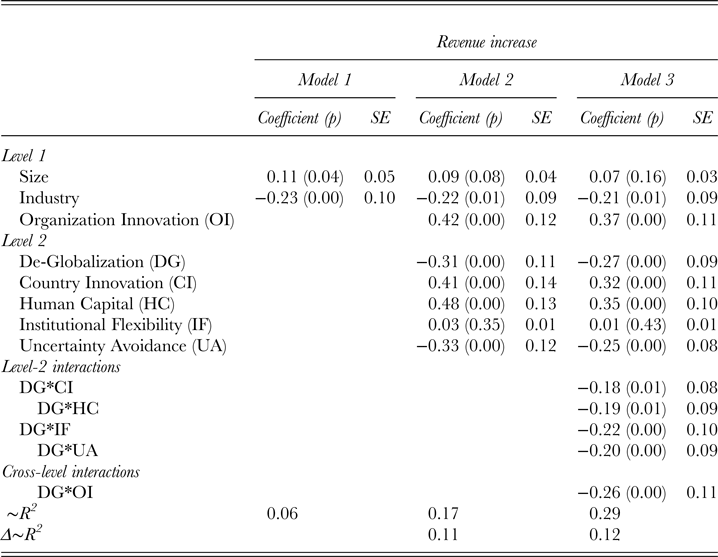
To estimate the conceptual model (see Figure 1), we conducted a three-step analysis, involving an incremental approach. We first estimated a model with control variables only, followed by a model that added main effects of de-globalization and the contextual variables. Finally, we added the interactions between de-globalization and all the contextual variables. Note that we rely on common multilevel analysis notations below, indicating the organizational level estimates using beta (β) coefficients and the cross-level estimates using gamma (γ) coefficients. The results are presented in Table 2.
Summary of the multi-level analysis

Notes: N = 283 organizations (level 1) in 20 countries (level 2). Pseudo R2 values (~R2) estimate the amount of total variance (both level 1 and level 2) in the dependent variable captured by predictors in the model. Model 1 includes controls only; Model 2 includes controls and main effects; Model 3 includes controls, main effects, and interactions
The results (see Table 2, model 2) indicate that de-globalization is negatively related to revenue increase (γ = −0.31, p = 0.00), so that the higher the level of de-globalization, the lower the increase in revenue. The total effect size (~R2) indicated that the contribution of the predictors' and covariates main effect to the variance of revenue was 0.17.
Adding moderating effects of contextual variables to the multilevel modeling (see Table 2, model 3) results in five significant interactions. At the organizational level, we found an interaction effect of organizational innovation (R&D intensity) on the random slope between de-globalization and MNCs performance (γ = −0.26, p = 0.00). Following Cohen, Cohen, West, and Aiken's (Reference Cohen, Cohen, West and Aiken2003) recommendations, this interaction was plotted at conditional values of the organizational innovation (1 S.D. above and below the means) (see Figure 2).
The moderating effect of organizational innovation (R&D intensity) on the relationship between de-globalization and revenue increase

As Figure 2 shows, the relationship between de-globalization and the revenue gap is stronger in cases of low organizational innovation (low R&D intensity).
With respect to country-level effects, we found four interactions between country-level endowments and de-globalization on revenue. Specifically, human capital, institutional flexibility, country innovation, and uncertainty avoidance moderate the relationship between de-globalization and the revenue gap (γ = −0.19, p = 0.01; γ = −0.22, p = 0.00; γ = −0.18, p = 0.01; and γ = −0.20, p = 0.00, respectively).
Figures 3 to 6 present the plotts of those interactions. As the figures show, the relationship between de-globalization and revenue is stronger in situations of low human capital, low institutional flexibility, low country innovation, and high uncertainty avoidance. The incremental effect size (Δ~R2) for the interactions effects was 0.12. The total variance (~R2) of revenue explained by the main effects and interactions between de-globalization and the contextual endowments was 0.29.
The moderating effect of human capital on the relationship between de-globalization and revenue increase

The moderating effect of country institutional flexibility on the relationship between de-globalization and revenue increase

The moderating effect of country innovation on the relationship between de-globalization and revenue increase

The moderating effect of uncertainty avoidance on the relationship between de-globalization and revenue increase

Finally, we also found main effects of country-level indicators and organizational-level indicator on revenue. Regarding country-level variables, the higher the human capital and country innovation, and the lower the uncertainty avoidance, the higher the revenue increase (γ = 0.35,p = 0.00; γ = 0.32, p = 0.00; and γ = 0-.25, p = 0.00, respectively). At the organizational level, a main effect of organizational innovation (R&D intensity) on revenue was also found (β = 0.37, p = 0.00) so that the higher the innovation, the higher the revenue. In addition, we also found an industry effect on revenue increase whereby for service organizations the increase on revenue was higher (β = −0.21, p = 0.01).
DISCUSSION
There is a concern regarding the extent to which globalization, an approach built on the principles of free trade and open capital markets, is beginning to fracture (King, Reference King2018; Verbeke, Coeurderoy, & Matt, Reference Verbeke, Coeurderoy and Matt2018). Livesey (Reference Livesey2018) suggests that the changes that have been occurring are best viewed essentially as direct challenges to the three main assumptions of globalization, namely that globalization will continue to increase, that trade is the route to growth and development, and that economic power is moving from the west to the east.
The analysis we offer in this contribution seeks to shift attention from the macro level to the potential impact of de-globalization on organization performance. Specifically, our study addressed two key issues: (a) the effect of de-globalization on MNC performance; and (b) the moderating effects of national and organizational contextual endowments on the relationship between de-globalization and MNC performance.
With respect to de-globalization and MNC performance, our results reveal that de-globalization would indeed appear to be impacting MNC performance. MNCs located in countries with higher de-globalization rates report larger decreases in revenue, compared to MNCs located in countries that have experienced less by way of de-globalization. With respect to the moderating effects of contextual endowments, our results support the notion that they are indeed important contributors to the effects of de-globalization on MNC performance. Thus, if MNCs are embedded in an environment with high human capital, high institutional flexibility, low uncertainty avoidance, and pursues high levels of innovation, the negative effects of de-globalization on their performance may be reduced.
Our study offers a number of theoretical and practical contributions. From a theoretical standpoint, our results help advance understanding of the (re)emerging phenomenon of de-globalization. Our study shows that the well theorized trajectory of globalization, which is characterized by growth and open markets (Verbeke et al., Reference Verbeke, Coeurderoy and Matt2018) is being challenged by de-globalization. Our study measures show that, in recent years, countries around the world have, on average, reduced their foreign investment and increased their border restrictions on labor flows. Second, our study represents an application and expansion of the event system theory framework offered by Morgeson et al. (Reference Morgeson, Mitchell and Liu2015) and its explanatory power in accounting for the systems shifts inherent in the notion of de-globalization. The theory suggests that events in the environment impact organizations through top-down processes. Moreover, disruptive and critical events may be more salient (Morgeson et al., Reference Morgeson, Mitchell and Liu2015). Our results indeed demonstrate how critical events in the environment exemplified in the case of de-globalization affect organizations as entities operating on a turbulent landscape (e.g., MNC performance). In addition, our study supports the notion of contingency fit (Volberda et al., Reference Volberda, van der Weerdt, Verwaal, Stienstra and Verdu2012). Fit has been a key element explaining organizational performance within institutional and contingency frameworks with fit occurring when organizational variables match environmental variables. Our results once again call attention to this important question of fit and show how specific contextual endowments operating at both national systems level and organizational level can reduce the negative system shifts effects of de-globalization on performance.
From a practical standpoint, our study has important implications for MNC performance and competitiveness. First, de-globalization will undoubtedly result in workforce shortages in countries which significantly rely on foreign nationals in growing their talent pools (Allen & Raynor, Reference Allen and Raynor2004). MNCs should seek to respond to labor shortages by establishing effective HR policies dedicated to attracting and retaining valuable talent, as well as establishing excellent employer brands. Because talent is rare and hard to substitute, organizations that better attract, select, and retain this talent may in part insulate themselves from some of the negative effects of de-globalization and, in the process, outperform other players on their competitive landscape facing similar significant systems events shifts. Second, as innovation appears to be a crucial factor in addressing the uncertainty associate with de-globalization (Crossan, & Apaydin, Reference Crossan and Apaydin2010), organizations that expand their capacity for action on the innovation front, will be more competitive and better placed to face de-globalization effects. Finally, developing strategic leaders who are flexible and able to respond quickly to change also will enhance the competitive advantage of MNCs in an era of de-globalization.
Our preliminary analysis here has limitations that should be addressed in future studies. First, de-globalization can be measured in a variety of different ways, encompassing economic, labor, and capital elements (Postelnicu, Dinu, & Dabija, Reference Postelnicu, Dinu and Dabija2015). The study measure of de-globalization employed here potentially did not cover all aspects of de-globalization. Future research should replicate and extend our study with additional de-globalization indicators, and could expand on its scope (for example, migration rates). Second, our sample for this preliminary analysis comprised of 283 MNCs from 20 countries. Although this sample is sufficient for a two-level model with continues outcomes (McNeish & Stapleton, Reference McNeish and Stapleton2016), future studies should increase the sample size, both with respect to the number of countries included in the analysis and the number of organizations per country. Furthermore, our study focuses only on five dimensions of context at the country and organizational level. A worthwhile future direction would be to investigate additional national and organizational level contextual endowments that may help MNCs to cope with system event shifts, uncertainty and workforce shortages. Future studies could also usefully investigate the optimal configuration of practices that might serve to assist MNCs in addressing some of the effects of de-globalization. This would have direct implications for the managerial recipes that organizations should adopt in periods of risk and uncertainty arising from de-globalization.
CONCLUSION
In addressing a recent call to empirically assess the effects of de-globalization on organizations (see Alvarez & Rangan, Reference Alvarez and Rangan2019), our study represents a first step at investigating the influence of national and organizational contextual endowments on the relationship between de-globalization and MNC performance. Our results indicate that human capital, institutional flexibility, country innovation, uncertainty avoidance, and organizational innovation, in combination, play an important role in the diminution of the negative effects of de-globalization on MNC performance. From a practical perspective, our findings may also serve as a reference point for MNC decision-makers charged with rethinking and redesigning their strategies and practices in a post globalization era and seeking to navigate many of the enigmas that have been thrown up by the volte face inherent in this new order.