- GIT
gastrointestinal tract
- LAB
lactic acid bacteria
Currently great attention is dedicated to probiotics, prebiotics or their combined use as synbiotics, to improve human health in natural ways (Šušković et al. Reference Šušković, Kos, Goreta and Matošić2001). Intestinal microflora plays a prime role in health. Therefore, there is a growing interest in manipulating the composition of intestinal flora in order to achieve a more beneficial intestinal bacterial community (Šušković et al. Reference Šušković, Kos, Goreta and Matošić2001). Attempts have been made to increase the number of intestinal bifidobacteria and lactobacilli. The microbiological nutritional components, known as probiotics, are used to alter the composition of microflora in the colon. Thus, there is a great interest in dietary components known as prebiotics, which have a beneficial effect on human health through the selective stimulation of the growth and activity of beneficial bacteria, which already reside in the colon. It has been shown that prebiotics stimulate the growth of endogenous bifidobacteria, which in one week can predominate in human faeces. A combination of the probiotics and prebiotics properties suggests the concept of synbiotics, and makes these compounds suitable candidates for classification as functional dietary components that improve human health (Losada & Olleros, Reference Losada and Olleros2002).
Lactobacillus helveticus is an industrially important, thermophilic starter culture, mostly employed for cheese manufacture. In our laboratory, Lb. helveticus M92 was previously selected, based on in vitro selection criteria, as probiotic strain (Kos et al. Reference Kos, Šušković, Goreta and Matošić2000, Reference Kos, Šušković, Vuković, Šimpraga, Frece and Matošić2003). Lb. helveticus M92 was identified and previously assigned as Lactobacillus acidophilus M92, but after the cluster analysis by DNA fingerprinting (FAFLP) the strain was re-identified as Lb. helveticus M92 (Frece, Reference Frece2007). This strain has ability to survive simulated conditions in the gastrointestinal tract (GIT), is bile resistant, has antibacterial activity against some enteropathogenic and spore-forming bacteria, and as such is a potential candidate for probiotic (Šušković, Reference Šušković1996; Kos et al. Reference Kos, Šušković, Goreta and Matošić2000; Šušković et al. Reference Šušković, Kos, Matošić and Besendorfer2000). Furthermore, in vitro studies have shown that Lb. helveticus M92 assimilated cholesterol in the presence of bile, so it is postulated that this strain might help in lowering serum cholesterol in vivo (Kos, Reference Kos2001). Lb. helveticus M92 adheres to porcine ileal epithelial cells in vitro (Kos et al. Reference Kos, Šušković, Vuković, Šimpraga, Frece and Matošić2003). The aggregation and adhesion experiments performed on Lb. helveticus M92 suggested that these processes are mediated by proteinaceous components (S-layer) on the cell surface (Frece et al. Reference Frece, Kos, Svetec, Zgaga, Mrša and Šušković2005a; Frece, Reference Frece2007). Preliminary results in the technological context have shown viability and activity of the selected strain at high population level during freeze-drying and storage at different temperatures (Kos et al. Reference Kos, Šušković, Beganović, Gjuračić, Frece, Iannaccone and Canganella2008). Moreover, Lb. helveticus M92 has a great potential as probiotic strain due to protective role of its S-layer proteins during transit through GIT and also during processing of culture for probiotic products (Frece et al. Reference Frece, Kos, Svetec, Zgaga, Mrša and Šušković2005a).
The aim of this study was to investigate, in vivo, synbiotic effect of probiotic strain Lb. helveticus M92 in combination with inulin, lactulose or raffinose, on the intestinal and faecal microflora and immune system of mice, in comparison with probiotic effect of Lb. helveticus M92 and prebiotic effect, respectively. After the monitoring of in vitro effects of variety of prebiotics on Lb. helveticus M92 growth, inulin, lactulose and raffinose best stimulated growth, hence were selected for further in vivo studies (Frece, Reference Frece2007). In order to distinguish and monitor the survival and persistence of probiotic strain Lb. helveticus M92, between intestinal microflora, during the passage through GIT of mice, rifampicin-resistant variants of strain were used, and screened by RAPD (random amplified polymorphic DNA) method.
Methods and Materials
Bacteria
Lb. helveticus M92, from the culture collection of the Laboratory for antibiotic, enzyme, probiotic and starter culture technology, University of Zagreb was stored anaerobically in MRS medium containing 30% (v/v) glycerol at −70°C.
Mice
Four month old female Swiss albino mice weighing from 22 to 24 g were used after a month quarantine period. Each experimental group consisted of 4 mice, housed in cage, kept in a controlled atmosphere (temperature 22±2°C; humidity 55±2%) with a 12 h light/dark cycle. Mice had continual access to water and were fed ad libitum on skim milk powder (SMP)-based diet contained SMP (53%), corn oil (8%), vitamin (5%), minerals (5%), corn flour (28%), and cellulose (1%). All experimental procedures were carried out according to the standards set in the “Guide for the Care and Use of Laboratory Animal's of the National Research Council” (1996).
Rifampicin marking
Lb. helveticus M92 was cultured anaerobically in MRS-broth at 37°C for 18 h. The cultured cells were plated on MRS media containing 100 μg/ml rifampicin (Sigma Chemical Co., St. Louis, MO, USA) and incubated for 2 d at 37°C. The selected antibiotic-resistant strain was isolated and further used for monitoring survival and persistence of this strain in the GIT of mice.
Mouse feeding and faecal sampling
Rifampicin-resistant Lb. helveticus M92 cells were centrifuged at 10 000 g for 2 min, washed three times and resuspended in 10 g skim milk/l to final concentration of 1·0×1011 viable bacterial cells per ml. Mice were fed with 200 μl of this suspension without or with addition of 10 g inulin, lactulose or rafinose/l. Survival of Lb. helveticus M92, during transit through GIT, was determined in 1 g dry weight faecal samples, which were individually colleted on the 1st day of the mice feeding. Faecal samples were homogenized in 1 ml sterile 0·5% NaCl solution and serially diluted before plating in non-selective medium (Peptone yeast extract glucose agar, Biolife) and selective media: MRS-agar for LAB count and MRS-agar with rifampicin (100 μg/ml), violet red bile glucose agar (Biolife) for Enterobacteriaceae counts and Sulphite agar (Difco) for sulphite-reducing clostridia counts. The plates were incubated anaerobically at 37°C for 48 h. Additionally, plates of total anaerobes and of clostridia were incubated in anaerobic jars (Oxoid Ltd, Hampshire, UK) by placing one activated Anaerocult A gas pack (Merck, Darmstadt, Germany) per jar. Lactic acid bacteria, Enterobacteriaceae and sulphite-reducing clostridia were identified on the basis of colony morphology, Gram staining, cell morphology and the catalase reaction.
In vivo adhesion test
Mice were fed orally with Lb. helveticus M92 with a daily dose of 2·0×1010 rifampicin-resistant cells, without and with addition of 10 g inulin, lactulose or raffinose/l, for 8 consecutive days, according to procedure described by Frece et al. (Reference Frece, Kos, Beganović, Vuković and Šušković2005b). The control group was fed with 200 μl sterile 0·5% NaCl solution. On the d1 and d14, after the above described 8 day feeding procedure was ended, adhesion ability of examined probiotic strain and its synergic effect in combination with different prebiotics were determined in homogenates of small and large intestine of Swiss albino mice. Tissue samples were preformed from intestines from mice sacrificed by ether inhalation.
Immunization
On d4, 8, 10, 14, 17 and 21 after the first immunization the blood samples were collected by bleeding of the tail vein with heparinized capillaries into the tubes, allowed to cloth at room temperature for 1 h and left overnight at 4°C. Tubes were centrifuged at 3000 g for 20 min. The sera samples were kept at −20°C until use.
On d3, 5, 7, 9, 11 and 13 after first immunization the faecal samples were collected and stored immediately at −20°C until use. For the determination of the faecal secretory SIgA antibody by ELISA method, the frozen faecal samples were defrosted on ice. Suspensions were prepared by adding 1 g faeces to 9 ml phosphate-buffered saline (PBS) and homogenizing for 10 min using a stomacher. The homogenates were stored at −80°C until further processing.
Serum and faecal antibody determination (ELISA method)
The total antibody sera titres and faecal SIgA antibodies were determined in polystyrene microtiter plates (NUNC) (Frece et al. Reference Frece, Kos, Beganović, Vuković and Šušković2005b).
Reaction conditions for RAPD (random amplified polymorphic DNA)
Each reaction was performed in a volume of 50 μl with the following components: 10–100 ng purified chromosomal DNA (chromosomal DNA were isolated by Ulrich & Hughes (Reference Ulrich and Hughes2001) ; 50 pmol oligonucleotide ISS1rev (5′-GGATCCAAGACA-ACGTTTCAAA-3′) (Veyrat et al. Reference Veyrat, Miralles and Perez-Martinez1999); 50 pmol of each dNTP; 1·5 mmol l−1 MgCl2; 5 μl 10×Taq buffer and 0·5 U Taq polymerase (Boehringer GmbH, Mannheim, Germany). The reaction set-up was as performed by Veyrat et al. (Reference Veyrat, Miralles and Perez-Martinez1999).
Statistical methods
A randomized complete block design which incorporated the 8 treatments (control, Lb. helveticus M92, prebiotics: inulin, lactulose, raffinose and synbiotics, Lb. helveticus M92 in combination with inulin, lactulose or raffinose) and 15 treatments (control, Lb. helveticus M92 1 or 14 day (M92 1d, M92 14d), inulin 1 or 14 day (I 1d, I 14d), lactulose 1 or 14 day (L 1d, L 14d), raffinose 1 or 14 day (R 1d, R 14d), Lb. helveticus M92+inulin 1 or 14 day (M92+I1d, M92+I14d), Lb. helveticus M92+lactulose 1 or 14 day (M92+L1d, M92+L14d), Lb. helveticus M92+raffinose 1 or 14 day (M92+R1d, M92+R14d) and three block trials was used for analysis of the response variables. Analysis of variance of the randomized complete block design was carried out using a general linear model of SAS (1995) where the effect of treatment and replicates were estimated for all response variables. Duncan's multiple comparison test was used as a guide for pair comparisons of the treatment means. Differences between treatments that are described subsequently as being significant were determined at least P<0·05.
Results
Survival of probiotic in combination with prebiotics during the transit through GIT of mice
The number of LAB on MRS and MRS with rifampicin, obtained from faeces of mice after introducing synbiotic, and probiotic or prebiotics alone, was increased compared with control, approximately ∼3·2, ∼2·0 and ∼2·7 log units, respectively (Table 1). Furthermore, synbiotic preparations and probiotic or prebiotics alone, positively influenced the faecal microflora by decreasing the number of enterobacteria by ∼1·6, ∼0·6 and ∼1·2 log cfu/g respectively, and totally reducing the number of sulphite-reducing clostridia, with exception of prebiotics, which decreased the number of clostridia by ∼1·8 log units (Table 1). Synbiotic with Lb. helveticus M92 and inulin has shown the best synergic effect on faecal microflora of mice (Table 1).
Comparison of the bacterial count in faeces of mice not fed (control) and fed by probiotic strain Lb. helveticus M92, prebiotics (inulin, lactulose, raffinose) and synbiotics (Lb. helveticus M92 in combination with inulin, lactulose or raffinose). Total aerobic (A) and anaerobic bacteria (B) on Peptone yeast extract glucose agar; total lactic acid bacteria (C) and rifampicin-resistant lactic acid bacteria (D) on MRS-agar; Enterobacteriaceae (E) on Violet red bile glucose agar; sulphite-reducing clostridia (F) on Sulfite agar
Values are mean±standard deviations of results from three separate experiments

(—) colonies are not detected
a,b,c,d Values in the same row having a different letters differ significantly (P<0·05)
Probiotic adhesion and influence of synbiotics on intestinal microflora of mice
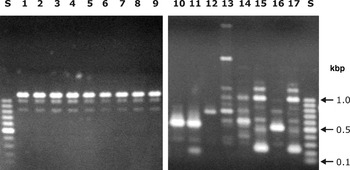
In vivo adhesion of rifampicin-resistant cells of probiotic strains was monitored by determination of microflora in homogenates of large intestine of mice. Lb. helveticus M92 in synbiotic combination with inulin has shown the best synergic effect on intestinal microflora of mice (Table 2). The LAB counts were most effectively increased, while enterobacteria and sulphite-reducing clostridia counts were decreased after the mice were fed with synbiotics (Table 2). 8 colonies from MRS-rifampicin agar (samples of large intestine of mice fed with probiotic strain Lb. helveticus M92) were randomly screened and identified by random amplified polymorphic DNA (RAPD). RAPD patterns identical with the pattern of probiotic strain Lb. helveticus M92 indicated that those colonies belonged to the same strain Lb. helveticus M92 (Fig. 1).
RAPD-PCR patterns obtained with Lactobacillus-specific primers. S, 1000 bp DNA ladder, lane 1, Lb. helveticus M92 (standard), lanes 2–9, isolates from large intestine from rifampicin MRS-agar (mice fed with Lb. helveticus M92), lanes 10–17, isolates from large intestine from MRS-agar (mice which were not fed with probiotic strain Lb. helveticus M92 – control).

Comparison of the bacterial counts in large intestine of mice on days 1 and 14 after feeding with probiotic strain Lb. helveticus M92, prebiotics (inulin, lactulose or raffinose) and with synbiotics (Lb. helveticus M92 in combination with inuline, lactulose and rafinose). Total aerobic (A) and anaerobic bacteria (B) on Peptone yeast extract glucose agar; total lactic acid bacteria (C) and rifampicin-resistant lactic acid bacteria (D) on MRS-agar; Enterobacteriaceae (E) on Violet red bile glucose agar; sulphite-reducing clostridia (F) on Sulfite agar, Control (con.), Lb. helveticus M92 1 or 14 day (M92 1d, M92 14d), Inulin 1 or 14 day o(I 1d, I 14d), Lactulose 1 or 14 day (L 1d, L 14d), Raffinose 1 or 14 day (R 1d, R 14d), Lb. helveticus M92+Inulin 1 or 14 day (M92+I1d, M92+I14d), Lb. helveticus M92+Lactulose 1 or 14 day (M92+L1d, M92+L14d), Lb. helveticus M92+Raffinose 1 or 14 day (M92+R1d, M92+R14d)
Values are means±standard deviations of results from three separate experiments

(—) colonies are not detected
a,b,c,d Values in the same row having a different letters differ significantly (P<0·05)
First day after oral administration of synbiotics, and Lb. helveticus M92 or prebiotics alone, the number of LAB in large intestine of mice was increased in comparison with the control group by ∼4·0, ∼1·8 and ∼2·5 log cfu/g, respectively (Table 2). The higher number of LAB in large intestine was also detected 14 d after oral administration of synbiotics compared with the counts in control mice (Table 2). When mice were fed with synbiotics the number of enterobacteria was decreased compared with the control group 1 d as well as 14 d after feeding by ∼2·0 log units.
Furthermore, application of probiotic strain Lb. helveticus M92 and synbiotics totally reduced the number of sulphite-reducing clostridia in large intestine of mice (Table 2). Similar results were obtained in small intestine of mice after probiotic and synbiotics administration (Frece, Reference Frece2007).
Modulation of mice immune system
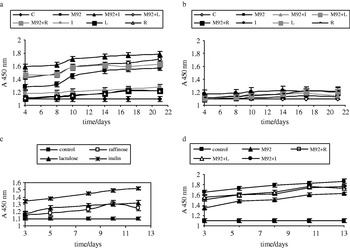
Oral administration of mice with viable cells of Lb. helveticus M92 alone or in combination with applied prebiotics stimulated the immune response in mice (Fig. 2). The levels of faecal and total serum IgA antibodies, from all groups of mice, were higher in comparison with control groups. The highest level of serum and faecal IgA antibodies were observed after oral administration of mice with Lb. helveticus M92 in combination with inulin (Fig. 2).
Determination of total (a) and specific (b) IgA antibodies in sera diluted 1:100 and faecal SIgA antibodies in faecal samples by ELISA method after oral administration of mice with: (c) prebiotics: inulin, lactulose and raffinose, and (d) with Lb. helveticus M92 alone or in combination with prebiotics: inulin (M92+I), lactulose (M92+L) and raffinose (M92+R). Error bars represent standard deviations of the mean values.

Discussion
The concept of synbiotics has recently been proposed to characterize health-enhancing foods and supplements used as functional food ingredients in humans (Mountzouris et al. Reference Mountzouris, Balaskas, Fava, Tuohy, Gibson and Fegeros2006). Prebiotics are known for their ability to stimulate the growth of beneficial intestinal bacteria, bifidobacteria and lactobacilli, in vitro and in vivo. Although there is a great interest in the physiological and pharmacological effects of dietary fibres, only a few studies are available concerning the influence of prebiotics on the intestinal immune system (Manhart et al. Reference Manhart, Spittler, Bergmeister, Mittlbock and Roth2003). Lb. helveticus M92 fulfils in vitro selection criteria for probiotic strains and exerts inhibitory activity against a wide range of bacteria including some pathogens (Kos et al. Reference Kos, Šušković, Goreta and Matošić2000; Šušković et al. Reference Šušković, Kos, Matošić and Besendorfer2000; Frece et al. Reference Frece, Kos, Svetec, Zgaga, Mrša and Šušković2005a, Reference Frece, Kos, Beganović, Vuković and Šuškovićb).
Therefore, in vivo adhesion of Lb. helveticus M92 in Swiss albino mice was studied. The increased number of LAB and decreased number of enterobacteria have shown that the bacterial composition in faeces and intestine of mice was altered by applied synbiotics. The increased number of LAB in large intestine was detected even 14 d after Lb. helveticus M92 administration, and the number of enterobacteria and sulphite-reducing clostridia in large intestine of mice was decreased. These results could be a consequence of lactic acid and bacteriocins production proved for examined probiotic strain. Namely, their antibacterial activities were confirmed against some enteropathogenic bacteria in vitro (Šušković, Reference Šušković1996; Kos, Reference Kos2001).
Results of RAPD analysis confirmed the capability of Lb. helveticus M92 to survive transit through GIT of mouse and to interact and compete with other microorganisms within the gut environment. The results of other authors have also shown that administration of certain strains of LAB can decrease the numbers of faecal Escherichia coli, anaerobic coci and sulphite-reducing clostridia (Lund et al. Reference Lund, Adamsson and Edlund2002; Marquina et al. Reference Marquina, Santos, Corpas, Munoz, Zazo and Peinado2002), but probiotic strain Lb. helveticus M92 has shown very strong inhibition against clostridia. Besides the antibacterial activity, the advantage of Lb. helveticus M92 strain is that it contains surface (S-layer) proteins responsible for survival of this strain in the GIT of mice and adhesion to intestinal epithelial cells. Namely, Lb. helveticus M92 S-layer proteins have been proved to be resistant to pepsin and pancreatic juice. In addition, the adhesion of Lb. helveticus M92 cells was higher when S-layer protein was not removed, compared with Lb. helveticus M92 cells if S-layer protein was removed by 5m-LiCl (Frece et al. Reference Frece, Kos, Svetec, Zgaga, Mrša and Šušković2005a).
The number of probiotic bacteria detected 14 d after the administration of probiotic strains was lower than 1 d after administration of these strains. Therefore, it appears likely that administration at regular intervals is necessary for maintenance of high probiotic level.
The possible competitive exclusion mechanisms of probiotic action include not only direct attack of probiotic cells by production of antibacterial substances and competition for nutrients and receptors on the gut enterocytes, but also stimulation of the non-specific immune system. SIgA plays a key role in the gastrointestinal defence mechanism against dietary and microbial antigens. Therefore, the effect of probiotic strain Lb. helveticus M92 itself, or in combination with prebiotics, on the faecal SIgA and total serum IgA levels in mice was investigated. The levels of faecal and total serum IgA antibodies from all groups were higher compared with control groups after oral administration of mice with viable probiotic cells, prebiotics or synbiotics. The increase of intestinal IgA antibody represents an important result, since SIgA is the predominant mucosal antibody and plays an important role in protection against intestinal pathogens (Shu & Gill, Reference Shu and Gill2001). There is accumulating evidence that the intestinal SIgA production is highly influenced by the intestinal microflora (Zierikzee et al. Reference Zierikzee, Tol, Kroes, Alles, Kok and Bindels2006). Moreau & Baforiau-Routhiau (Reference Moreau, Baforiau-Routhiau, Fuller and Perdigon2000) have shown that bifidobacteria from the infant's intestine, in particular, are important for the synthesis of SIgA against viral enteropathogens. Therefore, the authors suggested that prebiotics, which promote growth of bifidobacteria in the intestine, could be instruments in stimulating endogenous SIgA production and hence promote resistance in infants. Several studies reported that supplementation of food with prebiotics or probiotics or their combination can increase SIgA response to viruses and bacteria (Hosono et al. Reference Hosono, Ozawan and Kato2003; Zierikzee et al. Reference Zierikzee, Tol, Kroes, Alles, Kok and Bindels2006). Furthermore, Lb. helveticus M92, prebiotics and synbiotics did not evoke the specific humoral immune response after oral application and are as such suitable for probiotic, prebiotic and synbiotic application.
Our findings indicated that Lb. helveticus M92 in combination with inulin, lactulose or raffinose is an immunomodulator, because the application of these synbiotics stimulated the mucosal and total humoral immune response. Applied probiotic strain have shown ability to survive and adhere in the intestinal tract of mouse and positively influenced the intestinal microflora of the host. Confirmed synbiotic properties of Lb. helveticus M92 are of great importance for its application in fermented foods as functional starter culture and fermented dairy product (Lb. helveticus M92 in mixture with inulin). However, further investigations will be carried out to determine the influence of food matrix and applied processing technology on the functionality of this probiotic strain.
This research was financial supported by The Ministry of Science and Technology of Republic Croatia (Projects: 0058009 “Role of lactic acid bacteria in synbiotic effect” and 0581990 “Probiotics, prebiotics and functional starter cultures”).