Introduction
Panic disorder (PD) is among the most prevalent anxiety disorders in the community (Wittchen et al. Reference Wittchen, Jacobi, Rehm, Gustavsson, Svensson, Jonsson, Olesen, Allgulander, Alonso, Faravelli, Fratiglioni, Jennum, Lieb, Maercker, van Os, Preisig, Salvador-Carulla, Simon and Steinhausen2011) signifying a major public health burden in terms of economic costs (Coley et al. Reference Coley, Saul and Seybert2009) and disability worldwide (Baxter et al. Reference Baxter, Vos, Scott, Norman, Flaxman, Blore and Whiteford2014). Although anxiety has been clinically linked with coronary heart disease (CHD) for more than 100 years (Walsh, Reference Walsh1912), the nexus between PD and CHD remains tenuous and is yet to be clarified by means of a systematic review.
Part of the suspicion concerning an aetiological association is that persons with PD report a myriad of symptoms overlapping those with CHD (Carmin et al. Reference Carmin, Ownby, Wiegartz and Kondos2008). Moreover, persons with PD persist in emergency department presentations (Fleet et al. Reference Fleet, Dupuis, Marchand, Burelle and Beitman1997) and outpatient examinations for chest pain (Rutledge et al. Reference Rutledge, Reis, Olson, Owens, Kelsey, Pepine, Reichek, Rogers, Merz, Sopko, Cornell, Sharaf and Matthews2001) despite negative diagnostic results from coronary catheterization, electrocardiogram or serum markers of myocardial damage (Rohacek et al. Reference Rohacek, Bertolotti, Grutzmuller, Simmen, Marty, Zimmermann, Exadaktylos and Spyridon2012). A second cause for scepticism of the link between PD and CHD, and a caveat to interpreting the extant evidence base, is reverse causality. Specifically, persons with PD may be simply experiencing somatic symptoms of undiagnosed coronary conditions such as coronary spasm, microvascular angina and coronary slow-flow (Vural et al. Reference Vural, Satiroglu, Akbas, Goksel and Karabay2009), therefore it is plausible that PD partly represents a misdiagnosis. The inconsistency in collective findings to date (Bowen et al. Reference Bowen, Senthilselvan and Barale2000; Bringager et al. Reference Bringager, Arnesen, Friis, Husebye and Dammen2008; Walters et al. Reference Walters, Rait, Petersen, Williams and Nazareth2008; Janszky et al. Reference Janszky, Ahnve, Lundberg and Hemmingsson2010; Cheng et al. Reference Cheng, Leu, Su, Huang, Chiang, Huang, Chung, Lin, Chen and Chan2013), coupled with the high coronary healthcare utilization by PD patients (Fleet et al. Reference Fleet, Dupuis, Marchand, Burelle and Beitman1997), indicates that a meta-analysis is both timely and warranted. This review aims to synthesize the quantitative evidence base regarding PD, panic attacks and incident CHD. The reporting of this review conforms to the PRISMA guidelines (Liberati et al. Reference Liberati, Altman, Tetzlaff, Mulrow, Gøtzsche, Ioannidis, Clarke, Devereaux, Kleijnen and Moher2009); a review protocol is described elsewhere [PROSPERO CRD42014014891] (Tully et al. Reference Tully, Wittert, Turnbull, Beltrame, Horowitz, Cosh and Baumeister2015).
Method
Search strategy
One systematic search of the Medline, EMBASE, SCOPUS and PsycINFO electronic databases was performed from database inception without language restrictions and text explosion, the last search was on 2 January 2015 incorporating Ovid week 5 December 2014 (Supplementary Table S1). Hand search was performed of the reference lists of prior qualitative reviews (Beitman et al. Reference Beitman, Mukerji, Russell and Grafting1993; Hemingway & Marmot, Reference Hemingway and Marmot1999; Fleet et al. Reference Fleet, Lavoie and Beitman2000; Katerndahl, Reference Katerndahl2008) and articles selected for full text review, and the principal investigators of studies were contacted to clarify data if required.
Eligibility criteria
Population: The population of interest was persons with PD at baseline but without verified or known CHD at this time from the general, cardiology or psychiatric population (inpatients and outpatients). PD must be reported according to a recognized criteria including the Diagnostic and Statistical Manual of Mental Disorders (DSM-IV) or the International Classification of Diseases (ICD-10), or determined by a standardized interview (e.g. Structured Clinical Interview), or diagnosis made by a qualified professional (e.g. psychiatrist), or medical records. Studies reporting PD ± other anxiety disorders were eligible as were studies reporting anxiety neurosis [the diagnostic precursor to PD in ICD-10 (Feighner et al. Reference Feighner, Robins, Guze, Woodruff, Winokur and Munoz1972)] ± other anxiety disorders. Validated self-report measures of panic attack or panic-attack symptoms were also eligible to determine dose-response associations (Nicholson et al. Reference Nicholson, Kuper and Hemingway2006).
Comparator/control: The comparator group consisted of persons without PD or related conditions at baseline and without verified or known CHD at this time from the general, cardiology or psychiatric population (inpatients and outpatients).
Outcomes: Incident CHD was considered in any of the following categories:
-
(1) Major adverse cardiac events (MACE) – defined as documented death due to CHD, cardiac arrest (including ventricular fibrillation), sudden cardiac death or myocardial infarction (MI) (fatal or non-fatal).
-
(2) Structural coronary artery disease – as evidenced by obstructive coronary artery disease (⩾50% stenosis) on coronary angiography and/or subsequent coronary revascularization.
-
(3) Ischaemic heart disease – clinical evidence of myocardial ischaemia on ECG (transient ST/T wave changes), myocardial scintigraphy (reversible defect), echocardiography (transient wall motion abnormality) or cardiac magnetic resonance imaging (perfusion defect or transient wall motion abnormality), either during a spontaneous episode or a provocative stress stimulus.
-
(4) Other CHD – physician- or cardiologist-diagnosed CHD.
Only studies reporting verified CHD endpoints were eligible (e.g. ICD-10 coding of hospital admission, death certificate, cardiologist or physician diagnosis). In studies reporting multiple CHD outcomes we initially extracted the most common CHD endpoint for primary analyses (categories 1–4), and the secondary endpoints of fatal CHD (categories 1–4), and fatal or non-fatal MACE including MI (category 1).
Study design: Prospective longitudinal cohort, case-control study, database registry, randomized controlled trials (RCTs), or retrospective studies were eligible.
Exclusion: Studies utilizing patient self-report to determine incident CHD were ineligible. Studies reporting neurocirculatory asthenia, cardiac neurosis, effort syndrome or Da Costa's syndrome were ineligible as they preceded the formulation of anxiety neurosis and PD nomenclature and are conceptualized under multiple psychosomatic disorders (Taylor, Reference Taylor2001).
Data extraction process, risk of bias, and strength of recommendations
Two reviewers (P.J.T., S.C.) independently screened titles and abstracts of all the retrieved bibliographical records for eligibility. In the case of title/abstract disagreements, the study was subjected to full-text review. The RTI item bank (Viswanathan & Berkman, Reference Viswanathan and Berkman2012) was utilized to identify methodological bias at the primary CHD outcome level. Risk of bias was independently undertaken by two reviewers (P.J.T., S.C.) and disagreements adjudicated by consensus after discussion. Adjudication of the strength of evidence was made according to the Grading of Recommendations Assessment, Development and Evaluation (GRADE) criteria with GRADE Profiler 3.6.1 (The GRADE Working Group, Reference Schünemann, Brożek, Guyatt and Oxman2013).
Statistical analysis
In studies where an effect size was not reported we extracted the individual cell data for each CHD outcome and calculated the risk ratio (RR) and 95% confidence interval (CI) with Cochrane RevMan version 5.3 (raw data provided as a footnote to Supplementary Table S2). Otherwise the original data was reported as hazard ratios (HRs) and 95% CIs. Each of the HR and RR estimates were pooled together using random-effects models utilizing the DerSimonian & Laird method (Reference DerSimonian and Laird1986). Because of possible under- or over-estimation of the calculated RRs we adopted Loef & Walach's (Reference Loef and Walach2012) methodology for sensitivity analyses applying the natural logarithms of these values. Heterogeneity was evaluated with the I 2 statistic: I 2 = 0–60% (not important to moderate), I 2 > 60% (substantial statistical heterogeneity) (Higgins & Green, Reference Higgins and Green2008).
Sensitivity analyses and meta-regression was performed with Comprehensive Meta-Analysis 2.0. Sensitivity analyses examined the effect sizes stratified by depression co-morbidity, depression adjustment, and exclusion of depression. Sensitivity analyses also stratified studies according to the inclusion of unstable angina and/or angina pectoris in the primary CHD endpoint. Meta-regression was performed to determine possible sources of heterogeneity. A random-effects model was used to combine studies within each subgroup according to the following psychiatric-level variables: inclusion of psychiatric inpatients, anxiety neurosis, disorders v. PD symptoms. Meta-regression was utilized to assess the effects of gender (categorical and % of females in the sample) and the effects of age (categorical <50 years and mean age of the study population). Meta-regression also considered covariates and general study characteristics as possible sources of heterogeneity: adjustment for exercise, tobacco smoking, alcohol use, socioeconomic status, diabetes, cholesterol, hypertension, retrospective design, length of follow-up (<2 years, 2–10 years, >10 years), and region of recruitment. To evaluate the presence of publication bias, the test of Egger et al. (Reference Egger, Davey, Schneider and Minder1997), and the funnel plot including the trim-and-fill method outlined by Duval & Tweedie (Reference Duval and Tweedie2000) were inspected. Effect size graphs were constructed using Microsoft Excel (Microsoft Corp., USA).
Results
Study selection and characteristics
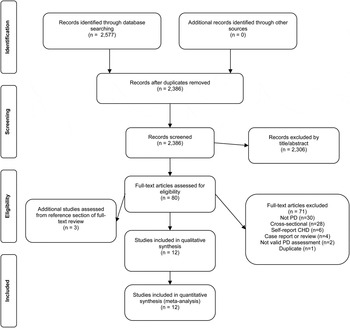
The search yielded 2386 citations from which 83 were reviewed in detail, 71 were excluded and 12 articles were retained (Fig. 1). Ineligible studies were excluded most commonly for not reporting PD (30 studies) and cross-sectional design (28 studies). The 12 articles comprised a pooled sample of 11 31 612 persons and 58 111 CHD events (study characteristics given in Supplementary Table S2). Briefly, the 12 participating studies originated from three regions, North America (five studies), Europe (six studies) and Asia (one study). The median sample size was 41 660 participants per study (s.d. ± 1 36 929.6). The median patient age across studies was 36.5 ± 11.6 years and the median percent of females in the individual studies was 42 ± 31.2%. Common CHD risk factors in the samples included dyslipidaemia (median 22.8% prevalence), hypertension (median 21.2% prevalence) whereas diabetes was uncommon (median 3.6% prevalence); however, five studies did not report suitable subgroup data in participants without CHD at baseline. PD was assessed according to diagnostic interview (two studies), database codes (six studies) and self-report questionnaires (three studies) and was unclear in one study. Baseline sampling was conducted until 2004. Follow-up time ranged from 1 to 37 years (median 7 years).
PRISMA flow chart showing the number of studies at each stage of the systematic review, reasons for exclusion, and the total number of retained studies. CHD, Coronary heart disease; PD, panic disorder.

Assessment of risk of bias and precision
The adjudication of risk of bias is provided in Supplementary Table S3. There were six prospective studies and six retrospective studies, and clear inclusion criteria were only stated in seven studies. An attempt to adjust for baseline differences between groups was made in six studies. The study outcome was clearly defined in all 12 studies but blinding to PD groups could not be determined in nine studies. Generally, however, CHD outcomes were assessed with reliable methods and studies tended to be sufficiently powered to identify differences between groups. A source of funding was identified in eight studies.
PD and incident CHD outcome
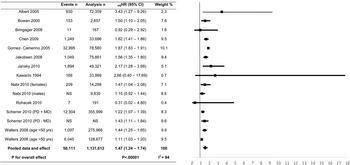
The analysis of the primary least-adjusted CHD endpoint was calculated from 11 studies (10 97 916 persons and 56 862 CHD events). There was evidence of high-level heterogeneity between estimates (I 2 = 87%). The pooled unadjusted HR was highly significant (HR 1.62, 95% CI 1.45–1.82, p < 0.00001). Pooling the bivariate and multivariate adjusted effect sizes from all 12 studies (11 31 612persons and 58 111 CHD events) attenuated the effect size by 15% and remained highly significant [adjusted HR (aHR) 1.47, 95% CI 1.24–1.74, p < 0.00001]; however, there was substantial heterogeneity between estimates (I 2 = 94%) (Fig. 2). The first sensitivity analysis was restricted to adjusted risk estimates only which remained significant (aHR 1.45, 95% CI 1.22–1.73, p < 0.0001). The second sensitivity analysis excluding angina pectoris and unstable angina in the CHD endpoint was largely unchanged (aHR 1.49, 95% CI 1.22–1.81, p < 0.00001); however, the pooled estimate was based on only eight studies.
Forest plot of adjusted and weighted hazard ratios for incident coronary heart disease (CHD) (primary endpoint). Adjusted hazard ratios (aHR) with 95% confidence intervals (CI) that exceed 1 (vertical line) indicate an increased CHD risk for persons with panic disorder (PD). GRADE assessment = low. GRADE, Grading of Recommendations Assessment, Development and Evaluation; NS, not specified; MD, major depression.

PD and incident MACE and MI
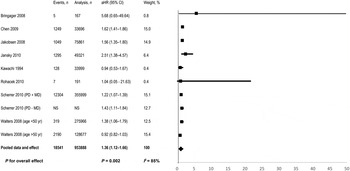
Incident MI was the most common individual endpoint with a total of 18 541 MI events reported in 9 53 888 persons obtained from six studies. There was evidence of high-level heterogeneity between estimates (I 2 = 86%). The unadjusted model suggested a 47% increased risk for MI in least-adjusted analyses (95% CI 1.17–1.86, p = 0.001). Adding multivariate adjusted effects attenuated the effect size by 11% (aHR 1.36, 95% CI 1.12–1.66, p = 0.002, I 2 = 85%) (Fig. 3).
Forest plot of adjusted and weighted hazard ratios for incident myocardial infarction (MI) (secondary endpoint). Adjusted hazard ratios (aHR) with 95% confidence intervals (CI) that exceed 1 (vertical line) indicate an increased MI risk for persons with panic disorder (PD). GRADE assessment = high. GRADE, Grading of Recommendations Assessment, Development and Evaluation; MD, major depression.

The review protocol specified that we would examine MACE (Tully et al. Reference Tully, Wittert, Turnbull, Beltrame, Horowitz, Cosh and Baumeister2015). Specifically, the MACE analyses added the findings of Albert et al. (Reference Albert, Chae, Rexrode, Manson and Kawachi2005) and the combined fatal CHD and MI results of Kawachi et al. (Reference Kawachi, Colditz, Ascherio, Rimm, Giovannucci, Stampfer and Willett1994), otherwise data were the same as for MI events. The analysis of MACE provided similar results (aHR 1.40, 95% CI 1.16–1.69, p = 0.0004, I 2 = 83%).
PD and fatal CHD
Fatal CHD was infrequently reported and there was a non-significant increased risk in unadjusted analyses from four studies (HR 1.39, 95% CI 0.75–2.59, p = 0.29). Multivariate adjustment was performed in one study (Walters et al. Reference Walters, Rait, Petersen, Williams and Nazareth2008) and inclusion of the aHR did not change the non-significant association (aHR 1.39, 95% CI 0.69–2.79, p = 0.35, I 2 = 83%).
Sensitivity analysis
The first sensitivity analyses corroborated that the calculated RRs and 95% CIs for two studies (Bringager et al. Reference Bringager, Arnesen, Friis, Husebye and Dammen2008; Rohacek et al. Reference Rohacek, Bertolotti, Grutzmuller, Simmen, Marty, Zimmermann, Exadaktylos and Spyridon2012) were equivalent to the HRs and 95% CIs calculated from the applied natural logarithms of these values (Loef & Walach, Reference Loef and Walach2012). Sensitivity analysis was then performed for analyses stratified by depression. The risk for CHD remained significant in studies excluding depression (aHR 1.64, 95% CI 1.45–1.85, I 2 = 73%) but was substantially reduced in studies which adjusted for depression (aHR 1.38, 95% CI 1.03–1.87, I 2 = 98%). The effect sizes for co-morbid PD depression indicated a 79% increased CHD risk; however, this estimate was based on only two studies and substantial heterogeneity remained (aHR 1.79, 95% CI 0.85–3.76, I 2 = 99%).
Meta-regression
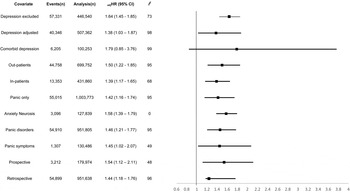
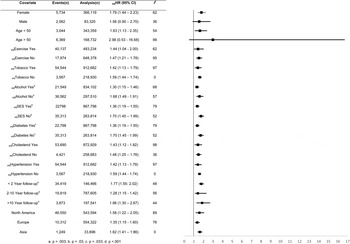
Meta-regression of the primary CHD endpoint according to psychiatric-variable study characteristics are shown in Fig. 4. No psychiatric-level variables were identified as a source of between-study heterogeneity. Meta-regression of the primary CHD endpoint according to general study characteristics are shown in Fig. 5. The analysis of gender and age >50 years as categorical variables did not reveal heterogeneity. However, analyses using the median % suggested that the attributable PD-CHD risk increased with the percentage of females in the study (point estimate for slope 0.002, s.e. = 0.0001, p = 0.003) and decreased with the age of participants (point estimate for slope −0.029, s.e. = 0.002, p < 0.00001). In terms of psychosocial and CHD risk-factor adjustment we found that adjustment for socioeconomic status and diabetes were sources of between-study heterogeneity. A trend towards between-study heterogeneity was also evident for alcohol covariate adjustment (p = 0.15). We also observed length of follow-up as a source of heterogeneity (I 2 > 10 years = 25%, 2–10 year = 63%, <2 years = 48%, p = 0.001).
Forest plot of adjusted hazard ratios (aHR) for incident coronary heart disease (CHD) by psychiatric-level panic disorder (PD) study characteristics. aHR with 95% confidence intervals (CI) that exceed 1 (vertical line) indicate an increased CHD risk for persons with PD.

Forest plot of adjusted hazard ratios (aHR) for incident coronary heart disease (CHD) by general panic disorder (PD) study characteristics. aHR with 95% confidence intervals (CI) that exceed 1 (vertical line) indicate an increased CHD risk for persons with PD. SES, Socioeconomic status.

The meta-regression results for the MACE endpoint are shown in Supplementary Table S4 (psychiatric moderators) and Supplementary Table S5 (study-level moderators). These results indicated that source of statistical or methodological heterogeneity included adjustment for depression and exercise, and the study region.
GRADE assessment of quality of evidence and publication bias
The assessment of each CHD endpoint according to the GRADE criteria (Guyatt et al. Reference Guyatt, Oxman, Vist, Kunz, Falck-Ytter, Alonso-Coello and Schünemann2008) is shown in Supplementary Table S6. The quality of evidence was generally low and this was attributable to imprecision in the estimates, plausible confounding and the absence of a dose-response gradient effect. MI was the only endpoint rated as high-quality evidence where there was evidence of a dose-response gradient effect.
A funnel plot of selected studies and imputed studies on the primary outcome did not suggest the presence of publication bias (Supplementary Fig. S1). Egger's test showed a trend towards significant asymmetry (p = 0.07). The fail-safe N shows that another 2314 null studies are needed for the p value to exceed 0.05. According to the trim-and-fill test the association between PD and CHD remains significant after imputing possible missing studies (HR 1.75, 95% CI 1.72–1.79).
Discussion
General findings
In the first meta-analysis reporting the association between PD and verified CHD we observed a 47% increased risk of developing CHD, a 36% increased MI risk, a 40% MACE risk and a non-significant association with fatal CHD in persons with PD. However, there was considerable statistical heterogeneity between study estimates for the primary endpoint that was related to length of follow-up, population age, gender, socioeconomic status and diabetes. For the MACE endpoint, heterogeneity was related to adjustment for depression and exercise, and the study region. Incomplete and biased reporting was also evident; five studies did not list clear inclusion criteria, blind adjudication of CHD endpoints could not be determined in nine studies. None of the retained studies had performed coronary catheterization on all participants to rule out coronary disease as specified in the review protocol (Tully et al. Reference Tully, Wittert, Turnbull, Beltrame, Horowitz, Cosh and Baumeister2015) although three studies employed a clinical examination of participants to identify overt CHD (Bringager et al. Reference Bringager, Arnesen, Friis, Husebye and Dammen2008; Janszky et al. Reference Janszky, Ahnve, Lundberg and Hemmingsson2010; Rohacek et al. Reference Rohacek, Bertolotti, Grutzmuller, Simmen, Marty, Zimmermann, Exadaktylos and Spyridon2012). Consequently, the manner in which PD has been investigated in relation to incident CHD cannot rule out reverse causality.
Reverse causality
One study excluded CHD events in the early follow-up period, but this was only the first 6 months (Bowen et al. Reference Bowen, Senthilselvan and Barale2000). In addition Jansky et al.'s (2010) longitudinal cohort was performed among 18- to 20-year-old Swedish military conscripts making reverse causality biases unlikely in such a young population. The symptoms of PD and CHD substantially overlap and it is plausible that PD may aggravate underlying coronary disease (Sardinha et al. Reference Sardinha, Nardi and Zin2009). Here it was evident that the largest pooled HR without heterogeneity was evident in the studies with >10 years follow-up, a marginally higher risk than studies with <2 years follow-up. Together these findings suggest that PD populations are at an increased risk of CHD in both the longer term and more immediate term. However, the heightened CHD risk in the short-term (2-year) period might represent different mechanisms. For example, it is plausible that immediate CHD risk reflects a tendency toward misdiagnosis of PD (Tully, Reference Tully2015), such as a lower tendency to ascribe CHD admissions to PD in older persons. It is also possible CHD is misdiagnosed in circumstances of psychological stress. Along these lines, takotsubo cardiomyopathy is notably associated with sympathetic activation and cardiac beta-receptor stimulation, often mimicking ST segment elevation MI (Tsuchihashi et al. Reference Tsuchihashi, Ueshima, Uchida, Oh-mura, Kimura, Owa, Yoshiyama, Miyazaki, Haze, Ogawa, Honda, Hase, Kai and Morii2001).
PD subtypes and dose-response relationship
We did not find evidence of a dose-response relationship between PD and CHD, only between PD and MI. Effect sizes for PD symptoms were comparable to studies assessing PD and there was no evidence of between-study heterogeneity. A previous meta-analysis of non-specific anxiety reported a 26% overall increased CHD risk (I 2 = 74%), a 48% increased fatal CHD risk, and a non-significant association with MI (Roest et al. Reference Roest, Martens, de Jonge and Denollet2010). However, there were too few studies to report anxiety disorder effect sizes separately from anxiety symptoms in the previous review (Roest et al. Reference Roest, Martens, de Jonge and Denollet2010). Such findings contrast those evident here where we observed the largest risk attributable to be for incident CHD risk followed by MI whereas the fatal CHD association was non-significant. It is possible that methodological differences account for such discrepancies. First, we did not include studies comprising persons with established CHD at baseline which is problematic for establishing aetiological associations independent of reverse causality. Moreover, we did not include studies with self-reported CHD which is subject to recall biases among anxiety populations (Goodwin et al. Reference Goodwin, Davidson and Keyes2009). One such study reported a three- to four-fold higher risk of stroke and CHD events in persons with panic attacks (Smoller et al. Reference Smoller, Pollack, Wassertheil-Smoller, Jackson, Oberman, Wong and Sheps2007). A second possibility explaining the divergence in findings from previous reviews is the relatively large sample sizes here (median 41 660 participants per study).
Our finding that studies comprising anxiety neurosis had higher effect sizes than PD alone points to the possibility that time of publication, period of recruitment and historical changes to psychiatric nomenclature may affect the purported CHD risk. Given that anxiety neurosis was the precursor to PD (Feighner et al. Reference Feighner, Robins, Guze, Woodruff, Winokur and Munoz1972) but contains generalized anxiety symptoms, this raises the possibility that generalized anxiety could be associated with incident CHD (Goodwin et al. Reference Goodwin, Davidson and Keyes2009; Scherrer et al. Reference Scherrer, Chrusciel, Zeringue, Garfield, Hauptman, Lustman, Freedland, Carney, Bucholz, Owen and True2010). As such the effect of generalized anxiety and anxiety phenotypes upon CHD risk warrants further study. Given the broad inclusion of anxiety neurosis, PD and panic symptoms, it is not known whether findings relate to more general constructs shared between depression and anxiety such as negative affect which is considered the defining feature of anxiety and depression disorders (Goldberg et al. Reference Goldberg, Krueger, Andrews and Hobbs2011).
Sensitivity analyses with depression adjustment
The importance of depression to CHD is well known (Glozier et al. Reference Glozier, Tofler, Colquhoun, Bunker, Clarke, Hare, Hickie, Tatoulis, Thompson, Wilson and Branagan2013; Ladwig et al. Reference Ladwig, Lederbogen, Albus, Angermann, Borggrefe, Fischer, Fritzsche, Haass, Jordan, Junger, Kindermann, Kollner, Kuhn, Scherer, Seyfarth, Voller, Waller and Herrmann-Lingen2014) although methodological inconsistencies have been highlighted (Nicholson et al. Reference Nicholson, Kuper and Hemingway2006; Kuper et al. Reference Kuper, Nicholson, Kivimaki, Aitsi-Selmi, Cavalleri, Deanfield, Heuschmann, Jouven, Malyutina, Mayosi, Sans, Thomsen, Witteman, Hingorani, Lawlor and Hemingway2009). Here adjustment for depression and antidepressant medication attenuated CHD risk attributable to PD by 24% compared to studies excluding depression. The modifying effect of depression on PD risk for CHD is comparable to that reported in a recent review of post-traumatic stress disorder (Edmondson et al. Reference Edmondson, Kronish, Shaffer, Falzon and Burg2013). In a meta-analysis of six studies Edmondson et al. (Reference Edmondson, Kronish, Shaffer, Falzon and Burg2013) found that incident CHD risk was attenuated by 28% with depression adjustment. Previous systematic reviews concerning depression have reported CHD risks in the range of 30–90% (Kuper et al. Reference Kuper, Marmot and Hemingway2002; Rugulies, Reference Rugulies2002; Wulsin & Singal, Reference Wulsin and Singal2003; Nicholson et al. Reference Nicholson, Kuper and Hemingway2006; Gan et al. Reference Gan, Gong, Tong, Sun, Cong, Dong, Wang, Xu, Yin, Deng, Li, Cao and Lu2014) with the smallest effect size reported in the most recent and largest sample of 8 93 850 persons (Gan et al. Reference Gan, Gong, Tong, Sun, Cong, Dong, Wang, Xu, Yin, Deng, Li, Cao and Lu2014). In fact many of the meta-regression analyses here exceeded the total sample of prior depression reviews, (Kuper et al. Reference Kuper, Marmot and Hemingway2002; Rugulies, Reference Rugulies2002, Wulsin & Singal, Reference Wulsin and Singal2003; Nicholson et al. Reference Nicholson, Kuper and Hemingway2006) some of which have included only prospective studies. Indeed, recent decades have focused almost exclusively on depression disorders (Berkman et al. Reference Berkman, Blumenthal, Burg, Carney, Catellier, Cowan, Czajkowski, DeBusk, Hosking, Jaffe, Kaufmann, Mitchell, Norman, Powell, Raczynski and Schneiderman2003) which remain the primary psychiatric intervention in established CHD populations. By comparison, the importance of post-traumatic stress disorder and anxiety disorders to cardiovascular health is emerging more recently (Sardinha et al. Reference Sardinha, Nardi and Zin2009; Edmondson et al. Reference Edmondson, Kronish, Shaffer, Falzon and Burg2013; Chalmers et al. Reference Chalmers, Quintana, Abbott and Kemp2014; Tully & Baune, Reference Tully and Baune2014; Tully et al. Reference Tully, Cosh and Baumeister2014).
PD intervention
The frontline treatments for PD include cognitive-behavioural therapy (Lessard et al. Reference Lessard, Marchand, Pelland, Belleville, Vadeboncoeur, Chauny, Poitras, Dupuis, Fleet, Foldes-Busque and Lavoie2012), serotonergic reuptake inhibitors (Van Apeldoorn et al. Reference Van Apeldoorn, Van Hout, Timmerman, Mersch and den Boer2013), benzodiazepines (Moylan et al. Reference Moylan, Giorlando, Nordfjærn and Berk2012), and their combination such as collaborative care (Archer et al. Reference Archer, Bower, Gilbody, Lovell, Richards, Gask, Dickens and Coventry2012). It remains unclear whether the treatment of PD, by any modality, has a significant beneficial effect lowering the incidence of CHD. However, it was demonstrated recently in the IMPACT trial that collaborative depression care led to a 48% reduction in MACE at 7-year follow-up in persons without established CHD (Stewart et al. Reference Stewart, Perkins and Callahan2014). By contrast, two recent RCTs indicate that collaborative anxiety disorder management is feasible in primary-care populations with substantial cardiovascular co-morbidity (Roy-Byrne et al. Reference Roy-Byrne, Craske, Sullivan, Rose, Edlund, Lang, Bystritsky, Welch, Chavira, Golinelli, Campbell-Sills, Sherbourne and Stein2010; Huffman et al. Reference Huffman, Mastromauro, Beach, Celano, Dubois, Healy, Suarez, Rollman and Januzzi2014).
Potential mechanisms of cardiopathogenesis
The hypothesized mechanisms underlying PD and CHD association include platelet abnormalities and inflammation (Sardinha et al. Reference Sardinha, Nardi and Zin2009), diminished heart rate variability (Yeragani et al. Reference Yeragani, Pohl, Berger, Balon, Ramesh, Glitz, Srinivasan and Weinberg1993; Kemp et al. Reference Kemp, Quintana, Felmingham, Matthews and Jelinek2012), change in the QRS complex (Yeragani et al. Reference Yeragani, Pohl, Bar, Chokka and Tancer2007) and especially the QT interval (Pohl & Yeragani, Reference Pohl and Yeragani2001; Yeragani et al. Reference Yeragani, Pohl, Balon, Jampala and Jayaraman2002; Sullivan et al. Reference Sullivan, Kent, Kleber, Martinez, Yeragani and Gorman2004). More recent evidence has also indicated links between PD and atrial fibrillation (Cheng et al. Reference Cheng, Leu, Su, Huang, Chiang, Huang, Chung, Lin, Chen and Chan2013). It is possible that PD and panic attacks may lead to higher sympathetic discharge and myocardial ischaemia (Fleet et al. Reference Fleet, Lesperance, Arsenault, Gregoire, Lavoie, Laurin, Harel, Burelle, Lambert, Beitman and Frasure-Smith2005, Reference Fleet, Foldes-Busque, Grégoire, Harel, Laurin, Burelle and Lavoie2014). Certainly, associations between PD and microvascular disorders including coronary slow-flow (Vural et al. Reference Vural, Satiroglu, Akbas, Goksel and Karabay2009), microvascular angina (Roy-Byrne et al. Reference Roy-Byrne, Schmidt, Cannon, Diem and Rubinow1989) and arterial stiffness (Cicek et al. Reference Cicek, Durakoglugil, Kocaman, Guveli, Cetin, Erdogan, Sahin, Dogan and Canga2012) have been reported. Further, it was recently shown that mental stress-induced myocardial ischemia was associated with microvascular constriction quantitated as peripheral arterial tonometry ratio but not angiographic burden of coronary disease (Ramadan et al. Reference Ramadan, Sheps, Esteves, Zafari, Bremner, Vaccarino and Quyyumi2013). In addition to such mechanisms behavioural factors including a preponderance of smoking (Isensee et al. Reference Isensee, Wittchen, Stein, Hofler and Lieb2003), alcohol use (Hoertel et al. Reference Hoertel, Le Strat, De Maricourt, Limosin and Dubertret2013), overt exercise-avoidance behaviours (Muotri & Bernik, Reference Muotri and Bernik2014) or heightened sensitivity to cardio-respiratory symptoms (Ramos et al. Reference Ramos, Sardinha, Nardi and Araújo2014) might explain links between PD and CHD.
Strengths and limitations
The strengths of this review include the standardized extraction and rating conducted by two independent reviewers. The findings hold relevance for clinicians given that this review excluded studies adopting self-reporting of CHD. The findings of this review are presented with several limitations including that high risk of bias was particularly evident for unclear or unblinded determination of CHD outcome, the absence of clear inclusion criteria, retrospective design, and extent to which studies adjusted for between-group differences at baseline. Another limitation is that the original studies precluded an evaluation of whether the chronicity and severity of PD or frequency of panic attacks were discretely associated with incident CHD outcomes. Only the meta-regression analyses comparing psychiatric in- and out-patients might be a crude marker of PD severity. However in-patient ICD-10 codes for PD might also be associated with more severe psychiatric problems including psychosis and bi-polar disorder. Another limitation is potential regional bias as no studies were eligible from Africa, South East Asia, Asia Pacific or South America. Finally, there may be other unknown biases in the original studies not captured by our sensitivity analyses to determine heterogeneity.
Conclusion
In conclusion, high-quality evidence assessed by GRADE criteria suggested that PD was a risk factor for incident MI although heterogeneity remained. Moderate evidence supported an association between PD and MACE. By contrast, low-quality evidence assessed by GRADE indicated an association between PD and CHD and no association between PD and fatal CHD. These findings are tempered by the heterogeneity between study estimates and risk of biases especially reverse causality. Given the latter possibility, future research is required to examine bi-directional mechanisms of cardiopathogenesis evident in persons with PD and subclinical coronary artery disease and to evaluate further the cardiovascular effects of panic attacks and incident CHD.
Supplementary material
For supplementary material accompanying this paper visit http://dx.doi.org/10.1017/S0033291715000963.
Acknowledgements
P.J.T. is supported by the National Health and Medical Research Council of Australia (Neil Hamilton Fairley —Clinical Overseas Fellowship no. 1053578). P.J.T. has received project grant funding from the National Heart Foundation of Australia, and the Sir Robert Menzies Foundation. The funding body had no role in design or interpretation of the study.
Systematic review registration: PROSPERO CRD42014014891 ( http://www.crd.york.ac.uk/PROSPERO/display_record.asp?ID=CRD42014014891).
Declaration of Interest
None.