

Introduction
The importance of field vegetables in terms of economics, cultivated area and food supply
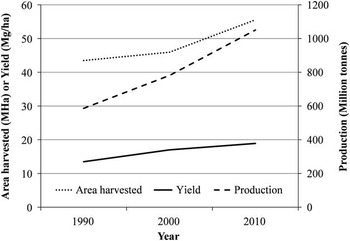
According to the World Health Organisation, a healthy diet should include a minimum of 400 g of fruits and vegetables per day and a higher daily dose would further help in disease prevention (WHO, 2004; Oyebode et al., Reference Oyebode, Gordon-Dseagu and Walker2014). Yet it has been reported that global fruits and vegetables supply is 22% lower than that required to supply a healthy diet to all humans (Vandevijvere and Knai, Reference Vandevijvere and Knai2015). The global production of field vegetables has been increasing in terms of cropped area and marketable weight but the productivity has stagnated (Fig. 1; FAOSTAT, 2015). It is anticipated that field vegetable production will keep increasing to supply the demand and that fertilizer use will follow the same trend in order to increase productivity. Nitrogen being the most important fertilizer for increasing productivity, attention should be given to field vegetable N management and ways to improve it’s efficiency while maintaining or improving the production levels. Precision N management may be a promising way to achieve these goals. Our definition of precision N management is inspired from the Southern Agricultural Economics Association Annual Meeting (2008) definition of precision agriculture. In this context, precision N management is a strategy that uses a wide range of technology to gather and process data for the purpose of guiding targeted actions that improve the precision, efficiency and productivity of N fertilization. Multiple studies have been conducted on precision N management for cereal crops (Chen et al., Reference Chen, Bell, Brennan, Bowden, Dobermann, Rengel and Porter2009; Diacono et al., Reference Diacono, Rubino and Montemurro2013; Miao et al., Reference Miao, Stewart and Zhang2011; Zebarth et al., Reference Zebarth, Drury, Tremblay and Cambouris2008). Most of these studies have demonstrated that precision N management in cereals can improve N use efficiency, increase profitability and reduce N loadings in the biosphere (Diacono et al., Reference Diacono, Rubino and Montemurro2013; Khosla et al., Reference Khosla, Inman, Westfall, Reich, Frasier, Mzuku, Koch and Hornung2008; Fixen and West, Reference Fixen and West2002). However, few studies exist on precision N management for field vegetable crops.
Statistics of global field vegetables production.

Benefits of precision N management
Nitrogen is the nutrient needed in the largest amount for optimal plant growth as it is required for proteins, enzymes, vitamins and chlorophyll synthesis (Moorby and Besford, Reference Moorby and Besford1983). For this reason, most crops have a positive response to N fertilization (Burns, Reference Burns1996; MAFF, 1994; Warncke et al., Reference Warncke, Dahl and Zandstra2004). While it may be tempting to apply excess amounts of N to crops to ensure non-limiting levels of N in the soil during crop growth, over application of N may have negative impacts on the crop and the environment. Excess N fertilization may increase crop susceptibility to diseases (Batal et al., Reference Batal, Bondari, Granberry and Mullinix1994; Everaarts, Reference Everaarts1994; Scaife and Wurr, Reference Scaife and Wurr1990). It can also alter crop quality in terms of appearance, taste and nutritional content (Rahn, Reference Rahn2002). In addition, because N is a mobile element in the soil, over-application may result in deep percolation, water table contamination, leaching in water bodies, eutrophication and emission of nitrous oxide, a powerful greenhouse gas (Fageria and Baligar, Reference Fageria and Baligar2005). Organic soils are powerful emitters of N2O (Rochette et al., Reference Rochette, Tremblay, Fallon, Angers, Chantigny and MacDonald2010). For these reasons, precision N management can ensure optimal yield in terms of quantity and quality while limiting the negative impacts of N on the environment.
Lag of precision N management in field vegetables compared to cereal crops
Field vegetable crops cover a small portion of arable land compared with cereal crops and each crop may have different requirements for the successful implementation of precision N management (Burns et al., Reference Burns, Hammond and White2010; Rahn, Reference Rahn2002). Nevertheless, field vegetable crops have unique properties that may benefit from more attention in order to improve N management by using precision N management. For instance, field vegetable crops return larger amounts of nitrate to the soil than cereal crops (Brinkjans and Scholz, Reference Brinkjans and Scholz2003). This may affect how soil residual N is accessed in the spring. One may wonder: how important is the spatial map of biomass produced by the previous vegetable crop in creating N prescription maps? Moreover, multiple vegetable crops are cultivated in histosols, which display physical, chemical and mechanical properties that are different from mineral soils. For instance, histosols tend to display spatial variability from the center of the ‘pool’ to the edges, with edges having higher mineral content and a thinner O horizon (Everett, Reference Everett1983). How can this known spatial variability be successfully integrated in N management decisions? Histosols can also display unique spectral characteristics, which may require different soil mapping approaches from mineral soils (Won Suk et al., Reference Won Suk, Rao, Jung Seob and Jodie2001). This paper intends to review the work that has already been done and the research areas that will need to be investigated to improve precision N management in field vegetable crops grown in organic soils.
The case of histosols
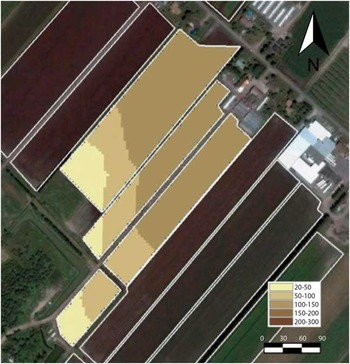
Soil characteristics are a determinant factor in the nutrient management process. Muck soils (histosols with highly decomposed organic material) are naturally low in many essential elements and require an appropriate pH evaluation to determine the availability of nutrients. Nitrogen is naturally released from the organic matter of muck soils during a growing season and may also be lost through leaching or denitrification. An adapted management strategy is necessary as less (about 45 to 55 kg N/ha) supplemental N is required for vegetables grown on muck soils than on mineral soils (Warncke et al., Reference Warncke, Dahl and Zandstra2004). Means of characterising and managing the soil properties such as soil moisture, pH or soil temperature, which influence N mineralization by micro-organisms, may benefit PNM by prioritizing mineralized N use by the plant over added N use (Caron et al., Reference Caron, Theroux Rancourt, Belec, Tremblay and Parent2014). Moreover, as illustrated in Figure 2, histosols are often contained in basins and display a characteristic pattern of soil depth from the center of a field (i.e. pool) to the basin’s margins (Everett Reference Everett1983). Means of characterizing organic soil depth and accounting for it in N management practices have the potential to benefit PNM.
Spatial variability of organic soil depth. The key shows variability in soil depth from 20 to 300 cm. Adapted from Periard et al. 2012.

Precision N management is often stated as a means of mitigating N2O emissions from agriculture sources (Millar et al., Reference Millar, Doll and Robertson2014). Nitrous oxide emissions from histosols behave differently from emissions of mineral soils because of their high organic matter content and their high levels of N mineralization (Kasimir‐Klemedtsson et al., Reference Kasimir‐Klemedtsson, Klemedtsson, Berglund, Martikainen, Silvola and Oenema1997). For instance, a study conducted in Quebec, Canada found that N2O emissions from non-irrigated cultivated histosols decreased with N fertilizer addition (Rochette et al., Reference Rochette, Tremblay, Fallon, Angers, Chantigny and MacDonald2010). All these factors indicate that histosols used for field vegetable cultivation have unique features that should be considered when implementing PNM.
Estimating field vegetable crop N needs
Samborski et al. (Reference Samborski, Tremblay and Fallon2009) have reviewed the literature on the need and procedures for data normalization, the usefulness of reference plots and the methods for translating readings into actual N fertilizer recommendations using the tools available for plant sensor-based diagnostic information. They attribute the current limitations on their widespread use to the availability of algorithms that would be reliable in a variety of soil and weather conditions. In the case of vegetable crops, the application of canopy sensing is further limited by the great diversity of cultivars and management practices used in the industry.
Modeling tools for N rate determination
Presidedress assessment of soil nitrate-nitrogen in soils has the potential to reduce N use and reduce N leaching without impairing marketable yield (Hartz et al., Reference Hartz, Bendixen and Wierdsma2000). Pre-sidedress assessment of plant available N implies the collection of soil samples in the field prior to mid-season N fertilizer application. Although presenting multiple advantages for precision N management, this operation often is cost prohibitive because of the labor, resources and money invested in sampling and analysis. To overcome these limitations, models have been proposed to improve the precision of soil available N estimates using multiple sources of information such as crop rotations, satellite imagery and weather data. For example, AmaizeN is a decision support system (DSS) helping farmers to plan N fertilizer application by integrating crop production and environmental impact components and providing estimates of crop yield, N-fertilizer application rate and economic returns (Li et al., Reference Li, Johnstone, Pearson, Fletcher, Jamieson, Brown and Zyskowski2009). The AmaizeN system was developed in New Zealand. Another way to merge information from multiple sources is to develop complex models integrating weather data, soil characteristics and crop growth models under the form of a DSS. With the increasing number of meta-analyses applied to agriculture and the precision in soil, crop and weather monitoring, farmers now have access to a new generation of DSS for nutrient management. An example of this is SCAN, standing for Soil, Crop, Atmosphere, and Nitrogen, which enables site-specific N rate recommendations. This system builds on multiple years of field trials in Ontario and Quebec (Canada) and on results of a meta-analysis on the impacts of soil and weather parameters on maize N response (Tremblay et al., Reference Tremblay, Bouroubi, Bélec, Robert William, Newell and Thomason2012). While the SCAN system integrates complex datasets (soil surface texture, cumulative and forecast rainfall, previous crop, soil organic matter, historical yield, economic ratio) and uses advanced decision-making models (fuzzy inference), it provides a simple interface for farmers to use with minimal inputs (Hmielowski, Reference Hmielowski2016). A case study conducted over 82 farmer’s fields, two seasons and two tillage systems in Southern India compared productivity and economic return of N management using three different approaches: Nutrient Expert (NE), farmer’s practices and state recommendations (Satyanarayana et al., Reference Satyanarayana, Majumdar, Pampolino, Johnston, Jat and Kuchanur2013). The NE is a decision support system developed by the International Plant Nutrition Institute for small holder famers of Asia and Africa that integrates information on site characteristics, climate, price of farm inputs and crop produce to provide N recommendation (Pampolino et al., Reference Pampolino, Witt, Pasuquin, Johnston and Fisher2012). Satyanarayana et al. (Reference Satyanarayana, Majumdar, Pampolino, Johnston, Jat and Kuchanur2013) observed the potential improvement in yield production when using DSS over conventional approaches. These systems were developed for cereal crops, but no such decision support system currently exists for field vegetable crops.
Crop specific decision support systems for N management
In order to be robust and reliable over time and multiple crop growing contexts, crop specific DSS for N management in field vegetables should be based on process-based models that account for multiple characteristics notably: crop root development, crop N response, soil organic matter, soil physical properties, crop residues and rainfall (actual and forecasted). Crop root growth influences soil N utilization and differ from one crop to another, which reinforces the need for crop specific models (Thorup-Kristensen, Reference Thorup-Kristensen2001). Field vegetable crop N response vary with contrasting soil organic matter content (SOM) and crop specific characteristics should be studied and accounted for in models (Quinche Gonzalez et al., Reference Quinche Gonzalez, Pellerin and Parent2016). Means of characterizing SOM and soil physical properties exist commercially (e.g. Veris MSP, Veris Technology, Salina, KS, USA) and may help to incorporate spatial variability in process-based DSS and thus improve PNM. As mentioned above, field vegetable crops return large amounts of mineralized N to the system and accounting for the amount and nature of crop residues is mandatory for the development of N management DSS (Delgado et al., Reference Delgado, Ristau, Dillon, Duke, Stuebe and Follett2001). Crop residues may be estimated based on crop and potentially mapped using aerial imagery (Quemada and Daughtry, Reference Quemada and Daughtry2016). Finally for DSS like the SCAN system mentioned above, forecasted and actual rainfall are important in estimating N loss from the system (Tremblay et al., Reference Tremblay, Bouroubi, Bélec, Robert William, Newell and Thomason2012). Incorporating all these spatial, temporal and model-based characteristics in a DSS for N management of field vegetables requires a strategy that uses a wide range of technology to gather and process data for the purpose of guiding targeted actions that improve the precision, efficiency and productivity of N fertilization.
Conclusions on research gaps
There is currently a gap between precision N management tools for field crops on mineral soils, at one end, and vegetable crops on organic soils, at the other end. Field crops on mineral soils have been subjected to sophisticated studies, generally leading to process-based models (mainly for corn and winter wheat) handling the physical and biological processes determining the fate of nitrogen in the soil-plant-atmosphere system. Yet, few of these models have resulted in decision support systems with proven performances for recommendation purposes. Vegetable crops on organic soils have been much less studied and therefore N management tools are very much limited, particularly ‘precision’ ones. Organic soils used for vegetable crops are known for their ability to mineralize considerable amounts of N during the course of a productive season. Precision tools would be appropriate to identify the locations in a field where N mineralization would be less likely to meet crop demands, due to soil depth or hydrological reasons. Vegetable crop production and quality is highly dependent on proper N supply and vegetable farmers are keen to insure that no N limitations will jeopardize the profitability of the vegetable production operation. One service that precision tools can bring to vegetable crop production on organic soils would be to rely on the natural delivery of N by the organic soil system, and to monitor the N status of crops in such a way that the farmer can be confident that minimal or no N fertilization needs to be brought in a synthetic form. Crop sensing tools capable of being sensitive for a diversity of vegetable crops, but insensitive to the interference of the soil itself would be warranted.
Acknowledgement
Special thanks to Marlène Piché for her help in literature review.