The 1990s “Decade of the Brain” stimulated research on many fronts and resulted in considerable advancement in neuroscience. Unfortunately, we have been slow to develop a policy dialogue to anticipate and deal with vast implications. Simply put, our political and social institutions have not kept pace with these advances. At the base, policy issues center on how we interpret the implications of these developments, especially given the complexity of the subject and the speculative nature of much of the evidence to date. The issues discussed here go to the heart of the major problems facing the world today and challenge basic assumptions on both the right and the left of the political/ideological spectrum as well as the standard social science model of behavior. As a result, the findings of neuroscience are open to ideological maneuvering designed to put the most expedient spin on their meaning.
Although we know considerably more about the brain than we did even several years ago, in many ways it is still rudimentary. There are a lot of theories and suppositions, as well as a proliferation of information and findings, as scientists work to identify the anatomical connections and to understand the biochemical, molecular, and genetic mechanisms of the brain. There is a synergism and convergence of many types of research coming together in the neuroscience research area.1
See Farah M. Emerging ethical issues in neuroscience. Nature Neuroscience 2002;5:1123–29; Blank RH. Brain Policy. Washington, D.C.: Georgetown University Press; 1999.
Policy Issues in Brain Interventions
There is an expanding array of techniques for intervention in the brain. Direct brain interventions range from cruder forms of electroconvulsive therapy (ECT) to more precise, directed placement of electrodes through electronic brain stimulation (EBS), where insulated wires implanted in the brain allow electrical impulses to be sent and received. More recent developments include transcranial magnetic stimulation (TMS), which utilizes powerful electromagnetic discharges to alter brain activity, and deep brain stimulation (DBS), where electrodes are implanted in brain to deliver high-frequency electrical stimulation to control tremors of Parkinson's disease or epilepsy. Cruder forms of psychosurgery like frontal lobotomies have been replaced by stereotaxic surgery that destroys the tissue in precise spots of the brain using lasers, radiation, cryoprobes, or focused ultrasound beams. Moreover, clinical trials have begun for a variety of brain implants as well as implanted pacemaker-like devices that send mild electronic pulses to alter mood in persons suffering from depression and other disorders.
Likewise, there have been significant developments in psychotropic drugs designed to treat or enhance specific behavioral traits. The proliferation of new generations of antipsychotic, antianxiety, and, especially, antidepressant drugs that inhibit serotonin reuptake has been accompanied by expanded use by persons of all ages. Nootropics, or brain performance enhancing drugs, are becoming more widely used and are expected to represent a huge market in the near future. Already beta-blockers are used by a large proportion of members of symphony orchestras to relieve anxiety and enhance performance.2
Tindall B. Better playing through chemistry. New York Times 2004 Oct 17.
Another type of intervention is the use of virtual reality (VR) for operant conditioning (usually combined with drug therapy). VR is a computer-mediated, multisensory technology designed to trick the senses and put us in an alternate reality. As a deliberate manipulation of the senses to produce a hallucinatory state, there is a fine line between VR and certain schizophrenia-type states. As VR advances to include more senses and more complete perceptual field with less intrusive and more efficient delivery systems, it will increase the difficulty for at-risk persons to distinguish the real world from the artificial. To date, there has been little discussion as to the possible dangers of placing individuals in alternate realities, including interference with normal psychological processes, reduced motivation of the individual to change his or her actual life, effective means of social withdrawal, and possible addiction to a virtual reality that is more pleasurable than the person's real world.
Other areas that are likely to experience rapid growth in light of neuroscience research are those targeting the interface of genetics and the brain. Some promising research areas involve supplementing deficient neurotransmitters or blocking effects of specific neurotransmitters, identifying genes that prevent normal brain development or that produce progressive brain degeneration followed by treatment using gene replacement therapy, and use of viral vectors to remove inoperable brain tumors. Neurogenetics and neurografting open significant policy issues as to the extent to which we should intervene in humans as well as significant resource allocation questions and questions of access.
Every time we intervene in the human brain, we face a multitude of policy issues. For instance, although ECT has been used for over a half century, it still elicits highly contentious debate. What makes brain intervention therapies such controversial political issues? First, there are questions concerning informed consent. Although informed consent is problematic with any medical procedure, when the target is the brain, the informed consent has to come from the very organ that is identified as having a problem. This makes it easier to rationalize treatment on paternalistic grounds, where consent is not forthcoming, and in turn triggers fears of potential abuse.
Second, any time we deal with brain intervention or any type of mental illness or disorder, there is the problem of stigmatization. Mental disorders are not treated the same as physical diseases, which is apparent in the wide disparity of financial support across different areas in healthcare where mental health always comes up short. Some of this discrepancy has to do with stigmatization both by the public and healthcare professionals. As a result, any technique targeted at the brain automatically raises concern over its impact on the subject's or patient's rights.
Third, although there is a fine line between experimentation and therapy in all medical research and treatment regimes, when the target organ is the brain, the question over where experimentation stops and treatment begins is all but impossible to answer. In part, this difficulty emanates from the fact that each person's brain is unique to the extent that there is always an element of experimentation, and, in part, it centers on the central role of this organ in defining the person. This is especially important when the intervention is irreversible, such as the case with psychosurgery. This concern is exacerbated when the intervention in the brain is done for treating or correcting behavioral disorders that have no clear organic origin or when it is used to modify behavior.
Fourth, any form of intrusion in the brain takes us to the core concerns over individual autonomy and personal identity because the brain is integral to both. The brain is also the foundation of our notion of free choice, and any intervention thus brings questions of potential control by others and of behavioral modification or engineering. The fact that these new techniques are more subtle than previous interventions, for example, lobotomy versus TMS or DBS, makes them all the more open to abuse and overuse. Related to this are issues surrounding privacy and confidentiality of data collected through brain intervention, especially as we move to broader use of brain imaging techniques for understanding human behavior.
Finally, intervention in the brain raises questions of distributive justice, specifically resource allocation and equitable access to these techniques. Many of these techniques are costly, both on a per-case and aggregate societal basis, and will compete for increasingly scarce healthcase resources. What priority should these interventions have, particularly when used to treat behavioral problems? How can we best design assessment processes to proactively evaluate the safety (long and short term), efficacy, and social impact of the multitude of developments in neuroscience? Furthermore, who should have access to these intervention technologies, particularly as we move into an era where enhancement of brain functioning and an accompanying social advantage are possible?
These many generic issues accompanying any intervention in the brain are accompanied by specific issues raised by particular applications. For example, with mind-altering and psychotropic drugs, there are widening possibilities of overuse and abuse surrounding the use of these drugs by children who themselves cannot consent. There are also broader questions concerning the long-term effects of psychotropic and mind-enhancing drugs on the population. These issues have been expressed by many observers, but, to date, they have not been adequately addressed by society, especially because it might be decades before we understand the long-term effects of these drugs. In the meantime, how far should we go with these applications in light of the uncertainty?
The Brain and Behavior
Concurrent with the advances in brain intervention outlined above, advances in cognitive neuroscience are uncovering significant linkages between brain structure and function and human behavior. Cognitive neuroscience centers on the interaction or the relationship between the structural and physiological aspects of the brain and its neural transmitters and receptors, and the mind (or human behavior). According to Hamer,3
Hamer D. Rethinking behavior genetics. Science 2002;298:71–2.
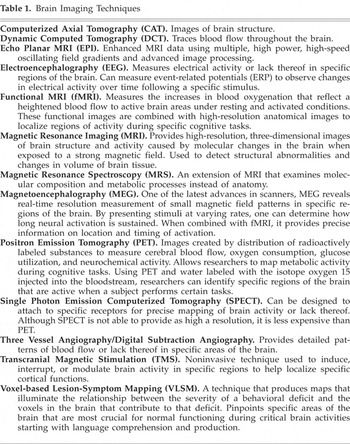
Until recently, our understanding of brain structure and function was limited, based on extrapolation from animal studies, intrusive and risky lesion studies in the human brain, or autopsies. Safe, practical ways to study the living brain did not exist until the 1970s when researchers began using computers to process information from CT scans passed through the brain into a single whole-brain image. Since then, a wide variety of noninvasive techniques have been developed that give us the capacity to monitor directly the interaction among brain structure, brain function, and human behavior and to observe brain activity while a subject performs a particular task (see Table 1).
Brain Imaging Techniques

Scientists also have developed computer programs that can alter or rearrange anatomical brain images from MRI and PET to match a standardized brain map, making it possible to compare the anatomy and function of different brains. In 2003, for example, the Brain Atlas, which is comprised of digitalized high-definition structural maps collected from MRI scans of over 7000 subjects, was published on the Internet.4
Available at www.brainatlas.org.
Chance B, Anday E, Nioka S, Zhou S, Hong L, Worden K, et al. A novel method for fast imaging of brain function, non-invasively with light. Optics Express 1998;2:411.
Brain Fingerprinting Laboratories. Scientific Procedure, Research, and Applications. 2003. Available at: www.brainwavescience.com/technologyoverview.php.
Most of the current research on the brain and human behavior is dependent on these increasingly sophisticated imaging techniques. The knowledge emerging from this research challenges many assumptions about a wide range of human behavior, including addiction, sex differences, violence, and free will itself. Among other things, brain imaging has been used to investigate altruism, love, empathy, lying and truth telling, personality traits, political leanings, racial prejudice, and moral reasoning.
One important set of issues centers on addictive behaviors, which extract a huge social cost. PET and MRI studies of addicts in craving and withdrawal have found that all abused substances, no matter what the mechanism, stimulate the brain's reward system and induce feelings of pleasure that can override even the basic survival activities. This explains why addicts are willing to substitute one substance for another. When exposed to these addictive substances, tolerance builds up within certain neurotransmitters. If the brain is excessively stimulated over time, it learns to adjust and its functions change. The brain is then affected directly. In terms of research, the two most important areas are the biochemical and genetic bases of addiction and the impact of addictive substances on the brain and its functioning. Both are moving ahead rapidly, but without accompanying interpretation or analysis of the social implications. Such research has broad implications for designing workable antidrug policies and treating these major social problems.
Another potentially explosive political issue surrounds brain imaging studies that show significant differences in the brains of males and females (on average and in normal distributions). For instance, some of the nuclei of the hypothalamus (the regulatory center of primal activities) are larger in males than in females whereas others are spherical in males and elongated in females. There are also differences in metabolic activity, with men having higher levels of activity in the temporal limbic region and women higher levels of activity in the posterior cingulate gyrus region. Also, the corpus callosum, which connects the two hemispheres, is much larger in women. So there are sexual differences in the brain: Why does this matter? It matters in terms of policies in prescribing drugs, especially psychotropic drugs, because they operate on differently structured brains of men and women. This raises serious political issues for education and challenges existing notions of equity. This applies to many areas. For example, some school systems have eliminated recess, in spite of evidence that suggest that many boys might need recess instead of Ritalin.
Ultimately, the work in cognitive neuroscience comes down to the question of free will and individual responsibility. Does our new knowledge that much of our behavior is being shaped by neurotransmitters and receptors mean that individuals are no longer responsible for their own actions? Should we assume that we no longer have free will? Free will, or some concept like free will, is at the center of our retributive justice system. Democracy, itself, assumes that individuals have the capacity to make rational choices. Brain research that undermines this is, therefore, highly controversial and raises broad, conceptual questions concerning free will and individual responsibility.7
Spence SA, Hunter MD, Harpin G. Neuroscience and the will. Current Opinion in Psychiatry 2002;15:519–26.
The Brain and Aggression
Among the most significant findings are those regarding the set of related concepts encompassing fear, aggression, violence, hatred, and antisocial behavior. Although the past several years have seen a proliferation of publications on the neurological bases of aggression, there have been very few published works on the policy implications of the research itself. Attention here focuses on the path-breaking imaging research surrounding the prefrontal cortex and the limbic system and their relationships to aggression and on the potential policy implications of this emerging research in cognitive neuroscience.
Although no credible scholar today would argue that the causes of aggressive behavior are either entirely environmental or biological,8
Comings DC. Both genes and environment play a role in antisocial behavior. Politics and the Life Sciences 1996;15:84–5.
Foreman J. Roots of violence may lie in damaged brain cells. Los Angeles Times 2002 Apr 29.
For example, see Pietrini P, Guazzelli M, Basso G, Jaffe K, Grafman J. Neural correlates of imaginal aggressive behavior assessed by positron emission tomography in healthy subjects. The American Journal of Psychiatry 2000;157:1772–81.
Early EEG research found relationships between abnormal electrical discharges in the brain and behavioral problems, and, through more sophisticated brain imaging, these data are becoming more distinct. Because they are the important communication links between neurons, neurotransmitters (and the receptors) logically are the prime targets for explanations of behavior. The focus of research on the neural influences on aggressive behavior centers on the neurotransmitter serotonin. Disruption of the serotonin system has been linked to aggression and violence in a variety of groups including aggressive psychiatric patients, impulsive violent men, impulsive fire setters, and victims of suicide by violent means.11
Davidson RJ, Putnam KM, Larson CL. Dysfunction in the neural circuitry of emotion regulation: A possible prelude to violence. Science 2000;289:591–4.
The identification of a specific brain system that processes fear has created substantial interest within neuroscience. Advances in imaging techniques are helping reveal the specific brain areas and mechanisms that are involved in an amygdala-based fear circuit. Despite their small size, these almond-shaped areas of the temporal lobes have been implicated in a variety of behaviors, especially those related to fear and anger. Researchers suggest that the amygdala receives signals of the potential danger and then sets off a series of reactions that help protect the individual from the perceived harm. As the threat of harm passes, additional messages are sent to the amygdala that the threat is past. Importantly, this process often occurs without conscious awareness of the stimulus.12
Armony JL, Dolan RJ. Modulation of spatial attention by fear-conditioned stimuli: An event-related fMRI study. Neuropsychologia 2002;40:817–26.
Findings of numerous studies using a variety of imaging techniques have highlighted the importance of the amygdala and other limbic regions, together with prefrontal cortical regions, in the identification of and response to emotionally salient information in the environment.13
Phillips H. Private thought, public property. NewScientist 2004;31 July:38–41.
Papps BP, Calder AJ, Young AW, O'Carroll RE. Dissociation of affective modulation of recollective and perceptual experience following amygdala damage. Journal of Neurology, Neurosurgery and Psychiatry 2003;74:253–4.
Adolphs R, Tranel D, Damasio AR. The human amygdala in social judgment. Nature 1998;393:470–4; Adolphs R. Is the human amygdala specialized for processing social information? Annals of the New York Academy of Sciences 2003;985:326–40.
Blair RJ. Neurobiological basis of psychopathy. British Journal of Psychiatry 2003;182:5–7.
Although there is an expanding catalogue of brain imaging research substantiating the roles of other brain regions in fearful, aggressive behavior, this summary shows that the limbic system and prefrontal cortex coexist in a delicate balance. A better understanding of this relationship is crucial for explaining human aggression. In turn, this knowledge has considerable implications for public policy and for our models of human behavior. The next section is a speculative overview of the potential impact of these research findings on our use of the findings of neuroscience, the criminal justice system, race relations, and intergroup conflict, and argues for a more in depth integration of cognitive neuroscience into the traditional study of these areas.
Policy Implications of Cognitive Neuroscience
The policy implications of the new neuroscience are expansive and touch on most areas of the human existence. Because of the availability of sensitive knowledge about the brains of individuals that accompanies diffusion of the applications, critical issues center on what type of information should be collected and what to do with it once we have it. Because of the problems inherent in brain intervention discussed earlier (informed consent, stigmatization, autonomy, privacy, justice) these techniques must be scrutinized carefully as to their impact on the basic democratic concepts of freedom and equality. As noted by a recent editorial: “Researchers are delving into the most intimate details of who we are, including such things as our personality traits, moral reasoning and tendency to violence. While their aims are commendable, many of their results raise big questions.”17
Misplaced faith in “mind reading” scans is sure route to injustice. NewScientist 2004;31 Jul:3.
Illes J, Racine E. Imaging or imagining? A neuroethics challenge informed by genetics. American Journal of Bioethics 2005;5:5–18.
One concern revolves around the commercial uses of cognitive neuroscience. Even apparently innocuous uses of brain imaging in the rapidly growing area of neuromarketing strikes many observers as offensive.19
Singer E. They know what you want. NewScientist 2004;31 Jul: 36–7.
See note 12, Phillips 2004:41.
Complicating the problem is that while how we handle our new knowledge is problematic, there is a tendency to exaggerate the significance of this research. In most imaging studies, even the statistically significant differences in brain structure and function are often very subtle and minor, but extrapolation is attractive and commonplace in media headlines because its subject (the human brain and behavior) is so important and dramatic. “Police arrested an 8-year-old boy who allegedly had a violent outburst in school, head-butting his teacher and kicking an assistant principal when he was told he couldn't go outside to play with other students.”21
Edelman MW. The injustices of the juvenile justice system. Children's Defense Fund 2005 11 Apr. Available at: www.childresdefense.org/childwatch/050411.aspx.
An issue that increasingly will challenge policymakers in light of new findings in neuroscience is the degree to which brain abnormalities should affect sentencing of lawbreakers.22
Scarano VR. Psychiatric defenses to criminal offenses. Current Opinion in Psychiatry 2001;14:559–63.
At the minimum, the new research on brain and aggression will force wider debate of this issue.23
Marzuk PM. Violence, crime, and mental illness: How strong a link? Archives of General Psychiatry 2000;53:481–6.
Enserink M. Searching for the mark of Cain. Science 2000;289:575–9.
See Pincus JH. Base Instincts: What Makes Killers Kill? New York: W. W. Norton; 2002.
In a related area, there is considerable research on the neural foundations of bias and its ties to intergroup conflict. Imaging studies have found that even among seemingly unprejudiced people, racial category labels prime stereotypes.26
Fiske ST. What we know about bias and intergroup conflict: The problem of the century. Current Directions in Psychological Science 2002;11:123–8.
Phelps EA. Faces and races in the brain. Nature Neuroscience 2001;4:775–6.
Phelps EA, Cannistraci CJ, Cunningham WA. Intact performance on an indirect measure of race bias following amygdala damage. Neuropsychologia 2003;41:203–8.
As Pinker notes, diplomats often try to bring the opposing sides together by facilitating trade, cultural exchanges, and people-to-people exchanges.29
Pinker S. The Blank Slate: The Modern Denial of Human Nature. New York: Viking; 2002.
Fiske notes, however, that whether bias is conditionally or unconditionally automatic, less prejudiced perceivers can compensate for their automatic associations with conscious effort or not act on them.30
See note 26, Fiske 2002:124.
See note 26, Fiske 2002:127.
How can policymakers best integrate this emerging knowledge of the brain's influence on aggression, bias, and intergroup conflict into domestic and foreign policy? Are there more effective ways to deal with such problems than force or traditional mediation with handpicked leaders? What good does it do to remove a ruthless dictator if his followers hold similar views of outsiders? Moreover, what dangers are there when leaders identify certain easily identifiable ethnic groups as the enemy? Or when they profile based on physical characteristics? What deep-seated evolutionary fear circuits do such policies trigger? To what extent do leaders exploit the fear system to build support for their policies?
It is likely that we will never fully understand, much less be able to predict or treat, aggression by looking only at the genes and brain, because at their base they are political and social problems, not just biological ones. However, the phenomena we call social and political, themselves, represent shared understandings among individuals, not external happenings that “mysteriously affect” human affairs. So, although a better knowledge of the role of the brain and human behavior is not sufficient to explain human aggression, “one cannot understand violence without a thorough understanding of the human mind.”32
See note 29, Pinker 2002:317.
Conclusions
Are we ready to face the issues accompanying the new neuroscience? Are our government and political institutions at the stage where they can deal with the advances in cognitive neuroscience? The Decade of the Brain was tremendously successful, particularly because other sciences were integrated and technologies in imaging and computerization were utilized. However, as noted earlier, we have not kept pace in terms of framing the political issues flowing from these technologies. There is little evidence of anticipatory policy, or even timely reactive policy for that matter. Moreover, the inclusion of the brain in a more interactive paradigm of human behavior threatens a prevailing and deeply entrenched social–environmental model that assumes we are born with a tabula rasa—that we are basically empty organisms that can be modified and shaped by our environment. Environment is important, but we cannot dismiss the findings of neuroscience no matter how uncomfortable they might be.
Cognitive neuroscience challenges basic assumptions on both ends of the ideological spectrum. As a result, those on both the left and the right attempt to interpret the findings in the most favorable way for their particular ideology. As with many areas of technology, applications can be considered either good or bad depending on one's perspective. Although cognitive neuroscience has not yet received the attention of the other areas of science—such as genetic engineering and transplant surgeries—its policy implications warrant close scrutiny by independent scholars, think tanks, and policymakers. We must be skeptical of wild speculation on all sides, but too much is at stake to ignore the findings of neuroscience or to leave to chance how they are interpreted and applied.