




No CrossRef data available.
Shape decompositions and their algebras
Published online by Cambridge University Press: 02 November 2005
Abstract
Shapes play an important role in many human activities, but are rarely seen in their natural form as raw and unanalyzed. Rather, shapes come analyzed, structured in terms of their certain parts, forming shape decompositions. Different kinds of shape decompositions are developed, the most interesting among which are the decompositions that could be used as shape approximations. Two kinds of such decompositions, discrete and bounded, are examined in greater detail. Computations with shapes conducted in the framework of shape grammars and related shape algebras have been standard for over 3 decades. Similar computations are possible with analyzed shapes or shape decompositions. Different algebras to compute with shape decompositions are developed and compared to the shape algebras. The measure of their agreement determines how well the shapes are approximated by their decompositions.
Keywords
Information
- Type
- Research Article
- Information
- Copyright
- © 2005 Cambridge University Press
1. INTRODUCTION
Shapes are part of our everyday experience and play important roles in many human activities. Shapes come without apparent structure, therefore rendering any division into parts possible. However, any attempt to (verbally) describe a shape inevitably leads to structuring the shape in terms of its certain parts or to a shape decomposition. According to Stiny (1991), “These are defined in a variety of ways, but most simply as sets of shapes that show how their sums are divided into parts of certain kinds.”
For example, the 3-dimensional shape in Figure 1a may be described as a table having four legs and a board, which leads to the decomposition (Fig. 1b).

Decomposition of a table: (a) the original shape and (b) its decomposition.
The fact that we can name things around us structures our surroundings in a shape decomposition; whereas the simple naming of a shape structures it by recognizing the shape as being a part of itself.
For example, the original shape in Figure 1a is called a table in the description above. It should also be included in the decomposition so that all of the shapes in Figure 1 become elements of the latter.
Shapes are rarely perceived in their natural form as raw/unanalyzed, but rather approximated by their decompositions. An unknown shape may at first appear as raw/unanalyzed, but it gradually acquires a structure as one tries to understand it. As our understanding grows, we move from raw/unanalyzed shapes to structured/decomposed shapes.
Although important in many human activities, shapes are prime to design and fine arts. Designers use shapes to specify things to make: to provide information on how things function or how they should be built. To do so, designers differentiate some parts of their designs by naming and relating the parts. Shapes in designs are utilitarian in nature. They come structured in decompositions with ambiguities removed in order to avoid misunderstanding.
Ambiguities, although dismissed in designs, may well be at home in fine arts. Shapes of art may serve a different purpose than those of design. They need not be rationally understood. An art object may appear pure, unanalyzed, and open to any kind of interpretation by both the public and critics. This kind of ambiguity allows for multiple interpretations and adds to the richness of the object.
Although the outcomes of a designer's or artist's efforts may be different in nature (analyzed vs. raw shape), the design process may well be the same.
In the course of design, an unanalyzed shape may be seen in a certain way and accordingly decomposed into a certain set of parts. These may then be used to compose new shapes. The latter may again be seen as unanalyzed, only to be decomposed in some new way leading to new sets of parts. The process may be repeated until a design or an art object is created. Moving from analyzed to raw shapes creates an opportunity to see things in a different way, which then moves shapes back from raw to analyzed. The creative phases of the design process are characterized by shifts between raw/unanalyzed shapes and decomposed/analyzed ones. Stiny's (1994, 2001) shape computations with unexpected outcomes are good examples of such shifts at work.
Decompositions are used to describe shapes. They often appear in place of shapes functioning as their approximations. The purpose of this paper is to investigate how good such approximations are.
The investigation is conducted in the context of formal design theory that involves shape grammars and related shape algebras. Central to the theory are shape computations that attempt to formalize what designers do when they design. To use decompositions as shape approximations, tools for computing with decompositions are developed. In particular, algebras for decompositions similar to algebras for shapes are introduced; and the properties of such algebras are investigated and compared to the properties of shape algebras. The measure of their agreement determines how computations with decomposition may compare to the similar computations with shapes. This ultimately shows how well shapes are approximated by their decompositions.
1.1. A note on notation
Symbols like

are used in their standard set-theory meaning: empty set, intersection, union, subset, proper subset, element of, not an element of, and power set, respectively. Some standard set-theory notions are assumed, such as the ordered set with related maximal and minimal elements, bounds, and closures, as well as the direct product and related functions and relations.
Computations are carried out in different algebras, where an algebra is seen as a set of objects that is closed under a set of operations. The elements of an algebra may satisfy certain equations, like distributive or associative laws, which are axioms of that algebra. Axioms may serve to distinguish classes of algebras such as rings, lattices, groups, Boolean algebras, and so forth.
New algebras, in particular subalgebras and quotient algebras, are constructed from the old ones. The former are subsets of an algebra that are algebras themselves. The latter are algebras whose elements are equivalence classes of some algebra, which has been partitioned with respect to an equivalence relation of a certain kind: congruence. Congruence preserves the operations of the algebra so that the result of computations carried on with the equivalence classes of some elements of the algebra is the equivalence class of the result of the same computation carried on with the elements themselves.
Algebras with the same kinds of operations could be related via certain mappings. If there is a mapping from an algebra to another algebra such that the mapping enumerates all of the elements of the latter algebra, and if it also preserves the operations of the algebras, then the latter algebra is homomorphic to the former one. If the mapping is also one to one, then the two algebras are isomorphic. A mapping defining isomorphism is a surjection because it enumerates all of the elements of the latter algebra and it is an injection because it is one to one; thus, it is a bijection.
We also make use of shape algebras (Stiny, 1991, 1992, 2001). These compute with shapes in a Boolean fashion and are also closed under geometric transformations that act on shapes. Shape algebras are seen as two-sorted (operating on objects of two different sorts), conveniently keeping both shapes and transformations in a single algebraic structure (Krstic, 1996, 1999, 2001). Shape algebra (Uij) computes with i-dimensional shapes occupying j-dimensional space forming the set Uij (i, j = 0, 1, 2, 3, and i ≤ j) and j-dimensional geometric transformations forming the set Tj.
The set of shapes Uij has a lower bound, which is the empty shape denoted by 0, but has no upper bound. Shapes from Uij, together with Boolean operations of sum (+), product (·), and difference (−), form a generalized Boolean algebra: a relatively complemented distributive lattice with a smallest element (Birkhoff, 1993). This establishes the Boolean part of Uij.
Transformations of Tj form a group establishing the group part of Uij. Transformations are combined with the aid of group operations and act on shapes of Uij by a binary operation of group action that takes a shape a and a transformation t to produce a transformed shape t(a).
Shape algebras could be extended to other design-related objects such as labeled shapes, weighted shapes, or n-tuples of shapes. Such algebras still have the shape algebra structure, but the objects they operate on are not shapes.
1.2. Definition
Decompositions are used as shape descriptions that emphasize certain properties of shapes. There are different ways to define a decomposition of a shape depending mainly on the kind of information that is to be highlighted.
For example, decompositions defined as directed graphs containing shapes and spatial relations among them expose the details of how shapes are generated with a shape grammar (Knight, 1988).
Decompositions defined simply as sets of shapes will be used exclusively in this work. Although very elementary, the definition is general. Such decompositions do only the minimum of what decompositions should do: they structure unanalyzed shapes in terms of their certain parts and nothing else. That is, certain properties (parts) of a shape are chosen to represent the shape while others are neglected. This renders decompositions: shape approximations that suit certain purposes.
Shape parts are central to decompositions, and any shape, with the exception of shapes consisting of points, has infinitely many parts. A picture is literally worth infinitely many words. The set of all parts of a shape is the upper bound for all decompositions of that shape. This set has some interesting properties that reveal shape structure.
Let B(a) denote the set that includes all of the parts of a shape a. Any Boolean combination of parts of a carried out in the algebra in which a is defined yield another part of a. Set B(a) is a subalgebra of this algebra closed under its Boolean operations. If a is a shape from Uij, then B(a) is a Boolean algebra (Stiny, 1980; Earl, 1997). Because a is not changed by the transformations of its symmetry group S(a), the set B(a) is closed under S(a) in accordance with the following proposition.
Proposition 1. Set B(a) is closed under the symmetry group of a, or S(a). █
The proof follows from the definition of the symmetry group of a shape and the order preserving nature of transformations. That is, if t ∈ S(a), than t(a) = a, and if x ≤ a, then t(x) ≤ t(a). Consequently, t(x) ≤ a so that t(x) ∈ B(a).
This motivates the following definition: the maximal structure of a shape a denoted by B(a) is a two-sorted shape algebra with B(a) as the Boolean part and S(a) as the group part.
The maximal structure of a is clearly a proper subalgebra of Uij, which shows that shapes, like their algebras, have a dual nature. They have parts that are shapes from Uij closed under transformations from Tj, where B(a) and S(a) are respective upper bounds. The interplay of structure and symmetry, which is central to design, emerges here in the very nature of the building blocks of designs: shapes.
Although it is possible to have decompositions containing infinitely many parts of a shape, like B(a), only finite decompositions will be examined in this work. The former may be appealing to mathematicians, but the latter are central to the design practice.
Definition 1. A finite nonempty set of shapes is a decomposition. █
The set of all decompositions denoted by Δij is a proper subset of

. Set Δij is clearly without an upper bound when ordered by ⊆. It also lacks a lower bound, because the empty set is not a decomposition.
Definition 2. Let a be a shape, the set A is a decomposition of a whenever it is a decomposition and the sum of its elements is a, or a = Σ A. █
Any decomposition is a decomposition of a shape because finite sums of shapes are guaranteed to be shapes.
The set of finite subsets of B(a) that sum to a is the set of all decompositions of a. Like Δij, this set does not have an upper or a lower bound and is closed under the symmetry group of a.
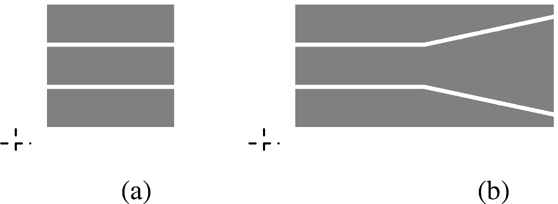
Decompositions structure shapes, and also structure their parts. In Figure 2a, the square is structured as a consequence of the structure of the double square in Figure 2b that contains it. Note that the location of the shapes in some coordinate system is indicated by cross marks.

(a,b) Decompositions: the structure of (b) is recognized in (a) whereas its elements are not.
The structure of an analyzed shape can be relativized to each of its parts in accordance with the following definition.
Definition 3. If a is a shape, A its decomposition, and shape b a part of a, then b is implicitly structured in decomposition B = {b · x| x ∈ A}, which is the relativization of the structure of a to b or the relativization of A to b. █
2. ALGEBRAS OF DECOMPOSITIONS
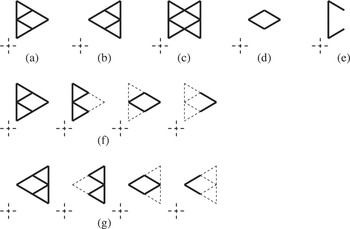
Computations with decompositions may be carried out in a similar way as computations with shapes. For example, the shapes in Figure 3a and b, when combined in the framework of U12, yield the shapes in Figure 3c, d, and e, which are their respective sum, product, and difference. It should be possible to duplicate these computations with the sets in Figure 3f and g, which are respective decompositions of the shapes in Figure 3a and b.

Computing in U12: (a,b) shapes and their (c) sum, (d) product, and (e) difference, as well as their respective (f,g) decompositions.
Computations with decompositions should be carried out in the framework of appropriate algebras belonging to the same family as shape algebras Uij. Such an algebra should be two-sorted, having decompositions as well as transformations that act on decompositions. The operations should include sum, product, and difference for decompositions, group operations for transformations, and a group action relating the two. More formally, an algebra for decompositions should satisfy the following general definition.
Definition 4. An algebra for decompositions is an extended shape algebra. Its Boolean part is a set of decompositions X ⊆ Δij, whereas its group part is a group of transformations that can act on shapes. The group action is extended to decompositions so that t(A) = {t(x)| x ∈ A}, where A is a decomposition and t is a transformation. █
The definition above allows for specifying different algebras of decompositions, which may be tailored for specific applications. We will examine two algebras defined on the set of all decompositions Δij: the set algebra of decompositions, and the complex algebra of decompositions. Based on these algebras, some other “smaller” algebras will be constructed and examined.
2.1. Set algebras of decompositions
If parts recognized in decompositions are paramount in computations, combining decompositions as sets is a viable option. Set operations of union, intersection, and difference may be taken as sum, product, and difference of decompositions. The operations preserve the set elements, and set inclusion establishes the ordering on Δij. However, set Δij of decompositions is not closed under ∩ and −. The intersection or difference of two decompositions may be empty, but there is no empty decomposition; a decomposition contains at least one shape, which may be 0. The set Δij has to be augmented with the empty set to become an algebra.
Definition 5. A set algebra of decompositions Dij satisfies Definition 4 and has the set Δij ∪ {Ø} together with operations ∪, ∩, and − as the Boolean part, whereas its group part is the same as that of Uij. █
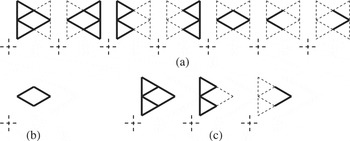
This algebra, which was introduced by Stiny (1990, 1994), treats shapes that are elements of decompositions as symbolic objects without further dividing or summing them. The algebra works well if shapes have predetermined parts that remain fixed throughout a computation. The result of the computation contains only shapes that are elements of decompositions entering the computation. These are the atoms of the computation. For example, decompositions in Figure 4a, b, and c are respective sum, product, and difference of decompositions in Figure 3 computed in the framework of Dij. Note that no new shape has been created in the computations.

Computing in D12: (a) sum, (b) product, and (c) difference of decompositions in Figure 3.
2.2. Complex algebras of decompositions
Set algebras compute with shapes as they would with any other object. Properties of shapes are irrelevant in Dij. In contrast, shape properties, in particular spatial properties, are most important in design. An algebra of decompositions that aspires to be an algebra of analyzed shapes should take into account spatial properties of shapes that are elements of decompositions. This can be achieved by letting the elements of one decomposition combine with the elements of another decomposition in computations. With no special preference, these combinations may be taken exhaustively. The operations of such an algebra are no more than extensions of shape operations (+, ·, and −) to direct products of decompositions.
Let A and B be two decompositions, then their sum +′ is defined as A +′ B = +(A × B). “Polish” notation used here is an elegant way of writing A +′ B = {x + y| x ∈ A, y ∈ B}. The other two operations product ·′ and difference −′ follow as A·′B = · (A × B) and A −′ B = −(A × B).
Because decompositions are finite subsets (complexes) of some algebra of shapes Uij, they may be seen as elements of a complex algebra

constructed on Uij. The algebra operates on the set

with the set of all decompositions Δij as a subset. The latter set is precisely the set of all finite complexes and forms a subalgebra in

. The general rule for operations of complex algebras (Gratzer, 1979) yields operations +′, ·′, and −′ as defined above.
Decompositions are ordered by ≤′ defined in accordance with the general definition for relations of complex structures (Gratzer & Whitney, 1978). That is, A ≤′ B, if for every x ∈ A there exists y ∈ B, such that x ≤ y, and for every y ∈ B there exists x ∈ A such that x ≤ y.
The set Δij has a lower bound under the ordering ≤′. It is the decomposition of the empty shape {0}. However, Δij does not have an upper bound.
Definition 6. Complex algebra of decompositions

satisfies Definition 4 and has the set Δij together with operation +′, ·′, and −′ as the Boolean part, whereas its group part is the same as that of Uij. █
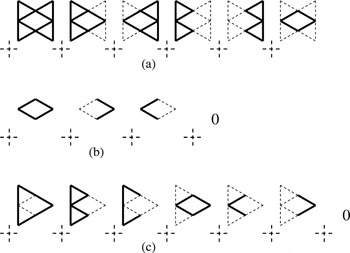
The new algebra handles shapes as spatial objects, not unlike Uij. For example, decompositions in Figure 5a, b, and c are the respective sum, product, and difference of decompositions in Figure 3 when computed in the framework

. Note that the resulting shapes differ from the input ones: the former are combinations of the latter.

Computing in : (a) sum, (b) product, and (c) difference of decompositions in Figure 3.
3. DECOMPOSITIONS AS SHAPE APPROXIMATIONS
Shape grammars and later shape algebras have a history of more than three decades as formal design theory tools. They have been established as formalizations of design practice. The algebras model what designers do when they draw and erase shapes, build, and modify models, or just move shapes around to produce new spatial relations. Grammars and algebras are capable of handling the emergence and ambiguity of shapes, which are important in the most creative, exploratory phase of a design process (Knight, 2003a, 2003b). In contrast, algebras of decompositions operate on sets of shapes, but these may or may not be seen as approximations of shapes. If decompositions are seen as shape approximations, the properties of their algebras should match those of shape algebras as closely as possible.
At minimum, an algebra for decompositions should be such that an appropriate shape algebra is homomorphic to it. This guaranties that the result of a computation carried on with decompositions of shapes is a decomposition of the result of the same computation carried on with the shapes themselves. Such symmetry between the two algebras is important if shapes in computations are to be approximated by their decompositions. Note that the mapping defining the homomorphism is the summation from Definition 2.
At maximum, algebras for shapes and decompositions should be isomorphic. At this point, symmetry between the algebras is complete and decompositions behave as shapes. Such an algebra of decompositions becomes a true algebra of analyzed shapes.
As an additional requirement, an algebra of decompositions should have enough power to inform the decision on whether two of its elements are analyzing the same shape. This renders the transition from an analyzed shape to the raw unanalyzed shape possible within the framework of the algebra.
3.1. Properties of set algebras of decompositions
Set algebras for decompositions compare favorably with shape algebras. All of the important properties of the latter, such as distributive and idempotent, are preserved by the former algebras. However, set algebras are less successful in satisfying minimum and additional requirements.
The minimum requirement holds for sums, but not for products and differences.
It is not possible to decide, by using operations and the relation of Dij, whether two of its different elements are decompositions of the same shape. The algebra sees decompositions as sets of shapes (Definition 1), rather then decompositions of shapes (Definition 2). It manipulates elements of decompositions as symbols disregarding their spatial properties.
This renders Dij an unlikely choice if computations with analyzed shapes are an objective. However, Dij is not without design applications.
Set algebras work well in situations where design is restricted to a finite kit of discrete parts, such that all shapes of interest are simple sums of the parts. Designing in the framework of a building system is a good example. Such systems usually offer kits of prefabricated building parts that may be assembled to produce a variety of buildings. Parts may range from structural members, like bearing walls or ceiling slabs, to architectural elements, such as partitions or facade articulations.
The set of all subsets of such a kit is a subalgebra of Dij, which is isomorphic with a certain subalgebra of Uij.
Let Kij be a finite set of pairwise discrete shapes (no two of its elements share parts),

the set of all of its subsets, and

the set of shapes obtained by summing the elements of

. Because elements of Kij are pairwise discrete shapes, combining them in products and differences yields no new shapes except for the empty shape. For example, if a, b ∈ Kij and a ≠ b, then a · b = 0 and a − b = a, if a = b, then a · b = a and a − b = 0. New shapes can only be produced in sums so that

is the set of all shapes that could be created from the shapes of Kij. In contrast, set

enumerates all of the decompositions of the former shapes into the latter ones. Mapping Σ that connects the two sets has some interesting properties.
Lemma 1. Mapping Σ from

is a bijection. █
Because

is an image of

, Σ is a surjection. To prove that Σ is an injection (one to one) we assume the opposite: there are two distinct decompositions in

that analyze the same shape in

. For the assumption to hold, there has to be at least one shape that is an element of one of the decompositions, but not an element of the other one. Say, decompositions A and B both analyze some shape a, and shape x is an element of A, but not of B. Consequently, x is a part of Σ A, but not of Σ B. The latter holds because x does not share parts with any of the elements of B because they all belong to Kij and so does x. However, Σ A = Σ B = a, which leads to a contradiction rendering x both a part of a and not part of a. This refutes the assumption rendering Σ an injection. Because Σ is both a surjection and an injection it is a bijection, which completes the proof.
Sets

are closed under set operations of Dij, and shape operations of Uij, respectively. They are Boolean parts of the two new algebras: decomposition algebra

and shape algebra

. The two new algebras are isomorphic in accordance with the following proposition.
Proposition 2. Algebras

are isomorphic. █
The isomorphism is framed by the bijection Σ. We only need to show that Σ preserves the operations of algebras. Sum is preserved because a + b = Σ A + Σ B = Σ(A ∪ B), where a and b are shapes from

and A and B are their respective decompositions from

. The same can be shown for product and difference to complete the proof of the proposition.
The new kit of parts algebra

computes with analyzed shapes in a meaningful way even though it does not see them as spatial objects. In formal design theory

algebras are used in systems like set grammars (Stiny, 1982) or structure grammars (Carlson et al., 1991), which work with predefined vocabularies of shapes. These systems have the same computational power as shape grammars and produce languages of designs similar to that generated by shape grammars. However, they cannot handle the emergence and ambiguity of shapes, which are important in creative phases of a design process. In contrast, shape grammars do that well (Knight, 2003a, 2003b).
3.2. Properties of complex algebras of decompositions
Unlike set algebras, complex algebras for decompositions do not preserve important properties of Uij algebras. There are two reasons for this.
First, it is known in universal algebra that the identities r = s valid in an algebra are also valid in its complex counterpart if and only if individual variables occur only once in both r and s (Guatam, 1957; Bleicher et al., 1973; Shafaat, 1974). However, most of the important identities of Uij are not of this kind. In particular, these defining idempotent, a + a = a, a · a = a, and distributive property, a · (b + c) = (a · b) + (a · c), a + (b · c) = (a + b) · (a + c) are valid in Uij, but not in

.
Second, the relation ≤′ is not a partial order, but a preorder. It is reflexive and transitive, but not antisymmetric. Consequently, Δij is not a partially ordered set so that identities that are valid in Uij, under some condition(s) expressed in terms of ≤, may not be valid in

. In particular, if a ≤ b, then a + b = b and a · b = a, and if a ≤ b and b ≤ a, then a = b are valid in Uij, but not in

.
Algebra

, does better than Dij when it comes to satisfying the minimum and the additional requirements above. The former holds if the differences are ignored, whereas the latter holds with no constraints.
Because it is possible to decide by using operations and the relation of

whether its two elements are decompositions of the same shape, the algebra sees decompositions as in Definition 2, that is as decompositions of shapes. This is handled by the following proposition.
Proposition 3. Let A and B be decompositions of shapes a and b, respectively, then a = b if and only if Σk=1,…,m′ A ≤′ Σk=1,…,n′ B and Σk=1,…,n B ≤′ Σk=1,…,m′ A, where m and n are cardinalities of A and B, respectively, and Σ′ is the extension of the sum +′ of

. █
Therefore, Σk=1,…,m′ A = A +′ A +′ A +′ … , where A appears m times on the right side of the equality. The proof then follows from the definition of ≤′ and the fact that a ∈ Σk=1,…,m′ A and b ∈ Σk=1,…,n′ B. The latter is due to the following lemma and its corollary.
Lemma 2. Let A = {x1, x2, … , xn} be a decomposition, the sum S(k) = Σi=1,…,k′ A, where A appears k-times as an argument with k ≤ n, contains an element y = Σi=1,…,k xi. Note that Σ′ is the extension of +′ of

whereas Σ is the extension of + of Uij. █
The proof is based on the definition of +′ where each element of one decomposition is combined in sum + with each element of the other decomposition. Therefore, the lemma holds for k = 2 because S(2) = A +′ A contains shape x1 + x2. If we assume that it holds for k, 2 < k < n, so that S(k) contains shape z = Σi=1,…,k xi, then it is easy to show that it also holds for k + 1. Sum S(k + 1) = S(k) +′ A contains shape z + xk+1 = (Σi=1,…,k xi) + xk+1 = Σi=1,…,k+1 xi, which completes the proof by the induction.
Corollary. Let A be as above and let a be the shape A analyzes, Σ S(n) then contains a. █
By Definition 2, a = Σ A = Σi=1,…,n xi whereas by the lemma above, S(n) contains Σi=1,…,n xi.
Note that the dual of Lemma 2 also holds, so that P(k) = Πi=1,…,k′ A contains an element y = Πi=1,…,k xi, where Π′ is the extension of ·′ whereas Π is the extension of ·.
Computations involving sums and products satisfy the minimum requirement. For example, the decompositions in Figure 5a and b analyze shapes in Figure 3c and d. The latter are the respective sum and product of the shapes in Figure 5a and b, whereas the former are the respective sum and product of their decompositions in Figure 5f and g.
Unfortunately, the minimum requirement is not satisfied by computations involving difference. For example, decomposition in Figure 5c analyzes shapes in Figure 3a. The latter is not the difference of the shapes in Figure 5a and b, although the decomposition is the difference of their decompositions in Figure 5f and g.
Although

treats shapes as spatial objects, the same way Uij does,

is still a poor choice for computing with analyzed shapes. It does not satisfy the minimum requirement and most of the important identities (properties) of Uij.
However, as with Dij, special kinds of decompositions form a subalgebra in

, which is capable of handling analyzed shapes in a meaningful way. The decompositions are singletons containing the shape they analyze and nothing else. Approximating a shape with itself does not add much to the shape description, so that an algebra of such decompositions should behave as a shape algebra. This is true due to the following result.
Proposition 4. Any identity r = s valid in Uij is valid in

if a singleton from

is assigned to each individual variable occurring more than once in r or s. █
This proposition is valid for any algebra and its complex counterpart; however, the proof in its generality is left to mathematicians. We will only show that it holds for one of the identities defining the distributivity of Uij. Let A, B, C ∈

. The identity A ·′ (B +′ C) = (A ·′ B) +′ (A ·′ C), defining distributivity of ·′ over +′, is not valid in

, because A occurs twice on the right-hand side. However, if A is a singleton {a}, the identity becomes {a} ·′ (B +′ C) = ({a} ·′ B) +′ ({a} ·′ C) (′). Elements of {a} ·′ (B +′ C) are, in accordance with definitions of the operations ·′ and +′, of the form a · (x + y), where x ∈ B and y ∈ C. In contrast, all of the elements of ({a} ·′ B) +′ ({a} ·′ C) are of the form (a · x) + (a · y). Because Uij is distributive, a · (x + y) = (a · x) + (a · y), so that identity (′) holds.
The algebra for singleton decompositions can now be constructed as follows. The set Aij ⊂ Δij of singleton decompositions together with operations +′, ·′, and −′ forms the Boolean part of a new algebra Aij. The group part and the operation of the group action of Aij are the same as in

.
Proposition 5. The new algebra Aij is a subalgebra of

isomorphic with Uij. █
For

to hold Aij should be closed under the operations of

. Indeed, according to definitions of these operations we have {a} +′ {b} = {a + b}, {a} ·′ {b} = {a · b}, and {a} −′ {b} = {a − b}, where a, b ∈ Uij and {a}, {b} ∈ Aij (′). In set theory, a singleton (decomposition) can uniquely be specified as {a} = {x| x = a}, whereas (shape) a can be “recovered” from the singleton (decomposition) via ∪{a} = a. Therefore, there is one to one correspondence between shapes and their singleton decompositions. This correspondence preserves operations of Uij as evident in identities (′), which completes the proof.
3.3. Algebras of analyzed shapes
Even though

treats shapes as spatial entities, the only analyzed shapes it can meaningfully handle are (trivial) singleton decompositions. This is rather disappointing because analyzed shapes play an important role not only in design, but also in our everyday lives. However, there is still some room for improvement of

.
One can normalize operations of

to make a shape algebra homomorphic to it, the minimum requirement. The normalization relies on the concept of relativization of the structure of a shape to its subshape. In

, the relativization can be expressed in accordance with the following proposition.
Proposition 6. Let a be a shape,

its decomposition, and shape b its part. Set B = {b}·′ A is a decomposition of b, which is the relativization of A to b. █
Set B = {b} ·′ A = · ({b} × A) = {x · y| x ∈ {b}, y ∈ A} = {b · x| x ∈ A}, which is, according to Definition 3, the relativization of A to b.
If A is the result of a computation with decompositions and b is the result of the same computations carried on with the corresponding shapes, then B is the result of the normalized operation. If A is the result of a sum or a product, then B = A, which means that normalization does not affect these operations. The normalized sum +* and product ·* are the same as +′ and ·′. Normalization affects only the difference, which becomes A −* B = {Σ A − Σ B} ·′ (A −′B) = A −′ {Σ B}, where A and B are decompositions. Set A −* B is clearly a decomposition of the difference of shapes analyzed by decompositions A and B. It has the structure of A, but not of B.
It is now possible to define a new normalized complex algebra of decompositions

, which is the same as

except for the Boolean operations, which are now normalized.
For example, the decompositions in Figure 6a, b, and c are the respective sum, product, and difference of decompositions in Figure 3 when computed in the framework

. Note that sum in Figure 6a and product in Figure 6b are the same as the ones computed in the framework of

(Fig. 5a,b).

Computing in : (a) sum, (b) product, and (c) difference of decompositions in Figure 3.
The new algebra satisfies the minimum requirement: Uij is homomorphic to it. However, the two algebras still have different properties.
These differences could be largely reduced if the ordering on decompositions is changed to reassemble that on shapes. Relation ≤′ is a preorder on Δij, whereas ≤ is a partial order on Uij. Universal algebra provides a procedure for turning a preordered set into a partially ordered one (Vickers, 1989). The partially ordered set can then be extended to an algebra to handle analyzed shapes.
The procedure starts with equivalence relation ≡ defined on Δij in terms of preorder ≤′. Two decompositions A and B are equivalent with respect to ≡, or equivalent modulo ≡, or A ≡ B, if and only if A ≤′ B and B ≤′ A.
For example, decompositions in Figure 7a and b are equivalent modulo ≡. Every element of the former decomposition is a part of shape c from the latter decomposition. In contrast, the empty shape from the former decomposition is a part of every element of the latter decomposition. Consequently, the latter includes the former decomposition in accordance with the definition of ≤′. It is easy to verify that the relation also holds if the decompositions exchange places.

(a,b) Decompositions are equivalent modulo ≡. Every element of (a) is a part of (c) the shape included in (b). The empty shape in (a) is a part of every element of (b). Every element of (b) is a part of shape (c) included in (a). The empty shape in (b) is a part of every element of (a).
In the next step, Δij is partitioned so that decompositions equivalent modulo ≡ are grouped into subsets or equivalence classes. Each decomposition A belongs to a class [A] ≡ and the set of all equivalence classes is a quotient set Δij/≡.
Finally, set Δij/≡ is partially ordered by ≤′ so that [A]≡ ≤′ [B] ≡ if and only if A ≤′ B (Vickers, 1989).
Each equivalence class of Δij/≡ contains decompositions that have the following common properties.
Proposition 7. Two decompositions are equivalent modulo ≡ if and only if they share the sets of minimal and maximal elements. █
Let min A and max A denote sets of minimal and maximal elements of a decomposition A, and let B be a decomposition. We will first prove the following lemma.
Lemma 3. If A ≡ B, then max A ⊆ B, max B ⊆ A, min A ⊆ B, and min B ⊆ A. █
Let x ∈ max A. According to the definition of ≡, A ≤′ B and, according to definition of ≤′, there is y ∈ B such that x ≤ y. According to the same definitions, B ≤′ A and there is z ∈ A such that y ≤ z. Consequently, x ≤ y ≤ z (*) and because x is a maximal element of A and z is an element of A, the two have to be equal for (*) to hold. This makes x equal to y so that x ∈ B, which proves that max A ⊆ B. The proof of max B ⊆ A follows from the symmetry of ≡. The proofs of the last two assertions may be done in the similar fashion to complete the proof of the lemma.
Let us now assume that max A = max B and min A = min B. For every x ∈ A there is y ∈ max A such that x ≤ y, and because max A = max B, y ∈ B. Similarly, for every v ∈ B there is u ∈ min B such that u ≤ v, and because min A = min B, u ∈ A. Consequently, A ≤′ B in accordance with the definition of ≤′. The proof of B ≤′ A may be obtained in the similar fashion so that A ≡ B, which completes the proof of the “if” part of the proposition.
Now assume that A ≡ B, but the two do not have a common set of maximal elements. For example, there is an element x maximal in A but not in B. According to Lemma 3, max A ⊆ B so that x ∈ B. Because x is not maximal in B there is y ∈ max B such that x < y. Again, according to lemma 3, max B ⊆ A so that y ∈ A, and because x is maximal in A, x < y does not hold. This refutes our assumption that max A ≠ max B so that max A = max B holds. The proof that min A = min B holds could be obtained in a similar fashion, which completes the proof of the “only if” part of the proposition.
Corollary 1. Decompositions equivalent modulo ≡ are analyzing the same shape. █
Let A and B be two decompositions such that A ≡ B. The shape that A analyzes is Σ A and because a + b = a if b ≤ a, we can take Σ max A for Σ A. By the same token, the shape that B analyzes or Σ B is the same as shape Σ max B. According to Proposition 7, max A = max B so that Σ A = Σ max A = Σ max B = Σ B, which completes the proof.
Corollary 2. There is a unique smallest representative max A ∪ min A for each equivalence class [A]≡, where A is a decomposition. █
Note that the word smallest is related to the cardinality (number of elements) of decompositions.
For Δij/≡ to be extended to a quotient algebra, equivalence ≡ needs to be a congruence on

.
Proposition 8. Equivalence relation ≡ is a congruence on

. █
Let

and let A ≡ B and C ≡ D. For ≡ to be a congruence, substitution property has to hold for each operation of

. Substitution property for the sum is A +* C ≡ B +* D. Elements of max(A +* C) are of the form x + y, where x ∈ max A and y ∈ max C. In contrast, elements of max(B +* D) are of the form u + v, where u ∈ max B and v ∈ max D. Because, max A = max B and max C = max D, in accordance with Proposition 7, max(A +* C) = max(B +* D). Similarly, min(A +* C) = min(B +* D), so that, according to Proposition 7, A +* C ≡ B +* D, which proves that the substitution property holds for +*. It can be shown that the same property also holds for ·* and −*, which renders ≡ a congruence on

.
It is now possible to construct a quotient algebra

, with elements that are classes of decompositions that share the shape they analyze and sets of minimal and maximal elements. The set of such classes is partially ordered with a smallest element, which is a one-element equivalence class of {0}, but with no greatest element.
Computations in

are carried on as in

. For example, computations in Figure 6 may be seen as computations in

, except that the decompositions are now seen as representatives of their equivalence classes. Consequently, any other representative of the same class may be used in the place of any of the decompositions. For example, decomposition in Figure 6a may be replaced with decomposition in Figure 8a because they belong to the same equivalence class. That is, they share sets of maximal and minimal elements, represented in Figure 8b and c, respectively.

(a) Decompositions and Figure 6a belong to the same equivalence class. (a,d) Decompositions both analyze (b) the shape, but they do not belong to the same equivalence class. Their sets of maximal and minimal elements are different: (b,c) for (a), and (c) and {0} for (d), respectively.
Although all decompositions of an equivalence class are guaranteed to analyze the same shape, there are other classes in

with decompositions that analyze that very shape.
For example, decompositions in Figure 8a and d both analyze the shape in Figure 8b, but they do not belong to the same equivalence class. The former decomposition has a singleton containing the shape (Fig. 8b) as the set of maximal elements and the decomposition in Figure 8c as the set of minimal elements. In contrast, the decomposition in Figure 8d has c as the set of maximal elements and a singleton containing an empty shape as the set of minimal elements.
There is no one to one correspondence between shapes of Uij and classes of

so that the two algebras are not isomorphic. However, any subalgebra of

whose elements enumerate shapes in a one to one fashion is isomorphic with Uij.
For example, the algebra Aij of singleton decompositions can be constructed as a subalgebra of

. For each singleton {a}, sets of maximal and minimal elements are equal and both are equal to {a}. This places {a} into an equivalence class of

, with {a} the only element.
The following proposition sheds some light on the structure of decompositions that are building blocks of subalgebras of

that are isomorphic with Uij.
Proposition 9. Only decompositions that contain the shape they analyze and have exactly one minimal element qualify as the members of equivalence classes forming a subalgebra of

isomorphic with Uij. █
Members of the Boolean part of such a subalgebra are equivalence classes of decompositions, which according to Proposition 7, are characterized by the common sets of maximal and minimal elements. Proposition 9, however, requires these sets to be singletons. The following two lemmas prove this statement.
Lemma 4. No subset of

with elements that are classes of decompositions characterized by nonsingleton sets of maximal elements is a subalgebra of

isomorphic with Uij. █
Let

be such a subset and let [A] ≡ be one of its elements, where A = {x1, x2, … xn}, maxA = {x1, x2, … xk}, 2 ≤ k ≤ n, and A analyzes shape a. If we take a finite sum Σi=1,…n* [A]≡ = Σi=1,…n′ [A]≡ = [Σi=1,…n′ A]≡ = [S(n)]≡ then, according to the corollary of Lemma 2, a is an element of S(n). Because Uij is homomorphic to

, both S(n) and A are analyzing the same shape, a. Consequently, max S(n) = {a}, and because k ≥ 2 max A = {x1, x2, … xk} ≠ max S(n) so that [A]≡ ≠ [S(n)]≡. This means that if [S(n)]≡ is an element of Vij and Vij is a subalgebra

, then Vij is not isomorphic with Uij because shape a is represented by the two different elements: [A] ≡ and [S(n)]≡ of Vij. If [S(n)]≡ is not an element of Vij, then Vij is not a subalgebra of

, which completes the proof.
Lemma 5. No subset of

with elements that are classes of decompositions characterized by nonsingleton sets of minimal elements is a subalgebra of

isomorphic with Uij. █
The proof is similar to that of Lemma 4 except that P(n) = Πi=1,…,n′ A and the dual of Lemma 2 are used in the place of S(n) and Lemma 2.
According to the lemmas above, only subsets of

with elements that are equivalence classes of decompositions characterized by singleton sets of minimal and maximal elements may be subalgebras of

isomorphic with Uij. If max A is a singleton, it has to be equal to {a}; however, for min A we have more options. For example, in Aij, min A is the same as max A, namely {a}.
Another example of a subalgebra of

isomorphic with Uij is based on equivalence classes of decompositions that recognize the shape they analyze, as well as the fact that the empty shape is a part of any shape. It may contain other parts too, but has, at least, to recognize the two. Such a decomposition satisfies Proposition 9 with minimal element 0. For each shape a ∈ Uij there is exactly one equivalence class [{a, 0}]≡ of such decompositions that corresponds to a. Set Cij ⊂ Δij/≡ of such equivalence classes can be elevated to an algebra in accordance with the following result.
Proposition 10. Set Cij together with operations +*, ·*, and −*, is the Boolean part of an algebra Cij, which is a subalgebra

isomorphic with Uij. █
Let a and b be shapes from Uij, A and B their respective decompositions, and t a transformation from the group part of

. In addition, let A and B be members of some equivalence classes of Cij.
Because [A]≡ ∈ Cij, {a, 0} ⊆ A so that max A = {a} and minA = {0}. According to Corollary 2 of Proposition 7, there is a unique representative of [A] ≡, such that [A] ≡ = [max A ∪ min A] ≡ = [{a, 0}]≡. Consequently, there is only one equivalence class in Cij containing decompositions of a, each class of Cij corresponds to only one shape, and for every shape in Uij there is a corresponding class in Cij. The correspondence is a bijection, thus, enumerating all of the elements of Uij and Cij. It needs to be shown that the correspondence also preserves the operations and transformations of Cij (or Uij).
For the sum we have [A]≡ +* [B]≡ = [{a, 0}]≡ +* [{b, 0}]≡ = [{a + b, a, b, 0}]≡ = [{a + b, 0}]≡ ∈ Cij in accordance with Corollary 2 of Proposition 7. The result of the sum of equivalence classes is the equivalence class of the sum of corresponding shapes. The same is true for products and differences: [A]≡·*[B]≡ = [{a, 0}]≡ ·*[{b, 0}]≡ = [{a · b, 0}]≡ ∈ Cij and [A]≡ −* [B]≡ = [{a, 0}]≡ −* [{b, 0}]≡ = [{a − b, 0}]≡ ∈ Cij. This renders Cij a subalgebra of the Boolean part of

isomorphic with the Boolean part of Uij.
Set Cij is closed under transformations of

and the correspondence above preserves the transformations. We have t([A]≡) = t([{a, 0}]≡) = [{t(a), 0}]≡ ∈ Cij. Consequently, Cij and Uij are isomorphic, which completes the proof.
For example, each of the decompositions in Figure 3 may be augmented with an empty shape and used to compute in the framework of Cij as illustrated in Figure 9.

Computing in Cij: (a) sum, (b) product, and (c) difference of decompositions in Figure 3, each augmented with an empty shape.
Algebra Cij is the most interesting of the algebras constructed here. It computes with decompositions that are nontrivial shape approximations and behaves like a shape algebra. The shape approximations of Cij are rather general ones. They may contain any set of parts of a shape provided that the shape itself and the empty shape are included. This renders Cij an excellent choice as a framework for computations with decompositions seen as shape approximations. Computations carried on with shapes in the framework of Uij algebra can now be repeated with analyzed shapes in the framework of Cij algebra.
For example, the result [{a + b, a, b, 0}]≡ of the sum above seems like a reasonable explanation of the sum of shapes a and b. One should expect both a and b to be preserved by the sum. If we add two new parts c ≤ a and d ≤ b to the decompositions above, the same computation becomes the following:

The new parts are preserved, whereas their sum c + d, also included, extends the computation to the new parts. The two principles, preservation and extension, inform computations in Cij. A computation preserves as much as possible of the original parts, but also extends (to) these parts.
It has been believed that algebras Aij and Cij are the only subalgebras of

isomorphic with Uij (Krstic, 2004); however, Proposition 9 seems to allow for construction of some other such algebras. This is based on the fact that for a given shape a we can create an equivalence class [{a, f (a)}]≡ to represent a. Operator f (on the Boolean part of Uij) has to be chosen so that f (a) is a part of a. For a set of such equivalence classes to be an algebra isomorphic with Uij, operator f has to satisfy the following five conditions:

where a and b are shapes from the Boolean part of Uij and t is a transformation from the group part of Uij.
Because every shape is guaranteed to be a part of itself and to have 0 as a part we can take operator f to be an identity f (a) = a or a constant f (a) = 0 and get algebras Aij and Cij, respectively. In both cases, f satisfies all five of the conditions above. We may also try some other ways of defining f.
For example, we can pick parts of a by using some fixed shape c so that f (a) = a · c, or alternatively f (a) = a − c. In both cases, f satisfies first four of the above conditions, rendering the related sets of equivalence classes, algebras isomorphic, with the Boolean part of Uij. However, f fails the fifth condition, and the related sets are not closed under transformations of the group part of Uij.
To satisfy the fifth condition we may choose f so that it involves transformations. For example, f (a) = a · τ(a), or alternatively f (a) = a − τ(a), where τ is a transformation defined in a coordinate system local to a. When a is transformed, so is its local coordinate system. If a is represented by an equivalence class [{a, a · τ(a)}]≡, then t(a) is represented by [{t(a), t(a) · t ○ τ ○ t−1(t(a))}]≡ = [{t(a), t(a) · t ○ τ(a)}]≡, where ○ is a group composition. Alternatively, if a is represented by [{a, a − τ(a)}]≡, then t(a) is represented by [{t(a), t(a) − t ○ τ(a)}]≡. Although f satisfies the first and fifth condition, it fails the second and the third one. We may choose for τ to be defined in a global coordinate system. Thus, if a is represented by [{a, a · τ(a)}]≡, or by [{a, a − τ(a)}]≡, then t(a) is represented by [{t(a), t(a) · τ(t(a))}]≡ = [{t(a), t(a) · τ ○ t(a)}]≡ or [{t(a), t(a) − τ ○ t(a)}]≡, respectively. This again satisfies the first four conditions but fails the last one because τ ○ t(a) may differ from t ○ τ(a).
Although all of the possibilities for f have not been exhausted, we may speculate with a great certainty that f (a) = a and f (a) = 0 are the only solutions that satisfy all of the conditions above. Thus, we have the following conjecture.
Conjecture 1. Algebras Aij and Cij, which are subalgebras of

isomorphic with Uij, are the only such subalgebras. █
Conjecture 1 singles out both: algebra Cij, as the only nontrivial algebra for analyzed shapes, and also decompositions that recognize the shape they analyze as well as the empty shape as the only meaningful shape approximations.
3.4. Properties of decompositions
Thus far, different algebras of decompositions were constructed and analyzed. Now, attention will be shifted to different decompositions of shapes emerging with these algebras. Seven algebras Dij,

, have been defined. The first four compute with general/unstructured decompositions, whereas the remaining three use different kinds of structured decompositions.
The structure of decompositions unfolds on two levels: local, exposing the relations between the elements of a decomposition; and global, relating these elements to the parts of the shape analyzed by the decomposition. If a decomposition is to be an approximation of a shape, then its structure on the global level is of the most importance. All parts of the shape should be represented by the elements of the decomposition. There are infinitely many shape parts, but only finitely many elements so that the relation between the two is many to one.
For a given shape a, its part x, and its decomposition A, this relation is as follows. There may exist two elements y and z in A such that y is a part of x and x is a part of z, or y ≤ x ≤ z. Decomposition A approximates part x by means of elements y and z. If y exists, then x is bottomed by y, or x has at least properties of y. If z exists, then x is topped by z, or x has at most properties of z. If both elements exist, then x is bounded by y and z, or x has at least properties of y and at most properties of z. If neither y nor z exist, then x is not recognized by decomposition A. All elements of A, when seen as parts of a, are bounded by themselves.
Algebra Aij works with singleton decompositions that are singleton sets of Δij. These contain only the shape they decompose and nothing else. Each part of the shape is trivially represented, topped, by the shape itself (i.e., it has at most properties of the shape).
In set algebras, where shape parts are of the most importance, singletons inform that the shape is a part of itself. Singletons are less informative in complex algebras. The former depend on shape structures, but singletons by themselves do not structure shapes. Singletons and their algebras simply demonstrate that complex algebras behave well in a boundary case. They do so by validating all of the identities of Uij, as shown in Proposition 4.
Algebra

uses discrete decompositions, or subsets of a finite set Kij of pairwise discrete shapes. No two elements of such a decomposition have common parts. Approximating shapes with discrete decompositions is thrifty, with no redundancy or ambiguity. The only shape parts that are bounded are the elements of a decomposition. All other parts are topped by only one element, bottomed by one and possibly more elements, or not recognized at all. Any part of the shape that consists of proper parts of two or more elements of the decomposition is not recognized.
The set in Figure 10a is an example of a discrete decomposition of the shape in Figure 3a, whereas the shapes in Figure 10b, c, and d are its proper parts. The shape in Figure 10b is topped by the first element of decomposition a, shape c is bottomed by both the second and the third element of decomposition a, whereas shape d is not recognized by a.

(a) A discrete decomposition of the shape in Figure 3a, with shape parts that are (b) topped, (c) bottomed, or (d) not recognized by decomposition (a).
Discrete decompositions are good representations of finished designs ready to be assembled from the parts that are elements of the decompositions.
By including the sums of the original elements, a discrete decomposition could extend to a hierarchical structure. Hierarchies are often used in design and elsewhere because their straightforward structure shows not only the parts of a shape, but also the way the parts are put together to assemble the shape.
The algebra of analyzed shapes Cij computes with bounded decompositions, which are, as shown earlier, the only meaningful shape approximations. These recognize the shape they analyze and the empty shape and can include other shape parts besides the two. At a minimum, no other parts are included. Every shape part is guaranteed to be bounded (represented) by such a decomposition. However, at a minimum, this representation is a rather trivial one. At most, a part has properties of the shape itself, and at least, no properties at all. The other elements a bounded decomposition may contain contribute to a finer shape part representation. Shapes in Figure 5b and c are examples of bounded decompositions.
The two shapes recognized in a minimum bounded decomposition are important from the algebraic point of view. They work in computations to preserve structures and shape parts recognized by decompositions.
For example, if two shapes a and b are analyzed by their respective bounded decompositions A and B and if the product A ·* B is taken, then shape a from A combines with elements of B to preserve the structure recognized by B, whereas shape b from B combines with the elements of A to preserve the structure recognized by A. If b ≤ a, then a preserves elements of B as well. Similarly, b preserves elements of A if b ≤ a. The empty shape has the same function in sums: the one in A preserves elements of B and vice versa. Both a and b assure that the product, sum, or difference of A and B contains the shape it analyzes: a + b, a · b, or a − b, respectively.
Bounded decomposition may serve as the basis for creating more structured decompositions of shapes. They may satisfy additional conditions to become lattices, topologies, groups, and Boolean algebras.
4. DISCUSSION
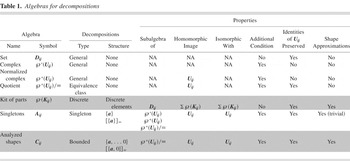
If algebras for shapes are good models of how shapes are used in design, then algebras of decompositions may inform on how analyzed shapes are utilized. Table 1 sorts all of the algebras for decompositions constructed here and highlights the ones suitable for computing with analyzed shapes. It also exposes relationships among the algebras and shows how they relate to shape algebras.
Algebras for decompositions

Unstructured decompositions are not suitable as approximations of shapes. Neither set nor complex algebras of general decompositions could be used to duplicate computations with shapes. This could only be achieved with decompositions structured in some ways. Two such structures were distinguished: discrete decompositions and bounded decompositions.
The structure of a discrete decomposition is minimum in the sense that there is no overlap between the elements. The same amount of material would be used for making all of the elements of a discrete decomposition as for making the shape itself.
However, bounded decompositions are far from being minimum because they always contain the shape they analyze and may contain some other parts as well. Although their structure comes from purely algebraic considerations, it is not without intuitive appeal. The presence of both, the shape analyzed by a decomposition and the empty shape, provides certain context for the other shape parts recognized by the decomposition.
The former shape assures that the parts are always seen in the context of the whole. This local context is given explicitly by the fact that the whole is a member of the decomposition. If a description is associated with a bounded decomposition, it contains the name of the shape analyzed by the decomposition. In this sense, bounded decompositions are named.
The empty shape in a bounded decomposition implies the global context in which the analyzed shape is placed. It shifts attention from shape parts to the shape surroundings, which are implied by the absence of the parts. In an associated description, the empty shape may map to a description of the shape surroundings.
Algebra Cij suggests that both local and global contexts are necessary for decompositions to be successfully used as shape approximations. How intuitive is this? Do we analyze (see) shapes with their parts always related to both the whole and its surroundings? These questions are interesting in their own right, but need to be decided by cognitive psychologists.
For our part, future research should concentrate on moving from general decompositions to ones tailored to specific applications. This may lead to decompositions with more elaborate structures.
As mentioned earlier, both discrete and bounded decompositions could be extended to more structured entities. The elements of such decompositions may form different algebras. The latter could then be combined within the framework of algebras capable of preserving the algebraic structure of decompositions.
For example, Stiny (1994, 2001) computes with decompositions that are topologies and Boolean algebras, whereas Krstic (1996) does it with decompositions that are lattices, hierarchies, topologies, Boolean algebras, and Boolean algebras with operators. Such decompositions are able to handle a variety of problems, from continuity of computations in shape grammars, to recasting spatial computations with shapes into nonspatial ones with symbols.
4.1. A note on implementation
Although this work is theoretical, the results obtained could lead to practical applications. It would be advantageous to be able to experiment with shape decompositions used as shape approximations, or analyzed shapes. This way the assumptions we make about shapes and their parts will be included in computations with shapes and affect the results of such computations.
Major domains of implementation for shape algebras are shape grammars (production systems), which use rewriting rules to generate designs. Grammars were introduced over three decades ago by George Stiny and James Gips, and were successfully used to generate new design styles and analyze the existing styles (Stiny, 2001). Computer implementations of shape grammars are many, ranging from general grammar interpreters (Krishnamurti, 1982; Krishnamurti, & Giraud, 1986; Chase, 1989; Piazzalunga & Fitzhorn, 1998; Tapia, 1999) to ones specific to certain design styles (Flemming, 1987; Agrawal & Cagan, 1998).
Algebras developed here should serve as a framework for a new kind of grammars for analyzed shapes (shape decompositions), thus extending the shape grammar formalism. Computer implementations of such grammars could be based on the existing shape grammar interpreters because operations of algebras

are extensions of shape operations (+, ·, and −) to direct products of decompositions. Such an operation can be computed by computing a number of shape operations.
For example, to compute the sum or product of decompositions A and B in

, we need to compute cardAcardB corresponding shape operations, where cardA and cardB are cardinalities of the respective decompositions. The same number of shape operations is needed to compute a difference in

. However, for difference A − B in

, only cardA shape operations is needed if the shape B analyzes is known. If this shape is not known, another cardB operations is needed to compute Σ B, which amounts to total of cardA + cardB operations for the difference. To transform a decomposition A we need cardA shape transformations. In

, the number of shape operations needed to compute a single analyzed shape operation could be further reduced if the unique smallest representatives for equivalence classes are used (Corollary 2 of Proposition 7), which for Cij will amount to just one shape operation. This is not surprising because Cij and Uij are isomorphic. However, by using the smallest representatives in Cij, all of the distinguished shape parts that are not included in the representatives are lost in computations. Therefore, there is no advantage in computing with decompositions instead of shapes themselves. Even without using the smallest representatives, computations could be reduced because bounded decompositions of Cij are guaranteed to contain empty shape so that shape operations involving it may be omitted. For the sum or product of decompositions A and B in Cij we need (cardA − 1)(cardB − 1) shape operations; and for the difference A − B or transformation t(A), cardA − 1 shape operations. Note that in the case of difference above there is no need to compute Σ B because it is already an element of B, and one only needs to keep track of it. The latter task is not difficult because of isomorphism between Cij and Uij. If one knows Σ A and Σ B, then computing Σ(A + B) is simple because it is equal to Σ A + Σ B. The same is true for products and differences, Σ(A · B) = Σ A · Σ B and Σ(A − B) = Σ A − Σ B.
A shape generation with a shape grammar starts with an initial shape, which is then gradually changed by recursive applications of shape rules. Similarly, an analyzed shape generation should start with an initial analyzed shape (shape decomposition). To change an analyzed shape C with a shape rule A → B, which replaces an analyzed shape A with an analyzed shape B, one needs a transformation t under which A becomes a part of C, or t(A) ≤′ C. If such t exists, then a transformed analyzed shape t(A) is removed from C and replaced with the transformed analyzed shape t(B) to create a new analyzed shape C′. This can be accomplished by computing four operations from an algebra for analyzed shapes, in accordance with the following expression.

To implement the expression above in Cij, one needs to compute cardA − 1 of shape operations for t(A), cardB − 1 for t(B), cardC − 1 for C − t(A) and another (cardC − 1) (cardB − 1) for the sum, which totals cardBcardC + cardA − 2 of shape operations. This is k = 1/4 (cardBcardC + cardA − 2) times more shape operations per rule application than is needed in standard shape grammars. Note that k = 1 if decompositions in the computations are of cardinality 2, which means at they are the smallest representatives. This is expected because Cij and Uij are isomorphic. If we take n for an average number of elements for decompositions in computations, then k = (n/2)2 is an approximation with less then 2% error for n > 50. Computation time is proportional to the square of cardinalities of decompositions in computations. The time could be reduced with the aid of parallel computing. Operations in Cij are extensions of shape operations to direct products of decompositions and are done componentwise, which may be computed in parallel.
Subshape evaluations necessary to determine transformation t are computationally the most complex operations a shape grammar interpreter faces. However, no complexity is added for evaluating decompositions of Cij. Because Cij and Uij are isomorphic, t(A) ≤′ C if and only if t(Σ A) ≤ Σ C so that shapes Σ A and Σ C could be evaluated instead of their decompositions A and C.
We have not elaborated on implementations of algebras

as there are no computational issues with these algebras. Decompositions of the first algebra are, for any practical application, shapes themselves whereas operations of the last two algebras are set operations, which are easier to implement than standard shape operations.
References
REFERENCES
Agrawal, M. &
Cagan, J.
(1998).
A blend of different tastes: the language of coffee makers.
Environment and Planning B: Planning and Design
25,
205–226.CrossRefGoogle Scholar
Birkhoff, G.
(1993).
Lattice Theory.
Providence, RH:
American Mathematical Society.
Bleicher, M.N.,
Schneider, H., &
Wilson, R.L.
(1973).
Permanence of identities on algebras.
Algebra Universalis
3,
72–93.CrossRefGoogle Scholar
Carlson, C.,
Woodbury, R., &
McKelvey, R.
(1991).
An introduction to structure and structure grammars.
Environment and Planning B: Planning and Design
18,
417–426.CrossRefGoogle Scholar
Chase, S.C.
(1989).
Shapes and shape grammars: from mathematical model to computer
implementation.
Environment and Planning B: Planning and Design
16,
215–242.CrossRefGoogle Scholar
Earl, C.
(1997).
Shape boundaries.
Environment and Planning B: Planning and Design
24,
668–687.CrossRefGoogle Scholar
Flemming, U.
(1987).
The role of shape grammars in analysis and creation of
designs. In
Computability of Designs
(Kaley, Y.E., Ed.), pp.
245–272.
New York:
Wiley.
Gratzer, G.
(1979).
Universal Algebra.
Providence, RI:
American Mathematical Society.
Gratzer, G. &
Whitney, S.
(1978).
Infinitary varieties of structures closed under the formation of
complex structures [Abstract].
Notices of the American Mathematical Society 25,
A224.Google Scholar
Guatam, N.
(1957).
The validity of equations of complex algebras.
Archives Mathematic Logik Grundlagenforch
3,
117–124.CrossRefGoogle Scholar
Knight, T.
(1988).
Comparing designs.
Environment and Planning B: Planning and Design
7,
73–110.CrossRefGoogle Scholar
Knight, T.
(2003a).
Computing with emergence.
Environment and Planning B: Planning and Design
30,
125–155.Google Scholar
Knight, T.
(2003b).
Computing with ambiguity.
Environment and Planning B: Planning and Design
30,
165–180.Google Scholar
Krishnamurti, R.
(1982).
SGI: A Grammar Interpreter [Research Report].
Centre for Configurational Studies, The Open University,
Milton Keynes.
Krishnamurti, R.
Giraud, C.
(1986).
Towards a shape editor: the implementation of a shape generation
system.
Environment and Planning B: Planning and Design
13,
391–403.CrossRefGoogle Scholar
Krstic, D.
(1996).
Decompositions of shapes.
PhD Thesis.
University of California, Los Angeles.
Krstic, D.
(1999).
Constructing algebras of design.
Environment and Planning B: Planning and Design
26,
45–57.CrossRefGoogle Scholar
Krstic, D.
(2001).
Algebras and grammars for shapes and their boundaries.
Environment and Planning B: Planning and Design
28,
151–162.CrossRefGoogle Scholar
Krstic, D.
(2004).
Computing with analyzed shapes. In
Design Computing and Cognition '04
(Gero, J.S., Ed.), pp.
397–416.
Dordrecht:
Kluwer Academic.CrossRef
Piazzalunga, U. &
Fitzhorn, P.I.
(1998).
Note on three-dimensional shape grammar interpreter.
Environment and Planning B: Planning and Design
25,
11–33.CrossRefGoogle Scholar
Shafaat, A.
(1974).
On varieties closed under construction of power algebras.
Bulletin Australian Mathematical Society
11,
213–218.CrossRefGoogle Scholar
Stiny, G.
(1980).
Introduction to shape and shape grammars.
Environment and Planning B: Planning and Design
7,
243–251.CrossRefGoogle Scholar
Stiny, G.
(1982).
Spatial relations and grammars.
Environment and Planning B: Planning and Design
9,
113–114.CrossRefGoogle Scholar
Stiny, G.
(1990).
What is a design.
Environment and Planning B: Planning and Design
17,
97–103.CrossRefGoogle Scholar
Stiny, G.
(1991).
The algebras of design.
Research in Engineering Design
2,
171–181.CrossRefGoogle Scholar
Stiny, G.
(1992).
Weights.
Environment and Planning B: Planning and Design
19,
413–430.CrossRefGoogle Scholar
Stiny, G.
(1994).
Shape rules: closure, continuity, and emergence.
Environment and Planning B: Planning and Design
21,
S49–S78.Google Scholar
Stiny, G.
(2001).
How to calculate with shapes. In
Formal Engineering Design Synthesis
(Antonson & E.K.,
Cagan, J., Eds.), pp.
24–60.
Cambridge:
Cambridge University Press.CrossRef
Tapia, M.A.
(1999).
A visual implementation of a shape grammar system.
Environment and Planning B: Planning and Design
26,
59–73.CrossRefGoogle Scholar
Vickers, S.
(1989).
Topology Via Logic.
New York:
Cambridge University Press.

Decomposition of a table: (a) the original shape and (b) its decomposition.
(a,b) Decompositions: the structure of (b) is recognized in (a) whereas its elements are not.
Computing in U12: (a,b) shapes and their (c) sum, (d) product, and (e) difference, as well as their respective (f,g) decompositions.
Computing in D12: (a) sum, (b) product, and (c) difference of decompositions in Figure 3.
Computing in : (a) sum, (b) product, and (c) difference of decompositions in Figure 3.
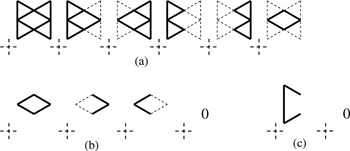
Computing in : (a) sum, (b) product, and (c) difference of decompositions in Figure 3.
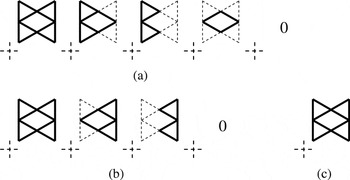
(a,b) Decompositions are equivalent modulo ≡. Every element of (a) is a part of (c) the shape included in (b). The empty shape in (a) is a part of every element of (b). Every element of (b) is a part of shape (c) included in (a). The empty shape in (b) is a part of every element of (a).
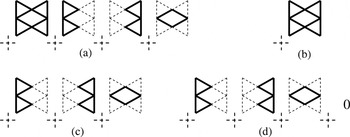
(a) Decompositions and Figure 6a belong to the same equivalence class. (a,d) Decompositions both analyze (b) the shape, but they do not belong to the same equivalence class. Their sets of maximal and minimal elements are different: (b,c) for (a), and (c) and {0} for (d), respectively.
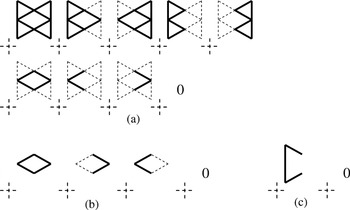
Computing in Cij: (a) sum, (b) product, and (c) difference of decompositions in Figure 3, each augmented with an empty shape.

(a) A discrete decomposition of the shape in Figure 3a, with shape parts that are (b) topped, (c) bottomed, or (d) not recognized by decomposition (a).
Algebras for decompositions
 You have
Access
- 13
- Cited by