Fears to some extent are considered normal throughout the development of children and adolescents (Beidel & Alfano, Reference Beidel and Alfano2011; Muris, Merckelbach, Mayer, & Prins, Reference Muris, Merckelbach, Mayer and Prins2000; Ollendick & March, Reference Ollendick and March2004). Nevertheless, when fears create unreasonable emotional distress and they are persistent, unbounded, or developmentally inappropriate they could be considered as pathological or as a part of a mental disorder (Beidel & Alfano, Reference Beidel and Alfano2011). Research indicates that, in a substantial minority of the children, childhood fears reflect serious anxiety problems which interfere with children’s daily routine (Muris et al., Reference Muris, Merckelbach, Mayer and Prins2000). Therefore, the accurate evaluation of fears of the youth is helpful for research on both normal and abnormal fears of young people. Among different measures evaluating fears of children and adolescents, the Revised Fear Survey Schedule for Children (FSSC-R; Ollendick, Reference Ollendick1983; Ollendick, King, & Frary, Reference Ollendick, King and Frary1989) is one of the most widely used. A number of studies confirmed both reliability and validity of the FSSC-R scores (King et al., Reference King, Ollier, Iacuone, Schuster, Bays, Gullone and Ollendick1989; Ollendick, Reference Ollendick1983; Ollendick et al., Reference Ollendick, King and Frary1989). Also, the discriminant validity of the FSSC-R scores has been shown by the significant discrimination of specific (simple) phobias and social phobia (Weems, Silverman, Saavedra, Pina, & Lumpkin, Reference Weems, Silverman, Saavedra, Pina and Lumpkin1999) and the schedule has been shown to be useful as a pre- and post-measure of treatment outcome (Kendall & Treadwell, Reference Kendall and Treadwell2007; Ollendick et al., Reference Ollendick, King and Frary1989). The FSSC-R has been translated into many languages including Chinese, Greek, Italian, Dutch, and Turkish (Bokhorst, Westenberg, Oosterlaan, & Heyne, Reference Bokhorst, Westenberg, Oosterlaan and Heyne2008; Di Riso, Salcuni, Chessa, & Lis, Reference Di Riso, Salcuni, Chessa and Lis2010; Dong, Yang, & Ollendick, Reference Dong, Yang and Ollendick1994; Mellon, Koliadis, & Paraskevopoulos, Reference Mellon, Koliadis and Paraskevopoulos2004; Serim-Yildiz & Erdur-Baker, Reference Serim-Yildiz and Erdur-Baker2013). All these translated versions of the FSSC-R have shown good reliabilities in terms of internal consistency (α = .94 – .97) and test-retest reliability (e.g., 2-week test-retest reliability of r = .88 in (Mellon et al., Reference Mellon, Koliadis and Paraskevopoulos2004)). Also the original factor structure of the FSSC-R has been replicated in the translated versions with minor changes or few extra factors (e.g., Di Riso et al., Reference Di Riso, Salcuni, Chessa and Lis2010; Mellon et al., Reference Mellon, Koliadis and Paraskevopoulos2004; Muris & Ollendick, Reference Muris and Ollendick2002).
The primary aim of this study was to investigate reliability and validity of the scores of the Farsi translation of the FSSC-R (namely, the FSSC-FA) so that the instrument could be used for anxiety research in the Iranian population.
In addition to the purpose of validating the FSSC-FA scores, considering fear profile differences which may be observed in the young people of varying cultures, we also hope that the results of the study contributes to the current cross-cultural understanding of fears in children and adolescents.
Method
Participants
Participants consisted of 400 third, fourth, and fifth grade students (210 females) recruited through five elementary schools in a modern city in North-East Iran, Mashhad. Data collection was carried out as part of a larger study between April and May 2013. The researchers utilized convenience sampling for recruiting the participants (i.e., the schools were not chosen randomly nor were the selected classrooms, but all children in any chosen classrooms participated in the study). Regarding the sociodemographic characteristics of the sample, it is worth noting that Mashhad is the second most populous city in Iran and it houses the holy shrine of one of the most respected persons in Shi’a Muslims’ faith. Consequently, a majority of people in Mashhad are religious and the people are (and so is our sample) from different origins and cultures because the city is a migrant destination. Overall, the participants included diverse social classes and were from both religious and non-religious families, though we didn’t obtain details of socioeconomic status or religiosity. Six participants rated all questions identically and therefore were removed from the study as being outliers. Thus the final sample consisted of 394 participants (206 girls) who were divided into three age groups: ages 9–9:11 (n = 86), 10–10:11 (n = 109), and 11–11:11 (n = 199).
Measure
The FSSC-R items were translated into Farsi. All items were literally translated except the item “Terrorists” which was changed to “Criminals” (because the concept of “terrorism” is not very familiar to Iranian children). The FSSC-R was administered as part of a battery of questionnaires following the completion of two inventories assessing depression and related cognitions. After a researcher introduced the questionnaire and gave a brief description of all items, participants completed the FSSC-R via paper and pencil during class time. A teacher was always available to provide assistance when necessary. The FSSC-R consists of 80 items which assess the intensity of a wide variety of fears. Respondents are asked to rate each item on a three-point fear scale, 1 = None, 2 = Some, and 3 = A lot. Because the number of missing values was small (11 missing values with at maximum two corresponding to each participant), all the missing values were replaced by the middle rating (2) for ease of analysis.
The response variance of each item was examined as in previous research (Mellon et al., Reference Mellon, Koliadis and Paraskevopoulos2004; Ollendick et al., Reference Ollendick, King and Frary1989). In the current study Ollendick et al.’s criterion was adopted, that is items were excluded from the analyses if more than 90 percent of the subjects did not report any fear on these specific items. No items were deleted because all items did show enough variance in our sample. We also did this analysis for each gender separately. The least feared items were Cats and Riding on the train (with 75.8% and 73.7% of children had no fears about respectively) among boys and Riding on the train and Talking on the telephone (with 79% and 78.6% had no fears about respectively) among girls. To determine face validity, before the analysis was done on the Farsi translation of the FSSC-R, a panel consisting of two psychologists and two elementary school teachers validated the questionnaire items. We asked them to provide reasons for their validations. Considering overall responses from the validators, we decided to drop ‘Being teased’ item from our analysis. It is good to mention that, this might be due to poor Farsi translation of the item, as the item has had high reliability in the original questionnaire (Ollendick et al., Reference Ollendick, King and Frary1989).
Data analysis
The Statistical Package for Social Sciences (SPSS) was used for computing descriptive statistics, correlations, and carrying out exploratory factor analyses (EFA). We used EFA to find the probable factor structure of the Farsi translation of the FSSC-R. We did subsequent confirmatory factor analyses (CFA) to evaluate the model based on this factor structure, to refine the model, and to evaluate and compare the finally obtained model by its one-factor rival model. The CFAs were carried out by means of the lavaan package in R (R Core Team, 2013; Rosseel, Reference Rosseel2012). Because of the three-point fear scales, polychoric correlations were used to do EFA, and Diagonally Weighted Least Squares (DWLS) estimation was used for CFA to overcome the problem of normality assumption violations. The R script that was run to perform the CFA can be found in the Appendix.
Results
Exploratory factor analysis
We used exploratory factor analysis as a precursor to confirmatory factor analysis (an approach proved viable by Gerbing & Hamilton, Reference Gerbing and Hamilton1996). Principle components analysis was utilized as the factor extraction method and since high correlations evidenced among factor scores in previous research (Ollendick et al., Reference Ollendick, King and Frary1989), direct oblimin method was used for factors rotation.
By dropping one item, due to the lack of face validity, EFA was carried out on the residual 79 items. A six-factor solution was deemed appropriate based on the scree test criterion and appearance of the established fear factors in previous research. It is worth to mention that Parallel Analysis (PA) and the Minimum Average Partial (MAP) methods (Watkins, Reference Watkins2006) also were applied and both techniques confirmed that up to 7 factors could be extracted. The six extracted factors accounted for 52.8% of the total variance in the sample. Subsequently the items were assigned to the factors representing the established fear categories with an exception of one new assumed category. The main basis for the assignment was the pattern coefficient matrix. Firstly, items were assigned to the factor on which they loaded most strongly. However, in instances that this was uninterpretable according to most other scale items, or secondary pattern coefficients were comparably large causing ambivalence in factor assignments, we assumed an unknown factor for the items under consideration and determined appropriate factor assignment for them by means of the subsequent CFA results. This eventually resulted in a six-factor structure similar to the factor structure reported by Ollendick et al. (Reference Ollendick, King and Frary1989). Three of the FSSC-R factors (“Fear of the Unknown”, “Fear of Failure and Criticism”, and “Fear of Danger and Death”) were replicated. The “Minor Injury and Small Animals” factor was split into the “Fear of Minor Injury” and “Animal Fears” factors. The “Medical Fears” factor didn’t appear in the factor structure and a new factor named “Fear of Darkness and Loneliness” was revealed instead.
Confirmatory factor analysis
In contrast to the approach adopted by the previous research that used CFA to examine the factor structure of the adapted FSSC-R obtained from EFA (e.g., Di Riso et al., Reference Di Riso, Salcuni, Chessa and Lis2010; Muris & Ollendick, Reference Muris and Ollendick2002), although the initial factor structure was taken from EFA, we explicitly made use of CFA to determine the final factor structure. Using CFA modification indices, we assigned ambiguous items (i.e., items we were ambivalent about assigning them to one factor or the other) to their best-fit factors. In addition, we removed unstable items which had poor parameter estimates.
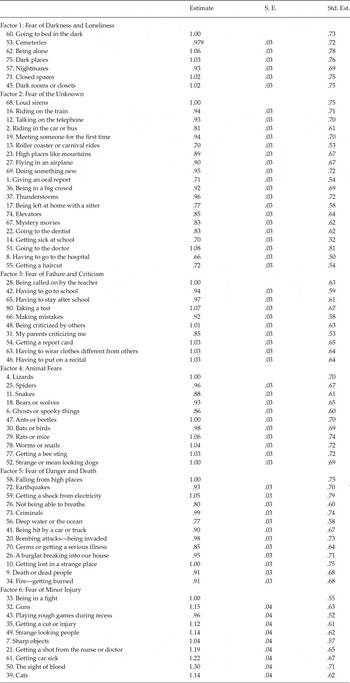
Firstly, we did CFA on the intact six-factor structure obtained from the precedent EFA (Model 1). Next, to refine the factor structure using modification indices, we assumed unknown factors for the items we were ambivalent about their most suitable factor (these items were included in the model with zero weights). The CFA modification indices were utilized then to assign these items to the factors in a way they contributed to the best model fit (Model 2). Afterwards, to improve the model further, items with poor parameter estimates (standardized parameter estimate < 0.5) were removed from the model (the removed items included “Getting poor grades”, “Having to eat some food I don’t like”, “Failing a test”, “Looking foolish”, “Being sent to the principal”, “Having my parents argue”, “Getting punished by mother”, and “Getting punished by my father”). The aforementioned procedure resulted in a 71-item, six-factor structure (Model 3). We examined these three models by means of CFA, along with a rival model consisting of one-factor associated with all final model items (Model 4). The items and factors associated with them and their parameter estimates in the final model are presented in Table 1 and the results of CFAs are shown in Table 2. As can be seen in Table 2, goodness-of-fit statistics obtained for Model 1 hardly demonstrates an acceptable fit: the chi-square/degrees of freedom ratio was > 4.0, RMSEA > .08, and CFI and NNFI slightly < .90. The fit indices of the respecified Model 2 were better than Model 1 and the final six-factor model with the poor items removed (Model 3) shows the best fit: the chi-square/degrees of freedom ratio was < 3.0, RMSEA clearly < .08, and CFI and NNFI approached .95. Finally, the rival one-factor model indicated poor model fit: the chi-square/degrees of freedom ratio was > 4.0, RMSEA > .1, and CFI and NNFI clearly < .90.
Parameter estimates for the final six-factor CFA model

Note: Estimate = unstandardized parameter estimate; S.E. = standard error; Std. Est. = standardized parameter estimate; lavaan output.
Goodness-of-fit statistics for the proposed models of the structure of the FSSC-FA as obtained by means of confirmatory factor analysis using DWLS estimation

Note: FSSC-FA = Fear Survey Schedule for Children—Farsi; RMSEA = Root Mean Square Error of Approximation; CFI = Comparative Fit Index; NNFI = Non-Normed Fit Index.
a 79 items.
b 71 items.
Reliability of FSSC-FA
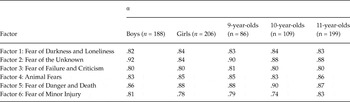
We computed reliability of total score of the Farsi translation of FSSC-R, in terms of internal consistency (Cronbach’s α), for all gender and age subgroups. The results ranged from .94 to .96 which show the excellent reliability of the adapted measure. Also internal consistencies for the FSSC-FA subscales are presented in Table 3 with regard to gender and age. The internal consistency of the FSSC-FA subscales was also good. All alphas were > .75 except for the factor “Fear of Minor Injury” in the 10-year-old subgroup.
Cronbach's alphas by gender and age for the FSSC-FA

Note: FSSC-FA: Fear Survey Schedule for Children-Farsi.
Age and gender differences
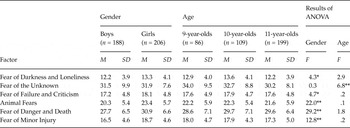
To examine age and gender differences in FSSC-FA scores, 2(gender) × 3(age groups) univariate and multivariate ANOVAs were carried out. The results of MANOVA indicated that there were significant age and gender differences on a linear combination of FSSC-FA subscales, age groups: Wilks’ lambda = .91, F(12, 768) = 3.11, p < .001; gender: Wilks’ lambda = .90, F(6, 384) = 7.70, p < .001. In addition, a significant interaction effect was found between gender and age groups, Wilks’ lambda = .92, F(12, 768) = 2.79, p < .001. The results of follow-up univariate ANOVA’s, as shown in Table 4, revealed that age effects were produced by only the subscale “Fear of the Unknown”, F(2, 389) = 6.8, p < .01, but the gender effect was present for all subscales except the subscale “Fear of Unknown”. Girls typically reported more fears than boys. The largest gender difference was for the subscale “Fear of Danger and Death” with the girls’ mean = 30.9 and the boys’ mean = 27.7, F(1, 389) = 29.2, p < .001.
Means and SDs by gender and age for the FSSC-FA factors

Note: FSSC-FA: Fear Survey Schedule for Children-Farsi.
* p < .05, **p < .001.
Intercorrelations among the FSSC-FA subscales
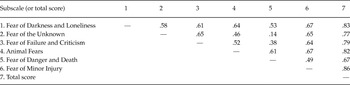
Intercorrelations among the FSSC-FA six scales sums and total score are shown in Table 5. The total score was highly correlated with all the subscales. With few exceptions, there were moderate intercorrelations among the FSSC-FA subscales. The “Fear of Danger and Death” subscale typically showed the lowest correlations with the total score and other subscales and the correlation between the “Fear of the Unknown” and “Fear of Danger and Death” subscales was not significant.
Intercorrelations among the FSSC-FA subscales and total score

Note: FSSC-FA: Fear Survey Schedule for Children-Farsi.
Most common fears
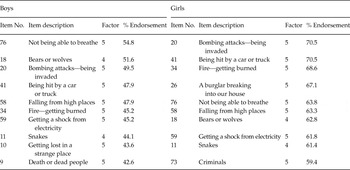
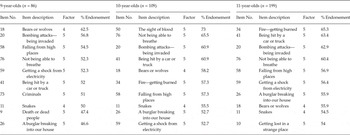
Table 6 and Table 7 present the 10 most common FSSC-FA fears by gender and age groups respectively, that is, those items that were most frequently endorsed with “a lot”. With the exception of the two items “Bears or wolves” and “Snakes” which belonged to the “Animal Fears” factor, each of the other fears belonged to the factor “Fear of Danger and Death”. It is interesting to note that the self-reported fears across gender and age groups were very similar. The fears were nearly always more common among girls, but generally their frequencies were not different across age groups.
Common fears of boys and girls

Common fears across age

Discussion
In this study, we examined the factor structure and psychometric properties of the Farsi version of the Revised Fear Survey Schedule for Children in a sample of Iranian children aged 9–11 years. We proposed a 71-item, six-factor schedule drawn from the original FSSC-R. Confirmatory factor analysis confirmed the factor structure of this schedule and resulted in satisfying fit indices. Similar to other studies used CFA to examine the rival one-factor model (Bokhorst et al., Reference Bokhorst, Westenberg, Oosterlaan and Heyne2008; Muris & Ollendick, Reference Muris and Ollendick2002), current study showed that the one-factor model did not provide a good fit for the data indicating that fearfulness in children could not be conceived of as only one general factor. The current factor structure is similar to the factor structure originally offered by Ollendick et al. (Reference Ollendick, King and Frary1989) and also to the factor structures reported and evaluated in further adaptations of the FSSC-R (Bokhorst et al., Reference Bokhorst, Westenberg, Oosterlaan and Heyne2008; Di Riso et al., Reference Di Riso, Salcuni, Chessa and Lis2010; Mellon et al., Reference Mellon, Koliadis and Paraskevopoulos2004). It is interesting to note that the factors “Fear of the Unknown”, “Fear of Failure and Criticism”, “Animal Fears”, and “Fear of Danger and Death”, that were the most stable factors in all versions of FSSC-R, are also present in the factor structure confirmed in the current study. The fact that the other mentioned factors such as “Medical Fears”, “Fear of Dark-Closed Places”, “Worries”, “School Performance Fears”, etc. were not as stable as the four abovementioned factors may shed light on the controversies concerning what the fear schedule measures (Muris & Ollendick, Reference Muris and Ollendick2002). Given the outcome that all these stable factors possess some generality and the high intercorrelations evidenced among the fear factors, one would suggest that instead of measuring specific fears, the FSSC-R and its adaptations measure general fear categories, which are fear categories that have meaningful underlying anxiety conceptualizations. Another feature of the factor structure confirmed in the study is that it does not include a factor consisting of items constituting the “Medical Fears” factor in the original FSSC-R, rather, these items showed higher loadings in the other factors. Not only were assignment of these items to the other factors meaningful and interpretable, but also CFA confirmed this assignment. It is curious that the item “Getting a shot from the nurse or doctor” was assigned to the “Fear of Minor Injury” factor and the items “Going to the dentist”, “Going to the doctor”, and “Having to go to the hospital” were assigned to the “Fear of the Unknown” factor. Although this outcome may be due to the particular characteristics of our sample, it may support the earlier mentioned general anxiety conceptualization. It may be of interest to note that Chapman and Kirby-Turner (Reference Chapman and Kirby-Turner1999) also believed that fear of the unknown is an important factor in dental fear. Other studies carried out by Muris and Ollendick (Reference Muris and Ollendick2002), Gullone and King (Reference Gullone and King1992), and Shore and Rapport (Reference Shore and Rapport1998) also failed to achieve a single factor composed of medical items. As a final note about the current factor structure, we point out that to achieve the best model fit, we removed 9 items from the original FSSC-R (one due to lack of face validity and 8 due to poor parameter estimates in a prior CFA) which all are found on the original “Fear of Failure and Criticism” factor. This raises a question: Why all these poor items pertain to this particular factor. A quick look at the items in the “Fear of Failure and Criticism” factor reveals that most of them have to do with fears children experience in relation to the school (e.g., “Being sent to the principal”, “Failing a test”) or their parents (e.g., “Having my parents argue”, “Getting punished by my father”). Given the cultural differences that probably exist between Iranian and Western schooling and/or parenting practices, it is not surprising that the translated items associated with this “social” fear subscale display poor psychometric properties in our sample. For example, consider the study by Chen and Stevenson (Reference Chen and Stevenson1989) that found cultural differences in beliefs and attitudes about homework among American, Chinese, and Japanese children. Similar to the attitudes toward homework, it is likely that non-Western children differ from their Western counterparts in their fears regarding other practices in the educational system. By the same way, research has shown that there are differences between Western and non-Western cultures not only in child rearing practices (Kelley & Tseng, Reference Kelley and Tseng1992) but also in how parenting relates to children’s behavior (Ho, Bluestein, & Jenkins, Reference Ho, Bluestein and Jenkins2008). In particular, with respect to physical discipline, Lansford et al. (Reference Lansford, Chang, Dodge, Malone, Oburu, Palmérus and Quinn2005) found in their cross-cultural study that in conditions of greater perceived normativeness, physical discipline was less strongly associated with adverse child outcomes. It can be implied from the studies mentioned above that culture might be influential in how children believe, feel, or behave within family and/or school contexts; children’s fears are no exception. To conclude, as shown in a study by Li and Prevatt (Reference Li and Prevatt2008) through comparison of data from the items of the Chinese translation of the FSSC-R with data from an open ended question, the translated “Fear of Failure and Criticism” factor might fail to tap the social and interpersonal fears adequately in non-Western cultures (see also Bodas & Ollendick, Reference Bodas and Ollendick2005).
The study showed that total and subscale scores of the FSSC-FA have acceptable internal consistencies indicating that the resultant scores are reliable for assessment of fears in Iranian children.
Consistent with the results reported by other studies about age and gender differences in children’s fears, the present study showed that gender differences were large but age differences were modest (Mellon et al., Reference Mellon, Koliadis and Paraskevopoulos2004; Muris & Ollendick, Reference Muris and Ollendick2002). However, regard to the subscale “Fear of the Unknown”, although there was not any difference between the fears of boys and girls, younger children scored higher. A few other studies (that were carried out in age groups similar to ones in the study) also reported significant differences for the “Fear of the Unknown” subscale among different age groups (King et al., Reference King, Ollier, Iacuone, Schuster, Bays, Gullone and Ollendick1989; Mellon et al., Reference Mellon, Koliadis and Paraskevopoulos2004; Shore & Rapport, Reference Shore and Rapport1998). One probable explanation for this is that as children age, there might be a decrease in the number of their “Unknown things”. Children may become familiar with several items of the “Fear of the Unknown” factor such as “Riding on the train”, “Giving oral report”, “Elevators”, and “Thunderstorms” as they get older. Although there is little evidence supporting this account, some studies suggested that familiarity could have an effect on fearfulness (Doogan & Thomas, Reference Doogan and Thomas1992; Smith, Burkle, & Archer, Reference Smith, Burkle and Archer2011). However, Gullone and King (Reference Gullone and King1997) did not report a decrease in unknown fears with age and reported declines in fears related to death/danger and to psychic stress/medical procedures.
As in two other studies reported intercorrelations among subscale scores of the FSSC-R and its Hellenic adaptation (Mellon et al., Reference Mellon, Koliadis and Paraskevopoulos2004; Ollendick et al., Reference Ollendick, King and Frary1989), we found moderate correlations among the subscales. The range of intercorrelations were similar between the studies that indicates further similarities between the factor structure of the FSSC-FA and other measures assessing children’s fears.
A review of the most endorsed fears of the Iranian children participated in the current study reveals that these prevalent fears are similar to those reported by studies in other countries or populations (King et al., Reference King, Ollier, Iacuone, Schuster, Bays, Gullone and Ollendick1989; Mellon et al., Reference Mellon, Koliadis and Paraskevopoulos2004). But there are specific items that show cultural or developmental characteristics existing in Iran. Children in North-East Iran showed a highly prevalent fear of “Bears or wolves”. Presumably this is due to dearth of these animals in the region the study was done. Perhaps if the study had been done in western regions of Iran, the results would have been different. Chinese children also rated bears as one of their “top 10” fears (Ollendick, Yang, King, Dong, & Akande, Reference Ollendick, Yang, King, Dong and Akande1996). Another common fear with unusual endorsement compared to other studies was the “Getting shock from electricity”. This fear was also quite common among Hellenic children (Mellon et al., Reference Mellon, Koliadis and Paraskevopoulos2004). As fear from electricity endorsed by children in a developed country as well, this fear may hardly be attributed to the developmental state in Iran, especially because the study was done in the Iran’s second modern city, rather we suggest this is because of great overprotective comments Iranian parents usually make about getting electricity shock. Nevertheless, one would note that more work of a cross-cultural nature that is based on emic assessment measures (measures developed within the culture) as opposed to the imposed-etic (measures developed in one culture and translated for use in a different culture like the current measure) assessment, may reveal more culture-specific fears in non-Western cultures like Iran (Gullone, Reference Gullone2000).
In conclusion, the results of the present study demonstrate that the resultant scores of the Farsi translation of the FSSC-R, FSSC-FA, which consists of 71 items in six factors, are valid for assessment of fears in Iranian children and adolescents. We evaluated reliability of total and subscale scores of the FSSC-FA in terms of internal consistency and examined the construct validity of the measure by means of exploratory and confirmatory factor analyses. However, these results should be interpreted considering certain limitations existing in the study. Firstly, the small sample size and that we did not controlled demographic variables such as socio-economic status (SES) may compromise generalizability of the findings. In addition, our sample consisted of young people residing in a modern urban area in North-East Iran. Given the diversity of cultures and ethnic groups existing throughout the country, an assumption that the results of the current study are easily generalizable to other Iranian populations would be a precarious one. Finally, we did not carry out a test-retest reliability analysis for the measure, nor did we investigate concurrent validity of the FSSC-FA scores using other fear or anxiety measures. Future studies should address these limitations to further confirm the validity of the FSSC-FA scores for assessment of fear in the Iranian youth.
APPENDIX
The R script used for the CFA in the study