1. Introduction
The term ‘genre’ can be traced as far back as Aristotle; it means ‘kind’ or ‘form’ and was used by the Greek philosopher in his Poetics to refer to major types of literature: poetry, drama and the epic. These divisions have expanded considerably, but the notion of genre as a particular type of literature has lasted into the present era. At the same time, it has been extended to refer to more popular cultural forms: soap opera, film noir, western, thriller, etc. These are terms which have entered into the popular consciousness and which are studied in the fields of cultural and media studies. In our own field of applied linguistics and educational linguistics, ‘genre’ has been used in the diverse contexts of the United States, Great Britain and Australia, most notablyFootnote 1. In North America, genre theory, sometimes called the New Rhetoric or Rhetorical Genre Studies, has taken a more sociological approach, while in Great Britain and Australia the approach to genre has been more linguistic. In all three domains, genre theory has been applied in pedagogic practice, with differing emphases (Flowerdew, forthcoming; Flowerdew, in press).
In this paper I want to consider some basic issues in genre analysis which I consider to be important for language teaching, especially foreign language teaching and English for Special Purposes (ESP).Footnote 2 In North America, in particular, there is a belief among some scholars that you cannot teach genre and that there is a particular danger in dealing with the linguistic patterning of genre, because genres are highly variable and unpredictable. As Benesch (Reference Benesch2001: 18) states: ‘. . . genres are not simply texts to be analyzed for their grammatical and discoursal features’. Rather, she argues, citing Mauranen, genre is ‘a social activity of a typical recognizable kind in a community, which is realised in language’ (Benesch Reference Benesch2001: 18). While accepting this precept and that there is more to genre than grammar and discoursal features, it has always been my belief that with learners whose first language is not English and whose exposure to the language may be limited to the context of the classroom, we have a duty – in addition to making students aware of the social and variable aspects of genre – at the same time to provide linguistic input (Flowerdew Reference Flowerdew and Johns2002). Learners need to be provided with this input so that they can develop and test their hypotheses about what might be said by whom, to whom, when, where, why and in what manner in the performance of a given genre or genres. Genre theory provides us with a powerful heuristic with which to develop such competence.
2. Action vs. propositional content in genre
It has been maintained in ESP theory since its inception that the types of texts used in particular fields have specific properties which distinguish them from other types of text. This being the case, the way we define and describe text may have an important bearing on the instruction that is offered. Genre is usually thought of in terms of action, but I want also to consider here the notion of content, in the sense of propositional content.
I think most informed ESP practitioners would have a basic understanding of the term genre as action, as staged, purposeful, communicative events. This conception resonates in the following summary of the views of various linguists from Bhatia (Reference Bhatia2004), as follows:
Genre is the study of situated linguistic behaviour in institutionalized academic or professional settings, whether defined in terms of typification of social and rhetorical action, as in Miller (Reference Miller1984), and Berkenkotter & Huckin (Reference Berkenkotter and Huckin1995), as regularities of staged, goal oriented social processes as in Martin (1993), or as consistency of communicative purposes, as in Swales (Reference Swales1990) and Bhatia (Reference Bhatia1993: 22).
In its emphasis on purpose, genre is inherently appealing to practitioners in ESP. It is purpose, after all, the third word of the ESP acronym, which provides the whole basis for our work. An analysis of how purpose is realised linguistically provides an organisational principle for syllabus and materials design. Similarly, the staged nature of genre provides for a description which is systematic, moving from one communicative stage, or purpose, to the next.Footnote 3
When we consider genre in terms of communicative purpose, we are concerned, as in the definition given by Miller (Reference Miller1984) in the above quote from Bhatia, with language as action. Language as action has traditionally been dealt with in that branch of pragmatics known as speech act theory. The problems of speech act theory in dealing with real world language data have been well documented (e.g. Flowerdew Reference Flowerdew1990), although, as Bazerman (cited in Swales Reference Swales2004: 67) points out, thinking of genres in terms of the actions they perform brings a useful ‘directedness’ to our analysis. The point I want to make here, though, is that in analysing genre only in terms of action we are neglecting other aspects of discourse and meaning that can help us in providing more complete descriptions, and the more complete our descriptions are, the better they are likely to carry over into practice, especially in terms of identifying form–function relationships (while at the same time recognising that such relationships are variable and flexible).
Swales (Reference Swales2004; also Askehave & Swales Reference Askehave and Swales2000), in a reconsideration of his better known proposals for genre theory (Swales Reference Swales1990), presents a potential text-driven model for genre analysis which puts more emphasis on the other dimensions I am interested in, as follows:
1 Structure + style + content + purpose
2 ‘Genre’
3 Context
4 Repurposing the genre
5 Realigning the genre network
The starting point for genre analysis, in this model, is thus structure + style + content + purpose. These four elements – according to Swales’ model – feed into the initial characterisation of a genre, which is then refined by a consideration of context, which in turn leads to a ‘repurposing’, which leads, finally, to a ‘realignment’.Footnote 4 What interests me here (although Swales does not develop it, because he is more interested in ‘repurposing’ and ‘realignment’ in genre analysis), is the grouping together of structure, style, content and purpose.
I don't know if Swales would agree with what I am going to suggest, but I would like to consider how I see these four elements interacting. Structure, the first of the elements listed, can be applied to any of the three other concepts, according to my suggested reading. So a model of genre would consider units of style, content and purpose, and structure would apply to how these units are put together. Purpose is what I have already discussed, in terms of action. So this leaves us with content and style, and I want to suggest today, along with Swales, that these are the two aspects of meaning that need to be added to action.
I will start with ‘content’ or propositional content, as I prefer to call it (I will discuss ‘style’ in the next section). Action and propositional content were the two important considerations in Wilkins's original (1976) framework for ‘notional syllabuses’, which led to the revolution in language teaching syllabuses based on ‘functions’ and ‘notions’ known as the ‘communicative approach’, as exemplified by the Threshold Level (Van Ek Reference Van Ek1976), associated work by the Council of Europe and, in our own field of ESP, the two most successful textbook series: English in Focus (Allen & Widdowson Reference Allen and Widdowson1974) (organised around functions) and Nucleus (Bates & Dudley-Evans Reference Bates and Dudley-Evans1976) (organised around notions), both now over three decades old. As was later acknowledged, a problem with these syllabuses was that they were limited to the individual utterance, for the most part, as opposed to connected discourse.Footnote 5
Fairclough (Reference Fairclough2003: 26) describes the relation between genre, action and content in a way that matches what I am trying to get at here:
One way of acting and interacting is through speaking or writing, so discourse figures first as ‘part of the action’. We can distinguish different genres as different ways of (inter)acting discoursally – interviewing is a genre, for example. Secondly, discourse figures in the representations which are always a part of social practices – representations of the material world, of other social practices, reflexive self-representations of the practice in question. Representation is clearly a discoursal matter, and we can distinguish different discourses, which may represent the same area of the world from different perspectives or positions.
So what we have been referring to as content is, for Fairclough, ‘representation’. Fairclough's approach is interesting because, while focusing on the content of discourse as representation, it at the same time expresses it as a ‘function’ of language. In fact, Fairclough (Reference Fairclough2003: 26–7) attributes a lot of his characterisation of discourse to Halliday and his three metafunctions of ideational (content, or representation), interpersonal (social interaction) and textual (how parts of texts are connected together) meaning (e.g. Halliday Reference Halliday1978).
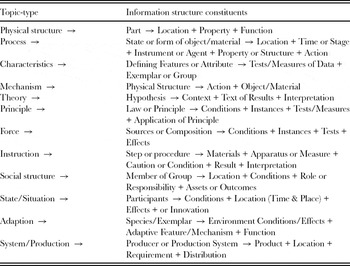
For me, a consideration of content in genre analysis is essential. In the ESP literature, quite a lot of work has in fact been done on studying discourse from a content point of view, although it is usually presented in terms of how the content is staged, or structured.Footnote 6 Paltridge (Reference Paltridge1996: 238) cites examples of various analyses of content, which he refers to as text types.Footnote 7 Thus Meyer (Reference Meyer1975), in an analysis of ‘expositions’, identifies four main types of text structure: time order, collections of descriptions, comparisons, and cause and effect. Hoey (1983) discusses problem-solution, general-particular, matching contrast, and hypothetical-real text types. Hedge (Reference Hedge1988) has static descriptions, process descriptions, narratives, cause and effect, discussion, compare and contrast, classifications, definitions and reviews. A lot of this work was anticipated by similar work by the group known as the Washington School at the University of Washington in the 1970s, as summarised in Trimble (Reference Trimble1985) under the rubric of rhetorical functions. Davies (Reference Davies1995: 110), in her model of reading, provides a framework for what she calls topic types and their structures, shown in Table 1. These topic types represent the cognitive organisation of what I am referring to as propositional content.
Davies's Model of Text Types (Davies Reference Davies1995: 110)

In science and technology, in particular, many texts have informational content foregrounded in models like this, rather than action, or purpose. Let me give you an example of a simple text written by a young (native English-speaking) school pupil quoted in Martin & Rose (Reference Martin and Rose2008: 42), where content would seem to be more to the fore than action (Table 2). The text is conveniently based on a scaffold provided by a teacher (shown in bold).
A text where content is to the fore (Martin & Rose Reference Martin and Rose2008: 42)

While this writing is obviously lacking in sophistication, it is, arguably, quite clear and effective in achieving its communicative purpose: to tell the reader about crocodiles. The scaffolding provided by the teacher is interesting here, because it is clearly in terms of propositional content.
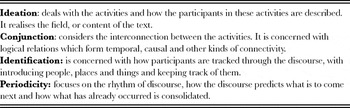
The most complete system for analysing content from a linguistic point of view that I am familiar with is, in fact, that of Martin & Rose (Reference Martin and Rose2003, Reference Martin and Rose2008), who incorporate a level they refer to as ‘discourse semantics’ into their model of genre (Table 3). This model, in its emphasis on linguistic realisation above the level of the sentence, overcomes one of the important limitations of the work of Wilkins referred to earlier. The model has four dimensions to do with content, as in Table 3.Footnote 8 An important feature of this model is that it operates at the level of discourse, rather than the individual sentence or utterance.
Content aspects of model of discourse semantics (Martin & Rose Reference Martin and Rose2008: 30)

3. Action and content vs. identity in genre
In the quotation from Fairclough earlier in this paper, as noted, he talks about action and representation (propositional content). I would now like to give you the continuation of this quotation, because Fairclough then goes on to discuss another function of discourse, which he refers to as ‘style’, the other element listed in Swales's model for genre theory that I referred you to earlier.Footnote 9
Thirdly and finally, discourse figures alongside bodily behaviour in constituting particular ways of being, particular social or personal identities. I shall call the discoursal aspect of this a style. An example would be the style of a particular type of manager – his or her way of using language as a resource for self-identifying (2003: 26).
Later, Fairclough (Reference Fairclough2003: 159) states that styles correspond to ‘identities’:
Styles are the discoursal aspect of ways of being, identities. Who you are is partly a matter of how you speak, how you write, as well as a matter of embodiment – how you look, how you hold yourself, how you move, and so forth. Styles are linked to identification . . . how people identify themselves and are identified by others.
‘Identity’ is the term I prefer to use here, rather than style, although we can say that identity is realised through style. Identity is not something that has traditionally been the focus of much attention in traditional ESP course design. In his discussion of this issue, Fairclough focuses primarily on individual identity. However, I would argue that both individual and professional identity construction are important for the ESP learner.
Let me deal first with professional identity. Professional identity is important because the ESP learner needs to know how language is typically used by members of the target disciplines or professions they are working towards or in. What are the typical stylistic features that mark a given discourse as emanating from a particular profession? Aspiring academic writers, for example, need to know the ‘tricks of the trade’ of published writers. They need to know when the personal ‘I’ is used and when a more impersonal style is more common, to take just one obvious example (Mur Dueñas Reference Mur Dueñas2007). Similarly, budding business executives need to know the way language is used by members of their chosen profession: for example, to what extent they should show deference in their discourse when dealing with their superiors and how ‘authoritative’ their language should be with more junior colleagues. It is also worth emphasising here that, as well as knowing what is typically said or written and how it is said or written, it is important to know what is not typically said or written, because, as Dressen & Swales (Reference Dressen, and Trosborg2000: 207) note, professional conventions are often most noteworthy in discoursal omissions.
The work of Bilbow (Reference Bilbow1995, Reference Bilbow1996, Reference Bilbow1997, Reference Bilbow and 1998) provides an interesting example of research into ESP professional identity. Bilbow recorded a series of regular business meetings held at a large international airline in Hong Kong. The meetings, which were in English, involved local Hong Kong Chinese and Western expatriates. Using the recordings in a training model that he developed, in which the recordings were played back to participants in focus group discussions, and concentrating on the directive speech acts of requesting and suggesting, Bilbow showed how the local Hong Kong Chinese participants realised that their use of language was much less direct and assertive than that of their Western counterparts, while the Westerners, on the other hand, saw themselves as much more direct and assertive than their local colleagues. The chair of the meetings, interestingly, found his own style to be too domineering and demeaning to some of his colleagues (especially the women). Bilbow (Reference Bilbow and 1998: 174) also has some interesting findings regarding the use of ‘bad language’ in these meetings:
‘Bad’ language, or the use of expletives and slang words (e.g. bloody, bugger up, etc.).
One of the most marked differences between native English-speaking chair-talk and nonnative English-speaking participant talk in the corpus is in the use of bad language. Such language is relatively common in the meetings in the corpus, but its use appears to be largely restricted to native English-speaking chairs.
In this case, of course, the models presented are not put forward to be emulated, but in a critical spirit, to encourage self-reflection and possible change. In analysing the language used by their colleagues and themselves in these meetings, the participants were asked to critically consider what might be an appropriate professional discourse style, or identity, for them to adopt.
Another example of applied linguistic research concerning professional identity is that of Spencer-Oatey (Reference Spencer-Oatey2000), again in the context of inter-cultural interactions involving Chinese and Western business people. While Bilbow focused his work on speech acts and their realisation, Spencer-Oatey used a much broader framework, arguing that ‘the management of harmony and dis-harmony’ needs to focus on five inter-related areas of interaction: the illocutionary domain (performance of speech acts), the discourse domain (choice of topic, structure and sequencing), participation domain (turn-taking, inclusion or exclusion of participants and back-channelling), the stylistic domain (choice of tone, formality level, register, etc.) and the non-verbal domain (including eye contact and hand gesture). Spencer-Oatey & Zing (Reference Spencer-Oatey and Zing2003: 39–41) elicited interesting interview data indicating disagreements about what corresponds to appropriate (discoursal) behaviour in inter-cultural business meetings. After one such meeting, the leader of the Chinese delegation, for example, commented as follows:
According to our home customs and protocol, speech is delivered on the basis of reciprocity. He has made his speech and I am expected to say something . . . Condescension was implied. In fact I was reluctant to speak, and I had nothing to say. But I had to say a few words. Right for the occasion, right? But he had finished his speech, and he didn't give me the opportunity, and they each introduced themselves, wasn't this clearly implied that they do look down upon us Chinese?
Clearly, training in inter-cultural discourse in situations such as this might have prepared the Chinese delegation for the behaviour of their British counterparts, on the one hand, and might have avoided the embarrassing treatment displayed by the British to their Chinese counterparts, on the other.
As well as professional identity, I would also argue that ESP learners may need to know how to project their own personal identity through their discourse. (In the earlier example from Bilbow's research, in fact, we have already seen how the chair of the meetings was led to reconsider his personal style.) After all, although there may be professional conventions, we do not want to create an army of total conformists. For a theory of personal identity in discourse, I think we can draw on the work of Goffman and his concept of ‘impression management’, as set out in his seminal ‘On the presentation of self in everyday life’ (Goffman Reference Goffman1959). Using the analogy of actors on a stage, impression management is, according to Goffman, the (conscious or unconscious) process people use to control the impressions they give to others and thereby influence the perceptions those others have of them. Goffman's work was based on observations he had made of Shetland Islanders and how they adapted their social participation by consciously or subconsciously anticipating the impression others would form of them. Goffman's work was not specifically linguistic in orientation, but he did emphasise how identity is ‘something which is constructed in interaction, rather than an individual state of being’ (Ivanič Reference Ivanič2005: 6).
How might a focus on individual identity work in practice? Interestingly, there is a fascinating article by Hyland (Reference Hyland2008) on the identity that John Swales, someone I have referred to elsewhere as the doyen of our field, creates for himself in his writing. I can do no better than quote from Hyland's abstract:
Based on a 340,000 word corpus comprising 14 single-authored papers and most chapters from his three main books, this paper sets out to identify the main features of this [Swales's] style. Using frequency, keyword and concordance analyses, I compare the Swales’ corpus with a broader applied linguistics corpus of 710,000 words and identify self mention, hedging and attitude, reader engagement and considerateness as characteristic of Swalesian rhetoric. I conclude with the view that this is a disciplinary voice informed by a keen assessment of his readers and representing an independent creativity shaped by an accountability to shared practices.
So, if an aspiring academic writer wants to adopt a style like that of Swales and create ‘a disciplinary voice informed by a keen assessment of [their] readers and representing an independent creativity shaped by an accountability to shared practices’, they might be well advised to read this analysis and focus on discursive features such as self mention, hedging, attitude, and the other features mentioned by Hyland to find out how to do it. If, on the other hand, they would prefer to carve out an identity for themselves along the lines of that of the well-known sociolinguist, Deborah Cameron, they can turn to Hyland's more recent work (Reference Hyland2009), where he compares the discursive identity of these two luminaries, Swales and Cameron. In actual fact, both of these individuals are probably too idiosyncratic to serve as models to be emulated. However, a consideration of the various discursive features, as identified by Hyland, might provide the sort of framework learners could be led to consider.
Now, let us take another example of how learners might be encouraged to consider their individual identity as projected through their discourse. Also looking at identity through writing, but with regard to the writing of students, not established academics, is Ivanič (Reference Ivanič1998). On the basis of an analysis of mature university students’ texts and their writing practices, Ivanič identifies three interrelated and overlapping aspects of writer identity. They are: autobiographical self: the ‘socially constructed and constantly changing identity which people bring with them to any act of writing’ (p. 24); discoursal self: ‘the impression – often multiple, sometimes contradictory – which [a writer] consciously or unconsciously conveys of themself in a particular written text’ (p. 25); and self as author: the authorial stance of the writer as authority, or ‘the writer's “voice” in the sense of the writer's position, opinion and beliefs’ (p. 26). I do not have time to discuss these aspects of identity in an any sort of detail, but I can give you some examples of the self as author, which is to do with ‘the writer's “voice” in the sense of the writer's position, opinions and beliefs’ (Ivanič Reference Ivanič1998: 26) and one of the discoursal self, which concerns how the discourse one is inhabiting (or the ‘style’) constructs one's identity. In places in Ivanič's data, her research participants talk about their ‘ownership’ of their writing, how they felt that it was ‘theirs’; this concerns their self as author. Here is an extract where Ivanič (Roz) is talking to one of her research participants, John (Ivanič Reference Ivanič1998: 221).
Roz: About style, are there parts you were more pleased with than others?
John: Yes, the last part. Sections where I use ‘I’ a lot better than where I try to adopt this academic style. Parts where I feel that I'm putting very important beliefs forward. (..) We're starting very much on my own thoughts, beliefs and feelings. These are all things I would want to voice and argue about and consider, issues that I'd really want to press forward.
And here is a comment from Justin (Ivanič Reference Ivanič1998: 219):
Justin: I'm delighted with it.
Roz: Why?
Justin: All sorts of ways. Partly because it's all things that have come from me rather than from anywhere else, although it's based obviously on basic influences it's nothing that I've read. I've just integrated it with my own ideas . . . it's all my own ideas based on my own observation.
At other points, Ivanič's participants feel uncomfortable about aspects of their writing, where they do not feel in control or where they project aspects of discourse with which they do not identify. This is a case of discoursal self. In the following extract (Ivanič Reference Ivanič1998: 228), John is unhappy with his use of the expression ‘opportune infections’:
Roz: Do you mind using it?
John: No, but I feel slightly embarrassed at using, because it's not me. In one sense I try to distance myself from the [language of the books I quote], and this has got little bits of it and I don't like that.
In all of these extracts from Ivanič, we see writers struggling with the identity they want to project of themselves in their discourse. Although these are native speakers, similar struggles are also experienced by L2 writers.
Working in a similar framework as Ivanič, Cadman (Reference Cadman2000) has a very appropriate example to do with individual identity construction. Cadman recounts how a young woman MA student had difficulty with a sentence in her thesis on Plato, Mill, Aristotle and feminism. The text contained the following sentence: ‘a basic distinction between the sexes is that men beget and women have bears’. Cadman tried to reformulate the sentence for the student with various alternatives, such as ‘a basic distinction between the sexes is that men beget and women bear children’, ‘a basic distinction between the sexes is that men beget but women bear children’, and ‘a basic distinction between the sexes is that men beget children but women bear them’, this last one corresponding most closely to what Cadman thought the writer probably wanted to say.
After it became clear to Cadman that the student was not comprehending, the following discussion ensued:
Cadman: Ah, so this is your point, about the Republic?
Student: Yes.
Cadman: So Plato himself does not use these words in the Republic.
Student: Oh yes, Plato uses these words.
Cadman: What is Plato's purpose in using these words? What point is he making?
Student: ? (Puzzlement)
Cadman: What point are you going to make?
Student: But it is true.
When Cadman suggested that she and the student find the extract in the Republic in order to clarify matters, the student admitted that, in fact, the statement did not come from Plato himself, but from a feminist critique of Plato, which was not referenced in her text. Cadman argues that the ‘plagiarism’ in question here resulted from the fact that the student was not approaching the text from her own individual perspective, but relying on sources, and so led to plagiarise. If the student had sought to develop her own perspective on the issue, Cadman implies, the student would not have had the difficulty she did in selecting the appropriate phrase from those offered by her teacher, because the need for such a phrase would not have arisen. Putting this another way, I think that this is a very good example of how writers with limited linguistic competence are led into difficulty in constructing their self identity, in this case speaking with what is often referred to as an individual voice (e.g. Belcher & Hirvela Reference Belcher and Hirvela2001).
4. Conclusion
I have argued that a focus uniquely on action, at the expense of content, on the one hand, and identity, on the other, in applied genre analysis is to leave a lot out that is important for fully understanding what is going on in any given text. If we are using genre as our model for pedagogy, then, by implication, this has important ramifications for ESP in particular and language teaching more generally. There are (at least) three types of meaning – action, propositional content and identity – not one, and all three need to be represented in our teaching. Of course, in any one instance of a genre or at any one stage in a given genre, one type of meaning may be more salient than the others and we may want to give this more attention at any point in our teaching, but all three will always be present (Fairclough Reference Fairclough2003: 26–27).
Let me also reiterate what I said in my introduction about the social context of genre and how genres are not just grammar and discourse features. Of course, it is important to consider the social nature of genres, how they can vary, how they can mix one with another and how they can change over time, how they are ‘stabilized for now’ constructs, in the words of Schryer (Reference Schryer1993). We might also like to consider, and this is something that will be for another paper, the critical side of genre analysis, how students need to consider genre and genre learning with a critical eye. But what I want to leave you with today is that, as well as these other considerations, it is highly important to consider the basic types of meaning I have talked about here and the possible ways they may be realised in the target language. The latter – the possible ways meanings are realised in the target language – is something which might be taken for granted by native speakers, but which is highly important for L2 language learners who are not exposed to the language on a highly regular, authentic basis. Without being prescriptive, it is essential that learners see what resources they may draw upon to establish the types of meaning – action, propositional content, and identity – that I have been talking about today.
Acknowledgements
I would like to thank the organisers of the CELC conference who initially invited me to present this paper and to acknowledge the support of Graeme Porte, editor of Language Teaching, and the reviewers, who gave me useful feedback for revising the original draft.
John Flowerdew is a professor in the English Department at City University of Hong Kong, Hong Kong, China. His research and teaching is in the field of applied linguistics, focusing on discourse studies and on language learning. He has authored or edited 11 books and special editions of journals, and has published over 100 book chapters and internationally refereed journal articles. He serves on the editorial boards of a range of international journals and book series and is regularly invited to give plenary talks at conferences worldwide.