Introduction
Bulbothrix Hale is a genus of parmelioid lichens mainly characterized by small thalli, lobes with bulbate marginal cilia and atranorin in the cortex (Hale Reference Hale1974, Reference Hale1976; Elix Reference Elix1993). However, recent phylogenetic studies demonstrate that the genus, as currently circumscribed using morphological and chemical characters, is polyphyletic with species containing salazinic acid closely related to Parmelinella wallichiana (Taylor) Elix & Hale (Divakar et al. Reference Divakar, Crespo, Blanco and Lumbsch2006, Reference Divakar, Lumbsch, Ferencova, del Prado and Crespo2010; Crespo et al. Reference Crespo, Kauff, Divakar, del Prado, Pérez-Ortega, Amo de Paz, Ferencova, Blanco, Roca-Valiente and Núñez-Zapata2010; Benatti Reference Benatti2012d , Reference Benatti2013a ). Sixty-one species are currently recognized in the genus Bulbothrix s. lat. (Reference BenattiBenatti Reference Benatti2011, 2012a–d, 2013a–c, 2014; Reference BenattiBenatti Reference Benatti&Elix Reference Benatti and Elix2012; Bungartz et al. Reference Bungartz, Benatti and Spielmann2013; Zhang et al. Reference Zhang, Wang, Liu, Li, Shi, Ye and Wang2014). These species are mainly tropical-subtropical (Elix Reference Elix1993) but several species extend to temperate regions (Calvelo & Adler Reference Calvelo and Adler1999).
Lying near the Tropic of Capricorn c. 700 km east of Madagascar in the Indian Ocean, the Mascarene archipelago is part of the Madagascar and Indian Ocean Islands biodiversity hotspot (Mittermeier et al. Reference Mittermeier, Gil, Hoffman, Pilgrim, Brooks, Mittermeier, Lamoreux and da Fonseca2004), and its moist forests (together with those of the Seychelles islands) belong to the “Global 200 ecoregions with outstanding biodiversity” (Olson & Dinerstein Reference Olson and Dinerstein2002). Until 1990, a single Bulbothrix species [B. suffixa (Stirt.) Hale] was reported from the Mascarenes, based on a single specimen collected by R. E. Vaughan in Mauritius (Hale Reference Hale1976). However, a further enigmatic species has been found several times on the nearby (170 km apart) island of Réunion (by J. A. Elix on the basis of collections made by K. Kalb, and by the first author). It is characterized by bulbate-ciliate isidia, at first cylindrical but frequently developing into phyllidia, a black lower cortex, branched cilia and rhizines, ecoronate apothecia and a medulla with gyrophoric acid as the main secondary metabolite. It is thus morphologically similar to the South American Bulbothrix pseudofungicola Benatti & Marcelli (Reference BenattiBenatti Reference Benatti2012c ) but has wider lobes, laminal ciliate isidia which frequently develop into phyllidia, larger cilia and rhizines, and longer ascospores. It therefore seemed to be intermediate between B. fungicola (Lynge) Hale and B. suffixa, as circumscribed by Hale (Reference Hale1976). Detailed morphological, anatomical, chemical and molecular studies of additional material from Réunion and surrounding countries, as well as type specimens of all Bulbothrix species as part of a revision of that genus (Reference BenattiBenatti Reference Benatti2010), led us to conclude that the material from Réunion does indeed represent a new species. It is formally described in this paper.
Material and Methods
The material from Réunion was collected by the first author during several field trips in 2003, 2005, 2012 and 2013. Two specimens from the same island, collected by P. van den Boom in 2008, were also studied. Herbarium specimens determined as Bulbothrix suffixa sensu Hale from Kenya (O), Madagascar (BR), Mauritius (BM, O) and South Africa (UPS) were also examined for comparative purposes.
Morphological, anatomical and chemical characters were investigated following the procedure outlined by Masson (Reference Masson2012). Definition and terminology of the apothecial layers follow Ferencova (Reference Ferencova2012): the proper exciple is divided into three parts, the hyaline layer below the subhymenium, the intermediate layer, and the cortex-like basal layer just above the algal layer. When fertile material was available, 30 mature non-deformed ascospores in a single well-developed apothecium per thallus (=one individual) were measured. To measure the thickness of anatomical structures, five random measurements were carried out in three individuals after staining in lactic cotton blue. Statistics for spore measurements are given as arithmetic mean value (in italics) plus/minus 1·96×standard deviation (rounded to the nearest 0·5 µm for the length and width values); observed maximum and minimum dimensions that fall outside the 95% confidence interval are given in parentheses; Q = length/width ratio. Statistics for the other anatomical measurements are given as the arithmetical mean value (in italics) between the observed minimum and maximum values (in parentheses).
Secondary metabolites were studied by thin-layer chromatography (TLC) according to the standard procedure and with the solvent systems A, C, E, EA and G (Orange et al. Reference Orange, James and White2001). The catalogue of Elix (Reference Elix2014) was used for identification of lichen substances.
The codes used for colours follow Online Auction Color Chart (2004). Bioclimates of the localities are determined according to Rivas-Martínez & Rivas-Sáenz (Reference Rivas-Martínez and Rivas-Sáenz2009); climatic data is from Jumaux et al. (Reference Jumaux, Quetelard and Roy2011). Typology of the natural habitats of Réunion follow Strasberg et al. (Reference Strasberg, Rouget, Richardson, Baret, Dupont and Cowling2005). Material preserved in the private herbarium of the first author is referred to as ‘h’.
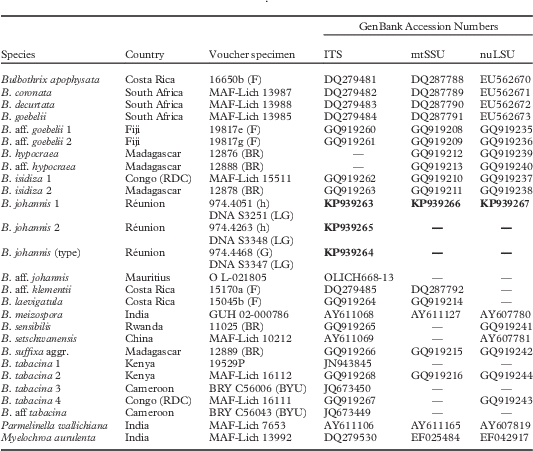
Three well-preserved lichen specimens lacking any visible symptoms of fungal infection were sampled for DNA isolation. Extraction of DNA and PCR amplification were performed following the protocol of Cubero et al. (Reference Cubero, Crespo, Fatehi and Bridge1999). The following primers were used: a) for ITS: ITS1F (Gardes & Bruns Reference Gardes and Bruns1993) and ITS4 (White et al. Reference White, Bruns, Lee and Taylor1990); b) for mtSSU: mrSSU1 and mrSSU3R (Zoller et al. Reference Zoller, Scheidegger and Sperisen1999); c) for nLSU: LIC2044, LR0R, LR3R, LR3, and LR6 available at http://www.lutzonilab.net/primers. Amplicons were sequenced by Macrogen®. Sequence fragments were assembled with Sequencher version 5.2.3 (Gene Codes Corporation, Ann Arbor, Michigan). Sequences were subjected to MEGABLAST searches to detect potential contamination. They were included in a single matrix extracted from Divakar et al. (Reference Divakar, Lumbsch, Ferencova, del Prado and Crespo2010). Pertinent data available from GenBank for the genus Bulbothrix plus one accession of B. suffixa (OLICH668-13) retrieved from http://nhm2.uio.no/lichens/barcode were also included (Table 1). Myelochroa aurulenta (Tuck.) Elix & Hale was chosen as outgroup following Divakar et al. (Reference Divakar, Lumbsch, Ferencova, del Prado and Crespo2010).
List of species, specimens and accession numbers of the three markers ITS, mtSSU, and nuLSU included in the phylogenetic analysis of the genus Bulbothrix. Newly obtained sequences for this study are in bold
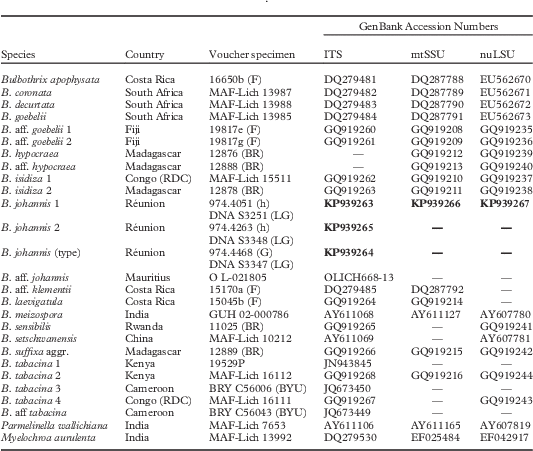
Accessions retrieved from GenBank already published in Divakar et al. (Reference Divakar, Lumbsch, Ferencova, del Prado and Crespo2010) and in Orock et al. (Reference Orock, Leavitt, Fonge, St. Clair and Lumbsch2012). Accession OLICH668-13 retrieved from http://nhm2.uio.no/lichens/barcode/index.php?sp=Bulbothrix&pfx=O-L-&gui=&pr=&full=1.
Sequences were aligned manually using MacClade version 4.08 (Maddison & Maddison Reference Maddison and Maddison2005) and checked with the MAFTT facility (Katoh & Standley Reference Katoh and Standley2013). Ambiguous regions were delimited using the online version of GBlocks v 0.91b (Castresana Reference Castresana2000) at http://molevol.cmima.csic.es/castresana/Gblocks.html, allowing for gap positions within the final blocks, and carefully checked manually. The aligned matrix is deposited in Treebase (accession no. 17258).
Congruence of the three fungal loci was assessed by the comparison of single-locus phylogenetic trees produced with RAxML HPC2 version 7.2.8 (Stamatakis Reference Stamatakis2006; Stamatakis et al. Reference Stamatakis, Hoover and Rougemont2008), as implemented on the CIPRES portal (Miller et al. Reference Miller, Pfeiffer and Schwartz2010), looking for the best ML tree and bootstrapping with 1000 pseudoreplicates in the same run, using the GTRCAT model and default settings. No significant conflict with bootstrap values (BS) >70 was detected and we therefore concatenated the different loci. We thus produced the best likelihood tree and bootstrapped for 1000 pseudoreplicates in the same run using RAxML. Phylogenetic trees were visualized using FigTree v1.2.3 (Rambaut Reference Rambaut2009). Branch support values were considered significant when ML bootstrap (BS)>70%.
Material examined for comparison. Bulbothrix aff. johannis: Mauritius: Black River: path from Plaine Champagne towards Piton de la Petite Rivière Noire, 20°25'S, 57°25'E, 600 m, 1991, H. Krog & E. Timdal MAU09/01 (O L-021167); ibid., 20°25'S, 57°25'E, 620–828 m, 1991, H. Krog & E. Timdal MAU51/06, MAU51/28 (O L-021833, L-021835). Moka: Mt Le Pouce, 20°12'S, 57°31'E, 730–750 m, 1991, H. Krog & E. Timdal MAU47/01 (O L-021805). Plaines Wilhems: Pétrin Heath, 20°24'S, 57°28'E, 650 m, 1991, H. Krog & E. Timdal MAU10/35 (O L-021241); near Midlands, R. E. Vaughan L/6, det. M. E. Hale 1963 (BM). Savanne: Mt Cocotte, SE of the peak, 20°26'S, 57°28'E, 640 m, 1991, H. Krog & E. Timdal MAU59/01 (O L-022033); ibid., 20°26'S, 57°28'E, 750 m, 1991, H. Krog & E. Timdal MAU32/01, MAU32/02 (O L-021556, L-021557); Plaine Champagne, 20°26'S, 57°27'E, 650 m, 1991, H. Krog & E. Timdal MAU57/01, MAU57/02 (O L-021989, L-021990).
Bulbothrix suffixa (Stirton) Hale aggr. Kenya: Eastern Province: Meru District, Mt Kenya, 0°09'S, 37°34'E, 2100 m, 1974, H. Krog 3K 15/124 (O L-184256).—Madagascar: Fianarantsoa: Col de Tapia, N Ambositra, 2008, D. Ertz 12889 (BR).— South Africa: Western Cape: Langeberg, Grootvaderbosch, 34°00'S, 20°49'E, 300 m, 1996, L. Tibell 21366 (UPS L-101225); Outeniqua Range, Ysternek Nature Reserve, close to Dal van Varings Picnic area, 33°55'S, 23°09'E, 640 m, 1996, L. Tibell 21272 (UPS L-101132); Knysna Div., Buffelsnek, Dal van Varings, 720 m, 1970, G. Degelius SA-270a, det. M. E. Hale 1971 (UPS L-55529).
Results
Phylogenetic analysis
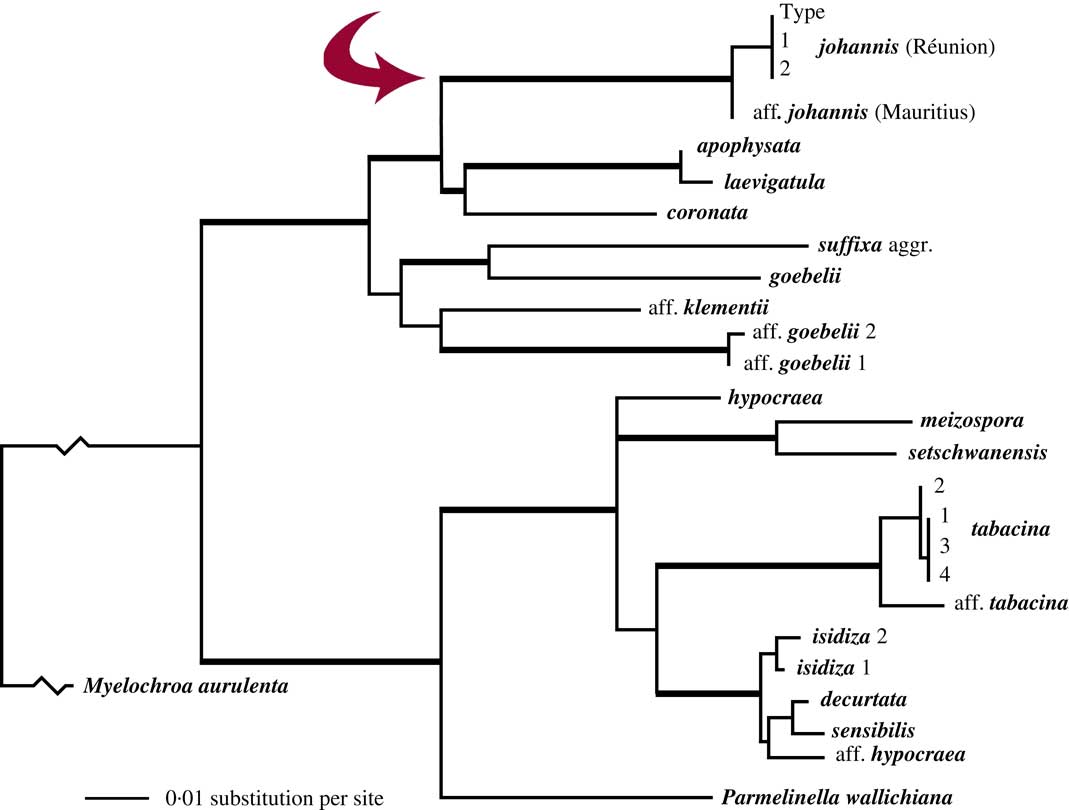
One sequence of ITS, mtSSU, and nuLSU and two sequences of ITS from three Bulbothrix johannis specimens, including the type, were newly generated for this study. 1467 characters were included, 187 being potentially parsimony-informative. The single most-likely tree had a likelihood score of −5067·220860. The genus Bulbothrix is retrieved into two strongly supported lineages (Fig. 1). The first corresponds to ‘clade C’ in Divakar et al. (Reference Divakar, Lumbsch, Ferencova, del Prado and Crespo2010), with P. wallichiana as sister to a strongly supported branch that includes B. decurtata (Kurok.) Hale, B. hypocraea (Vain.) Hale, B. aff. hypocraea, B. isidiza (Nyl.) Hale, B. meizospora (Nyl.) Hale, B. sensibilis (J. Steiner & Zahlbr.) Hale, B. setschwanensis (Zahlbr.) Hale, B. tabacina (Mont. & Bosch) Hale and B. aff. tabacina. The second lineage corresponds to ‘clade B’ in Divakar et al. (Reference Divakar, Lumbsch, Ferencova, del Prado and Crespo2010) and includes a poorly resolved and poorly supported branch with B. goebelii (Zenker) Hale, B. aff. goebelii, B. aff. klementii and the Malagasy material of B. suffixa, and also a strongly supported branch with the new species B. johannis and B. aff. johannis from Mauritius sister to a strongly supported group including B. apophysata (Hale & Kurok.) Hale, B. coronata (Fée) Hale and B. laevigatula (Nyl.) Hale.
Most likely phylogenetic tree of the lichen genus Bulbothrix including B. johannis sp. nov. from Réunion, inferred from a 3-loci matrix (ITS, nuLSU, mtSSU). Thickened branches with ML support >70%.
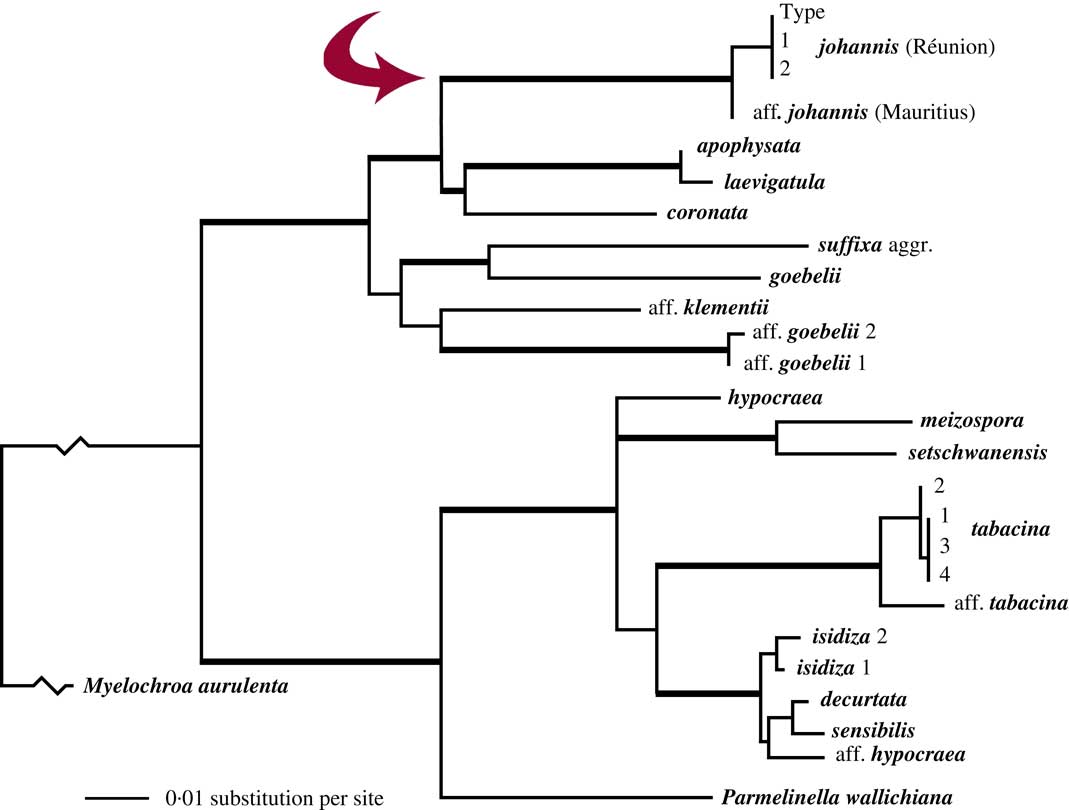
ITS sequences of B. johannis are identical for the three collections from Réunion, except for the type specimen which differs from the other two by a single substitution in ITS1. It further differs from the Mauritius accession of B. aff. johannis by one indel in ITS1 and two substitutions and one indel in ITS2, and further from the Malagasy accession of B. suffixa by more than 20 substitutions in ITS1 and more than 15 in ITS2.
Taxonomy
Bulbothrix johannis D. M. Masson, Benatti & Sérus. sp. nov.
MycoBank No.: MB811846
Similar to Bulbothrix pseudofungicola Benatti & Marcelli but with wider (0·4–2·0 vs 0·4–1·1 mm) lobes, the presence of laminal isidia which frequently develop into phyllidia, larger cilia and rhizines, and longer ascospores (6·0–9·0 vs 4·0–6·0 µm).
Type: Réunion, Salazie, Bélouve, GR R1 trail, 21°04'36''S, 55°31'45''E, 1700 m, on bark of Erica reunionensis along the edge of an Erica montane thicket at the top of a cliff, 25 August 2013, D. Masson 974.4468 (G—holotype; LG, SP, hb. Masson—isotypes; GenBank Acc. for ITS: KP939264).
(Fig. 2)
Bulbothrix johannis sp. nov. A, part of the holotype with three ecoronate apothecia; B, laminal bulbate-ciliate isidia (holotype); C, isidia developing into phyllidia (Masson 974.4473); D, habit in the field, lateral sunlight emphasizes the laminal isidia and phyllidia (Masson 974.4402); E, type locality: tree heather (Erica reunionensis) montane thicket along a crest; F, currently known distribution on a topographic map of Réunion, a single dot may represent several nearby localities. Scales: A & D=5 mm; B & C=0·4 mm; F=10 km.
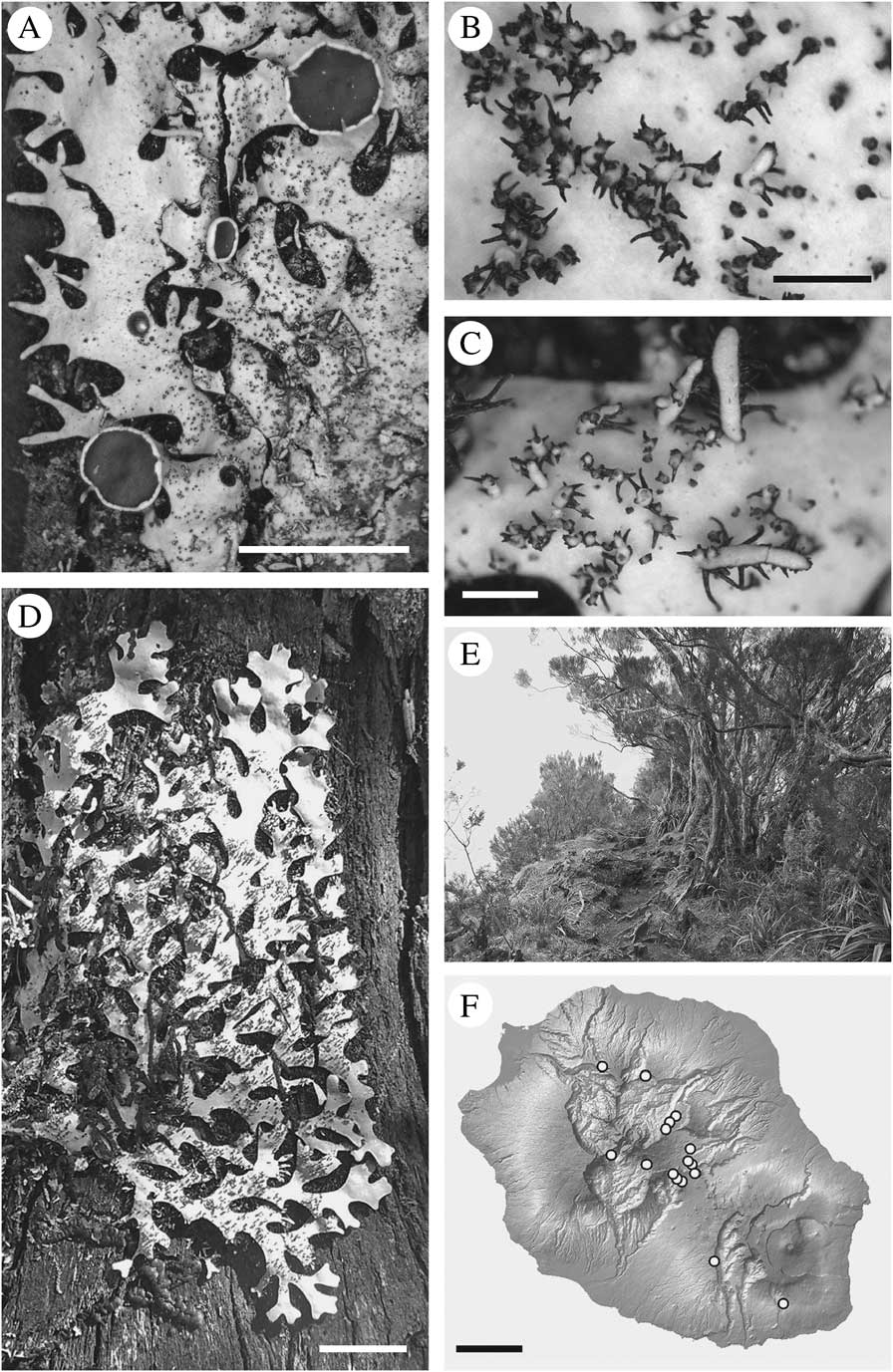
Thallus foliose, corticolous, up to 8 cm wide, subcoriaceous, usually tightly adnate. Lobes sublinear, anisotomously dichotomously, trichotomously or irregularly branched (Fig. 2D), 0·4–2·0 mm wide, contiguous or becoming slightly imbricate in central parts, plane or slightly convex, occasionally uneven, apices plane or somewhat revolute, truncate to subtruncate, occasionally lacinulate, often darkening at the very tip; margins mostly flat, smooth and sinuous or subirregular, entire to slightly incised, not or rarely lacinulate, the axils oval or subirregular. Cilia black, apices initially simple or furcate, eventually becoming ±dichotomously to irregularly branched at the axils, 0·05–0·60(–1·10)×0·03–0·05 mm, with immersed to semi-immersed bulbate bases c. 0·05–0·15 mm wide, abundant at the margins, spaced c. 0·05 mm from each other to occasionally contiguous, being sparse or absent only at the apices of the lobes. Upper surface pale ash grey (oac151, oac179, oac214, oac235 or oac256), more yellowish in the herbarium, continuous, smooth, ±shiny, epruinose, emaculate (only scars left by broken isidia/lacinules), without pseudocyphellae, laminal ciliary bulbs absent, lacking pustules, dactyls and soredia. Isidia simple to irregularly branched, laminal, frequent to abundant, smooth, with ciliary bulbs often developing into ±elongated cilia, apically darkening (brownish), initially ±cylindrical (Fig. 2B) but often soon flattening and developing into lacinules (Fig. 2C), 0·05–0·10 mm thick, up to 1·0 mm long. Lacinules often laminal, rare to abundant, from occasional to sparse or absent at the margins, originating from isidia initials and frequently with propagule function (phyllidia), except for a few marginal or apical adventitious ones that are short, subcanaliculate to plane and lingulate, ascendant to procumbent, simple to furcate, bulbate-ciliate, apices truncate or acute, lower side brown to black when developed, 0·10–1·20×0·05–0·40 mm. Medulla white throughout. Lower surface black, shiny, smooth to somewhat rugulose, marginal zone brown, attenuate, c. 0·5–1·5 mm wide, shiny, smooth, weakly papillate, rhizinate. Rhizines black, rarely brown or with brownish apices at the margins, initially simple or furcate but very soon becoming dichotomously or irregularly branched, some with bulbate bases, 0·05–0·80(–1·20) × 0·03–0·05 mm, moderately dense or dense almost like a tomentum up to the margins, evenly distributed. Upper cortex palisade paraplectenchymatous, (13·0–)22·0(–30·0) µm thick. Algal layer continuous, (15·0–)18·6(–23·0) µm thick; photobiont trebouxioid. Medulla (31·0–)42·6(–55·0) µm thick. Lower cortex paraplectenchymatous, proportionally thick (19·0–)22·3(–28·0) µm.
Apothecia rather frequent (fertile thalli found in 55% of the localities), laminal, sessile or rarely substipitate, first concave then almost plane or contorted with age, up to 1 cm diam., ecoronate, amphithecium smooth, rarely faintly isidiate, margin entire or ±crenate; disc red-brown (oac643 or oac686), epruinose, ±glossy, imperforate, sometimes radially split with age (Fig. 2A); epihymenium (5·0–)7·5(–10·0) µm high; hymenium (30·0–)41·9(–53·0) µm high, subhymenium (5·0–)7·1(–8·0) µm high; proper exciple of type IV (Ferencova Reference Ferencova2012), hyaline layer (13·0–)18·8(–24·0) µm high, intermediate layer (10·0–)12·8(–16·0) µm high, basal layer (9·0–)11·6(–15·0) µm high. Ascospores 8 per ascus, simple, colourless, ellipsoidal, 6·0–7·6–9·0(–10·0)×3·5–4·2–5·0 µm, Q=(1·20–)1·32–1·75–2·17(–2·57) (n=210, from 7 individuals), epispore c. 0·5–1·0 µm thick.
Pycnidia sparse, laminal or on the lacinules, immersed, with black ostioles. Conidia not found.
Chemistry. Upper cortex K+ yellow, C−, KC−, P− or P+ faintly yellow, UV−; medulla K−, C+ reddish pink, KC+ reddish pink, P−, UV−. Secondary metabolites: TLC: upper cortex with atranorin and chloroatranorin; medulla with gyrophoric acid; HPLC (det. J. A. Elix, from specimen P. van den Boom 40422B): atranorin (minor), chloroatranorin (minor), gyrophoric acid (major), lecanoric acid (minor), isopigmentosin B (minor).
Etymology. From the Latin Johannes: John. The species is named in honour of Prof. John A. Elix (Canberra) who was the first to suspect it was an undescribed taxon and for his generous help and support on many occasions.
Habitat and distribution. Bulbothrix johannis is currently known from 22 localities on Réunion (Mascarene Islands, Indian Ocean) (Fig. 2F). Interestingly, all are within the core zone of Réunion National Park. The majority of localities lie between 1330–1860 m a.s.l. Their bioclimatic features can be summarized as follows: bioclimate = pluvial tropical, thermotype belts = lower and upper mesotropical (342 ≤ It ≤ 424), ombrotype belts = from upper humid to ultrahyperhumid (10·8 ≤ Io ≤ 28·7). The most southern locality lies at a lower elevation (1015 m) in the upper thermotropical thermotype belt (It=523). Habitats in which the species thrives are leeward and windward montane rainforests, Erica reunionensis montane thicket and Acacia heterophylla montane forest, but some specimens were also found in Pandanus montanus montane wet thicket or in an old Cryptomeria japonica plantation. Fairly large populations can be found in cloud forests or Erica montane thickets along crests at the top of cliffs, for example at the type locality (Fig. 2E). Bulbothrix johannis grows on bark, sometimes overgrowing mosses, mainly on branches, rarely on boles. The main phorophyte (65% of the collections) is the endemic tree heather Erica reunionensis E. G. H. Oliv., but B. johannis was also found on the native shrub Phylica nitida Lam. and the native trees Aphloia theiformis (Vahl.) Benn., Dombeya spp., Pandanus montanus Bory, Weinmannia sp. as well as the introduced Cryptomeria japonica (L. f.) D. Don. The most frequent macrolichens growing intermixed with B. johannis thalli are Heterodermia boryi (Fée) K. P. Singh & S. R. Singh and Usnea spp. (young thalli). Bulbothrix johannis can be described as a hygrophilous (mostly aerohygrophilous), ombrophilous, rather photophilous (thrives in light) but not heliophilous (it avoids direct sunlight), acidophilous lichen.
Additional specimens examined. Réunion: Cilaos, above Îlet des Salazes, 21°06'47''S, 55°26'42''E, 1710 m, 2012, D. Masson 974.3897 (h); ibid., 21°06'38''S, 55°26'39''E, 1725 m, 2012, D. Masson 974.3901 (h); Cilaos, Bras Sec, sentier Kervéguen, 21°07'41''S, 55°29'57''E, 1560 m, 2012, D. Masson 974.3976 (h); Le Tampon, forêt de Notre-Dame de la Paix, 21°16'S, 55°36'E, 1700 m, 2005, D. Masson 974.4212 (h); ibid., Le Belvédère, 21°15'51''S, 55°36'09''E, 1720 m, 2005, D. Masson 974.1381 (h); Le Tampon, Plaine-des-Cafres, sentier de Bébour, 21°08'35''S, 55°34'18''E, 1600 m, 2012, D. Masson 974.4051 (h); Le Tampon, forêt de la Plaine-des-Cafres, between Piton Tortue and Piton Lepervanche, GR R2 trail, 21°09'11''S, 55°33'12''E, 1710 m, 2013, D. Masson 974.4402 (h); ibid., GR R2 trail west of Piton Tortue, 21°09'04''S, 55°32'44''E, 1735 m, 2013, D. Masson 974.4410, 974.4412 (h); ibid., 21°08'39''S, 55°32'25''E, 1860 m, 2013, D. Masson 974.4424-974.4426 (REU, h); Saint-Benoît, forêt de Bébour, Piton de Bébour, 21°07'33''S, 55°33'52''E, 1390 m, 2003, D. Masson 974.0017 (h); ibid., east of Piton de Bébour, 21°07'45''S, 55°34'10''E, 1330 m, 2003, D. Masson 974.0057 (h); ibid., sentier de Takamaka, 21°06'25''S, 55°34'02''E, 1365 m, 2005, D. Masson 974.2155 (h); Saint-Denis, Plaine d’Affouches, 20°59'14''S, 55°26'02''E, 1720 m, 2012, D. Masson 974.3884 (SP, h); ibid., 20°59'15''S, 55°25'58''E, 1710 m, 2012, D. Masson 974.3891 (SP, h); Saint-Philippe, forêt de Saint-Philippe, trail to Piton Ravine Basse Vallée, 21°19'36''S, 55°42'12''E, 1015 m, 2013, D. Masson 974.4263 (h); Sainte-Marie, haut de la Plaine des Fougères, 21°00'02''S, 55°29'59''E, 1705 m, 2012, D. Masson 974.4151 (SP, h); Salazie, Bélouve, near Gîte de Bélouve, 21°03·5'S, 55°32·5'E, 1520 m, 2008, P. van den Boom 39841 (hb. van den Boom) [mentioned as Bulbothrix suffixa in van den Boom et al. Reference van den Boom, Brand, Ertz, Kalb, Magain, Masson, Schiefelbein, Sipman and Sérusiaux2011]; ibid., trail GR R1 from Gîte de Bélouve, to Caverne Mussard, 21°04·4'S, 55°32·0'E, 1600 m, 2008, P. van den Boom 40422B (hb. van den Boom) [mentioned as Bulbothrix goebelii in van den Boom et al. Reference van den Boom, Brand, Ertz, Kalb, Magain, Masson, Schiefelbein, Sipman and Sérusiaux2011]; ibid., GR R1 trail, 21°04'29''S, 55°31'49''E, 1665 m, 2013, D. Masson 974.4456, 974.4457 (REU, h); ibid., GR R1 trail, 21°04'36''S, 55°31'45''E, 1700 m, 2013, D. Masson 974.4473 (h); ibid., GR R1 trail, 21°04'38''S, 55°31'43''E, 1720 m, 2013, D. Masson 974.4483 (h); ibid., GR R1 trail, 21°04'47''S, 55°31'38''E, 1785 m, 2013, D. Masson 974.4478, 974.4479 (h).
Discussion
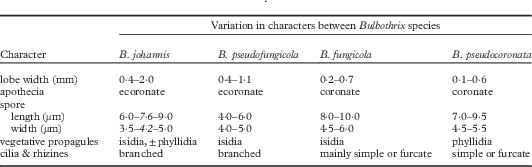
Bulbothrix johannis differs from B. fungicola and B. pseudocoronata (Gyeln.) Benatti & Marcelli by having much wider lobes (c. two or three times larger), ecoronate apothecia (uncommon for species containing gyrophoric acid), more highly branched cilia and rhizines, and somewhat smaller ascospores (Table 2). Furthermore, B. fungicola is only isidiate, while B. pseudocoronata is only phyllidiate, producing laminal lacinules that function as propagules. Both B. fungicola and B. pseudocoronata are so far known only from the New World, being found in Central and South America (Hale Reference Hale1976; Reference BenattiBenatti2012a, Reference Benatti2014).
Comparison of Bulbothrix johannis with similar Bulbothrix species which have black lower cortex, ciliate isidia/phyllidia and medullary gyrophoric acid
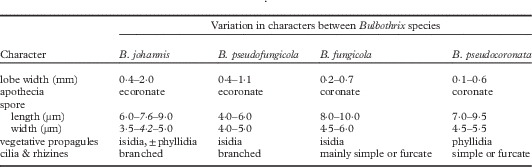
References: B. johannis, this study; B. pseudofungicola, Benatti (2012c); B. fungicola, Reference BenattiBenatti(Reference Benatti2014); B. pseudocoronata, Benatti (2012a).
Bulbothrix pseudofungicola Benatti & Marcelli is another similar species with a black lower cortex, ecoronate apothecia, branched cilia and rhizines, and medullary gyrophoric acid. It differs by the narrower lobes, smaller ascospores (amongst the smallest found in the genus), and presence of bulbate-ciliate isidia only (Table 2). It is known only from South America (Benatti Reference Benatti2012c ).
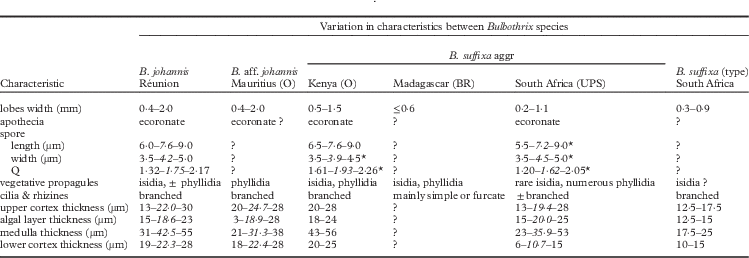
Bulbothrix suffixa is another taxon morphologically (black lower surface, branched rhizines) and chemically (gyrophoric acid in the medulla) somewhat similar to B. johannis. However, the type material (BM !) is poorly developed, without apothecia, and in only the early stage of propagule formation (laminal isidium initials with cilia). Moreover, the protologue does not mention any vegetative propagules (Stirton Reference Stirton1878). It is therefore impossible to clearly establish the identity of that species (Reference BenattiBenatti Reference Benatti2014). In his monograph of the genus, Hale (Reference Hale1976: 23–24) described B. suffixa as having a densely lobulate upper surface with no isidia and lobes 0·5–1·5 mm wide [so somewhat larger than the lobes of the type specimen: 0·3–0·9 mm wide according to Reference BenattiBenatti(Reference Benatti2014)]. The apothecia are described as coronate in the paragraph dedicated to the taxon (p. 23) but ecoronate in a comparison with B. fungicola in the same paper (p. 14). In an earlier publication (Hale & Kurokawa Reference Hale and Kurokawa1964: 136), Parmelia suffixa Stirt. was mentioned with ecoronate apothecia. Therefore, Bulbothrix suffixa sensu Hale (Reference Hale1976) corresponds poorly to the type material. Bulbothrix suffixa is mentioned from several African countries near Réunion: South Africa (where the type was collected), Mauritius (Hale Reference Hale1976), Kenya (Swinscow & Krog Reference Swinscow and Krog1988), Madagascar (Aptroot Reference Aptroot1990) and Tanzania (Alstrup et al. Reference Alstrup, Aptroot, Divakar, LaGreca and Tibell2010). Examination of several herbarium specimens from these countries (Table 3) shows that several different taxa are obviously included under that name, at least in Africa, and thus further study is required. Compared to B. johannis, material from South Africa (UPS) has narrower laciniae and a thinner lower cortex (akin to the type specimen of Parmelia suffixa), and shorter and wider spores (which make them more broadly ellipsoidal). The Malagasy specimen examined has much narrower lobes, more densely ciliate isidia/phyllidia, less branched cilia and rhizines, and it is phylogenetically distant from B. johannis (Fig. 1). The rich collection studied from Mauritius is homogeneous and was attributed to B. suffixa by Hale (material from BM) and Krog & Timdal (material from O). These specimens have clearly wider and thicker lobes than the type of B. suffixa. They further differ from B. johannis by abundant phyllidia without any genuine isidia, as in B. pseudocoronata. Moreover, the medulla is thinner in the collection from Mauritius (comparison between 15 measurements of medulla thickness from 3 thalli of each species; one-tailed Wilcoxon-Mann-Whitney test: U=25, α<0·001). Only a tiny apothecium (0·45 mm diam.), totally devoid of bulbs, was found on one thallus (O L-021805). As Bulbothrix species with coronate apothecia commonly start developing apothecial bulbs at very young stages, it is likely the material from Mauritius refers to a taxon with ecoronate apothecia. The ITS sequence of a single specimen (O L-021805) is slightly distinct from B. johannis from Réunion (one indel in ITS1 and two substitutions and one indel in ITS2); the four accessions form a strongly supported branch in our phylogenetic analysis (Fig. 1). Because of the different kinds of vegetative propagules, and the somewhat different thallus anatomy and ecology (B. johannis thrives at higher elevations than the Mauritian taxon: 1015–1860 m vs 600–800 m), we propose to regard the Mauritian Bulbothrix as a taxon different from B. johannis but phylogenetically closely related to it.
Comparison of selected morphological and anatomical features between B. johannis from Réunion, B. aff. johannis from Mauritius, herbarium material labelled B. suffixa from the surrounding African countries (=B. suffixa aggr.) and the type of B. suffixa
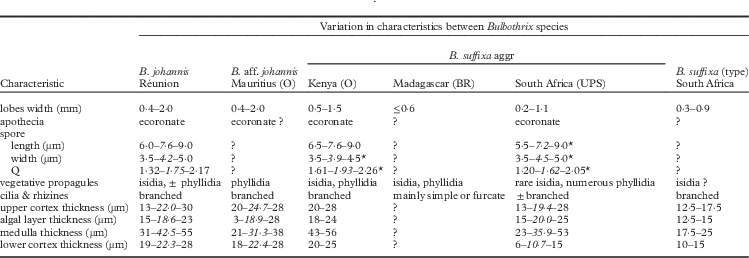
References: B. johannis and B. suffixa aggr this study; B. suffixa (type), Reference BenattiBenatti(Reference Benatti2014). * mean values significantly different from those of B. johannis (two-tailed Z-test α < 0.02).
The single specimen from Kenya we examined (O L-184256) is most probably the one mentioned by Swinscow & Krog (Reference Swinscow and Krog1988) under the name B. suffixa, even though the ascospore measurements are inconsistent (6·5–9·0×3·5–4·5 (our measurements) vs 10–12×5 µm (description of Krog & Swinscow 1988)). This specimen might belong to B. johannis according to the morphology, anatomy and chemistry of its thallus. The only discrepancy lies in the narrower and therefore more oval ascospores for the Kenyan specimen. It was collected in a subtropical evergreen submontane forest (nomenclature following Bussmann Reference Bussmann2006) on the eastern slope of Mount Kenya. Compared with the bioclimatic features of the B. johannis localities, the bioclimate of the Kenyan locality is more seasonal (pluviseasonal tropical vs pluvial tropical) and somewhat drier (ombrotype belt: lower humid) but the thermotype belt is similar (lower mesotropical). More material is needed to confirm the presence of B. johannis in Kenya.
Bulbothrix papyrina (Fée) Hale from Asia and South America is also rather similar to B. johannis. It shares the same width of lobes, emaculate upper cortex, black lower cortex, ecoronate apothecia, branched cilia and rhizines, and the same chemistry. However, B. papyrina has eciliate isidia, no phyllidia, and thicker ascospores; it is also one of the only two species in the genus known to produce pycnidia on the isidia at mature stages, the other being B. cassa Jungbluth et al. (Reference BenattiBenatti Reference Benatti&Elix Reference Benatti and Elix2012; Benatti Reference Benatti2013b ).
So far, no true counterpart of B. johannis lacking vegetative propagules is known. The American species Bulbothrix atrichella (Nyl.) Hale could be a candidate but its thallus is thinner, the upper surface is distinctly maculate, the base of the rhizines is not bulbate and the ascospores are more globose (Hale Reference Hale1976; Benatti Reference Benatti2013c ).
The authors are indebted to the curators of BR (D. Ertz), BM (H. Thüs), O (E. Timdal) and UPS (S. Ekman), as well as P. van den Boom (Son, The Netherlands) and P. K. Divakar (Universidad Complutense de Madrid) for the loan of specimens for this study and to P. Richard (BORD) for facilitating some of these loans. The first author is grateful to J. A. Elix (Canberra) for discussion about the identity of the Bulbothrix from Réunion and for help in the preparation of the manuscript, and P. Clerc (Genève) for taxonomic advice. Fieldwork by D. Masson in Réunion National Park was carried out under permits DIR/I/2012/034 and DIR/I/2013/046. Finally we wish to thank three referees for their interesting and helpful comments.