Attachment theory (Bowlby, Reference Bowlby1969) has a longstanding record in guiding research on social and emotional (child) development. Whereas scholars have traditionally approached attachment as a relatively stable, trait-like construct, there is increasing awareness that attachment additionally comprises a more variable, state-like component that fluctuates across contexts and from day to day (Bosmans et al., Reference Bosmans, Bakermans-Kranenburg, Vervliet, Verhees and Van IJzendoorn2020, Reference Bosmans, Van de Walle, Goossens and Ceulemans2014; Gillath et al., Reference Gillath, Hart, Noftle and Stockdale2009; Girme et al., Reference Girme, Agnew, VanderDrift, Harvey, Rholes and Simpson2018). To date, it remains largely unknown how, when, and why attachment states fluctuate on a day-to-day basis. Contemporary models of attachment propose that attachment states may fluctuate in response to everyday life experiences with the attachment figure (Arriaga et al., Reference Arriaga, Kumashiro, Simpson and Overall2018; Bosmans et al., Reference Bosmans, Bakermans-Kranenburg, Vervliet, Verhees and Van IJzendoorn2020; Kobak & Bosmans, Reference Kobak and Bosmans2019), but this has not been empirically tested in daily life. Moreover, these models suggest that short-term state attachment dynamics may be a relevant source of information for our understanding of more trait-like attachment development, as the repeated experience of specific attachment states may evolve into trait-like attachment over time. Additionally, research suggests that these state attachment dynamics are important to understand why children develop symptoms of psychopathology (e.g., Verhees et al., Reference Verhees, Ceulemans, Van IJzendoorn, Bakermans-Kranenburg and Bosmans2020, Reference Verhees, Ceulemans, Bakermans-Kranenburg and Bosmans2021). Therefore, a better understanding of state attachment dynamics can have added value for attachment theory and clinical practice.
Research into state attachment dynamics in children is scarce. In the current study we aimed to fill this gap by exploring dynamics of secure state attachment expectations in middle childhood using a daily diary study design. Specifically, we assessed (1) state attachment carry-over: the tendency of state attachment fluctuations to linger from day to day; and (2) state attachment reactivity: the concurrence of state attachment fluctuations with everyday attachment-relevant experiences, specifically, experiences of maternal support in the context of stress. These dynamics were assessed in two independent middle childhood samples: one nonadopted community sample and one sample of internationally adopted children who experienced early separation from their biological parents. It has been proposed that middle childhood serves as an important period for cognitive attachment development, due to social, biological and cognitive developments that underlie shifts in the parent–child attachment relationship and an increased potential to develop generalized cognitive relational scripts (Del Giudice, Reference Del Giudice2015). Middle childhood may therefore be a particularly interesting period to study dynamical characteristics of state attachment, as these may help clarify the mechanisms underlying shorter and longer term stability and changes in attachment.
Trait and state attachment
One of the core propositions of attachment theory is that every day experiences with caregivers form the basis of attachment security (Bowlby, Reference Bowlby1969). These experiences are proposed to accumulate into internal working models (IWMs), which contain expectations and beliefs about caregiver availability and support in attachment-relevant situations. IWMs allow children to rely on past experiences in their reaction to (minor) events in or perturbations of the interpersonal environment (Bowlby, Reference Bowlby1969; Bretherton & Munholland, Reference Bretherton, Munholland, Cassidy and Shaver2016). Securely attached children’s IWMs reflect a general expectation of trust in caregiver support, that is, that the child can use the caregiver as a secure base from which to explore the world and can turn to the caregiver for support as a strategy to regulate distress or discomfort (Ainsworth et al., Reference Ainsworth, Blehar, Waters and Wall1978). These children are proposed to develop a specific cognitive script about support during distress that serves as a basis for their attachment expectations: the secure base script (Waters et al., Reference Waters, Bosmans, Vandevivere, Dujardin and Waters2015; Waters & Roisman, Reference Waters and Roisman2019; Waters & Waters, Reference Waters and Waters2006). The secure base script comprises a temporal–causal event sequence in which the child is engaged in interaction or exploration, encounters distress, seeks or signals for support, the caregiver is available and willing to provide support, and that support is effective in overcoming the distress after which the child can return to exploration. More insecurely attached children’s IWMs, on the other hand, reflect a general lack of trust in caregiver support. These children might develop alternative (nonsecure base) cognitive schemas (e.g., Bosmans et al., Reference Bosmans, Braet and Van Vlierberghe2010; McLean et al., Reference McLean, Bailey and Lumley2014, Waters & Facompré, Reference Waters, Facompré, Waters, Vaughn and Waters2021). Traditionally, attachment security and the related overall expectation whether or not one can trust in caregiver support has been approached as a trait-like feature that is relatively stable over time.
Longitudinal research, however, shows that stability of attachment security throughout the lifespan is weak to moderate (Fraley, Reference Fraley2002; Groh et al., Reference Groh, Roisman, Booth-laforce, Fraley, Owen, Cox and Burchinal2014; Pinquart et al., Reference Pinquart, Feußner and Ahnert2013), and that attachment stability can be moderated by different factors such as family conflict (Jones et al., Reference Jones, Fraley, Ehrlich, Stem, Lejuez, Shaver and Cassidy2018; Waters et al., Reference Waters, Yang, Finet, Verhees and Bosmans2021). In addition, attachment researchers have recently explored the possibility that attachment intraindividually fluctuates on short-term across daily life at the level of expectations of trust in the caregiver. Indeed, there is evidence for significant within-person variation in attachment expectations. For instance, Girme et al. (Reference Girme, Agnew, VanderDrift, Harvey, Rholes and Simpson2018) found that adults experience within-person fluctuations in attachment security within a specific attachment relationship across a period of 1 year. Moreover, in children, considerable within-person variation was found when attachment expectations towards mother were assessed daily across a 1-week period (Bosmans et al., Reference Bosmans, Van de Walle, Goossens and Ceulemans2014), and attachment expectations were found to fluctuate in response to experimental manipulation of maternal support during distress (Vandevivere et al., Reference Vandevivere, Bosmans, Roels, Dujardin and Braet2018).
The finding that attachment expectations can fluctuate over time and in response to contextual cues has led scholars to propose more dynamic models of attachment. Such models suggest that attachment comprises both a trait-like component that refers to more stable and general attachment expectations which are not specific to the situation or time of measurement, and a more flexible, contextualized component. The latter has been referred to as state attachment (e.g., Gillath et al., Reference Gillath, Hart, Noftle and Stockdale2009) or state attachment appraisals (e.g., Bosmans et al., Reference Bosmans, Van de Walle, Goossens and Ceulemans2014) and concerns children’s expectations, feelings and thoughts in the moment. State attachment is thus more context-specific than trait attachment. Several dynamic models of attachment proposed that (repeated) experience of attachment states may over time affect more general trait-like attachment. For example, Bosmans et al. (Reference Bosmans, Bakermans-Kranenburg, Vervliet, Verhees and Van IJzendoorn2020) proposed that secure attachment states are related to a sense of felt security, induced by the experience of parental support during distress, and they suggested that the repeated experience of secure or insecure attachment states evolves into more or less secure trait-like attachment. Relatedly, Kobak and Bosmans (Reference Kobak and Bosmans2019) proposed that the experience of an insecure context and related insecure attachment states can maintain and enhance an individual’s insecure IWM or decrease trait security. In addition, Arriaga et al. (Reference Arriaga, Kumashiro, Simpson and Overall2018) suggest that insecure attachment states can be buffered by an attachment figure who provides a secure context (i.e., responds in a responsive manner to insecure feelings and behavior), which over time can increase trait attachment security. Empirical examination of dynamical characteristics of state attachment can shed light on the factors underlying state attachment fluctuations, and may eventually provide insights into the role of state attachment fluctuations in stability and (developmental) changes in trait attachment (Ram & Gerstorf, Reference Ram and Gerstorf2009; Waters et al., Reference Waters, Merrick, Treboux, Crowell and Albersheim2000). Of note, it is difficult to completely disentangle state attachment from trait attachment as attachment expectations at any moment in time are the result of both the more general trait-like factor as well as contextual factors (Fraley, Reference Fraley2007). To distinguish state from more trait-like attachment, we use participants’ daily deviations from their own mean state attachment scores across days to assess state attachment dynamics. An individual’s mean state attachment across days can be seen as an indicator of more trait-like attachment as mean scores across repeated measurements may average out varying contextual effects.
Dynamical characteristics of state attachment
The first empirical studies into dynamics of state attachment have mainly focused on degree of variability, that is, how much attachment states deviate from their mean across contexts (Bosmans et al., Reference Bosmans, Van de Walle, Goossens and Ceulemans2014; Verhees et al., Reference Verhees, Ceulemans, Van IJzendoorn, Bakermans-Kranenburg and Bosmans2020, Reference Verhees, Ceulemans, Bakermans-Kranenburg and Bosmans2021). To date, other dynamical characteristics that are commonly distinguished in within-person variability research in different areas of psychology (Kuppens & Verduyn, Reference Kuppens and Verduyn2015; Ram & Gerstorf, Reference Ram and Gerstorf2009) have remained largely unexplored for state attachment. In the current study we used daily diaries to assess (1) carry-over, that is, the tendency of attachment state fluctuations to linger from one day to the next day; and (2) reactivity, that is, the systematic association of fluctuations in state attachment with contextual cues.
Carry-over refers to whether state attachment deviations linger before an individual returns to his or her average state (also called recovery, or in affective dynamics research: inertia). Carry-over is usually assessed by calculating the autocorrelation between measurements across time, with a high and positive autocorrelation indicating that the preceding state positively affects the subsequent state. Contrary to degree of variability, in the assessment of carry-over the serial ordering of measurements over time is accounted for (Ram & Gerstorf, Reference Ram and Gerstorf2009). Whereas estimates of the degree of variability are not affected by the serial ordering of the measurements over time (i.e., randomly reordering the scores will yield the same sample variance), carry-over assessments are strongly dependent on the order (i.e., randomly reordering the scores will almost always change the carry-over estimate). Therefore, carry-over effects can provide insight into how momentary attachment processes unfold and evolve over time. To our knowledge, carry-over in state attachment has not been studied to date, which marks a gap in our knowledge. A strong carry-over effect for state attachment may reflect (partial) temporal stability of state attachment fluctuations, that is, a slow return to the average state attachment level across days.
Reactivity refers to how an individual’s state attachment fluctuations co-occur with or depend on other internal or external influences, such as experiences in the interpersonal environment (Koval et al., Reference Koval, Brose, Pe, Houben, Erbas, Champagne and Kuppens2015). With reactivity, we aim to capture the sources of ups and downs in states across contexts. Potentially interesting contextual factors to examine state attachment reactivity are experiences of (lack of) caregiver support during distress (“stress-support experiences”), as these are of direct relevance for attachment (Bosmans et al., Reference Bosmans, Bakermans-Kranenburg, Vervliet, Verhees and Van IJzendoorn2020; Bowlby, Reference Bowlby1969; Waters & Waters, Reference Waters and Waters2006). If attachment states are indeed sensitive to experiences with the attachment figure, one would expect increases in secure state attachment after (effective) support, and decreases in secure state attachment following a lack of (effective) support. The proposition that state attachment in middle childhood is immediately sensitive to stress-support experiences in everyday life has not been tested to date, although two studies provided preliminary support. In an experimental study, Vandevivere et al. (Reference Vandevivere, Bosmans, Roels, Dujardin and Braet2018) found that, at a group level, children who experienced lack of maternal support during distress had lower state attachment levels as compared to children who did receive maternal support. The children who did not receive support also showed significant intra-individual decreases in their state attachment compared to baseline. Moreover, group differences disappeared when the latter children eventually also received maternal support, suggesting that support had effects at a group-level (Vandevivere et al., Reference Vandevivere, Bosmans, Roels, Dujardin and Braet2018). Relatedly, Bosmans et al. (Reference Bosmans, Van de Walle, Goossens and Ceulemans2014) found in a diary study that when children reported conflicts with their mother, their state attachment negatively deviated from their individual mean state attachment across days. These studies, however, could not test the proposition that everyday stress-support experiences are relevant for state attachment fluctuations in middle childhood as the study by Vandevivere et al. (Reference Vandevivere, Bosmans, Roels, Dujardin and Braet2018) was conducted in a laboratory setting, and the study by Bosmans et al. (Reference Bosmans, Van de Walle, Goossens and Ceulemans2014) did not concern caregiver support-related experiences during distress.
The current studies
Our aim was to explore secure state attachment dynamics across everyday life in middle childhood. In specific, we assessed two dynamical characteristics: (1) state attachment carry-over and (2) state attachment reactivity to experiences of caregiver support in the context of stress. Children completed daily diaries in which they reported on their secure state attachment towards mother at that moment, and on experiences of stressors and subsequent maternal support they had had throughout that day. Since research on carry-over in state attachment is lacking in the literature, we had no specific predictions regarding the significance of state attachment carry-over. That is, as far as we know, there are no theoretical propositions or empirical studies concerning whether state attachment fluctuations either linger from one day to the next day or children tend to return to their average state the day after they deviated from their average score. For reactivity, we focused on stress-support experiences as these are considered an important context for expectations of trust in caregiver support (Waters & Waters, Reference Waters and Waters2006). Based on previous research we predicted that variance in everyday experiences with the attachment figure would relate to state attachment fluctuations (Bosmans et al., Reference Bosmans, Van de Walle, Goossens and Ceulemans2014), and this especially so for experiences of distress followed by a lack of maternal support (Vandevivere et al., Reference Vandevivere, Bosmans, Roels, Dujardin and Braet2018).
We assessed these secure state attachment dynamics in two middle childhood samples. Study 1 included a community sample of boys and girls (age range 9–12 years); Study 2 included a sample of girls (age range 8–11 years) who were adopted from China to the Netherlands at an average age of 13 months. The sample from Study 2 thus constitutes a group of children who had the early adverse interpersonal experience of separation from the biological parents after which they lived in institutional or foster care (in China) prior to adoption. Focusing on trait attachment, research in this sample showed that early (i.e., 2 and 6 months) after adoption these children showed less attachment security than a normative group of nonadopted children (Van den Dries et al., Reference Van den Dries, Juffer, Van IJzendoorn, Bakermans-Kranenburg and Alink2012), but they seemed to show complete catch-up in attachment security by the age of nine (Finet et al., Reference Finet, Waters, Vermeer, Juffer, Van IJzendoorn, Bakermans-Kranenburg and Bosmans2019). By using a similar design as in Study 1, we could assess whether state attachment fluctuations in these adopted children are characterized by the same dynamics as in the (nonadopted) community sample of Study 1. In the current studies we focused on the mother–child attachment relationship, since mothers are often the primary caregivers in middle childhood and the association between child attachment and responsive parenting was found to be stronger for mothers than for fathers (Grossmann et al., Reference Grossmann, Grossmann, Kindler, Zimmermann, Cassidy and Shaver2008; Kerns et al., Reference Kerns, Tomich and Kim2006; Koehn & Kerns, Reference Koehn and Kerns2018; Lucassen et al., Reference Lucassen, Tharner, Van IJzendoorn, Bakermans-Kranenburg, Volling, Verhulst and Tiemeier2011).
Study 1
Methods
Participants
The full sample consisted of 152 children (55 boys, 97 girls) and their mothers (same sample as in Study 2 of Verhees et al., Reference Verhees, Ceulemans, Van IJzendoorn, Bakermans-Kranenburg and Bosmans2020). Children were 9–12 years old (M = 10.41, SD = 0.60). Most children lived with both parents (74%) and the majority of children had the Belgian nationality (89%). Regarding maternal and paternal educational level, respectively 39% and 44% had completed elementary or high school, 41% and 19% had a bachelor degree, 15% and 15% had a master’s degree, and 4% and 22% of the data was missing. Twenty-six children were excluded from the analyses because they did not complete the diary on the intended day for at least 7 days. Moreover, three children were excluded from the analyses because they were adopted and for Study 1 we wanted to examine state attachment dynamics in nonadopted children specifically. Therefore, the final sample consisted of 123 children (81%). Children who were excluded did not differ significantly from children who were included on gender (χ 2 (1, N = 152) = .42, p = .52) or age (t (150) = 0.66, p = .51).
Procedure
Participants were recruited by distributing 558 informative letters at elementary schools in Belgium. One hundred fifty-two mothers replied and gave their active informed consent (response rate: 27%). Children also provided their active informed consent before the start of the procedure. Data were collected three times over the course of 1 year, with a 6-month interval between waves. In the current study we focus on the data from wave 1 for two reasons: (1) the analysis technique we used (dynamic structural equation modeling [DSEM] in Mplus) allows analysis of two-level, but not three-level data (Hamaker et al., Reference Hamaker, Asparouhov, Brose, Schmiedek and Muthén2018), and therefore we could not analyze the data from all three waves while taking the nested data structure into account and chose to focus on data from one wave only; and (2) in wave 1 we had more data available than in waves 2 and 3 (i.e., more children completed more diary days in wave 1). Children participated in an assessment at school which included measures of trait attachment and psychological well-being that were not used in the present study. During the assessment at school, children were instructed about the use of the daily diary. Starting that day, they received an email containing a link to an online diary every day for 14 consecutive days. Mothers participated in the study by completing online questionnaires about their child and themselves. Except for demographic information, information from these mother-reported questionnaires was not used in the present study. The current study procedure was approved by the Social and Societal Ethics Committee KU Leuven.
Measures
Diary
Children completed an online diary that comprised two parts: in part one children reported on attachment towards their mother at that moment (state attachment); in part two children reported about stressors and support they experienced earlier during that day. Children were instructed to fill out the diary every day for 14 consecutive days right before they went to sleep. Diary days that were not completed on the intended date were marked as missing.
State attachment. To measure children’s daily attachment states towards mother, children were asked to rate nine items concerning their in-the-moment expectations of maternal support. The diary items were similar to those used in previous attachment diary studies in middle childhood (Bosmans et al., Reference Bosmans, Van de Walle, Goossens and Ceulemans2014). All items had the same stem (“At this moment, I feel that…”). Six items were secure and reflected trust in maternal support (i.e., “I would ask my mother for help if I had a problem”; “I would let my mother know if I don’t feel good”; “my mother thinks that I am important”; “I can count on my mother when I need her”; “it helps to talk to my mother”; “my mother makes me feel better”), three items were insecure and reflected lack of trust (i.e., “I prefer to solve my problems on my own”; “my mother rather does not help me”; “I keep worrying after I talked to my mother about my problems”). Children rated the items on a VAS scale ranging from 0 (not at all) to 100 (completely). To derive a state attachment score for each day, we reverse-coded the insecure items and then calculated a mean score over items, with higher scores reflecting more secure state attachment that day. Cronbach’s alpha across participants and days was .84 when calculated on non-person-mean centered data and .70 when calculated on person-mean centered data.
Stress-support experiences. In part two of the daily diary, children were asked about their experiences of stressors and support in the context of these stressors during that day. Specifically, children were presented with seven potential stressors (i.e., conflict with classmates or friends; conflict with siblings, conflict with mother; conflict with father; having a sense of failure; feeling angry; feeling scared). For each stressor, children were asked whether they experienced it that day (stressor: yes or no); if yes, how bad this was for them (scale from 0 to 100) and whether they talked about it with their mother (support: yes or no); and if yes, whether talking to their mother helped (support effective: yes or no). Per participant, per day, we derived three stress-support ratio measures from this information: “Effective support” = Number of effective support experiences / number of experienced stressors; “Ineffective support” = Number of ineffective support experiences / number of experienced stressors; “No support” = Number of no support experiences / number of experienced stressors. When children reported no stressors that day, all three stress-support measures were coded as zero. Overall, when children indicated they experienced a stressor, they reported that this event was distressing for them. Specifically, when asked how bad experiencing the stressor was, children reported over 50 on a scale ranging from 0 to 100 for 64% of the stressors (with mean scores per stressor ranging from 49 to 70).
Data analysis plan
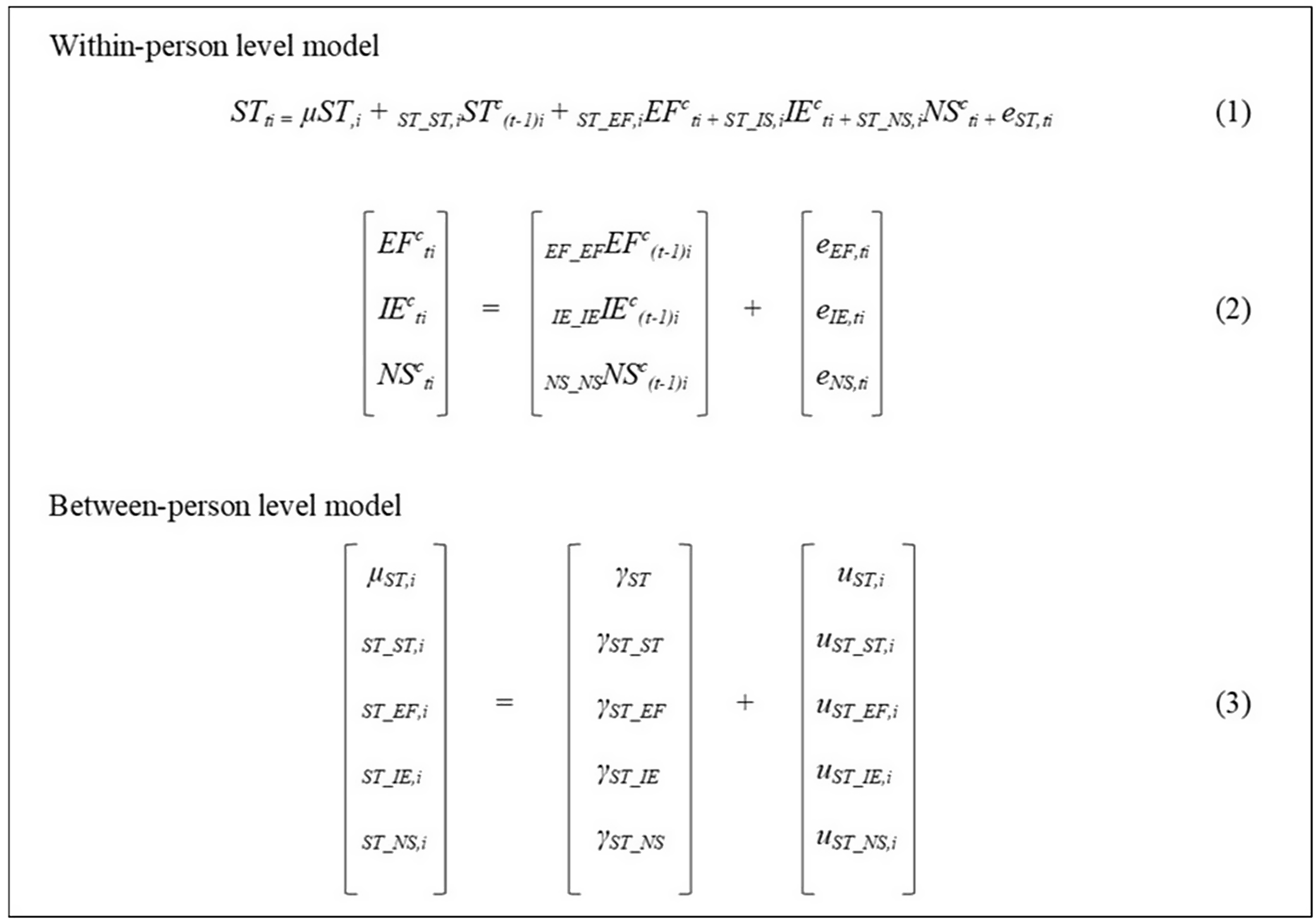
To model state attachment over time, we used DSEM as provided in Mplus (Hamaker et al., Reference Hamaker, Asparouhov, Brose, Schmiedek and Muthén2018). We aimed to assess whether (after latent person-mean centering) state attachment is predicted by (1) state attachment the preceding day, and (2) stress-support experiences throughout the day, where all effects are considered random. Therefore, we specified a multilevel first-order autoregressive (AR 1) model predicting State attachment (at time t for individual i) from the mean state attachment across days (for individual i) and the time-varying covariates State attachment on the previous day (time t−1 for individual i), Effective support, Ineffective support and No support (all at time t for individual i), see Equations (1)–(3) in Figure 1. The effect of State attachment the previous day reflects the carry-over effect. The effects of Effective support, Ineffective supports and No support reflect the reactivity effects. To be able to run the model, we also included fixed effects from the stress-support covariates t−1 to t (see Equation 2 in Figure 1), but because state attachment was the outcome variable of interest, we did not consider these stress-support carry-over effects here. The Mplus syntax for the models is provided in Appendix 1. Point estimates for the means of the random effects distributions (γs in Equation 3, Figure 1) of the autoregressive path (State attachment the previous day) and concurrent paths (Effective support, Ineffective support, and No Support) were examined to determine carry-over and reactivity effects, respectively, across children. If the credible interval (CI) for the estimate did not contain zero, it was considered statistically significant. For the interpretation of the magnitude of the significant effects, we considered the standardized results. The variance of the random effects distribution (us in Equation 3, Figure 1) reflects whether there are individual differences in the associated parameter. We performed additional analyses in which we accounted for possible linear trends in state attachment over time in different ways (i.e., by including time as a time-varying covariate in the model and by modeling the time-trend separately from the autoregressive effect using residual DSEM, see McNeish & Hamaker, Reference McNeish and Hamaker2020).
Equations for the multilevel first-order autoregressive (AR 1) model predicting state attachment. ST = state attachment; EF = effective support; IE = ineffective support; NS = no support; ST_ST, ST_EF, ST_IE, ST_NS = slopes resulting from regressing state attachment on state attachment the previous day, and effective support, ineffective support and no support at the same day, respectively; t = time t; i = individual i; c = within-person centered; e = dynamic error or innovation; γ = means across individuals; u = variances, individual deviations from γ.

Results
Preliminary analyses
We examined the amount of variance in state attachment due to differences within individuals (between days) and differences between individuals (across days). To this end we predicted state attachment with an empty two-level model (i.e., without predictors), which partitions the total variance in state attachment into a between-part (intraindividual means across days) and a within-part (intraindividual fluctuations around the intraindividual means). Of the total variance, 36% was situated at a within-person level and 64% was situated at a between-person level, indicating that state attachment varied both within and between children.
DSEM results
Across all children who were included, 20% of the daily reports were missing (M days = 11.23, SD = 1.96). Missing values (for missing days) were estimated in Mplus if they were in-between the first day with observed values and the last day with observed values (i.e., if the participant completed the diary at least one day preceding and following the missing day). The results from the DSEM analysis are presented in Table 1. The overall mean state attachment score across which the scores of all children vary amounts to 88.10. As indicated by the preliminary analyses, the person-specific means vary around this overall mean (i.e., variance amounts to 208.93). On average, the model explained 48% of the within-person variance in state attachment (R 2 = 0.48, CI = [0.41, 0.54]).
Unstandardized point estimates (posterior means) and 95% credible intervals for means and variances of the random effects in the multilevel AR(1) model predicting state attachment for Study 1

Carry-over
We next examined the first-order autoregressive parameters for state attachment, which reflect state attachment carry-over. On average, over time, there was a positive autoregressive effect of state attachment fluctuations (see Table 1, random effect “State attachment previous day”). The standardized estimate for this effect was 0.28 (CI = [0.21, 0.35]). This finding suggests that children’s deviations in state attachment on day t are positively predicted by their state attachment deviation on the preceding day (t − 1), and thus that positive or negative state attachment fluctuations tend to linger across time. Results were replicated when we controlled for possible linear trends in state attachment over time (see Supplemental Table S1).
Reactivity
To assess whether state attachment fluctuations at the end of day t were related to stress-support experiences during this day, we examined the concurrent parameters (see Table 1, random effects “Effective support.” “Ineffective support” and “No support”). Experiencing no support during distress was uniquely related to negative state attachment deviations, with a standardized estimate of −0.09 (CI = [−0.15, −0.03]). This indicates that when children experienced no support, their secure state attachment was lower than their own mean state attachment across days. On average, there was no evidence for a unique effect of successful support experiences nor for an effect of ineffective support experiences on state attachment in this sample. These findings suggest that on a group level, attachment state deviations were not explained by experiences of effective support or ineffective support in the context of distress. Results were replicated when we controlled for time (Supplemental Table S1).
Study 2
Methods
Participants
The full sample consisted of 87 girls (same sample as in Finet et al., Reference Finet, Vermeer, Juffer, Bijttebier and Bosmans2020). Children were 8–11 years old (M = 9.98, SD = 0.44). All children were adopted from China to the Netherlands, at a mean age of 13.08 months (SD = 1.35). Children participated together with their mother (93%), father (3%), or both parents (3%). Most children lived with both adoptive parents (95%). Regarding maternal and paternal educational level, respectively, 34% and 26% had completed elementary or high school, 31% and 34% had a bachelor’s degree, 35% and 40% had a master’s degree, 1% of the data regarding paternal education was missing. Eighteen children were excluded because they did not complete the 7-day diary for at least 5 days, leaving a final sample of 69 children (79%). Children who were excluded did not differ significantly from children who were included on age (t(85) = −0.64, p = .53).
Procedure
The data were collected during the second follow-up from a larger study examining the development of children postadoption (Van den Dries et al., Reference Van den Dries, Juffer, Van IJzendoorn and Bakermans-Kranenburg2010, Reference Van den Dries, Juffer, Van IJzendoorn, Bakermans-Kranenburg and Alink2012). Recruitment was set-up via three agencies arranging adoptions from China to the Netherlands (see Van den Dries et al., Reference Van den Dries, Juffer, Van IJzendoorn and Bakermans-Kranenburg2010, Reference Van den Dries, Juffer, Van IJzendoorn, Bakermans-Kranenburg and Alink2012 for further recruitment details). For the current study, children and parents who participated in the first two time points (N = 92) were contacted and asked to participate in the third measurement wave (see Finet et al., Reference Finet, Vermeer, Juffer, Bijttebier and Bosmans2020). Eighty-seven families agreed to participate (response rate: 95%). Children and parents participated in a home visit and a lab visit, during which measures of child trait attachment, cognitive development, and behavioral adjustment were administered; parental sensitivity and child responsiveness were observed; and parents reported on demographic information, parenting and child psychological well-being. Of this data, only the parent-reported demographic information was used in the present study. Children were instructed about the daily diaries during the home visit. After the home visit, every day for seven consecutive days children received an email containing a link to an online diary. Due to technical difficulties, a small number of the diary days were completed on paper instead of online (3% of the days). The study procedure was approved by the Ethics Review Board of the Faculty of Social Sciences of Leiden University.
Measures
Diary
Children completed an online diary in which children reported on attachment towards their mother at that moment (state attachment) and on their experiences of stress and support during that day. Children were instructed to fill out the diary every day for seven consecutive days right before they went to sleep. Diary days that were not completed on the intended date were marked as missing.
State attachment. To measure children’s daily attachment states towards mother, children rated nine diary items that were the same as those used in Bosmans et al. (Reference Bosmans, Van de Walle, Goossens and Ceulemans2014). All items had the same stem (“At this moment, I feel that…”) and were rated on a VAS scale ranging from 0 (not at all) to 100 (completely). Three items were secure and reflected trust in maternal support (i.e., “my mother pays attention to me”; “I can count on my mother when I have a problem”; “I get along well with my mother”), and six items were insecure and reflected attachment anxiety (i.e., “if I show my mother that I love her, I am afraid that she does not love me as much as I love her”; “I am afraid that my mother likes me less than other children”; “my mother would not love me anymore, if she knew what I really thought and felt”), and attachment avoidance (i.e., “I prefer to solve my problems on my own”; “I would rather not ask my mother for help”; “it does not help me to talk to my mother”). To derive a state attachment score for each day, we reverse-scored the insecure items and then calculated a mean score over items, with higher scores reflecting more secure state attachment that day. Cronbach’s alpha across participants and days was .72 when calculated on non-person-mean centered data and .51 when calculated on person-mean centered data.
Stress-support experiences. In part two of the daily diary, children were asked about their experiences of stress and support during that day. Children were presented with eight potential stressors, the same seven stressors as in Study 1 plus one extra that inquired about experiences of conflict with the teacher but was not included in the present study to increase comparability with Study 1. The questions about the stressors and experienced support, as well as the calculation of the three stress-support measures were the same as in Study 1. Overall, when children indicated they experienced a stressor they reported that this was mildly distressing to them. Specifically, when asked how bad experiencing the stressor was on a scale ranging from 0 to 100, children’s mean scores per stressor ranged from 31 to 51. For 34% of experienced stressors scores were over 50.
Results
Preliminary analyses
We again examined the amount of variance in state attachment due to differences within individuals (between days) and differences between individuals (across days). Of the total variance in state attachment, 41% was situated at a within-person level and 59% was situated at a between-person level.
DSEM results
Across all children who were included, 11% of the daily reports were missing (M days = 6.20, SD = 0.87). Missing values (for missing days) were estimated in Mplus if they were in-between the first day with observed values and the last day with observed values. We ran the same DSEM model in Mplus as in Study 1. The results from this analysis are presented in Table 2. The overall mean state attachment score across which the scores of all children vary amounts to 91.94. As in Study 1, the person-specific means vary around this overall mean (i.e., variance amounts to 166.14). The model explained 45% of the within-person variance in state attachment on average (R 2 = 0.45, CI = [0.35, 0.54]).
Unstandardized point estimates (posterior means) and 95% credible intervals for means and variances of the random effects in the multilevel AR(1) model predicting state attachment for Study 2

Carry-over
We examined the first-order autoregressive parameters to explore state attachment carry-over. There was a positive autoregressive effect of state attachment and the standardized estimate for this effect was 0.30 (CI = [0.17, 0.45]). These results indicate that children’s state attachment deviations on day t are positively predicted by their state attachment deviations the preceding day (t − 1). Results were largely replicated when we controlled for linear trends in state attachment over time (see Supplemental Table S2).
Reactivity
To assess whether fluctuations in state attachment at day t were related to stress-support experiences during day t, we examined the concurrent parameters. There was a positive unique effect of effective support experiences during the day on state attachment deviations at the end of the day with a standardized estimate of 0.14 (CI = [0.06, 0.22]). This suggests that when children experienced effective support, their state attachment that day was higher than their mean state attachment across days. On average, there was no evidence for effects of ineffective support experiences or no support experiences on state attachment deviations. This indicates that on a group level, intraindividual fluctuations in state did not relate to experiences of ineffective or no support. When we controlled for time, results largely replicated (Supplemental Table S2).
Discussion
The current study explored dynamics of secure state attachment in everyday life in middle childhood, specifically carry-over and reactivity to experiences of stress and caregiver support. To this aim, two studies were conducted in which a sample of nonadopted children (Study 1) and a sample of internationally adopted children (Study 2) reported on their state attachment and stress-support experiences for respectively 14 and seven consecutive days. Results in both samples indicated that state attachment fluctuations on a day-to-day basis are characterized by a significant positive carry-over effect. Concerning reactivity effects, results showed convergence and divergence across the two samples. In Study 1, experiencing no support during distress was related to intra-individual decreases in state attachment, whereas in Study 2, experiencing effective support during distress was associated with intra-individual increases in state attachment. In both studies, there was no unique effect of ineffective support on state attachment deviations.
Carry-over
The current study was the first to examine day-to-day state attachment carry-over. In both samples, a positive state attachment carry-over effect showed that state attachment fluctuations are self-predictive, or in other words, that these fluctuations linger. Because the experiences of maternal support in the context of stress were included in the model, state attachment carry-over cannot be ascribed to (stability in) stress-support experiences. The current results suggest that there was some temporal stability in state attachment fluctuations on a day-to-day basis in the current samples: when a person scores, for example, higher than his mean state attachment on day 1, this person likely also scores higher than his mean on day 2.
At a conceptual level, the carry-over effects provide a first indication that fluctuations in state attachment linger from day to day, suggesting that children slowly return to their average attachment level across days after they deviated from it due to a specific event or interpersonal experience. Thus, factors associated with state attachment deviations may have not just immediate, but also longer term effects on attachment states.
Reactivity
The reactivity effects shed light on which factors are associated with such changes in children’s state attachment. Overall, results in both studies indicated that (some) experiences of caregiver support in the context of stress are relevant for state attachment in middle childhood. In Study 1, experiencing no support during distress was related to negative state attachment deviations, whereas experiencing effective and ineffective support did not uniquely contribute to state attachment fluctuations across children. As no previous studies specifically investigated the association between state attachment and daily-life stress-support experiences, the finding that state attachment is systematically related to experiencing no support following distress is a novel and unique contribution to the literature. This finding fits well with preliminary experimental research in a community middle childhood sample showing intraindividual decreases in state attachment after the experience of distress followed by no maternal support (Vandevivere et al., Reference Vandevivere, Bosmans, Roels, Dujardin and Braet2018).
In Study 2, effective support was associated with positive state attachment fluctuations. Previous research had already suggested that effective support can affect state attachment at a group level (Vandevivere et al., Reference Vandevivere, Bosmans, Roels, Dujardin and Braet2018), however, the current study is the first to find intraindividual increases in state attachment following effective support during distress. Ineffective and no support during distress were unrelated to state attachment across children in Study 2. Reactivity effects in this sample thus diverged from those in the sample of Study 1 in terms of significance, although the direction of the effects converged across the two samples. Discrepancies in the results of both studies should be carefully interpreted. First, the stressors were overall somewhat less distressing to children in Study 2 compared to children in Study 1, which may contribute to the finding that their state attachment was less negatively affected by the experience of no support during distress. Second, we cannot rule out that differences in the study design might have contributed to these discrepant findings. That is, there were gender differences between the samples (sample 1 comprised both boys and girls, sample 2 consisted of girls only); the studies slightly differed in their diary measures (e.g., different number of assessment days), Study 1 included more children than Study 2, and children in Study 1 were slightly older than those in Study 2. A more consistent study design across samples would have been preferable for better comparison of the findings in the community vs. adopted sample. We did explore the probability that the discrepancies in the reactivity effects between Study 1 and Study 2 were driven by gender differences, by rerunning the analyses in the sample of Study 1 including only girls (n = 80). Also with the inclusion of only girls, there was no evidence for an effect of effective support on state attachment. Thus, results did not provide evidence for the proposition that reactivity to effective support was not found in the full sample of Study 1 because of the inclusion of boys. Reactivity to no support experiences became nonsignificant in this subsample of girls. We cannot be sure whether this was due to decreased power (i.e., we excluded 43 male participants), or due to gender effects. Research in larger samples that can include gender as a covariate is needed to further explore this issue.
Nevertheless, if the current differential findings between community vs. adopted children would replicate in larger studies with the same design, it could be that different state attachment reactivity processes play a role in the adopted children as compared to nonadopted children due to differences in their early caregiving experiences. The adopted children from Study 2 experienced early separation from their biological parents, after which they needed to build new trust in their adoptive caregivers. This is illustrated by the finding that these children were less securely attached compared to a normative group early after adoption (Van den Dries et al., Reference Van den Dries, Juffer, Van IJzendoorn, Bakermans-Kranenburg and Alink2012), but their attachment security has caught-up with a normative group by the time of the current assessment (Finet et al., Reference Finet, Waters, Vermeer, Juffer, Van IJzendoorn, Bakermans-Kranenburg and Bosmans2019). Therefore, we hypothesize that children who build trust coming from more adverse relational circumstances may remain more susceptible to the positive influence of effective support on a day-to-day basis. This may provide an important window of opportunity for treatment of children with ruptures in trust in their attachment.
In both studies, we found that experiencing ineffective support was unrelated to state attachment fluctuations. A potential explanation for the absence of such effects is a lack of variance: a substantial number of children (79 in Study 1; 52 in Study 2) did not report experiencing ineffective support on any of the days. This suggests that, at least in these two samples and in relation to the currently examined stressors, ineffective support (or experiencing support as ineffective) did not occur on a day-to-day basis for most children.
In all, the reactivity findings are in line with contemporary dynamic models of attachment (Arriaga et al., Reference Arriaga, Kumashiro, Simpson and Overall2018; Bosmans et al., Reference Bosmans, Bakermans-Kranenburg, Vervliet, Verhees and Van IJzendoorn2020; Kobak & Bosmans, Reference Kobak and Bosmans2019), proposing that attachment may (in part) be a dynamic construct that reacts to experiences in the interpersonal environment. Our findings suggest that children’s state attachment is sensitive to everyday experiences of caregiver support following distress, maybe in particular to unpredictable and fragmented parental care leading to atypical neurodevelopment (Glynn & Baram, Reference Glynn and Baram2019). Stability and change in experiences of caregiver support may prove vital for our understanding of stability and change in short-term state-like attachment and longer term trait like attachment.
Clinical implications
Clinically, the current findings are important in light of an increasing understanding that state attachment fluctuations might prove highly relevant to understand attachment-related mechanisms underlying the development of psychopathology. A recently formulated dynamic model of insecure attachment proposes that the degree to which insecure trait-like attachment is a risk factor for the development of psychological problems depends on other attachment components such as momentary attachment beliefs based on recent attuned or mistuned interactions with the attachment figure (Kobak & Bosmans, Reference Kobak and Bosmans2019). To date, however, it remained untested whether everyday experiences of caregiver support constitute relevant experiences that affect current expectations regarding the attachment figure. Our findings indicate that such everyday stress-support interactions may indeed serve as targets for interventions that aim to enhance momentary attachment security.
In addition, the findings inform attachment-focused interventions. Currently, there is an increasing interest in interventions targeting more trait-like attachment security when treating children with emotional and behavioral problems during childhood, adolescence, and young adulthood (Bernard et al., Reference Bernard, Dozier, Bick, Lewis-Morrarty, Lindhiem and Carlson2012; Bosmans, Reference Bosmans2016; Devacht et al., Reference Devacht, Bosmans, Dewulf, Levy and Diamond2019; Diamond et al., Reference Diamond, Diamond and Levy2014; Juffer et al., Reference Juffer, Bakermans-Kranenburg and Van IJzendoorn2017). Knowledge of the mechanisms underlying attachment development, however, is largely lacking (Bosmans et al., Reference Bosmans, Bakermans-Kranenburg, Vervliet, Verhees and Van IJzendoorn2020). This knowledge is needed to design more effective interventions. Our findings support the idea that even when children’s attachment development is at peril, positive caregiving-related experiences can have a positive effect at state-attachment level. Moreover, the state attachment carry-over effects we found in the present study suggest that positive (but also negative) deviations linger before children return to their average state attachment. In all, these findings suggest that creating singular corrective learning experiences, as is done for example in video-feedback interventions (e.g., VIPP-SD, Van IJzendoorn, et al., in press), in the Attachment and Biobehavioral Catch-Up Intervention using in-the-moment comments (Dozier, Reference Dozier2019), or in attachment-based family therapy (Diamond et al., Reference Diamond, Diamond and Levy2014), is a sound basis for reshaping the attachment relationship. In line with a recently proposed learning theory of attachment (Bosmans et al., Reference Bosmans, Bakermans-Kranenburg, Vervliet, Verhees and Van IJzendoorn2020), it seems reasonable to suggest that repeated positive caregiving-related experiences in the long run may act as a leverage towards repairing attachment development and family relationships, which, in turn, increase children’s resilience against developing psychopathology when faced with distress. Thus, the current study strengthens the arguments for referring children and their parents to attachment-based interventions that focus on restructuring care-related interactions.
Limitations and future directions
The current findings should be considered within the context of the studies’ limitations. First, while there was time-ordering in the reactivity effects (i.e., we asked children to report at the end of the day on stress-support experiences that happened throughout the day, and on their state attachment expectations at that moment), we did not examine cross-lagged paths from stress-support experiences reported at time t − 1 to state attachment at time t. The relatively small number of repeated measurements (i.e., a maximum of 14 measurements in Study 1 and of seven measurements in Study 2) limited power to add cross-lagged parameters. As a result, we cannot derive from the current results whether state attachment reactivity effects extend to the subsequent day. Therefore, future research should include additional (ambulatory) measurements (more days and multiple assessments per day) in larger samples.
Second, we used self-report measures which assess the explicit part of attachment that children can reflect upon (Zimmermann & Iwanski, Reference Zimmermann and Iwanski2015). The use of self-report fits the current study’s focus on attachment expectations, as it may be more difficult to directly capture attachment expectations with for instance observational measures (Waters et al., Reference Waters, Rodrigues and Ridgeway1998). Nevertheless, response tendencies (possibly influenced by social desirability or retrospective biases) may play a role. Although the finding that within-person fluctuations in attachment states exist argues against the concern that the results only reflect response bias and social desirability, a combination of explicit and implicit measures is preferable to provide a more comprehensive picture in future studies (Bosmans & Kerns, Reference Bosmans and Kerns2015).
Third, the list of stressors that children reported on was not exhaustive, and other stressors or events may have happened during the day outside of this set. A potential solution for future research is to have children report freely on their experiences of the day, although this may limit comparability between children. Fourth, the “No support” variable did not allow disentangling whether children did not receive support because for instance their mother was not available or whether children did not seek support (which may reflect an avoidant strategy). Future studies should try to disentangle these two, for example by asking questions about support-signaling and -seeking, and actual support-receiving, as it could be hypothesized that receiving no support when the child did try to get support may relate to stronger negative state attachment deviations.
Given that previous research indicated that dynamic features of state attachment (i.c., degree of variability) are associated with psychological problems, over and above trait attachment (Verhees et al., Reference Verhees, Ceulemans, Van IJzendoorn, Bakermans-Kranenburg and Bosmans2020), an additional relevant avenue for future research is to include measures of psychopathology to assess associations of state attachment carry-over and reactivity with psychological functioning. Moreover, future research may address our research questions in more at-risk samples to see whether the current findings replicate.
Conclusions
The current studies were the first to assess state attachment carry-over and reactivity effects in everyday life in middle childhood. At a methodological level, the present article describes a novel approach to the exploration and statistical modeling of state attachment in daily life, thereby laying the groundwork for future studies that aim to investigate dynamical state attachment characteristics and their relevance for understanding stability and change in trait attachment security and the development of psychopathology. At a conceptual level, the present findings are important as they confirm that intraindividual state attachment variability exists, within a specific attachment relationship and on the short term. This indicates a capacity for change in attachment expectations and suggests that developmental attachment research should not approach attachment as a solely stable, trait-like feature, but might benefit from incorporating a flexible state component. Our findings indicate that fluctuations in state attachment linger from day to day and are associated with everyday experiences of caregiver support in the context of distress. These insights add to our understanding of how state attachment unfolds in daily life and provide important leads for attachment-based interventions.
Supplementary material
The supplementary material for this article can be found at https://doi.org/10.1017/S0954579421001784
Funding statement
This work was supported by grant G077415 and G075718 from Research Foundation Flanders (FWO) and C14/16/040 from Research Fund KU Leuven.
Conflicts of interest
The authors declare that they have no competing interests.