In an age of globalization, governments have eased restrictions on movements of goods, services and capital. Yet migration – another political problem that spans national boundaries – provokes intense political backlashes in wealthy democracies. As James Hollifield has argued, migration is the political mirror of trade and finance.Footnote 1 The wealthier states push hard for protection (to keep foreign labour flows out), whereas many poorer states (though rarely explicitly) push for openness. Like trade and capital mobility, migration is a global phenomenon with political causes and effects. Improved communications and transport technology have made human migration easier and more people than ever before are living outside the country of their birth. The number of world migrants rose from 120 million to 175 million in the 1990s, and is currently estimated at 214 million. The Economist summarized the basic contours of the movement of people around the globe at the turn of the twenty-first century: migration to Europe and the United States is slowing, while ‘many places including Australia, the Persian Gulf, parts of Asia and much of Africa will no doubt see migration continue apace for some time yet.’Footnote 2
Despite ever-growing numbers of humans crossing national borders, political science has not kept up with these new realities. Instead, the literature concentrates almost exclusively on migration from the developing world to rich democracies (capturing only a small share of world migration) and ignores the bilateral relationships between sending and receiving countries. In redress, this article aims at modelling some basic mechanisms about the political sources of global migration, focusing on the role of political regime type. In the first global era of mass migration, before the First World War, political regimes largely were unable to regulate migration flows. Immigrants were relatively free to respond to economic incentives for movement. But today, analysts must take into account the role of political regimes, because regimes ‘act as a filter … that mutes wage and employment effects on international migration’.Footnote 3
This article develops the argument that a country's regime type affects both the volume of immigration (entrance) and of emigration (exit). We outline both micro-level and macro-level mechanisms to explain why democratic regimes accommodate fewer migrants than non-democratic regimes and why democracies enable emigration to other countries while autocracies prevent it. In explaining these mechanisms, we first identify several theoretical arguments refuting the idea that political freedoms associated with democracies are a key motivation for immigrants leaving their home countries. Instead, migrants, on average, primarily are motivated by expected economic prosperity. Even if migrants are motivated by political rationales, as in the case of refugees, they do not usually reach democratic states.
Since much of the world's recent economic growth has taken place in emerging markets, a wider range of countries has become a viable destination for migration. However, a migrant's ability to relocate is affected by the presence of political boundaries and specified in a political regime's institutional rules about entry and exit. A regime's willingness to allow migration depends on (1) its ability to limit rights granted to workers and (2) the necessity to respond to anti-immigrant public demands. Because non-democracies are able to grant fewer rights to workers, their labour markets are consequently more flexible, allowing them to make increased use of immigrant labour at will.Footnote 4 In contrast, empirical research shows that the public in even the most liberal democracies is consistently anti-immigration.Footnote 5 Democratic regimes have to respond to this public xenophobia by strengthening border controls and deportation capacity.Footnote 6 In short, autocracies attract immigrants because of their flexible labour markets and guest worker programmes, and because their rulers are less constrained by popular xenophobic demand. Political regimes also differ in their willingness to grant exit to their citizens. While many authoritarian regimes do not allow freedom of exit, all democracies allow both citizens and residents the freedom to leave. In fact, many emerging democracies have policies in place that actively encourage citizens to seek work abroad.Footnote 7 The difference in exit options is, we argue, one of the main reasons that democracies send more emigrants than autocracies.
As a preview, the article's theoretical argument can be broken down into the following three components. First, migrants tend to seek out economic opportunities, not political freedoms. Second, political leaders can influence the level of immigration. In autocracies, the political leadership is less constrained than their democratic counterparts with regard to international and domestic norms on political and civil rights (even for immigrants) and domestic demand for anti-immigration policies. This freedom allows autocratic leader to admit their chosen level of immigration. In democratic regimes, political leaders are constrained by xenophobic public opinion and norms on political and civil rights. This constraint limits their ability to admit immigrants. Third, political regime type affects emigration. In democracies, political leaders follow the international norm to exit a country freely. On the other hand, autocrats restrict emigration.
Using the most comprehensive bilateral data set on migration, containing 226 by 226 countries/entities,Footnote 8 and a modelling strategy that accounts for country-specific, dyadic and network effects, we are able to identify strong empirical regularities between regime type and global migration. By uncovering this pattern and proposing some core mechanisms for the influence of regime type on migration, this article contributes to two bodies of scholarship. First, our findings contribute to the literature on migration and are able to direct migration research towards theorizing migration as a global network with political sources. Second, our article adds to the literature that examines the domestic sources of international political economy. A large body of scholarly literature examines the influence of domestic institutions and regime type on trade, investment and capital.Footnote 9 We expand the scope of this literature into the realm of migration. In contrast to the patterns that hold for trade or finance, we find that human migration is characterized by democracies pushing for closure and non-democratic regimes opening their borders to foreign flows. In sum, this article advances the study of migration by developing a political theory of global migration, employs a statistical method that captures the higher-order dependencies of network data, and introduces the most up-to-date and comprehensive dataset on bilateral migration.
The Effects of Political Regime Type on Bilateral Migration
This section develops our central argument on how political regime type affects bilateral human migration. We first assert that, at the individual level, migration is mainly driven by economic rather than political motivations. Given the economic motivations at the individual level, all countries that can offer economic betterment become attractive destinations for migration. Consequently, a political regime's willingness to regulate entry and exit becomes the crucial determinant for migration. We argue below that democracies tend to bar entry and allow exit, while non-democracies tend to prevent exit and allow entry. We explicate the individual and institutional levels in turn.
Individual Motivations
To explain the above arguments in more depth, let us begin with the micro-foundations of a migrant's motivation. A great deal of both theoretical work and empirical evidence suggests that the majority of migrants are not motivated by political factors in their choice of departure and destination. For instance, Leblang et al., in their comprehensive analysis of migration motivations, find ‘no statistical support for the argument that political rights … have a significant effect on migration decisions’.Footnote 10 Massey et al., in their exhaustive review of the theoretical literature explaining international migration, highlight the various bodies of scholarship that explain individual and household-level migration causes.Footnote 11 In their write-up, Massey et al. do not focus on political freedoms/democracy (or the lack thereof) as either a cause of choice of exit or a choice of destination.Footnote 12
Instead, past research has shown that economic concerns are the single most important variable affecting a migrant's decision to move and choice of destination. Pathbreaking works by Borjas, Massey et al. and Harris and Todaro have reported extensive empirical research on the micro-foundations of migration choice and destination.Footnote 13 The research consistently finds that migrants do perform a cost/benefit calculation and do migrate to states in which their expected returns will be highest. Researchers even include in their models such ‘costs’ as learning a new language or the probability of being arrested if the trip is made illegally. Massey sums up the state of research: ‘the strongest and most consistent influence on immigration policy came from relative wages – specifically, the ratio of unskilled wages to per capita income’.Footnote 14 More recent theorizing confirms this economic logic by focusing more narrowly upon socio-economic factors such as wage differentials, capital investment, labour markets, education and skills, costs of migration versus expected returns, and economic structures and labour recruitment in a receiving society. If democracies appear to attract immigrants, it may be simply because they are rich;Footnote 15 hence, the importance of controlling for a country's wealth, as our analysis below does.
For individual-level motivation, it is especially important to tackle the case of refugees, who are often assumed to be fleeing authoritarian systems and seeking political liberties. We grant that refugees often flee undemocratic countries (though new or unconsolidated democracies might give rise to refugee populations as well, if ethnic or other tensions persist after democratization). However, the conventional wisdom that refugees migrate to democratic countries is belied by empirical evidence. According to the United Nations High Commissioner for Refugees, Syria, Pakistan and Iran are among the world's top four refugee-receiving countries, with Pakistan leading the table with over one million refugees.Footnote 16 This situation makes sense when one considers that asylum-seekers arriving in the rich world must first have the resources to make the journey, often paying tens of thousands of dollars to human smugglers. The fact that most refugees cannot afford this journey means that they end up in camps or other precarious situations in neighbouring countries. Only a tiny fraction of asylum seekers manage to make the journey to the democratic world.Footnote 17 Thus, we propose that authoritarian states host at least as many refugees as do democracies, or at least that regime type has little if any effect upon a refugee's destination. While one might argue that refugee populations should not be studied in conjunction with ‘normal’ migrant stocks, recent evidence from Europe has shown that asylum-seekers seem to arrive whenever legal avenues to economic migration are closed. In other words, there is a suspicion that stocks of asylum-seekers may be at least partially made up of economic migrants ‘in disguise’.Footnote 18
Regime Types and Their Entry and Exit Opportunities
The above arguments merely refute the notion that individuals’ motivations to migrate are primarily based on a desire for political rights and freedoms. Instead, migrants seek to relocate to countries that offer sufficient economic opportunities for them. The dawning of the twenty-first century has seen a tremendous surge of economic growth and diversification in ‘developing’ countries, many of which are non-democracies. This growth has created an incredible movement not only of financial capital, but also of human capital, of high-skilled managers from developed countries, as well as low-skilled workers from the developing world. While these workers may be leaving democratic regimes, in many cases they are arriving in high-growth non-democracies.
The question now becomes whether individual countries are willing to open their borders and allow emigration and welcome immigration. By understanding migration as a bilateral phenomenon, we can posit expectations about how regime type determines a country's exit and entry options. With regard to entry, we argue that autocracies are more open than democracies because their political leaders are able to offer only limited social and political rights to immigrants (for example, in the form of guest worker programmes) and do not need to respond to restrictionist policy demands by the populace. With regard to exit, we contend that democracies follow the Universal Declaration of Human Rights and place fewer restrictions on exit than autocratic regimes. Both exit and entry options and their relationship to regime type can be delineated more carefully.
To show that dictatorships are willing to receive more migrants than democracies, it is clear that we must take into account the global rise of ‘rich dictatorships’ and their attraction of foreign labour. In debunking the idea that democracies are inherently liberal in their immigration policy because of their tendency to grant political rights to non-citizens,Footnote 19 Mirilovic argues that the two central goals of immigration policy are finding low-cost labour and ensuring that immigrants pay more in taxes than they receive in entitlements.Footnote 20 The most common way of meeting both goals at the same time is a guest worker programme in which foreigners are not eligible for entitlements. Autocratic regimes are the most likely to implement such minimal entitlement programmes and flexible labour market policies because of their ability to limit the political and social rights of migrants. An additional advantage in employing a guest worker scheme instead of other forms of immigration is that it can swiftly be rescinded if domestic conditions change. Thus, we expect that dictatorships, compared to democracies, have permissive immigrant admissions policies. This permissiveness particularly opens the doors to rich dictatorships, or the ‘competitive authoritarian regimes’ that Levitsky and Way identify as highly linked to the global market.Footnote 21
This line of argument justifies why authoritarian states’ entrance policies not only apply to unskilled labour but also to stocks of skilled labour that have often left democracies and moved into dictatorships. Because non-democratic states are becoming increasingly talented at providing stable investment climates with high-profit potential, they attract a population of highly skilled foreigners (and encourage native highly skilled labour to stay home as well). In the words of Massey et al., ‘the movement of capital [into developing countries] also includes human capital, with highly skilled workers moving from capital-rich to capital-poor countries in order to reap high returns on their skills in a human capital-scarce environment, leading to a parallel movement of managers, technicians and other skilled workers.’Footnote 22 In short, workers at all levels of skill are able to enter non-democratic regimes, and the more flexible labour markets in these regimes give a powerful incentive to immigrants when there is an abundance of jobs.
So far, our argument on receiving countries is related to Mirilovic's recent work on the relationship between regime type and migration.Footnote 23 Mirilovic argues that migrants would prefer to move to democracies, all other things being equal (we do not take a position on this issue but note that economic preferences dominate generally). He affirms our theoretical expectation by arguing that dictatorships end up attracting more migrants because migrants’ economic motivations match better with dictatorships’ ability to recruit immigrant labour. While this logic works well in a non-democratic setting, we propose that a different set of causal mechanisms determines immigration in democracies. Mirolovic starts with a median voter model and contends that immigration lowers wages and increases welfare state spending (and by extension taxation). Consequently, democracies attempt to limit migration. We agree with the main thrust of his argument with regards to receiving countries: that autocracies recruit immigrant labour more readily than democracies. However, we maintain that the key constraint on democratic leaders is anti-immigrant public opinion and not wage pressure per se.
Compared to their counterparts, democratic regimes are also less likely to grant entry than autocracies because democratic elections allow the public to select its leader and thereby constrain a regime's policy choices. The key distinction between non-democratic regimes and democracies concerns the obligation of a regime's leadership to respond to restrictionist immigration demands. While dictators are relatively free to ignore these political costs and do not have to be responsive to anti-immigration sentiments, democratic leaders are more constrained by popular domestic demand and ultimately are forced to respond to public xenophobia by tightening immigration policy. ‘Given that the primary responsibility of the state is to tend to the welfare of its citizens … nation-states need to restrict who belongs within their societies and to protect their “insiders” from “outsiders” ’.Footnote 24 Whether or not one agrees with this political imperative on ethical or utilitarian grounds, the main finding of empirical research on this topic has been the relatively consistent xenophobia of the public in democratic states. Indeed, most scholarship confirms that public opinion regarding immigration tends to be relatively restrictionist.Footnote 25 In a relatively recent review article, Cornelius and Rosenblum summarize the existing evidence by stating that ‘a substantial body of political science literature examines general public responses to immigration, which are characterized throughout the industrialized world by opposition to existing immigration levels and negative feelings about the most recent cohort of migrants.’Footnote 26
Research on immigration policy in advanced democracies often focuses on whether these public anti-immigration preferences are translated into policy outcomes. While some institutionalistFootnote 27 and interest group-basedFootnote 28 theories argue that immigration policy is more liberal than public opinion, the work of Lahav argues that policy ‘reflects norms that broadly reflect public opinion’.Footnote 29 Specifically, Lahav finds that European policy co-operation on immigration corresponds to public demands. Despite the fact that the European Union (EU) is a liberalizing project that privileges the ‘free movement’ of goods, services, capital and (most importantly) labour, EU-level migration policy has thus far been quite restrictive, in line with public preferences (see also Guiraudon).Footnote 30 This discussion suggests, as Massey writes in 1999, that ‘the likely result is that core receiving countries will employ increasingly strict measures to hinder the entry of immigrants from poorer countries, discourage their long-term settlement, and promote their return.’Footnote 31 In sum, authoritarian leaders are freer to ignore public opinion and are more capable of devising ‘cost-saving’ immigration policies than their democratic counterparts, and therefore we hypothesize that democracy tends to block the entry of migrants more than autocracy does.
Regimes also differ with regard to exit options available to emigrants. The Universal Declaration of Human Rights states in Article 13 that ‘everyone has the right to leave any country, including his own’.Footnote 32 However, no corresponding right of entrance is given. Thus, democracies, which tend to take international law more seriously, are obliged to allow all persons on their soil to leave the country, but they are not obliged to grant entrance to immigrants who do not fit into narrow protected categories (refugees, family migrants). In most democracies, there are no formal requirements at all for leaving and, at worst, individual citizens may be asked to deregister their residency.
In contrast, many non-democracies have policies in place that bar exitFootnote 33 and for that reason are cited for violating the Universal Declaration of Human Rights.Footnote 34 Among other things, this policy divergence makes it easier for skilled workers to leave poor democracies than to leave poor dictatorships. The fact that Cuba, Belarus and Turkmenistan have some of the world's highest rates of doctors per capita is a telling sign here. Autocracies in all regions restrict freedom of exit. US State Department reports for 2009 cited Cuba for denying exit permits to medical personnel, men of military age and citizens with certain political beliefs.Footnote 35 Cuba was also reported to have denied exit permits to relatives of individuals who emigrated illegally. Cuban law provides for imprisonment of up to three years for unauthorized departures by boat or raft. In Turkmenistan, a 2005 migration law forbids travel by any citizen whose travel contradicts ‘the interest of national security’. The education law allows the government to impose limitations on obtaining education in specific professions and specialties, which has been applied to prevent students from travelling abroad to study.Footnote 36 As a final example, the Ministry of Internal Affairs in Belarus has a database of at least 100,000 persons who are prohibited from foreign travel. Under a presidential decree, the Ministry of the Interior also tracks citizens working abroad and forces travel agencies to report people who do not return from abroad as scheduled.Footnote 37 In short, the increased freedom of exit found in democracies enables a higher-than-expected population to live abroad, and the restrictions placed on exit by dictatorships results in a lower-than-expected population living abroad.
Taken together, the outlined individual-level motives and macro-level differences in providing entry and exit to citizens who are motivated to migrate allow us to propose the article's main hypothesis:
HYPOTHESIS 1: Non-democracies receive more immigrants than democracies, and democracies send more emigrants than non-democracies.
Alternative Explanations for Bilateral Migration
It is well known that geographical factors play a role in bilateral transactions. All things being equal, it is easier to send goods, services or capital across borders than it is for humans to cross international borders. Despite the fact that technology and the diminished cost of travel have lowered barriers to migration, the physical distance to be travelled is still a significant obstacle. Thus, we propose that geographic proximity plays a causal role in diminishing or augmenting bilateral migration stocks. Geographical distance can also be a proxy measure for more socially related variables, such as cultural or normative differences, which may be positively related to geographic distance.Footnote 38 As these social or cultural differences increase, the volume of migration is expected to decrease. Thus, we hypothesize:
HYPOTHESIS 2: As the geographic distance between two countries decreases, the volume of bilateral migration increases.
As discussed above, economic factors are usually theorized as a prime determinant of migration. Despite the fact that some migrants are ‘forced’ to move by war, natural disaster or political or other types of persecution, most scholars agree that economic opportunity (or, at least, the prospect of it) influences the large majority of human migration. In other words, even when poverty is not the reason for leaving a country, economic opportunity might influence the choice of destination.Footnote 39
By the same token, in many cases poverty might be the actual or primary reason for leaving. Massey et al. argue that ‘the volume of international migration is directly and significantly related, over time and across countries, to the size of the international gap in wage rates’.Footnote 40 However, Deutsche Bank reminds us that:
due to the substantial costs of migration, marginal differences in wages between regions do not necessarily lead to [migration]. Migration will only set in from a certain wage gap. One-third is often mentioned in relevant literature as [a] critical threshold, i.e. wages have to differ by over one-third for sizeable migration to another region to occur.Footnote 41
Consequently, we do not expect minute economic gaps between countries to be the most important causal variable. However, it is clear that when significant wealth differences occur, migration can be triggered.
HYPOTHESIS 3: As gross domestic product (GDP) per capita increases in a receiving country, or decreases in a sending country, the volume of bilateral migration increases.
In the book Worlds in Motion, Massey et al. bring our attention to the importance of social networks for migration.Footnote 42 Leblang et al. test the causal impact of social networks and find that ‘the existence and volume of migrant social networks, which provide information and support to would-be migrants, are key to understanding the perpetuation of [migration].’Footnote 43 According to Massey et al., one aspect of these social network ties can be captured by the prevalence of common languages in the sending and receiving country.Footnote 44 Given that migration is a costly endeavour, the existence of a common language should significantly lower the barriers to entry.
Additionally, the existence of prior or ongoing colonial or neo-colonial relationships can be a source of social networks, independent of language. Randall HansenFootnote 45 demonstrates that the colonial ‘subject’ status held by large numbers of North Africans (with respect to France) and residents of the Caribbean and Indian subcontinent (with respect to Britain) was in and of itself responsible for large-scale post-war migration between the ex-colonies and the metropole. Not even economic slowdowns and political hostility could abate the growth of migrant population stocks. For world systems theorists (for example, Wallerstein), this is only one chapter in a long story of colonially induced migration based on social networks.Footnote 46 According to Massey et al., ‘capitalist investment foments changes that create an uprooted, mobile population in peripheral countries while simultaneously forging strong material and cultural links with core countries, leading to transnational movement’.Footnote 47 The same authors explain the social effects of colonization on increasing the likelihood of migration as follows: ‘international migration is especially likely between past colonial powers and their former colonies, because cultural, linguistic, administrative, investment, transportation and communication links were established early and were allowed to develop free from outside competition during the colonial era, leading to the formation of specific transnational markets and cultural systems’.Footnote 48 We can summarize this logic with the following hypothesis:
HYPOTHESIS 4: Countries that have common languages or a prior colonial relationship have a higher volume of bilateral migration than countries without colonial or linguistic ties.
So far, our alternative explanations have focused on rational models of migration related to expected utility calculations that include geographical (travel), economic (wealth gaps) or social (linguistic) costs. But none of these variables takes into account the phenomenon of forced migration stemming from civil war or natural disasters.Footnote 49 Many refugees flee from disasters, whether natural or man-made. To capture this effect, our analysis tests for the impact of natural disasters, as well as civil conflict in sending countries. Although victims of natural disasters are not ‘refugees’ as recognized by the Geneva Convention, this certainly does not mean that they do not fall into the ‘forced migrant’ category. According to the Forced Migration Learning Module at Columbia University's Mailman School of Public Health, ‘forced migration’ is ‘a general term that refers to the movements of refugees and internally displaced people (those displaced by conflicts within their country of origin) as well as people displaced by natural or environmental disasters, chemical or nuclear disasters, famine, or development projects’.Footnote 50 Many victims of civil conflict, however, might fall into the definition of a legally recognized ‘refugee’, though not all do. To qualify as a refugee under international law, one must reside outside of one's country of nationality, and be unable or unwilling to return because of a ‘well-founded fear of persecution on account of race, religion, nationality, membership in a particular social group, or political opinion’. While most civil conflicts obviously produce such refugees, there is a potentially larger group of forced migrants resulting from civil conflicts who may not be able to meet any one of these strict standards. Such people do migrate, nonetheless, and our analysis will attempt to model these populations by including a variable for civil conflict.
HYPOTHESIS 5: If a sending country experiences a natural disaster or a civil conflict, bilateral migration between this country and other countries increases.
Data and Empirical Analysis
In this section, we model bilateral stock of migration as a function of dyadic explanatory variables, that is, common language, colonial ties, geographic distance and specific characteristics of sender and receiver countries. Five variables describe sender and receiver countries: polity, population size, GDP per capita, natural disaster and civil conflict. In the following, we first describe the bilateral migration data and dyadic, as well as sender and receiver country variables in detail. We then present a latent space model for network analysis that takes into account not only the effects of covariates but also random country effects (for both sender and receiver country) and higher-order dependencies often seen in network data. This is followed by a discussion of the empirical findings.
Bilateral Migration Data
The most comprehensive bilateral dataset on bilateral migration stocks has been constructed by Parsons et al., working in conjunction with the Development Research Centre on Migration, Globalization and Poverty at the University of Sussex.Footnote 51 The dataset contains information on immigrants and emigrants for 226 countries/entities for the 2000 round of censuses. Starting with all available census data, the authors employ several steps in order to estimate missing data and identify previously unclassified cases (such as foreigners classified as ‘Others’ or countries that do not report an immigrant's origin) in order to describe the total world population. Their final matrix, entailing only foreign-born people, combines all available information on international bilateral migrant stocks. While potentially sensitive to the estimation techniques employed, these stock data are the most comprehensive available data on global migration.
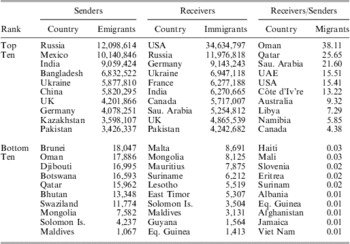
The final version of the database contains 175.7 million international migrants. Table 1 displays some basic characteristics. Russia, Mexico and India are the top three sending countries. More than 9 million people have emigrated from each of them. The top three receiving countries are the United States, Russia and Germany with more than 9 million immigrants. Interestingly, among the top ten receivers we also find Saudi Arabia, Ukraine, India and Pakistan. Clearly, small island states and landlocked countries are among the smallest sending and receiving countries. The final two columns of the table provide a first glimpse at the migrant stock between countries. The columns present the ratio between immigrants and emigrants for each country. At the extreme, for each person emigrating from Oman there will be about 38 immigrants; or for every 100 Jamaican emigrants there will be one immigrant. An important aspect here is that oil-rich Arab states have a very high receiver:sender ratio and some of the smaller and ‘poorer’ European states have a low ratio.
Basic Characteristics of the Bilateral Migration Data, 2000Footnote *

* Only considering independent states that are not microstates.
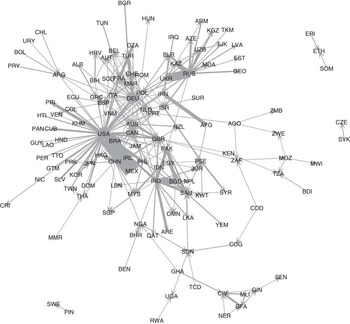
Figure 1 displays some of the information of the 226 by 226 country/entity matrix of bilateral migrant stocks.Footnote 52 The graphic displays all migrant populations of more than 500,000 people for the 2000 census.Footnote 53 The plot employs the Fruchterman–Reingold algorithm for placing the vertices. The width of the edges corresponds to the size of each migrant population. While some of the central countries – such as the United States, Germany, Russia and India – are on different continents, the ‘spokes’ of these centres clearly are in close geographic proximity. Russia has sent and received significant migration from its former satellite republics in the Soviet Union. By far the largest bilateral stock is migrants from Mexico to the United States. The Arabian Peninsula draws a large number of its migrants from the surrounding parts of Asia. Finally, a considerable part of the ‘large’ African migration stocks occur within the continent.
Fruchterman–Reingold layout of migration stocks of more than 500,000 people, 2000

The Parsons et al. data on bilateral migration are data on migration stock and consequently we need to justify why stock data capture our hypotheses about global migration.Footnote 54 The first rationale for using stock data has to do with the fact that bilateral migration flow data are only available for flows to and from a handful of countries in the Organization for Economic Co-operation and Development (OECD). In other words, bilateral migration flows between other countries in the world (≥200 countries) are completely missing. Indeed, as far as we are aware, the best alternative bilateral migration data are from the United Nations.Footnote 55 This dataset provides bilateral migration flow data, from the early 1950s to 2004, to and from fifteen OECD countries (Australia, Belgium, Canada, Denmark, Finland, France, Germany, Italy, Netherlands, New Zealand, Norway, Spain, Sweden, the United Kingdom and the United States). If bilateral migration flows among the rest of the countries in the world are small enough to be negligible, the United Nations data would be a better choice for our analysis.Footnote 56 However, we know that migration flows outside the OECD countries are becoming more and more important: Figure 1 has revealed the importance of migration flows between Russia and other former republics of the Soviet Union; some rich Gulf countries such as Saudi Arabia and Kuwait are important migration destinations with most of the inflow of guest workers coming from other Middle Eastern and South Asian countries. A considerable segment of African migration occurs within the continent. In short, the available migration flow data capture only a fragment of the global migration pattern.
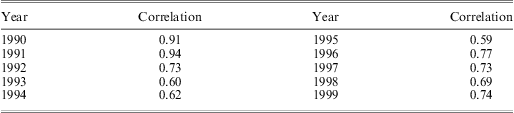
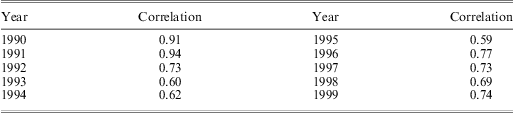
The second justification for using stock data is that migration stocks can serve as a good proxy for migration flows. In order to test this assertion, we examine the correlations between bilateral migration stocks from Parsons et al.Footnote 57 and bilateral flows from the United Nations,Footnote 58 based on the overlapped country-pairs. The stock data from Parsons et al. are based on the 2000 round of censuses.Footnote 59 We calculate the correlations between the stock data in 2000 and flow data from 1990 to 1999, that is, the migration flows for the ten years before 2000. The correlation statistics are presented in Table 2: the bilateral migration stock data in 2000 are highly correlated with bilateral migration flows from previous years. In sum, because the data for bilateral migration flows among non-OECD countries are systematically missing and because migration stocks can serve as a good proxy for migration flows, we chose to use the most comprehensive stock data available to test our hypotheses. In our models, the migration is measured with a logged scale: the logged number of immigrants from country j living in country i in 2000.
Correlations between the Stock Data in 2000 and Flows Data, 1990–99
Dyadic Covariates
Common language and colonial ties are both binary variables, with 1 denoting the existence of a common language/previous colonial relationship and 0 otherwise. Data on countries’ primary language(s) are obtained from the CIA Factbook.Footnote 60 Data on colonial relationship are obtained from the online data archive from Rose.Footnote 61 We control for the effects of proximity in geography by calculating distance using the Haversine formula with data on latitude and longitude of capital cities taken from the world.cities database maintained as part of the maps package in the  $ {\scr R} $ statistical programming package.Footnote 62 Distance is calculated in thousands of kilometers (logged).
Sender and Receiver Country Characteristics
We first control for the size of population for both sender and receiver countries of migration.Footnote 63 We also include GDP per capita, measured in purchasing power parity (PPP), for both sender and receiver countries, to test whether the common wisdom holds: people leave poor countries and move to rich countries. Data on total population and GDP per capita are both from World Development Indicators.
We use the annualized polity score which ranges from −10 (for highly authoritarian states) to +10 (for highly democratic regimes) to gauge the effects of domestic institutions in pushing and pulling migration.Footnote 64 The Polity score provides the best available measurement of the regime characteristics that we argue affect migration levels: decisional constraints on leaders. Autocratic governments are more isolated from international and domestic norms on political and civil rights (even for immigrants) and domestic demand for anti-immigration policies than their democratic counterparts. The Polity data specifically measure executive constraints, which is the core of our theory. Other measures of democracy, such as Freedom House, do not focus as closely on executive constraints.
‘Natural disasters’ refer to ‘nature-induced cataclysmic events or situations which overwhelm local capacity, often (although not necessarily) resulting in a request for external assistance.’Footnote 65 The OFDA/CRED International Disaster Database (http://www.em-dat.net) carries comprehensive records of natural disasters in the world and defines an event as a natural disaster if one or more of the following criteria are met: (1) ten or more people reported killed, (2) one hundred people reported affected, (3) a declaration of a state of emergency is issued, and/or (4) international assistance is requested.Footnote 66 We operationalize the natural disaster variable for our empirical analysis as the number of years that one country experienced natural disaster(s) in the previous ten years before 2000.
For the civil conflict variable, we use data from the UCDP/PRIO Armed Conflict Dataset (Version 4-2007) that define conflict as ‘a contested incompatibility that concerns government and/or territory where the use of armed force between two parties, of which at least one is the government of a state, results in at least 25 battle-related deaths’.Footnote 67 We operationalize the civil conflict variable as the number of years that one country experienced civil conflict(s) in the previous ten years before 2000.
The Parsons et al. dataset contains information on immigrants and emigrants for 226 countries/entities.Footnote 68 However, data on the covariates are often missing for entities that are not an independent country or a micro state such as Kiribati or Tonga. For example, Reunion is one of the overseas départements of France and civil conflict data are missing for this entity. Given this, our sample contains 148 countries in our model presented in Table 3.
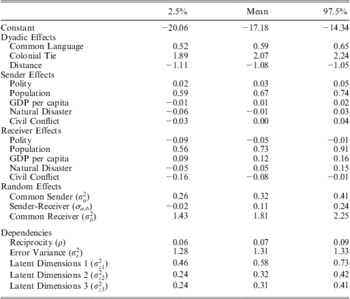
Posterior Distributions of Estimated Coefficients for Year 2000Footnote *

* Bayesian estimates for 2000, using Equation 1, are the posterior means for the estimated quantities. Quantile-based, empirical credible intervals of 95% are presented. The number of observations is 21,756.
A Generalized Latent Space Network Model
Since global migration represents network data, a major challenge for our empirical assessment is identifying a proper estimation technique. We use a generalized version of the latent space model from Hoff.Footnote 69 The model can be written as follows:
 $$ {{y}_{i,j}} = \beta{'} \!\!_{d} {{x}_{i,j}} + \beta{'} \!\!_{s} {{x}_i} + \beta{'} \!\!_{r} {{x}_j} + {{a}_i} + {{b}_j} + {{\gamma }_{i,j}} + z{'}\!\!_{i} {{z}_j}, \eqno<$$><$
where
 $$ \beta{'} \!\!_{d} {{x}_{i,j}} = \:{{\rm dyadic}}\;{{\rm effects}}\!:\;{{\rm common}}\;{{\rm language}},\;{{\rm colonial}}\;{{\rm ties}},\;{{\rm distance}}\: \eqno<$$><$
 $$ \beta{'} \!\!_{s} {{x}_i} = \:{{\rm sender}}\;{{\rm effects}}\!:\,{{\rm population}},\;{{\rm GDP}}\;{{\rm per}}\;{{\rm capita}},\;{{\rm polity}},\;{{\rm natural}}\;{{\rm disaster}},\;{{\rm civil}}\;{{\rm conflict}}\: \eqno<$$><$
 $$ \beta{'} \!\!_{r} {{x}_j} = \:{{\rm receiver}}\;{{\rm effects}}\!:\,{{\rm population}},\;{{\rm GDP}}\;{{\rm per}}\;{{\rm capita}},\;{{\rm polity}},\;{{\rm natural}}\;{{\rm disaster}},\;{{\rm civil}}\;{{\rm conflict}}\: \eqno<$$><$
 $$\[--><$$l>\qquad\qquad\quad\qquad {{a}_i} = \:{{\rm random}}\;{{\rm effect}}\;{{\rm of}}\;{{\rm sender}}\: \eqno<$$><$
 $$\[--><$$l>\qquad\qquad\quad\qquad {{b}_j} = \:{{\rm random}}\;{{\rm effect}}\;{{\rm of}}\;{{\rm receiver}}\: \eqno<$$><$
 $$\[--><$$l> \qquad\qquad\quad\quad\quad \!\!{{\gamma }_{i,j}} = \:{{\rm reciprocity}}\: \eqno<$$><$
 $$\[--><$$l>\qquad\qquad\quad\qquad \!\!\! z{'}\!\!_{i} {{z}_j} = \:{{\rm separate}}\;{{\rm latent}}\;{{\rm positions}}\;{{\rm for}}\;{{\rm sender}}\;{{\rm and}}\;{{\rm receiver}}\: \eqno<$$><$
yi,j is the response variable, that is, the stock of immigrants from sender country i to receiver country j in 2000. In addition to the effects of the dyadic covariates ( $ \beta{'} \!\!_{d} {{x}_{i,j}} $: common language, colonial ties, and geographic distance), this model set-up adds covariates that are specific to sender (
 $ \beta{'} \!\!_{s} {{x}_i} $) and receiver (
 $ \beta{'} \!\!_{r} {{x}_j} $) countries of migration. These covariates include population, GDP per capita, polity, natural disaster and civil conflict in both sender and receiver countries.
The model also includes random effects of sender (ai) and receiver (bj) countries. The rationale is that in addition to the sender and receiver specific covariates already included in the model, other variables characterizing sender and receiver countries might also affect migration. Random effects are able to capture country-specific variables that are potentially important but not included in our model. For example, if data were available, labour market regulations of both sender and receiver countries and the influence of far-right parties in receiving countries could also be included. Moreover, random effects of sender (ai) and receiver (bj) countries can account for the heterogeneity among countries as senders and receivers of migration. The chances are that some countries are special even after controlling for all the possible variables that we can name. For example, Mexico is often considered an unusual case – a country sending large number of migrants to the United States that might not only be explained by variables such as geographic proximity, population, GDP per capita, polity, natural disaster and civil conflict.Footnote 70
Considering γi,j as the residual error term,  $ {{y}_{i,j}} = \beta{'} \!\!_{d} {{x}_{i,j}} + \beta{'} \!\!_{s} {{x}_i} + \beta{'} \!\!_{r} {{x}_j} + {{a}_i} + {{b}_j} + {{\gamma }_{i,j}} $ is a typical regression model setup with random effects. Employing such a model assumes observational independence. However, this assumption is often violated in network data by the existence of higher-order dependencies. Social network literature makes clear that second-order and third-order dependencies are prevalent in most network environments. In the context of directed relationships, second-order dependence refers to what is often described as reciprocity. This means that we expect yi,j and yj,i to be positively correlated. In the study of international relations, strong reciprocity often exists among a large number of dyads. Previous research on trade shows that imports from country i to j are more likely to go up as the movement of commodities in the opposite direction within the same dyad increases.Footnote 71 Ward, Siverson and Cao also reveal strong reciprocity in the context of interstate conflict: if country i initiates a conflict with j, one expects j to reciprocate.Footnote 72
With regard to the migration network, we lack empirical evidence from previous research on the reciprocal nature of migration stocks. We can only speculate that at least for some areas in the world, such as Europe, we might expect high levels of reciprocity in migration. For example, Germans emigrate to neighbouring countries and create connections between the German labour market and those of neighbouring countries. This in itself might trigger migration in the opposite direction: more French, Austrians and Italians going to Germany to find jobs. Whether this pattern actually occurs and whether reciprocity of migration can be generalized to other parts of the world is a question that our empirical analysis seeks to answer. The latent model, therefore, further parameterizes the covariance of the errors across dyads, that is, the covariance of the errors between γi,j and γj,i, as  $ \rho \sigma _{\gamma }^{2} $, allowing a specific measure of reciprocity to be estimated by ρ.
Similar to second-order dependence, third-order dependence is commonly recognized in the literature of social network analysis. Aspects of this higher-order dependence include transitivity, balance and clusterability.Footnote 73 An often-used example in the literature on third-order dependence considers the following relationships among a triad {i,j,k}. If we know that i considers j as a friend and j is a friend with k, then the probability that k will also be a friend with i is likely to be higher than for a random person outside of this triad, since i and k are at least indirectly connected in the friendship network by virtue of their separate linkages to j. In other words, knowing something about the relationships in the first two dyads in a triad often tells us something about the relations in the third dyad. As we think about the nature of the third-order dependence in some network datasets, a conceptualization of a somehow ‘unobserved’ or latent ‘social space’ in which every network actor is embedded is very fruitful. Thus, for example, the observation of two links, i → j and j → k, suggests that i and k are not too far away from each other in this social space (which is often unobservable), and therefore are also likely to have a link between them.
The third-order dependence is an expression of the underlying probability of a link between two actors. We do not observe the complete set of all of these network characteristics, but we can infer them from the pattern of dyadic linkages. If we can map out the latent positions of each actor in the ‘social space’, we can then assume that the ties in the network are conditionally independent. A series of latent models have been recently developed by Hoff, Raftery and Handcock and by Hoff where latent vectors, say zi and zj, for any two actors i and j are used to locate the actors in the ‘social space’ in order to account for third-order dependence.Footnote 74 The latent model includes an estimate of the latent positions of each country in the migration network (zi and zj). These latent positions (zi and zj) index the propensities for country pairs to have similar interaction patterns towards other countries. Put in a simple way, if two countries share similar positions in the latent space, they have a higher probability of interacting with each other. In the context of transnational migration, this means a high level of bilateral migration.
Empirical Findings
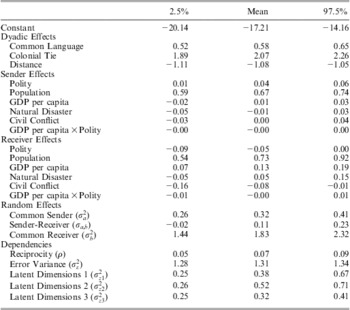
We model bilateral migration stock in 2000 as a function of connections between countries including common language, colonial ties, and geographical distance, and sender and receiver country characteristics such as polity, population, GDP per capita, natural disaster and civil conflict. The generalized latent space model we applied also takes into account sender-country and receiver-country random effects, as well as second-order and third-order dependencies in network data. Model 1 is estimated by a Bayesian Markov Chain Monte Carlo (MCMC) procedure.Footnote 75Table 3 reports our empirical findings by showing the 95 per cent confidence intervals of the posterior distributions.Footnote 76
The estimates of the dyadic effects on migration confirm some of the conventional wisdom. Sharing a common language and historical colonial ties both increase bilateral migration. Note that these are two binary variables. Therefore, the predicted logged difference between a pair of countries that share a common language and a country pair that does not, all else being equal, is about 0.6. The mean estimate for previous colonial relationship is much larger than that of common language: the predicted logged difference between a pair of countries with a colonial tie and a country pair without it, all else being equal, is about 2.1. Finally, a negative mean estimate of −1.08 illustrates the importance of geographic proximity for migration. As the distance between countries increases, their bilateral migration decreases.
In terms of sender and receiver country characteristics, we find a strong validation of our central argument. The polity of the sending country has a statistically significant and positive effect on migration: the more democratic a country is, the more migrants it sends, all else being equal. Equally important, there is a statistically significant but negative effect of a receiving country's polity on migration. Ceteris paribus, the less democratic a country is, the more migration it receives. These two findings reveal an important aspect of global migration at the end of the twentieth century. Taking both findings together, the Bayesian estimation reveals that international migration stocks are influenced by the barriers to entry and freedom of exit from democracies, as well as non-democracies’ willingness to take on immigrants and their ability to prevent exit.
Our findings also indicate that the total population size of both sending and receiving countries has an important effect on bilateral migration stock: the higher the total population of a country, the more migration it sends and receives. This finding is consistent with Lewer and Van den Berg's recent research on a gravity model of immigration based on data from sixteen OECD countries for 1991–2000.Footnote 77 A gravity model specifies bilateral interaction as a positive function of the attractive ‘mass’ of two units, and a negative function of distance between them.Footnote 78 Similar to Lewer and Van den Berg, our finding here indicates that, in the world of immigration, the attractive masses are the population size of the sender and receiver countries of migration.Footnote 79
GDP per capita of the migration-sending country does not have a significant effect on migration. Our estimation does not lend support to the idea that poverty necessarily drives people away from their home country in search of a better life. The findings support the notion that people in extreme poverty often lack the means to travel to other countries.Footnote 80 In contrast, GDP per capita of the receiving country (a ‘pull’ factor of migration) has a significant and positive effect on migration. The estimate indicates that high living standards (as measured by GDP per capita) attract immigrants.
We find no effect of natural disaster of both sender and receiver countries on migration. Finally, countries with civil conflicts do not send out more immigrants than countries with no or fewer incidents of civil conflicts.Footnote 81 However, a significant and negative effect of a receiver country's civil conflict record indicates that people are less likely to move to countries with civil conflicts. Taken together, these two findings lend support to the argument that forced migration due to natural disasters and civil war most likely lead to internal displacement and not necessarily to international migration.
The generalized latent space model includes random sender and receiver country effects to account for heterogeneity among countries. We find that both the variance of the receiver random effects ( $ \sigma _{b}^{2} $) and the variance of the sender random effects (
 $ \sigma _{a}^{2} $) are important and non-negligible. However, the variance of the receiver random effects,
 $ \sigma _{b}^{2} = 1.81 $, is much more important than the variance of the sender random effects,
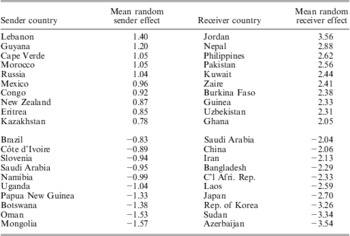
 $ \sigma _{a}^{2} = 0.32 $. Table 4 lists the top ten and bottom ten countries ranked by mean random effects for sender and receiver countries, respectively, and illustrates this dispersion. This means that the 148 countries included in our analysis display a much higher level of heterogeneity as receiving countries of migration than as sending countries of migration. In other words, after taking into account the effects of the covariates and second-order and third- order dependencies in the data, migration outflows come more evenly from all countries, while inflows tend to go to some, but not all, countries.
Top Ten and Bottom Ten Countries Ranked by Mean Random Sender and Mean Random Receiver Country Effects

Also notice that none of the top ten countries ranked by mean random receiver country effects (led by Jordan) are OECD countries. This ranking suggests that outside the usual (often narrow) focus on developed countries as migration destination countries, there are other dynamics that drive international migration that cannot be easily explained by current immigration theorizing, at least not by the variables we included in the model so far. In other words, even after controlling for the effects of geographical proximity (distance), cultural similarity and historical legacies (common language and colonial ties), and a battery of variables describing the political institutions, level of economic development, demographies, natural disasters and civil conflicts of sender and receiver countries of migration, there are still factors that we do not know (yet) that make some developing countries attractive as the destinations of migration.Footnote 82
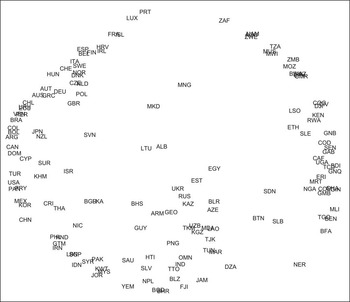
Table 3 also reveals a statistically significant, positive, but weak reciprocity parameter, ρ = 0.07. This finding indicates the existence of the second-order dependencies in the migration data. Moreover, we capture the third-order dependencies in the data using a three-dimensional latent space (k = 3). The variances of these three dimensions ( $ \sigma _{{z1}}^{2} $,
 $ \sigma _{{z2}}^{2} $,
 $ \sigma _{{z3}}^{2} $) are important. For illustrative purposes, we collapse these three dimensions to two and display the latent space in Figure 1.Footnote 83 Recall that in the latent space, the closer the two countries, the higher the chance of interactions between them. In the context of transnational migration, this means a higher level of migration. A closer look at Figure 2 indicates some clustering among countries in the latent space. The top-left corner is occupied by the European countries such as Britain (GBR), France (FRA), Denmark (DNK), Luxembourg (LUX) and Portugal (PRT). Since our model controlled for the geographic proximity (and other variables included in the model), some unmeasured factor makes these countries mutually ‘attractive’ as migration destinations. Similar clustering can be found on the right side of the space where most of the African countries such as Kenya (KEN), Lesotho (LSO) and Ethiopia (ETH) lie. In short, these positions in the latent space give us more information for dyadic interactions among countries that go beyond the monadic effects of commonly used random country effects (ai and bj).
Latent positions for countries in migration, 2000

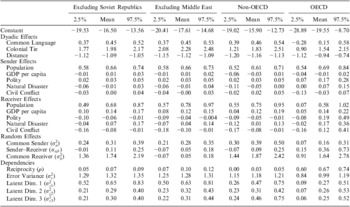
Finally, as robustness checks, we also ran the same latent space model for different samples of countries. First, we excluded all the former Soviet republics. The rationale is that the Soviet Union had considerable internal migration (some forced) and when it split up, many of the people involved were recorded as migrants as the result of changing country definitions rather than of any movement that they chose to undertake.Footnote 84 We report the findings based on all countries excluding fifteen former Soviet republics in Table 5 under the heading ‘Excluding Soviet Republics’. We also report the findings based on all countries excluding fourteen Middle Eastern countries under the heading ‘Excluding Middle East’. We thereby consider the possibility that the ways that some Middle Eastern countries attract immigrants (especially from their neighbouring countries) are different from general migration patterns of the world, given their oil-rich status.Footnote 85 Moreover, we ran the model separately for non-OECD countries and OECD countries. What we find in the analysis based on non-former Soviet republics, on non-Middle Eastern countries, and on all non-OECD countries, almost exactly matches what we found in the previous section covering all countries. All else being equal, migrants tend to move to countries that are richer, less democratic and without civil conflict.
Robustness Checks with Using Different Samples of Countries

However, the findings from the analysis based on the OECD countries suggest that receiver country's polity and civil conflict do not have a significant effect on migration. This is largely due to the lack of variation in polity and civil conflict as receiver country variables: twenty-five out of thirty current OECD countries have a polity score of 10 and the average among these thirty countries is 9.31; meanwhile, twenty-six out of thirty current OECD countries have no incidence of civil conflict. The only outlier is Turkey: it experienced incidents of civil conflicts during the 1990s. Essentially, this finding goes along with our initial claim that a scholarly focus on only OECD countries misses the influence of regime type on migration patterns.
The analysis of OECD countries reveals another interesting aspect of migration. We observe a high level of reciprocity for within-OECD migration as indicated by a reciprocity parameter ρ estimated around 0.7. This detection of a much higher level of reciprocity (second-order dependence) in the migration data of the OECD countries suggests that, within the sphere of developed countries, the existence of a migrant stock from a given country in itself significantly induces the increase in migration stock in the opposite direction.
We also explore whether political regime type interacts with the incentives to migrate from and to a certain locale.Footnote 86 In essence, the logic of our theoretical story goes from characteristics of political regimes (democracy or not) to immigration/emigration policies to ex-post migration outcomes. A natural theoretical extension is a potentially interactive effect between regime types and incentives to migrate. For example, one might expect that entry restrictions for a rich democracy are more severe than for a poor democracy due to the heightened immigration pressure that might be expected in a more prosperous economy. Moreover, emigration policies might be less restrictive in rich autocratic countries than in poor autocratic countries because there is less incentive for people to leave rich countries. Consequently, we should analyse the interactions between regime type and GDP per capita (both for sender and receiver countries).
Using the same estimation technique, we display the results in Table 6. The estimation makes clear that our findings concerning the estimated effects of other variables hardly change. The mean estimates for the interaction terms between polity and GDP per capita for both sender and receiver effects are indeed both negative: −0.0002 and −0.0005 respectively. This is consistent with the aforementioned theoretical expectations. For the interaction between sender polity and sender GDP per capita, a negative sign means that as GDP per capita increases, the positive effect of democracy, that is, the negative effect of autocracy, on emigration decreases, suggesting that as countries become richer the emigration policies might become less restrictive because there is less incentive for people to leave. For the interaction between receiver polity and receiver GDP per capita, a negative sign means that as GDP per capita increases the restrictive effect of democracy on immigration deepens; in other words, as countries become richer, immigration pressure heightens, and immigration policies become more restrictive because democracies are more responsive to public anti-immigration demands.
Posterior Distributions of Estimated Coefficients for Year 2000

Notes: Bayesian estimates for 2000, testing an interaction between GDP per capita and polity, are the posterior means for the estimated quantities. Quantile-based, empirical credible intervals of 95% are presented. The number of observations is 21,756.
However, both estimates are far from being statistically significant in terms of the 95 per cent confidence intervals. We plot the interactive effects in Figures 3(a) and 3(b). The long-dashed lines are the upper and lower bounds of the 95 per cent confidence interval of the estimated effect. The dark line in between the dashed lines represents the estimated mean coefficient. Indeed, we can see the interactive effects, both for sender and receiver countries, are very small by looking at the slopes of the dark lines – the mean coefficients estimated for polity conditional on different levels of GDP per capita. The two dark lines are almost flat, suggesting that the extent to which GDP per capita conditions the effects of polity on emigration and immigration is very small. Moreover, Figures 3(a) and 3(b) also suggest that the effects of sender polity and receiver polity are significant only for countries with relatively low levels of GDP per capita. However, these changes in confidence intervals across different levels of GDP per capita could simply be a function of the number of observations in the data associated with different income groups. Looking at the distribution of countries according to levels of GDP per capita in our data, we have many more observations (see Figure 3(c)) for countries with GDP per capita lower than $10,000: the estimates on the effects of polity when GDP per capita is relatively low are based on many more observations, which naturally give much narrower confidence intervals.Footnote 87
The effects of polity conditional on GDP per capita Notes: (a) Sender (b) Receiver (c) Density, GDP per capita (thousand dollars).

Since the evidence for interactive effects between regime types and income levels (for both sender and receiver countries) is rather limited, further research in this direction would be useful. One potential explanation for this non-finding is that labour market competition between natives and the foreign-born is not restricted to developed, rich countries. As far back as 1996, a survey in the New York Times found widespread anti-immigrant sentiment and policies (including mass deportations and anti-immigrant violence) in countries such as Gabon, Ethiopia, Zambia, Kenya, Thailand, Pakistan, India, Mexico, Panama, El Salvador and Russia.Footnote 88
Conclusion
This study is motivated by the pressing need for social scientists to explain international migration networks and model them accurately. Unlike the first great era of globalization, migration is heavily affected by regime type and policy choice, which in turn has large political and economic effects, intersecting with other key issues like security, nationalism and economic prosperity. Thus, migration deserves all the attention that social scientists give it. However, the literature thus far has been hampered by a narrow focus on either receiving conditions in the advanced industrial economies, or sending conditions in the developing world. Given that this dichotomy hardly gives a complete picture of world migration (witness the 2009 riots in South Africa against migrants from Zimbabwe and Mozambique, among other fellow developing countries), our analysis attempts to explain bilateral stocks among all categories of countries.
Our findings confirm some common assumptions but reject others. We confirm existing scholarship on bilateral effects by finding that linguistic/colonial ties and a lower geographic distance play a strong causal role in increasing the volume of migration between two given countries. The linguistic/colonial variable seems to validate theories based on social networks as independent drivers of migration. If geographic distance can be taken as a proxy for cultural distance, as suggested by the Deutsche Bank study,Footnote 89 then social networks do indeed appear to be an important independent cause of migration.
Some striking results of our study come from factors that affect the volume of emigration. First, three seemingly important conditions have no statistically significant effect on pushing migrants to leave their countries of origin. Wealth, natural disasters and civil conflict are apparently not important here. We might explain the null finding for natural disasters and civil conflict by pointing out that a large portion (if not a majority) of the afflicted people do not leave their country of origin, but instead become ‘internally displaced persons’.Footnote 90 The fact that poverty does not push migrants to leave, however, begs more detailed explanation. Upon first glance, it might appear improbable that poverty does not cause emigration. However, the work of De Haas shows us that the poverty–emigration relationship is much more complex than some might suspect.Footnote 91 In fact, migrants do not tend to come from the poorest of poor countries. Instead, migrants tend to come from middle-income countries that are experiencing mid-to-late stages of development. The reason for this occurrence is that development tends to decimate small-scale agriculture and causes a rise in economic expectations, which are often not fulfilled by the domestic labour market in the short term. At the same time, development increases such trends as education and urbanization, which give potential migrants the skills and resources to leave their countries of origin, at least until such time as their native country can satisfy their expectations. This little-studied phenomenon is particularly fascinating considering that it casts doubt upon the attempts of many rich-world governments to reduce migrant populations through development assistance to sending countries (for example, the European Union's plan to ‘combat’ illegal migration through development aid). In fact, the implication of our finding is that such efforts may be counter-productive (if the goal is reducing migration), at least in the short term. If democracies wish to spread liberal norms and attract necessary foreign labour, while also gaining greater control over immigration flows, then putting pressure on economically growing autocracies to provide a social safety net and political rights for immigrants could prove far more fruitful.
With respect to receiving country characteristics, some findings are fairly intuitive: migrants tend to be attracted to countries that are larger, have more wealth and have less civil conflict. More importantly, however, the impact of polity (political institutions) is an important dimension of migration. An initial view might suggest that humans migrate from non-democracies to democracies, but we find strong support for our expectation that democracies send more emigrants and receive less immigrants than non-democracies. The article offers an individual-level and macro-level logic as to why democracies receive less and send more migrants than non-democracies. At the individual level, the search for economic well-being trumps any aspiration for the political freedoms offered by democracy. At the macro-level, it is important to recognize that democracies tend to block entry and allow exit, while non-democracies tend to block exit and allow entry. Clearly, a burgeoning agenda for research is to disaggregate these individual and macro-level push and pull factors of migration in the context of our study. Our empirical findings indicate a fruitful area for future political science research.
This article should also remind scholars working in international political economy that, in addition to trade, investment and capital flows, migration is a crucial element of the international environment.Footnote 92 However, state incentives and preferences on trade or finance are often divergent from those for migration. As Hollifield argues, for trade and finance invested interests tend to follow market incentives, but with migration this is often not the case.Footnote 93 In the case of migration, purely economic arguments are usually overshadowed by political, cultural and ideological arguments. Thus, developed states are caught in a ‘liberal paradox’. The rules of the market require openness and factor mobility, but the rules of the liberal polity and an anti-immigrant public require some degree of closure. Our article sheds light on this paradox by examining the influence of regime type on immigration. While we agree with international political economists that regime type influences the policy options of political leaders, the policy consequences are reversed – instead of liberalizing, democracies, in comparison to autocracies, are restrictionist. Human migration is characterized by exiting democracies and entering non-democratic regimes.
Appendix A: Predictive Power of the Model and Estimation Technique
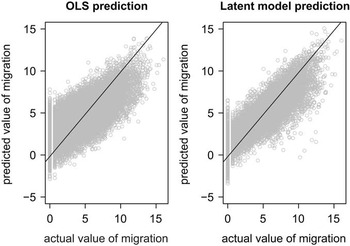
Our latent model has a better predictive power than alternative estimation techniques. While the latent model using a Bayesian Monte Carlo Markov Chain is much more difficult to estimate compared to a simple OLS regression, the latent model is able to control for higher order dependencies in the data and heterogeneity at sender and receiver and dyadic levels. One way to test whether the latent model outperforms an OLS regression is to look at the their predictive power. Figure 4 plots the predicted values of bilateral migration on the actual values, separately for an OLS and a latent space model. A 45° line is drawn for each plot on which perfect predictions shall fall. The latent model seems to provide better prediction as the points on the plot are closer to the 45° line. We also calculate the mean root squared error (RMSE) for both OLS and latent models:
 $$ RMSE = \sqrt {\frac{1}{n}\mathop{\sum} {{{({{y}_i}{\rm{ - }}\widehat{{{{y}_i}}})}}^2} }, $$
where  $ \widehat{{{{y}_i}}} $ is the predicted value, yi the actual value, and n is the number of observations. The latent model has a much smaller mean root squared error (1.35) than the OLS model (1.96).
A comparison of in-sample prediction between simple OLS and latent space model.

Appendix B: Country Names and Acronyms Used in Figures
Afghanistan (AFG), Albania (ALB), Algeria (DZA), American Samoa (ASM), Andorra (AND), Angola (AGO), Antigua & Barbuda (ATG), Argentina (ARG), Armenia (ARM), Australia (AUS), Austria (AUT), Azerbaijan (AZE), Bahamas (BHS), Bahrain (BHR), Bangladesh (BGD), Barbados (BRB), Belarus (BLR), Belgium (BEL), Belize (BLZ), Benin (BEN), Bermuda (BMU), Bhutan (BTN), Bolivia (BOL), Bosnia & Herzegovina (BIH), Botswana (BWA), Brazil (BRA), Brunei Darussalam (BRN), Bulgaria (BGR), Burkina Faso (BFA), Burundi (BDI), Cambodia (KHM), Cameroon (CMR), Canada (CAN), Central African Republic (CAF), Chad (TCD), Chile (CHL), China (CHN), Hong Kong (HKG), Macao (MAC), Colombia (COL), Comoros (COM), Congo (COG), Costa Rica (CRI), Cote d'Ivoire (CIV), Croatia (HRV), Cuba (CUB), Cyprus (CYP), Czech Republic (CZE), Democratic People's Republic of Korea (PRK), Democratic Republic of the Congo (COD), Denmark (DNK), Djibouti (DJI), Dominica (DMA), Dominican Republic (DOM), Ecuador (ECU), Egypt (EGY), El Salvador (SLV), Equatorial Guinea (GNQ), Eritrea (ERI), Estonia (EST), Ethiopia (ETH), Fiji (FJI), Finland (FIN), France (FRA), French Guiana (GUF), French Polynesia (PYF), Gabon (GAB), Gambia (GMB), Georgia (GEO), Germany (DEU), Ghana (GHA), Gibraltar (GIB), Greece (GRC), Greenland (GRL), Grenada (GRD), Guam (GUM), Guatemala (GTM), Guernsey (GGY), Guinea (GIN), Guinea-Bissau (GNB), Guyana (GUY), Haiti (HTI), Honduras (HND), Hungary (HUN), Iceland (ISL), India (IND), Indonesia (IDN), Iran (IRN), Iraq (IRQ), Ireland (IRL), Israel (ISR), Italy (ITA), Jamaica (JAM), Japan (JPN), Jersey (JEY), Jordan (JOR), Kazakhstan (KAZ), Kenya (KEN), Kiribati (KIR), Kuwait (KWT), Kyrgyzstan (KGZ), Laos (LAO), Latvia (LVA), Lebanon (LBN), Lesotho (LSO), Liberia (LBR), Libyan Arab Jamahiriya (LBY), Liechtenstein (LIE), Lithuania (LTU), Luxembourg (LUX), Madagascar (MDG), Malawi (MWI), Malaysia (MYS), Maldives (MDV), Mali (MLI), Malta (MLT), Martinique (MTQ), Mauritania (MRT), Mauritius (MUS), Mayotte (MYT), Mexico (MEX), Micronesia (FSM), Monaco (MCO), Mongolia (MNG), Montenegro (MNE), Montserrat (MSR), Morocco (MAR), Mozambique (MOZ), Myanmar (MMR), Namibia (NAM), Nepal (NPL), Netherlands (NLD), New Caledonia (NCL), New Zealand (NZL), Nicaragua (NIC), Niger (NER), Nigeria (NGA), Norway (NOR), Oman (OMN), Pakistan (PAK), Palau (PLW), Panama (PAN), Papua New Guinea (PNG), Paraguay (PRY), Peru (PER), Philippines (PHL), Poland (POL), Portugal (PRT), Puerto Rico (PRI), Qatar (QAT), Republic of Korea (KOR), Republic of Moldova (MDA), Reunion (REU), Romania (ROU), Russian Federation (RUS), Rwanda (RWA), St. Helena (SHN), St. Kitts & Nevis (KNA), St. Lucia (LCA), St. Pierre & Miquelon (SPM), St. Vincent & the Grenadines (VCT), Samoa (WSM), San Marino (SMR), Sao Tome & Principe (STP), Saudi Arabia (SAU), Senegal (SEN), Serbia (SRB), Seychelles (SYC), Sierra Leone (SLE), Singapore (SGP), Slovakia (SVK), Slovenia (SVN), Somalia (SOM), South Africa (ZAF), Spain (ESP), Sri Lanka (LKA), Sudan (SDN), Suriname (SUR), Swaziland (SWZ), Sweden (SWE), Switzerland (CHE), Syria (SYR), Tajikistan (TJK), Thailand (THA), Macedonia (MKD), Timor-Leste (TLS), Togo (TGO), Tokelau (TKL), Tonga (TON), Trinidad & Tobago (TTO), Tunisia (TUN), Turkey (TUR), Turkmenistan (TKM), Tuvalu (TUV), Uganda (UGA), Ukraine (UKR), United Arab Emirates (ARE), United Kingdom (GBR), Tanzania (TZA), United States of America (USA), Uruguay (URY), Uzbekistan (UZB), Vanuatu (VUT), Venezuela (VEN), Viet Nam (VNM), Yemen (YEM), Zambia (ZMB), and Zimbabwe (ZWE).