The Valdostana is an autochthonous dual-purpose Italian breed mainly raised in the Valle d'Aosta region of northwest Italy. The cows are mainly dedicated to milk production, used almost entirely for the production of Fontina cheese. Fontina is a typical semi-hard cheese produced from raw cow's milk following well-established traditional rules. Due to its specific organoleptic characteristics and unique production technology, it received the European Community's Protected Designation of Origin status (PDO) in 1996.
The traditional husbandry system is based on small herds that are housed during the winter in closed barns, located in the valley. The herds then move to mountain pastures in summer. In spring, the cows are given temporary access to confined pastures in lowland areas around the farms for diurnal grazing. In this specific production system, the first turning out to pasture might appropriately be considered as a stressful event that compromises adaptation and performance (Bobić et al. Reference Bobić, Mijić, Knežević, Šperanda, Antunović, Baban, Sakač, Frizon and Koturić2011), not only due to the changes in housing and diet, but also due to social stress caused by the need to assess dominance relationships, a trait that is specific to Valdostana cattle (Sartori et al. Reference Sartori, Manser and Mantovani2014). No effective strategies currently exist for controlling stress during this period, making the application of pheromones of interest as a potential solution.
The family of appeasing pheromones includes pheromones which were first isolated in sows, and subsequently in female dogs, horses, cattle, sheep and cats. These pheromones are secreted by the sebaceous glands of the sulcus between the two mammary chains. In bovines, the synthetic analogue of the Bovine Appeasing Pheromone (BAP) is a mixture of fatty acids that reproduces components of the natural pheromone (Pageat, Reference Pageat1998). Some preliminary studies on BAP suggest a positive effect on stress in veal calves during the post-weaning (Madec et al. Reference Madec, Gaultier and Pageat2001a) and fattening (Madec et al. Reference Madec, Gaultier and Pageat2001b) phases, but no other effects of BAP have been explored.
In light of the need for more research, the present study aimed to evaluate the effects of BAP against placebo on milk parameters in Valdostana dairy cows, specifically during a stressful event such as the first turning out to pasture in spring prior to moving to the mountains. Because of the putative role of the appeasing pheromones in stress control, it was hypothesised that BAP might help modulate adaptation in ways that may improve Valdostana dairy cows’ performance in this specific context.
Materials and methods
Thirty healthy lactating Valdostana dairy cows were used in the experiment. The study was conducted on the farm of the Institut Agricole Régional (I.A.R., Reg. La Rochère 1/A, 11100 Aoste, Italy) between April and May 2014. All procedures involving animals were approved by the Research Institute in Semiochemistry and Applied Ethology (IRSEA, Quartier Salignan, 84400 Apt, France) Ethics Committee CE_201403_03 under EU legislation and in the spirit of good clinical practice for dairy cows.
The experiment started (T0) six days before the transition from an exclusively indoor system to a partially outdoor system, characterised by pasture during the day and confinement in the tie-stall facility at night. In the local traditional husbandry system, this is a transitional and intermediary phase when the cows begin grazing in the fields next to the farms from the middle of April until the end of May, before moving to the mid and higher alpine pastures.
Using a blinded experimental procedure with repeated measures, all cows were first randomly divided into two groups: experimental group (EG, n = 15) and control group (CG, n = 15). The cows were housed in the same tie-stall facility from 4 : 00 pm until 8 : 00 am; the EG was completely separated from the CG. Outside the two groups were managed in two different enclosures, at a distance of 200 m from each other. The cows were milked twice daily, in the morning and in the afternoon. During the period prior to being turned out to pasture, all cows were fed a hay-based diet supplemented with concentrate. The day before T1, they began grazing outside with the concentrate supplementation, but continued feeding on hay in the morning and evening.
The treatments were administered every 7 d for 28 d (T0–T4) while the animals were inside the farm at the feeding rack after the afternoon milking. Milk samples were evaluated at the same time points (T0–T4).
The treatment consisted of a liquid containing the active BAP ingredient (1%) in Transcutol® (IRSEA, Quartier Salignan, 84400 Apt, France). The control was identical to the treatment, but did not contain the active ingredient. Both the control and treatment were kept in plastic bottles and were visually and olfactively indistinguishable. The solutions were poured on the nuchal skin area between the horns of each cow using a multi-dose pistol calibrated at 5 ml.
Milk yield was measured during each of two daily milkings. Data were recorded using the computerised Afifarm 4·1 dairy management system which was linked to an Afimilk milking machine with Afilite milk meter (TDM, Via dello Strone San Paolo, BS, Italy). Measures were expressed as the mean produced/cow/day. To test milk composition, a plastic bottle was attached directly to the milking machine to collect milk from each cow during milking. The samples were transferred to tubes, refrigerated and transferred to an external and independent accredited laboratory (Région Autonome Vallée d'Aoste, Assessorat de l'agriculture et des ressources naturelles, Loc. Grande Charrière 66, 11020 Saint-Christophe, Italy) that performs standard quality control analyses on milk. Somatic cells were counted using the fluoro-opto-metric method (ISO 13366-2/IDF 148-2:2006); mid-infrared spectrometry was used to measure fat and proteins (ISO 9622:2013/IDF 141), as well as casein, urea and fat-free dry matter (ISO 9622:2013/IDF 141 modified accredited procedure). Data were supplied by the laboratory through a certified report.
Daily milk production (kg/day) was the main parameter. Secondary parameters included somatic cell count (SCC) (103 cells/ml), fat (g/100 g), proteins (g/100 g), casein (g/100 g), fat-free dry matter (g/100 g) and urea (mg/dl) in the milk.
The data were analysed using 9.4 SAS software (2002–2012 by SAS Institute Inc., Cary, NC, USA). The significance threshold was classically fixed at 5%.
For all milk parameters, data analysis was performed with a mixed model repeated measures ANCOVA using General Linear Mixed Model (mixed procedure of 9.4 SAS software) or Generalized Linear Mixed Model (glimmix procedure of 9.4 SAS software). Repeated measures ANCOVA were performed to explore both the main effects of treatment and time and their interaction.
To distinguish T0 (corresponding to the baseline, i.e. the data collected prior to the application of the treatment) from the other sampling times, the baseline was included in the model as a covariate. This allowed for comparisons before and after the application of the treatment (baseline effect), and enabled us to examine the main effect of the treatment only after the application of the treatment (treatment effect). LSMEANS statement was used for multiple means comparisons using Tukey test and the correction of Kramer with the help of the option adjust = Tukey.
Results
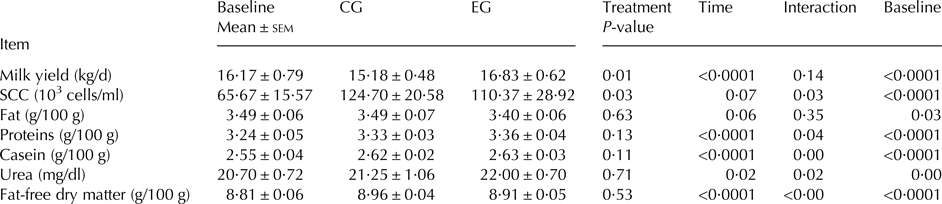
Table 1 shows the mean ± Standard Error Mean (± sem) and statistical analysis of all studied parameters (ANCOVA repeated measures, P < 0·05). Milk yield showed a significant effect for treatment and time factors, while their interaction was not significant. Values for milk yield were significantly higher in EG (16·82 ± 0·62) than in CG (15·18 ± 0·48). The high significance of the baseline value (P < 0·0001) underlines the difference between before and after the treatment application. The effect on milk yield at different times is presented in Fig. 1.
The interaction treatment × time for milk production (kg, means ± sem) of cows between cows treated with Bovine Appeasing Hormone (EG) and control group (CG) for 28 d.

Milk yield, SCC and milk composition parameters (mean ± sem) in cows treated with Bovine Appeasing Hormone (BAP: EC) and control group (CG).

The effects of treatment, time, the interaction treatment/time and the baseline are presented (ANCOVA repeated measures, P < 0·05).
In SCC, a significant effect was observed for the treatment factor (P = 0·03); values were significantly higher in CG (124·70 ± 20·58) than in EG (110·37 ± 28·92) but the effect of time was not significant (P = 0·07). There was, however a tendency for a greater increase across time in the control group, and the treatment × time interaction was significant (P = 0·03). In particular, lsmeans statement showed a significant difference between the two treatment groups at T1 (204·73 ± 63·70 for CG vs. 73·27 ± 21·98 for EG; P = 0·01). As for milk production, the high significance of the baseline value (P < 0·0001) underlines the difference between before and after the treatment application.
A significant difference was observed for time factor in proteins, casein, fat-free dry matter (P < 0·0001), and urea (P = 0·02). Their interaction was significant for proteins (P = 0·04), casein (P = 0·00), urea (P = 0·01), and fat-free dry matter (P < 0·0001). There were few treatment effects, apart from at T1 when urea values differed in the two groups (32·62 ± 0·91 for CG vs. 27·88 ± 1·35 for EG; P < 0·0001).
Discussion
Milk production showed significantly higher values in the EG than in the CG. The transition from barn to pasture is a big challenge for dairy cows, not only due to the changes in husbandry, but also because it gives cows the possibility to move around and interact with other animals in a social group, especially for cows kept in tie stalls (Wredle et al. Reference Wredle, Östenssonb and Svennersten-Sjaunjaa2014). Negative consequences on physiology, production and welfare due to increased stress have been observed in cattle after the experience of regrouping, or other situations where social status needs to be settled (von Keyserlingk et al. Reference von Keyserlingk, Olenick and Weary2008). Stimuli which disrupt the homeostasis of the animals can potentially elicit a stress response, with disturbances in the release of milk, decreased productivity and decreased immunity (Bobić et al. Reference Bobić, Mijić, Knežević, Šperanda, Antunović, Baban, Sakač, Frizon and Koturić2011). Similarly, Comin et al. (Reference Comin, Prandi, Peric, Corazzin, Dovier and Bovolenta2011) observed a reduction in milk yield in alpine dairy cows when transitioning from winter housing to summer highland grazing. Since stress is one of the influencing factors for a decreased performance in dairy cows, these results seem to confirm the beneficial effects of BAP during the environmental transition from indoor to outdoor housing conditions.
A significant difference in favor of the BAP compared to the CG was observed in SCC. Even if the sample is too small to demonstrate effects, and inadequate for any statements on incidence of clinical mastitis, an increase of SCC might be considered greatly negative for the Fontina cheese. The cheese from high-SCC milk may be higher in moisture and may have a higher level of proteolysis during ripening, which could compromise the typical sensory quality of the product (Mazal et al. Reference Mazal, Vianna, Santos and Gigante2007). Finally, our results are in accordance with Wredle et al. (Reference Wredle, Östenssonb and Svennersten-Sjaunjaa2014), who reported an immediate increase in SCC when the cows were turned out to pasture, and a decline after the first day.
Milk composition has a relevant influence on the technical and economic efficiency of cheesemaking. Chemical analysis of milk is required to maintain efficient operations and to ensure good safety and quality of fermented dairy products: fat, proteins, casein, urea and fat-free dry matter are routinely monitored by cheesemakers to ensure desired characteristics and prevent adulteration. Due to the importance of the milk quality factors, determining the possible effects of BAP on milk composition might be interesting for the dairy products. Fat, proteins, casein and fat-free dry matter showed values compatible with literature (Wredle et al. Reference Wredle, Östenssonb and Svennersten-Sjaunjaa2014), but were unaffected by the treatment. Concerning urea, the results fall in the range of values reported by Romanzin et al. (Reference Romanzin, Corazzin, Piasentier and Bovolenta2013). Nevertheless, in T1 urea content was higher in CG vs. EG, suggesting a more correct metabolic balance during the initial transition in the group treated with BAP.
In conclusion, the results of this study support the hypothesis that BAP might contribute to modulate adaptation in ways that may improve Valdostana dairy cows’ performance, specifically during a stressful event such as the first turning out to confined pastures around the farms in lowland areas before moving to the mountains. Further studies are needed to obtain data in different situations related to breeds, bovine productions and productive systems, and to gain more insight into the pheromonal approach.