Introduction
Neuropsychological tests and batteries are increasingly used, both clinically and in research studies, to differentiate normal cognitive aging from disease states and to understand the cognitive phenotypes of pathological processes. However, there have been inconsistencies in the literature regarding what different neuropsychological variables measure. This is particularly true of variables designed to measure executive functioning, in part because executive functioning refers to a fairly broad array of skills. This is relevant to numerous conditions in which decline in executive functions are a prominent aspect of the disease process. In particular it has become increasingly accepted in studies on the effects of subclinical vascular lesions such as white matter damage, infarctions, and microbleeds that executive function is specifically affected. Indeed, recent harmonization standards from the National Institute of Neurological Disorders and Stroke and Canadian Stroke Network (NINDS-CSN) have recommended the use of neuropsychological batteries that emphasize executive function in studies of vascular cognitive impairment–that is, any cognitive disorder in which vascular damage plays a role (Hachinski et al., Reference Hachinski, Iadecola, Petersen, Breteler, Nyenhuis, Black and Leblanc2006).
Typically, executive functioning tasks are designed to assess the ability to control and coordinate cognitive operations. The inclusive nature of the definition of executive function has lead to the use of tests that, at least on the surface, vary substantially from one another. For example, some of the tests that are commonly used to examine executive function in large studies include tests of verbal fluency, variations on the trail making tasks (e.g., Color Trails), the Wisconsin Card Sorting Test (WCST; Heaton, Chelune, Talley, Kay, & Curtis, Reference Heaton, Chelune, Talley, Kay and Curtiss1993), the Tower of Hanoi or the Tower of London, the Stroop Color Word test, and the Paced Auditory Serial Addition Task (PASAT; Gronwall & Wrightson, Reference Gronwall and Wrightson1974). However, what do these tests, hypothesized to reflect executive functioning (and other cognitive abilities) measure?
One way to address this question is to use a technique called contextual analysis (Salthouse, Reference Salthouse2005; Salthouse, Pink, & Tucker-Drob, Reference Salthouse, Pink and Tucker-Drob2008; Salthouse, Siedlecki, & Krueger, Reference Salthouse, Siedlecki and Krueger2006), an analytic method in which the meanings of target variables, such as performance on individual neuropsychological tests, are interpreted within the context of a set of reference cognitive abilities. Each reference cognitive ability is typically represented in the analyses as a latent construct (factor) defined by the variance common to a set of observed variables.Footnote 1 In contextual analysis, each target variable is regressed on all of the reference ability constructs simultaneously (analogous to a set of multiple regression equations, but in this case the predictors are represented by latent constructs in a structural equation model). The magnitude of the standardized regression coefficient reflects the extent to which the target variable is uniquely related to each cognitive ability.
Contextual analyses of this sort have several advantages. First, the reference abilities are represented by latent constructs and, as such, are theoretically free of measurement error (because the latent construct represents the variance that is shared and common among the observed variables—and to be shared and common, the variance must necessarily be reliable). The relationships among the target variables and reference ability constructs may be underestimated when the cognitive abilities are represented by a single variable (as in the case of multiple regression) because the relationship may be attenuated due to the presence of measurement error. However, use of contextual analyses within the framework of a structural equation model addresses this issue of underestimation due to unreliability of the measures since the latent construct is, theoretically, perfectly reliable. Second, the simultaneous nature of the analysis is advantageous because the relations between the target variables may be overestimated when several predictors (e.g., cognitive abilities) are not included. This is because shared influences cannot be distinguished from influences unique to a specific predictor (e.g., when only one predictor is included). For example, in a model in which only memory is included as a predictor of the target variable the relationship between memory and the target variable may be significant. However, if several other cognitive constructs are included in the model, the memory construct may no longer be a significant predictor because the variance it shared with the target variable was variance common to all the cognitive abilities—in this scenario, once memory's unique relationship with the target variable is assessed, it is no longer significant.
Salthouse et al. (Reference Salthouse, Siedlecki and Krueger2006) recommend this analytical procedure because it provides an “objective method of determining the contribution of different factors on a particular variable. That is, a variable can be inferred to be influenced by a factor to the extent to which people who have high or low values on that factor differ in their level of performance on the target variable. Until more direct methods of quantifying the influence of various factors on a variable are developed, basing the determinations on comparisons of people who differ in the levels of established factors may be the most objective method available for investigating the ‘meaning’ of a variable.” (p. 121).
Another important aspect of evaluating the meaning of a variable is to examine whether the variable retains the same meaning (in this context we are suggesting that the “meaning” of a variable is derived from those factors that predict it) across different groups. Of particular interest is whether the same constructs are predictors of target variables across samples of English-speakers and Spanish-speakers. Many Spanish speaking individuals from Latin America and the Caribbean self-identify as racially white and of Hispanic ethnicity. White Hispanics are the fastest growing demographic group in the United States (www.CensusScope.org). In addition, it is projected that the population of Hispanic older adults (those over the age of 65) will increase 600% over the course of the next 50 years (cited from Mungus, Widaman, Reed, & Tomaszewski Farias, Reference Mungus, Widaman, Reed and Tomaszewski Farias2011). Although specialized batteries exist (e.g., The Spanish and English Neuropsychological Assessment Scales) to assess the neuropsychological functioning of Spanish speakers, batteries are often translated and administered to Spanish speakers under the assumption that the variables are measuring the same constructs, or cognitive domains, in both groups. An important endeavor is to empirically examine whether the same factors predict neuropsychological performance across English and Spanish speaking samples. Thus, one of the aims of this study is to examine whether neuropsychological variables reflect the same dimensions of individual differences across disparate samples since performance on these tasks are often used in the assessment of neuropsychological disorders, with the assumption that the task measures the same dimension across all individuals.
Consequently, the purpose of this study is two-fold: (a) to examine which reference abilities predict performance on a set of target neuropsychological variables to gain a better understanding of the meaning of those target variables (in particular, executive functioning variables) in samples of older adults, and (b) to examine whether the pattern of relations among the target variables and the cognitive constructs are similar across English and Spanish speaking samples.
In the current study, we examined the meaning of a set of neuropsychological variables that have been used to assess different aspects of neuropsychological or cognitive functioning. Measures of verbal memory, psychomotor speed, comprehension and knowledge, visual processing, and executive functioning were obtained from samples of individuals over the age of 50. As explained by Salthouse et al. (Reference Salthouse, Siedlecki and Krueger2006) the interpretation of the results of contextual analyses is dependent on the particular set of constructs used to examine the meaning of the target variables, and the researcher's theoretical perspective is what likely determines which context is the most meaningful. To determine which model provided the most meaningful context for our analyses, we examined several theory-based models via confirmatory factor analysis (CFA) and chose the theoretical model that fit the data best.
Ultimately, our “target variables” comprised the executive functioning tasks of letter fluency, category fluency, and the Color Trails Test (CTT; D'Elia, Satz, Uchiyama, & White, 1996). In addition, source recognition and Visual-Motor Integration (VMI; Beery, Reference Beery1997) were examined as target variables.
To make predictions regarding what factors will be related to the target variables, we turn to past research conducted by Salthouse (Reference Salthouse2005) and colleagues (2006). Salthouse (Reference Salthouse2005) used contextual analyses to examine the relationship of several executive functioning variables within the context of the following latent constructs: reasoning, spatial visualization, memory, processing speed, and vocabulary. Salthouse found that across 1447 participants (comprising seven separate samples) letter fluency had significant relations with the constructs of processing speed and vocabulary. Salthouse (Reference Salthouse2005) also reported that in a subsample of 454 participants category fluency had significant relations with memory and speed, and Trail Making A, Trail Making B and a third Trail Making variable (reflecting the difference between conditions A and B) were each significantly related to the speed construct only (in a sample of 383 participants).
Source memory refers to memory for the features or conditions (or source) from which a memory is acquired (Johnson, Hashtroudi, & Lindsay, Reference Johnson, Hashtroudi and Lindsay1993). The source recognition variable in the current study was assessed by asking participants to identify the speaker of a word list (i.e., from a male or female speaker). Salthouse et al. (Reference Salthouse, Siedlecki and Krueger2006) examined several measures of source memory (see Siedlecki, Salthouse, & Berish, Reference Siedlecki, Salthouse and Berish2005 for further details of the source memory measures) within the framework of contextual analyses. Their results indicated that seven of the eight source memory measures were significantly related to the memory construct, and half of the measures were also significantly related to the fluid ability construct.
Therefore, based on previous findings reported by Salthouse (Reference Salthouse2005) and colleagues (2006) described above, we hypothesized that in the current study letter fluency would be significantly related to psychomotor ability (Gp) and crystallized intelligence (Gc); category fluency would be significantly related to Gp and memory; the Color Trails variables would be related to Gp; and source recognition would be significantly related to memory. Although the VMI has not previously been examined via contextual analyses, we hypothesized that it would be related to Gp and visual processing (Gv) since the VMI is designed to asses both visual and psychomotor ability.
To summarize, the purpose of this study was to examine which reference abilities predict performance on a set of target neuropsychological variables to gain a better understanding of the meaning of those target variables. Of particular interest in these analyses are the meanings of the executive functioning variables (i.e., letter fluency, category fluency, Color Trails test). The second purpose of the study was to examine whether the pattern of relations among the target variables and the cognitive constructs were similar across English and Spanish speaking samples.
Method
Participants
Participants were part of a magnetic resonance imaging (MRI) substudy cohort recruited from the larger Northern Manhattan Study (NOMAS), a prospective, population-based study designed to study stroke incidence, risk factors, and prognosis in a sample from a multi-ethnic, urban community. Details regarding recruitment into NOMAS and the MRI substudy have been documented in detail elsewhere (Prabhakaran et al., Reference Prabhakaran, Wright, Yoshita, Delapaz, Brown, DeCarli and Sacco2008; Sacco et al., Reference Sacco, Boden-Albala, Abel, Lin, Elkind, Hauser and Shea2001). Only participants with a Clinical Dementia Rating (CDR) of 0 at the time of the neuropsychological examination were included in the analyses (N = 624). A CDR of zero denotes no evidence of cognitive impairment.
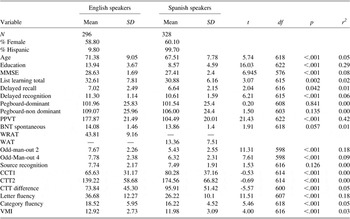
Test language (and subsequent delineation as part of the English-speaking sample and Spanish-speaking sample) was determined by the participants’ self selected preferred language. Ten percent of the English-speaking sample identified as Hispanic and the self-reported race of the English-speaking sample was as follows: 48.6% White, 42.9% Black or African American, 1% American Indian, 1% Asian, and 6.4% “other.” In the Spanish-speaking sample 99.7% indentified as Hispanic and 25.3% identified as White, 8.5% identified as Black or African American, 0.6% identified as American Indian, and 65.5% identified as “other.” The Spanish-speaking sample mainly comprised individuals born outside of the United States (95.4%), of which 67.4% reported being born in the Dominican Republic, 9.5% in Cuba, 7.9% in Puerto Rico, and 14.9% in “other.” Additional demographic information is reported in Table 1.
Sample characteristics and neuropsychological scores

Note. Age = age in years at the time of the neuropsychological evaluation.
The data included in this manuscript were obtained in compliance with regulations of the Columbia University Medical Center Institutional Review Board.
Neuropsychological evaluation
The sample was divided into English speakers (n = 296) and Spanish speakers (n = 328). English and Spanish speakers completed neuropsychological evaluations. For the most part, both samples completed identical tasks, except for the task instructions which were administered in English or Spanish respectively. Instances when the Spanish version differed from the English version are noted below. The task that differed the most among the two samples was the Wide Range Achievement Test-3 reading subtest (WRAT-3; Wilkinson, Reference Wilkinson1993), which was administered to only the English speakers, and the Word Accentuation Test (WAT; Del Ser, González-Montalvo, Martínez-Espinosa, Delgado-Villapolas, & Bermejo, 1997) which was administered to only the Spanish speakers. The WRAT-3 possesses high internal consistency (median α = .95), test–retest reliability (r = .92), and convergent validity with the WAIS-R verbal IQ (Wilkinson, Reference Wilkinson1993). In a sample of older adults the WRAT-3 was reported to have a test–retest reliability of 0.81 (Ashendorf, Jefferson, Green, & Stern, Reference Ashendorf, Jefferson, Green and Stern2009). The WAT has been shown to have high internal consistency (Cronbach's α = .91) and external validity as assessed by its relationship to the WAIS vocabulary subtest (r = .84; Del Ser et al., Reference Del Ser, González-Montalvo, Martínez-Espinosa, Delgado-Villapalos and Bermejo1997).
Psychomotor ability was assessed with the Grooved Pegboard task (Matthews & Klove, Reference Matthews and Klove1964), measuring speed in both dominant and non-dominant hands. Comprehension and knowledge were measured with performance on the Peabody Picture Vocabulary Test-third edition (PPVT-III; Dunn & Dunn, Reference Dunn and Dunn1997), a modified Boston Naming Test (BNT; Kaplan, Goodglass, & Weintraub, Reference Kaplan, Goodglass and Weintraub1983), and either the WAT or WRAT (as described above) depending on language spoken at home. The PPVT requires participants to name black-and-white line drawings. Cronbach's alphas ranging from .92 to .98 indicate that the PPVT has high internal consistency (Williams & Jang, Reference Williams and Jang1997). The Spanish-speaking sample was administered the Test de Vocabulario en Imagenes Peabody- Adaptacion Hispanoamericana (TVIP- H; Dunn, Padilla, Lugo, & Dunn, Reference Dunn, Padilla, Lugo and Dunn1986), the Spanish version counterpart to the PPVT. An Internal consistency reliability coefficient of .93 has been reported by the publisher.
The BNT variable used in these analyses was the total number of objects named spontaneously. The BNT has been shown to have high test–retest reliability in a sample of older adults (r = .91; Flanagan & Jackson, Reference Flanagan and Jackson1997). The Odd-Man-Out task (Flowers & Robertson, Reference Flowers and Robertson1985) was administered to assess visual processing. In the Odd-Man-Out task participants select which item in a set of three does not belong with the other items. Although the Odd-Man-Out task comprises four subtests, only the Odd-Man-Out subtests 2 and 4 were included in the analyses since those variables demonstrated less skew. Time to complete the Color Trails test (CTT; D'Elia, Satz, Uchiyama, & White, 1996) Form 1 and Form 2, as well as a difference score (CTT2- CTT1) was obtained from the participants. The CTT was developed for use across diverse groups, including for use in Spanish-speaking adults (D'Elia et al., Reference D'Elia, Satz, Uchiyama and White1996; Maj et al., Reference Maj, D'Elia, Satz, Janssen, Zaudig, Uchiyama and Chervinsky1993). In the CTT participants connect numbers (CTT1) or numbers alternating in color and numerical order (CTT2) as quickly as possible. For additional description of the above neuropsychological tests, see Siedlecki et al. (Reference Siedlecki, Stern, Reuben, Sacco, Elkind and Wright2009).
In addition to the tasks described above, tests of letter fluency, category fluency, verbal list learning, source recognition, and the VMI were also assessed. Letter fluency and category fluency are measures of verbal fluency. In the letter fluency task participants are asked to generate as many words as they can, within particular guidelines, that begin with a given letter (i.e., C, F, L) within 60 s. In the category fluency version, participants are given a category (i.e., animals) and are asked to generate as many words at they can that fall within the category within 60 s. The test–retest reliability of the verbal fluency tasks has been shown to be adequate for both letter fluency (r = .82) and category fluency (r = .68) (Harrison, Buxton, Husain, & Wise, Reference Harrison, Buxton, Husain and Wise2000).
Memory was assessed with a verbal learning test consisting of 12 words presented on a tape-recorder in either a male or female voice. Participants repeated all the words they could remember after each of five trials and a total score was obtained as well as scores on a delayed recall and delayed recognition test. The words selected for the Spanish version of the verbal learning test was not a direct translation of the words used in the English version. Rather, the words used in the Spanish version were selected to be of similar frequency and sophistication as the English version. A measure of source memory was obtained by asking the participants to indicate whether each word was presented in a male or female voice.
The VMI (Beery, Reference Beery1997) is designed to assess visuomotor skills and consists of a series of shapes presented in a test booklet that participants are instructed to copy. The copied shapes are scored based on a set of pre-determined criteria and are awarded either a 1 (passing) or 0 (failing).
Sample characteristics are presented in Table 1. Inspection of Table 1 shows that English speaking sample had significantly better scores on all the variables than the Spanish-speaking sample except for the following variables in which there were no significant differences: pegboard dominant, pegboard non-dominant, the BNT spontaneous variable, and source recognition. However, inspection of the effect sizes presented in Table 1 indicates that the effects were generally quite small.
Modeling Procedure
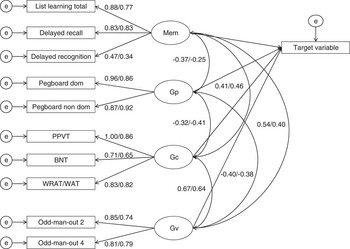
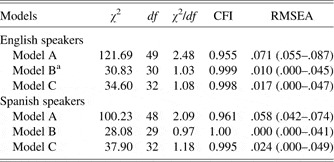
The first step in contextual analysis is to select the context in which to examine the meaning of target variables. CFA was conducted on a series of models to determine the best fitting model. Model fit was evaluated with several fit statistics, including chi-square (χ 2), critical ratio (χ 2/df), and the Root Mean Square Error of Approximation (RMSEA) for which values closer to zero indicate a better fit. The Comparative Fit Index (CFI), in which values closer to 1.0 indicate a better fit, was also evaluated. CFI values ≥.95 are considered to be indicative of a good fit (Hu & Bentler, Reference Hu and Bentler1999). The models were selected a priori based on evidence from the literature as to what each variable is hypothesized to measure. Model A is a four-factor model comprising the following constructs: executive function (CTT difference, Odd-Man-Out subtest 2, Odd-Man-Out subtest 4, letter fluency), memory (total score, delayed recall, delayed recognition), psychomotor speed (Pegboard dominant and non-dominant), and comprehension and knowledge (PPVT, BNT, WAT/WRAT). Model B is a four-factor model consisting of the same memory, psychomotor speed (Gp), and comprehension and knowledge constructs (Gc) as Model A, plus a visual processing construct (Gv) consisting of the two Odd-Man-Out subtests. Model B is depicted in Figure 1; however, the target variable is not included in assessment of Model B. Model C consists of the four-factors in Model B designated as lower factors, with one general higher-order factor.
Representation of the four-factor structural model (Model B) comprises memory, Gp, Gc, and Gv constructs. Two-headed arrows connecting latent variables (depicted as circles) represent correlations between the constructs. The paths from the latent constructs to the observed variables (depicted as rectangles) represent the loadings of each task onto its respective construct. The values presented represent the standardized path coefficients for the lower order loadings, and the inter-factor correlations. The first number represents the value for the English speaking sample and the second number represents the value for the Spanish speaking sample. All the loadings and inter-factor correlations are significant at the p < .01 level. The latent variables labeled “e” represent the unique variance and error associated with each observed variable.

Maximum likelihood estimation algorithm was used to deal with missing data (Arbuckle, Reference Arbuckle1996; Enders & Bandalos, Reference Enders and Bandalos2001) with the Amos 16.0 structural equation modeling program (Arbuckle, Reference Arbuckle2007). For the contextual analyses, approximately 2% of the data were missing in the English-speaking sample and 2.3% of the data were missing in the Spanish-speaking sample.
A significance level of 0.01 was used in all analyses because of moderately large sample sizes, and the large number of statistical comparisons.
Results
Inspection of the fit statistics of the CFAs presented in Table 2 indicate that Model B fit best for both the English and Spanish speaking samples, both in relative and absolute terms (RMSEA <.06, CFI >.95; χ 2/df < 2.0). This model exhibited both convergent and discriminant validity. The significant loading of each variable from its respective latent construct (as reported in Figure 1) for both samples provides evidence for convergent validity. The inter-factor correlations were small to moderate for each sample, thereby providing evidence of discriminant validity. In the English-speaking sample the correlations ranged from .32 to .67 (M = .45) and in the Spanish-speaking sample the correlations ranged from .26 to .64 (M = .42) (see Figure 1).
Fit statistics

Note. CFI = Comparative Fit Index; RMSEA = Root Mean Square Error of Approximation.
aThe error variance associated with the PPVT was negative and was, therefore, set to .02.
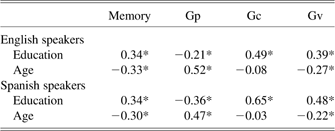
Figure 1 depicts Model B (with the addition of the target variable) and all subsequent contextual analyses were conducted with the model depicted in Figure 1 with each of the target variables examined separately. In addition to the four factors of memory, Gp, Gc, and Gv, years of education and age at time of neuropsychological evaluation were also included as predictors of the target variables. The correlations among education and age with the latent cognitive constructs are presented in Table 3. The matrices in the appendix contain the correlations for all the variables in the English-speaking and Spanish-speaking samples.
Correlation coefficients among age and education and the latent cognitive constructs

Note. * p < .001.
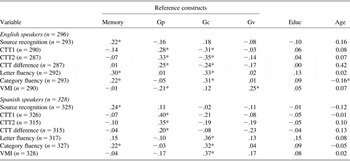
While education was related to each of the individual target variables, Table 4 shows that education was not a significant source of unique variance for any of the variables of interest when examined in the context of the latent constructs, in either the English or Spanish-speaking subsamples. Age had few significant relations with the target variables when examined in the contextual analyses–the only variable it significantly predicted was the category fluency variable in the English-speaking sample (see Table 4).
Contextual analysis results

Note. Values are standardized regression coefficients predicting the target variable from the reference constructs. In the models with the English speaking sample, the error variance associated with the PPVT was negative and was, therefore, set to .02.
* p < .01.
Within the English-speaking sample, source recognition was significantly related to memory. Of note, the CTT1, CTT2, and CTT difference variables were each significantly related to Gp and Gc. Letter fluency was significantly related to memory and Gc, whereas category fluency was significantly related to memory, Gc, and Gp. The VMI variable had significant relations with Gp and Gv.
In the Spanish-speaking sample the three CTT variables were each significantly related to Gp. As in the English-speaking sample, letter fluency and category fluency were significantly related to Gc. Category fluency was also related to memory. The VMI variable had significant relations with the Gc variable.
To examine if the different pattern of relations for the Color Trails across the English-speaking and Spanish-speaking samples was perhaps a function of lower performance on the Gc variables by the Spanish-speaking sample, post hoc contextual analyses were performed in which only those Spanish speakers who scored above the median of the sample on the WAT (n = 180) were included in the analyses. Results revealed that the pattern of relations between Gc and the Color Trails variables in the subsample was virtually identical to the pattern of relationships identified with the full Spanish-speaking sample. That is, Gc was not a significant predictor of any of the Color Trails variables.
Discussion
As compellingly stated by Mungus and colleagues (2011), the “population of older adults is growing rapidly and becoming increasingly diverse. Neuropsychological assessment is important in older persons because it is central to identifying, monitoring, and diagnosing neurodegenerative diseases of aging. Identifying useful dimensions of cognition and understanding the similarities and differences of these dimensions across groups defined by race, ethnicity, language, and culture has important implications for clinical and scientific understanding of both normal and abnormal cognition in late life.” (p. 265). To that end, the current study used contextual analyses to examine the meaning of a set of neuropsychological variables across samples of English-speaking and Spanish-speaking older adults.
Because of its superior fit, Model B was selected as the context in which to investigate the meaning of the selected target variables. Model B maps closely to the Cattell-Horn-Carroll (CHC; Carroll, Reference Carroll1993; Flanagan & Harrison, Reference Flanagan and Harrison2005) taxonomy of cognitive ability. Specifically, in our Model B, a memory construct is similar to Glr (i.e., long-term storage and retrieval), and the other constructs are consistent with Gp (psychomotor abilities), Gc (comprehension and knowledge, routinely labeled crystallized intelligence), and Gv (visual processing) (McGrew, Reference McGrew2009).
The results of our analysis were generally consistent with our hypotheses. We hypothesized that letter fluency would be significantly related to Gp and Gc. We found that letter fluency was related to Gc in both samples, as well as memory in the English-speaking sample. We hypothesized that category fluency would be related to memory and Gp and our results show that category fluency was significantly related to memory and Gc in both samples. Consistent with our hypothesis, each of the Color Trails variables were significantly related to Gp in both samples, and source recognition was significantly related to memory in both samples. Also, consistent with our hypothesis, we found that the VMI task was significantly related to Gp and Gv in the English-speaking sample. However, in the Spanish-speaking sample it was related to Gc only. Our results were fairly consistent with the results described by Salthouse (Reference Salthouse2005) and Salthouse et al. (Reference Salthouse, Siedlecki and Krueger2006).
The first aim of this study was to examine which reference abilities predict performance on a set of target neuropsychological variables to gain a better understanding of the meaning of those target variables. The results of the contextual analyses described above suggest that each of the executive functioning target variables likely reflects the unique contribution of several reference abilities, suggesting that many neuropsychological variables are multi-dimensional. This is unsurprising since it is well established that most cognitive variables are correlated with one another (e.g., Deary, Reference Deary2000; Spearman, Reference Spearman1904), but important for planning studies of conditions (such as vascular cognitive impairment) that selectively involve functions of the pre-frontal lobe and its connections.
The second main goal of this study was to examine whether the relations among the target variables and constructs were similar across the two samples. There were many similarities in the patterns of relations across the English and Spanish-speaking samples. For example, performance on the fluency variables were predicted by Gc in both samples, and the memory construct also predicted category fluency in both samples. Although the patterns of relationships were similar, there were a few differences across the English-speaking sample as compared to the Spanish-speaking sample for several variables. For example, the VMI variable was predicted by Gp and Gv in the English-speaking sample and Gc in the Spanish-speaking sample. The most substantial difference was that the Color Trails variables had significant relations with Gc in the English speaking sample, but not in the Spanish speaking sample. We did not find differences in the relations among Gc and the Color Trails variables in post hoc analyses of the subsample of Spanish speakers above the median for literacy, suggesting that level of performance does not affect the pattern of relationships. A potential clinical implication of these findings is that the Color Trails variables are more reflective of crystallized ability among English speakers, as compared to Spanish speakers. Further research would, therefore, be helpful to understand the potential differences in the meaning of the Color Trails task across English and Spanish speakers.
Collectively, these results suggest that the meanings of the variables are fairly similar across the two subsamples. These results are consistent with previous research that has demonstrated partial metric invariance in a model of cognitive constructs (memory, language, visual-spatial ability, and processing speed) across English- and Spanish-speaking samples in a community sample (Siedlecki et al., Reference Siedlecki, Manly, Brickman, Schupf, Tang and Stern2010).
Education was not a significant unique predictor of any of the target variables in either sample. This is likely because the inclusion of the Gc construct accounted for much of the variance associated with education. The inter-correlations among the Gc construct and the education variable were large in both samples (see Table 3). Research has suggested that years of education is not an adequate measure of quality of education (e.g., Manly, Jacobs, Touradji, Small, & Stern, Reference Manly, Jacobs, Touradji, Small and Stern2002) and measures such as the WRAT or WAT (i.e., measures of literacy) are likely better measures. This may be particularly true of our Spanish-speaking sample, a large proportion of which received their education in rural areas of the Dominican Republic where school curricula were not standardized. Our Gc construct comprised measures of literacy (i.e., WRAT/WAT and PPVT). As such, we found that Gc was a significant predictor of several of the target variables, whereas education was not a significant predictor of any of the target variables. This suggests that education level does not explain any unique variance in performance of the target variables, when examined in the context of the latent constructs.
In the contextual analyses, age was only significantly related to the category fluency variable in the English-speaking sample. This finding is consistent with previous research that has shown that the influence of age on cognitive variables is substantially reduced when examined in the context of other variables (e.g., Salthouse, Reference Salthouse2005).
This study is limited by the variables that we obtained (e.g., no measures of fluid ability) but the results are useful in demonstrating the multi-dimensional nature of the target variables, many of which have been postulated to reflect several different cognitive domains. Of particular interest were the relations among the latent constructs with the executive functioning variables. Our findings indicate that variables hypothesized to reflect one domain (i.e., executive functioning) showed similar, but distinct, patterns of relations with the cognitive constructs. Specifically, letter fluency was significantly related to Gc in both samples and also to memory in the English-speaking sample, while category fluency was significantly related to the memory and the Gc constructs, and all three of the Color Trail variables were significantly related to Gp (as well as the Gc construct in the English-speaking sample).
The current study provides evidence of heterogeneity of some neuropsychological variables in relation to latent cognitive constructs using an established theoretical model of individual differences in a community-based sample under study to detect the cognitive effects of subclinical vascular damage. It is expected that subclinical vascular damage may preferentially affect executive function through damage to frontal lobe circuits and structures. As such, the heterogeneity of cognitive abilities predicting performance on the executive function variables suggests that additional work is needed to understand how diverse target variables relate to specific cognitive abilities. This may help guide the construction of valid tailored assessment protocols for studies of cognitive aging and disease.
Acknowledgments
No financial or other relationships exist that could be interpreted as a conflict of interest. This work is supported by grants from the National Institute of Neurological Disorders and Stroke (R37 NS 29993; K02 NS 059729), the American Heart Association (0735387N), and the Irving General Clinical Research Center (M01 RR00645). Dr. Wright is supported by the Evelyn F. McKnight Brain Institute. We thank the staff of the Northern Manhattan Study, in particular Janet DeRosa, Project Manager.
Appendix
Correlation matrix for the English-speaking sample

*p < .05.
**p < .01.
Correlation matrix for the Spanish-speaking sample

*p < .05.
**p < .01.