The safety of the foods that we eat every day, once an ordinary issue too mundane to warrant scrutiny from society or the state, has become a focal point in public opinion, scholarly research, professional management, and government regulations throughout the contemporary world (Jensen and Sandøe Reference Jensen and Sandøe2002; Nestle Reference Nestle2010; Pawsey Reference Pawsey2000). In a very literal way, food-safety problems and the associated waves of national panic confirm one of Ulrich Beck's insightful observations, namely, that fear of various kinds of risks is a new psychological state among those who live in postindustrial societies (Beck Reference Beck and Ritter1992; see also Almas Reference Almas1999; Buchler, Smith, and Lawrence Reference Buchler, Smith and Lawrence2010).
Beck argues that the notion of risk is a product of modernity, because in all traditional societies hazards, dangers, and disasters are perceived as givens or determined by an external force such as nature or God. Advancements in science and technology during the stage of industrial modernization led to a belief that one can calculate the probabilities and costs of hazards and dangers, can control or avoid them, and can deal with or mitigate their consequences through insurance. At the postindustrial stage, however, the potential impact of some incalculable and uninsurable risks—such as those associated with pollution and climate change, the threat of nuclear war, and the global transmission of disease—threaten the existence of everyone, rich and poor alike. These risks, ironically, are the unintended consequences of the very advances in science and technology that once made the world seem more predictable and less risky, as well as the effects of scientism, particularly its logic of control, in modern politics (Beck Reference Beck, Adam, Beck and van Loon2000). Unlike the natural risks in the past, most risks in contemporary times are manufactured and widespread across spatial and social boundaries. The increasing awareness and various perceptions of risks have begun to redefine how we think, behave, and engage in politics in the contemporary world; hence, the emergence of a risk society that in turn marks, together with the process of individualization, the arrival of a second modernity (see Beck Reference Beck and Ritter1992, Reference Beck and Cronin2009; Giddens Reference Giddens and Franklin1998; for a updated and comprehensive review of the theory, see Ekberg Reference Ekberg2007).
China, as it rockets from a largely preindustrial to a largely industrial and in certain aspects even postindustrial state, provides a fascinating window onto this process where various forms of risk are concerned, as recent headlines about protests triggered by issues such as the hazards of fast trains (in Shanghai in 2008) and pollution (in Dalian in 2011) indicate. Especially interesting, though, are issues associated with eating. Chinese society has arguably been affected more by food-safety scares than has any other on earth. Incidents of food contamination and poisoning have been exposed in succession for two decades and show no signs of declining, even after promulgation of a much-discussed 2009 Food-Safety Law (Zou Reference Wei2011); China's use of chemical fertilizers and pesticides ranks number one in the world; exported foods from China are often rejected by foreign countries due to chemical contamination (Calvin et al. Reference Calvin, Gale, Hu and Lohmar2006; Gale and Buzby Reference Gale and Buzby2009); and in official surveys the Chinese public consistently considers food safety a top concern (see, e.g., the annual survey reports by the Ministry of Commerce since 2004).
Do the frequent and widespread food-safety problems also constitute an omnipresent perception of risk in Chinese society? Has China entered the stage of a risk society, thus allowing an examination in light of the risk society theory of Ulrich Beck, Anthony Giddens (Reference Giddens and Franklin1998), and others? Although some scholars answer these questions in the positive (Thiers Reference Thiers2003; X. Zhang Reference Xiaofang2007; W. Zhang and Zhao n.d.), others have serious reservations because many Chinese citizens still regard science and market mechanisms as solutions to their food-safety problems and thus seem to be far away from the postindustrial stage of a risk society (Veeck, Yu, and Burns Reference Veeck, Yu and Burns2008).
This disagreement arises, I argue here, mainly from the complexity of food-safety problems in China that cut across the boundaries of premodern, industrial modern, and postindustrial modern times and therefore present a mix of different types of risks. In the following, I first briefly review the development of food-safety problems in China from the 1950s to the present, noting that the emergence of poisonous foods is indicative of a shift in the focus of risk from food hygiene to food safety. Next, I take a closer look at the four types of poisonous foods that continue to cause national food scares and are perceived by ordinary people to be the most serious and highly possible risks (see, e.g., W. Zhang and Zhao n.d.). In the third section, I treat three levels of food-safety problems—food hygiene, unsafe food, and poisonous foods—arguing that their coexistence constitutes a unique challenge of mixed risks. After that, I further analyze the nature and ramifications of food-safety problems in light of Ulrich Beck's theory of risk society. I argue that food-safety problems not only affect the lives of Chinese people in harmful ways but also pose a number of manufactured risks that are difficult to calculate and control. Yet, conditioned by a number of social factors embedded in China's transition to a modern society, such as the disjunction between economic development and political reforms, the unequal distribution of food-safety problems across social groups, and the dominance of scientism, technocracy, and materialistic understandings of modernization, food-safety risks have become entangled with premodern dangers and modern industrial hazards. More importantly, food-safety problems in China have contributed to a rapid decline of social trust, thus posing a risk of distrust that has far-reaching social and political ramifications. In this sense, a risk society has already arrived in China but it comes with certain local characteristics.
The present study is based on a mixed body of data that include case studies by medical and public-health professionals, surveys by government agencies and researchers, investigative reports in printed and online media, and ethnographic evidence gathered over a long stretch of time via in-depth interviews and participant observation.Footnote 1
From Food Poisoning to Poisonous Food: A Brief History
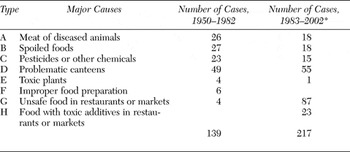
The notion of food safety (shiping anquan) is relatively new in Chinese discourse, emerging in the 1990s in Chinese media and becoming a household term by the turn of the century. To obtain a basic understanding of the evolution of food-safety problems, I collected 356 case studies of food poisoning from 1950 to 2002 through a keyword search of the published journal articles contained in the China Academic Journals Full-text Database of the China National Knowledge Infrastructure (http://www.cnki.net). In Table 1 below, I classify these cases into eight types based on their major causes, with the earliest cases occurring in 1950. I divide the five decades into two periods, comparing conditions before and after the 1982 Food Hygiene Law (provisional), a law that indicates official recognition of the prevalence of food-borne diseases. I end the review in 2002 because thereafter there was an explosion of reports on food scandals in the Chinese media, social surveys, and government documents. The major cases of food scandals after 2002 will be examined in the next section.Footnote 2
A Comparison of Food-Poisoning Cases during Two Periods

*Food-poisoning cases that involved one hundred or more victims.
Several features of food-safety problems during the first period (1950 to 1982) are noteworthy. First, during the period prior to the Provisional Food Hygiene Law, 49 out of the 139 cases of food poisoning were caused by public canteen problems (Type D in Table 1), which include poor sanitation, unsafe storage of leftovers, lack of hygiene regulations, improper cooking methods, and the use of spoiled foods (J. Wang Reference Jinfu1975). The concentration of food-poisoning cases in public canteens is related to the fact that during the pre-reform era most urban employees ate at least one meal per week in their work-unit canteens, and rural collectives offered lunches in canteens to peasants during the busy seasons. But the causes of food poisoning in public canteens are not much different from those occurring in private homes, such as spoiled foods (Type B in Table 1) or poor sanitary conditions. Second, the consumption of diseased animals (Type A in Table 1) caused food poisoning in both public canteens and private homes during this period, such as the case of workers in a Shanxi factory who ate diseased pork (G. Zhang and Chen Reference Guining and Shifu1961). Third, under the planned economy, staff members in state-owned or collective food stores perfunctorily performed their duties at assigned jobs, with no profit-making incentives. When they sold substandard food products, such as meat from diseased animals or spoiled foods, they made no effort to cheat the customers—they merely used the lower prices to attract buyers, and the customers or public canteens willingly and knowingly purchased substandard, contaminated, or even spoiled foods to save money.Footnote 3 Fourth, food-poisoning cases caused by pesticides or other harmful chemicals (Type C in Table 1) began to occur in the 1970s. A close reading of the reports, however, shows that in most cases pesticides had been mistakenly directly or indirectly consumed. The most common occurrence was the use of pesticide containers to store food; in several cases, public canteen staff accidently put pesticides or other chemicals into the foods (Hu Reference Bing1982). Interestingly, none of the Type C food-poisoning cases were attributed to pesticide residuals; this might be due to the fact that in the 1960s and 1970s growers used only a limited amount of pesticides and did not apply them repeatedly.
Most authors in the public-health literature attribute these cases to problems of backwardness, namely, the lack of modern scientific knowledge and regulations, and they identify education and hygiene regulations as the main solutions (see, e.g., Sun Reference Ruixing1980; J. Wang Reference Jinfu1975; S. Zhou Reference Shunan1958). Their argument seems to be well-grounded to a certain extent because all of the above-mentioned features changed in the second period (1983–2002). When peasants became more familiar with the use of pesticides, the number of Type C food-poisoning cases among farmers declined. Health concerns increased among Chinese consumers because of both the spread of scientific knowledge, as the health professionals had hoped, and improvements in living standards. Consequently, the number of Type A, B, and D food-poisoning cases also declined.
Two new types of food-poisoning cases emerged in the second period, namely, those caused by foods purchased at markets and/or consumed in restaurants (Types G and H in Table 1). In these cases, the contaminated foods were traced to the restaurant owners or the producers and retailers of the processed food, who deliberately added poisonous chemicals to foods for the sake of profit-making. Since the late 1990s, toxins such as nitrite have frequently been the primary cause of food poisoning because they are regularly used to lower the costs of processed foods. Food poisoning has also been caused by the harmful chemicals contained in animal feed. These developments have motivated Chinese health professionals and food experts to think beyond the conventional boundaries of food hygiene. By the turn of the century, a new Chinese phrase was coined to describe the contaminated foods that caused Types G and H food poisoning, that is, youdu shipin, which literally means “poisonous food.”
The New Challenge of Poisonous Food
The defining feature of poisonous food is deliberate contamination, and the new phenomenon can be broken down into the following four major types.
Food Adulteration
The first and perhaps most common type of poisonous food is adulterated food. Seeking higher profits, food processers and/or producers resort to cheaper, inferior, or less-desirable materials to produce or cook foods. On their own, these are not necessarily dangerous. In most cases, however, the inferior foods need to be polished with chemicals, such as coloring unripe strawberries or cherries with carmine dye so that they appear to be of good quality and can be sold at higher prices. Using toxic chemicals to preserve processed foods is also common; for example, formaldehyde (jiaquan, 甲醛) or sodium formaldehyde sulfoxylate (diaobaikuai, 吊白块) are widely used to whiten seafood and grains (see Q. Zhou Reference Qing2007, 87–123). The Chinese media frequently expose scandals of food adulteration, especially the use of toxic agents in the process of adulteration. The most disgusting yet perhaps the most widely consumed adulterated food, however, is adulterated cooking oil that is extracted from oil in sewage pipes or from leftover foods collected in restaurants. Chinese food-safety expert He Dongping, who led a research team in a multiyear project to investigate the large-scale production and circulation of sewage cooking oil, asserts that the tainted cooking oil was widely found in eateries and food-processing factories as well as in private homes, probably used to prepare one out of every ten meals in China (Barboza Reference Barboza2010).
Food Additives
Food additives constitute the second most frequent channel by which a variety of toxins enter the food chain. Antibiotics, colorants, and hormones are widely used as additives to animal feeds and processed foods. Well-known examples include using Sudan dye IV (sudanhong, 4 hao 苏丹红 4 号) to feed chicken or ducks so they produce eggs with red yolks, or using ciprofloxacin (huanbing shaxing, 环丙沙星), enfofloxacin (ennuo shaxing, 恩诺沙星), flavomycin (huangmeisu, 黄霉素), or simply contraceptive pills to feed farm fishes, or adding melamine to a number of foods. More often than not, farmers openly use illegal food additives, such as clenbuterol, that have long been banned by government regulation.
Clenbuterol was originally developed to help patients with breathing disorders. It causes central nervous system stimulation and increases aerobic capacity in the metabolism rate. Used in excessively large amounts in pig feed, clenbuterol can reduce the amount of fat in pigs. During the 1980s, it was experimented with but was soon banned in the United States and other Western countries due to its harmful effects on humans. In the 1990s, clenbuterol was introduced to China, reportedly by Chinese scientists returning from a visit to the United States, as a pig-feed additive to increase the production of lean meat. The additive was sold in the market under the Chinese name shouroujing (瘦肉精), meaning “lean meat powder.” The first case of food poisoning from clenbuterol-contaminated pork was reported in Guangzhou in 1998, followed thereafter by a string of similar cases. In 2001 alone, more than 1,100 people in Beijing, Guangzhou, and Hangzhou were victims of tainted pork, leading the Chinese government to strictly ban the use of clenbuterol in animal feed (Q. Zhou Reference Qing2007, 68–75). However, pork contaminated by clenbuterol has continued to be found in the market during the subsequent decade, with recent cases reported in late 2009 (CNN 2009) and early 2011. The 2011 outbreak of clenbuterol contamination, well-covered by the key state-owned media outlets such as CCTV and Xinhua News, led the central government to convene an emergency meeting (McKenna Reference McKenna2011).
Pesticides Used as Food Preservatives
The third type of poisonous food results from the direct application of pesticides, especially in the course of food processing. For a number of food producers, pesticides serve as a cheap yet strong preservative, as in the well-known cases of pickled vegetables in Sichuan province and Jinhua ham in Zhejiang province. In Xianghe county, Hebei province, farmers used a strong pesticide called 3911 to soak the roots of chives so that the vegetable would grow extremely large and strong. From 1999 to 2004, the pesticide was used on thousands of acres of chive fields. This was an open collective action; when the pesticide was applied there was a very strong acrid odor in the entire area. Yet, until an investigation team from a journal sponsored by the General Administration of Quality Supervision, Inspection and Quarantine (GAQSIQ) in the central government exposed this illegal operation, no local government agency had bothered to question this harmful practice (L. Wang Reference Liming2004).
Modern farming relies heavily on the use of chemical fertilizers and pesticides, making pesticide residues the most common threat to food safety throughout the world. The problem of pesticide residues widely exists in China and has become worse as farmers are using an ever-increasing amount of pesticides and shortening the non-spray time before harvest to avoid infestations of insects from neighboring farms, thus creating a vicious cycle of pesticide residuals. It should be noted that the abuse of pesticides by food-processing companies differs from the problem of pesticide residues because in the former food producers and processors intentionally violate the laws and regulations, directly adding add toxins to foods and resorting to chemicals and other techniques to make sure that the consumers are not aware of them. This is why Chinese consumers carefully distinguish between pesticide residues and the abuse of pesticides, calling the former nongyao canliu (pesticide residuals) and the latter youdu shipin (toxic foods).
Fake Foods
The last type of poisonous food is a challenge to the imagination—it is simply fake or counterfeit food, such as the 2004 case of fake milk powder made out of starch in Anhui province. The earliest and perhaps also the most common practice is the production of fake medicine. As early as June 1985, an investigative report was published in the party's mouthpiece, the People's Daily, exposing a large business scam of fake medicine that involved more than 1,000 participants and various local government agencies in Jinjiang county, Fujian province. When more details were revealed in other reports, provincial party boss Xiang Nan resigned, the highest-level political casualty of food-safety problems in China to date. However, fake medicines did not disappear along with the fall of Xiang Nan. Counterfeit drugs still constitute a large share of the Chinese market and they are also exported to foreign countries, with serious medical consequences. Describing this as a sign of the weakness of the Chinese state, Shaoguang Wang cites some horrifying figures: “In 2001, 192,000 people died after using bogus or poor-quality medications. Despite government efforts that led to the shutting down of 1,300 pharmaceutical factories, or half of the entire industry that year, the first half of 2002 brought an additional 70,000 deaths from fraudulent drugs” (Reference Wang2003, 40).
The making of fake foods often involves heavy doses of toxic chemicals and the use of cheaper and inferior substitute materials. For example, fake soy sauce made out of human hair and chemicals was found in 2004 because human hair can be collected as recyclable waste at an extremely low price; fake chicken eggs made out of water and chemicals appeared in different regions between 2005 and 2007; and fake pig-blood pudding made out of water and chemicals caused a new food scare in 2009. Despite government efforts to punish offenders with criminal charges under the new 2009 Food Safety Law, the production and circulation of fake liquor and wine, fake soy sauce, fake beef, and fake milk powder continued throughout 2010, and some of the cases were cited as among the top-ten most influential criminal cases (Zou Reference Wei2011).
The Spectrum of Food-Safety Problems and the Mix of Risks
Food-safety problems in contemporary China are complicated because they result from different causes and pose different kinds of risks to consumers and the society as a whole. For the sake of analysis, I classify the food-safety problems into three levels and refer to them respectively as food-hygiene problems, unsafe food, and poisonous food.
Food-Hygiene Problems and Conventional Risks
Conventional food-hygiene problems continue to exist but with a shift of their primary site from family kitchens or public canteens to food factories and various eateries. During the past three decades, Chinese consumers have increasingly relied on fangbian shipin, or convenience food, i.e., processed, precooked, or semicooked foodstuffs. Many urban employees and migrant workers eat out of lunch boxes, another type of convenience food, offered by street vendors or available at small eateries. The increasing demand for convenience foodstuffs also goes strong in the countryside. In the village where I have worked since the 1980s, the most popular items in the village stores are sausages, instant noodles, and roasted chicken or pork (in order of sales volume). Consumers have little knowledge about the origins, ingredients, and the actual making of the foods they eat. Such a disconnection and a sense of alienation associated with food has long been regarded as a major cause of the public fears and the actual incidents of food safety (Pawsey Reference Pawsey2000; Smith Reference Smith2007).
Food processing has thus become a booming business. Yet, as many have pointed out, small-scale family workshops, with more than 70 percent of market share, dominate the food-processing industry in China. The highly fragmented and primarily household-based food-processing sector presents a challenge to regulatory agencies in terms of public health, quality control, food processing, and transportation. Furthermore, corruption in these regulatory agencies creates an additional problem of enforcement (Li Reference Li2009; Tam and Yang Reference Tam and Yang2005). Many of the family workshops operate under poor sanitary conditions with little modern technology. For example, an investigative report in 2003 revealed that 70 percent of the new food-processing enterprises in Guangzhou had to be closed down because of failure to meet official quality-control standards. Among them, many cooking-oil processing plants were actually operating in residential apartment units. In Hunan, it was reported that 80 percent of the food-processing workshops lacked production permits and/or business licenses (cited in Tam and Yang Reference Tam and Yang2005, 26). Packaging and labeling procedures are also poorly regulated, and official corruption and counterfeiting are often prevalent. As an informant explained to me, “All you need to do is to buy the good-looking packaging materials, wrap your products, and seal the package. Better yet, you can buy packaging materials with famous brand-names or super-quality labels. This really helps.”Footnote 4 In 2005, two men were found guilty of making fake brandy under the Hennessy and Remy Martin brand names. The liquor bottles they used had laser-burned lot numbers and special anti-counterfeiting labels, making the fake products appear to be authentic (Lin Reference Lin2009, 56–57).
The heavy reliance on processed foods has significantly increased the chances of food contamination, thereby keeping food-hygiene problems in the limelight. According to the Chinese Ministry of Health, the number of victims of food poisoning by microbial contamination exceeds the number poisoned by farm chemicals (Calvin et al. Reference Calvin, Gale, Hu and Lohmar2006; S. Wang et al. Reference Wang, Duan, Zhang and Li2007). This is why Wu Yongning, a senior scientist at China's Center for Disease Control, argues that media coverage of food scares in China in 2007 misinformed the public. Citing statistical results from a national survey on diet and health, Wu asserts that despite headline news stories about chemical contamination, the main food-safety threat remains microorganisms (see Ellis and Turner Reference Ellis and Turner2007).
Food-hygiene problems are not new. This conventional risk in public health, according to many Chinese medical-health professionals and government officials, can be controlled and managed in terms of more education campaigns, food quality control, regulation and integration of the food-processing market, and rigorous and systematic management of public-health authorities (see, e.g., Ministry of Commerce 2008; S. Wang et al. Reference Wang, Duan, Zhang and Li2007). In this connection, it is noteworthy that food-hygiene problems generally are not regarded as key issues in the developed countries and thus do not constitute the kind of modernization risks that risk society theory helps us to understand.
Unsafe Food and the Arrival of Postindustrial Risks
At the second level, unsafe foods result mainly from the heavy use of chemical fertilizers, pesticides, hormones, steroids, preservatives, flavor enhancers, colorants, and pollution and environmental degradation in the larger context. Nonseasonal growing and intensive factory farming also contribute to the production of unsafe foods. Among other problems, pesticides stand out as the number-one cause of food-safety problems in China. As a Chinese promoter of organic food has noted, in Shanghai the excessive use of pesticides is profit-driven and regarded as a survival strategy by vegetable farmers, who apply four times the recommended amount of pesticides to boost yields (Moore Reference Moore2010). According to research by Paul Thiers in the 1990s, about one-third of the pesticides sold in China were not registered or tested. Safety information rarely reached down to the level of farmers; consequently 10,000 or more Chinese farmers died of pesticide poisoning every year (Thiers Reference Thiers1997). The situation appears not to have improved, as one decade later nearly 50 percent of the fruits and vegetables grown in China contain pesticide residue exceeding China's official standard and on average more than 100,000 people are poisoned by pesticide residue each year (Yang Reference Yang2007). It has been estimated that in 2005 only about 6 percent of Chinese agricultural production was pollution-free and only 1 percent was green (Calvin et al. Reference Calvin, Gale, Hu and Lohmar2006, 20).Footnote 5 The only significant progress has been found in the death toll from the improper use of pesticide among farmers, which has dropped to several hundred per year (Yang Reference Yang2007, 2).
The unsafe food problems associated with chemical contamination and other modern agricultural techniques are a global phenomenon, and China is merely following the Western path of modern production and consumerism. For example, Chinese dietary patterns have changed rapidly since the 1980s, especially meat and egg consumption. By 2005 China's meat output reached 78 million tons, representing 29 percent of the world's total output; in the same year, per capita meat consumption was 63 kilograms. To meet the high market demand, Western technologies of factory farming have increased in popularity in the livestock sector, resulting in a number of food-safety concerns (Li Reference Li2009).
Because many problems of unsafe food are actually derived from modern farming and food-processing technologies as well as from a modern consumerist ideology, the food-safety problems at this level are an inherent and reflexive part of modernity, a typical example of manufactured risk (Beck Reference Beck and Ritter1992; Giddens Reference Giddens and Franklin1998). Moreover, as science and modern technology have proved not to be omnipotent forces and as the global scale of food production and circulation has made it almost impossible to predict and control some of the most serious problems of unsafe food, food-safety problems have posed increasingly daunting yet uninsurable risks (see, e.g., Beck Reference Beck and Ritter1992, and a number of the studies cited at the beginning of this article). In this sense, China has indeed joined the global trend of postindustrial risk society, despite the fact that it is still striving to reach the goals of industrial modernization (see Thiers Reference Thiers2003).
But not all the problems of unsafe food at this level are simply byproducts or unintended consequences of modern technologies. Some of them overlap with other types of food risks. For instance, the large number of sick or dead animals is a typical problem associated with factory farming; but how these animals are disposed of depends mostly on institutional regulations and their implementation. According to Peter Li (Reference Li2009), three out of the eight Chinese factory farms that his research team studied sold dead chickens to employees who in turn resold the chickens to food dealers or restaurants, and five out of the seven pig farms they examined disposed of dead pigs by selling them to vendors who collected the animals for small street food-stall vendors. This practice can be traced back to the 1990s, and even though it has been repeatedly exposed by the Chinese media and food-safety professionals, the problem persists (Li Reference Li2009, 235–36). In 2007 Chinese scientist Jiang Gaoming and his research team found that nearly 80 percent of the more than 200 million chickens that had died from various diseases or from the harsh conditions of factory farming each year were sold to roast-chicken shops and sausage factories or were used as animal feed. Even avian hospitals were involved in these illegal practices. In one animal hospital, for example, 25 to 50 kilograms of diseased chicken carcasses were sold daily for USD 0.10 per kilogram to pig farmers who then blended the chicken meat into pig feed (Jiang Reference Jiang2007).
This illegal trade in sick or dead animals among farmers and vendors constitutes a different kind of food-safety risk in China because it is intentional and calculated, revealing not only the loopholes in market regulation but also the existence of a serious ethical problem. The selling of chicken carcasses by avian hospitals is indicative of the corruption of the professionals who are supposed to be the guardians of food safety. This does not resemble the postindustrial risks in risk society theory; instead it leads us to the next level of food-safety problems.
Poisonous Food, the Risk of Trust, and the Challenge to Regulatory Governance
At the third level, the poisonous-food phenomenon stands out as a new and devastating development in Chinese food-safety problems, with the deliberate contamination of foods as a defining feature. The producers, processors, and traders knowingly add an array of banned toxic chemicals to human foods or animal feed. In order to make profits, they not only violate government laws and regulations but also intentionally hurt consumer health. Moreover, because they are fully aware of the illegality of their actions, the harm to consumers, and the punishment if they are to be caught, the retailers of toxic foods resort to hiding the true nature of their foodstuffs and sell them as normal and healthy products. This distinguishes poisonous food from other counterfeit products that flood the Chinese market, especially fraudulent luxury goods such as fake cosmetics, watches, bags, and famous-brand clothing, which are sold as an open secret of a defiant lifestyle (for a systematic study of counterfeiting culture in China, see Lin Reference Lin2009).
Perhaps the most morally disturbing fact is the well-organized and large-scale production and distribution of poisonous food, which often involves various government institutions. Many people, most of whom are ordinary workers on the frontlines of production and processing, actively participate in the deliberate contamination of food. Others are the economic or political elite at various levels, such as entrepreneurs, managers, professionals in quality-control agencies, and government officials. Poisonous food beyond the household workshop level causes serious damage to public health and the social ethos, easily creating national panics, such as during the 2008 case of the tainted baby formula by the Sanlu Group, a leading joint-venture giant in the Chinese dairy business.
To artificially increase the amount of protein in inferior milk that was either diluted with water or spoiled, melamine, a chemical used to make plastic and to tan leather, was added, and the contaminated milk was then used to produce baby formula, ice cream bars, and other products. By September 15, 2008, Sanlu products had been found to be manufactured with melamine, and the company recalled 700 tons of its baby formula. But on the following day a nationwide test conducted by the GAQSIQ revealed that the milk products of 22 out of another 109 inspected firms were also contaminated with melamine, including products made at Yili and Mengniu, two top firms. Although most contaminated products were sold on the domestic market, some were also exported to Hong Kong. The Sanlu Group milk products had enjoyed the privilege of a quality-inspection and quarantine waiver by the GAQSIQ, and the reports on the Sanlu problematic baby formula were not disclosed by the local government and its agencies until the New Zealand partner company contacted the authorities in Beijing. Obviously, the production and distribution of hundreds of tons of contaminated milk powder would not have been possible without negligence and dereliction of duty by a number of government agencies in charge of the safety and quality of dairy products, including the GAQSIQ, the Bureau of Food and Drug Supervision, the Ministry of Health, and the Bureau of Industry and Commerce. The tainted Sanlu milk powder stands out as one of the worst cases of poisonous food, causing six deaths, 51,900 hospitalizations of children with serious kidney problems, and 24,900 cases of children suffering from other problems. The seeking of justice by the families of the victims remains an open wound, even after harsh legal punishments were meted out to a few individuals who played a major role in the scandal (Barboza Reference Barboza2009; Yoo Reference Yoo2010).
In addition to the toxic chemicals that directly harm the physical well-being of consumers, the problem of poisonous foods is socially lethal because of the disregard or even outright dismissal of the health and safety of others, the intention to cause harm to others for the sake of profits, the secrecy and deception necessary for the production and circulation of such toxic foods, and, in the case of organized large-scale production and circulation of poisonous foods, the indifference and failure of the regulatory agencies that are closely associated with the flows of poisonous food. It is true that poisonous food does not enter the food chain on an everyday basis, and it is not produced on a regular or national scale. Thus, statistically, the actual number of people sickened or dying from consuming poisonous foodstuffs is less than the number of those suffering from food-hygiene problems or unsafe foods. However, after being exposed by the media or on the Internet, almost every incident of poisonous food has caused large-scale panic and nationwide food scares. These food scares have resulted in widespread social distrust of both food sellers and of the food industry as a whole as well as a deeply felt sense of insecurity—at any moment and through any imaginable or unimaginable channel the consumption of foodstuffs may result in food poisoning and even possibly death.
During my interviews, most people cited incidents of poisonous foods as justification for their worries about food safety, and almost without variation my informants wondered why on earth someone would put toxins in foods for the sake of profits. This widely expressed disbelief was regularly followed by a strong expression of distrust because, as many informants told me, “nowadays you never know what is inside a package of food; anything is possible.”Footnote 6 Outraged and morally disturbed, many informants lamented that they no longer knew what was safe to eat and who could be trusted. “I am so panicked these days that I suspect every food-seller on the street and I only buy expensive and well-packaged foods from supermarket chains,” said another informant, “but food scandals come from these supermarkets too. What can we ordinary people do?”Footnote 7 “I heard on the news that China has become the number-two most powerful country in the world and our state leaders are even more powerful than the American president, your president!” A village friend jokingly announced to me but then questioned me with all seriousness: “But why do our powerful leaders not protect us from those poisonous foods out there? This society is very dangerous, you know. You could die if you do not carefully watch the foodstuffs you buy in the market. No one can help you.”Footnote 8 “I hate those people who manufacture or sell poisonous foods, especially those who deliberately poison the babies [referring to the 2008 milk powder scandal],” a young mother said, becoming so angry during our discussion of food safety that she announced that she would not hesitate to harm the producers and sellers of poisonous foods if she had the chance. “I just want to let them know how painful it is,” she told me.Footnote 9
These individual testimonies show that the threat of poisonous food has incited suspicion of strangers, stirred up social resentment, caused a decline of social trust, and posed a risk of trust that China cannot afford to bear during its rush to modernity. Distrust in strangers is a common feature in most traditional societies, and China is by no means an exception. As the historian Chen Ruoshui notes, popular texts on moral teaching for children in late imperial China are full of messages about the dangers of strangers and the wisdom of not trusting anyone outside one's own network; these messages were meant to be memorized during the process of socialization (Chen Reference Ruoshui2006, 118–55). But distrust of strangers was less harmful in a culture of close-knit communities and kinship organizations where strangers were normally kept at a distance, or were not known to even exist. However, in a highly mobile and open society, most social interactions occur among individuals who are not related to one another by any particularistic ties, and more often than not people do not expect to interact with the other party again in the future. Consequently, distrust of strangers is socially destructive, and social trust is more important than personal trust.
Social trust is understood as a more generalized trust in social institutions that one expects will act in accordance with the stated rules, in experts who will guard the rules to make the institutions work well, and in strangers who will engage in peaceful and nonharmful social interactions. In contrast, personal trust is only invested in people who are in one's own social web, ranging from the family, kinship, or community, to a wider yet still well-defined network of friends. The expansion of personal trust to social trust provides one of the key mechanisms in making a modern economy and society work and thus it is a necessary precondition for modernity (Giddens Reference Giddens1990, 79–111).
The promotion of social trust has become an urgent issue in contemporary Chinese society as it rapidly becomes more open, modern, and highly mobile. Unfortunately, even though the market economy has developed rapidly, social trust has generally declined. A Chinese sociologist describes the six kinds of distrust prevailing in contemporary Chinese society that contribute to the crisis of social trust: namely, distrust of the market due to faulty goods and bad service, distrust of service providers and strangers, distrust of friends and even relatives, distrust of law enforcement officers, distrust of the law and legal institutions, and distrust of basic moral values (Peng Reference Siqing, Yefu and Siqing2003, 292–95). The widespread production and distribution of contaminated and fake foods, as indicated above, has played an especially vicious role in further spreading distrust in strangers and social institutions. The most damaging risk that poisonous foods, together with other food-safety problems, present to Chinese society is therefore the risk of distrust. The cases of large-scale and organized production and circulation of poisonous foods, such as the contaminated milk powder by the Sanlu Group in 2008, are particularly lethal in provoking the decline of trust because they expand distrust in strangers to distrust in food experts, regulatory agencies, and modern society in general.
Thus far the Chinese government seems to have few ways to promote social trust and consumer confidence other than enacting more regulations and establishing more regulatory agencies in an effort to keep the food-safety problems under control (Liu Reference Liu2010; Tam and Yang Reference Tam and Yang2005). Yet, due to the fragmentation and internal competition among regulatory agencies, the developmental preference for employment and growth over safety and health, and, more importantly, the corruption of government officials and the lack of rule of law, the results of top-down initiatives for food-safety regulation are often ineffective and unsatisfactory (Li Reference Li2009; Liu Reference Liu2010; Tam and Yang Reference Tam and Yang2005) and high-profile food scandals continued to surge (see, e.g., Barboza Reference Barboza2010; Watts Reference Watts2011; Zou Reference Wei2011).
Consequently, public concerns about food safety and waves of national food fears have become a regular feature in media reports and large-scale surveys. Since 2004, the Ministry of Commerce has carried out an annual investigation on food-safety conditions and has issued a yearly report. Year after year, the investigation shows that Chinese consumers are highly concerned about food-safety problems. Among urban consumers, the rate of concern increased from 79 percent in 2005 to 96 percent in 2008 and among rural residents it increased from 58 percent in 2006 to 94 percent in 2008. The 2008 report admits, quite diplomatically, that the increase in public concern about food safety may be an indicator of the decline of consumer confidence in the government's ability to regulate food safety (Ministry of Commerce 2008). In 2006, the State Food and Drug Agency admitted that more than 60 percent of surveyed consumers viewed food-safety conditions in China as bad or very bad. In 2007, an online survey conducted by the official Xinhua News Net revealed that 95 percent of respondents agreed that there are too many problems with the food-safety situation in China (cited in Mou Reference Xiurui2007). According to a recent study on perceptions of food risks, the greatest fear of Beijing residents is the risk of consuming fake food, and the majority believe that food risks are highly likely to occur (W. Zhang and Zhao n.d.).
Risk Society Theory and Chinese Reality
It should be noted that the classification of China's food-safety problems at three levels is obviously for analytical purposes; in reality the boundaries between the lack of food hygiene, unsafe food, and poisonous food are often blurred, especially in cases of food adulteration. The recycling of cooking oil from sewage and restaurant waste and the harmful trade of dead animals from factory farms are two prominent examples in this regard. My main point is that food-safety problems indeed constitute a mixed body of risks to Chinese people and society, chief among which is the social risk of distrust, which is incalculable and uninsurable, undermining regulatory governance and having far-reaching social and political implications. Risk society theory can indeed provide us with a powerful conceptual tool both to examine the food-safety problems in China and to address their consequent risks. It is even more relevant to the Chinese case because the Chinese government and most scholars in China still view food problems and risks from a modernization perspective, and they do not critically assess the unintended consequences of industrial modernity.
Although many of the food risks in China belong to the category of manufactured risks and are closely related to the rapid advances in science and technology and the control-logic of modernity, not all of them—the premodern, natural risks of food-hygiene problems—are equally serious and challenging. These counter-facts in Chinese social life to risk society theory do not necessarily discount the applicability of the theory; rather, they may simply point to cultural specificities that differ from those in the Western societies where the theory was developed. A close look at the differences actually reveals a deeper layer of food risks in the Chinese social context. In the remainder of this article, I will highlight two of them.
First, it is common in China for science, technology, and modernization generally to be regarded as the solution to food-safety problems and as the proper way to control food risks. For example, Ann Veeck, Hongyan Yu, and Alvin C. Burns (Reference Veeck, Yu and Burns2008) discovered that most Chinese consumers do not attribute food-safety problems to the unknowable consequences of scientific advancement, and many consumers turn to the famous brands of large companies and other market mechanisms to minimize their food risks. Such behavior seems to contradict risk society theory (Veeck, Yu, and Burns Reference Veeck, Yu and Burns2008). In a similar way, the majority of my informants, both urban and rural, placed the blame for the outbreak of food-safety problems on individual farmers, manufacturers, and retailers of toxic foods for being too greedy and for lacking morality, while others criticized the government agencies for regulatory failures or traced the origins of all food scandals to corrupt officials. Moreover, because of the dominance of household workshops in China's food-processing sector, chemicals are used in low-tech and labor-intensive processes. An elderly villager put it succinctly: “No poison can be poisonous without the touch of human hands.”Footnote 10 These folk explanations and attributions are precisely the same as the explanations offered by Chinese journalists and scholars in media reports and academic research, albeit in a much more systematic and sophisticated fashion in the latter.
In other words, the epistemological role of science and technology and modernity in the formation of contemporary food-safety problems remains a blind spot in Chinese public opinion and professional discourse. But does the existence of this blind spot cancel out the actual link between modernity and contemporary food-safety problems? Does not knowing of this link eliminate the felt risk of poisonous foods among Chinese consumers? Do the counter-facts make the theory of risk society irrelevant in Chinese reality, as suggested by Veeck and her colleagues? In my mind, the answer to these questions is clearly “no.” What it does tell us is perhaps the unquestionable centrality of modernity and the much stronger influence of its control-logic among Chinese people across all walks of life, which is missing from risk society theory because it aims to explain postindustrial or second modernity in Western Europe.
The significance of modernization in developing countries tends to be underestimated by Western scholars because modernity has never been a most sought-after objective in Western history: it gradually arrived even before people found a name to call it. In contrast, modernization was the Holy Grail when China was fighting for national survival and nation-building and it remains unchanged to this day as the country is trying to redefine its position on the global stage. It is impossible to review China's spiral path in pursuit of modernity here, but what I want to point out is that in the post-Mao era, this Holy Grail has been interpreted and understood almost exclusively in materialistic terms. Such an understanding was first made possible through the state-sponsored national debate in 1978 that concluded that practice is the sole criterion for testing truth. It was then specified in material terms in Deng Xiaoping's well-known definition of Chinese modernization.Footnote 11 Ever since the early 1980s the promotion of science and technology and the maintenance of political stability have been sacredly guarded by the Chinese state as the secret recipe to realize the dream of modernization, and since the early 1990s this way of thinking has been widely accepted and practiced by the majority of both the elite and ordinary people. It is not surprising, therefore, that few in China—scholars and ordinary people alike—could (or would want to) attribute the food-safety problems and food risks to the unintended consequences of science-technology advances and modernity's control-logic.
The second noteworthy difference between Chinese reality and risk society theory lies in the fact that food-safety problems and the consequent risks are unequally distributed among the Chinese social groups and have resulted in an increase in social injustice. This may contradict the risk society theory at a surface level because the theory also emphasizes the equalizing effects of modernization: “Reduced to a formula: poverty is hierarchic, smog is democratic. With the expansion of modernization risks—with the endangering of nature, health, nutrition, and so on—the social differences and limits are relativized” (Beck Reference Beck and Ritter1992, 36, italics in the original). This is also known as the “boomerang effect,” namely, that people who produce modernization risks will also be caught up by them. However, Beck notes that the logic of wealth redistribution is replaced by the logic of risk distribution because in Western Europe the people's basic material needs are already met and individuals are generally protected by the law, modern regulations and institutions, and a culture of democracy in the welfare state (Beck Reference Beck and Ritter1992, Reference Beck and Cronin2009).
This “boomerang effect” of risk distribution has yet to be seen in China, where wealth is accumulated at the upper levels and risks of various kinds are channeled downwardly, and the rich and powerful can find a variety of ways to avoid risks (see, e.g., Xia and Wu Reference Yuzhen and Yadan2007). This pattern can be found in the food-safety realm as well. To deal with food-safety problems, wealthy individuals in Shanghai, Beijing, Guangzhou, and other cities have long had their own production bases of safe foods, that is, by hiring a farmer in the countryside to exclusively produce their foods. In most cases, this is practiced by way of the existing guanxi (social connections) network. The most noteworthy development in this respect is the surge of contracted green food production by government agencies and large state-owned enterprises. Typically, these powerful state entities commission a company to produce green foods exclusively for their canteens and for their employees' private consumption, a practice known as tegong (special supply). At the special supply farms, food safety is the top concern: use of chemicals is banned, non-seasonal growing is limited, factory farming is replaced by free-range farming, and the safety period for pesticide use is strictly observed. In the capital city Beijing, for example, “special supply farms are located near the airport, home to wealthier expatriates and many international schools, and to the northwest, beyond the miasma of pollution emanating from the overcrowded, traffic-choked central city” (Demick Reference Demick2011). In 2010 I took a group of UCLA students to visit a special farm for green food production in suburban Shanghai as part of our outside-the-classroom learning experience in a summer program on globalization. At the farm, we were repeatedly assured by the host that all the farm's produce was organic and absolutely safe because its foods are not for sale on the market; since the farm's establishment in 2001 all its foods have gone directly to the canteen of the municipal government. In recent years, the production site has become a favorite venue for city leaders to entertain important guests and friends because they know the foods are absolutely safe and taste good.
This practice of special supply, serving high-ranking government officials and selected intellectual elite, began in the 1950s when food shortages were a regular part of everyday life. After the Chinese economy took off in the 1980s, the practice temporarily disappeared but it then resumed as a strategy to cope with the newly emerging food-safety problems. In recent years, several investigative reports have been published in the Chinese media (for the latest, see Lü et al. Reference Zongshu, Qing, Yang and Nianzu2011; see also Demick Reference Demick2011), drawing public attention to this long-existing yet little- known practice. The reports have incited anger among the people because government agencies use the taxpayers' money to fund the production of green foods for themselves, while the general populace must suffer from so many food-safety hazards and risks. At the societal level, this practice enhances the power and privileges of government entities and enterprises and at the same time increases the gap in social equality by protecting the privileged and abandoning the powerless.
The unequal distribution of risks, which coincides with the unequal distribution of wealth, is certainly recognized and felt by ordinary people in the lower rungs of society. In different ways they exercise their agency to protect themselves from the looming food risks (see, e.g., Lora-Wainwright Reference Lora-Wainwright2009). In some cases, the painful experiences of social injustice are used by individuals in socially disadvantaged positions to morally justify the harm they have done to others. In 2008 I had a rare opportunity to interview a migrant worker in Shanghai who admitted he used to make fake blood pudding but he had stopped doing so by the time of our meeting. When asked whether he was aware that his product would harm the consumers' health, he replied without any hesitation: “I knew but I did not care. Why should I? I don't know them at all.” Two more clues emerged as our conversation proceeded. At first, he told me that it was acceptable to sell fake food to people in the cities because urbanities had medical insurance. “If they get sick, they can afford to see a doctor.” Then he recalled his painful experiences working in two cities during the last twelve years and how on several occasion he was seriously beaten by the “chengguan dui,” a self-supporting patrol force in charge of maintaining order in urban food markets. “I actually felt good when some of them ate my blood pudding and I hoped that they would become seriously ill,” he admitted triumphantly.Footnote 12 In a similar way, chicken farmers do not consume the chickens they raise through factory farming, telling researchers, “We just sell them to the cities” (Jiang Reference Jiang2007).
Is the production of fake blood pudding this man's way of making money or his way of taking revenge or both? What are the social implications of his using his personal suffering of social injustices to justify the harm he does to others? How much have we learned about the motivations and moral justifications among producers, manufacturers, and retailers of poisonous foods who may be victims of food-safety problems on other occasions? More importantly, will the unequal distribution of wealth and the unequal distribution of risks reinforce each other in a vicious cycle and thus generate another risk beyond that of nutrition and health? These are some of the daunting questions that beg for answers; but it is possible that risk society theory cannot provide a ready answer to any of them in the Chinese case due to differences in social conditions and the mix of different types of risks.
In my research on the individualization of Chinese society, I found that the individualization thesis (which is part of Beck and others' theory of second modernity) in its original form is based on three social premises, namely, the welfare state, cultural democracy, and classic individualism. None of these three premises exists in China; consequently, the Chinese process of individualization has taken quite a different path and has generated unique features and challenges. Nevertheless, the individualization thesis in the theory of second modernity is still critically important and useful to study the Chinese case (Yan Reference Yan2010). The same is true, I believe, with the application of risk society theory to study food-safety problems and food risks in China.
Final Remarks
To conclude, food-safety problems constitute a new, urgent, and multifaceted risk to Chinese people, society, and the state, involving a number of social, political, and ethical issues beyond those of food safety, nutrition, and health. The complexity of the looming risk, however, has yet to be fully recognized, as evidenced by the lack of a detailed account of the typology, major features, and wider implications of food-safety problems and of food-risk perceptions. In an initial effort, I have reviewed the development of food-safety problems, identifying the shift from the public hazard of food poisoning to the social fear of poisonous food as a key to understanding the changing patterns of food-safety problems during the last six decades. I classify food-safety problems into three types, namely, problems of food hygiene, unsafe food, and poisonous food, and note that each of them constitutes a different type of risk. Although the traditional problem of food hygiene persists and calls for continuing attention from health professionals, unsafe food caused by modern modes of farming and food processing has quickly become the dominant and increasingly large-scale cause of the food-safety problems affecting the health and lives of Chinese people. Socially and ethically, however, it is the poisonous food that presents the most serious challenge to public trust, regulatory governance, and the general well-being of Chinese individuals, not to mention the physical and psychological damage that each poisonous-food scandal causes at the level of society. The consequent social risk of trust, I reiterate, poses the most serious challenge to China.
The tripartite food-safety problems and the mix of natural and manufactured risks also cut through temporal space and reflect a time-compressed feature of modernization in China. Although the unsafe food problem certainly presents a social risk of second modernity or postindustrial and late modernity, it occurs in the Chinese context in a much fragmented market of food production and processing, where most food-safety problems exist at household farms and workshops where food-hygiene problems persist. The disregard and distrust of strangers, reflected in the making and circulation of poisonous food, however, is indicative of the ethical tension and crisis during China's transition from a kinship-based society of acquaintances to a highly mobile society in which interactions with strangers are increasingly common. This premodern-to-modern problem, however, has a contemporary twist of increased social inequality and injustices caused by the Chinese model of growth and development that in turn allows many to justify their immoral behavior. In this regard, the food-safety problems present a clear and present danger to social solidarity and political stability of first modernity on top of the science- and technology-induced risks of postindustrial modernity. The food-safety problems and the associated risks have indeed demonstrated the arrival of a risk society in China, but they have arrived with a number of Chinese characteristics. More scrutiny of the Chinese case in light of risk society theory will, as I argue elsewhere (Yan Reference Yan2010), help to enrich the theory of second modernity and expand it into a cosmopolitan scale.
Acknowledgements
I owe special thanks to my research assistants, Li Tian of Fudan University and Zhang Hui of UCLA, for their help in the data collection and to Nancy Hearst for editorial assistance. I am very grateful to Daniel Fessler, James L. Watson, Rubie Watson, and three anonymous reviewers of JAS for their insightful comments, criticisms, and suggestions for revision. I am also indebted to Jeff Wasserstrom for his untiring support and encouragement. Thanks to the Guggenheim Fellowship I received for the year of 2010–2011, I was able to concentrate on writing and complete this article.