Introduction
Teloschistaceae, with its 1000 or more species (Arup et al. Reference Arup, Søchting and Fröden2013), has highest biodiversity in temperate regions (Feuerer Reference Feuerer2011). In Central Europe, hot spots of Caloplaca diversity are restricted to habitats with sun-exposed calcareous or base-rich siliceous outcrops in alpine zones of the Alps and high Carpathians (e.g. Poelt Reference Poelt1953a , Reference Poelt b , Reference Poelt1954, Reference Poelt1955, Reference Poelt1960, Reference Poelt1964; Wilk & Flakus Reference Wilk and Flakus2006; Vondrák et al. Reference Vondrák, Šoun, Hrouzek, Říha, Kubásek, Palice and Søchting2008), or in dry and warm rocky steppes (e.g. Poelt Reference Poelt1975; Vondrák et al. Reference Vondrák, Kocourková, Palice and Liška2007). In other Central European habitats, only the common epiphytic and epilithic species are found; the highest number of these common species is found on lime-rich artificial substrata (e.g. Vondrák & Hrouzek Reference Vondrák and Hrouzek2006; Svoboda et al. Reference Svoboda, Czarnota, Bouda, Halda, Liška, Kukwa, Müller, Palice, Peksa and Šoun2007; Vondrák et al. Reference Vondrák, Halda, Malíček and Müller2010a ).
Altogether, more than one hundred Caloplaca species occur in Central Europe (Vondrák & Wirth Reference Vondrák, Wirth, Wirth, Hauck and Schultz2013), but about two thirds of these are rare species, known from very few localities. In other words, the generally low Caloplaca species diversity in Central Europe is partly enriched by marginal occurrences of some ‘exotic’ taxa further distributed in the Mediterranean basin, western Asia or in the Arctic. Known examples are C. exsecuta (Nyl.) Dalla Torre & Sarnth., C. haematites (Chaub.) Zwackh, C. pollinii (A. Massal.) Jatta (Vondrák & Wirth Reference Vondrák, Wirth, Wirth, Hauck and Schultz2013), C. raesaenenii Bredkina (e.g. Søchting & Stordeur Reference Søchting and Stordeur2001), C. tominii Savicz (Vondrák et al. Reference Vondrák, Říha, Redchenko, Vondráková, Hrouzek and Khodosovtsev2011), and many others.
Here we report several taxa newly discovered in Central Europe. Caloplaca interfulgens and C. scabrosa were previously known only from very distant areas and their occurrence in Central Europe was not expected. Caloplaca emilii, C. molariformis and C. substerilis are newly described from elsewhere, but also occur in Central Europe.
Materials and Methods
Sampling
Lichen samples were collected by the authors from various European and Asian localities between 1994 and 2012. We list information regarding locality, habitat, collection and deposition of specimens. Citations of the older herbarium samples from BRA and STU (in Caloplaca interfulgens and C. emilii) are as complete as we can make them. Specimens from CBFS, PRA and GZU used for comparative studies are cited more briefly in the text.
Phenotype evaluation
More than 100 phenotype characters were assessed before preparing descriptions of the three new taxa. The list of characters and the way in which they were studied is provided in Vondrák et al. (Reference Vondrak, Frolov, Arup and Khodosovtsev2013). All observations were carried out on dead, stabilized material, on hand-cut sections mounted in water, without any chemical treatments. Measurements are accurate to 0·5 µm for cells and 10 µm for larger structures. All measurements of cells include their walls, except for tissues with glutinized cell walls. In Caloplaca molariformis, the widths of algal and fungal stacks are measured at the mid-point of their vertical extent. In each sample, ten measurements were made for each measurable character. Results of the measurements are given as (min.–)
 $\bar x_1-\bar x_2-\bar x_3$
(–max.), where min/max are extremes from all measurements,
 $\bar x_1$
is the lowest specimen arithmetic mean observed,
 $\bar x_2$
is the arithmetic mean of all observations,
 $\bar x_3$
is the highest specimen arithmetic mean observed. In cases where measurements were made from one sample, only
$\bar x_2$
is recorded. Total number of measurements (n), number of samples asessed (N), and standard deviation from all measurements (SD) are given in square parenthesis for each character measured [n; N; SD]. General morphological terminology follows Smith et al. (Reference Smith, Aptroot, Coppins, Fletcher, Gilbert, James and Wolseley2009); the term “alveolate cortex” is adopted from Vondrák et al. (Reference Vondrák, Říha, Arup and Søchting2009a
).
Chemistry
Spot tests with KOH (K), sodium hypochlorite (C), paraphenylenediamine (P) and UV light were performed in each new species. Tissues were also tested for amyloidity by the reaction with Lugol's solution (I). Pigments insoluble in acetone were evaluated following Meyer & Printzen (Reference Meyer and Printzen2000). Extracellular crystals were examined by the reaction with concentrated H2SO4 for detection of Ca. HPLC was used for identification of acetone-soluble compounds. The anthraquinone contents were analyzed on a LichroCART 250-4 RP18-e (5 µm) column using an Agilent 1100 Series Chromatograph after Søchting (Reference Søchting1997), but using the wavelength (240 nm). Whole absorption spectra in the range 200–600 nm were monitored. The presence of atranorin in the samples was determined after Feige et al. (Reference Feige, Lumbsch, Huneck and Elix1993) on the same column and chromatographic system.
DNA extraction, amplification and sequencing
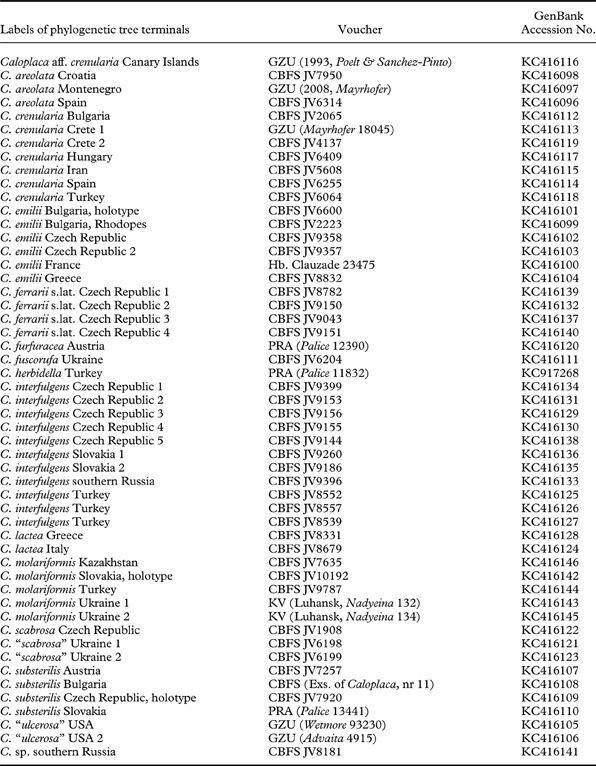
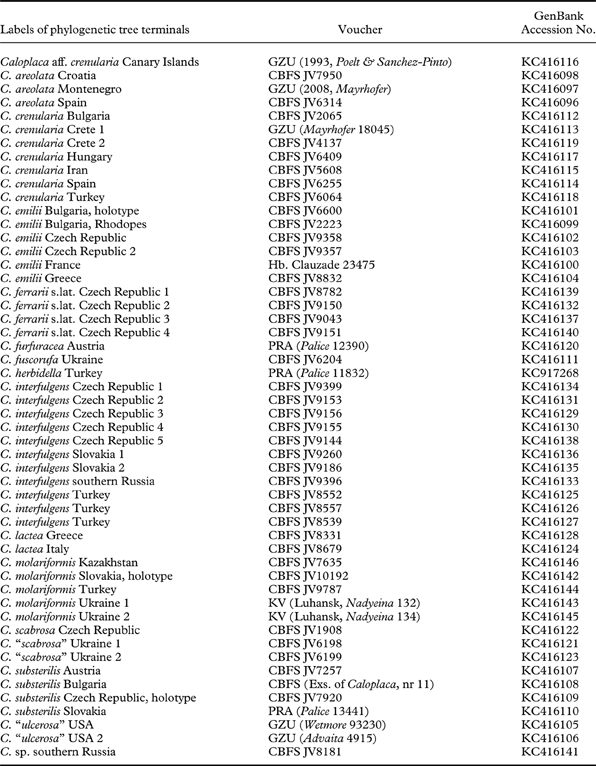
The simple NaOH extraction (Werner et al. Reference Werner, Ros and Guerra2002) was used for DNA isolations. Primers for PCR amplification were ITS1F (Gardes & Bruns Reference Gardes and Bruns1993) and ITS4 (White et al. Reference White, Bruns, Lee, Taylor, Innis, Gelfand, Sninsky and White1990). PCR cycling parameters follow Ekman (Reference Ekman2001). A total of 51 nuclear ITS sequences were newly generated (Table 1).
New Caloplaca ITS sequences generated during this study
Phylogenetic analyses
Five independent phylogenetic analyses of the nuclear ITS region were made to cover the individual groups studied. All analyses followed almost the same design; differences are listed in Table 2. Sequences were aligned using the MAFFT v6 server (http://mafft.cbrc.jp/alignment/server; Katoh & Toh Reference Katoh and Toh2008) according to the L-INS-i strategy. The resulting alignments required some manual adjustments (done in BioEdit; Hall Reference Hall1999) and, in the case of the C. crenularia group, also trimming of unalignable positions (using TrimAl-automated1 algorithm, Capella-Gutierrez et al. Reference Capella-Gutierrez, Silla-Martinez and Gabaldon2009). The length of datasets submitted to further analyses ranged from 486–535 positions. Final alignments were submitted to TreeBase http://treebase.org/treebase-web/home.html.
Summary of phylogenetic analyses: length of alignments (including gapped positions) and model selected for the purpose of MrBayes calculation

Molecular phylogenies were estimated by Bayesian inference as incorporated in MrBayes 3.0b4 (Huelsenbeck & Ronquist Reference Huelsenbeck and Ronquist2001; Ronquist & Huelsenbeck Reference Ronquist and Huelsenbeck2003). Model selection was committed to the Kakusan4 algorithm (Tanabe Reference Tanabe2011), whereas the baseml software (Adachi & Hasegawa Reference Adachi and Hasegawa1996) served as the computational core. With reference to the Bayesian information criterion (Schwartz Reference Schwarz1978), we opted for SYM or GTR models with rate variation across sites simulated by discrete gamma distribution (Γ8) and autocorrelated by the AdGamma rates prior (Table 2.). The increased probability of transitions over transversions, well documented in many rDNA datasets (see e.g. Keller et al. Reference Keller, Bensasson and Nichols2007), was reflected by setting the substitution rates prior (revMatPr) to dirichlet with values 1 and 3 for these two mutational types, respectively. Each analysis comprised two independent runs, each of which encompassed four Metropolis-coupled MCMC chains with 10 000 000 generations sampled after every 1000th generation. In every run, one Markov chain was cold and three were incrementally heated by the parameter of 0·3. To eliminate trees sampled before reaching apparent stationarity, the first 25% of entries were discarded as burn-in and the rest were used to compute majority-rule consensus, where the relative occurrences of nodes are identified with the Bayesian posterior probabilities (Figs 2–6). Bayesian posterior probabilities ≥50 are shown, branches with lower posterior probabilities are collapsed.
Nomenclature
Arup et al. (Reference Arup, Søchting and Fröden2013) proposed a new nomenclature within Teloschistaceae and split the crustose genus Caloplaca into numerous genera. We do not follow the new nomenclature in this paper, because generic names are still missing for many Teloschistaceae taxa, including Caloplaca emilii and C. substerilis described here. Names of other lichen taxa follow the Index Fungorum http://www.indexfungorum.org/names/names.asp
Records new to Central Europe
Caloplaca interfulgens (Nyl.) J. Steiner
Verh. zool.-bot. Ges. Wien 52: 479 (902). – Lecanora interfulgens Nyl. Flora 56: 340 1878.
Images of some Czech and German specimens are available on the lichenological web page at the University of South Bohemia http://botanika.bf.jcu.cz/lichenology/index.php?pg=5.
Diagnostic characters
Thallus well-developed, consisting of yellow areoles and often with squamules at the margin. Ascospores polarilocular, c. 15–19×5·0–7·5 µm with septa up to 4 µm wide. Prothallus indistinct. Occurs on calcareous rocks.
Similar taxa are Caloplaca crenulatella s. lat. (the yellow thallus usually reduced), C. diffusa Vondrák & Llimona (on non-calcareous rocks, yellow thallus with thin diffuse margin, with grey-white prothallus, squamules absent) and species of the Caloplaca velana complex (ascospores shorter with thicker septa).
Distribution
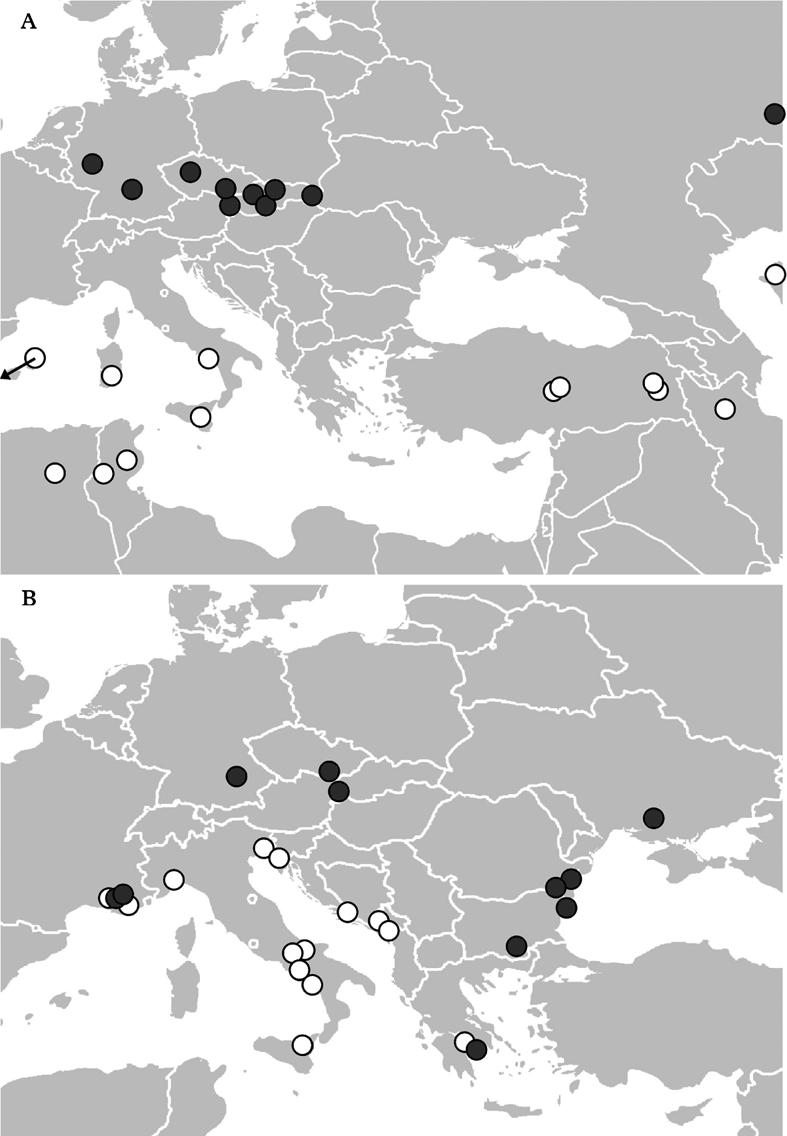
(Fig. 1A)
Distribution maps. A, Caloplaca interfulgens, previously published data (white dots), new records (black dots); B, C. emilii (black dots), C. areolata (white dots).
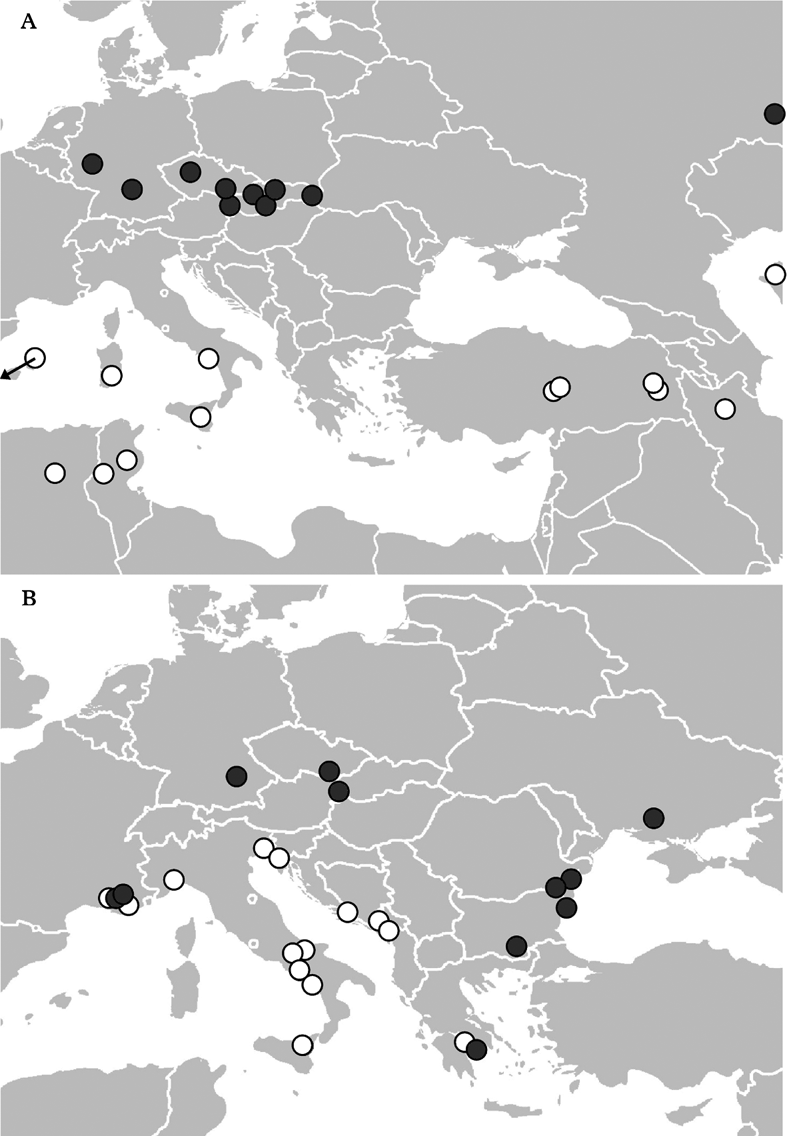
Caloplaca interfulgens was previously known only from deserts, semi-deserts or steppes in North Africa (Nylander Reference Nylander1878; Navarro-Rosinés & Hladun Reference Navarro-Rosinés and Hladun1996), Mediterranean Europe (Italy: Nimis & Martellos Reference Nimis and Martellos2008; Spain: Nimis et al. Reference Nimis, Seaward, Ariño and Barreno1998), Iran, Kazakhstan (Vondrák et al. Reference Vondrák, Říha, Redchenko, Vondráková, Hrouzek and Khodosovtsev2011) and continental Turkey (Vondrák et al. Reference Vondrák, Halıcı, Kocakaya and Vondráková2012a ). The new records are surprisingly from less arid territories in Austria, the Czech Republic, Germany, southern Russia and Slovakia. In all Central European localities, C. interfulgens is restricted to limestone outcrops in xerothermic sites (often south-facing steppes).
Phylogeny
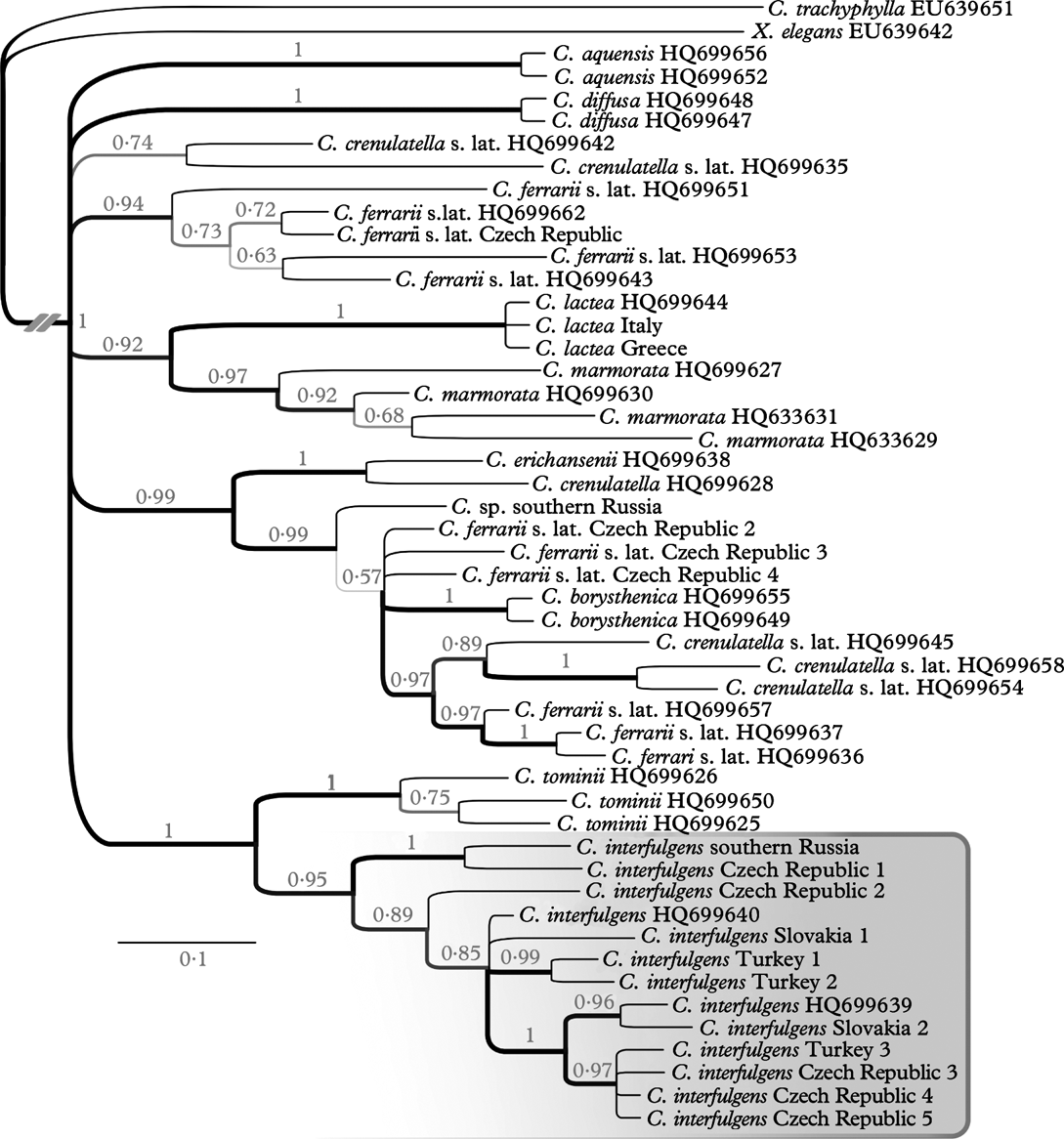
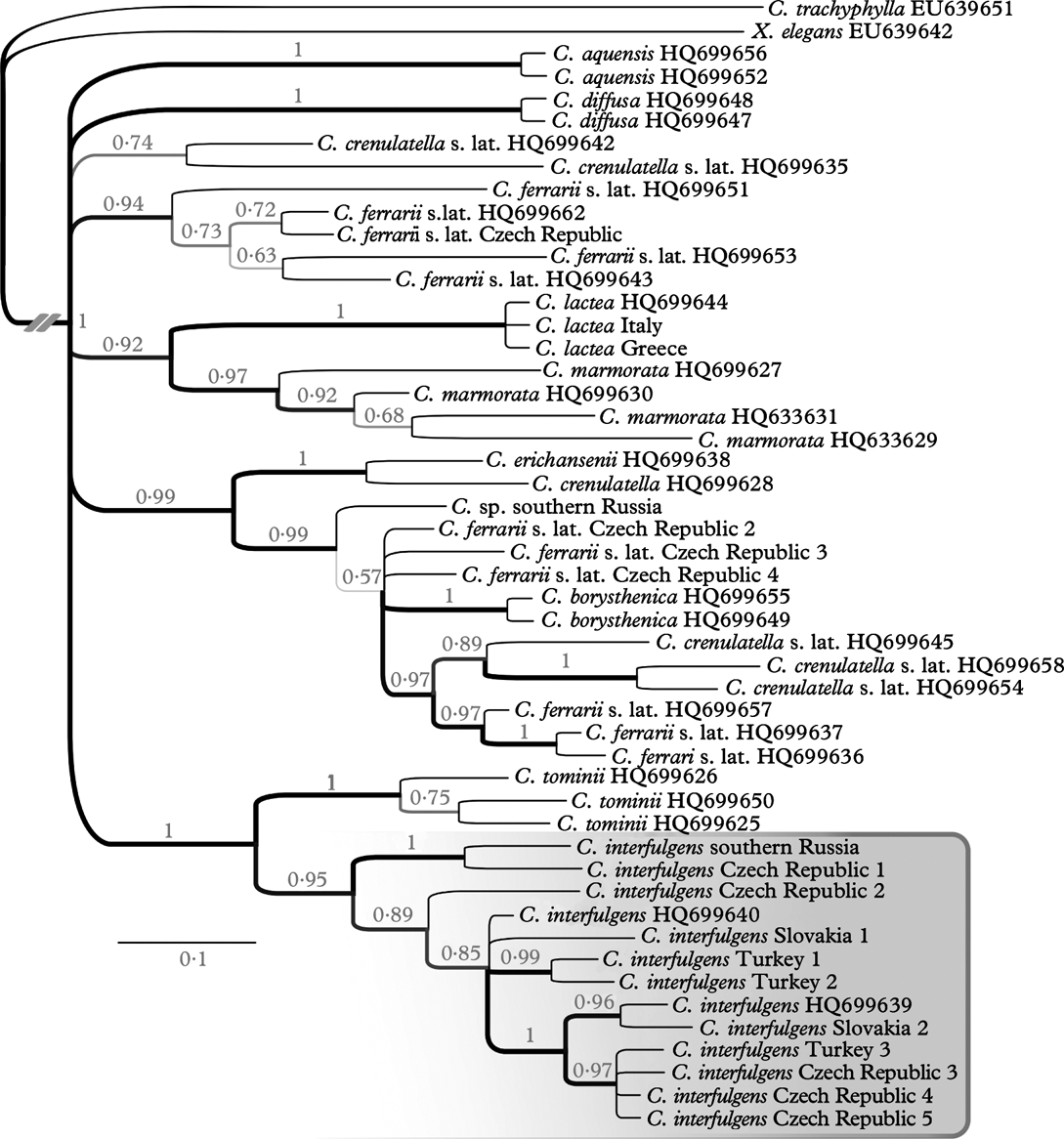
In the ITS phylogeny of the Caloplaca crenulatella group (Fig. 2), Caloplaca interfulgens forms a well-resolved sister clade to Caloplaca tominii, a sorediate species with a similar distribution pattern in Europe.
Bayesian ITS phylogeny of the Caloplaca crenulatella group; C. interfulgens clade delimited by the grey square.
Taxonomic note
Although the Caloplaca crenulatella group has been studied recently (Navarro-Rosinés & Hladun Reference Navarro-Rosinés and Hladun1996; Vondrák et al. Reference Vondrák, Říha, Redchenko, Vondráková, Hrouzek and Khodosovtsev2011), it is still poorly understood and many lineages are not yet well characterized. Fortunately, its well-developed areolate thallus separates C. interfulgens from the many taxa with reduced thalli. However, some Central Asian taxa have a thallus similar to C. interfulgens (e.g. ‘Caloplaca sp., southern Russia’ in Fig. 2) and their delimitation requires further study.
New records. Austria: Niederösterreich: Wien, Hainburg an der Donau, rocks on SW slopes of hill Braunberg NE of town, 48°09′10″N, 16°57′12″E, 280 m, 2012, J. Vondrák 9550 (CBFS).—Czech Republic: Central Bohemia: Bohemian karst, Beroun, Tmáň, protected area Kotýz, 1·5 km NE of village, 49°54′56″N, 14°2′55″E, 350 m, 2011, J. Vondrák 9153, 9155 & 9156 (CBFS); Praha, Dobřichovice, Karlík, limestone outcrops 1 km NW of ruin of Karlík, 49°56′56″N, 14°14′49″E, 300 m, 2011, I. Frolov & J. Vondrák 9399 (CBFS); Praha, Radotín, Kosoř, protected area Černá rokle, E of village, 49°59′21″N, 14°20′8″E, 250–300 m, 2011, Z. Palice & J. Vondrák 9144 (CBFS). Southern Moravia: Pavlovské vrchy hills, Mikulov, Klentnice, SE slope of hill Pálava, 48°51′22″N, 16°38′33″E, 350–400 m, 2012, J. Vondrák 9577 (CBFS).—Germany: Baden-Württemberg: Schwäbishe Alb Mts, Langenau, Albeck, shallow valley W of Kornberghöfe, 520–550 m, 1984, V. Wirth 29418 (STU; hb. Wirth). Rheinland-Pfalz: Eifel Mts, Uxheim, Dreimühlen, limestone outcrops in dry grassland, 1992, V. Wirth 23937 & R. Düll (STU; hb. Wirth).—Russia : Orenburgskaya Oblast': surroundings of water reservoir “Iriklinskoe vodokhranilishche”, vill. Chapaevka, limestone rocks on opposite slope of lake, NE of village, 52°05′12″N, 58°48′1″E, 270–290 m, 2011, I. Frolov & J. Vondrák 9396 (CBFS).—Slovakia: Cerová vrchovina upland: Filakovo, Hajnáčka, hill Ragač, lime-rich outcrop of volcanic pyroclastics in open beech-oak forest, 48°13′25″N, 19°59′6″E, 500 m, 2012, J. Vondrák 10137 (CBFS). Muranská Planina Mts: Brezno, Tisovec, hill Okruhla skala, c. 2 km W of town, 48°40′42″N, 19°54′57″E, c. 800 m, 2011, J. Vondrák 9260 (CBFS). Strážovské vrchy Mts: Ilava, Zliechov, on S-slope of Mt Strážov, 48°56′59″N, 18°27′16″E, 1000 m, 2012, J. Vondrák 10198 (CBFS). Vihorlat Mts: Sobrance, Podhorod [Podhradí], 1930, J. Buček (BRA, sub Caloplaca zimmermannii, Servít, nomen ined.).
Caloplaca scabrosa Søchting, Lorentsen & Arup
Nova Hedwigia 87: 89 (2008).
Images of European samples and the isotype are available on the lichenological web at the University of South Bohemia http://botanika.bf.jcu.cz/lichenology/index.php?pg=5.
Observation of the type specimen
Isotype (CBFS JV9402, ex C; Søchting 5513) examined in detail.
Thallus rough and scabrous by blastidia, densely covering the thallus surface. Blastidia (40–)71(–130) µm diam. [10; 1; 29]. Thallus surface pale grey to sordid white, but tips of blastidia often dark grey. Grey thallus parts containing Cinereorufa-green (green-grey in water, K−, N+ red) in the uppermost thallus cells. Thallus divided into thin and more or less flat angular areoles, c. 0·2–1·3 mm diam. The real cortex absent, but indistinct alveolate cortex present in spots, of spherical, thick-walled cells (wall c. 1 µm thick). Thallus without anthraquinones, but with atranorin.
Apothecia biatorine, deep red (old apothecia somewhat blackened), with anthraquinones; major: parietin and 7-Cl-emodin; traces of emodin, 7-Cl-citreorosein, 7-Cl-emodinal and parietinic acid (C+ purple owing to chlorinated compounds). True exciple of palisade prosoplectenchyma, of cells with glutinized, c. 1 µm thick walls. Lower exciple and lower hypothecium brown-red (possibly due to small amount of anthraquinones; with weak K+ purple reaction). Ascospores polarilocular, (12·0–)14·0(–17·0)×(5·5–)6·5(–8·0) µm [10; 1; 1·3 & 0·7], with septa (4·0–)5·0(–5·5) µm [10; 1; 0·5].
Pycnidia not present on the available isotype material. The type material is also described in Søchting et al. (Reference Søchting, Lorentsen and Arup2008).
Observations of the Central European specimens
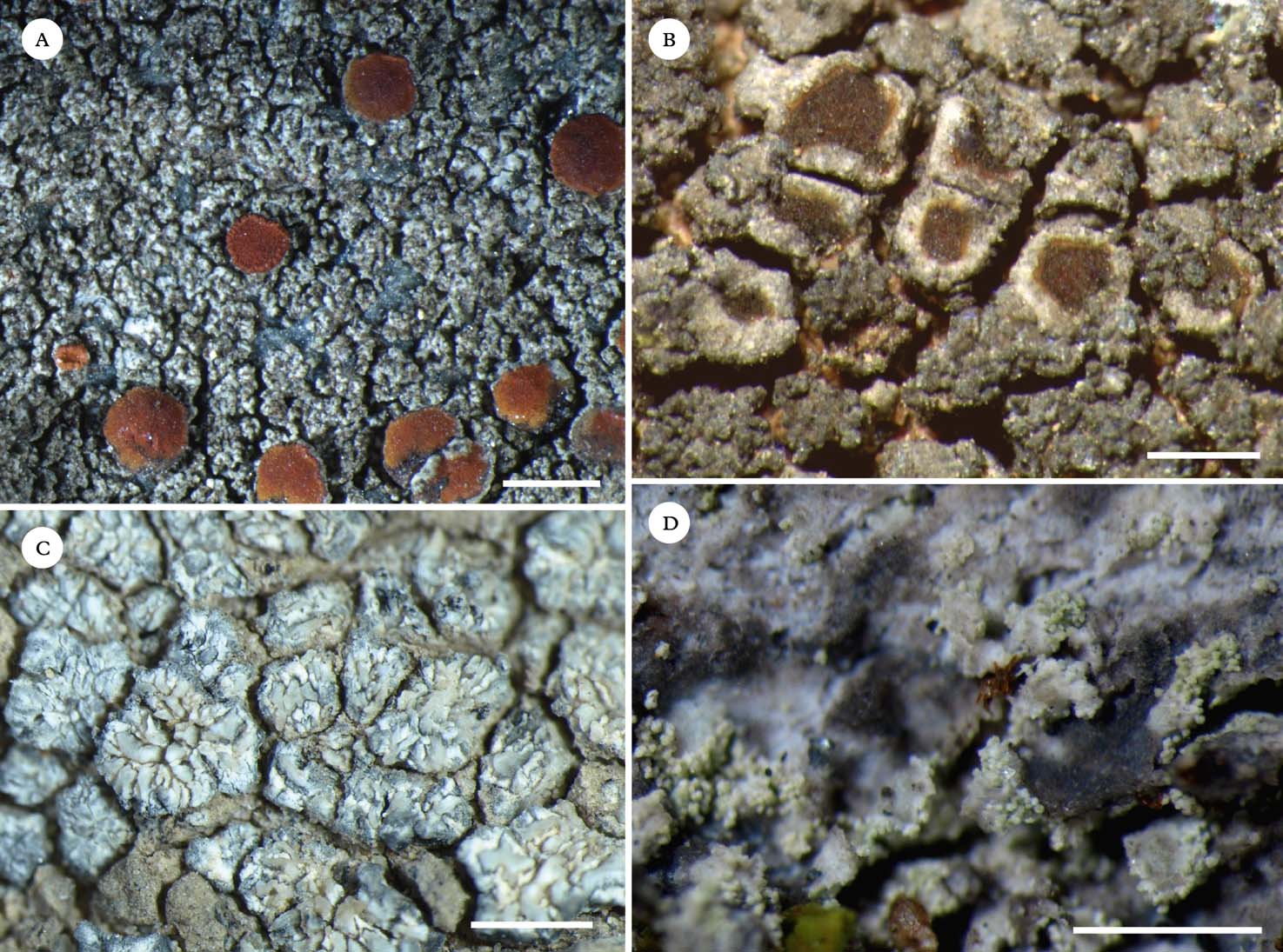
(Fig. 7A).
Thallus rough and scabrous by blastidia, densely covering the thallus surface. Blastidia (30–)58–67–72(–130) µm diam. [30; 3; 28]. Thallus surface pale grey to white, but tips of blastidia often dark grey. Grey pigmented thallus parts containing Cinereorufa-green (green-grey in water, K−, N+ red) in the uppermost thallus cells. Thallus divided into thin and flat angular areoles, c. 0·2–1·0 mm diam. The real cortex absent, but indistinct alveolate cortex present in spots, of spherical, thick-walled cells (walls c. 1 µm thick). Thallus without anthraquinones, but with atranorin.
Apothecia deep red (old blackened apothecia not observed), with anthraquinones; major: parietin and 7-Cl emodin; traces of emodin, fragilin and parietinic acid (C+ purple owing to chlorinated compounds); biatorine or zeorine; thalline exciple sometimes strongly expanded in old apothecia. True exciple of palisade prosoplectenchyma, of cells with glutinized, 1–2 µm thick walls. Inner exciple and lower hypothecium brown-red (perhaps by anthraquinones). Ascospores polarilocular, (11·5–)13·0(–15·0)×(6·5–)7·5(–9·0) µm [10; 1; 1·4 & 0·8], with septa (3·0–)4·0(–5·0) µm [10; 1; 0·5].
Pycnidia with red tops, containing chlorinated anthraquinones (C+ purple). Conidia more or less bacilliform, c. 3–4×1 µm.
Importance of particular characters
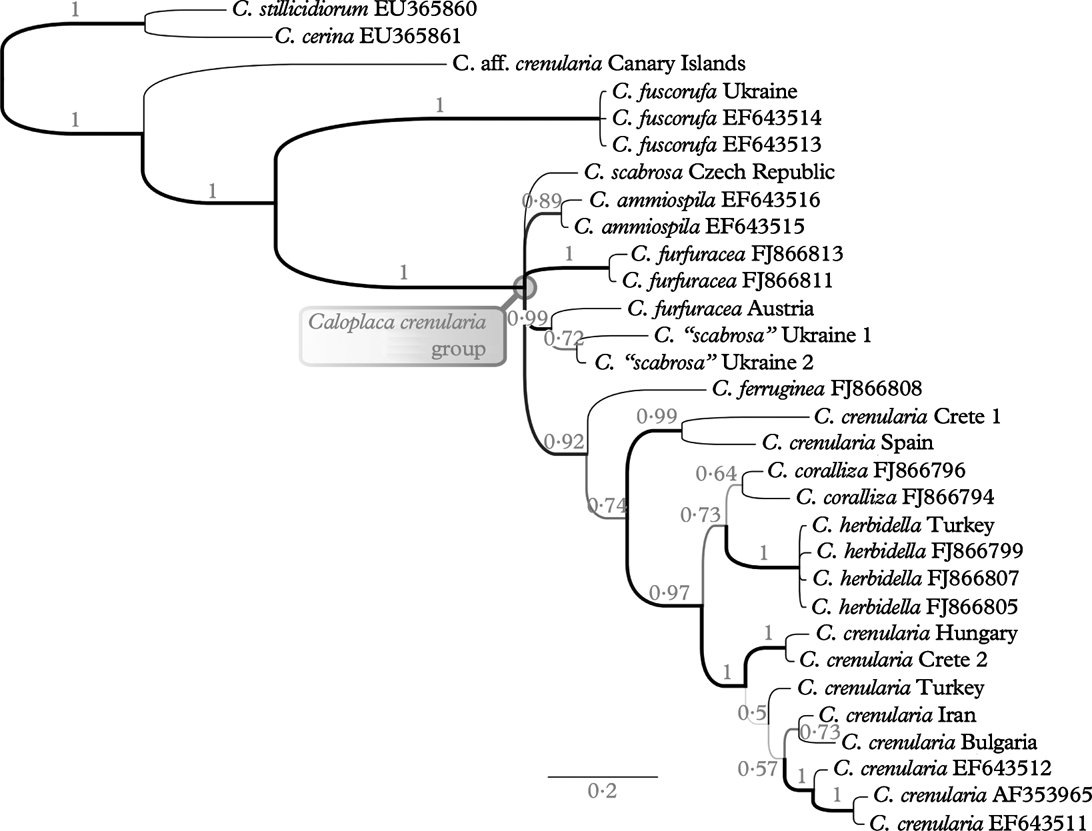
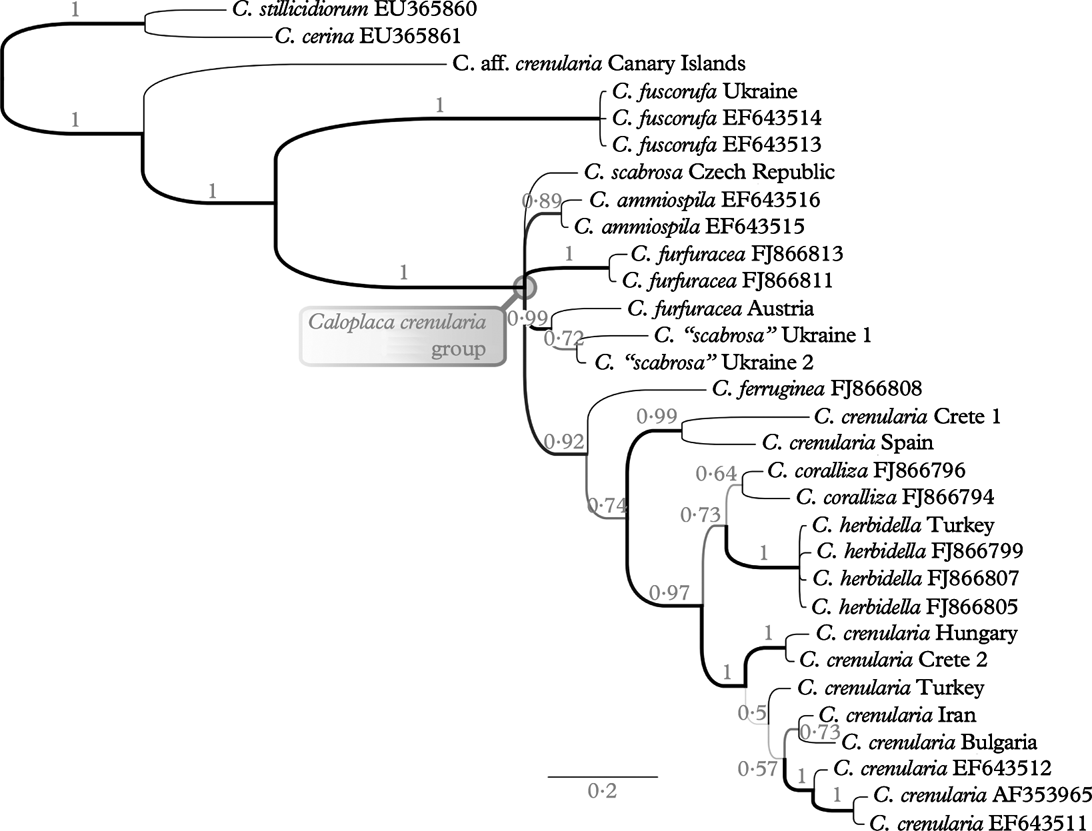
Caloplaca scabrosa shares many characters with other related taxa from the C. crenularia group (as defined in Fig. 3), so their diagnostic power is rather low. They include: 1) presence of Cinereorufa-green in the thallus; 2) apothecia with chlorinated anthraquinones (C+ purple); 3) structure of the true exciple; 4) brownish pigment in lower hypothecium and inner true exciple; 5) pycnidia with red caps.
Bayesian ITS phylogeny of the Caloplaca crenularia group including the Central European sample of C. scabrosa and C. “scabrosa” from the Eastern Carpathians.
Some characters are specific for C. scabrosa: 1) presence and size of blastidia; 2) presence of atranorin in the thallus. We have tested the diagnostic power of the presence of atranorin. We analyzed thalli of various species of the C. crenularia group: Caloplaca ammiospila (Ach.) H. Olivier (CBFS JV10223), C. crenularia (With.) J. R. Laundon (CBFS JV4596; 5608; hb. Z. Palice 7837; Poland, Nowak's exsiccate 203 in GZU; Sardinia, 1986, Poelt in GZU), C. ferruginea (Huds.) Th. Fr. (CBFS JV7224; 7256), C. furfuracea H. Magn. (Ural, hb. I. Frolov), and C. hungarica H. Magn. (CBFS JV3081). Atranorin was detected in only one sample of C. crenularia from the basalt outcrops in the Karkonosze Mountains, W Sudetes (Nowak, Lich. Polon. Exs. n. 203), indicating that this C. crenularia specimen does not belong in the main C. crenularia clade.
The type specimen of Caloplaca scabrosa differs from the Central European material in the following characters: 1) size of areoles; 2) thallus thickness; 3) extent of the thalline exciple. Based on our observations of numerous samples of the C. crenularia group, these characters were very variable both within and between specimens of a single species, so the differences are of little taxonomic importance. Ascospore size and septum width also differ between the type and the Central European collections, but this difference may be merely a consequence of the low number of available specimens and measurements.
Phylogeny
The ITS sequence of the Central European specimen of Caloplaca scabrosa is placed in the basal polytomy of the ITS phylogeny of the C. crenularia group (Fig. 3). It is perhaps closely related to the arctic-alpine C. ammiospila or boreo-montane C. furfuracea.
Taxonomic notes
The epixylic taxon Caloplaca furfuracea is very similar to C. scabrosa. It likewise produces blastidia (isidia according to Arup & Åkelius Reference Arup and Åkelius2009) of the same size; tips of blastidia are also usually dark grey due to the Cinereorufa-green content in the alveolate cortex. With the exception of the ecology, the only reliable character distinguishing C. furfuracea from C. scabrosa is the absence of atranorin.
We have collected samples of a granular to blastidiate lichen in the subalpine belt of the Eastern Carpathians (“Caloplaca scabrosa” in Fig. 3). These saxicolous specimens are very similar to both C. furfuracea and C. scabrosa. They appear to be closer to C. furfuracea in the ITS phylogeny but they share chemistry and ecology with C. scabrosa.
New records. Czech Republic: Northern Moravia: Rýmařov, Karlov, central part of Velký kotel corrie, on phyllitic overhanging rock, 1330–1340 m, 2002, Z. Palice 7024 (PRA); ibid., 50°03′20″N, 17°14′E, 1250–1300 m, 2004, J. Vondrák 1907, 1908 & 1909 (CBFS).
C. “scabrosa”. Ukraine: Eastern Carpathians: Svidovets Mts, at glacial lake at bottom of glacial cirque in N slope, 48°15′41″N, 24°13′22″E, on sun-exposed base-rich sandstone boulders close to water, c. 1300 m, 2007, J. Vondrák 6199 (CBFS).
New species
Caloplaca emilii Vondrák, Khodos., Cl. Roux & V. Wirth sp. nov.
MycoBank No: MB 803332
Thallus grey or brown-grey, non-pruinose, of more or less flat areoles, with Sedifolia-grey and without anthraquinones. Dark grey blastidia always present at margins of thallus units. Mature apothecia zeorine, usually with brown disc and more or less yellow true exciple, C± purple (with chlorinated anthraquinones). Ascospores broadly ellipsoid, less than 15 µm long, with thick septa. Pycnidial tops dark grey. Conidia ellipsoid, not bacilliform.
Type: Bulgaria, Black Sea coast, Kavarna, limestone cliffs on seashore 1·5 km NE of Kamen Brjag, 43°27′58·76″N, 28°33′55·02″E, on coastal limestone outcrop above supralittoral zone, 6 April 2007, J. Vondrák 6600 (CBFS—holotype; KHER—isotype). ITS sequence of the holotype: KC416101.
Images of the German sample are available on the lichenological web page at the University of South Bohemia http://botanika.bf.jcu.cz/lichenology/index.php?pg=5.
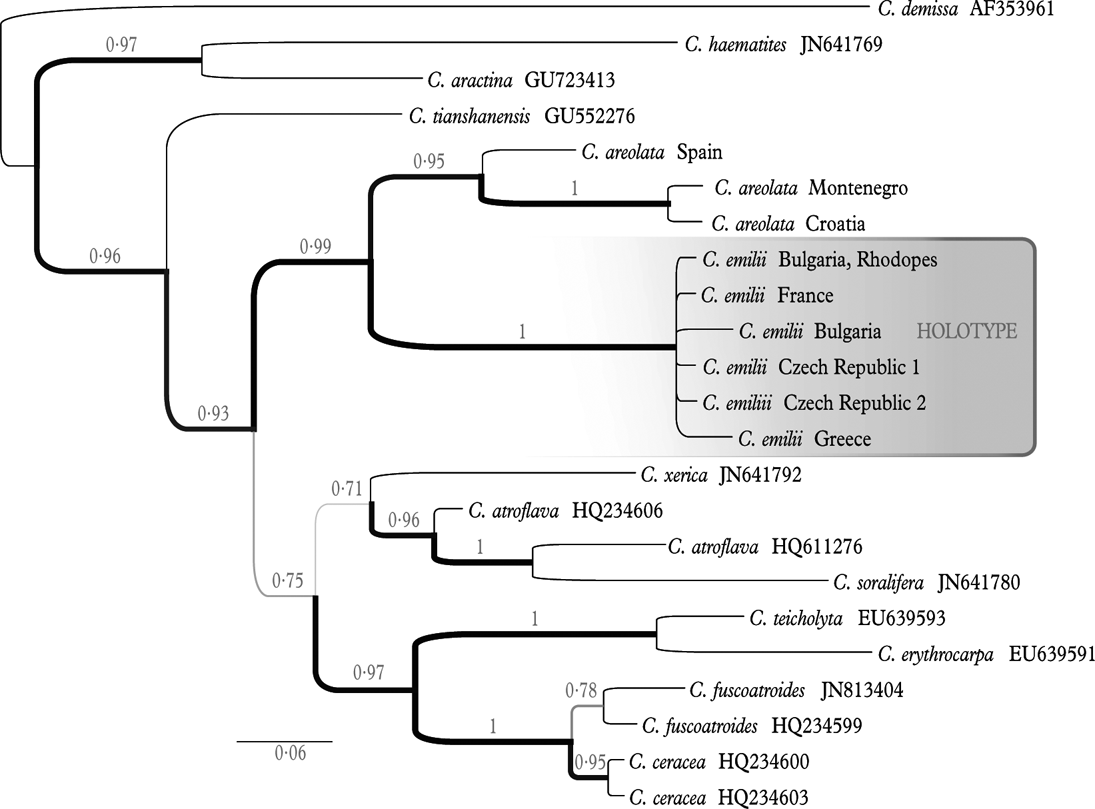
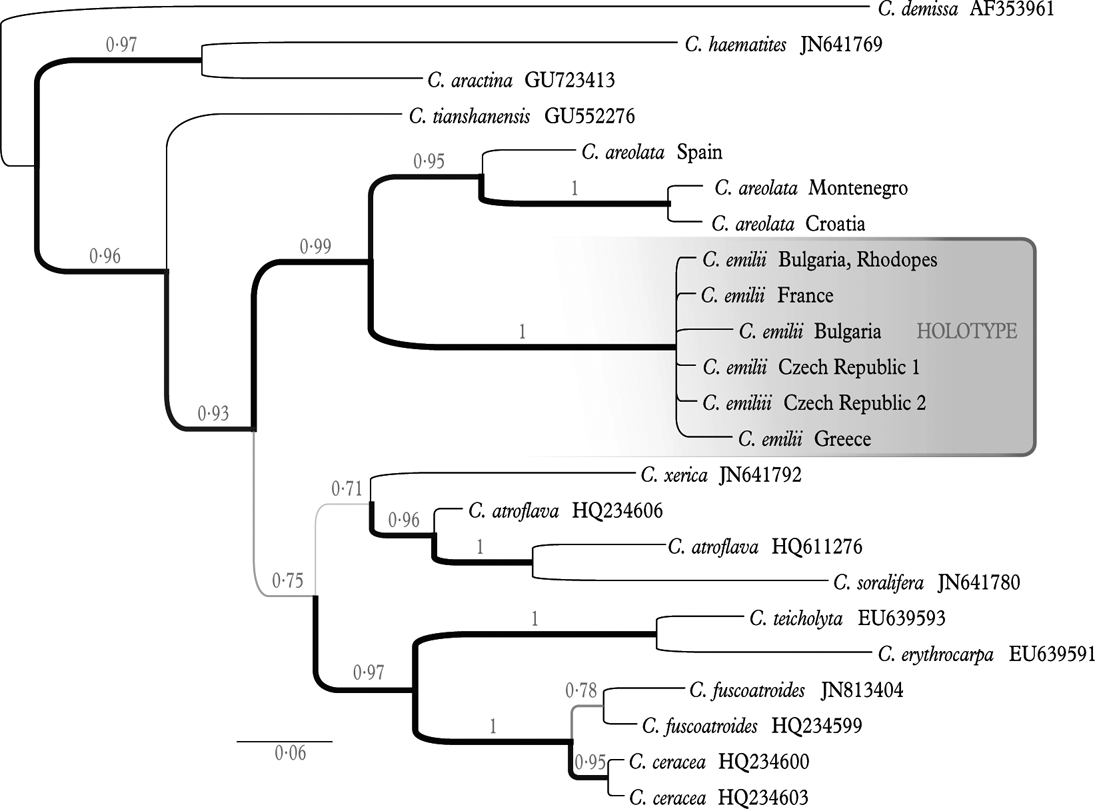
Bayesian ITS phylogeny of the Caloplaca xerica group including C. emilii (in the grey square) and C. areolata.
Thallus forming irregular spots, brown-grey or pale to dark grey, to several cm wide; often starting on other crustose lichens; of tightly arranged, angular to rounded, flat to slightly convex, areoles or squamules, (0·3–)0·6–0·9–1·1(–2·6) mm diam. [70; 7; 0·4]. Thickness of thallus 100–500 µm. Medulla well-developed only in thick thalli, but up to 400 µm thick; medullary tissue formed of loose prosoplectenchyma; medullary hyphae c. 2–3 µm wide with walls thickened up to 1 µm. Algal layer 50–140 µm thick; algal cells globose, c. 5–20 µm diam. Cortex developed in patches, up to 30 µm thick, not gelatinous; sometimes only alveolate cortex present. Epinecral layer often present, up to about 10 µm thick. Cortex cells or alveolate cortex cells spherical, thin-walled, about 4–6 µm diam. Blastidia simple, globose, dark grey, always present, produced at margins of areoles or squamules, rarely also on their upper surface, (20–)53–65–95(–210) µm diam. [60; 6; 36]. Extracellular crystals of calcium salts not observed in any thallus part. Pruina absent. Prothallus indistinct or absent. Thallus frequently affected by brown hyphomycetes resembling species of Intralichen.
Apothecia present in c. 50% of samples collected; rare in northern populations; (0·3–) 0·5–0·7–0·9(–1·4) mm diam. [40; 4; 0·2]; zeorine. Disc in shades of brown (orange in young apothecia); true exciple usually yellow (contrasting with disc); thalline exciple in shades of grey; pruina absent. Hymenium colourless, without distinct gelatinous matrix and without extracellular oil drops, c. 70–110 µm high; epihymenium ochre to green-yellow. Hypothecium colourless, rarely with extracellular oil drops, more or less flat, c. 100–300 µm high, formed of cells variable in shape; subhypothecial algal layer present (algal cells underlying entire hypothecium). Exciple c. 70–110 µm wide, formed of true exciple, c. 30–60 µm wide, and thalline exciple, c. 10–70 µm wide. Upper part of true exciple of thin-walled spherical cells c. 4–6×3–4 µm. Lower part of palisade prosoplectenchyma of thin-walled cells c. 5–12×1·5–2·0 µm. Thalline exciple without cortex or with indistinct alveolate cortex. Paraphyses 2·0–2·5 µm wide in lower part, but widening gradually to (2·5–)3·0–3·5–4·0(–5·0) µm [30; 3; 0·5] in upper part; rarely branched and anastomosed. Asci clavate, c. 50–70×15–20 µm. Ascospores polarilocular, (8·0–)12·0–12·5–13·5(–15·0)×(5·0–)7·0–7·5–8·0(–9·5) µm [50; 5; 1·5 & 0·9], septa (4·0–)5·0–5·5–6·0(–7·5) µm [50; 5; 0·9]. Ascospore length/breadth ratio: (1·0–)1·5–1·7–1·8(–2·2) [50; 5; 0·3]; septum width/ascospore length ratio: (0·30–)0·40–0·45–0·47(–0·60) [50; 5; 0·1]. Extracellular crystals of calcium salts absent from all apothecial parts.
Pycnidia not common (observed in only three samples), c. 150–200 µm wide, with several partly separated chambers (Xanthoria-type), distinguished by their darker grey tops on the thallus surface. Conidiophores formed of isodiametric cells, c. 2–4 µm diam. Conidia ellipsoid, broadly ellipsoid or tear-shaped, rather uniform in size, 2·0–2·5×1·5 µm.
Chemistry
True exciple, medulla and lower cortex non-amyloid (I−); hymenium and hypothecium amyloid (I+). Uppermost cells in cortical tissue of thallus and thalline exciple contain Sedifolia-grey (grey in water, K+ violet, N+ red, H2SO4+ red, I+ blue). Content of Sedifolia-grey is higher in pycnidial tops. Epihymenium and outer cells in the true exciple contain anthraquinones: fragilin (major) and 7-Cl-emodin (HPLC done in sample JV6597).
Etymology
The epithet is derived from the name of our great friend Emil Červenka, who supported the first author during difficult times.
Similar taxa
Caloplaca areolata (Zahlbr.) Clauzade (without blastidia), C. chlorina (Flot.) Sandst. and C. isidiigera Vězda (with blastidia but with lecanorine apothecia and bacilliform conidia), C. concreticola Vondrák & Khodos. (with blastidia but without anthraquinones in apothecia), C. soralifera Vondrák & Hrouzek (with soredia, often pruinose) and C. xerica Poelt & Vězda (usually with isidia, without flat areoles, with larger ascospores). A little-known blastidiate morphotype of Caloplaca atroflava (Turner) Mong. is a similar lichen; it is very common in Central Europe, but occurs mainly on non-calcareous rocks (orange, C− apothecia, without chlorinated anthraquinones, blastidia usually overgrowing most of thallus surface).
Phylogeny
In the ITS phylogeny (Fig. 4), Caloplaca emilii is definitely placed in the C. xerica group (sensu Vondrák et al. Reference Vondrák, Šoun, Vondráková, Fryday, Khodosovtsev and Davydov2012b ). It forms a well-circumscribed clade (PP=1·0), sister to C. areolata. Both taxa form a well-supported monophyletic group (PP=0·99).
Ecology and distribution
Caloplaca emilii occurs on sun-exposed, usually horizontal, faces of limestone outcrops in fast-drying places in steppes, forest-steppes or in open Mediterranean shrub vegetation, mainly in the Placocarpetum schaereri (Roux Reference Roux1978: 120–130). Co-occurring lichens are Acarospora cervina, Aspicilia calcarea, A. contorta, Bagliettoa calciseda, Caloplaca aurantia, C. chalybaea, C. coronata, C. crenulatella s. lat., C. inconnexa, C. lactea, C. teicholyta, C. variabilis, Candelariella aurella, Diplotomma hedinii, D. venustum s. str., Heteroplacidium fusculum, Lecanora muralis s. lat., Lobothallia cheresina s. lat., L. radiosa, Placocarpus schaereri, Placopyrenium canellum, Rinodina calcarea, R. ocellata, R. bischoffii, Verrucaria lecideoides, V. macrostoma f. furfuracea, and V. nigrescens s. lat.
The species is already known from Germany (as the blastidiate variant of Caloplaca areolata in Wirth et al. Reference Wirth, Vondrák, de Bruyn and Hauck2011). Nevertheless, this lichen has a rather southern distribution in Europe; it is probably most common in the Mediterranean basin and adjacent areas, such as France, Italy, Spain, mainly in the supramediterranean and montane belts (Roux Reference Roux1978: 124, as C. areolata). Although it is common in continental areas around the Black Sea, we do not know it from continental areas east of the Mediterranean basin. In southern areas, it sometimes grows with its close relative C. areolata (for example in southern France and Greece). Both taxa have similar ecology, but C. areolata without vegetative diaspores appears to be restricted to the Mediterranean region, whereas the blastidiate C. emilii also occurs in isolated localities far to the north (Fig. 1B). The ability to reproduce vegetatively may have facilitated the northward extension of its distribution. A similar situation is observed in other Mediterranean lichens from the C. xerica group; sorediate/blastidiate C. albolutescens (Nyl.) H. Olivier and C. teicholyta (Ach.) J. Steiner are known from much more northern territories than the closely related C. erythrocarpa (Pers.) Zwackh, which is without vegetative diaspores.
Taxonomic notes
Caloplaca emilii is well known from the Mediterranean regions of France, where it has been named C. areolata (Clauzade Reference Clauzade1963, Reference Clauzade1965, Reference Clauzade1969; Roux Reference Roux1978) or later C. isidiigera (Roux Reference Roux1982, Reference Roux1984; Boissière et al. Reference Boissière, Déruelle and Roux1989; Houmeau & Roux Reference Houmeau and Roux1991; Roux & Gueidan Reference Roux and Gueidan2002; Bricaud Reference Bricaud2007). However, these names belong to other taxa; C. areolata lacks vegetative diaspores (see also under ecology) and C. isidiigera is an unrelated species with lecanorine apothecia and a (sub-)alpine distribution (Vězda Reference Vězda1978; Šoun et al. Reference Šoun, Vondrák, Søchting, Hrouzek, Khodosovtsev and Arup2011).
Caloplaca areolata has recently been considered a synonym of C. spalatensis Zahlbr. (e.g. Nimis & Martellos Reference Nimis and Martellos2008). This synonymization is incorrect, because C. spalatensis is a very different lichen which belongs to the C. crenularia group (images of both holotypes, deposited in the herbarium W, are available on the lichenological web page at the University of South Bohemia http://botanika.bf.jcu.cz/lichenology/index.php?pg=5).
Paratypes. Austria: Nieder österreich: Wien, Hainburg an der Donau, rocks on SW slopes of hill Braunberg NE of town, 48°09′10″N, 16°57′12″E, 280 m, 2012, J. Vondrák 9570 (CBFS).—Bulgaria: Black Sea coast: Kavarna, Kamen Brjag, 43°27′59″N, 28°33′55″E, 2007, J. Vondrák 6600 (CBFS). The Rhodopes: Madzharovo, Silen, Byal Kladenets, in valley below village, 41°37′N, 25°40′E, 350 m, 2004, J. Vondrák 2223 (CBFS).—Czech Republic: Southern Moravia: Mikulov, in town, ruin of castle Kozí Hrádek, 48°48′34″N, 16°38′17″E, 2011, J. Vondrák 9358 & O. Vondráková (CBFS); Mikulov, Klentnice, SE slope of hill Pálava, 48°51′22″N, 16°38′33″E, 350–400 m, 2012, J. Vondrák 9581 (CBFS); Mikulov, Klentnice, at ruin of Sirotčí hrádek, 48°50′43″N, 16°38′25″E, c. 410 m, 2011, J. Vondrák 9357 & O. Vondráková (CBFS).—France: Provence: Vaucluse, Gordes, entre les Devens et Lancie, sur dalle de molasse miocène au ras su sol, 43·9026°N, 5·1931°E, 275 m, 1975, G. Clauzade (MARSSJ 189); Vaucluse, Mirabeau, 520 m, 2005, C. Roux 23475 (hb. Roux).—Germany: Bayern: Oberfranken, Fränkische Alb: Kleinziegenfelder Tal, Grenzstein, 1976, V. Wirth 6101 (STU).—Greece: Attica: Poros, limestone outcrops in N-part of island, 37°31′28″N, 23°29′10″E, c. 200 m, 2010, J. Vondrák 8726, 8832 & O. Vondráková (CBFS).—Romania: Dobrogea: Târguşor, 44°27′46·26″N, 28°28′07·59″E, 2007, J. Vondrák 6599 (CBFS); Tulcea, Enisala, 44°52′42·09″N, 28°51′01·27″E, 2007, J. Vondrák 6604 (CBFS); Tulcea, Popina Island, 44°58′03″N, 28°58′57″E, 2007, J. Vondrák 6596, 6597, 6598 & 7149 (CBFS).—Ukraine: Kherson region: Berislav, Burgunka, 2008, A. Khodosovtsev & G. Naumovich (KHER, dupl. in CBFS).
Caloplaca molariformis Frolov, Vondrák, Nadyeina & Khodos. sp. nov.
MycoBank No: MB 803333
Anthraquinones entirely absent. Thallus epilithic, thick, ochre or dark grey, pruinose in spots, with Sedifolia-grey in superficial fungal cells. Blastidia and/or soralia always present. Thallus formed by high algal and fungal stacks (sensu Vondrák & Kubásek Reference Vondrák and Kubásek2013). Fungal stacks of colourless palisade prosoplectenchyma, of cells elongated vertically. The upper thallus surface with ridges derived from the epinecral layer, above fungal stacks (similar structure is described in South African “Fensterflechten” by Vogel Reference Vogel1955). Epihymenium and outer part of true exciple brown to grey, with Sedifolia-grey, K+ (slightly) violet to violet-brown. Ascospores c. 14–18 µm long with rather thin septa, c. 3 µm wide.
Type: Slovakia, Cerová vrchovina upland, Filakovo, Hajnáčka, Šurice, SW-slope of the hill Soví hrad, 48°13′34″N, 19°54′45″E, on lime-rich outcrop of volcanic pyroclastics in sun-exposed abandoned quarry, c. 250 m, 8 November 2012, J. Vondrák 10192 (CBFS—holotype; isotypes to be distributed in Exsiccates of Caloplaca, fasc. 4). ITS sequence of the holotype: KC416142.
More images available on the lichenological web page at the University of South Bohemia http://botanika.bf.jcu.cz/lichenology/index.php?pg=5.
(Figs 5, 7C; fig. 2 in Vondrák & Kubásek Reference Vondrák and Kubásek2013)
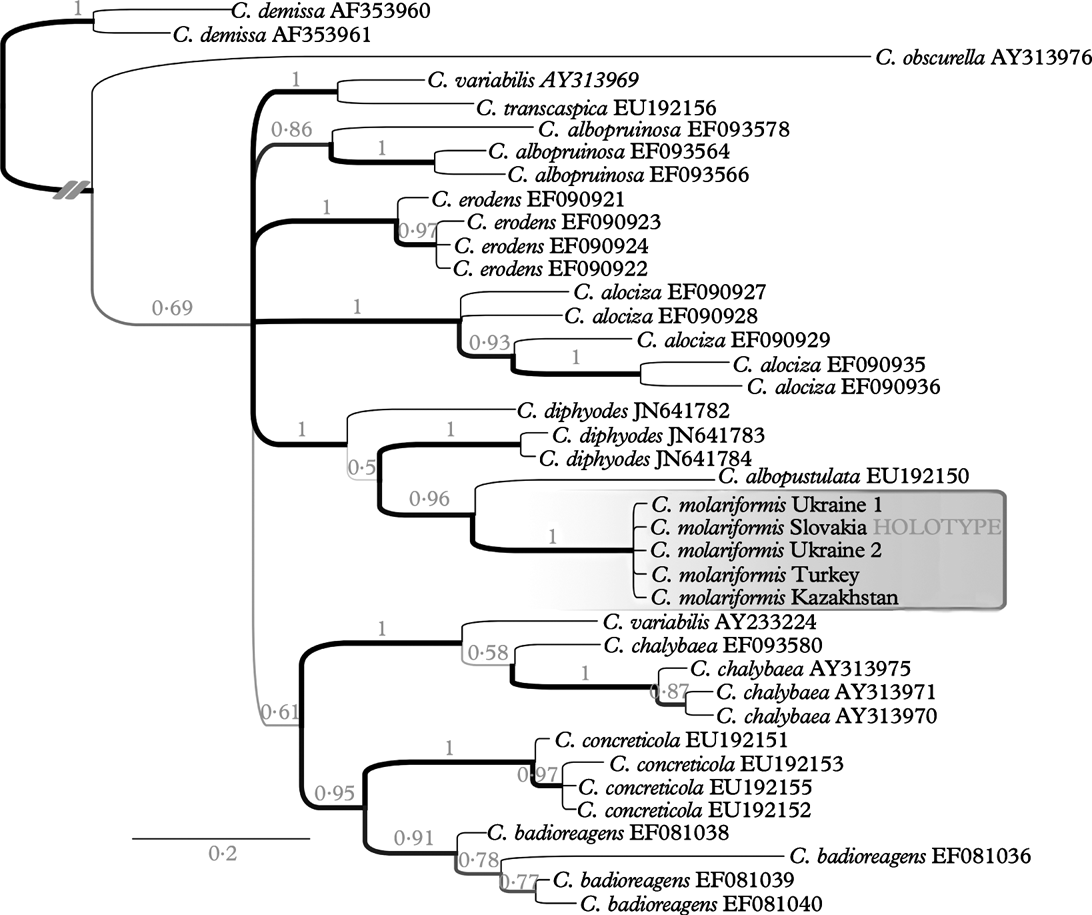
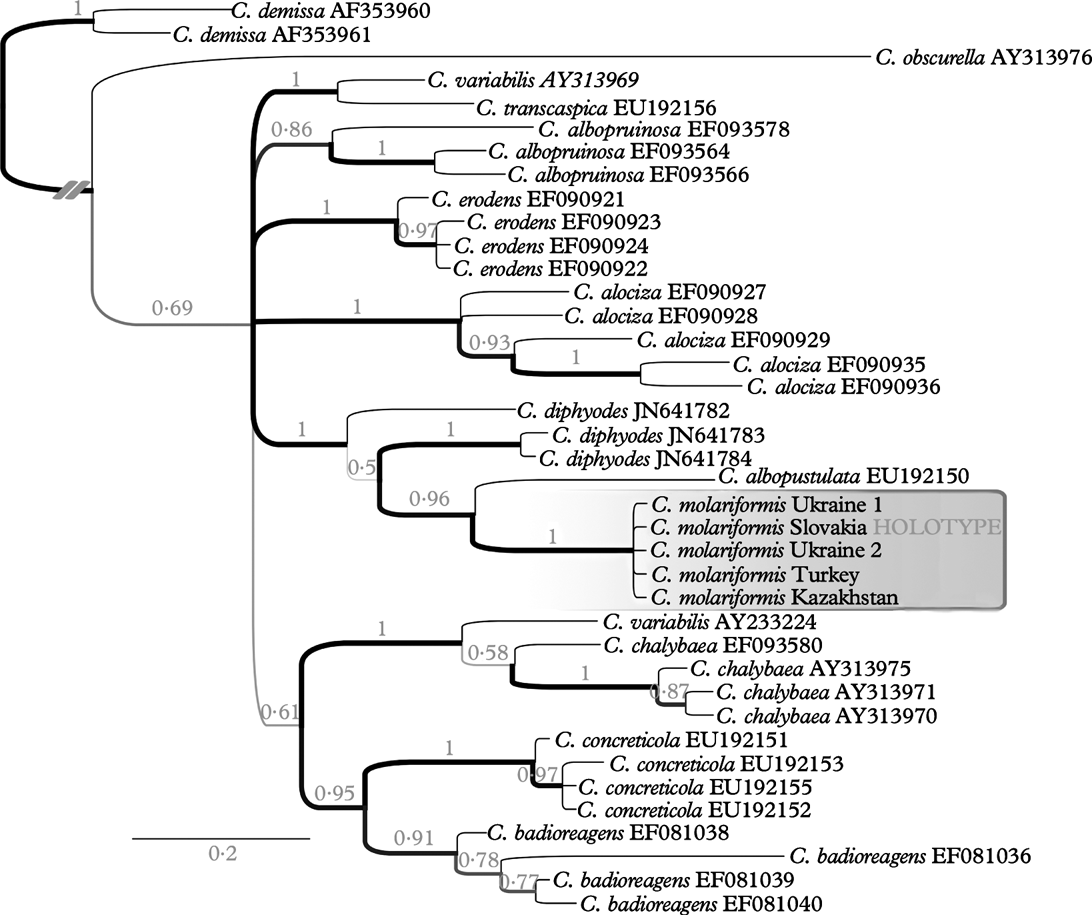
Bayesian ITS phylogeny of the Pyrenodesmia subgroup of Caloplaca, including C. molariformis clade delimited by the grey square.
Thallus epilithic, ochre, white-grey to dark grey, usually with white pruinose spots, forming irregular spots to several cm wide; of tightly arranged, angular to rounded, more or less flat areoles or somewhat umbilicate squamules, (0·44–)0·70–0·95–1·26(–2·05) mm diam. [100; 10; 0·35]. Marginal areoles sometimes bigger than areoles in the centre. Several small, tightly arranged areoles may merge to form larger units, but on the contrary, large areoles are sometimes divided into smaller subareoles due to secondary crevices. Thickness of the thallus, together with brown (probably necrotic) lower medulla (0·2–)0·6–1·2–2·2(–5·0) mm [30; 3; 1·0]; thickness of the thallus without lowermost brown part (0·1–)0·3–0·4–0·5(–0·9) mm [30; 3; 0·2]. The brown lower medulla usually distinct, up to 12·5 times thicker than the rest of the thallus. Colourless medulla also present, (50–)140–235–330(–550) µm thick [26; 3; 145]; cells hardly observable due to presence of extracellular crystals insoluble in KOH and only partly dissolved and recrystallized into needles in H2SO4. Algal cells arranged in vertical stacks, (30–)67–91–129(–250) wide [47; 6; 44], and (100–)223–263–334(–550) µm high [47; 6; 112]. Algal cells globose, (8·0–)12·6–13·7–14·5(–22·0) µm diam. [30; 3; 3·2]. Cortex above the algal stacks absent or indistinct, alveolate cortex present, up to c. 15–30 µm thick; upper fungal cells in algal stacks grey, containing Sedifolia-grey. Fungal stacks (measured with epinecral layer) (13–)45–86–120(–270) wide [46; 6; 55] and (75–)180–322–505(–750) µm high [46; 6; 165]; formed by vertically oriented palisade prosoplectenchyma; size of cells in the middle part of stacks (4·5–)9·4–11·9–13·3(–18·0)×(3·0–)3·7–4·3–4·8(6·5) µm [30; 3; 3·9 & 0·9]. In lower part of stacks, cells longer and narrower; in uppermost part, cells almost isodiametric, c. 4–7 µm diam. Epinecral layer above fungal stacks usually well-developed, (5–)20–95–200(–350) µm thick [81; 9; 72]; dead cells (colourless in cotton blue) recognizable in the lower part. Boundary between epinecral layer and upper cells of the fungal stack sometimes indistinct, but recognizable after KOH treatment as a sordid grey-violet line caused by traces of the Sedifolia-grey in uppermost fungal stack cells. Epinecral layer often forms distinct ridges on thallus surface above fungal stacks, because it is absent from surface of algal stacks (Fig. 7C). Epinecral ridges best developed in samples from deserts of Western Kazakhstan, but less distinct in samples from Slovakia and Ukraine. Fungal stacks sometimes reaching medulla at the bottom and the boundary between the stacks and medulla recognized by the crystals abundant in medulla but absent from stacks. Margins of areoles and squamules and the lower surface of squamules usually with cortex, up to c. 20 µm thick, of isodiametric cells, c. 4–7 µm diam. Vegetative diaspores are blastidia (always present) or rarely soredia; sometimes diaspores poorly developed, present only on few areoles. Blastidia simple, more or less globose, (30–)54–67–89(–150) µm diam. [52; 6; 25], dark grey, present on the margin and upper surface of areoles and squamules; detached blastidia occasionally cover the whole surface. Blastidia sometimes with appearance of consoredia, with internal soredia-like structures. Extracellular crystals soluble in KOH and Sedifolia-grey pigment present in outer fungal cells of blastidia. Soralia rarely observed, on the upper surface between epinecral ridges; soredia c. 25–40 µm diam. White pruina always present, better developed between epinecral ridges. Prothallus indistinct or absent. Thallus frequently affected by brown hyphomycetes resembling species of Intralichen.
Apothecia (0·33–)0·42–0·55–0·72(–1·32) mm diam. [100; 10; 0·15], zeorine or rarely almost lecanorine; mature apothecia sessile, usually not abundant on thallus, sometimes absent. Richly fertile populations known only from Slovakia and Ukraine. Disc brown to black, not pruinose, sometimes cracked; true exciple concolourous with the disc, occasionally white pruinose; thalline exciple concolourous with the thallus, with white pruina. Hymenium (63–)91–102–109(–175) µm high [30; 3; 23], colourless, often with very small (<1 µm) extracellular oil drops, sometimes strongly inspersed with extracellular oil drops up to c. 2 µm diam., sometimes not inspersed; without crystals. Epihymenium brown, grey or grey-brown. Hypothecium colourless, underlain by the algal layer, usually with extracellular oil drops, without extracellular crystals; with a central conical extension downward, (75–)153–174–185 (–275) µm high [30; 3; 48]; formed of thin-walled cells variable in shape. Exciple c. 10–160 µm wide. True exciple (10–)18–35–54(–93) µm wide [30; 3; 22], and thalline exciple (0–)18–24–27(–68) µm wide [30; 3; 20]. Upper part of the true exciple grey-brown, brown-grey or grey, of thin-walled cells (4·0–)6·2–6·6–7·3(–10·0)×(2·0–)3·4–4·5–5·2(–8·0) µm [100; 10; 1·1 & 1·1]. Lower part colourless, of palisade prosoplectenchyma of thin-walled cells (6·0–) 7·7–8·2–8·7(–11·5)×(2·0–)2·4–2·8–3·3(–5·0) µm [30; 3; 1·3 & 0·8]. Thalline exciple sometimes with cortex in its upper part, c. 8–20 µm thick; cortex changing into alveolate cortex in the lower part of thalline exciple. Cells of the cortex spherical, c. 3·5–7·0 µm diam., often hardly observed due to extracellular crystals insoluble in KOH. Paraphyses (1·5–)2·1–2·3–2·8(–3·5) µm wide [100; 10; 0·4] in lower part, but widening gradually to (3·0–)3·5–4·4–5·5(–6·5) µm [100; 10; 0·8] in upper part; rarely branched and anastomosed; the uppermost cell of paraphyses usually dead and deformed. Asci clavate, (40–)58–64–69(–85)×(12–)17–20–21(–28) µm [30; 3; 1 & 10]. Ascospores polarilocular, (12·0–)14·3–16·2–18·3(–23·0)×(5·0–)6·4–7·7–9·1(10·5) µm [70; 8; 2·3 & 1·3]; septa (2·0–)2·6–3·0–3·3(–4·0) µm wide [70; 8; 0·5]. Ascospore length/breadth ratio: (1·40–)1·98–2·12–2·27(–2·86) [70; 8; 0·32]; septum width/ascospore length ratio: (0·11–)0·17–0·19–0·22(–0·30) [70; 8; 0·04]. Ascospores with well-developed septa often absent.
Pycnidia rare, c. 140–190 µm wide, mainly with a single chamber, present on the upper thallus surface, but also on the lower surface of squamules; superficially hardly distinguishable. Old pycnidial chambers sometimes filled by crystals insoluble in KOH. Conidiophores of spherical or triangular, more or less isodiametric cells. Conidia narrowly to broadly ellipsoid, 2·5–4·5×1·5–2·0 µm [14; 2; 0·2 & 0·5].
Chemistry
Spot tests: thallus K± violet (sometimes not observable or observable only in spots with blastidia and soredia), apothecia K−, thallus and apothecia C−, P−, UV−. Epihymenium, uppermost true exciple, uppermost fungal cells in thallus and vegetative diaspores contain Sedifolia-grey (grey or invisible in water, K+ sordid violet). The reaction above fungal stacks usually weaker than above algal stacks. Strongest reaction in superficial hyphae of vegetative diaspores. True exciple non-amyloid (I−); hymenium and hypothecium amyloid (I+). No substances revealed by HPLC (apothecia and thallus of an isotype were investigated).
Etymology
Areoles and squamules of the lichen thallus often resemble molars of herbivores.
Similar taxa
The thallus anatomy, with tissues in stacks, is very rare within the Pyrenodesmia subgroup of Caloplaca. It is present in one known species only, Caloplaca albovariegata (B. de Lesd.) Wetmore, which is very similar to C. molariformis but has no vegetative diaspores (Wetmore Reference Wetmore1994; lectotype in UPS seen). This species was described from North America, but similar morphotypes are known in continental Eurasia (our observations). Zhou et al. (Reference Zhou, Zhao, Lü, Tong, Ma and Wang2012) reported a taxon with tissues in stacks from China and named it C. albovariegata, but it has a thallus surface without ridges derived from the epinecral layer and it does not resemble C. molariformis. Other similar taxa are Caloplaca albopustulata Khodos. & S.Y. Kondr. (with pustules and schisidia), C. bullata (Müll. Arg.) Zahlbr. (bullate thallus without vegetative diaspores), C. concreticola (with soralia) and C. transcaspica (Nyl.) Zahlbr. (without vegetative diaspores), but all these taxa have thallus tissues arranged in horizontal layers, not in stacks. They also do not have specific ridges derived from the epinecral layer. (Type specimens and other comparative material studied by the authors.)
Phylogeny
In the ITS phylogeny (Fig. 5), Caloplaca molariformis is placed in the C. variabilis group, closely related to C. albopustulata.
Distribution and ecology
Caloplaca molariformis is mainly distributed in steppes and deserts of Iran, Kazakhstan, continental Turkey and southern Russia, at altitudes of 50–2100 m. Two isolated localities are also known from the steppe or forest-steppe, in eastern Ukraine and southern Slovakia. The species occurs in sunny habitats on soft limestone, chalk, calcareous sandstone or tuffs with evident content of lime (always reacting with HCl). Co-occurring lichen taxa include Acarospora spp., Aspicilia spp., Caloplaca concreticola, C. crenulatella s. lat., C. decipiens, C. flavocitrina, C. soralifera, C. sororicida, C. teicholyta, C. tominii, C. transcaspica s. lat., C. xerica, Candelariella aurella, Lecanora muralis s. lat., Lemmopsis arnoldiana, Lichinella sp., Verrucariaceae spp. (e.g. Staurothele frustulenta, Verrucaria macrostoma, V. nigrescens agg.).
Paratypes. Iran: West Azerbaijan: Lake Urmia, rocks at road c. 2 km N of Saraydeh, 37°52′59″N, 45°34′26″E, 1280 m, 2007, J. Vondrák 5556 (CBFS); Khoy, airport, 38°25′16·17″N, 44°54′24·05″E, 1180 m, 2007, J. Vondrák 5801 (CBFS); Lake Urmia, rocky outcrops near coast N of Aq Gonbad, 37°49′12·02″N, 45°25′09·61″E, c. 1290 m, 2007, J. Vondrák 5846 (CBFS).—Kazakhstan: Mangistau province: Mangistau district, village Shetpe, West Karatau ridge, c. 15 km N of village, 44°14′35″N, 52°03′19″E, 100 m, 2009, A. Khodosovtsev 7775–7781 & J. Vondrák 8262, 8247, 9477 & 9487 (CBFS, KHER); Beyneu district, village Beyneu, c. 50 km SW of town at road to Aktau, valley of salt river Manashi, 45°01′26″N, 54°59′56″E, 50 m, 2009, A. Khodosovtsev & J. Vondrák 9483 (CBFS); Mangistau district, West Aktau ridge, soft valley with rocky outcrops at river Akespe, 44°24′21″N, 51°35′59″E, 100 m, 2009, A. Khodosovtsev & J. Vondrák 9486 (CBFS); Mangistau district, at road between village Shetpe and Say-Utes, c. 30 km SW of Say-Utes, 44°09′20″N, 52°39′10″E, 260 m, 2009, A. Khodosovtsev & J. Vondrák 9506 (CBFS); Mangistau district, East Karatau ridge, rocks at road between Zhatybay and Shetpe, c. 30 km SW of Shetpe, 43°57′00″N, 52°05′52″E, 180 m, 2009, A. Khodosovtsev & J. Vondrák 9499 (CBFS).—Russia: Orenburgskaya Oblast': Orenburg, village Mikhaylovka (c. 30 km SES of city), Khanskaya gora hill, S of village, above brook Berd'yanka, 51°25′48″N, 55°26′27″E, c. 200 m, 2011, I. Frolov & J. Vondrák 9456 (CBFS); Saraktash district, protected area Kamennaya, rock outcrops in S-slope above river Sakmara, 51°56′53″N, 55°58′23″E, 180 m, 2012, I. Frolov & J. Vondrák 10225 (CBFS). Republic of Altay: Kosh-Agach district, Kosh-Agach, Telengit-Sortogoy, S-slopes of Kuray Ridge (easternmost part), c. 6 km N of village, 50°04′24″N, 88°42′30″E, 2000–2100 m, 2012, I. Frolov & J. Vondrák 10224 (CBFS).—Slovakia: Cerová vrchovina upland: Filakovo, Hajnáčka, Šurice, SW-foot of hill Soví hrad, 48°13′34″N, 19°54′45″E, 240–250 m, 2012, Z. Fakovcová, A. Guttová, J. Liška, Z. Palice 15905 & J. Vondrák 10190 (CBFS, PRA; topotypes).—Turkey: Eastern Anatolia: Iğdır, shale hills SE of town, 39°51′23″N, 44°05′42″E, 1060 m, 2007, J. Vondrák 6463 (CBFS). Central Anatolia: Yozgat, Boğazlıyan, Özler village, 39°04′10″N, 35°08′17″E, 1100 m, 2012, J. Vondrák 9751 (CBFS); Kayseri, Talas, Derevenk valley, 38°41′23″N, 35°34′52″E, 1230 m, 2012, J. Vondrák 9760, 9809 & 9787 (CBFS); Kayseri, south-east of Himmetdede, north-west of Kalkancık village, montane steppe with shrubs, 38°53′43″N, 35°07′01″E, 1170 m, 2012, J. Vondrák 9791 (CBFS).—Ukraine: Donetsk Upland: Luhansk region, Lutugyno district, steppe slopes with marl outcrops near village Rozkishne, in botanical reserve “Balka Ploska”, c. 150 m, 2007, O. Nadyeina 131, 132 & 134 (KW). [Specimens from Ukraine were published as Caloplaca concreticola in Nadyeina (Reference Nadyeina2009)].
Caloplaca substerilis Vondrák, Palice & van den Boom sp. nov.
MycoBank No: MB 803334
Similar to Caloplaca ulcerosa, but differs in thallus morphology. Thallus endophloeodal, but also forming minute areoles or squamules; sorediate; without any pigments or TLC identifiable compounds. Apothecia up to c. 0·5 mm diam., orange-red, not pruinose, without chlorinated anthraquinones, biatorine to zeorine. Ascospores broadly ellipsoid, c. 10–15 µm long, with septa c. 4–6 µm wide. Pycnidia with yellow caps containing anthraquinones. Conidia bacilliform, c. 3–4×1·0–1·5 µm.
Type: Czech Republic, Southern Bohemia, Novohradské hory Mts, Benešov nad Černou, Žofín, alt. 745 m, 48°40′29″N, 14°41′38″E, on bark of solitary Ulmus glabra, 26 May 2010, J. Vondrák 7920, A. Vondráková & O. Redchenko (CBFS—holotype). ITS sequence of the holotype: KC416109.
More images available on the lichenological web page at the University of South Bohemia http://botanika.bf.jcu.cz/lichenology/index.php?pg=5.
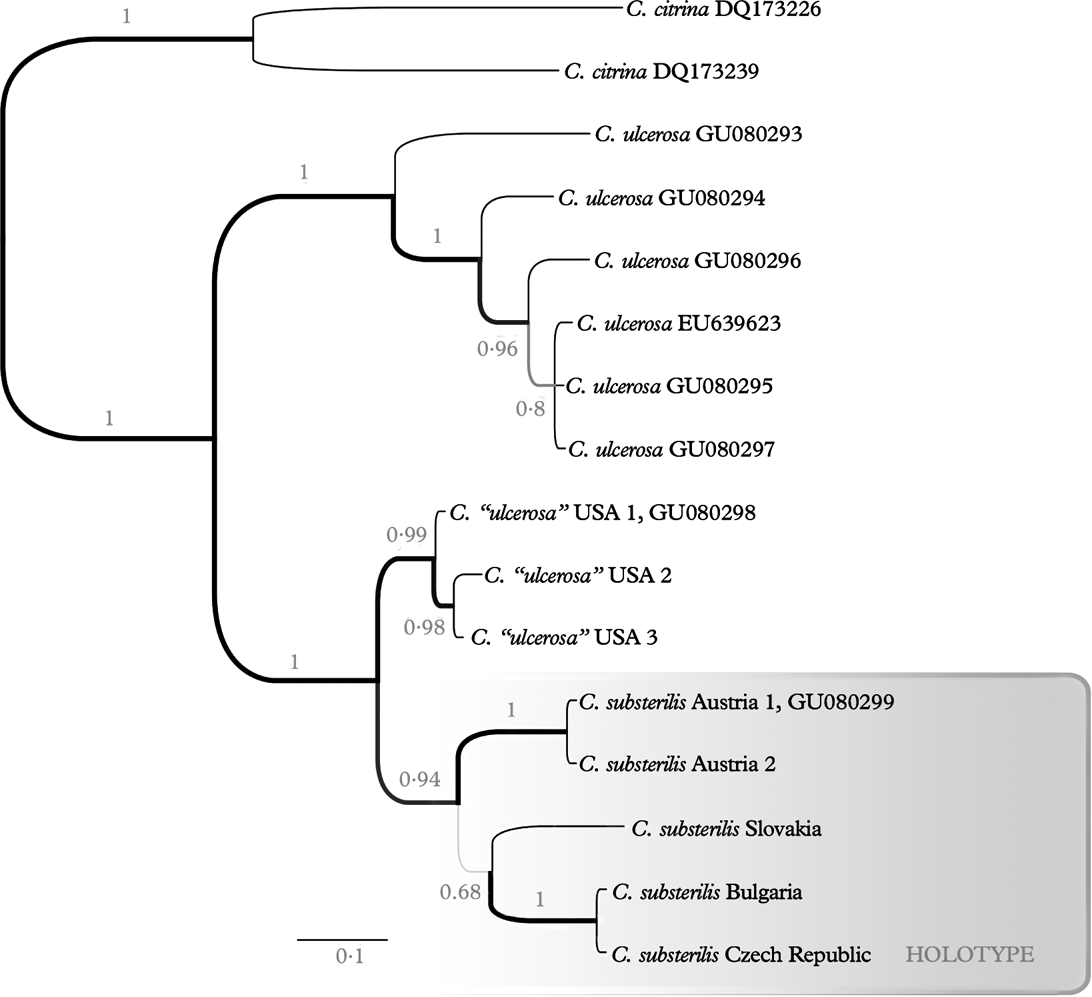
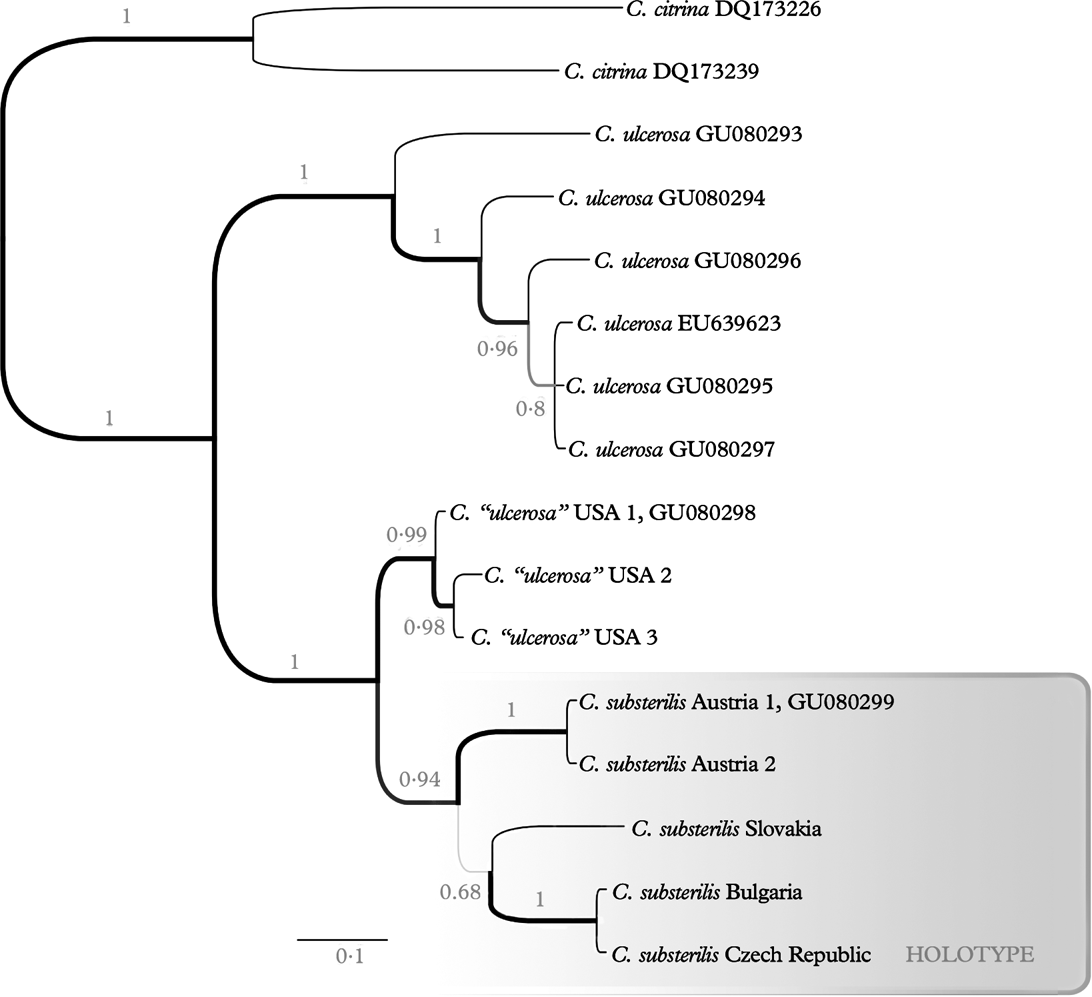
Bayesian ITS phylogeny of Caloplaca ulcerosa and related taxa including C. substerilis (delimited by the grey square).
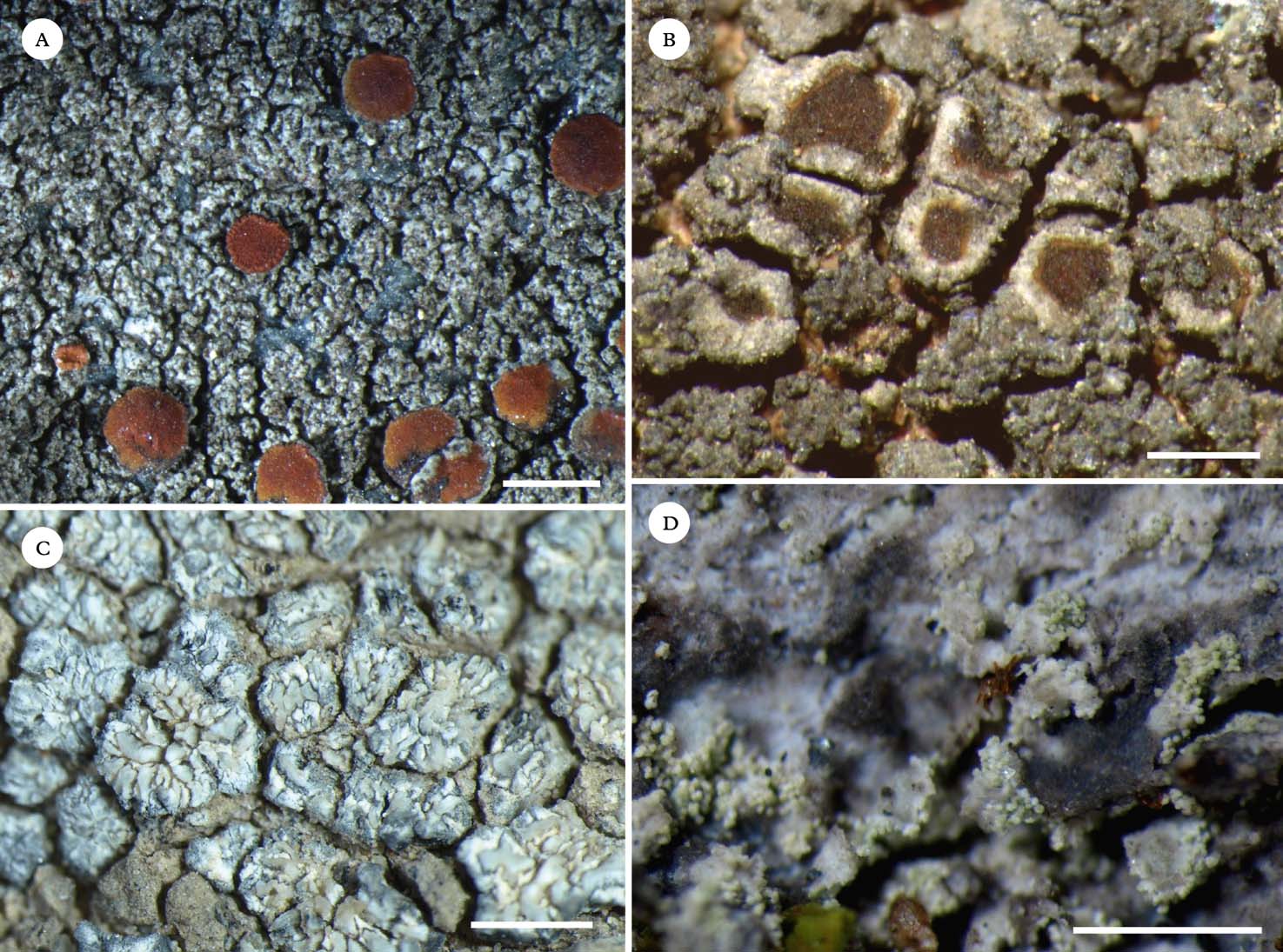
A, Caloplaca scabrosa (CBFS JV1908); B, C. emilii (holotypus); C, C. molariformis, morphotype with well-developed epinecral ridges above fungal stacks (CBFS JV9486); D, C. substerilis (CBFS JV7920, holotypus). Scales: A & C=1 mm; B & D=0·5 mm.
Thallus endophloeodal or partly of diffuse tiny squamules (somewhat epiphloedal areolate thallus present in samples from the Alps); sorediate; forming irregular pale grey to white spots or extensive crusts, covering large areas of trunks. Squamules 100–150 µm thick and (0·10–)0·17–0·18–0·19(–0·30) mm diam. [30; 3; 0·05]. Soralia small, usually extended in one direction (rarely rounded), usually up to 0·2 mm in length, formed in tiny cracks in the tree bark or on margins and lower surface of squamules, usually not in concave, crater-like depressions (typical for Caloplaca ulcerosa Coppins & P. James); soralia in older lichens often tightly arranged and may resemble a continuous sorediate crust. Soredia without pigmentation, (15–)23–24–26(–30) µm diam. [40; 4; 4]; consoredia (30–)37–41–46(–65) µm diam. [40; 4; 8]. Fungal cells in soredia or consoredia (3·5–)5·4–5·5–5·7(–7·5)×(2·0–)3·2–3·3–3·4(–4·5) [20; 2; 1·1 & 0·8]. Surface of soredia papillate; papillae formed of fungal cell outgrowths, up to 7 µm high. Medulla indistinct or absent. Algal layer forms majority of thallus, c. 100–140 µm thick; algal cells globose, c. 5–20 µm diam.; old cells often internally divided into several irregularly spherical autospores (cell division typical for Trebouxia; e.g. Peksa & Škaloud Reference Peksa and Škaloud2008). True cortex absent; alveolate cortex developed in patches, up to 20 µm thick, of thin-walled, more or less spherical cells. Epinecral layer indistinct. Thallus surface papillate; papillae of the same size and character as those in soredia. Extracellular crystals of calcium salts not observed in any thallus part. Pruina absent. Prothallus indistinct or absent.
Apothecia present in c. 20% of samples collected (indicated by asterisk in the list of paratypes), but fertile specimens usually with scattered apothecia. The sample from the Alps (van den Boom 15927) with many apothecia is exceptional. Apothecia mostly up to 0·5 mm diam.; biatorine or zeorine. Disc orange to orange-red; true exciple yellow-orange to orange (usually somewhat paler than disc); thalline exciple (when visible) yellow to white; pruina absent or indistinct. Hymenium colourless, somewhat gelatinous, without extracellular oil drops, c. 60–70 µm high; epihymenium ochre. Hypothecium colourless, up to 100 µm high, more or less flat, but with downward extension through the subhypothecial algal layer in the centre, of thin-walled cells variable in shape; extracellular oil drops not seen. Exciple c. 40–80 µm wide, formed of true exciple, c. 30–70 µm wide, and thalline exciple, c. 0–30 µm wide. Upper part of true exciple of cells c. 4–8×3–5 µm, with thin or more than 1 µm thick, glutinized walls. Lower part of palisade prosoplectenchyma of thin-walled cells, 6–11×2–4 µm. Thalline exciple sometimes with alveolate cortex in lower part, up to 30 µm thick, of spherical cells; thalline exciple sometimes sorediate. Paraphyses 1·5–2·0 µm wide in lower part, but about three upper cells widened; branching and anastomosing not observed; paraphyses tips (3·5–) 4·6–4·6–4·6(–5·5) µm [20; 2; 0·7] wide. Asci clavate, c. 50–60×10–16 µm. Ascospores polarilocular, (10·0–)12·0–12·0–12·5(–16·5)×(5·0–)7·5–8·0–8·0(–10·5) µm [20; 2; 1·4 & 1·3], septa (4·0–)4·5–5·0–5·5(–8·5) µm wide [20; 2; 1·3]. Ascospore length/breadth ratio: (1·2–)1·6–1·6–1·7(–2·2) [20; 2; 0·3]; septum width/ascospore length ratio: (0·26–)0·34–0·40–0·42(–0·52) [20; 2; 0·1]. Extracellular crystals of calcium salts absent from all apothecial parts.
Pycnidia more common than apothecia (observed in c. 50% of samples), c. 50–100 µm wide, with several partly separated chambers (Xanthoria-type), distinguished by their yellow tops containing anthraquinones. Conidiophores various in height, formed of rectangular, triangular or spherical cells, c. 3–5×4–8 µm. Conidia usually bacilliform, straight or slightly curved, rarely ellipsoid or tear-shaped, (2·5–)3·2–3·4–3·5(–5·0)×(1·0–) 1·2–1·2–1·3(–1·5) µm [20; 2; 0·7 & 0·2].
Chemistry
Spot tests: thallus K−, C−, P−, UV± white; apothecia K+ purple, C−, UV−. True exciple non-amyloid (I−). Hymenium and the upper part of hypothecium (subhymenium) amyloid (I+). The C− reaction of epihymenium and outer cells in the true exciple suggests an absence of chlorinated anthraquinones. No compounds revealed from thallus by TLC.
Etymology
‘Substerilis’ reflects the usually sterile occurrence.
Similar taxa
Apothecial characters in the new species are identical to those of the closely related Caloplaca ulcerosa, but they differ in thallus characters. In C. substerilis, the thallus is endophloeodal or of diffuse minute squamules, with marginal soralia, while Caloplaca ulcerosa forms an epiphloedal non-squamulose thallus with round to irregular soralia formed in crater-like depressions. The latter species further differs in its shorter, ellipsoid conidia (c. 2·5–3·0×1·5 µm), much higher fertility and in ecology; it is a maritime species (Vondrák et al. Reference Vondrák, Šoun, Arup, Aptroot and Redchenko2009b ).
White morphotypes of C. phlogina (Ach.) Flagey are similar (see Kondratyuk et al. Reference Kondratyuk, Søchting, Khodosovtsev and Kärnefelt1998; Vondrák et al. Reference Vondrák, Šoun, Sogaard, Søchting and Arup2010b ); they also have papillate soredia of similar size without pigmentation, yellow pycnidial caps and an endophloedal thallus, sometimes with minute white squamules. However, C. phlogina differs in frequently having apothecia: these are large (mostly >0·5 mm diameter), yellow-orange, with a rough surface caused by yellow anthraquinone pruina. Ascospores are significantly smaller with thinner septa: ascospores (8·5–)10·5–10·8–11·2(–13·0)×(4·0–)5·0–5·4–5·7(–7·0) µm [30; 3; 1·0 & 0·7], and septa (2·5–)3·1–3·6–3·8(–4·5) µm wide [30; 3; 0·6].
Sterile thalli may resemble a number of taxa, including: Caloplaca obscurella (J. Lahm) Th. Fr. (with rounded crater-like soralia, brown apothecia), C. sterilis Šoun et al. (on steppe shrubs, with lecanorine apothecia), C. subalpina Vondrák et al. (saxicolous, with lecanorine apothecia and Sedifolia-grey in soredia), Candelariella subdeflexa (Nyl.) Lettau (with different apothecia and more conspicuous squamules producing conidia from the underside) and Rinodina degeliana Coppins (areolate-squamulose thallus with marginal soralia; presence of atranorin and zeorin).
Phylogeny
In the ITS phylogeny (Fig. 6), Caloplaca substerilis forms a well-supported clade, sister to the clade of North American C. “ulcerosa”. Both taxa are sister to the European C. ulcerosa. Close relatives of these three taxa are not known.
Ecology and distribution
Caloplaca substerilis occurs on nutrient-rich bark of Acer campestris, A. platanoides, Carpinus, Juglans, Quercus, Populus and Ulmus in well-lit conditions, sometimes overgrowing mosses on bark. Specimens from the Alps were collected on the bark of Sambucus and on Picea abies twigs. Co-occurring lichens are more or less nitrophilous Caloplaca cerinelloides, C. monacensis, C. obscurella, Lecanora hagenii, Macentina dictyospora, Phaeophyscia nigricans, P. orbicularis, Physcia spp., Physconia sp., Piccolia ochrophora, Rinodina pityrea, Xanthomendoza fulva and Xanthoria parietina.
Caloplaca substerilis shows continental bias in Europe. It appears to be quite common in the Southern Ural Mountains (most of known localities). It is probably distributed throughout eastern and central Europe in suitable woodland areas with preserved undisturbed solitary elm and poplar trees. So far it is known from Austria, Bulgaria, the Czech Republic, Russia and Slovakia.
Taxonomic notes
The North American taxon called Caloplaca ulcerosa (Wetmore Reference Wetmore2004) is morphologically more similar to C. substerilis than to C. ulcerosa s. str. We have examined three samples of the North American taxon (GZU: Iowa, Teloschistaceae Exsiccati 95; Iowa, Wetmore 93230; South Dakota, Advaita 6490), and did not find any diagnostic difference from C. substerilis. It corresponds well with the ITS phylogeny, where both taxa form a monophyletic group. The distribution of the North American taxon (Wetmore Reference Wetmore2009) and the distribution of C. substerilis are similarly continental and different from the maritime distribution pattern of C. ulcerosa s. str. (Vondrák et al. Reference Vondrák, Šoun, Arup, Aptroot and Redchenko2009b ). Provisionally, we call the North American specimens C. “ulcerosa” in Fig. 6.
Two ITS sequences of C. substerilis from the Alps form a separate lineage from the other C. substerilis sequences. The specimens from the Alps also differ slightly in morphology (frequent apothecia, more or less epiphloeodal thallus and absence of minute squamules) and ecology. While most samples were collected from solitary elms, poplars and oak, specimens from the Alps came from Sambucus bark and spruce twigs. This suggests that the populations from the Alps might represent a distinct infraspecific taxon.
Paratypes (fertile specimens indicated by asterisk). Austria: Steiermark: Schladming, Ramsau am Dachstein, in gorge with road from Ramsau to Weissenbach, c. 850 m, 2009, J. Vondrák 7257 (CBFS). * Kärnten: Gailtaler Alpen, 10 km WNW of Weissbriach, 0·5 km SE of Felstritz, open pine forest, 550 m, 1994, P. van den Boom 15927 (hb. van den Boom).—Bulgaria: The Rhodopes: Madzharovo district, Silen, Rabovo, valley of small brook N of village, 41°37′N, 25°40′E, 250 m, 2004, J. Vondrák (CBFS, in sample “Caloplaca virescens, Exs. of Caloplaca, Nr 11”).—Czech Republic: Southern Bohemia: Novohradské hory Mts, Benešov nad Černou, Žofín, 48°40′29″N, 14°41′38″E, 745 m, 2009, 2010, Z. Palice 12943 & 13676 (PRA, topotypes); Šumava Mts, Borová Lada, Knížecí Pláně, avenue of old trees along yellow-marked tourist footpath near abandoned cemetery, 48°57·61′N, 013°37·19′E, 1000–1020 m, 2005, Z. Palice 8928 (PRA); distr. Jindřichův Hradec, Novobystřická vrchovina, W slope of crest Homolka–Fabián– “Lesovna v Dubovici”, 49°02′N, 14°58′50″E, 540 m, 2002, M. Kukwa & Z. Palice 6844 (PRA). Western Bohemia: Šumava Mts, Zhůří, valley of Pěnivý potok brook, nearby the settlement Bílý Potok, 49°06·3′N, 13°34·1′E, 770 m, 2005, Z. Palice 9414 & J. Palicová (PRA). Southern Moravia: Mikulov, Klentnice, protected area Soutěska, 48°51′48″N, 16°38′40″E, 400 m, 2013, J. Vondrák 10668, 10669, I. Frolov & N. Pirogov (CBFS).—Russia: Chelyabinskaya Oblast': Southern Ural Mts, Ust'-Katav, vill. Orlovka (c. 10 km SW of Ust'-Katav), fragments of forest with Ulmus laevis-Ulmus glabra in valley of small brook c. 2 km SE of village, 54°52′04″N, 58°06′36″E, 500 m, 2012, J. Vondrák 9963 (CBFS). Orenburgskaya Oblast': Kuvandik, vill. Maloe Churaevo (25 km N of Kuvandik), camp c. 2 km W of village, steppes and Quercus robur-Tilia cordata-Ulmus laevis woodland areas around camp, 51°40′9″N, 57°27′14″E, 250–500 m, 2011, J. Vondrák 9957, 9968 & 9970 (CBFS); *Saraktash, vill. Andreevka (c. 25 km NE of Saraktash), alluvial forest with Tilia cordata, Populus sp. and Ulmus laevis, c. 8 km NW of village, in valley of river Bolshoy Ik, 52°00′29″N, 56°33′39″E, 150 m, 2012, J. Vondrák 9967 (CBFS). * Republic of Bashkortostan: Irendik range, Sibay, vill. Gabelsha (c. 15 km W of Sibay), waterfall Gadelsha in upper stream of brook Khudolaz, 52°45′26″N, 58°22′34″E, 500–800 m, 2011, J. Vondrák 9361 (CBFS).—Slovakia: West Carpathians: Muránská planina Mts, Mt Cigánka, well-lit oak forest on limestone on S slope, 48°45′18″N, 20°03′22″E, 800 m, 2010, J. Halda & Z. Palice 13441 (PRA).
Linda in Arcadia kindly revised the English and proposed the Latin name molariformis. David Svoboda provided some translations from French. Our research was supported by the program NAKI of the Ministry of Culture of the Czech Republic (DF12P01OVV025), by long-term research development project no. RVO 67985939, by the Centre for Algal Biotechnology Třeboň – ALGATECH (CZ. 1.05/21.00/03.0110), by the institutional resources of the Ministry of Education, Youth and Sports of the Czech Republic and by TÜBİTAK (111T927 coded project).