I have sworn to work toward my client’s interests. I am neither a sociologist nor a politician … how should I prioritize society’s interests when my client is exhausted and can’t fight anymore?
—Sheyda, a woman family lawyer in Tehran
Research on gender inequality in Iran typically highlights the role of the state and its apparatuses, such as the judiciary, in constructing, maintaining, and reinforcing gender hierarchies post-1979 (Moghadam Reference Moghadam2004; Kar Reference Kar2007; Farzaneh Reference Farzaneh2014; Alikarami Reference Alikarami2019). It also examines the efforts of the women’s rights movement in Iran to dismantle what is referred to as “gender apartheid” (Hoodfar and Sadeghi Reference Hoodfar and Sadeghi2009; Sameh Reference Sameh2019; Tohidi Reference Tohidi2016; Mahmoudi Reference Mahmoudi2019). However, a deeper understanding of how gender inequality has been maintained and challenged emerges when gender is considered a pervasive structure that permeates individual, interactional, and institutional levels (Risman Reference Risman2004). This perspective not only recognizes the state’s influence in constructing and perpetuating systemic gender-based discrimination and notes the counter-efforts of women’s rights advocates, but it also urges exploration into the more subtle ways that gender inequality is continuously upheld, contested, and potentially transformed at different levels. This broader understanding of gender dynamics raises questions about the role of lawyers, as the primary legal actors who engage with individuals during the initial phases of disputes, in both challenging and reinforcing gender inequality.
In her candid reflection on her professional responsibility, Sheyda highlights the narrow scope with which many lawyers view their role, raising important questions about whether and how ordinary lawyers challenge legally sanctioned gender inequality through everyday legal practice. While Sheyda emphasizes the limited scope with which many lawyers view their role, her perspective contrasts with that of lawyers who “amplify” their clients’ voices and develop long-term strategies to challenge dominant ideologies, advance a greater “cause,” and promote social reform (Sarat and Scheingold Reference Sarat and Scheingold1998, Reference Sarat and Scheingold2001, Reference Sarat and Scheingold2005). However, in authoritarian contexts, repressive legal and political structures hinder lawyers’ ability to mount overt challenges, driving them to employ a range of strategies to oppose and resist arbitrary state power, unfair laws, and policies (Chua Reference Chua2019). As a result, when pursuing rights-based claims in court proves ineffective, litigation is de-emphasized, and legal actors instead employ alternative strategies such as public outreach and consciousness-raising (Chua Reference Chua2018). Unfavorable constraints also compel lawyers to develop less visible strategies and incorporate resistance into everyday practice (Liu and Halliday Reference Liu and Halliday2011; Nesossi Reference Nesossi2018; Stern Reference Stern2017; Batesmith and Stevens Reference Batesmith and Stevens2019). While much of the scholarship on legal professions in authoritarian regimes focuses on cause lawyers, analyzing their strategies and the barriers they face in pursuing social and legal reform, there is comparatively limited research on non-cause lawyers in these settings, particularly within civil law systems, and how they navigate discriminatory laws in their everyday legal practice. Since non-cause lawyers represent the majority in all jurisdictions, understanding their role in addressing codified inequality is crucial. It is, therefore, essential to ask:
Q1. How do non-cause lawyers, who do not actively seek to challenge the status quo, address inequality in their everyday practice?
Q1a. What factors inform their approaches?
Q1b. Do all lawyers perceive it as their responsibility to confront the inequalities embedded in the law in their everyday practice?
This study takes up these questions by examining the practices of family lawyers in handling some of the most demanding cases in Iran’s family courts—divorce cases initiated by women. Article 1130 of the Civil Code of the Islamic Republic of Iran (1982) grants women the right to initiate a divorce proceeding under certain conditions and potentially be granted a divorce if they can prove that the continuation of the marriage causes them “suffering and hardship.” While the law does provide some examples of such circumstances, the list is not exhaustive,Footnote 1 which leaves room for interpretation and contestation in practice.
Family law in Iran is subtly yet significantly shaped by broader political forces. The immediate repeal of the family law by the revolutionary state following the 1979 revolution highlights how family law is deeply intertwined with Islamic law, political ideology, and gender norms in Iran. Within this context, examining the role of family lawyers in divorce cases becomes especially important, as gender is often the decisive factor determining their outcome. Divorce cases also exemplify “extreme” instances of gender inequality not only because of their frequency, which can paradoxically obscure their analytical value, but also because they sit at the intersection of law, gender, and religious ideologies. These cases are routinely discussed, disputed, and litigated in ways that expose how gender is constructed, reinforced, and contested not only through interactions between spouses but also through broader engagements with lawyers, judges, court staff, and the legal system as a whole. This is also where the judiciary’s institutional position matters. Although the judiciary is formally a separate branch,Footnote 2 it “is designed as a political institution that is responsible not only for the administration of justice but also for the implementation of the ideological/political line advocated by the Supreme Leader” (Shambayati Reference Shambayati, Ginsburg and Moustafa2008, 301). So even though the judiciary does not make laws, it can still shape how the law operates in practice through memos, administrative rules, and similar directives.
Much of the existing scholarship, however, focuses on human rights lawyers in Iran, whose dedication to defending politically charged cases has made them prominent actors in struggles over rights. Their commitment to confronting gender inequality is most visible in high-profile legal battles with public dimensions, such as cases that criminalize women’s civil disobedience to compulsory hijab laws or penalize their participation in civil society. Yet divorce cases, while lacking such public visibility, are nonetheless deeply shaped by the gender politics of the state. This context raises the question of whether ordinary lawyers who handle these cases assume a comparable role in confronting gender inequality. Examining these sites is even more critical in light of the ongoing Woman, Life, Freedom movement,Footnote 3 as it is imperative to understand the roles played by legal actors in perpetuating and/or disrupting systemic gender discrimination.
This article begins with a review of the literature on legal mobilization under authoritarian regimes. It then outlines the methodology used, setting the stage for the findings. In the analysis, I present a typology of non-cause lawyers, contrasting outcome-oriented lawyers with those who favor a transformative approach. This typology helps explain how professional responsibility is perceived, talked about, and acted upon within the legal profession in an understudied context. Furthermore, it categorizes lawyers based on their perceptions of barriers to legal mobilization, which helps explain their engagement with or detachment from activities aimed at reshaping discriminatory laws and practices. Building on these findings, I argue that the majority of family lawyers act as agents of the status quo, inadvertently perpetuating gender inequality while believing they are fulfilling their professional responsibilities. These lawyers do not view themselves as equipped to challenge the legally sanctioned gender discrimination that is sustained by the judiciary, a major apparatus of the gender apartheid state. To fully understand this pattern, however, we must consider the broader context in which these professional norms have developed.
Lawyers and Legal Mobilization Under Authoritarianism
When political avenues are inadequate, ineffective, or unavailable, advocates for social change sometimes turn to legal mobilization. Legal mobilization refers to the use of rights-based claims through various formal, informal, and quasi-formal mechanisms, including litigation, legal education, and legal framing, among others (Chua Reference Chua2019). Through this process, advocates seek not only to achieve social and legal reforms but also to ensure the proper interpretation and full implementation of laws, identify gaps in existing laws, and raise public awareness (Sarat and Scheingold Reference Sarat and Scheingold1998; Tam Reference Tam2012; Van der Vet Reference Van der Vet2018; Chua Reference Chua2018; Kazun and Yakovlev Reference Kazun and Yakovlev2019; Lehoucq Reference Lehoucq2021). Scholars further show that advocates’ tendency to use the law as a means of resistance is informed by factors such as the organizational resources of social movements (Epp Reference Epp1998), legal opportunity structures (Hilson Reference Hilson2002; Andersen Reference Andersen2006; De Fazio Reference De Fazio2012; Fuchs Reference Fuchs2013), and political context (Rajah Reference Rajah2012; Tam Reference Tam2012; Chua Reference Chua2012, Reference Chua2015).
Building on this literature, a growing body of research examines legal mobilization in authoritarian regimes. When law and courts serve the interests of the state and are used to subvert rights and sustain authoritarianism, lawyers adopt varied forms of activism to navigate these constraints (Liu and Halliday Reference Liu and Halliday2016; Rajah Reference Rajah2012; Chua Reference Chua2019). Although rights-claiming is often risky and rarely results in courtroom victories, some lawyers persist in advocacy by developing strategies that minimize retaliation while pushing back against authoritarian control (Givens Reference Givens2011; Babakhani Reference Babakhani2026). In some contexts, lawyers adapt to structural limitations, fear of retaliation, and limited resources by de-emphasizing courtroom litigation and turning to other strategies, such as public outreach, consciousness-raising, or even boycotting legal proceedings (Chua Reference Chua2018; Van der Vet Reference Van der Vet2018; McEvoy and Bryson Reference McEvoy and Bryson2022). These strategic decisions are not shaped by the political environment alone; they are also informed by a range of interconnected factors, including lawyers’ perceptions of professional responsibility, their views of the legal system, their relationships with clients, their motivations, and their goals (Abel Reference Abel1995; Michelson Reference Michelson2006; McEvoy Reference McEvoy2011; Li Reference Li2016), and the kind of legal education they received (Hickle Reference Hickle2022).
Despite these findings, research on the everyday practices of non-cause lawyers in authoritarian regimes remains limited. Much of the existing work has focused on the everyday practices of criminal defense lawyers handling cases shaped by both procedural and substantive inequality. This body of work shows that, in such settings, lawyers may develop less visible strategies in their everyday practice, ranging from subtle resistance to arbitrary state power and unjust laws to efforts to adapt and survive within a hostile legal environment (Liu and Halliday Reference Liu and Halliday2011; Nesossi 2015; Stern Reference Stern2017; Batesmith and Stevens Reference Batesmith and Stevens2019; Pangaribuan Reference Pangaribuan2024). For example, Batesmith and Stevens (Reference Batesmith and Stevens2019) examine the everyday practice of “ordinary” lawyers in Myanmar, a hybrid regime where the rule of law is absent. By investigating how criminal defense lawyers negotiate the lack of rule of law and devise legal strategies to preserve and enhance their clients’ dignity, the study sheds light on an aspect of lawyering that is often overlooked in the literature: “everyday lawyering.”
Much of the existing research on lawyers in authoritarian regimes has focused on those who “seek a more just world” through “lawyering for the good”Footnote 4 (Menkel-Meadow Reference Menkel-Meadow1997, 37). By contrast, the approaches of lawyers who do not explicitly identify with cause lawyering remain underexamined. In particular, far less attention has been paid to the everyday practices of lawyers working on routine cases in which state ideologies shape legal norms and outcomes in ways that appear apolitical but, in practice, help sustain systemic inequality. This matters because not all ordinary lawyers whose clients face discrimination actively oppose systemic injustice and inequality in their everyday practice (Kisilowski Reference Kisilowski2015). Dominant and traditional models of legal professionalism position lawyers as “paid technicians” for whom the professional is not political (Sarat and Scheingold Reference Sarat and Scheingold2005; McEvoy Reference McEvoy2011, 354), an orientation reinforced through professional socialization and consequential when routine legal work intersects with systemic inequality. This study addresses this gap by exploring whether and how non-cause lawyers working on routine, seemingly apolitical cases in authoritarian regimes respond to systemic injustice embedded in both law and practice.
Methodology
Gender plays a pivotal role in shaping the Islamic Republic’s national and international identity (Hoodfar and Sadeghi 2009). Thus, any critical discourse that challenges the state’s perspective on gender is seen as a direct challenge to the state’s authority. The state not only politicizes women’s rights and gender equality but also treats academic research that deviates from its ideological framework as a national security threat, often labeling researchers with foreign ties as spies (Rezai-Rashti Reference Rezai-Rashti2013; Rivetti and Saeidi Reference Rivetti and Saeidi2018).Footnote 5 In light of this context, I designed and conducted a qualitative study to explore how Iranian lawyers’ strategies in divorce cases initiated by women may reinforce and/or undermine not only gender ideologies but also specific gendered laws and practices.Footnote 6
Population and sample
To recruit lawyers, I began with a convenience sample of Iranian lawyers within my personal networkFootnote 7 and expanded it through snowball sampling to reach additional participants. I asked participating lawyers to share the study flyer with their colleagues. The choice of snowball sampling was justified by the high level of skepticism toward external researchers and the remote nature of the research site. Despite its inherent bias, snowball sampling is an essential method for “understanding hidden [and hard-to-reach] populations and their circumstances” (Faugier and Sargeant Reference Faugier and Sargeant1997, 796).
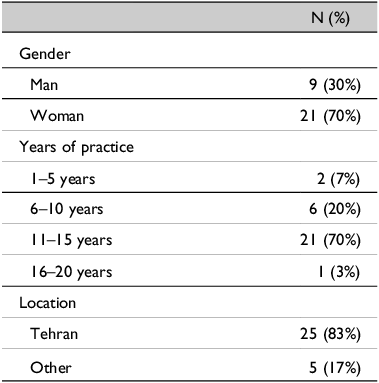
I approached lawyers with no specific criteria other than their having practiced family law for a minimum of two years. I recruited 30 lawyers who specialized in family law while concurrently engaged in other legal work. Given the significant impact that individuals’ social positions, such as gender, can have on their experiences, beliefs, actions, and choices (Harding Reference Harding2004), I assumed that women lawyersFootnote 8 would be more conscious of gender inequality (Martin et al., Reference Martin, Reynolds and Keith2002) and have a greater understanding of the patriarchal structures that shape both laws on the books and in action. As I aimed to balance the sample by gender, I faced challenges in recruiting male lawyers, resulting in only nine male participants and a higher number of female lawyers. This disparity may stem from prevailing views that deem family law as less prestigious (Heinz and Laumann Reference Heinz and Laumann1982) and stereotypically “women’s work” (Epstein Reference Epstein1993). On average, the lawyers in the study had eleven years of professional experience, and the majority practiced law in Tehran (see Table 1).
Lawyers’ Demographic Data (N = 30)

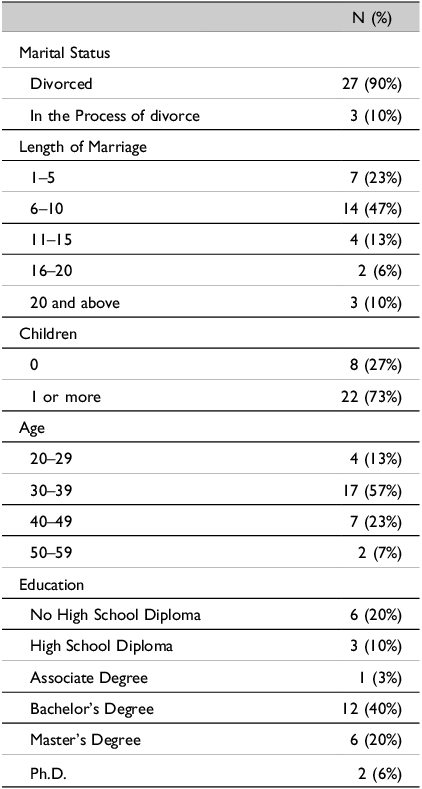
To recruit a diverse sample of divorced women, I initially used family lawyers to distribute study flyers, which yielded five participants. Expanding through snowball sampling and social media, I ultimately recruited 30 women, 2 of whom were divorced, with the majority having sought legal advice or representation during their divorce process. Out of the 30 participants, most lived in Tehran and had higher education and work experience. Their ages ranged from 20 to 50, with an average age of 35 (see Table 2).Footnote 9
Divorced Women’s Demographic Data (N = 30)

While my familiarity with family law in practice facilitated building rapport with participants, recruiting participants was challenging due to their high level of skepticism towards outsiders, especially researchers conducting research from the USA (Malekzadeh Reference Malekzadeh2016). Nevertheless, being geographically distant from the research site enabled me to report the concerns and criticisms raised by participants and to explicitly address the failures of the state and its apparatus in ensuring gender equality.Footnote 10
Data collection
I conducted a total of 60 semi-structured in-depth interviews with family lawyers, divorced women, and women seeking divorce.Footnote 11 The lawyers’ interview protocol posed seventeen open-ended questions and allowed for follow-up probing. The interview questions focused on lawyers’ approaches to and strategies in divorce cases initiated by women, their views of family law in theory and practice, and their recommendations for challenging discriminatory family laws. These in-depth interviews gave me a window into their experiences, their perspectives on the legal system, the reasoning behind their choices and practices, and how their work environment shapes the way they practice. The semi-structured interview guide for divorced women consisted of 23 open-ended questions followed by probes tailored to points raised by interviewees. The questions focused on women’s interactions with lawyers and the legal system, and whether their understanding of the law or perceptions of the legal process shifted as a result of these interactions. These interviews gave me a chance to hear how clients viewed the settlements they received. This, in turn, helped me better understand what divorce-seeking women seek and allowed for a deeper analysis of the lawyer-client relationship.
Due to the geographical distance, I conducted the interviews in Farsi via WhatsApp audio calls. All the interviews were audio recorded, and I also took handwritten notes during each interview. The average length of interviews with lawyers was one hour and thirty minutes; the shortest interview was 55 minutes, and the longest was three hours. The average length of interviews with divorced women was one hour and twelve minutes, ranging from 48 minutes to 1 hour and 52 minutes.
Ethical considerations
To protect participants’ confidentiality and ensure anonymity, I took several steps. I deidentified all transcription files and interview notes and removed any identifying details, including references to specific judges or lawyers, from the transcripts. I also assigned each participant a pseudonym. I stored all the signed consent forms in a password-protected folder on my laptop. The recruitment flyer and consent form clearly emphasized that participation was voluntary and that participants could withdraw at any time. While this option was available, no one chose to withdraw after the interview began.
Data analysis
In line with feminist methodology, I utilized constructivist grounded theory to analyze the data, recognizing the relativism, situatedness, and subjectivity of knowledge and assumptions (Allen Reference Allen2011; Denzin and Lincoln Reference Denzin and Lincoln2012). To analyze the interviews, I developed a coding scheme using an open-coding technique to identify meanings and assumptions within the data, coding interviews line-by-line and inductively. Through focused coding, I revisited interviews and refined key concepts and categories by continuously comparing codes and clustering similar ones. This iterative process led to a refined codebook after analyzing 15 interviews, including detailed definitions and examples for each code. I integrated concepts and categories and synthesized developing themes into a new conceptual framework (Charmaz Reference Charmaz2006). I reached saturation at fifteen interviews. While coding, the remaining interviews did not add new themes related to the research questions, it added nuance to the themes that had already emerged (Guest et al., Reference Guest, Bunce and Johnson2006). My final codebook included code names, a brief definition of each code, and an example for each. Once I completed the coding, I translated the relevant codes and quotes into English.
Reflexivity
Engaging in personal reflexivity is an important aspect of the research process because it allows researchers to critically examine how their social identity and background may shape the research process and findings (Mauthner and Doucet Reference Mauthner and Doucet2003; Berger Reference Berger2015). This impact extends beyond the personal level, shaping knowledge production and reproduction more broadly. Thus, the questions asked, social realities investigated, and approaches taken to analyze findings can all be affected. Here, I use reflexivity to make my analytic decisions more visible and my data analysis more transparent to the reader.
My experience practicing law as a woman lawyer in Iran, coupled with my frustration and critical attitudes toward family law in practice, shaped the way I framed my research questions and the issues I chose to investigate. Moreover, my theoretical understanding of the importance of rights-talk and of legal mobilization as a tool with limited but meaningful potential to effect change shaped how I designed my interview guides, asked follow-up questions, and interpreted and analyzed my findings.
To limit that influence, I took a self-reflective approach and kept a journal throughout the research process to record and examine my thoughts, assumptions, and emotional reactions during the research process, with the goal of bringing any unconscious biases into my awareness (Ortlipp Reference Ortlipp2008). For example, as I read participants’ narratives, I wrote down my immediate impressions and reactions, and I also conducted informal member checking to confirm and validate how I was interpreting their accounts.Footnote 12 These practices helped me notice and reflect on potential biases that might have affected my analysis (Dwyer and Buckle Reference Dwyer and Buckle2009).
My dual background as a former lawyer in Iran and a PhD student in America shaped my position as both an insider and an outsider, a status that was fluid and continually reconstructed throughout the research process (Naples Reference Naples2013; Edmonds-Cady Reference Edmonds-Cady2012). My insider position facilitated rapport with participants, but in some instances, it led participants to assume that some of my questions addressed topics that were too self-evident to warrant inquiry. For example, when I asked lawyers about their concerns regarding the long-term impacts of their strategies, they appeared to believe that the answer was so evident that they took a position of power to educate me on how the law works in practice and what a responsible lawyer should do. Navigating these complexities required maintaining a balance between my background knowledge and an open and inquisitive stance toward interviewees throughout the interviews.
Findings
To better understand how family lawyers approach divorce cases, I developed two ideal types: the “outcome-oriented” and the “transformative-oriented.” These types are distinguished by lawyers’ differing perspectives on professional responsibility and their beliefs regarding the potential for “meaningful or influential” reform in a context where the judiciary is unreceptive to women’s rights claims. Interviewing divorced women who had not hired the same lawyers interviewed in this study corroborated the validity of these categories.
In constructing ideal types, one can illustrate and compare the diverse patterns of behavior, thought, and emotions that participants demonstrate or articulate (Stapley et al., Reference Stapley, O’Keeffe and Midgley2022). While developing a typology of family lawyers helps to understand the reasons behind their different approaches, typologies or ideal types may not fully capture the nuanced behaviors and motivations of lawyers who do not fit neatly into these categories. The categories proposed here should therefore not be understood as rigid divisions. For example, lawyers in both groups recognized their potential to foster social change by invoking non-formal mechanisms such as raising women’s awareness of their rights before marriage. Moreover, it is worth emphasizing that these categories are based on participants’ accounts of their practice rather than on my direct observation of it.
In the next two sections, I elaborate on the main factors that shape each category’s stance on utilizing legal means to oppose gender inequality in everyday legal practice. For each category, I first present lawyers’ perceptions of professional responsibility, incorporating clients’ accounts to corroborate these perspectives in practice. I then turn to lawyers’ views on the prospects for meaningful reform in the absence of judicial independence.
Outcome-Oriented Lawyers: Barriers to Mobilizing Against Gender Inequality in Everyday Practice
Outcome-oriented lawyers are practitioners who define professional responsibility primarily as securing favorable outcomes for individual clients. Although they recognize gender-discriminatory law and practice, they regard systemic reform as outside their remit. Situated between cause lawyers and passive technicians, they engage with the legal process when it serves what they define as their clients’ best interests, yet refrain from strategic challenges to gender inequality codified in law.
This section illustrates how outcome-oriented lawyers’ perceptions of their professional responsibility and the judiciary shape their everyday practice in a setting where gender discrimination permeates all areas of law and legal practice. All 24 lawyers in this category criticized the discriminatory practices of family courts in Iran and their impact on women’s ability to access justice. Despite viewing the legal system as part of the problem, they did not consider it part of their professional duty to take strategic action to address this issue in their everyday practice.
Professional Considerations in Fighting Against Gender Inequality
Outcome-oriented lawyers framed justice in terms of their clients’ pressing needs. Given the emotional toll of a trial in an inhospitable court system that often produces unjust outcomes for women, lawyers advised clients to avoid going to court and instead pursue divorce through mutual consent.Footnote 13 While lawyers criticized judges for making discriminatory decisions, they admitted that they often did not rely on their legal expertise to ensure the full implementation of the law or develop a more progressive interpretation of family law. When questioned about their concerns regarding the long-term effects of their strategies, they emphasized that their ethical and professional responsibility compelled them to prioritize what they believed to be in the best interest of the client. This approach, however, could sometimes result in sidelining the promotion of gender equality in family law and the broader concerns of women seeking divorce.
Outcome-oriented lawyers put clients’ interests above any other moral or political causes, especially when pursuing such causes could, in their view, jeopardize the “best” interests of their clients. For example, in response to my question about whether he considered challenging discriminatory judicial practices when developing his strategies in divorce cases, Mani emphasized that he developed strategies based solely on his clients’ immediate needs, that is, securing a divorce, even if doing so meant using mutual consent and setting aside broader objectives. With 14 years of legal experience, Mani reflected that during his first decade of practice, he took more family law cases and enjoyed his work, despite feeling that the judicial system fell short of his expectations. Mani chose to take a conventional approach in his legal actions and to focus narrowly on clients’ immediate interests:
I put a client’s interests first. It appears that creating a new precedent is motivated by personal or moral desires…. If I anticipate losing a lawsuit, I will not file it for any other reason…. So even if a case has the potential to challenge the law, but the client has a chance to get a divorce through mutual consent, I’ll choose the latter. Challenging the law or developing a new understanding of the law are not my priority… I let my clients decide.
Despite being critical of the judiciary, Mani believed that his professional responsibility as a lawyer was not to dispute judges’ gendered arguments and decisions, but to protect his clients from harm by prioritizing their interests. Similarly, Samaneh prioritized her clients’ interests:
I understand that we should change judicial precedents and judges’ attitudes, but to be honest with you, if I want to change a precedent and use my legal knowledge to educate society that this [right to divorce] is a woman’s right, I shouldn’t expect my client to pay the cost, to pay the mental cost, and [face other] consequences. I personally would not do it unless my client agreed…. Family law includes private rights, and I do not allow myself to sacrifice my clients’ interests for a greater social cause…. Women rarely agree to participate since they are often desperate and seek the most definitive solution imaginable.
Samaneh believed that women were less likely to invoke the law to fight for greater gender equality because the hardship and suffering they experienced had put them in a vulnerable position. However, none of the divorced women in this study mentioned that their lawyers had ever informed them of such possibilities. Instead, a common theme in their accounts was their lawyers’ description of the divorce process as unfair, long, and unpredictable.
Outcome-oriented lawyers framed their reluctance to address gender inequality through their everyday practice as consistent with their professional responsibility to ensure their clients’ best interests, specifically obtaining a divorce as efficiently and painlessly as possible. To achieve this, they often encouraged clients to pursue a mutual-consent divorce, which required minimal judicial intervention. As Samaneh noted elsewhere in the interview, this approach often involved persuading husbands to consent to divorce in order to help women avoid the emotional, financial, and psychological toll of prolonged litigation.Footnote 14 Yet in doing so, lawyers seemed to overlook their role in (re)shaping their clients’ perceptions of their best interests and how such perceptions determine clients’ ultimate decisions about asserting their rights, an important aspect evident in divorced women’s accounts.
Although many outcome-oriented lawyers claimed to respect client autonomy, in practice, some placed clear limits on the types of cases they were willing to accept. These lawyers stressed that if a client did not meet specific criteria, such as experiencing severe physical abuse, being abandoned by her husband for a prolonged period, or dealing with a spouse with severe substance use issues, as outlined in Article 1130, they would not necessarily follow the client’s wishes even if she preferred to proceed. Maral, a lawyer with sixteen years of legal experience, explained that she refrained from filing a divorce case when she believed the chances of success were too low:
If she has enough evidence, that is, if her case has at least a ninety percent likelihood of winning, I would bring her case to court. Otherwise, if she doesn’t have enough evidence, I won’t accept her case, even if she insists. I won’t accept a case if the client doesn’t have strong evidence.
Despite the client’s insistence, this reluctance to take on a case suggests that some outcome-oriented lawyers support client autonomy and agency only selectively, mainly relying on their own professional judgment in determining whether to proceed.
In addition to setting practical limits on case selection, some outcome-oriented lawyers went further in defining what they considered the boundaries of ethical legal practice. These lawyers not only avoided strategic litigation but also expressed strong opposition to any form of activism within the profession. They characterized efforts to create new precedents or push legal boundaries through everyday legal practice as “unethical,” “selfish,” “adventurous,” “idealistic,” or “individualistic.” This criticism was raised by Hadi, a lawyer with 15 years of experience. Hadi described himself as a “realist” rather than an “idealist,” and stated that he had no intention of using his profession to promote “ideals of social justice.” When I asked whether he identified as a social or women’s rights activist, he responded, “According to your definition, I’m neither of them. No lawyer can be both an activist and a lawyer.” This response was surprising since I had not defined those terms. When I mentioned this point, he clarified that he meant the definition commonly used in the media, and went on to elaborate:
A lawyer has some tools that can be used to provide legal services to people to satisfy their needs. But I am not someone who wants to change the law, hold placards, and stand in front of the parliament…. What the media describes as a “women’s rights activist” is someone who pursues unconditional gender equality and demands equal written rights.… To me, a lawyer who reaches out to BBC Persian to discuss a legal case is different from lawyers who try to satisfy the legal interests of their clients.
Hadi believed that activism and professional lawyering were incompatible, arguing that lawyers who engaged in activism could no longer be considered lawyers. Hadi associated activism with pursuing radical changes that, in his view, required sacrificing clients’ interests. In their criticism, lawyers like Hadi often blamed cause lawyers such as Nasrin SotoudehFootnote 15 for seeking fame and recognition rather than defending the true interests of their clients. Similarly, Sara presented this boundary between activism and “professional” lawyering as a strategic response to the constraints of the judiciary:
I do not consider myself an activist…. It is important to contextualize tactics and strategies and keep in mind that we are dealing with Iranian judges. This has no effect other than to generate controversy. Some women’s rights activists want radical changes. My opinion is that Mrs. Sotoudeh is not a lawyer but rather an advocate for women’s rights. A lawyer is someone who prioritizes and defends the client’s interests.
Evident in these remarks was the belief that cause lawyering and “professional” lawyering cannot coexist. Outcome-oriented lawyers who drew this boundary criticized cause lawyers for prioritizing their social or political agenda over traditional legal practices and argued that they were not “real” lawyers. This perspective highlights a distinction within the outcome-oriented group: some explicitly criticized cause lawyers for their advocacy efforts, while others, though not openly critical, nonetheless maintained that it was not the duty of ordinary lawyers to confront inequality in their everyday practice.
This narrow understanding of professional responsibility also stands in tension with the broader obligations articulated in the Code of Professional Ethics of Lawyering in Iran, which emphasizes that lawyers have a duty to protect their clients’ rights, address injustices, challenge unlawful actions, and work toward implementing justice, portraying them as “crucial pillars of justice in society.” Yet, although these principles were not explicitly discussed during the interviews, they did not appear to significantly influence the everyday practices of ordinary lawyers, nor did they shape their understanding of their professional responsibility. In contrast to conventional cause lawyers, outcome-oriented lawyers’ accounts reflected their reluctance to “apply their professional skills in the service of a cause other than, or greater than, the interests of the client in order to transform some aspect of the status quo” (Hajjar Reference Hajjar2001, 68).
Divorced Women and Outcome-Oriented Lawyers
While outcome-oriented lawyers emphasized their commitment to ensuring clients’ best interests and deferring to clients’ wishes, divorced women’s accounts revealed that this approach often limited their understanding of legal options and narrowed the scope of what they considered possible or worth pursuing. Most women (73 percent) reported feeling discouraged during their initial legal consultations, as lawyers painted a bleak picture of the legal system. These consultations typically began with lawyers discrediting the legal system, emphasizing its flaws and shortcomings in both the law on the books and the law in action. Instead of offering proactive strategies to navigate these challenges, lawyers advised women to seek a settlement.
Shadi’s experience illustrates this dynamic. Married at eighteen to a devout man, she faced severe restrictions from her husband, including prohibitions on pursuing her education and employment. Despite these obstacles, she managed to pursue her education at an Islamic seminary. After two years, however, due to her husband’s excessive sexual demands and the restrictions he imposed, Shadi considered divorce. Yet she recalled that none of the lawyers she consulted encouraged her to demand her legal rights. She initially believed that a lawyer “could assert and secure her lawful claims,” meaning that a lawyer would help her obtain part of her mahr,Footnote 16 which could provide her with some financial resources to begin a new, independent life. Instead, as Shadi explained, lawyers repeatedly shifted the conversation away from her legal entitlements and toward what they described as the judiciary’s predictable resistance to women’s unilateral divorce claims, framing the process as long, emotionally difficult, and draining:
They said they see cases like this every day … and if I really wanted a divorce, I should give up my monetary rights…. They told me that I could not get a divorce based on his hypersexuality because judges would not accept my claim. And that a judge always takes the man’s side. Even when I asked them specific questions about getting my mahr or getting a divorce, they talked about judges and how they decide divorce cases…. After talking to all the lawyers whose offices were near the family court, I realized that demanding my mahr and filing for divorce would not be in my best interest.
The lawyers Shadi consulted did not provide her with a detailed explanation of her rights. Instead, they highlighted the typical judicial decisions in divorce cases initiated by women, which reshaped Shadi’s perception of her best interests and her approach to asserting her rights. After speaking with multiple lawyers, Shadi concluded that claiming her monetary rights and pursuing a unilateral divorce would be futile. As a result, she convinced her husband to agree to a mutual-consent divorce. To secure his agreement, she forfeited her monetary rights and accepted only 10 percent of her mahr (14 out of 140 gold coins), despite facing financial difficulties and lacking family support. Because of limited financial resources, Shadi never hired a lawyer to help her with negotiations.
Encouraging women to pursue a mutual-consent divorce may ease the divorce process for women like Shadi. But this outcome-oriented approach was particularly problematic for women who were reluctant to begin from a position of weakness or were unwilling to terminate their marriages as quickly as possible if it meant sacrificing what they regarded as rightfully theirs. This was evident in Haniyeh’s experience with the first lawyer she consulted. Haniyeh, a thirty-two-year-old woman, lived with her husband for almost ten years, enduring verbal and physical abuse even after the birth of their child. Despite hoping that the presence of their child might change his behavior, nothing changed. When her husband eventually offered to divorce her on the condition that she give up her monetary rights, Haniyeh refused, believing the proposal was unfair. Haniyeh consulted various lawyers in the hope of obtaining what she believed was rightfully hers:
The first lawyer told me that my husband did not meet any of the conditions that would allow me to get a divorce. He suggested demanding mahr as leverage. Another lawyer told me the same thing and suggested having a meeting with my husband to convince him to agree to a mutual-consent divorce. He told me that I should forget about my monetary rights.
But Haniyeh was not satisfied with this advice:
But why would I need a lawyer if I’m just going to compromise and forgo my monetary rights? I could have done it myself. I was looking to get my rights. I worked and shared my income with my husband. We bought a house together, but it was under his name. I wanted my share back.… I was so disappointed to see that his first option was compromise. I didn’t feel he would fight for my rights. I looked for another lawyer.
Haniyeh lost confidence in her lawyer, and her decision not to proceed with that lawyer illustrates how some women sought “zealous” advocates who could represent their voices in a legal battle already stacked against them. Dissatisfaction with outcome-oriented lawyers was especially common among women who had spent over a decade in marriage, with most falling between ten and twenty years, though it was not limited to them. About half of the women who sought assistance expressed frustration with lawyers’ failure to provide thorough information about their legal rights and the strategies available to assert them. Outcome-oriented lawyers often emphasized the obstacles women would face—particularly the gap between the law on the books and law in action—thereby persuading clients to relinquish certain claims. In doing so, they unintentionally reinforced the system that restricts women’s right to divorce.
While divorced women were dissatisfied with outcome-oriented lawyers’ approach to divorce, most did not expect or request that their lawyers pursue broader systemic changes alongside securing individual rights. This lack of expectation, possibly due to a lack of knowledge about the potential of rights advocacy, likely encouraged lawyers to align their practices with muted client demand, prioritizing expedient resolutions over challenges to systemic inequalities. This dynamic, in turn, helps sustain a practice style that not only limits progress toward gender equality but also reinforces existing inequalities.
Avoiding a futile battle: The judiciary as a pillar of gender inequality
The political structure of states impacts how their legal institutions and the legal profession function. The literature on cause lawyering stresses that in settings where elements of authoritarianism and democracy are intertwined, the absence of an independent judiciary hinders meaningful legal engagement (Hilbink Reference Hilbink2007; Ginsburg and Moustafa Reference Ginsburg and Moustafa2008; Tam Reference Tam2010). In such regimes, the legal profession may be subordinated to the ruling government, resulting in a lack of access to justice for citizens. Lawyers adopt different strategies to uphold the rule of law in societies where the judiciary is part of the state apparatus. Still, this subordination can turn some lawyers into passive actors. This institutional subordination is explicitly reflected in Iran’s 1979 Constitution, which frames the judiciary not as an independent body but as an arm of the Islamic state.Footnote 17
According to outcome-oriented lawyers, the lack of judicial independence in Iran and the judiciary’s active role in enforcing the state’s gender policies are significant obstacles to even minor progress in women’s rights through formal legal channels. The judiciary’s structure,Footnote 18 along with its internal policies and practices, is deeply shaped by politics, gender, and religion. In male-dominated family courts, women judges hold hearing sessions but are considered consultants to male judges. This reflects a prevailing perception of judging as a profession associated with objectivity, rationality, and neutrality, qualities often linked to masculinity.Footnote 19 Like other institutions, judges and staff bring their ideas about gender into the courtroom, which in turn reinforces gender ideologies in the context of marriage and divorce.
Outcome-oriented lawyers argued that maximizing women’s rights could not be achieved through lawyers’ engagement in everyday resistance. In this context, everyday resistance refers to lawyers actively engaging with the law and presenting arguments based on the current family law’s potential for ensuring women’s rights to divorce. Most of these lawyers believed that the gender apartheid state itself was responsible for institutionalizing discrimination against women and that the male-dominated judiciary played a significant role in maintaining this system. From this perspective, because the judiciary implements policies that are designed to maintain women’s subordination, individual legal mobilization, defined as “the process by which individuals make claims about their legal rights and pursue lawsuits to defend or develop those rights.” Epp (Reference Epp1998, 18) was not considered an effective form of everyday resistance.
In the context of divorce, participants contended that the judiciary actively enforces discrimination against women by instructing judges, through its written and unwritten policies, to curb the rising divorce rate. As Sara explained, resistance to progressive interpretations of the law did not simply reflect the personal gender biases of individual judges but was rooted in the judiciary’s gendered policies:
Judges are prohibited from doing so [to be more progressive in divorce cases at the request of women] by the judiciary or a higher authority. The divorce rate in Iran has skyrocketed,Footnote 20 and they must take action…. Let me be clear here. They fear the huge number of divorced women in society. They believe that if the number of divorced women goes up, moral degradation will rise, posing a challenge to the structure of the family…. It’s not that they are concerned about the rate of anything rising. The rate of execution is high, too. I think we are either #1 or #2 in the world regarding execution. But are they concerned about it? No. However, divorce is associated with their inability to control women.
Sara’s account sheds light on the role of the judiciary in maintaining systematic control over women’s sexuality and reinforcing traditional gender roles. As she noted, the state constructs divorced women as immoral and sexually available in contrast to the ideal of a married woman whose sexuality remains under control. To protect society from what it portrays as the sexual and moral impropriety of divorced women, who are viewed as “sex objects” and “a threat to other marital relationships” (Pirak et al. Reference Pirak, Negarandeh and Khakbazan2019). The patriarchal state uses the judiciary as one of its main apparatuses to restrict women’s right to divorce, rendering it a less promising terrain for advancing women’s rights. Moreover, the state’s portrayal of rising divorce rates as a national concern demonstrates how informal mechanisms such as the “rhetoric and framing of national concerns and ideology” are mobilized to enforce gender norms (Martin Reference Martin2004, 1259).
Taraneh echoed the unreceptivity of the judiciary to the cause of women’s rights and attributed this to the interdependence of the legal system and gender. Motivated by her commitment to social justice, she chose to study law and become a lawyer. However, after five years of practice, she became more pragmatic and came to believe that social justice aspirations cannot be entirely achieved through legal channels. She explained how the judiciary actively obstructs legal mobilization and enacts its discriminatory policies:
Judges are part of the system. The system, judges, and law are interconnected and follow one goal: to make divorce more difficult for women. In this irritating system, each of the players plays their roles…. Who do you think the judges on the Supreme Court are? A bunch of men and no women. All of them have gone through gozinesh Footnote 21 and are therefore approved by the system. None of them can have an independent thought process.
Taraneh drew my attention to the gendered structure of the judiciary and how the system was deliberately designed to maintain and reinforce gender hierarchy. According to Taraneh and seven other outcome-oriented lawyers, the hiring mechanism enables the judiciary to maintain this status and power by allowing officials to scrutinize prospective judges’ political, religious, and ideological beliefs. The selection of judges, as well as the appointment of the head of the judiciary, illustrates the state’s determination to rein in the courts and prevent them from becoming arenas for challenging its authority. Indeed, the manipulation of judges’ appointments and promotions is a common strategy authoritarian states employ to restrict judicial activism and autonomy (Moustafa Reference Moustafa2014). Paniz further elaborated on this point:
The system brings in people who are like itself. Through a strict selection process, it mostly brings in judges who fit its own mold. I don’t have overall statistics; I’m just speaking from what I’ve seen. For example, in strong public universities, a lot of the top law students, whether religious or not, don’t fit into the judiciary’s framework. Most of them become lawyers, and very few become judges. The judiciary doesn’t let in progressive or reform-minded judges. It tries to keep things the way they are by bringing in people who, for example, don’t see getting beaten as grounds for hardship, or who defend male authority.
Paniz explained how conservatism is reproduced through judicial appointments. She pointed to internal gatekeeping mechanisms that prevent the entry of judges who might challenge dominant gender norms or issue rulings in support of women’s rights. While the Constitution sets the ideological framework in terms of Islamic values, participants described the judiciary as the key enforcer of gender ideologies. Undoubtedly, gender ideologies are constructed at the intersection of religious, political, and other belief systems.
Overall, most participants agreed that family law could, in principle, protect women’s right to divorce; however, advancing this cause depended on sympathetic and supportive courts. The hostile judiciary signaled the absence of a key condition for legal mobilization, as outlined in the legal opportunity structure model (Hilson Reference Hilson2002; Andersen Reference Andersen2006; De Fazio Reference De Fazio2012). At the same time, participants’ accounts add a new dimension to this framework by foregrounding gender, extending the model beyond its traditional focus on judicial receptivity (De Fazio Reference De Fazio2012; Fuchs Reference Fuchs2013). Despite these constraints, rights talk remains possible within the existing structure, even in the most repressive systems (Scott Reference Scott1990). Transformative-oriented lawyers sought to make the most of these possibilities.
Transformative-Oriented Lawyers and the Pursuit of Change Through the Legal System
A small group of women lawyers integrated the cause of women’s rights into their everyday practice. I refer to them as “transformative-oriented” lawyers. This group, consisting of six individuals who identified as women’s rights activists or expressed a genuine passion for advancing women’s rights, adopted a distinct approach in their everyday practice. Unlike the broader population of lawyers, transformative-oriented lawyers combined service and impact lawyering by strengthening clients’ autonomy and agency in the divorce process while pushing the boundaries of the law in their everyday practice. Their work aligns with Sarat and Scheingold’s (Reference Sarat and Scheingold1998) conception of cause lawyers, which focuses on “altering some aspects of the social, economic, and political status quo” (4). This conceptualization is not rigid; even lawyers who engage in “traditional” legal practices to facilitate clients’ access to justice without being “self-consciously committed to a cause” can fall under the umbrella of cause lawyering (Ellmann Reference Ellmann, Sarat and Scheingold1998; Sarat and Scheingold Reference Sarat and Scheingold1998; Shdaimah Reference Shdaimah2011). However, the majority of transformative-oriented lawyers did not describe themselves as cause lawyers. Their understanding of cause lawyering resonated more with Statz’s (Reference Statz2018) definition, which portrays cause lawyers “as individuals who self-consciously commit themselves and their skills to a political cause, and for whom lawyering is not value-neutral” (6). While all but one emphasized that they had not fully dedicated themselves to advancing women’s rights, their practices still fit within a broader, more flexible understanding of cause lawyering as a spectrum.
Navigating the Intersection of Professionalism, Service, and Advocacy
Transformative-oriented lawyers believed that pursuing women’s rights and advocating for their clients’ best interests were not mutually exclusive. In other words, they viewed client-centered lawyering and policy advocacy as indivisible components of their work. For example, Nastaran was particularly interested in unilateral divorce cases because they created room for innovative arguments. She emphasized that taking on these cases required empathizing with clients, fully informing them of their options, and supporting their ability to make an informed decision, rather than steering them toward reconciliation, even when the case was difficult and the outcome uncertain:
I prefer to challenge judges and the current precedents in this area of family law. I’ve represented clients who were true fighters, and while we did not easily win those cases, we did finally win…. I have seen women who got a divorce through mutual consent, but in retrospect, they blamed themselves for forgoing their rights and not fighting … To avoid these feelings, … I explain to them all three types of divorce. It’s up to them to decide…. I think lawyers often decide on behalf of their clients. But I don’t want to do what their fathers, brothers, and husbands may do: make a decision for them. If they make an informed decision, they will accept its consequences. It’s wrong to view clients as victims. How would we differ from their fathers, brothers, husbands, and the regime if we did so?
Nastaran did not view women as “vulnerable” and “fragile” victims, nor did she assume that getting a divorce in the shortest possible way was necessarily in their best interests. Instead, she helped her clients determine what was best for them based on their individual circumstances, while also encouraging them to consider how they might later feel about “the process” of getting a divorce. In this way, she refrained from dictating what she personally considered to be the best course of action. As part of her fight for sweeping gender equality, she emphasized educating and empowering her clients by helping them make informed choices—a powerful strategy that is employed by cause lawyers who recognize the power of legal advice (Ellmann Reference Ellmann, Sarat and Scheingold1998).
Unlike outcome-oriented lawyers, those who value comprehensive legal advising view their responsibility as extending beyond merely representing their clients (Ellmann 1998). They also recognize that providing effective legal advice does not mean “overriding” or “influencing” clients’ interests and immediate needs (Ellmann 1998, 377). Nastaran exemplified this approach by refusing to let the low probability of courtroom success deter her from using the law. She helped clients understand that they had rights regardless of the outcome of a case. Her commitment to promoting gender equality and empowering women shaped her distinctive approach to practicing law.
Similarly, Raha did not view her clients as a means to an end. As an expert in family law, she made every effort to empower women and raise their awareness of their rights. She educated women on the “terms of marriage”Footnote 22 and provided pro bono services to those who could not otherwise afford a lawyer. The pursuit of gender equality was ingrained in every aspect of her legal practice, including her argumentation style:
I always think about changing precedents in the realm of family law. I take on cases that are not typically easy…. When preparing a brief, I usually highlight the points that might not seem important to a judge. However, I believe that over time, those arguments might lead to a precedent shift or help develop a new one. The possibility might be one percent. If relevant, I even cite international conventions and attach the Supreme Court’s decisions to my briefs…. The other day, I saw a judge taking notes from my brief. He even asked me to help the assigned arbitrators write a well-reasoned opinion!
When asked whether she thought her approach to lawyering conflicted with her client’s interests, she maintained:
I always keep my client’s best interests in mind. I don’t put my interests ahead of my clients to set a new precedent. Sometimes, bringing a case to the court is in the best interest of my clients. For example, if my client can’t reach a strong agreement with her husband or her husband drags out negotiations, I’ll file a unilateral divorce case even if winning seems unlikely…. The least I can do is not to discourage clients from pursuing their rights.
In her everyday practice, Raha channeled her own ideological, political, moral, and personal motivations into serving clients. While she sought cases that could advance women’s rights, she approached individual cases primarily as opportunities to challenge the law. Thus, if a woman was prepared to compromise, she worked to negotiate a mutual-consent divorce to secure her demands. Put differently, in her everyday practice, the cause of women’s rights did not seem to take on a life of its own but was intertwined with the specific needs and interests of clients.
Divorced Women and Transformative-Oriented Lawyers
Divorced women who described positive and empowering experiences with their lawyers typically worked with those who adopted a transformative approach, such as Raha and Nastaran. About one-third of the participants, after initially consulting with multiple lawyers, eventually hired someone who not only provided them with clear information about all available legal options but also warned them of the challenges they might face during the divorce process. These lawyers reassured their clients that they would support them throughout the process, do their best in representing them, and keep the women’s needs and interests at the center of their practice. Mona, a forty-two-year-old woman, illustrates this experience. She decided to pursue a divorce after finding out about her husband’s affair. She had been married for 18 years and had a thirteen-year-old daughter. Mona had not been employed before the divorce, and the lack of financial support made the process challenging for her. Her first lawyer agreed to pursue her mahr but failed to explain the divorce process to her and provided no support during court hearings. Mona had to frequently follow up with the lawyer to ensure even basic progress. Reflecting, she described him as motivated solely by financial gain and blamed herself for not consulting more lawyers before hiring him. Mona subsequently hired a different lawyer who was highly understanding and competent:
[My lawyer] gave me a full breakdown of the divorce procedure and was upfront about the possibility of losing at the trial level and having to appeal to the appellate court and [the] Supreme Court. She told me that my husband’s affair was not an admissible legal ground for divorce by the courts…. Throughout the process, she provided both legal and emotional support, going above and beyond what was expected of a lawyer. I trusted her. I owe my divorce to her.Footnote 23
Mona’s lawyer went beyond simply discussing judges’ discretionary decisions and provided a more comprehensive account of the divorce process, including different possible outcomes. This enabled Mona to ultimately make a choice that reflected her emotional needs and personal interests. Her account of this second lawyer’s approach aligns with the approach of transformative-oriented lawyers in divorce cases, who act as “legal educators”. These lawyers seek to empower clients by clarifying the legal process, explaining their rights, and presenting the potential consequences of different courses of action.
Overall, women did not seem to expect their lawyers to act as “mouthpieces” or “hired guns,” defending clients’ rights and furthering their interests even if it required crossing moral boundaries (Freedman and Smith Reference Freedman and Smith2023; Sarat and Felstiner Reference Sarat and William LF1995; Mather et al. Reference Mather, McEwen and Maiman2001; Mather Reference Mather2003). Instead, most women wanted lawyers who were attentive to their specific needs and adopted a more proactive, rather than purely defensive, role in ensuring their rights.
Confronting Institutionalized Gender Discrimination
Transformative-oriented lawyers expressed cautious optimism that everyday acts of resistance could, over time, generate meaningful change. While they did not deny the patriarchal structure of the legal system or its role in sustaining women’s oppression, they argued that lawyers should not remain passive or accept the status quo. They took a realistic approach, acknowledging that legal challenges are often time-consuming and uncertain, yet they can have a ripple effect. Although progress is not always linear, transformative-oriented lawyers emphasized the value of small changes, such as the full application of the law in individual cases, and believed that these gains could have a broader impact over time. Nastaran maintained that lawyers’ persistence in manipulating the legal system and using their symbolic resources in their everyday practice would eventually result in meaningful improvements:
Regardless of how gendered and patriarchal the system is, if judges routinely hear women’s grievances, they subconsciously begin to consider them, and the first judge to issue an unprecedented verdict will pave the way…. The verdict will then be discussed among the judges. They meet weekly to discuss their cases and decisions. They gradually shape one another’s viewpoints…. As a lawyer, you shouldn’t be concerned about losing a divorce case, even if it happens numerous times. Filing divorce cases at women’s request contributes to the development of a fresh and innovative discourse within the judicial system. However, there may not be many clients willing to accompany you on this journey.
Nastaran recognized the presence of gendered policies and practices in the judiciary but did not view them as insurmountable obstacles to the advancement of women’s rights through everyday lawyering. She emphasized the significance of rights talk in fostering more progressive interpretations of family law, thereby denaturalizing women’s suffering and hardship, which judges sometimes frame as inevitable parts of marriage.
Minoo echoed Nastaran’s cautious optimism about the long-term impact of rights talk. Over her 15 years of legal practice, assisting women and minors with their legal matters has been the most satisfying part of her career. She did not identify as a women’s rights activist because she believed that being an activist had particular requirements, such as devoting all one’s time to a passion. She nevertheless sought to advance women’s rights by, for instance, exposing the inadequacy of legal protections for survivors of gender-based violence and attempting to influence judges’ interpretations of family law. Minoo stated that these activities were part of her everyday lawyering and emphasized that her entire legal practice was not geared toward advancing women’s rights. She did not have any doubt about the long-term impact of rights-based claims on the advancement of women’s rights:
There are definitely some red lines that you cannot cross, and sometimes you can’t even tell what the red lines are. Some of them are defined based on Sharia or even politics…. In some cases, some judges have taken certain precedents into account. Of course, some of these precedents are problematic, but some are innovative, and you can benefit from them. I have provided other verdicts to judges, and that strategy helped me win cases. The short argument of the other judge helped me convince a judge in another case to grant a divorce. Although he did not cite that verdict, it had an impact on his decision.
Lawyers like Minoo, who did not overlook the importance of adopting a more strategic approach to their everyday practices, had realistic expectations about what could be achieved. Given that the judiciary in patriarchal and authoritarian states cannot be at the forefront of advancing women’s rights, they considered even a marginal shift in judges’ interpretations of women’s suffering and hardship to be a significant victory.
Lawyers from both groups provided examples showing that legal advocacy could influence judges’ understandings and interpretations of suffering and hardship. Successful divorce petitions based on grounds such as a husband’s sexual dysfunction, a one-time physical assault, verbal assault through text messages, or lack of mutual understanding, which are not listed among the legitimate grounds for divorce under Article 1130, suggest that not all judges serve as pawns of state policy. Some lawyers from both groups attributed progressive decisions in divorce cases to the location of family courts. They argued that social, cultural, and economic considerations impact how individuals perceive acceptable grounds for divorce and whether they opt to pursue a divorce petition. Since the north of Tehran is an affluent and upper-class neighborhood, judges at the family court in that district hear different types of arguments and have gradually adapted their decisions to the cultural norms and expectations of that setting. For instance, Arina said:
Each family court deals with individuals from diverse socio-economic backgrounds…. The cases heard by family court judges in the north of Tehran differ from those in the south…. In the south, judges hear cases involving severe domestic violence and addictions. From their perspective, a single incident of physical violence does not constitute suffering and hardship. If I go to the Mahallati courtFootnote 24 and tell a judge that my client feels like she has nothing in common with her husband, the judge will ask me whether he is employed. [I would say] he is. Does he have an income? [I would say] yes. Does he have an addiction? [I would say] no. Then he would say that she must get back to her husband.
Arina noted that what one judge in the north of Tehran may consider a legitimate cause of marital dissatisfaction and a sign of suffering and hardship could be interpreted differently by a judge in the south of Tehran. It is unlikely, however, that judges sympathetic to women’s rights are deliberately appointed to the family court in the north of Tehran. Judicial appointments in Iran are based on candidates’ qualifications and their “practical commitment to Islamic principles and loyalty to the system of the Islamic Republic” (Banakar and Ziaee Reference Banakar, Ziaee, Abel, Hammerslev, Sommerlad and Schultz2018).
Even so, there are reasons to believe that the rhetoric of rights is more effective than many lawyers think. Judges’ repeated exposure to women’s grievances and arguments can influence their understanding of suffering and hardship, as well as reshape their normative views on family dynamics. Furthermore, variations in judicial decisions may signal the presence of progressive judges who, rather than adhering strictly to gender ideologies, apply their discretion to interpret the law based on the specifics of each case and fundamental human rights principles. For example, Raha pointed to a judge in Mazandaran who cited a provision of the Convention on the Elimination of All Forms of Discrimination Against Women in a decision supporting a woman’s right to work:
Why do you think he does this? He is a progressive judge who attempts to set a precedent. While he could simply state that this woman has the right to have an independent profession in a single sentence, he writes an entire page and bases his conclusion on the provisions of CEDAW…. We can’t make a precedent as American or Canadian lawyers do, but divorce cases at the request of women rely heavily on precedent, and judges make the final decision…. Sometimes I get the impression that a judge is about to suffer a heart attack when he makes a more progressive decision in a divorce case!Footnote 25 Yet if there are more judges who make such decisions, they won’t be as terrified….
Raha acknowledged the constraints judges face but also recognized the potential for judges and lawyers to creatively challenge discriminatory laws and set new precedents that protect women’s rights. She stressed the importance of perseverance in the pursuit of justice, noting that not all judges act as gatekeepers against it. Overall, transformative-oriented lawyers’ accounts suggest that changing the state’s policies concerning women’s rights is unlikely to emerge from everyday practice alone. Yet, within individual cases, these lawyers work to ensure the full implementation of existing laws, thereby shaping more flexible and just interpretations of the law.
Discussion
This paper illuminates how ordinary lawyers working under an authoritarian regime approach codified gender inequality in their everyday practice, contributing to broader understandings of lawyering and legal mobilization in such contexts. Despite the limited and selective sample of lawyers and clients on which this research is based, it offers strong evidence that lawyers’ perceptions of their professional responsibility, as well as their understanding of meaningful reform in the face of a judiciary unreceptive to women’s rights, play a crucial role in shaping their everyday practice.
Lawyers’ perceptions of professional responsibility shape how they approach their everyday practice (Sarat and Scheingold Reference Sarat and Scheingold1998; Mather et al. Reference Mather, McEwen and Maiman2001; Hilbink Reference Hilbink2004; McEvoy Reference McEvoy2011). Despite the contentious and politically charged nature of women’s rights in Iran, most family lawyers maintain a conventional perception of professional responsibility, prioritizing the immediate needs of their clients over broader societal considerations, even in cases that have gender implications. They neither actively challenge the state nor prioritize upholding its interests. While they are highly critical of the legal system, they are hesitant to challenge inequality. Although their work appears to benefit their clients within what Hajjar (2001) calls “the prevailing arrangements of power” (68), their silence and lack of interest in confronting judges’ gender ideologies and the gendered reasoning underlying judicial decisions contribute to the legitimization of gendered judicial ideologies in divorce cases. Moreover, their paternalistic approach to lawyering not only undermines women’s agency and further disempowers them but also results in women’s rights remaining unclaimed. As Khan and Aziz (Reference Khan, Aziz, Steven, Corey and Michael2023) note, in such contexts, when legal actors withdraw from legal engagement, they may leave space for the law to be used more as a tool of control rather than protection.
This tendency to prioritize individual outcomes over challenging unjust laws and practices is not unique to family lawyers in Iran. Studies from other authoritarian contexts, where family law explicitly privileges men or where the implementation of the law leads to gender disparities, show that lawyers and legal practitioners similarly guide women toward “efficient” solutions like reconciliation or mutual-consent divorce, while framing these options as being in the woman’s best interest (see Welchman Reference Welchman2000; Sonneveld Reference Sonneveld2012; Li Reference Li2016; Van Eijk 2016). However, such strategies can ultimately reinforce traditional gender norms and maintain existing power hierarchies. In Syria, for example, mutual consent divorce may absolve men of financial obligations otherwise required by law (Eijk Reference Eijk2016). This occurs even as conciliatory and collaborative approaches to family law have been critiqued more broadly for reinforcing conventional gender roles and masking structural inequalities, even in contexts where the law is formally gender-neutral (Rebouché Reference Rebouché2016). Although these studies do not examine lawyers’ perceptions of professional responsibility, they illustrate how ordinary lawyers, in attempting to be efficient and conciliatory, may unintentionally sustain gendered hierarchies through everyday legal practice.
In contrast to dominant approaches to divorce disputes informed by conventional understandings of professional responsibility, an alternative conception leads some ordinary lawyers to engage in “everyday resistance.” In “everyday” or “hidden resistance,” individuals develop “quiet, dispersed, disguised, or seemingly invisible” tactics to “both survive and undermine repressive domination” (Lilja et al. Reference Lilja, Baaz, Schulz and Vinthagen2017, 42). The concept of “everyday resistance,” developed by Scott (Reference Scott1985, Reference Scott1990), has been used to describe everyday lawyering in authoritarian contexts, where the state’s exercise of power is more pervasive (Batesmith and Stevens Reference Batesmith and Stevens2019; McEvoy and Bryson Reference McEvoy and Bryson2022). This approach is evident among transformative-oriented family lawyers in Iran who, despite knowing that “they are unlikely to do more than marginally affect the various forms of exploitation” (Scott Reference Scott1985, 29–30), seek to develop a “counter-hegemonic” understanding of what constitutes “suffering and hardship,” grounded in the lived experiences of women. Rather than turning the courtroom into a political site (Sarat and Scheingold Reference Sarat and Scheingold1998, Reference Sarat and Scheingold2006) they try to expose the limitations and potentials of the current family law through their arguments and reasoning. Similar to the indivisible practice of cause lawyers in other authoritarian regimes (see Liu and Halliday Reference Liu and Halliday2011; Pils Reference Pils2014; Stern Reference Stern2017), transformative-oriented lawyers in Iran view their practice as “an incremental everyday process rather than a revolutionary one” (Van der Vet Reference Van der Vet2018, 305).
In addition to their perceptions of professional responsibility, lawyers’ understandings of structural barriers and the possibility of reform also shape their everyday practice. Both outcome-oriented and transformative-oriented lawyers identified the absence of a receptive judiciary as a major obstacle to reform, an element central to assessing the legal opportunity structure (Hilson Reference Hilson2002; De Fazio Reference De Fazio2012). From the family lawyers’ perspective, the judiciary in Iran lacks autonomy and functions as an extension of the state, thereby reinforcing gendered policies that uphold male authority and restrict opportunities for effective legal mobilization. These findings suggest that the judiciary’s unreceptiveness to women’s rights is not simply the result of individual bias or political belief, as prior research has often emphasized (Epp Reference Epp1998; Hilson Reference Hilson2002; De Fazio Reference De Fazio2012), but is tied to the judiciary’s structural position within a state agenda that resists gender equality. Contrary to the view presented by Osanloo (Reference Osanloo2009), who argues that the hybrid legal structure of Iran’s family courts, combining civil and Islamic law, provides a platform for asserting rights and allows women to position themselves as empowered citizens within the judiciary, family lawyers contend that the legal system is steeped in the state’s gendered policies. This, they argue, positions the judiciary as a significant obstacle to effective legal mobilization, not a facilitator.
Despite this shared understanding of the judiciary as an impediment to legal mobilization, lawyers’ perspectives on overcoming this obstacle differ. Outcome-oriented lawyers view an unreceptive judiciary as an insurmountable barrier to gender equality. From their perspective, rights talk is unlikely to result in “meaningful” changes since gender, as a social institution, plays an active role in shaping and enforcing rules. Similarly, transformative-oriented lawyers acknowledge that structural problems and inequalities cannot be resolved through courts (Scheingold Reference Scheingold1974; Handler Reference Handler1978), and providing legal services to socially disadvantaged individuals within the existing legal framework rarely leads to substantial reform or shifts in power dynamics (Tremblay Reference Tremblay1989; Houseman Reference Houseman1994). Yet, unlike their outcome-oriented counterparts, transformative-oriented lawyers still believe they can take steps to empower women and avoid reinforcing gender inequality, even if they cannot achieve formal gender equality. Rather than seeking to dismantle the system, they work within existing legal and institutional constraints to mitigate injustice (Batesmith and Stevens Reference Batesmith and Stevens2019; Prasse-Freeman Reference Prasse-Freeman2015) and do not disregard the “radiating” effects of their strategies. Like Hilbink’s (Reference Hilbink2004) “grassroots cause lawyers,” transformative-oriented lawyers recognize the gendered and biased nature of the legal system but do not reject the potential of rights talk altogether. They believe that with creativity and strategic use of legal tools, it is possible to “play the game” and still shift meanings (Coutin Reference Coutin, Sarat and Scheingold2001 136). Thus, they seek to gradually reshape legal interpretations, social norms, and expectations around marriage and divorce, with the hope that political change will eventually follow and the law will catch up (Abel Reference Abel1995, 522).
Lawyers’ understandings of professional responsibility and reform do not develop in a vacuum. Legal education and professional institutions play a central role in shaping how lawyers understand their role, act on that understanding, and define what counts as effective legal practice. Law schools and bar associations both instill and support institutional values, which Bourdieu suggests are aligned with maintaining the field’s stability and the interests of its most powerful members. In the juridical field, Bourdieu posits that education, among other factors, contributes to the formation of a specific habitus—“a system of schemes of perception and appreciation of practices, cognitive and evaluative structures which are acquired through the lasting experience of a social position” (Bourdieu Reference Bourdieu1989, 19). Lawyers internalize the norms and expectations of the legal profession, which shape their perceptions, behaviors, and experiences within the field, thereby reinforcing existing practices. This ingrained habitus, influenced by legal education and bar associations, shapes how family lawyers approach discriminatory laws in their everyday practice.
Empirical studies on the role of legal education in shaping law students’ professional identity in American law schools indicate that law school socialization can lead to alienation from public-interest career commitments among law students (Ashar Reference Ashar2016; Bliss Reference Bliss2018; Albiston et al. Reference Albiston, Cummings and Abel2021). Similarly, in Iran, the lack of a social justice-oriented legal education—which emphasizes the social and professional responsibility of lawyers to challenge injustice and promote equality—as well as the absence of legal clinics in Iranian law schools (Safai and Kazemi Reference Safai and Kazemi2014; Farzaneh and Javahernia Reference Farzaneh and Javahernia2022), contributes to lawyers’ limited understanding of the broader implications of their everyday practice.
Similar to academic legal education, bar associations in Iran fail to provide practical training in law, social justice, and advocacy (Banakar and Ziaee Reference Banakar, Ziaee, Abel, Hammerslev, Sommerlad and Schultz2018). Moreover, these associations neglect to protect lawyers involved in advocacy efforts.Footnote 26 The deficiencies in training were apparent during my interviews, as several participants stated that they had never thought about using individual cases to push for more progressive arguments or to set new legal precedents—ideas they were hearing from me for the first time. While only one participant specifically mentioned the impact of legal education on lawyers’ practice style, the common trajectory of lawyers entering the field with social justice aspirations only to later abandon these ideals suggests that legal education, combined with the profession’s unwritten norms, shapes lawyers’ practice styles. This pattern implies that family lawyers in Iran do not intentionally act in ways that primarily benefit the field’s most powerful members, contrary to what Bourdieu might suggest.
Family lawyers’ understanding of their professional responsibilities is also influenced by their upbringing and interpersonal interactions with clients, colleagues, mentors, and judges, among others. According to the theory of the relational self, such relationships influence behaviors, emotions, and motivations through transference across various social contexts (Andersen and Chen Reference Andersen and Chen2002). Although not directly addressed by participants, Nima’s reflection suggests that early relational experiences can influence a lawyer’s professional behavior. Nima, an outcome-oriented lawyer, noted that cultural norms endorsing “passive obedience” shape individuals’ characteristics from a young age. This societal conditioning often carries into adulthood, leading lawyers to adopt a passive and obedient role, as commonly advised through phrases like “keep your head down and attend to your own life.” Nima, who has practiced law for fourteen years, added that under an authoritarian regime, individuals learn to avoid taking risks and are discouraged from introducing new ideas because the system has taught them that only pre-approved solutions are valid.
This passivity may either be reinforced or modified throughout legal practice. After passing the bar exam, law graduates must complete an eighteen-month internship under the supervision of an experienced lawyer, marking their first real exposure to legal practice. The mentor’s practice style can influence the intern’s professional outlook. For instance, Raha’s internship with a lawyer dedicated to women’s rights influenced her legal practice and exposed her to an approach that integrates the fight for gender equality into everyday practice, without compromising clients’ interests. As new lawyers enter the courtroom, their repeated encounters with an adversarial judiciary, where judges often view lawyers as obstructive (Banakar and Ziaee Reference Banakar, Ziaee, Abel, Hammerslev, Sommerlad and Schultz2018), can reinforce passivity. These interactions tend to signal that lawyers are not agents of change but mere navigators of a hostile legal environment. In the context of family law, judges often treat cases as unimportant administrative tasks to be handled quickly and with minimal attention to detail. This routinized approach further discourages lawyers from adopting a more engaged and proactive approach. Future research could explore how family court judges in Iran exercise discretion and communicate expectations to lawyers, and how such dynamics influence lawyers’ strategic decisions and professional self-understanding within a constrained legal environment.
Concluding Remarks
Studies of the legal profession in authoritarian regimes, particularly those characterized by authoritarian legalism, where courts function relatively well for routine cases but not for politically sensitive ones, often focus on how lawyers navigate the latter. My findings point to the importance of examining how lawyers approach so-called routine cases. When the state’s ideological agenda permeates routine legal matters, routine cases are no longer apolitical; they reproduce the very hierarchies the regime seeks to preserve. Understanding lawyers’ approaches requires looking beyond structural constraints such as a state-controlled judiciary. Equally important are lawyers’ perceptions of professional responsibility and their sense of what is possible, appropriate, or necessary. These perceptions are shaped not only through practice but also through institutions like legal education and bar associations. Though not always formally designated as state organs, universities and bar associations are nevertheless embedded in state structures and ideological agendas. They play a critical role in shaping the professional habitus of lawyers and influencing how they perceive and respond to inequality and injustice in their everyday practice.
These findings suggest unexplored avenues for further consideration in the theory and research regarding the importance of different professional identities assumed by members of the legal profession and their impact on clients. More specifically, this study suggests that lawyers’ understandings of their professional responsibility and their perceptions of “meaningful reform” shape their practice style in ways that can inadvertently reinforce the status quo, including systemic gender inequality in this context. Moreover, this study opens a potentially rewarding field of research by examining how each lawyer’s identity is formed over the course of their career. It raises questions about how factors such as interpersonal relationships (Andersen and Chen 2002), legal education (Scheingold and Sarat Reference Scheingold and Sarat2004), and personal identity (Mather et al. Reference Mather, McEwen and Maiman2001), among others, influence lawyers’ formation of their professional identity under authoritarian regimes.
Supplementary material
To view supplementary material for this article, please visit https://doi.org/10.1017/lsi.2026.10153
Acknowledgments
I would like to thank the editors of Law & Social Inquiry for their generous support throughout this process, as well as the reviewers for their constructive feedback on the manuscript. I am also grateful to colleagues whose insights strengthened this paper, especially Dr. Frank Munger. This article draws on research and material originally developed as part of the author’s doctoral dissertation.