Introduction
As a result of changing food habits, cardiovascular diseases are on the rise worldwide and have great economic consequences. Therefore, health professionals worldwide are emphasizing the need to increase intake of ω-3 polyunsaturated fatty acids (PUFA), while reducing trans-fatty acids, saturated fatty acids (SFA) and cholesterol to prevent or lower the incidence of coronary heart disease, depression, Crohn's disease, ulcerative colitis and lupus erythematosus, and to lessen the impacts of aging (Simopoulos Reference Simopoulos2002; Vos & Cunnane Reference Vos and Cunnane2003). Since a close relationship exists between the fatty acid profile of poultry diets and that of deposited lipids, the majority of efforts are focused on alteration of the carcass fatty acid profile and improvement of poultry meat oxidative stability. In this regard, the poultry industry is looking at possibilities to include more and more flaxseed in the feed of broiler chickens, due to its nutritional properties. Among oilseeds, flaxseed is characterized by a higher content of alpha-linolenic acid (ALA). It is one of the most concentrated sources of PUFA available in animal feedstuffs for poultry, with moderate levels of monounsaturated fatty acids (MUFA) and low levels of SFA. The inclusion of flaxseed in broiler diets has shown an increase in the ω-3 fatty acid levels of chicken meat (Ajuyah et al. Reference Ajuyah1991). Linolenic acid is preferentially increased in dark meat, while long chain ω-3 fatty acids increase preferentially in white meat (Gonzalez-Esquerra & Leeson Reference Gonzalez-Esquerra and Leeson2000). However, increased unsaturation of broiler meat makes it more prone to oxidative rancidity leading to the production of a secondary metabolite, malondialdehyde (MDA), an indicator of rancidity along with free fatty acids and other peroxides. Thus, flaxseed feeding improves the fatty acid profile of chicken meat but may compromise its storage stability.
It is well established in swine and poultry that feeding lysine promotes carcass leanness by reducing carcass fatness and intramuscular lipid content, and also increases carcass muscling and intramuscular moisture content (Berri et al. Reference Berri, Besnard and Relandeau2008). This will consequently result in a higher proportion of muscle protein, thus exerting positive effects on water-holding capacity (WHC) and drip loss of meat. Lysine can also alter carcass yield and composition by both increasing meat yield and reducing carcass fatness (Sterling et al. Reference Sterling, Pesti and Bakalli2006). Numerous studies have reported that intramuscular fat content is increased by feeding lysine-deficient diets to swine (Apple et al. Reference Apple2004). L-Carnitine, a water-soluble zwitterionic compound synthesized in vivo from lysine and methionine (Golzar Adabi et al. Reference Golzar Adabi2011), has a role in transporting long-chain fatty acids across the inner mitochondrial membrane during β-oxidation; thus, it may play an important role in reducing fat deposition in modern strains of broiler chickens. Carnitine has been shown to depress lipid peroxidation and elevate enzymatic antioxidants activities in tissues of juvenile black sea bream (Ma et al. Reference Ma2008). In fish, it has been observed that carnitine prevents the accumulation of end products of lipid peroxidation and has effective superoxide anion radical scavenging, hydrogen peroxide scavenging and ferrous ions chelating abilities in vitro (Gulcin Reference Gulcin2006). In the present study, keeping in view the health-related issues and the role played by flaxseed and lysine in alteration of fatty acid profile of animal tissues, their physico-chemical properties and oxidative stability, broiler birds were fed diets containing 100 g FM/kg diet and increasing lysine levels to investigate the same along with their growth performance.
Materials and methods
Animals, experimental diets and design
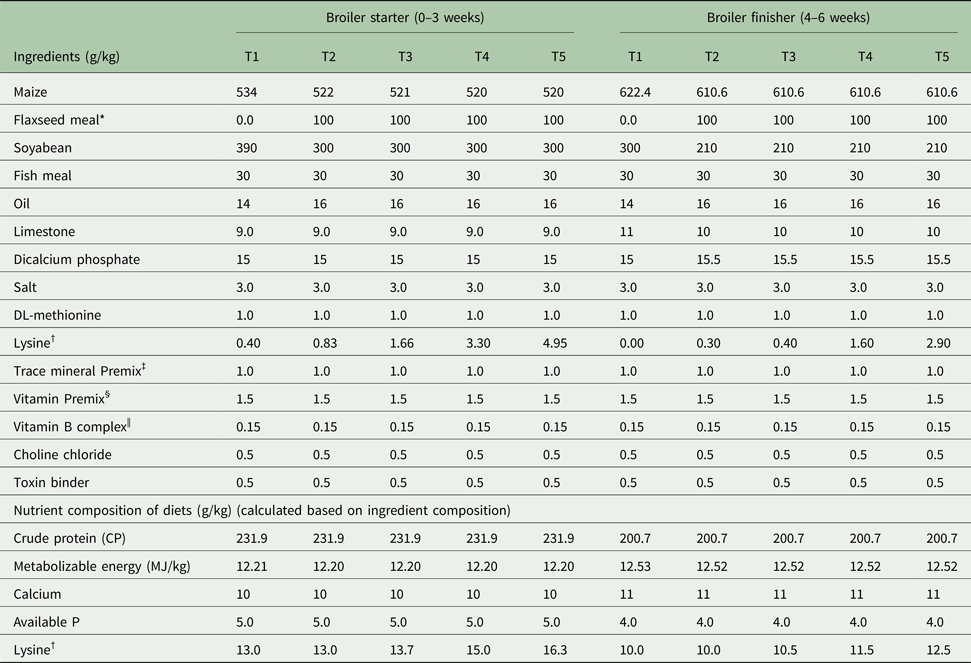
All procedures used in the experiment on the birds were reviewed and approved by Animal Ethics Committee of Indian Veterinary Research Institute, Izatnagar. Following a completely randomized design (CRD), 1-day-old straight run (sex ratio ≈1) 240 commercial broiler chicken of uniform body weight were distributed at random into 30 replicates with eight chicks in each and housed in specially designed battery brooder cages for 6 weeks. Five dietary treatments (iso-caloric and iso-nitrogenous) were formulated as per the recommendation of BIS (1992), using 100 g flaxseed meal (FM)/kg diet to replace soyabean in the basal diet and four levels of lysine (1.0, 1.05, 1.15 and 1.25 BIS recommended lysine) viz. T1 (0.0 g FM/kg & 1.0 BIS lysine), T2 (100 g FM/kg & 1.0 BIS lysine), T3 (100 g FM & 1.05 BIS lysine), T4 (100 g FM/kg & 1.15 BIS lysine) and T5 (100 g FM/kg & 1.25 BIS lysine). The ingredients and nutrient composition of broiler starter (0–3 weeks) and finisher (4–6 weeks) diets are shown in Table 1. Each dietary treatment was allocated six replicates (48 chicks/treatment) and each replicate was taken as an experimental unit. From each replicate, two birds were slaughtered at random, severing the carotid arteries, trachea, oesophagus and jugular veins, for the collection of meat samples at 42 days of age (whole breast & both thighs) without skin for meat quality analysis.
Ingredients and nutrient composition of broiler starter and finisher diets

* Protein content of soyabean meal (CP = 435 g/kg).
† T1 = 100%; T2 = 100%; T3 = 105%; T4 = 115%; T5 = 125% BIS recommended lysine (Bureau of Indian Standards).
‡ Trace mineral premix each (100 g) contains: ferrous sulphate heptahydrate (FeSO4.7H2O) 8 g, zinc sulphate heptahydrate (ZnSO4.7H2O) 10 g, manganese sulphate (MnSO4. H2O) 10 g, copper sulphate pentahydrate (CUSO4.5H2O) 1 g, potassium iodide (KI) 30 g.
§ Vitamin premix (each gm) contains: Retinol 82.5 IU, Cholecalciferol 12 000 U, dl-Tocopherol acetate 160 mg, Menadione 10 mg.
‖ Vitamin B complex (each gram) contains Thiamine 8 mg, Riboflavin 50 mg, Pyridoxine 16 mg, Cyanocobalamin 80 µg, Niacin 120 mg, Calcium.
pantothenate 80 mg, L-lysine 10 mg and DL-methionine 10 mg.
Measurements and analysis
Growth performance
The weekly body weight and feed intake was recorded to arrive at overall body weight gain, feed intake and feed conversion ratio (FCR).
Fatty acid profile
For fatty acid profile analysis, the direct and simple method of O'Fallon et al. (Reference O'Fallon2007) was followed for the preparation of fatty acid methyl ester (FAME) of meat samples. A fatty acid standard containing 37 different FAMEs was used and 0.5 µl was injected into a gas chromatograph (GC) to obtain standard peaks. The fatty acid composition of the FAME was determined by capillary GC on a CP-6173, 60 × 0.25 × 0.20 mm3 capillary column (Varian) installed on a Thermo Scientific Ceres 800 plus GC fitted with Automatic sampler AI3000, integrator and flame ionization detector. The initial oven temperature was 120 °C, held for 5 min, subsequently increased to 240 °C at a rate of 2 °C/min, and then held for 60 min. Nitrogen was used as the carrier gas at a flow rate of 1 ml/min. Both the injector and the detector were set at 260 °C. The split ratio was 30:1. Fatty acids were identified by comparing their retention times with the fatty acid methyl standards and were expressed as g/kg of total fatty acids.
Physicochemical properties
Fat content (dry basis) of fresh breast and thigh meat samples (2 g) was determined using Soxhlet extraction (AOAC 1995). Cholesterol estimation of fresh meat was done separately for breast and thigh using the method of Wybenga et al. (Reference Wybenga1970). The pH of meat samples, fresh as well as after 1 month of refrigerated storage, was measured as per the method devised by Troutt et al. (Reference Troutt1992). For the estimation of purge loss/drip loss, frozen meat samples from thigh as well as breast were taken, weighed and recorded as the initial weight (W1). The weighed samples were placed into polyethylene bags, labelled and stored hanging at 4 °C for 24 h. The meat samples were weighed again, final weight (W2) was recorded and drip loss was calculated by difference method.
The extract release volume (ERV) of fresh breast and thigh meat samples as well after 1 month of refrigerated storage was determined by the technique of Jay (Reference Jay1964). Water holding capacity of breast and thigh meat samples was determined by the method devised by Wardlaw et al. (Reference Wardlaw, Maccaskill and Acton1973) in fresh as well as in stored conditions. The Lovibond Tintometer colour (redness, yellowness and chroma) of breast and thigh meat samples was measured by Lovibond Tintometer (Model F, Greenwich, UK).
Antioxidant parameters
The antioxidant status of broiler meat was assessed by ABTS (2, 2-azinobis-3-ethylbenzothiazoline-6-sulphonic acid) and DPPH (1, 1-diphenyl-2-picrylhydrazyl) assay. Spectrophotometric (Perkin Elmer, Model: Lambda EZ 201) analysis of ABTS + and DPPH + radical scavenging activity of fresh breast and thigh meat samples as well as after 1 month of refrigerated storage was performed according to the methods of Shirwaikar et al. (Reference Shirwaikar2006) and Kato et al. (Reference Kato1988), respectively.
Lipid peroxidation parameters
The lipid peroxidation status of breast, thigh and liver samples on a fresh basis and after 1 month of refrigerated storage was assessed by the measurement of thiobarbituric acid reactive substances (TBARS) (Witte et al. Reference Witte, Krause and Bailey1970), free fatty acid and peroxide values (Koniecko Reference Koniecko1979). The TBARS value was calculated as mg MDA per kg of the sample by multiplying optical density (O.D.) value with K-factor of 5.2.
Statistical analysis
For each treatment, two meat samples were taken from each of the six allocated replicates for data collection and each replicate was taken as an experimental unit. The data obtained from the experiment were subjected to one-way analysis of variance for a CRD, using the GLM procedure of SPSS software (version 17), by the methods of Snedecor & Cochran (Reference Snedecor and Cochran1989). Significant mean differences were tested by Duncan multiple range test (DMRT) as described by Duncan (Reference Duncan1955) with a statistical significance level of P < 0.05.
Results
Growth performance
Although the results revealed no significant difference among dietary treatments, numerically higher body weight gain was observed in treatment T5 (Table 2). No dietary effect was observed on overall (0–42 days) feed intake of birds. However, overall (0–42 days) FCR of birds showed significant (P < 0.01) differences between treatments. FCR was significantly (P < 0.01) lower in T1 and T5 compared with T2, T3 and T4, which did not differ significantly from each other. This clearly indicated that FM feeding had a negative effect on FCR and this negative effect was neutralized by 1.25 BIS recommended lysine.
Growth performance of broiler chicken (n = 48)

NS, non-significant; BIS, Bureau of Indian Standards.
Fatty acid profile
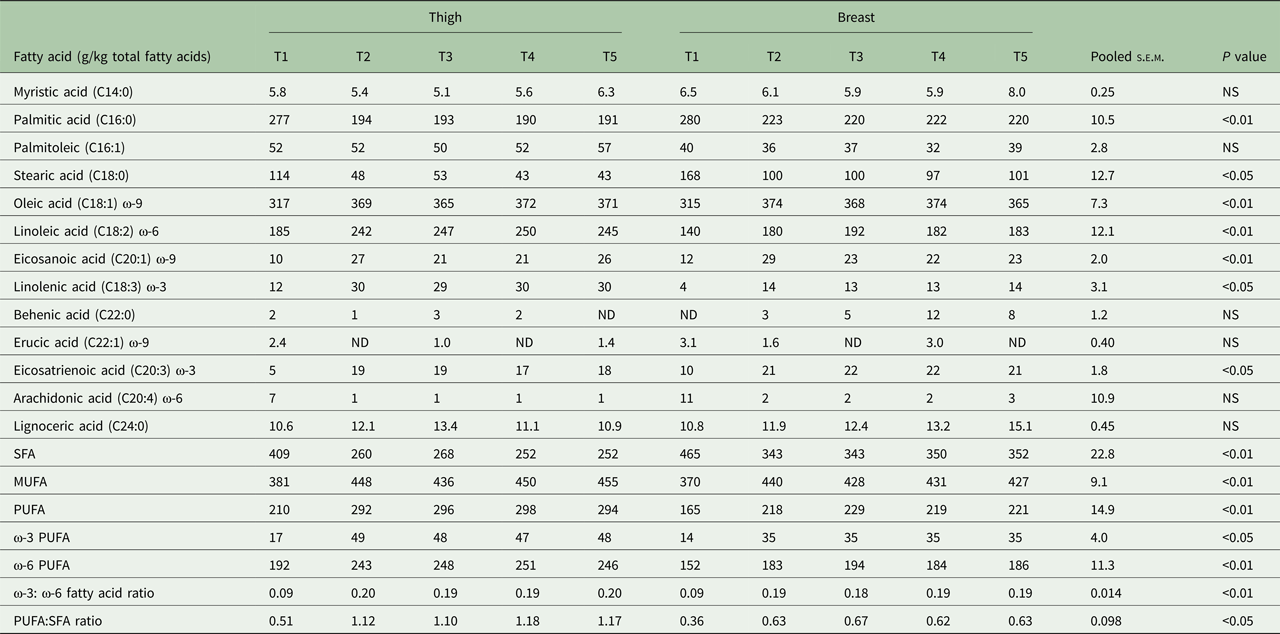
The current results showed significant differences between treatments (Table 3). Palmitic and stearic acid contents were significantly higher (P < 0.01 and P < 0.05, respectively) in treatment T1 compared with other treatments, which did not differ from each other. Again, contents of fatty acids such as oleic acid, linoleic acid, eicosanoic acid (P < 0.01), linolenic acid and eicosatrienoic acid were significantly lower (P < 0.05) in T1 compared with other treatments, which were statistically similar to each other. Further, significantly higher (P < 0.01) SFA content and lower MUFA, PUFA, ω-3 PUFA, ω-6 PUFA, ω-3: ω-6 fatty acid ratio and PUFA:SFA ratio were observed in T1, both in thigh and breast meat, as compared with other treatments, which were statistically similar to each other. These results clearly suggest that FM feeding caused a significant (P < 0.01) rise in the contents of unsaturated fatty acids (UFAs), including MUFA, PUFA, ω-3, ω-6 fatty acids, and ω-3: ω-6 & PUFA:SFR ratios, whereas a significant (P < 0.01) decline was observed in SFAs. However, treatments T2, T3, T4 and T5 with 100 g FM/kg diet and increasing lysine levels were similar to each other, indicating no effect of lysine feeding on fatty acid profile of broiler chicken meat.
Fatty acid profile of broiler chicken meat* (n = 5)

SFA, saturated fatty acids, MUFA, mono-unsaturated fatty acids; PUFA, poly-unsaturated fatty acids; ND, not detected; s.e.m., standard error of means.
* Sampling age of birds = 42 days.
Physicochemical properties
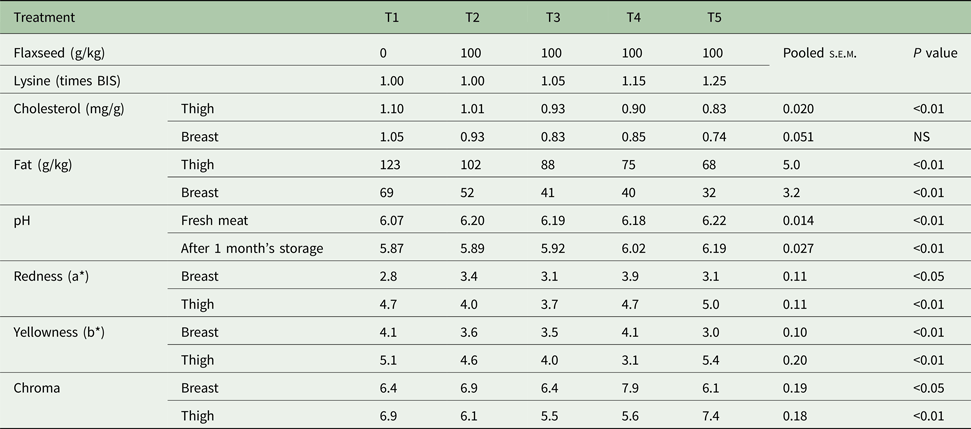
The results revealed significant (P < 0.01) dietary effects on meat cholesterol, fat content, pH and tintometer colour values (Table 4). Cholesterol content and fat content in both breast and thigh muscles reduced significantly (P < 0.01) due to the addition of 100 g FM in diet, whereas, progressive decline of the same was observed with increasing lysine levels, though the decline was not significant in the case of breast cholesterol. The pH of broiler meat, fresh as well as stored, was significantly lower (P < 0.01) in treatment T1 than other treatments and significantly higher (P < 0.01) in T5, followed by T4. No significant differences were observed in pH of fresh meat between T2, T3, T4 and T5 and between T1 and T2 in case of pH after 1 month of refrigerated storage. All these observations indicate that FM feeding caused the pH increase of fresh meat only, whereas increasing lysine levels caused a progressive rise of pH in stored meat only. Although significant effects of dietary FM and lysine (P < 0.01 and P < 0.05, respectively) were observed on all parameters of tintometer colour values of breast and thigh meat, no regular trend was observed.
Cholesterol, fat content, pH and colour of broiler chicken meat* (n = 6)

Redness = a*, Yellowness = b*, Chroma = (a*2 + b*2)1/2, s.e.m., standard error of means; NS, non-significant; BIS, Bureau of Indian Standards.
* Sampling age of birds = 42 days.
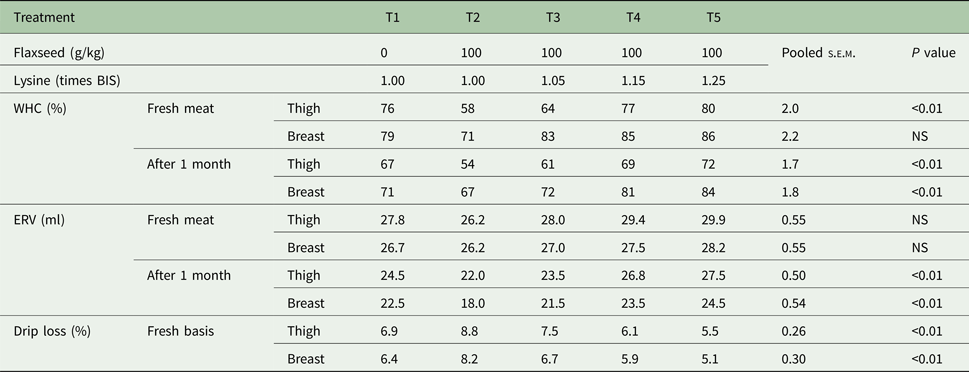
The results pertaining to WHC and ERV of breast and thigh meat, both in fresh and stored condition, revealed significantly lower (P < 0.01) values in treatment T2 and significantly higher (P < 0.01) values in T5, whereas an increasing trend was observed from T2 to T5 (Table 5). However, the differences were not significant in the case of WHC of fresh breast meat samples and ERV of fresh thigh and breast meat samples. The highest drip loss was observed in treatment T2 (P < 0.01), and lowest in T5, whereas a decreasing trend was observed from T2 to T5. These results indicated that FM feeding decreased WHC and ERV of broiler meat, whereas increasing lysine levels progressively increased them. Further, FM feeding increased drip loss of both breast and thigh samples, whereas increasing lysine levels progressively decreased it.
Water holding capacity (WHC), extract release volume (ERV) and drip loss of broiler chicken meat* (n = 6)

s.e.m., standard error of means; NS, non-significant.
* Sampling age of birds = 42 days.
Antioxidant parameters
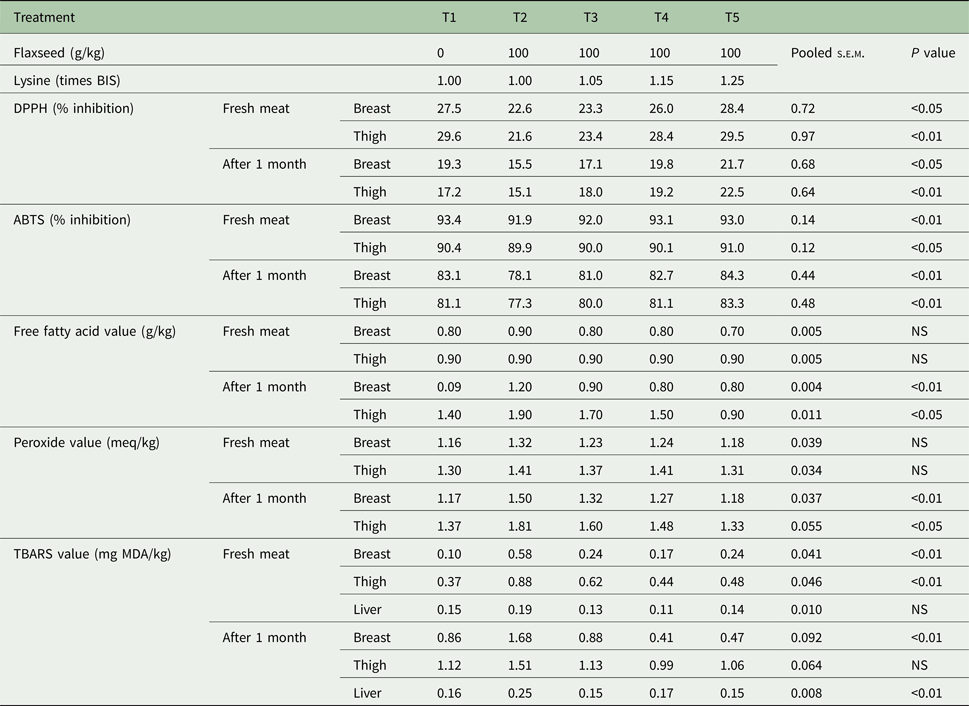
The DPPH and ABTS (% inhibition) values of meat reveal the free radical scavenging ability of the meat. The results show that significantly lower DPPH values of fresh breast (P < 0.05) and thigh meat (P < 0.01) were observed in treatment T2 and higher in T5, which was statistically similar to T1 (Table 6). A similar trend was observed in DPPH values of breast and thigh after 1 month of refrigerated storage, except that T2 and T1 were statistically similar. These observations indicated that FM feeding decreased the DPPH values of fresh meat but had no effect on the stored meat. However, with increasing lysine levels an increase in DPPH values of broiler meat was observed. Similarly, the ABTS values of fresh breast meat were found to be significantly lower (P < 0.01) in treatment T2 and higher in T1, whereas, T5 and T4 were statistically similar to T1. The ABTS value of fresh thigh meat was higher (P < 0.05) in T5 compared with other treatments but was similar to T1. Similarly, the ABTS value of breast and thigh meat after 1 month of storage revealed the significantly lower (P < 0.01) values in treatment T2 and highest in T5, which was statistically similar to that of T1. In general, an increasing trend of ABTS values was observed from T2 to T5 and T1 was significantly different (P < 0.01) from T2. All these observations suggested that FM feeding decreased the ABTS values and increasing lysine level up to 125% BIS recommendation increased the ABTS values of broiler chicken meat.
Antioxidant and lipid peroxidation parameters of broiler chicken meat* (n = 6)

BIS, Bureau of Indian Standards; DPPH, 1, 1-diphenyl-2-picrylhydrazyl; ABTS, 2, 2-azinobis-3-ethylbenzothiazoline-6-sulphonic acid; TBARS, Thio-barbituric acid reactive substances; MDA, malondialdehyde; NS, non-significant; s.e.m., standard error of means.
* Sampling age of birds = 42 days.
Lipid peroxidation parameters
Parameters such as free fatty acid value, peroxide value and TBARS value are used to assess the lipid peroxidation status of the broiler meat. The results revealed that no significant effects of FM feeding and increasing lysine levels were observed on fresh thigh and breast meat free fatty acid and peroxide values, whereas, after 1 month of refrigerated storage, significantly higher values in breast (P < 0.01) and thigh (P < 0.05) were observed in treatment T2 followed by T3 and the values were lower in T5 (Table 6). Similarly, significantly higher (P < 0.01) values of breast, thigh and liver TBARS values, both in fresh and stored conditions, were observed in treatment T2 than in other treatments, and lower in T5. In general, for all lipid oxidation parameters a progressive decreasing trend was observed from T2 to T5 and T2 was different from T1. These observations of the present study strongly suggest that FM feeding caused an increase of lipid peroxidation, whereas increasing lysine levels decreased it.
Discussion
Growth performance
The current results have shown no significant effects of FM feeding or lysine supplementation on body weight gain or feed intake of birds. However, FM feeding exerted a negative effect on FCR of birds, whereas lysine supplementation tended to reduce this negative effect. Similar results were reported by Lopes et al. (Reference Lopes2013) and Shafey et al. (Reference Shafey2014) who fed FM/flaxseed oil to birds. Similarly, Acar et al. (Reference Acar, Moran and Bilgili1991) and Corzo et al. (Reference Corzo, Moran and Hoehler2002) reported similar observations with respect to lysine supplementation in broiler chicken. However, in contrast, other researchers have reported a consistent reduction of body weight gain, feed intake and feed efficiency with increasing levels of flaxseed in the broiler diet (Rahimi et al. Reference Rahimi, Azad and Torshizi2011; Anjum et al. Reference Anjum2013), due to poor energy availability, presence of anti-nutritional factors, low digestibility of flaxseed and high viscosity of jejunal digesta. Increasing dietary levels of lysine resulted in better body weight gain, feed intake and feed efficiency of broiler chicken (Corzo & Kidd Reference Corzo and Kidd2004; Melaku et al. Reference Melaku2015). These contrasting observations can be attributed to differences in genetics and the management of birds.
Fatty acid profile
The higher proportion of UFAs in meat due to FM feeding can be attributed to a higher proportion of UFAs in FM, which undergo faster absorption in the gut. The ALA content of both breast and thigh tissues increased significantly with increasing levels of FM in broiler diet, whereas, in contrast, linoleic acid content decreased (Mridula et al. Reference Mridula2015). The incorporation of flaxseed and canola seed in the broiler diet has been shown to significantly increase the proportions of ω-3 PUFA in the form of ALA, along with increasing the PUFA and PUFA:SFA ratio (Rahimi et al. Reference Rahimi, Azad and Torshizi2011). Zuidhof et al. (Reference Zuidhof2009) reported that feeding flaxseed increased breast ω-3 fatty acid levels significantly, primarily ALA (18:3 ω-3) and eicosapentaenoic acid (C20:3 ω-3). The supplementation of diets with flaxseed/flaxseed oil significantly increased C18:3 ω-3, ω-3: ω-6 ratio, UFA:SFA ratio, and PUFA:SFA ratio in broiler chicken (Taulescu et al. Reference Taulescu2010; Anjum et al. Reference Anjum2013; Abdulla et al. Reference Abdulla2015). However, no literature citing the effects of lysine on fatty acid profile of broiler chicken meat is available.
Physicochemical properties
The decline of fat and cholesterol content due to FM can be attributed to increased UFAs which undergo rapid oxidation reactions compared to their saturated counterparts. The FM may also exert its effect through an interference with bile acid metabolism, where an increased intraluminal viscosity can (1) hinder micelle formation and thus diminish lipid uptake and (2) inhibit re-uptake of bile acids, causing increased hepatic synthesis of bile acids from cholesterol in the liver, thereby reducing its level in the body. Further, lysine serves as the source of L-carnitine, which could be used to augment carnitine supply for use in metabolism, thereby facilitating β-oxidation and so reducing the amount of long chain fatty acids available for storage in adipose tissues. The addition of 0.10 or 0.20 of either flaxseed or FM significantly decreases the lipid content in both white and dark meats (Ajuyah et al. Reference Ajuyah1991). Abdulla et al. (Reference Abdulla2015) reported a significant reduction in breast meat cholesterol due to flaxseed oil supplementation in broiler diets. Flaxseed oil supplementation to broiler diets cause a significant reduction of drumstick fat (Murakami et al. Reference Murakami2010; Lopes et al. Reference Lopes2013) and meat cholesterol (Murakami et al. Reference Murakami2010). Similarly, Duraisamy et al. (Reference Duraisamy, Senthilkumar and Mani2013) reported a decline of breast cholesterol content of broilers when fed diets containing more UFA than SFA. However, in contrast, Rahimi et al. (Reference Rahimi, Azad and Torshizi2011) observed no effect on fat content of breast and thigh muscles either by feeding flaxseed or canola seed meals and even Taulescu et al. (Reference Taulescu2010) reported significantly higher fat percentage (4.3%) at 0.15 flaxseed level compared to the control (1.96%). Dietary lysine was observed to cause significant reduction in carcass fatness (Berri et al. Reference Berri, Besnard and Relandeau2008; Bouyeh & Gevorgyan Reference Bouyeh and Gevorgyan2011), but no effect on breast and thigh cholesterol was observed, though numerically higher values were obtained at higher lysine levels (Bouyeh & Gevorgyan Reference Bouyeh and Gevorgyan2011).
The feeding of broilers with increasing flaxseed levels has been shown to result in a significant increase of muscle pH as well as redness (a*) values of breast muscle (Shafey et al. Reference Shafey2014). The contrasting observations of Betti et al. (Reference Betti2009) are that breast and thigh meat colour characteristics and functional properties such as pH of muscles were not significantly affected by feeding different levels of flaxseed (0.10 and 0.17) to broiler birds. Anjum et al. (Reference Anjum2013) also reported no effect of different dietary flaxseed levels on the pH of nuggets from broilers meat. Further, increasing the dietary lysine levels increases the ultimate pH values of broiler meat (Berri et al. Reference Berri, Besnard and Relandeau2008; Geraert & Mercier Reference Geraert and Mercier2010). However, in contrast, Tang et al. (Reference Tang2007) observed that dietary lysine had no influence on colour of breast muscle, muscle pH and the tenderness of breast fillets.
The negative effects of FM on WHC, ERV and drip loss of meat may be attributed to its ability to increase the UFA content of broiler meat, which makes it more prone to oxidation. This oxidation may generate free radicals leading to protein denaturation, thus exerting their negative effect on WHC, ERV and drip loss of broiler meat. On the other hand, lysine has a prominent role in enhancing muscle pH, reducing carcass fatness and increasing protein deposition, thereby exerting a positive effect on WHC, ERV and drip loss of meat. Moreover, it can be attributed to the fact that lysine residue is one of the major sites of damage during radical attack, thus lysine supplementation may provide alternate targets for free radicals, resulting in the stabilization of proteins in vitro. Similar to the current results, Geraert & Mercier (Reference Geraert and Mercier2010) reported that increasing dietary lysine in finishing broiler diets decreases drip loss. This effect was correlated with a higher ultimate pH value obtained with the high dietary lysine compared with low dietary supply. Berri et al. (Reference Berri, Besnard and Relandeau2008) observed that muscle drip loss revealed a significant reduction with increasing lysine levels. However, in contrast to the current findings Betti et al. (Reference Betti2009) reported that drip loss was not significantly affected by feeding different levels of flaxseed (0.10 and 0.17) to broiler birds. Tang et al. (Reference Tang2007) observed that WHC decreased significantly as dietary lysine concentration increased. Further, literature citing the effect of FM and lysine feeding in broilers on the WHC, ERV and drip loss (%) of broiler chicken meat is scarce.
Antioxidant parameters
The negative effects of FM feeding on antioxidant potential may be attributed to its ability to increase the UFA content of broiler meat, making it more prone to oxidation which results in greater generation of free radicals. Lysine serves to produce leaner carcasses with lower lipid storage in adipose tissue, which produce fewer free radicals. It has been documented that carnitine, synthesized from lysine, depresses lipid peroxidation and elevates enzymatic antioxidants activities in tissues of juvenile black sea bream (Ma et al. Reference Ma2008). In fish, it has been observed that carnitine prevents the accumulation of end products of lipid peroxidation and has effective superoxide anion radical scavenging, hydrogen peroxide scavenging and ferrous ion chelating abilities in vitro (Gulcin Reference Gulcin2006). However, no literature suggesting the impact of FM and lysine feeding on the anti-oxidant parameters of the broiler meat is available.
Lipid peroxidation parameters
Similar to the antioxidant potential the increased lipid peroxidation of broiler meat can be attributed to higher UFA content of FM and again lysine serves to counter it. Further, lysine exerts its effect via carnitine by reducing lipid peroxidation and effectively scavenging the super-oxides and peroxides in the fish meat (Wang et al. Reference Wang2017). Berthelot et al. (Reference Berthelot2012) reported increased lipid peroxidation due to the enrichment of lamb meat with UFAs. However, no literature is available suggesting the impact of FM and lysine feeding on free fatty acid and peroxide values of the broiler meat. Further, no literature is available related to the effect of lysine feeding on the TBARS value of broiler meat. However, Anjum et al. (Reference Anjum2013) found that TBARS value of both leg and breast meat showed a significant increase with increasing levels of flaxseed in diet because of increased unsaturation of broiler meat. Similar results of TBARS values were provided by Rahimi et al. (Reference Rahimi, Azad and Torshizi2011), Betti et al. (Reference Betti2009) and Abdulla et al. (Reference Abdulla2015).
Conclusion
In conclusion, the results of the present study have shown no effect of higher lysine levels and FM feeding on growth performance except the negative effect of 100 g FM/kg diet on FCR of birds which was alleviated by 1.25 BIS lysine feeding. The results revealed that 100 g FM feeding significantly improved the fatty acid profile of broiler chicken meat. Further, 100 g FM significantly reduced meat cholesterol, fat, WHC, ERV and antioxidant potential, whereas it increased the pH of fresh meat, drip loss and lipid peroxidation of broiler chicken meat. Increasing lysine levels up to 1.25 BIS recommendation increased the pH of refrigerated stored meat, WHC, ERV and antioxidant potential, whereas it significantly reduced cholesterol, fat, drip loss and lipid peroxidation of broiler chicken meat. Thus, it was concluded that inclusion of 100 g FM/kg diet and 1.25 BIS recommended lysine in the broiler chicken diet was optimum for a desirable broiler growth performance, fatty acid profile, physicochemical properties and oxidative stability of broiler chicken meat.
Acknowledgements
The authors are sincerely thankful to Ministry of Human Resource Development (MHRD) Govt. of India for providing the University Grants Commission (UGC) fellowship to the first author for his Ph.D. research. No other specific grant was availed from any agency for the research work.
Ethical standards
All procedures used in the experiment on the birds were reviewed and approved by Animal Ethics Committee of Indian Veterinary Research Institute, Izatnagar.
Statement of interest/conflict of interest
None.