I. INTRODUCTION
Polystyrene (PS) is one of the predominant polymers for producing extruded thermoplastic foams for various applications including insulation boards or thermoformed packaging. This polymer is derived from petrochemicals and is nonrenewable. Styrene as the main building block of PS is considered to be toxicologically questionable.Reference Bergamaschi, Smargiassi, Mutti, Franchini and Lucchini1,Reference Cherry and Gautrin2 In addition, hydrocarbons such as butane or pentane as well as fluorohydrocarbons such as HFC 134a or HFC 245fa still are the major industrially used blowing agents to produce thermoplastic foams.Reference Vachon and Gendron3–Reference Vo and Paquet5
The use of renewable resources, the reduction of packaging waste, and the minimization of emissions become more and more important with respect to a more sustainable economy. Traditional foam polymers as well as most of the conventional blowing agents used do not fulfill all of the requirements for sustainability. Consequently, lots of research has been conducted on the use of eco-friendly blowing agents such as inert gasesReference Vachon and Gendron3,Reference Kaewmesri, Lee, Park and Pumchusak6–Reference Park, Behravesh and Venter8 and on foaming bio-based polymers,Reference Lee, Park and Ramesh9–Reference Richards, Rizvi, Chow and Naguib12 for instance thermoplastic starch or poly(lactic acid) (PLA). These biopolymers exhibit several drawbacks with respect to certain foam applications such as trays for hot contents or cushioning products. Poor melt processing and restricted melt properties, embrittlement over time, limited heat distortion resistance for PLA, and insufficient moisture resistance for starch are the main disadvantages.
Cellulose acetate (CA) is a bio-based organic cellulose ester. Cellulose as the renewable resource is mainly obtained from wood, cotton linters or recycled paper. Therefore, the use of CA for foaming may be a sustainable approach to become independent from fossil-based polymers such as PS. CA is also odorless, nontoxic, and hypoallergenic. Thermoplastic CA, which generally has a degree of substitution of around 2.5, exhibits excellent optical, mechanical, and thermal properties comparable to those of neat PS. It also provides better heat distortion resistance, higher flexibility, and better melt properties than PLA or starch. Hence, CA may be a promising biopolymer to replace PS in certain foam applications, e.g., extrusion foamed trays for hot contents. Despite its long history, no systematic research has been conducted on foam extrusion of thermoplastic CA and only few publications are available concerning CA foams.Reference Deanin and Berner13,Reference Willett and Shogren14 In this paper, latest results of foam extrusion of thermoplastic CA are presented. The hydrofluoroolefin, HFO 1234ze, was used as a blowing agent claimed to have low global warming potential, low volatility, low flammability, and low thermal conductivity. The foam extrusion behavior, foam morphologies, and physical foam properties were investigated with respect to blowing agent content and nucleating agent concentration. Correlations between foam density, cell size, cell wall thickness, and cell density were also studied.
II. EXPERIMENTAL
A. Materials
Thermoplastic CA (BIOGRADE C7500, FKuR GmbH, Willich, North Rhine-Westphalia, Germany) was obtained as granules from FKuR Kunststoff GmbH (Willich, North Rhine-Westphalia, Germany) with a density of 1310 kg/m3 and a melt flow rate of 17 g/10 min at 230 °C under 5 kg load. HFO 1234ze supplied by Honeywell Fluorine Products Europe B.V. (Amsterdam, Netherlands) was used as physical blowing agent (PBA). Its molecular weight is 114 g/mol, its boiling point is −19 °C, and its vapor pressure at 25 °C is 490 kPa. HFO 1234ze has zero Ozone Depletion Potential and a Global Warming Potential of six carbon dioxide equivalents. To investigate the influence of the nucleating agent on the foam extrusion performance of thermoplastic CA, talc (Finntalc M05SL-AW, Mondo Minerals B.V., Amsterdam, Netherlands) was supplied by Mondo Minerals B.V. (Amsterdam, Netherlands). It has platelet geometry with a specific surface area of 9.5 m2/g and a median particle size d 50 of 2 µm. Before foam extrusion, talc was first melt compounded with thermoplastic CA to obtain a 5 wt% masterbatch. Compounding was done on an intermeshing co-rotating twin-screw extruder (EMP 26-40, TSA Industriale, S.r.l., Cernobbio, Como, Italy). The throughput was kept constant at 10 kg/h and the screw speed was set at 250 min−1.
B. Foam extrusion
The physical foam extrusion tests were carried out on a 60 mm single screw extruder (Oelikon Barmag Textile GmbH & Co.KG, Remscheid, North Rhine-Westphalia, Germany) with a length to diameter ratio (L/D) of 40:1. The extruder was equipped with a mixing screw optimized for the foam extrusion process. The last 11 D of the extruder length was temperature controlled with oil to cool the polymer melt. The blowing agent was compressed and injected into the extruder barrel through a pressure hole at 16 D using a metering system equipped with a diaphragm pump. By means of mixing elements on the screw, the blowing agent was dispersed in the melt. Extrusion-foamed strands were produced using a single strand die with a diameter D 0 of 6 mm.
C. Measurements
The investigation of the foam extrusion behavior was done with a conveyor belt with polytetrafluoroethylene (PTFE) finish. A camera system with a bright diffuse light source was installed over the conveyor belt to pick up images from the extruded foam rod. The diameter D of the extruded foam strands were measured and used to calculate the expansion ratio at the die. Foam density ρf in kg/m3 was also measured and correlated to the density of the neat polymer ρp. Porosity P was calculated from relative density ρr according to Eq. (1).Reference Gibson and Ashby15
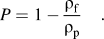 $$P = 1 - {{{\rm{\rho }}_{\rm{f}} } \over {{\rm{\rho }}_{\rm{p}} }}\quad .$$
Morphology of the extrusion-foamed strands was studied using optical microscopy (OM) and scanning electron microscopy (SEM). Five samples were characterized and the average values of cell size, cell wall thickness, and cell density were used. Cell size and cell wall thickness were measured 50-times on each sample. Cell density N c in cells/cm3 was calculated as the number of cells N in a defined area A in cm² using Eq. (2).Reference Peters16,Reference Rodrigue, Souici and Twite-Kabamba17
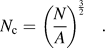 $$N_{\rm{c}} = \left( {{N \over A}} \right)^{{3 \over 2}} \quad .$$
The extrusion foamed CA was further compared with a standard XPS film typically used for tray production. The XPS film is produced with 4% butane and was obtained from Inde Plastik (Aldenhoven, North Rhine-Westphalia, Germany).
III. RESULTS AND DISCUSSION
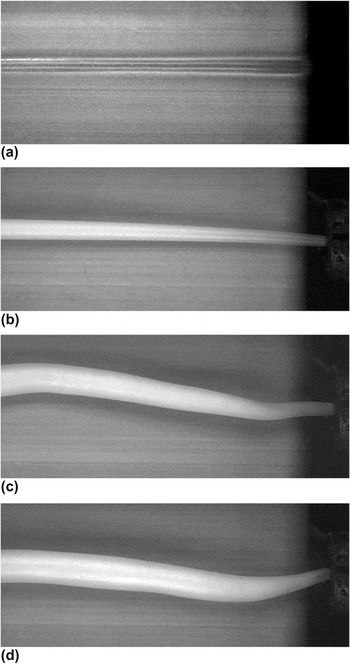
Thermoplastic CA exhibits good foam extrusion behavior, as shown in Fig. 1. However, the blowing agent concentration and the nucleating agent content significantly influence the expansion process at the die. As seen from Fig. 1(a), when HFO 1234ze is used without the nucleating agent, retarded cell nucleation and cell growth are observed. The addition of talc as a nucleating agent improves the foaming behavior of thermoplastic CA significantly, which is seen in Fig. 1(b). The expansion of thermoplastic CA foamed with 2% HFO 1234ze and 0.8 wt% talc starts directly at the die. Talc as a nucleating agent decreases the energy barrier for cell nucleation in the polymer melt. The cell nucleation rate increases and cells grow faster in shorter time due to reduced diffusion distances of the gas molecules. Naguib et al.Reference Naguib, Park, Lee and Xu4,Reference Naguib, Park and Lee18 studied the effect of talc on the volume expansion of polypropylene (PP). They also observed an improvement in volume expansion of PP up to 0.8 wt% talc. For higher talc content, they found a decrease in volume expansion. However, one of the most important factors affecting the foaming behavior of polymer is the amount of injected and dissolved blowing agent. It is well known that a higher amount of blowing agent, which is dissolved in the polymer melt without premature supersaturation, leads to a stronger expansion at the die and causes an increase in the diameter of the strand. This is in good agreement with the results obtained for HFO 1234ze, as seen in Figs. 1(c) and 1(d). An increase in HFO 1234ze content leads to a continuous increase in expansion at the die.
Foam expansion behavior of thermoplastic CA depending on HFO 1234ze concentration and talc content. With (a) 2% HFO 1234ze, (b) 2% HFO 1234ze + 0.8 wt% talc, (c) 2.5% HFO 1234ze + 0.8 wt% talc, and (d) 3% HFO 1234ze + 0.8 wt% talc.

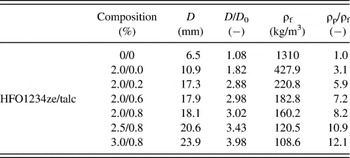
Table I shows the physical foam properties, strand diameter D, expansion ratio D/D 0, foam density ρf, and foaming ratio ρp/ρf depending on HFO 1234ze concentration and talc content. As seen from Fig. 1 and Table I, strand diameter D and expansion ratio D/D 0 increase considerably with increasing content of HFO 1234ze. Higher amounts of the dissolved blowing agent result in stronger expansion at the die. By comparison, an increase in talc content does not have a similar strong influence on the diameter D and expansion ratio D/D 0 of the strands. When 2% HFO 1234ze is added as a blowing agent, the density of CA decreased about three-times. Talc when used as a nucleating agent improves cell nucleation rate and leads to higher cell density and higher porosity P. As a result, foam density decreases continuously with increasing talc content within the range studied in this paper. Michaeli and SchumacherReference Michaeli and Schuhmacher19 also investigated the effect of talc on foam density of polyethylene foams. They also reported a slight decrease of foam density at low talc content. Above 1 wt% talc, they found a slight increase in foam density with increasing talc content.
Strand diameter D, expansion ratio D/D 0, foam density ρf, and foaming ratio ρp/ρf of extrusion-foamed thermoplastic CA depending on HFO 1234ze concentration and talc content.

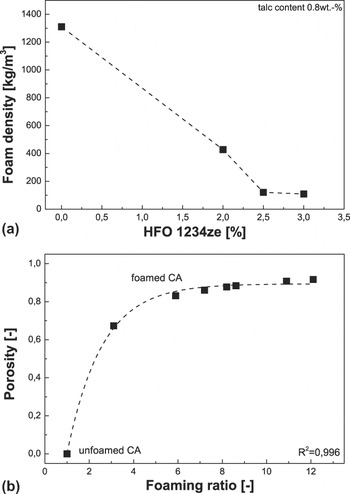
An additional increase in HFO 1234ze concentration at constant talc content results in further density reduction. This can be seen from Fig. 2(a) or Table I. The more HFO 1234ze is injected and dissolved in the CA melt, the more blowing agent is available for expansion at the die and density reduction. However, premature supersaturation must be avoided. Maximum porosity P of 92% was achieved for extrusion-foamed thermoplastic CA using 3% HFO 1234ze and 0.8 wt% talc. From Fig. 2(b) it can be seen that the porosity P increases with increasing expansion ratio D/D 0. No significant increase in porosity P was observed at expansion ratios higher than 10, indicating that maximum level of porosity P is reached for the content range of HFO 1234ze and talc investigated in this study. The foam density of the commercial XPS film from Inde Plastik is 88 kg/m3 and the foaming ratio ρp/ρf is 11.9, respectively. Thus, the values obtained for extrusion-foamed CA come very close to the ones of the standard XPS film.
(a) Foam density of extrusion-foamed thermoplastic CA as a function of HFO 1234ze content and (b) porosity P as a function of foaming ratio ρp/ρf.

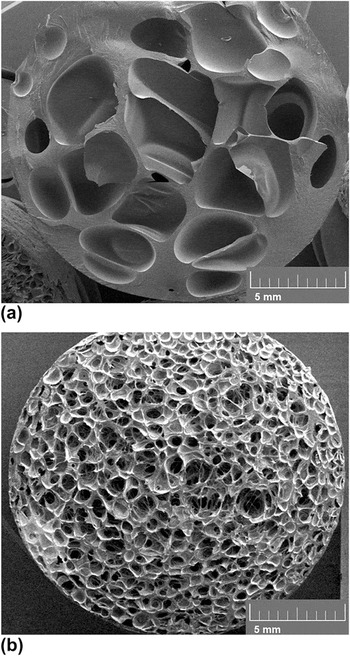
SEM images in Figs. 3(a) and 3(b) confirm the previous results. When only HFO 1234ze is added, coarse inhomogeneous foam morphology is observed. The cell nucleation is restrained in the absence of talc, and thus, cell growth is predominant yielding large cells with inhomogeneous distribution. Talc when added leads to heterogonous cell nucleation, which considerably increases the cell nucleation rate. Consequently, finer and more homogenous foam morphology with higher cell density is obtained.
SEM images of thermoplastic CA extrusion-foamed with (a) 2% HFO 1234ze and (b) 2% HFO 1234ze + 0.8 wt% talc (magnification 12x).

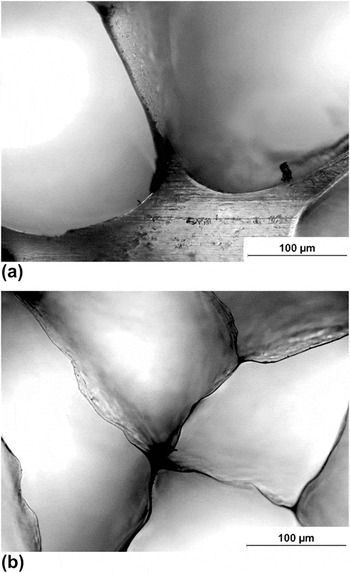
Nevertheless, too high talc contents can cause agglomeration effects of the nucleated cellsReference Michaeli and Schuhmacher19 and can result in cell collapse.Reference Heinz20,Reference Ito, Yamashita and Okamoto21 As a consequence, an increase in foam density and in open cell content may occur upon using too much talc. This was confirmed by Naguib et al.Reference Naguib, Park, Lee and Xu4,Reference Naguib, Park and Lee18 As can be seen from OM images in Figs. 4(a) and 4(b), extrusion-foamed thermoplastic CA exhibits a closed-cell structure within the content range of HFO 1234ze and talc investigated in this study.
OM images of thermoplastic CA extrusion-foamed with (a) 2% HFO 1234ze + 0.8 wt% talc and (b) 3% HFO 1234ze + 0.8 wt% talc (transmitted light; magnification 200x).

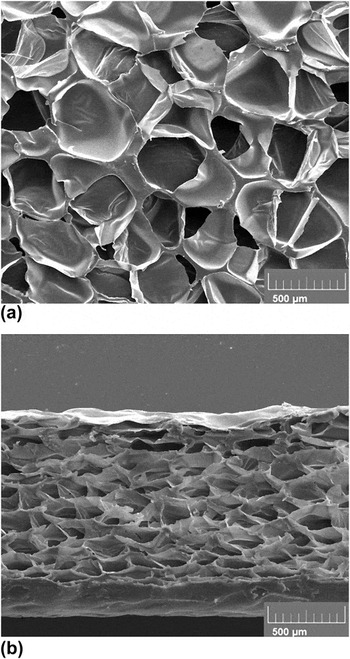
In Fig. 5, foam morphology of extrusion-foamed CA is compared to the commercial XPS film from Inde Plastik. Both foams exhibit closed cells with homogeneous cell size distribution. However, the standard XPS film shows a higher cell density and thinner cell walls.
Comparison of (a) extrusion-foamed CA strand (2% HFO 1234ze + 0.8 wt% talc) with (b) commercial extrusion-foamed XPS film (4% butane) from Inde Plastik (SEM; magnification 100x).

At this point, it should be explicitly emphasized that at this stage of our research the comparison of CA and XPS materials is only an indicative one because there are significant differences in foam production. The standard XPS is produced with butane on an industrial tandem extrusion line as film, whereas we produced extrusion-foamed CA strands with HFO 1234ze on a single screw extruder in lab scale. Further differences can be found in the blowing agent concentration and talc content. Irrespective of these differences, one can conclude that the morphology of extrusion-foamed CA is promising for potential XPS replacement in the future.
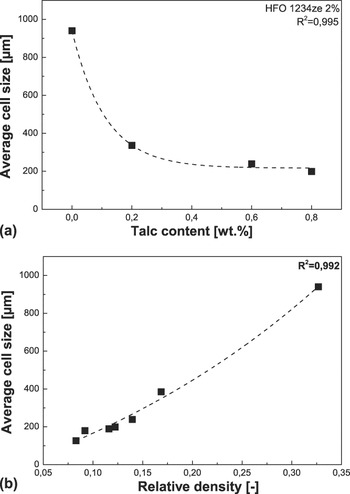
Quantitative analysis of the foam structure supports the qualitative morphology investigations from OM and SEM. Figure 6(a) shows the average cell size depending on the talc content at constant HFO 1234ze concentration. As expected, the average cell size decreases continuously with increasing talc content due to higher cell nucleation rate. There seems to be a level-off in cell size reduction at 0.8 wt% talc because no tremendous decrease in cell size was found between 0.6 and 0.8 wt% talc.
Average cell size of extrusion foamed thermoplastic CA (a) as a function of talc content and (b) as a function of relative density.

The lower the relative density ρr of the CA foam, the lower its average cell size, as shown in Fig. 6(b). A power law correlation can be applied to describe the relationship between average cell size and relative density ρr of the extrusion-foamed thermoplastic CA [Eq. (3)].
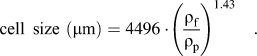 $${\rm{cell \,\;size\,\, (\mu m)}} = {\rm{4}}496 \cdot \!\left( {{{{\rm{\rho }}_{\rm{f}} } \over {{\rm{\rho }}_{\rm{p}} }}} \right)^{1.43} \quad .$$
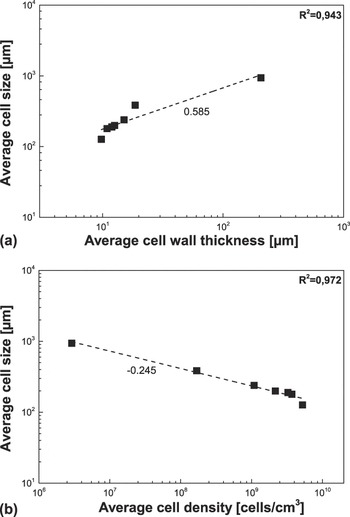
Figure 7 shows correlations between cell size and cell wall thickness as well as cell density. As the average cell size decreases, the average cell wall thickness also decreases, whereas the average cell density steadily increases. In other words, an increase in cell density is often associated with a higher amount of smaller cells. Ito et al.Reference Ito, Yamashita and Okamoto21 and Ema et al.Reference Ema, Ikeya and Okamoto22 also investigated the relationship between cell size, cell wall thickness, and cell density for polycarbonate-based nanocomposite foams and polylactide-based nanocomposite foams, respectively. They found similar trends in their studies. However, the values of the slopes are slightly different from the values obtained here. There are different possible explanations for the deviations. On one hand, they only measured the average cell size from SEM and then calculated the average cell density and average cell wall thickness from porosity and mean cell size. By comparison, we measured cell size, cell wall thickness as well as cell density. On the other hand, dissimilarities could be at least attributed to different foaming behaviors of the differing polymers, blowing agents, and nucleating agents used.
Average cell size of extrusion-foamed thermoplastic CA (a) as a function of average cell wall thickness and (b) as a function of average cell density.

IV. CONCLUSION
Foam extrusion tests of thermoplastic CA were conducted using HFO 1234ze as low global warming PBA and talc as nucleating agent. Foam extrusion behavior, foam morphology, and typical foam properties such as foam density were studied in detail. Thermoplastic CA exhibits excellent foam extrusion characteristics and good expansion behavior at the die. The expansion ratio of the extrusion-foamed strands increases with increasing HFO 1234ze content. An increase in talc content has only a slight influence on the strand diameter and the expansion ratio. Foam density decreased continuously from 428 up to 109 kg/m3, whereas porosity P increased steadily up to 92%. The CA foams exhibit a closed-cell structure. The use of HFO 1234ze without a nucleating agent results in coarse inhomogeneous foam morphology. Significant improvements in foam morphology are observed, when talc is added as the nucleating agent. Due to the heterogeneous cell nucleation in the presence of talc, finer and more homogeneous foam morphologies are achieved. This results in higher cell densities, lower cell sizes, and lower cell wall thicknesses of the extrusion-foamed thermoplastic CA. Decreasing average cell size leads to an increase in average cell density as well as a decrease in the cell wall thickness in this system. Finally, physical foam properties such as foam density as well as the foam morphology are close to or even comparable to a commercial XPS film typically used for tray production. As a result, thermoplastic CA is a promising bio-based polymer to substitute XPS in certain foam applications in the future.
Further studies will be carried out using mixtures of different eco-friendly blowing agents such as CO2 and HFO 1234ze. Additional types of nucleating agents, for instance nano-scaled particles, will be used to achieve further improvements in foam morphologies. Finally, the relationship between foam morphology and the mechanical properties of the extruded CA foams will be investigated.
ACKNOWLEDGMENTS
This work was funded by the Federal Ministry of Food, Agriculture and Consumer Protection BMELV and the Agency for Renewable Resources FNR (FKZ: 22023106). The authors thank FKuR Kunststoff GmbH, Honeywell Fluorine Products Europe B.V., and Mondo Minerals B.V. for material supply.