Introduction
The diamondback moth, Plutella xylostella (Linnaeus) (Lepidoptera: Plutellidae), is a global pest of Brassica Linnaeus (Brassicaceae) crops. In North America, the first report of diamondback moth was in 1854, in Illinois, United States of America (Fitch Reference Fitch1855), and by 1885 it was reported in the Canadian Prairies (Fletcher Reference Fletcher and Fletcher1891). Diamondback moth has since become a major pest in western Canada mainly attacking canola, Brassica napus Linnaeus and B. rapa Linnaeus (Brassicaceae), a commercial oilseed crop developed in the 1970s (Slinkard and Knott Reference Slinkard and Knott1995). Canola is one of Canada’s most valuable crops, contributing an estimated CAD$26.7 billion annually to the Canadian economy (Canola Council of Canada 2016). The main growing region is in the Prairie Provinces – Alberta, Saskatchewan, and Manitoba – where 98% of Canada’s canola is grown (Statistics Canada 2017). In eastern Canada, annual diamondback moth infestations occur in vegetable Brassicaceae, mainly the B. oleracea Linnaeus varieties of broccoli, Brussels sprouts, cabbage, and cauliflower (Howard et al. Reference Howard, Garland and Seaman1994). In recent years, canola acreage has increased in eastern Canada, which may provide additional host plants for diamondback moth infestation and outbreak. In western Canada, major outbreaks in 1995 and 2001 resulted in spraying of pesticides on 1.25 and 1.8 million hectares of canola, respectively, (Dosdall and Mason Reference Dosdall, Mason and Williams2010). This, combined with the potential for developing resistance to insecticides (Sarfraz et al. Reference Sarfraz, Keddie and Dosdall2005) and the lack of alternative control strategies (Dosdall and Mason Reference Dosdall, Mason and Williams2010), has led to renewed interest in revisiting the life history of the diamondback moth.
From 1954 through 1970, D.G. Harcourt conducted extensive research on the life history and population dynamics of the diamondback moth at the Experimental Farm in Ottawa, Ontario, Canada (Harcourt Reference Harcourt1954, Reference Harcourt1957, Reference Harcourt1960a, Reference Harcourt1960b, Reference Harcourt1963, Reference Harcourt, Talekar and Griggs1986). Outcomes of this research have been widely cited in publications on the dynamics and management of diamondback moth (Sarfraz et al. Reference Sarfraz, Keddie and Dosdall2005; Nedorezov et al. Reference Nedorezov, Löhr and Sadykova2008; Dosdall and Mason Reference Dosdall, Mason and Williams2010). However, Harcourt’s results from 50 years ago may no longer be representative of the present-day dynamics of this pest. Changes in climate and land use may have altered the population dynamics of the moth and its natural enemies. To better inform decision-making on control initiatives, such as the potential release of exotic biological control agents, a fresh look at the factors that drive diamondback population dynamics on the Central Experimental Farm is needed.
One factor that has the potential to increase the frequency and severity of diamondback moth outbreaks is temperature (Dosdall et al. Reference Dosdall, Weiss, Olfert, Mason, Soroka, Shelton, Collins, Youjun and Qingjun2006, Reference Dosdall, Zalucki, Tansey and Furlong2012). Over the five decades since Harcourt’s studies, southern Canada (Bonsal et al. Reference Bonsal, Zhang, Vincent and Hogg2001), and southern parts of Ontario in particular (Wazneh et al. Reference Wazneh, Arain and Coulibaly2017), have experienced fewer days with extreme low temperatures and more days with extreme high temperatures in winter and spring. Diamondback moth is considered a seasonal migrant, unable to tolerate typical winter conditions in Canada (Harcourt Reference Harcourt1954, Reference Harcourt1963; Dancau et al. Reference Dancau, Mason and Cappuccino2018). In western Canada, its arrival in spring coincides with strong southerly airflow coupled with mass emergence of adults from brassicaceous crops in the southern United States of America and northern Mexico (Dosdall et al. Reference Dosdall, Weiss, Olfert, Mason, Soroka, Shelton, Collins, Youjun and Qingjun2006). A decrease in extreme cold in winter could allow diamondback moth to overwinter further north and arrive earlier in Ontario. Harcourt observed 4–6 overlapping generations per year in the 1950s and 1960s (Harcourt Reference Harcourt1954; Harcourt and Cass Reference Harcourt and Cass1966). Increasing night-time temperatures during the summer (Bonsal et al. Reference Bonsal, Zhang, Vincent and Hogg2001; Wazneh et al. Reference Wazneh, Arain and Coulibaly2017) together with an earlier arrival of migrants in the spring could result in an increase in the number of generations per year in Ontario.
Increasing temperatures may also alter pest population dynamics by differentially affecting the pest and its natural enemies. Diamondback moth was shown to tolerate higher temperatures than the larval parasitoids Cotesia vestalis (Haliday) (Hymenoptera: Braconidae) (Machekano et al. Reference Machekano, Mvumi and Nyamukondiwa2018), Diadegma insulare (Cresson) (Hymenoptera: Ichneumonidae) (Bahar et al. Reference Bahar, Soroka and Dosdall2012), and D. semiclausum (Hellén) (Hymenoptera: Ichneumonidae) (Dosdall et al. Reference Dosdall, Zalucki, Tansey and Furlong2012; Furlong and Zalucki Reference Furlong and Zalucki2017). Projected higher temperatures by 2070 are predicted to favour diamondback moth over D. semiclausum, reducing the efficacy of this important biological control agent over much of eastern Australia (Furlong and Zalucki Reference Furlong and Zalucki2017).
After Harcourt’s original study in 1954, urban sprawl in the Ottawa area began to expand around the western and southern borders of the Central Experimental Farm, in areas that had previously been farmland (MacOdrum Library 2019; University of Toronto Libraries 2019). This increasing urbanisation might have influenced the persistence of natural enemies through habitat loss, habitat fragmentation, urban heat island effects and increased pollution (McIntyre Reference McIntyre2000; Gagné and Fahrig Reference Gagné and Fahrig2010). In addition, the stress caused by urbanisation on host plants has the potential to benefit herbivorous pests (Dale and Frank Reference Dale and Frank2014).
Changes in temperature and land use, as well as other factors, including changes in crop diversity, soil nutrients, and insecticide use over the past five decades since Harcourt’s life table study in 1970 have potentially altered diamondback moth population dynamics. Thus, our goal was to gather new baseline data on diamondback moth and its natural enemies to inform future control strategies. Like Harcourt, we adopted a life table approach. Harcourt built his life tables with data from destructive samples of thousands of naturally infested cabbage heads, taken at intervals corresponding to transitions between life stages. We limited destructive sampling of naturally infested plants to twice per summer, instead focusing our efforts on a sentinel-based approach (Van Driesche et al. Reference Van Driesche, Bellows, Elkinton, Gould and Ferro1991), exposing cohorts of laboratory-reared eggs, larvae, and pupae in the field to build a stage-based life table.
The data we obtained were qualitatively compared to those in the Harcourt (Reference Harcourt1954, Reference Harcourt1957, Reference Harcourt1960a, Reference Harcourt1963, Reference Harcourt, Talekar and Griggs1986) publications to determine whether there have been changes in the occurrence and strength of mortality agents – abiotic factors, parasitoids, and predators – acting on the diamondback moth during its various life stages. Using two life table methods, we can compare the older destructive sampling-based life table with the newer sentinel-based approach. In addition, by deploying pheromone traps and obtaining climate data, we examine the potential for overwintering, the spring arrival date, number of generations, and length of the diamondback moth “season.” Our contemporary life table study on the Central Experimental Farm represented a unique opportunity to revisit a historical ecological study at the same site.
Materials and methods
Field site
The study was conducted on the Central Experimental Farm (45°23′21.1″N, 75°43′19.5″W) from 2016 to 2017. Cabbage seedlings, Brassica oleracea variety Adaptor, were planted in May of each year in a 10 m × 10 m tilled plot with plants spaced every 0.5 m in rows 1 m apart. In the Harcourt (Reference Harcourt1954, Reference Harcourt1961) studies, multiple small plots (e.g., 5 m × 5 m or 7 m × 7 m) were sampled in large fields (1–2 ha). Twenty spots within the plot were randomly selected and left unplanted to contain experimental plants (sentinels). A buffer zone of 44 cabbage plants was planted 1 m from the edge, with 1 m between cabbages. The buffer zone was planted to allow detection of incursions from groundhogs, Marmota monax (Linnaeus) (Rodentia: Sciuridae), and other herbivorous Mammalia before they reached the experimental plants.
Plants were watered as needed based on temperature and rainfall. No chemical intervention was used; all plot maintenance was done manually. The crop surrounding the experimental plot was barley, Hordeum vulgare Linnaeus (Poaceae), in 2016 and soybean, Glycine max Linnaeus (Fabaceae), in 2017. Experimental plots of canola, as well as volunteer canola plants, were present within 0.5 km of our plot.
Climate data
Temperature above ground was taken with an air temperature logger contained in a solar radiation shield (Onset HOBO U23, Onset Computer Corporation, Bourne, Massachusetts, United States of America) located 1.5 m above the ground surface at the centre of the plot. Ground-level temperature was recorded using a soil probe (Tinytag TGP-4017, Gemini Data Loggers, Chichester, West Sussex, United Kingdom) buried 1 cm below ground, with the sensor at surface level. Rainfall and snow depth data were retrieved from the National Climate Data and Information Archive (Environment and Climate Change Canada, Ottawa, Ontario, Canada) from the weather station located on the Central Experimental Farm (Ottawa CDA RCS, World Meteorological Organization identifier: 71063).
Pheromone traps
To confirm the natural occurrence of diamondback moth within the plot at the Central Experimental Farm, two delta traps (Cooper Mill, Madoc, Ontario, Canada) were set up on the north and south sides of the plot. Traps were equipped with a sticky liner and a diamondback moth pheromone lure (Cooper Mill) suspended in the centre of the trap. The liner was changed weekly and the lure was changed every two weeks. Traps were established on 11 May 2016 and 5 April 2017 and taken down at first snowfall: 23 November 2016 and 19 November 2017, respectively.
Destructive sampling-based life table
To construct his life tables, Harcourt (Reference Harcourt1961, Reference Harcourt1963) destructively sampled mature cabbage plants on dates corresponding to developmental stages observed in a separate field cage. To facilitate comparisons with Harcourt (Reference Harcourt1961, Reference Harcourt1963), we destructively sampled mature cabbage plants from the plot once in July and once in late August of both years. We observed substantial overlap in generations where all life stages were present at each sampling date. This sampling method allowed us to examine natural infestation rates of diamondback moth in the plot and to estimate parasitism. However, we were not able to assess the reduction of individuals for each life stage transition as Harcourt had done in his studies, because that would have necessitated a plot large enough to support the destructive sampling of 1280–1600 cabbages, depending on the number of generations (Harcourt Reference Harcourt1961). In each sampling period, approximately 70 plants were randomly harvested and replaced in the plot with greenhouse-grown cabbage seedlings. Cabbage heads were examined in the laboratory and the number of diamondback moth individuals in each life stage was recorded for each plant sample. The eggs, larvae, and pupae recovered from these samples were kept in rearing containers and maintained in laboratory conditions (22 ± 1 °C degrees at 60% relative humidity, 16-hour light) to assess parasitism levels.
Sentinel-based life table
Laboratory-reared diamondback moth eggs, larvae, and pupae were introduced into the field plot on 3–6-week-old plants (5–8 true leaf stage) grown in the greenhouse using 15.24 cm diameter fibre pots (The HC Companies, Twinsburg, Ohio, United States of America). Younger cabbage plants were easier to handle than mature cabbage plants and were more suitable for host acceptance (Moreira et al. Reference Moreira, Teixeira, Santos, Valim, Maurício and Guedes2016). Plants infested with sentinel diamondback moth life stages in the laboratory were placed in randomly assigned unplanted spots in the plot, partially buried up to the pot rim in a shallow hole. Half of the plants were randomly assigned to a cage treatment, which allowed us to assess background mortality of diamondback moth life stages when natural enemies were excluded. Cylindrical plant cages 45.72 cm in diameter were fitted with an insect-rearing bag (DC3148; Megaview Science Company, Taichung, Taiwan), similar to the exclusion cages used by Furlong et al. (Reference Furlong, Shi, Liu and Zalucki2004) (Supplementary Fig. 1). Plants were left in the field until the sentinels were transitioning to the next life stage, as determined by observations supplemented with a modified degree-day developmental model for diamondback moth (Butts and McEwen Reference Butts and McEwen1981) based on air temperature data at the plot. The plants were brought back to the laboratory, where sentinel individuals were counted and reared to assess parasitism levels and additional mortality. In 2016, data were collected on sentinel eggs, larvae, and pupae for two generations (July and August). In 2017, data were collected for four generations of sentinels (May, June, July, and August).
Sentinels were sourced from a laboratory colony that had been founded in 2000 from a local wild population. The colony was reared on canola until May 2016, when the host plant was changed to cabbage (variety Adaptor) prior to commencing the life table study. Adult moths were fed a 10% honey-sucrose solution and were reared at 22 ± 1 °C at 60% relative humidity, with 16-hour light.
Sixty cabbage plants (variety Adaptor) were infested with sentinel eggs using an oviposition cage customised from a tall insect-rearing cage (BugDorm 4F3074; Megaview Science Company, Taichung, Taiwan) modified with additional sleeved entry holes (Supplementary Fig. 2). An individual leaf from a single plant was placed through each entry hole and the sleeve was tied around the petiole. Adult moths were introduced into the cage along with a vial of 10% sucrose solution as a food source and left to oviposit overnight. The following day, the leaves were removed from the sleeves and the eggs were counted using a microscope light source and magnifying visors.
To obtain 60 plants with sentinel first instars, eggs obtained using the oviposition cages were allowed to hatch. First instars were counted using a magnifying visor and unhatched eggs were removed.
In 2016, 20 plants were each infested with 30 second instars from the laboratory colony before being transferred to the field plot, where they were left until late fourth instar. In 2017, 20 plants with 30 second instars were left in the plot until they neared completion of third instar. A second set of 20 plants each infested with 20 fourth instars was transferred to the plot and left until the larvae had transformed into prepupae.
To obtain sentinel pupae, 60 plants were each infested with 20 late fourth instars and left in laboratory conditions overnight to transition to prepupae/pupae. Larvae that had not pupated by morning were removed from the plants. Pupae were then counted and the plants were transferred to the plot.
To estimate female fecundity for use in the life table analyses, nine females from the laboratory colony were placed individually in 240-mL plastic deli containers with two males, a 10% sucrose solution and a cabbage leaf disc, and maintained at 21 ± 1 °C, 60% relative humidity, and 16-hour light. Because fecundity varies among Brassica species and even cultivars (Zhang et al. Reference Zhang, Lu, Zalucki and Liu2012), we used the same cultivar, Adaptor, that was used in the rearing and the field plot. Leaf discs were changed daily and eggs counted until the females no longer laid eggs or had died.
Assessment of mortality factors and construction of the life tables
Separate life tables were constructed for 2016 and 2017. To ensure sufficient numbers to generate meaningful rates for all mortality factors, data were pooled over the two runs in 2016 and the four runs in 2017. Mortality rates were calculated indirectly from field data and applied to a hypothetical cohort of 1000 eggs to construct the life table.
In most life table studies, many individuals are killed by unknown mortality factors or simply disappear. Rainfall is a notable source of mortality of diamondback moth larvae (Harcourt Reference Harcourt1963). In 2016, we attempted to measure mortality due to rainfall by adding a rain shelter treatment; however, this treatment failed to reveal differences in mortality compared to unsheltered plants and was discontinued (median per cent recovery with shelters = 43.75, interquartile range = 65.76; median per cent recovery without shelters = 60.00, interquartile range = 62.14; n = 160, Mann–Whitney rank sum test P = 0.33). Mortality caused by rain is therefore included under “abiotic and unknown mortality” in the life tables.
Individuals in the uncaged treatment that were not recovered were assumed to have succumbed to predation or “abiotic and unknown mortality.” To estimate predation, we subtracted the mortality observed in the caged treatment from the mortality observed in the uncaged (exposed) treatment. This assumes that the mortality in the uncaged treatment in excess of the mortality found in the caged treatments was entirely due to predation and not due to individuals leaving the host plant. This is a reasonable assumption since younger instars tend to remain on the leaves of the host plant (Harcourt Reference Harcourt1957).
To estimate parasitism for each host life stage, we incorporated the numbers of individuals exposed, the numbers of individuals recovered, and the total numbers of individuals emerged (parasitoids + adult moths) into the calculation (equation 1). This calculation included an estimate (correction) of parasitoid-induced mortality (i.e., individuals that did not emerge) as well as the numbers of parasitoids emerged. The estimate assumes that parasitism levels determined by numbers of parasitoids and moths that had emerged are the same for the individuals that were recovered but had died in the laboratory.
 $${{\rm Parasitism \,=\, (((}}{{{N}}_{{{\rm parasitoids\,\, emerged}}}}{{/}}{{{N}}_{{{\rm moths + parasitoids\,\,emerged}}}}{{)}}\,{{ \times }}\,{{{N}}_{{{\rm recovered}}}}{{)/}}{{{N}}_{{{\rm exposed}}}}{{)}}\,{{ \times }}{{\rm {100\%} }}$$
where N is the number of individuals.
To estimate “abiotic and unknown mortality,” we added the background mortality observed in the caged treatments to mortality of individuals that died after being recovered in the uncaged treatments and then subtracted the difference between the corrected parasitism and the parasitism based on emergence.
We assumed sentinel eggs recovered from the exposed treatment that failed to hatch later were infertile. Infertility was calculated directly as a per cent of all sentinel eggs exposed. The mortality data were then applied to the hypothetical cohort of 1000 eggs. Mortality factors were expressed as apparent mortality, k-values and generational mortality, as described in Bellows et al. (Reference Bellows, Van Driesche and Elkinton1992). Apparent mortality by stage is calculated as q s = d s/l x, where l x is the number of individuals entering each stage and d s is the number dying in that stage. Apparent mortality by factor is calculated as q x = d x/l x, where l x is the number of individuals being subjected to each mortality factor and d x is the number of individuals dying from each mortality factor. k-Values (k x) are a density-independent index of survival for each contemporaneous mortality factor calculated as the negative log transformation of the proportions of individuals surviving each factor k x = −log10 (1 − m x) where m x is the marginal probability of dying (marginal attack rate) for each contemporaneous mortality factor calculated as
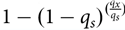 $$1 - {(1 - {q_s})^{({{{q_x}} \over {{q_s}}})}}$$
. Being log-transformed, k-values for stages or factors are additive. The sum of the k-values across all life stages yields total generational mortality, K G. Generational mortality can also be expressed as a percentage for each mortality factor calculated as 100k x/K G.
The number of surviving adults out of the hypothetical cohort was divided by two to yield the number of females, assuming a 1:1 sex ratio (Harcourt Reference Harcourt1957). This value was multiplied by the fecundity estimated in the laboratory to calculate the potential number of F1 progeny. The potential number of progeny was divided by 1000 to determine the net reproductive rate of the population (R 0), which is an indicator of whether the population is growing (R 0 > 1) or declining (R 0 < 1).
Natural enemies
Parasitoids that emerged from field-collected diamondback moth individuals placed in rearing were stored in 70% ethanol. Identification of parasitoids was confirmed by taxonomic experts at the Canadian National Collection of Insects, Arachnids, and Nematodes in Ottawa, Ontario, Canada.
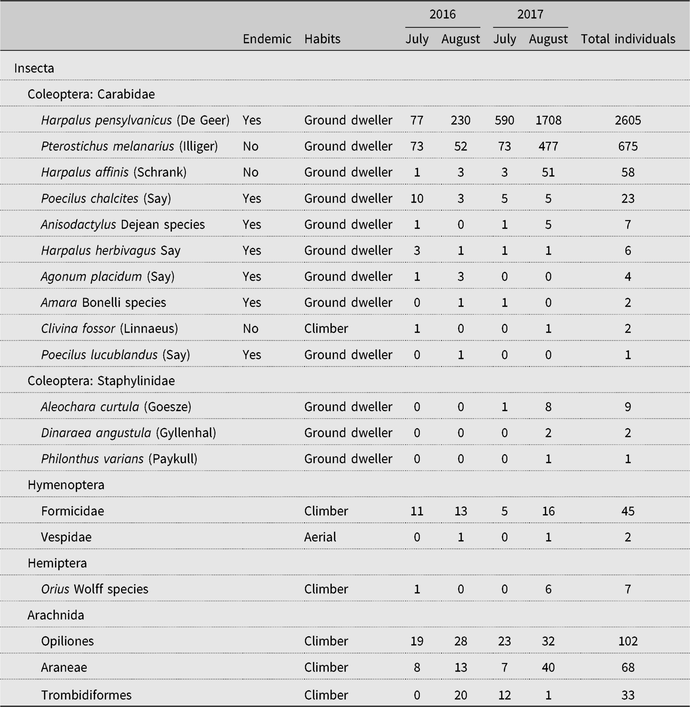
Pitfall traps were set out to identify potential ground-dwelling predators in the experimental plot. Plastic cups (12 cm height, 9.5 cm diameter top, 6 cm diameter bottom) were buried in the soil with the rim at ground level, filled with 150 mL of ethylene glycol, and protected with a wooden cover raised off the ground by 10-cm nails. In 2016, 12 pitfall traps were set up in three groups of four in a square formation at 4, 8, and 10 m from the centre of the plot. In 2017, eight pitfall traps were set up in the plot in a square formation at 4 and 8 m from the centre of the plot. The traps were set out twice each year (July and August), exposed for one week in 2016 and for two weeks in 2017. The contents of the traps were stored in 95% ethanol until the specimens could be identified and counted (Table 1).
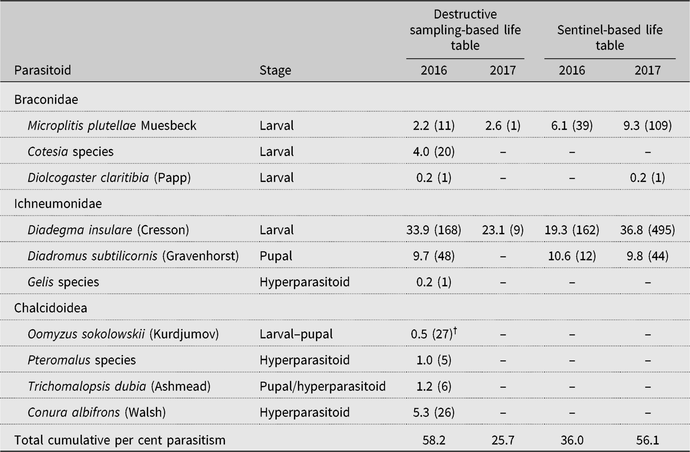
Cumulative per cent parasitism by parasitoids (Hymenoptera) in the sentinel-based and destructive sampling-based life tables for diamondback moth, Plutella xylostella, in Ottawa, Ontario, Canada.

Numbers in brackets are number of parasitoid individuals.
† Number of individuals divided by 10 for parasitism level per diamondback moth individual (Nakamura and Noda Reference Nakamura and Noda2002).
Voucher specimens of diamondback moth, parasitoids, and predators captured in this study have been deposited at the Canadian National Collection of Insects, Arachnids, and Nematodes.
Results
Climate data
The average summer temperature was 16.5 ± 8.0 °C in 2016 and 15.7 ± 6.0 °C in 2017. Total precipitation was 277 mm in 2016 and 573 mm in 2017 (Environment and Climate Change Canada) (Supplementary Fig. 3). The Canadian Drought Monitor (Agriculture and Agri-Food Canada, Ottawa, Ontario, Canada) had Ottawa under severe drought conditions in 2016. In contrast, in 2017, widespread flooding as a result of spring melt and high precipitation occurred.
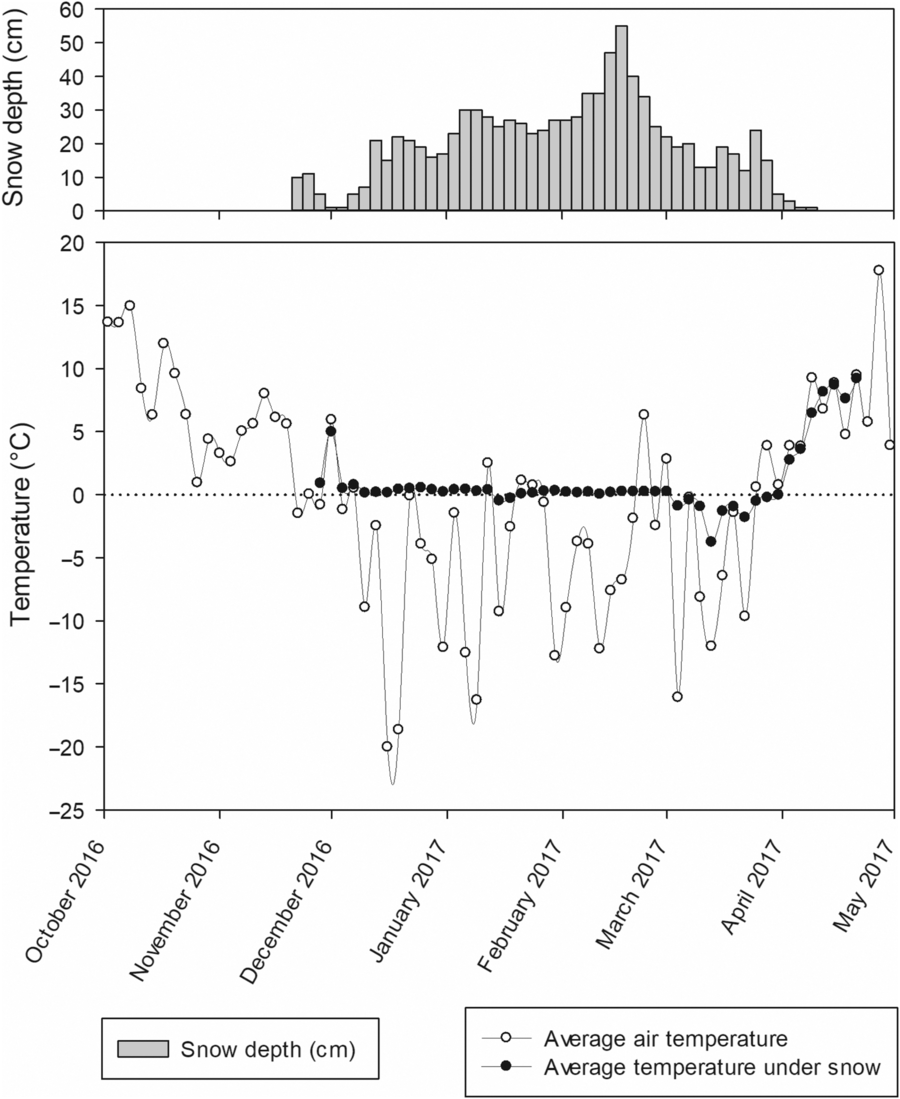
During the winter of 2016–2017, there were 141 days of snow cover (Fig. 1). The average daily temperature under the snow from 26 November 2016 to 1 April 2017 was 0.01 ± 1.03 °C (Fig. 1). The average daily air temperature from October 2016 to May 2017 was −0.22 ± 8.23 °C with 101 days where the average temperature was at or below 0 °C and four days where the daily minimum was at or below the lower lethal temperature for diamondback moth adults (−20 °C) (Nguyen et al. Reference Nguyen, Bahar, Baker and Andrew2014).
Average air temperature, average temperature under the snow and snow depth on the Central Experimental Farm, Ottawa, Ontario, Canada, during the winter of 2016–2017. Snow cover data obtained from the National Climate Data and Information Archive (Environment and Climate Change Canada).

Pheromone traps
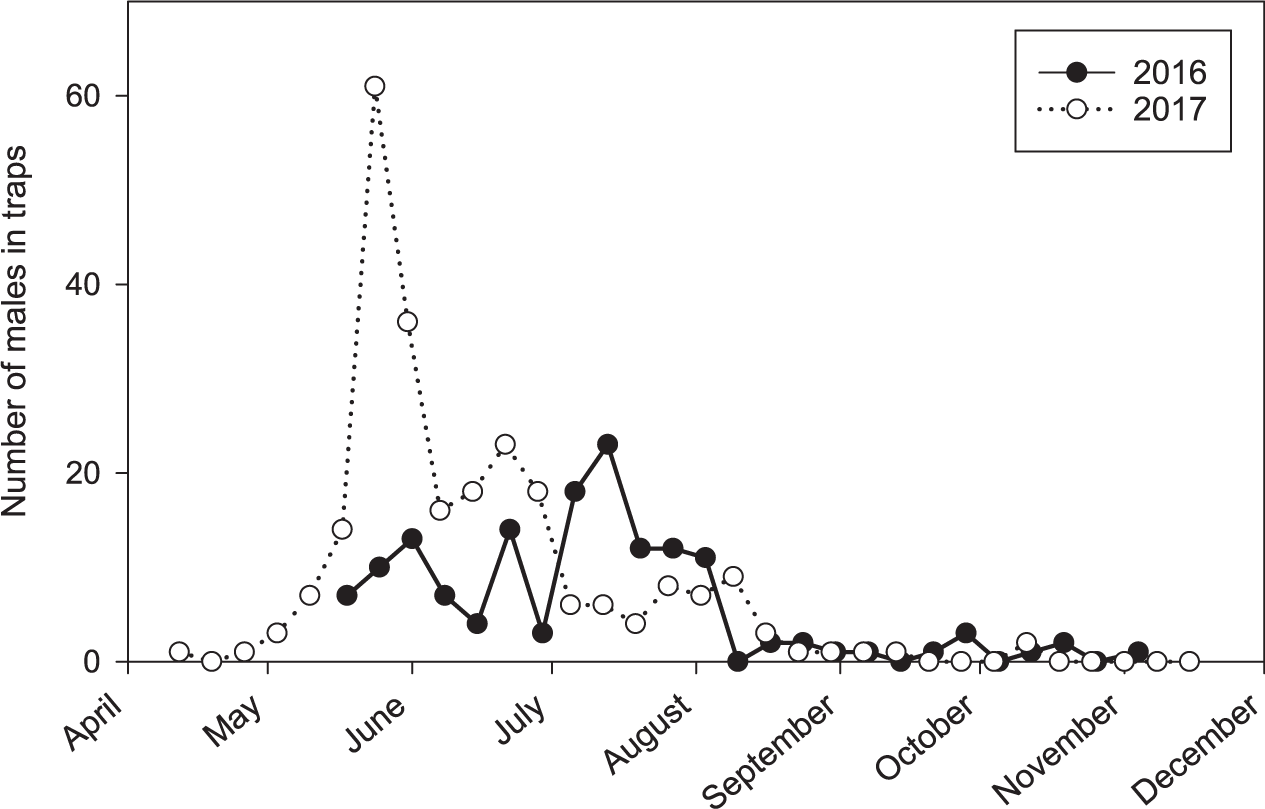
In 2016, adult moths were already present in the field when the pheromone traps were set up on 11 May and were no longer caught in traps after 4 November. In 2017, traps were first set up on 5 April, and one moth was caught during the first week of trapping. Overall, a total of 148 moths (2016) and 247 moths (2017) were caught in the traps. Notably, in 2017, there was a sharp peak in trap catches for the week of 15–24 May, when 61 moths were caught (Fig. 2). Using the pheromone trap data, temperature data and a degree-day development model with a developmental threshold of 7.3 °C and 293 degree-day accumulation for completion of a generation (Butts and McEwen Reference Butts and McEwen1981), we estimated there were four and three generations of diamondback moth in 2016 and 2017, respectively. These findings were consistent with output from the bioclimatic model (DYMEX, http://climatemodel.net/dymex.htm) presented in Dosdall et al. (Reference Dosdall, Weiss, Olfert, Mason, Soroka, Shelton, Collins, Youjun and Qingjun2006) running 2016 and 2017 seasonal weather data from the National Climate Archive (Environment and Climate Change Canada) (Supplementary Fig. 4).
Total number of adult male diamondback moth, Plutella xylostella, caught in two pheromone traps set up in a cabbage, Brassica oleracea, plot on the Central Experimental Farm, Ottawa, Ontario, Canada.

Destructive sampling-based life table
In 2016, 677 diamondback moth individuals were collected on the destructively sampled cabbages and only 57 individuals were collected in 2017. In 2016, we found (average ± standard error), 0.1 ± 0.41 egg per plant, 4.26 ± 0.22 larvae per plant, and 2.3 ± 0.35 pupae per plant. In July 2017, there were 0.37 ± 0.08 larvae per plant and 0.44 ± 0.22 pupae per plant with no eggs recovered. No life stages were recovered in August 2017.
Diadegma insulare was the most abundant parasitoid, with 33% and 23% parasitism in 2016 and 2017, respectively. In 2016, D. insulare and nine other parasitoid species, including four hyperparasitoids, contributed to the total cumulative parasitism rate of 58.2% (Table 1). In 2017, only two parasitoid species emerged from the samples, Diadromus subtilicornis (Gravenhorst) (Hymenoptera: Ichneumonidae) and Microplitis plutellae Muesbeck (Hymenoptera: Braconidae) for a total cumulative parasitism rate of 25.7% (Table 1).
Sentinel-based life table
Numbers of sentinel eggs, larvae, and pupae placed in the field plot were substantially higher than the naturally occurring densities. The mean number (± standard error) was 288 ± 28.14 for eggs, 75 ± 8.0 for first instars, and 17 ± 0.52 for pupae. Preliminary studies indicated that these numbers were necessary to ensure enough recovery to generate meaningful parasitism rates.
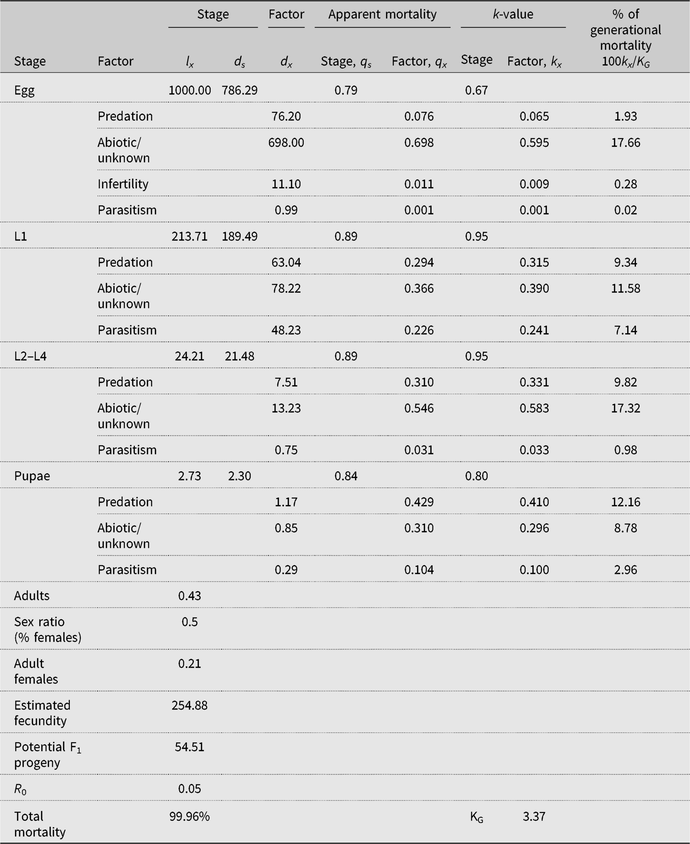
Recovery of all stages of diamondback moth was significantly different between uncaged and caged plant treatments (Kruskal–Wallis H = 118.4, 1 df, P < 0.0001). Mortality at the egg stage was high due to abiotic and unknown factors in both years: 69.8% in 2016 and 42.9% in 2017 (shown as apparent mortality in Tables 2–3). No egg parasitoids were recovered in either year; parasitism noted at the egg stage was probably due to a small proportion of eggs that had hatched before recovery from the field and were attacked by the larval parasitoid D. insulare.
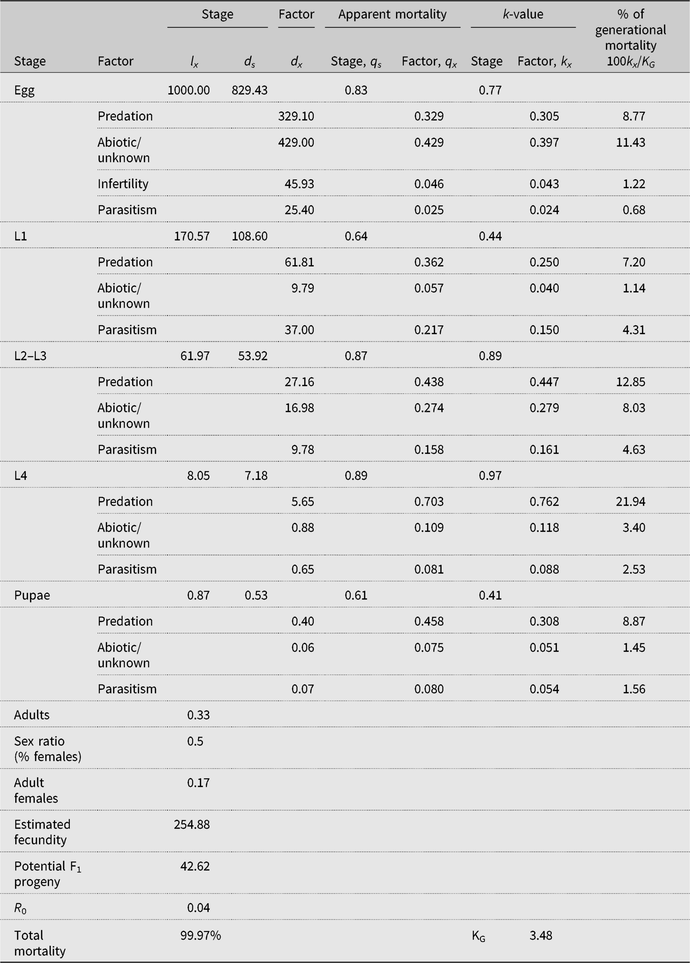
Sentinel-based life table of diamondback moth, Plutella xylostella, on the Central Experimental Farm in Ottawa, Ontario, Canada, for 2016 on cabbage, Brassica oleracea.

Sentinel-based life table of diamondback moth, Plutella xylostella, on the Central Experimental Farm in Ottawa, Ontario, Canada, for 2017 on cabbage, Brassica oleracea.

Major mortality factors of first instars differed between years, with abiotic and unknown factors accounting for 36.6% of mortality in 2016 and predation accounting for 36.2% in 2017 (shown as apparent mortality in Tables 2–3). Overall mortality for first instars was higher in 2016 (88.6%) compared to 2017 (63.7%).
In 2016, the major mortality factors of second to fourth instars were abiotic and unknown factors at 54.6% (Table 2), with parasitism by D. insulare being low at 2.9%. In 2017, the major mortality factor of second to third instars was predation at 43.8% (Table 3). Parasitism of second to third instars was 15.8%, with parasitoid composition at 79.1% D. insulare and 18.6% M. plutellae. Predation (70.2%) was the major mortality factor of fourth instars. Parasitism for fourth instars was 8.1%, of which 69.2% was by D. insulare and 15.3% by M. plutellae.
For the pupal stage, predation was the major mortality factor in both years at 42.9% (2016) and 45.8% (2017) (Tables 2–3). Parasitism of pupae by D. subtilicornis was 10.4% in 2016 and 8.0% in 2017.
Total mortality was 99.96% in 2016 and 99.97% in 2017 (Tables 2–3). The mean average lifetime fecundity of adult females from the laboratory colony was 255 ± 25 eggs (n = 9). This value was used for calculating potential F1 progeny and the net reproductive rate, R 0. The R 0 values of 0.05 in 2016 and 0.04 in 2017 indicate declining populations in both years.
In 2016, mortality of second to fourth instars was the largest contributor to generational mortality (28.1%), whereas mortality of fourth instars was the largest contributor to generational mortality in 2017 (27.9%). Combined parasitism of all stages contributed to 11.1% (2016) and 13.7% (2017) of generational mortality. Parasitoid species composition was also similar between years with the most abundant species being D. insulare (approximately 76%) followed by M. plutellae (approximately 17%).
Natural enemies
Over the two years of this study, 10 parasitoid species were associated with diamondback moth (Table 1). Five parasitoids were found in both our study and those of Harcourt (Reference Harcourt1954, Reference Harcourt1960a): the larval parasitoids D. insulare and M. plutellae, the pupal parasitoid D. subtilicornis, the larval–pupal parasitoid Oomyzus sokolowskii (Kurdjumov) (Hymenoptera: Eulophidae), and the facultative hyperparasitoid Conura albifrons (Walsh) (Hymenoptera: Chalcididae). Parasitoids reported by Harcourt (Reference Harcourt1954, Reference Harcourt1960a) but not found in the present study were Dibrachys microgastri (Bouché) (Hymenoptera: Pteromalidae), Pteromalus phycidis (Ashmead) (Hymenoptera: Pteromalidae), Trichomalopsis viridescens (Walsh) (Hymenoptera: Pteromalidae), Gelis tenellus (Say) (Hymenoptera: Ichneumonidae), and Campoletis Förster species (Hymenoptera: Ichneumonidae). These species are mostly generalists. Harcourt’s identification of species in the genera Gelis Thunberg and Pteromalus Swederus may not be valid since most species in these genera cannot be reliably identified at present (A. Bennett and G. Gibson, personal communication).
Parasitoids found in this study that have not been previously reported on diamondback moth in the Ottawa area were Cotesia Cameron species, Diolcogaster claritibia (Papp) (Hymenoptera: Braconidae), Gelis species, and Trichomalopsis dubia (Ashmead) (Hymenoptera: Pteromalidae). The Gelis individuals found in this study were wingless females and cannot be identified to species. However, wingless females indicate that these individuals are unlikely to be G. tenellus (A. Bennett, personal communication) previously reported by Harcourt (Reference Harcourt1954, Reference Harcourt1960a), which normally has winged females. Trichomalopsis dubia is a generalist facultative hyperparasitoid; this study is the first to report a host association with diamondback moth or any of its known parasitoids. There were also two distinct Cotesia species recovered. One is likely Cotesia rubecula (Marshall) (Hymenoptera: Braconidae) and the other is currently unknown (J. Fernández-Triana, personal communication); both require DNA barcoding to confirm identification.
Pitfall trapping determined that Coleoptera (primarily Carabidae) were the most frequently captured ground predators in the experimental plot. Other predators were from the orders Opiliones, Araneae, Hymenoptera, Trombidiformes, and Hemiptera, listed from most to least frequently captured (Table 4). The most frequently captured species of beetles were the native Harpalus pensylvanicus (De Geer) (Coleoptera: Carabidae) and the adventive Pterostichus melanarius (Illiger) (Coleoptera: Carabidae). The most frequently captured arachnids were Opiliones. Harcourt (Reference Harcourt1960a) had previously reported finding predatory mites (Acari) belonging to the Erythraeidae and Anystidae. Our study identified mites from the Anystidae and Parasitidae, which are predatory.
Predator species composition as total number of individuals in pitfall trap samples collected in a cabbage, Brassica oleracea, plot on the Central Experimental Farm, Ottawa, Ontario, Canada, during the summer of 2016 (12 traps) and 2017 (eight traps) with data on endemism (Bousquet et al. Reference Bousquet, Bouchard, Davies and Sikes2013) and predatory habits (Larochelle and Larivière Reference Larochelle and Larivière2003) for Carabidae.

Discussion
Since Harcourt’s life table studies on diamondback moth at the Central Experimental Farm in Ottawa, Ontario Canada (Harcourt Reference Harcourt1954, Reference Harcourt1957, Reference Harcourt1960a, Reference Harcourt1960b, Reference Harcourt1963, Reference Harcourt, Talekar and Griggs1986), there has been considerable urban expansion (MacOdrum Library 2019; University of Toronto Libraries 2019), changing global climate (Hansen et al. Reference Hansen, Ruedy, Sato and Lo2010; Rahmstorf et al. Reference Rahmstorf, Foster and Cahill2017), and the introduction of new crop types (Slinkard and Knott Reference Slinkard and Knott1995). Despite this, the mortality factors and demography of this important pest of Brassicaceae appear to have remained consistent.
In the summers of 2016 and 2017, the dominant parasitoid attacking diamondback moth was the larval parasitoid D. insulare, as it was during Harcourt’s studies (Harcourt Reference Harcourt1963, Reference Harcourt, Talekar and Griggs1986). The larval parasitoid M. plutellae and the pupal parasitoid D. subtilicornis were also present, with smaller contributions to total mortality. The total mortality was 99.96% in 2016 and 99.97% in 2017, similar to that which Harcourt reported in his studies (Harcourt Reference Harcourt1963, Reference Harcourt, Talekar and Griggs1986).
Immigration from southern climates (Smith and Sears Reference Smith and Sears1982; Harcourt Reference Harcourt, Talekar and Griggs1986; Dosdall et al. Reference Dosdall, Mason, Olfert, Kaminski, Keddie, Endersby and Ridland2001; Hopkinson and Soroka Reference Hopkinson and Soroka2010) was likely the origin of populations in our experimental plot because conditions were too harsh for diamondback moth to overwinter during the winters of 2015–2016 and 2016–2017. With 141 days of snow cover (0 °C) during the winter of 2016–2017, it is unlikely that any stage of diamondback moth could have survived (Dancau et al. Reference Dancau, Mason and Cappuccino2018). Furthermore, in early March 2017, spring freeze-thaw cycles caused average temperatures under the snow to dip below 0 °C for the remainder of the month (average temperature −1.08 ± 1.08 °C). Sub-zero temperatures following a long period at 0 °C would be lethal to all stages of diamondback moth. Although data for a single winter might not be representative of present-day trends, the conditions experienced during the winter of 2016–2017 are consistent with the hypothesis that diamondback moth is incapable of overwintering in the Ottawa area (Harcourt Reference Harcourt1954; Dancau et al. Reference Dancau, Mason and Cappuccino2018).
In both years, diamondback moth adults were detected in the field earlier in the spring and later in the fall than reported by Harcourt (Reference Harcourt1957), who observed moths typically arriving at light traps by May and no longer detected by October. In 2016, diamondback moth adults were retrieved from pheromone traps on 18 May and last recoveries were made on 4 November. In 2017, the first pheromone trap catch occurred during the week of 5–12 April. These phenological comparisons should be interpreted with caution, however, because the seasonal pattern of catches can differ between light and pheromone traps (e.g., Baker et al. Reference Baker, Tann and Fitt2011). Interestingly, temperatures during the week of 5 April 2017 were below the developmental threshold for diamondback moth (7.3–7.5 °C) and too cold for flight, with the exception of 10 April when the temperature rose to 14.8 °C, which was warm enough for flight (Goodwin and Danthanarayana Reference Goodwin and Danthanarayana1984; Shirai Reference Shirai1993). Although this is an extremely early record for diamondback moth in the Ottawa area, Smith and Sears (Reference Smith and Sears1982) recovered diamondback moth on 9 April 1981 in Cambridge, Ontario, Canada, located approximately 430 km south-west of Ottawa.
Because diamondback moth does not overwinter in most of Canada, reverse wind trajectories have been used to determine sources of immigrant populations (Hopkinson and Soroka Reference Hopkinson and Soroka2010). In 2017, trajectories at 2500 and 1500 m above ground traversed the states of Texas, New Mexico and Arizona (United States of America) (Supplementary Figs. 5–6), suggesting that populations appearing in the Ottawa area on 10–11 April originated from those states. These regions, as well as northern Mexico, are historically believed to be the source of immigrant populations of diamondback moth in Canada (Harcourt Reference Harcourt1957; Dosdall et al. Reference Dosdall, Mason, Olfert, Kaminski, Keddie, Endersby and Ridland2001, Reference Dosdall, Weiss, Olfert, Mason, Soroka, Shelton, Collins, Youjun and Qingjun2006; Hopkinson and Soroka Reference Hopkinson and Soroka2010). The date of first appearance (10–11 April) can be used to initiate the number of generations that develop from that point in time using the degree-day development model for diamondback moth (Dosdall et al. Reference Dosdall, Weiss, Olfert, Mason, Soroka, Shelton, Collins, Youjun and Qingjun2006). However, in 2017, this was confounded by a spike in the number of males caught in pheromone traps in May (Fig. 2) and likely due to immigration, since the number of degree days that had accumulated prior to that date (151.1) was below the minimum number of degree days (268 according to Liu et al. Reference Liu, Chen and Zalucki2002; or 293 according to Butts and McEwen Reference Butts and McEwen1981) required for the development of a complete diamondback moth generation.
Using the first collection date of moths in the pheromone traps, we estimated that diamondback moth produced four generations in 2016 and three in 2017. The pheromone trap counts show peaks that are separated by degree-day accumulations sufficient to allow for the production of a new generation in the field. However, it is not possible to determine the proportion of males in the traps that were locally produced as opposed to immigrants. The low net reproductive rates from the life tables (R 0 < 1) suggest that this system is immigration-driven. However, there may have been variation in R 0 over the course of the season that we could not detect with our single composite life table for each year; such variation could have allowed for population growth to occur in situ for some of the generations.
By including a cage treatment that excluded predators while allowing rain to reach the plants, we were able to assess the importance of predation as a mortality factor for diamondback moth. In the present study, predation accounted for 33.26% and 59.62% of generational mortality in 2016 and 2017, respectively, although these figures might be inflated somewhat due to wandering of late-instars, especially in 2017 when mortality of fourth instars was evaluated separately and the high densities used for the egg stage in both years. Harcourt (Reference Harcourt1963) noted that larvae occasionally fell prey to birds (Aves), Syrphidae (Diptera), mites, and spiders (Arachnida); however, he disregarded predation as an important source of mortality and did not include it as a factor in his life table analyses (Harcourt Reference Harcourt, Talekar and Griggs1986). The factor “rain” in his life tables, which affected the larval stage, may have also included some predation. Rain and predation may act in concert when rain knocks larvae off the plants making them accessible to ground-dwelling predators (Mauduit Reference Mauduit2012).
Pitfall trapping allowed us to identify 10 species of Carabidae (Coleoptera) that were present in the plot, as well as Arachnida, Hemiptera, and Hymenoptera (Table 4) that are potential predators of diamondback life stages. The taxonomic groups of predators abundant in our cabbage plot were similar to those observed in Alberta canola fields (Mauduit Reference Mauduit2012), as well as in cabbage (Furlong et al. Reference Furlong, Shi, Liu and Zalucki2004) and broccoli (Hosseini et al. Reference Hosseini, Keller, Schmidt, Baker, Shelton, Collins, Youjun and Qingjun2006) plots in Australia.
Harcourt constructed his life tables based on a destructive sampling technique for all diamondback moth life stages on mature cabbage plants throughout the season. In the present study, in addition to destructive sampling, we introduced sentinel individuals into our field plot, by inoculating cabbage plants in the laboratory with known numbers of a given life stage and placing these plants in the field for the duration of that life stage. Comparison of the two methods revealed important differences. The sentinel-based approach identified three dominant parasitoid species in both years: D. insulare, D. subtilicornis, and M. plutellae. These parasitoids were also the dominant species in Harcourt’s studies (Harcourt Reference Harcourt, Talekar and Griggs1986) and are the main species found on diamondback moth in the Canadian provinces of Prince Edward Island (Noronha and Bahar Reference Noronha and Bahar2018), Alberta and Saskatchewan (Braun et al. Reference Braun, Olfert, Soroka, Mason, Dosdall, Kirk and Bordat2004; Dosdall et al. Reference Dosdall, Soroka and Olfert2011; Bahar et al. Reference Bahar, Soroka, Dosdall and Olfert2013). A single individual of one other parasitoid species was detected using the sentinel-based approach: D. claritibia, a larval parasitoid. The destructive sampling technique, on the other hand, revealed more parasitoid diversity; in addition to the three main parasitoids, D. claritibia and five other larval and pupal parasitoids were present in these samples (Table 1), but only in 2016, when diamondback moth was more abundant. Four of the additional species were hyperparasitoids, which may require larvae or pupae that contain primary parasitoids at a specific stage of development. The destructive sampling technique, in which the hosts are exposed for a longer period, may have facilitated the detection of hyperparasitoids and rarer species in the system. Parasitoids may also be more responsive to herbivore-induced plant responses (Mao et al. Reference Mao, Liu, Chen, Chen, Fang and Hong2017) or cues produced by cumulative attack of hosts and nonhosts (Bukovinszky et al. Reference Bukovinszky, Poelman, Kamp, Hemerik, Prekatsakis and Dicke2012). The mature plants were occasionally infested with Pieris rapae (Linnaeus) (Lepidoptera: Pieridae) and Trichoplusia ni (Hübner) (Lepidoptera: Noctuidae) in our plot and that of Harcourt (Reference Harcourt1954).
The data set in the current study is relatively small compared to the work of Harcourt (Reference Harcourt, Talekar and Griggs1986), which spanned nearly two decades and included 74 diamondback moth generations. Harcourt initially sampled 49 plots of 5 m × 5 m (1950–1951) and 7 m × 7 m (1952–1953) containing early cabbage (variety Golden Acre) and late cabbage (variety Penn State Ballhead) (Harcourt Reference Harcourt1954). Later studies used 45 m × 45 m plots with early or late cabbage (Harcourt Reference Harcourt1961, Reference Harcourt, Talekar and Griggs1986). Harcourt evaluated 2450–10 000 cabbage plants per season (Harcourt Reference Harcourt1954, Reference Harcourt1961, Reference Harcourt, Talekar and Griggs1986) compared to the 200 plants per season used in this study.
Environmental factors have changed over the last five decades since Harcourt’s studies. Despite this, the conceptual model for the diamondback moth life system for the years 2016 and 2017 is remarkably similar to that suggested by Harcourt (Reference Harcourt, Talekar and Griggs1986): a system driven by immigration and dominated by three main parasitoid species, with high mortality in the absence of insecticide use. Our conceptual model differs from his by suggesting a greater role for predation in suppressing larval populations. This study provides insight into a system that appears to have changed little after 65 years. These findings could aid management initiatives moving forward for introductions of new exotic biological control agents for diamondback moth in Canada.
Acknowledgements
The authors would like to thank D. Blackburn for assistance in gathering data on moth fecundity; A. Spasojevic for the Tinytag data loggers for the overwintering study; A. Brauner, N. Gaskell, C. Cock, N. Marion, and S. Coghlan for assistance in pheromone trap monitoring and set-up; P. Abram for analysis support and editing; J. Hsiung for providing the illustrations; and R. Weiss for providing data outputs from the Dymex bioclimatic model and reverse wind trajectory model. Special thanks to taxonomic experts at the Canadian National Collection: A. Bennett, J. Fernández-Triana, G. Gibson, and J. Huber for parasitoid identification and guidance; H. Goulet for carabid identification; A. Brunke for staphylinid identification; and W. Knee for mite identification. Agriculture and Agri-Food Canada provided funding for this project.
Supplementary material
To view supplementary material for this article, please visit https://doi.org/10.4039/tce.2019.70.