Over the past two decades we have heard an historically unprecedented volume of talk about and praise of democracy, and many governmental, non-governmental, and international organizations have been engaged in democracy promotion. Democracy is a subject that crosses the boundaries in political science, and within my own field of political theory there has been a major revival of democratic theory. In political theory, argument about “democracy” is usually now qualified by one of an array of adjectives, which include cosmopolitan, agonistic, republican, and monitory. But the new form that has been by far the most successful is deliberative democracy. By 2007 John Dryzek could write that “deliberative democracy now constitutes the most active area of political theory in its entirety (not just democratic theory).”Footnote 1 Not only is there an extremely large and rapidly growing literature, both theoretical and empirical, on deliberative democracy, but its influence has spread far outside universities.
The last time that democratic theory enjoyed a prominent place in political theory was a long time ago. In the 1960s defenders of a participatory conception of democracy, which had a politically active citizenry at its center, took up the cudgels against proponents of a “realistic” democratic theory. The latter argued that, in light of findings from the (then new) empirical surveys showing that most individuals were politically inactive and lacked interest in or knowledge of politics, ideas about citizens' participation should be revised accordingly. Citizen apathy was seen as functional for the democratic system. By the 1980s the attention of most political theorists turned in other directions, interest in democratic theory waned and, in particular, participatory democratic theory became unfashionable.
Now that democratic theory is enjoying such a vigorous revival, an obvious question is whether there still a place for participatory theory, or is it now old-fashioned and outmoded?Footnote 2
On the face of it, we seem to be in a favorable time for participatory democracy. Deliberative democracy is a form of citizen participation, and over the past decade interest in participatory governance (also called, for instance, co-governance) has grown.Footnote 3 During the 1980s “participation” began to become part of mainstream development practice—one commentator has stated that participation has “become an act of faith in development”Footnote 4—promoted by nongovernmental organizations (NGOs) and international agencies, not least by the World Bank. In 1996 the World Bank published a Participation Sourcebook. Footnote 5 Perhaps most strikingly, examples of participatory budgeting have been spreading around the globe from its origin in Brazil. Or, at least, measures called participatory budgeting have been proliferating. Let me say at this point only that the term “participation” is used to cover a very wide range of disparate activities.Footnote 6 In 2007, the World Bank issued a Report on Participatory Budgeting. Footnote 7 The first international conference on participatory budgeting was held in 2010Footnote 8 and in England there is a Participatory Budgeting Unit.Footnote 9
The contemporary support for participation by governments, official bodies, and NGOs is in striking contrast to participation in the 1960s, which was championed by popular movements in rich countries (the inhabitants of many poor countries at that time participated in a different way in decolonization struggles for national liberation). In a number of Western countries a variety of grassroots political movements were actively demanding more participation and greater democracy; this was the time of Rudi Dutschke's famous call for “the long march through the institutions.” Part of the impetus for my own research as a graduate student and for my first book, Participation and Democratic Theory, was the glaring disjuncture between the popular movements and academic demands for “realistic” democratic theory.Footnote 10 But times have changed.
The current fashion for deliberative democracy began as a political theory-led enterprise, in the sense that it was deliberative democratic theory that emerged first in the 1990s and was followed by empirical studies and also the creation of special deliberative forums. For the most part, deliberative democrats have shown little interest in the last thirty years of participation promotion. Much empirical investigation is focused on the process of deliberation among participants in the new deliberative bodies. Moreover, in so far as deliberative democrats take an interest in examples of participatory democracy, they typically treat them as examples of deliberative democracy. Notwithstanding Dennis Thompson's belief that “the turn toward deliberative theory has not displaced participatory theory,”Footnote 11 the prevalent view, albeit not always made explicit, seems to be that deliberative democracy has now overtaken and subsumed its predecessor. Deliberative democracy has, for example, been seen as “participatory democratic regeneration,”Footnote 12 and the claim made that “deliberative democrats tend to be participatory democrats, too.”Footnote 13
I shall be taking issue with this view. Participatory democracy, I argue, is different from deliberative democracy. Deliberation, discussion, and debate are central to any form of democracy, including participatory democracy, but if deliberation is necessary for democracy it is not sufficient. Some of the more enthusiastic advocates of deliberative democracy tend to present deliberation as if it were synonymous with democracy itself.
The rapidity and enthusiasm with which deliberative democracy has been taken up so widely is, in itself, rather extraordinary. Diane Mutz recently commented that the “amount of time and money invested in it by governments, foundations, and citizen groups is staggering relative to virtually any other current social science theory.”Footnote 14 So what are so many people so enthusiastic about? The wide variety of arguments and examples to be found in the deliberative literature make the meaning of “deliberative democracy” hard to pin down. I am not going to try to do so here. For my purposes, it is enough to highlight the central claim of deliberative democratic theorists: that individuals should always be prepared to defend their moral and political arguments and claims with reasons, and be prepared to deliberate with others about the reasons they provide.
There is now an extensive theoretical debate about what properly counts as “deliberation,” much of which has been carried on at a fairly abstract level. But valuable though this discussion is, it is not my present concern. Rather, I am going to consider aspects of, and evidence from, the empirical side of deliberative democracy. The theoretical debate tells us very little about two important questions; one is where deliberation is to take place. Deliberative democracy has been held to include, for example, school boards, community policing, deliberative polling, community consultations, citizens' juries, citizens' assemblies, legislatures, judicial bodies and participatory budgeting. The second question is what is the aim of deliberation? Its aims have been held to include, for example, arriving at a consensus, making a decision, or revealing how individuals' preferences might change after they have deliberated.Footnote 15
I am going to consider two cases of deliberative democracy: citizens' juries and citizens' assemblies. Both are examples of the specially created democratic forums and, in both, the participants come to a decision at the end of their deliberations. These are instances of what are now frequently called mini-publics; that is to say, they are composed of a group of citizens “small enough to be genuinely deliberative, and representative enough to be genuinely democratic.”Footnote 16
Mini-publics share the following features:
• They are specially commissioned deliberative forums, typically sponsored by a government, government agency, or non-governmental organization, to deliberate about subject matter chosen by their commissioning body.
• Participants are chosen by (almost) random selection to ensure not only that there is no systematic exclusion of any part of the population but also that individuals with certain characteristics are included.
• Deliberation is guided by facilitators and, to help them become informed and to aid their deliberation, the participants receive specially prepared information and hear evidence from, and question, expert witnesses.
• At the end of their deliberation, the participants come to a conclusion about the matter at hand and prepare a report and recommendations.
There are also some important differences between citizens' juries and citizens' assemblies. Citizens' juries began in the 1970s in the US but have been used much more widely and frequently since the 1990s, particularly in the UK. A citizens' jury usually comprises about 12–24 citizens. Occasionally, the participants are able to amend their agenda. When a citizen's jury presents its report to its sponsor, the latter may or may not take their advice, although some citizens' juries now enter a contract with their commissioning body which requires that the latter provide an explanation of how it has responded to the jury's recommendations.
Citizens' assemblies are a much more recent development, beginning in Canada, in British Columbia, in 2004. Two more have subsequently been held in Ontario (2006) and the Netherlands (2007). All three were commissioned by their respective governments with a charge to review their electoral systems and to recommend an alternative. The three assemblies have been studied in detail from their beginnings to their conclusion.Footnote 17 I shall focus on the two Canadian assemblies because they stand apart from other mini-publics. Their recommendations went to their Provincial governments but (unlike the Netherlands assembly) were also put before their electorates in referenda (held in conjunction with elections). This was, the editors of a book on the British Columbia assembly remark, “possibly the first time a citizens' body has ever been empowered to set a constitutional agenda.”Footnote 18
Citizens' assemblies are much larger than citizens' juries and last longer; in British Columbia 160 participants, and in Ontario 103, sat for almost a year. The Assemblies not only had facilitators, but also staff and appointed chairs. They held hearings across their Provinces and also received written submissions. In both cases the Assemblies recommended a change from their first past the post (winner takes all) electoral systems to a version of proportional representation; to STV (single transferable vote) in British Columbia, and to MMP (multi-member proportional) in Ontario. In Ontario the government followed British Columbia and set a high standard for the referendum to pass: 60 percent of the vote in the Province as a whole and a majority in 60 percent of the electoral districts. In 2005, the referendum in British Columbia narrowly missed passing. A second referendum in 2009 was decisively defeated, and the same happened in the referendum in Ontario in 2007.
Referenda in British Columbia and Ontario
Source: Warren and Pearse Reference Warren, Pearse, Warren and Pearse2008; Fournier et al. Reference Fournier, van der Kolk, Carty, Blais and Rose2011.

Mini-publics are an intriguing innovation. In particular, I am looking forward to seeing how the citizens' assemblies develop and are used in the future. I now want to make four points about mini-publics.
First, a familiar criticism that is often brought against arguments for greater citizen involvement in politics is that most individuals are not sufficiently capable of doing so or are not interested. The idea that many people might be attracted by participation, according to Mark Warren, is “romantic dogma.”Footnote 19 On the contrary, the empirical evidence from mini-publics shows that citizens both welcome and enjoy the opportunity to take part and to deliberate, and that they take their duties seriously. The findings show that ordinary citizens, given some information and time for discussion in groups of diverse opinions, are quite capable of understanding complex, and sometimes technical, issues and reaching pertinent conclusions about significant public matters. Moreover, they have to justify their reasoning in their reports. These empirical findings provide a valuable counterweight to the poor opinion of ordinary citizens found in much political science, and to the frequently heard view that many, perhaps even most, matters of public policy are best left to, or must be left to, experts.Footnote 20
Second, despite the merits of mini-publics, or the benefits of practice in participation and deliberation gained by the citizens involved, they have some limitations. For example, it does not appear that the public as a whole knows much about them. Despite the fact that it was at work for eleven months, evidence from the Citizens' Assembly in British Columbia shows that by the time that the 2005 referendum was held just over 40 percent of the electorate knew nothing about either the Assembly or the STV electoral system.Footnote 21 Neither the media nor the politicians paid much attention to the assemblies or electoral reform when the referenda were held. The 2005 and 2009 campaigns in British Columbia and the 2007 campaign in Ontario “unfolded without the contending political parties discussing the reform proposals in any meaningful way. None of the major parties endorsed the assembly's recommendation, not even those who had initiated the reform enterprise.”Footnote 22 Similarly, coverage of electoral reform in the newspapers mostly “consisted of standard election articles,” that included a remark at the end that there was also going to be a referendum on electoral change.Footnote 23
Third, while the problem of publicity is, perhaps, relatively easily open to remedy, one aspect of citizens' juries is much harder to fix. At worst, the juries are little more than focus groups, or they become useful legitimating devices for an already-decided policy. In at least one case, the proceedings of a citizens' jury in Dublin deliberating about a proposal for a waste disposal incinerator were sabotaged by the City Manager's Office, which “boycotted the event and refused to participate in any way.”Footnote 24
Fourth, mini-publics have a more serious limitation. They are specially established bodies, to which participants are invited, that meet for a limited period (albeit for almost a year in the case of the Canadian citizens' assemblies) and they then disappear. That is to say, they are not integrated into the overall system of representative government or democratic institutions, nor do they become part of the regular political cycle in the life of a community.
More generally, a problem with deliberative democracy—a problem of particular concern for supporters of participatory democracy—is that the primary interest of its advocates lies in the process of deliberation inside deliberative forums. They are not usually concerned with structural features of the wider society. This means, for the most part, that “democracy” in the wider society and political system is outside of their purview; it is largely taken for granted as an institutional background of the forums. To be sure, deliberative democrats are dissatisfied with some features of that institutional background, which is why deliberation is seen as a necessary improvement in, and mini-publics are advocated as a supplement to, existing electoral democracy. But deliberative democracy still leaves intact the conventional institutional structures and political meaning of “democracy.”
This presents a sharp contrast to the democratic theory of the 1960s where the meaning of democracy itself—“realistic” or participatory?—was at the heart of the debate. And this brings me to participatory democracy.
Participatory democracy is often treated as a purely normative argument, concerned with ideals. That I presented empirical evidence in my book to support my arguments is often ignored.Footnote 25 In Participation and Democratic Theory I used the example of the workplace to show that participatory democracy was feasible.Footnote 26 There is little discussion either of the feasibility or desirability of workplace democracy today. I shall not be considering it now, yet the institution of employment, one of the most central institutions of our society, remains undemocratic.
I see the following elements as the most important in participatory democratic theory:
• The capacities, skills, and characteristics of individuals are interrelated with forms of authority structures. Individuals learn to participate by participating (the educative or developmental side of participatory democracy, the aspect most often mentioned). Thus, individuals need to interact within democratic authority structures that make participation possible.
• Participatory democratic theory is an argument about democratization. That is, the argument is about changes that will make our own social and political life more democratic, that will provide opportunities for individuals to participate in decision-making in their everyday lives as well as in the wider political system. It is about democratizing democracy.Footnote 27
• What I called a participatory society (in Participation and Democratic Theory) needs to be created.
• The changes required are structural; they necessitate reform of undemocratic authority structures.
The example of participatory democracy I am going to discuss is participatory budgeting (PB)—an example also claimed by some deliberative democrats. Or, more precisely, I am using as my model the original version of PB in the city of Porto Alegre, Brazil, created by the Workers' Party (Partido dos Trabalhadores) in the years following its victory in the municipal elections in 1988 at the end of the military dictatorship.Footnote 28 PB in Porto Alegre has evolved over the years. The Workers' Party lost the mayoral election in 2004, but PB still continues; the current municipal government gives a bigger role in participatory budgeting to NGOs and private business.
Brazil has other participatory institutions, mandated by the 1988 Constitution, which also increased the resources and authority of municipal governments (between 15 and 20 percent of government spending is controlled by municipalities),Footnote 29 but these institutions are less well known and less scrutinized than PB in Porto Alegre.Footnote 30 In the city in the late 1980s and early 1990s there were people in the Workers' Party and numerous grassroots organizations who supported PB for reasons that echoed the spirit of participatory democracy of the 1960s. According to Gianpaolo Baiocchi, Porto Alegre is “a city where participatory democracy has become a way of life.”Footnote 31
But there are other good reasons, too, for using the example of participatory budgeting in Porto Alegre; indeed, Archon Fung claims that its significance “for the theory of participatory democracy cannot be overstated.”Footnote 32 First, PB in Porto Alegre is not only very well known but it is also well studied. There is an expanding body of empirical information now available about its operation. Second, the example shows how central components of participatory democracy can be institutionalized successfully in what is conventionally seen as an expert, technical area. Third, citizen participation in decisions about the municipal budget is established as a right of citizens—a step necessary for democratization. Finally, because participatory budgeting has become so popular during the last decade it is necessary to have a yardstick to evaluate the very varied and diverse innovations now called “participatory budgeting.” While these developments can be worthwhile in their own right, current usage is in danger of draining the term “participatory budgeting” of meaning.

In Porto Alegre the structure of PB is quite complex but, in essence, from the bottom up, it involves three layers. First, there are assemblies open to all residents in the neighborhoods of the 16 regions of the city. In one set of assemblies citizens debate and vote on budget priorities, and also elect their representatives to the next levels. In the other set of assemblies, the thematic assemblies (less well studied), citizens consider broader city-wide policies, for example, education, transportation, or health. At the second level in the Regional Budget Forums, open to all citizens to attend as observers, the elected citizen representatives consider the investment priorities developed in the neighborhood assemblies and draw up the priority list for their region. (A similar process takes place by the elected representatives in Thematic Budget Forums).
The third level is the Municipal Budget Council (COP), to which two councilors are elected by each regional forum. The COP, again, open to all citizens to observe, guided by the priorities of the budget forums, conditions in each region, and by information from city officials, decides on the distribution of investment funds across the city. Importantly, there is another vital step; after the mayor has accepted the budget, the COP debates and decides on the distributive rules that will govern the following year's participatory budget. The COP also helps monitor the implementation of the chosen policies. Thus the entire process, until the mayor's final decision, is in the hands of citizens or citizen representatives elected by themselves.
PB obviously involves much deliberation—albeit not always in the form advocated by many deliberative theorists—but in other respects it could not be more different from mini-publics. Most fundamentally, all citizens have the opportunity and the right to participate each year in a major part of city government. PB is not a specially commissioned event for which a few citizens are chosen, but a regular part of a vital area of municipal government. Nor is it a supplement to existing democratic institutions. PB changes and democratizes the structure of one part of those institutions.
Tens of thousands of citizens have exercised their right to take part in decision-making about the budget in Porto Alegre. The municipal government has taken steps to encourage participation, and other incentives are built into the institutional structure. For example, the number of participants in the assemblies is related to representation in the Budget Forums. Figures for the scale of participation can differ; one estimate is that “an average of just more than 35,000 [participants] a year from 2000 through 2003” have taken part in PB, whereas a World Bank study states that participation peaked in 2002 at 17,000.Footnote 33 Still, whatever the exact figure, it is clear that there is large-scale participation by citizens and that it has grown enormously since 1990. A survey for the World Bank Report found that almost 20 percent of the population had participated.Footnote 34
Number of PB participants in regional and thematic assemblies, 1990–2006
Source: World Bank 2008, 23. [OP is the Portuguese acronym for PB].

In a very significant reversal of the usual pattern of political participation, poor citizens form a large proportion of participants; usually they are marginalized. In Porto Alegre it is the poorer citizens rather than the better off who participate in PB. They also become elected representatives; in 2002 it was found that about 20 percent of elected members of the budget forums and 15 percent of the COP came from poorer sections of the population.Footnote 35 However, the very poorest are much less likely to participate, excluded by the costs of transport and loss of earnings.Footnote 36 On the other hand, in surveys in 2000 and 2002, Indigenous Brazilians and Afro-Brazilians were found to participate in greater numbers than their proportion of the population.Footnote 37
Women have been active participants in the assemblies from the beginning, and by 2000 there were slightly more women than men (52.8 percent). But until the end of the 1990s a familiar pattern could be found at the second and third levels; women tended to be underrepresented in the Budget Forums and COP. This changed in 2005 when women became over 50 percent of the participants in these bodies too.Footnote 38 However, they tend to be single or widowed women; married women are rarely elected. This too is another long-standing pattern (only broken in recent years in Western countries), and the constraints reported by women are also long-standing; e.g., care of children and meetings held in the late evening. Interestingly, they also reported finding no place in PB for “gender issues.”Footnote 39
PB participation by sex in regional and thematic assemblies, 1933–2005
Source: World Bank 2008, 24.

I want to stress four points about participatory budgeting. First, PB has redistributed resources to poor areas of Porto Algre, a notable achievement in a country as unequal as Brazil, and during a period when the general trend has been for redistribution to be in favor of the rich. This is also true of PB in other Brazilian cities, for example, Belo Horizonte; 90 percent of the resources made available to PB were spent in neighborhoods with high or medium levels of social vulnerability.Footnote 40

Second, the example of Porto Alegre shows that when citizens can see a connection between participation and outcomes they are more likely to take part. Third, PB also shows that participants do not always look narrowly to their own neighborhoods and regions but consider the good of the city as a whole.Footnote 41 Fourth, two decades of participatory budgeting in Porto Alegre shows that it and, therefore, democratization is feasible.
As PB has spread across Brazilian cities (there are now over 200 examples), to the state level in Rio Grande do Sul, and to cities in other Latin American countries, various modifications have been introduced. Rosario in Argentina, for example, has introduced a quota for women on their COP. However, PB, as Brian Wampler's comparative study of eight Brazilian cities clearly shows, is not by any means equally successful everywhere.Footnote 42 Of course, there are problems and many questions can be, and have been, raised about various aspects of participatory budgeting.Footnote 43
I want to mention one question that deserves more attention. Participatory budgeting does not cover the whole of Porto Alegre's budget. In the assemblies, citizens' debates are confined to capital investment, and involve on average around 10 percent of the budget. On the other hand, according to Yves Cabannes, in Porto Alegre “100 per cent of the budget is regarded as participatory, since the COP examines and influences the overall budget” before it goes to the mayor and municipal council.Footnote 44 A significant sum, for example, $400 million between 1994 and 2004, has been sunk into capital projects through PB,Footnote 45 and the projects are almost 50 percent of total capital investment.Footnote 46 There are one or two small-scale examples of PB where a greater proportion of the budget is discussed by citizensFootnote 47 but, if democratization is to be strengthened, serious thought needs to be given to ways in which PB can be used for a much greater proportion of municipal budgets.
PB, as I noted earlier, has been spreading extremely rapidly in the twenty-first century, not only across Latin America, but to Europe (by 2010 there were almost 300 cases),Footnote 48 and to many poor, and not so poor, countries in other regions of the world.
In light of this dissemination, two questions come immediately to mind. First, why is PB so popular? Second, what exactly is it that is spreading around the globe and has caught the attention of such widely differing bodies as the World Social Forum, the World Bank, UN Habitat, UNDP, a multitude of NGOs, and municipal and local governments?
Part of an answer to the first question can be found by considering another feature of PB in Porto Alegre. Brazil is well-know for clientelism. The institutionalization of PB required considerable cleaning up and reform of the city government so that the administration could rely on regular, and increased, tax revenues.Footnote 49 Clientelism and corruption were greatly reduced and the openness of municipal government increased. Another part of the explanation for the popularity of PB lies in the wider changes that have been taking place during the last three decades. These include not only the fashion for participation in development, to which I have already referred, but trends summed up in the now ubiquitous jargon of transparency, capacity building, empowerment, stakeholders, good governance and the like, and developments such as New Public Management (which includes a participatory aspect). Suitably modified and diluted, PB finds its place in this broad complex.
In one of the two introductory chapters to the World Bank report, Participatory Budgeting, it is stated that most arguments in support of participation “portray it as a means of improving both the performance and accountability of a bureaucracy that is outdated, unrepresentative, and underperforming.”Footnote 50 While bureaucratic accountability and increased performance are all to the good—they are a necessary condition for democracy and participatory budgeting—they are not what PB is about, not, at least, if one is interested in participatory democracy and democratization.
How participatory budgeting has spread across the world
Source: Sintomer et al. Reference Sintomer, Herzberg, Allegretti and Röcke2010, 10.

And this brings me to my second question: what exactly, in this rapid expansion, is being called “participatory budgeting”? Of course, when an institution is transplanted from its original setting into a quite different social context, modifications are to be expected. Yet if the label “participatory budgeting” is to retain any genuine meaning it should indicate some significant measure of democratization of municipal budgeting. However, one does not have to delve too deeply into the accounts now available of participatory budgeting around the world to see that most cases are a very long way from the model I have been discussing.Footnote 51
For instance, numerous examples provided in the World Bank's Participatory Budgeting describe a variety of measures in developing countries to allow for citizens or NGOs to send signals to government, to provide feedback, to be consulted or to monitor government performance. A good example of the latter is a system of report cards set up by an NGO in Bangalore in 1999 that provided information on citizens' satisfaction with government services. Report cards have since expanded to other Indian cities and to other countries.Footnote 52 This is a good idea, and providing that governments actually listen and change their policies, measures such as this can improve people's lives. My difficulty is in seeing what such examples have to do with participatory budgeting.
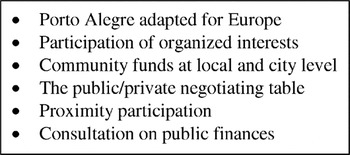
Typology of participatory budgeting
Source: Sintomer et al. Reference Sintomer, Herzberg and Röcke2008.

Yves Sintomer and colleagues have recently produced a typology of PB in Europe, containing six categories which range from “Porto Alegre adapted for Europe” to “consultation on public finances.”Footnote 53
Plock, in Poland, provides an example of “the public/private negotiating table.” A private/public partnership, sponsored by the UNDP, oversees a fund that allocates $10,000 each for projects submitted by NGOs. The projects are evaluated by a committee that includes citizens, and are implemented by civil society organizations.Footnote 54 Many cases can be found of the category “community funds at local and city level.” For example, with the assistance of the UN, a development project was set up in 2000 in Bangladesh, which provided an annual block grant (about $6,000) to the lowest level of local government. Committees were established to organize citizen planning discussions to decide how the money should be allocated, with the villagers divided into discussion groups, with facilitators, and including special women's groups.Footnote 55
In England, participatory budgeting has been organized by local governments allocating money to their communities. Usually, either local organizations apply for small sums of money for their projects or a planning committee decides on projects. Citizens' meetings are then arranged to discuss and vote on priorities for allocating the money. But in a time of austerity, as is noted in the report of a national conference on participatory budgeting held by the Participatory Budgeting Unit in November 2010, “practitioners are now challenged to move PB from the additional funds that no longer exist, to core service budgets and resources and discussions about all the budgets within a neighbourhood.”Footnote 56
Many other examples called “participatory budgeting” are merely consultative or provide information. To be sure, just as good governance is better than bad governance, so consultation or information is better than no consultation or no information. Local communities can benefit and citizens gain some practice in participation in some of these cases of “participatory budgeting,” but very few bear much resemblance to the PB that I have outlined. Little has changed from over a decade ago when one assessment of World Bank-supported participatory projects stated that “information sharing and consultation occur more frequently than participation in decisionmaking or implementation.”Footnote 57
There is now enormous interest in, discussion of, research into, and funding of a large variety of experiments in participation, monitoring, consultation, and provision of information. As I have emphasized, many of these developments can improve people's lives, but I want to insist on a distinction between (a) PB as a major step in democratizing democracy, and (b) so many of the wide variety of experiments in citizen participation or consultation now called participatory budgeting.
The spread of “participatory budgeting” around the world tends to involve measures that, rather curiously and despite their label, do not involve the municipal or local budget. Citizens are frequently discussing relatively small, discretionary sums of money that may or may not continue to be made available. Most of the examples being called participatory budgeting fit very easily within existing authority structures, and citizens are not participating, as a matter of right, in decisions about their city's or town's regular budget. Most of the innovations fall far short of participatory democracy.
Let me conclude by making some final observations and asking a question. My view of what is taking place is that, for the most part, we are seeing an expansion of participation and an extension of citizenship, but not the beginnings of democratization and the creation of a participatory society. The history of citizenship and democracy are commonly conflated. The term “democracy” is all too often used to describe situations where only a section of the population is granted citizenship; the remainder, which may be a majority, are merely subjects. From ancient times, there is a very long history of government, directly or through representatives, by citizens over non-citizens. Democracy did not appear until 1893 when New Zealand adopted universal suffrage, and thus the whole population, as a right, had some part in government. It took another century before most of the world had followed and, even today, universal suffrage—that very minimal but emblematic requirement for democracy—is still not quite global. That the struggle for universal suffrage was so long and so difficult is often forgotten today; it is unlikely that the democratization of democracy is going to be any easier.
I began by remarking that we are we surrounded by democracy-talk. Yet in Western countries popular confidence in old-established institutions is fading, voters are disaffected, trust in government is declining and a very wide gap has opened up between citizens and governments and political elites more generally. Ordinary citizens' voices are now being heard very loudly in a number of countries. But the outcome depends on whether anyone is listening; when actual budgets and policies are at stake, political elites rarely listen to citizens. One way of looking at the new expansion of participation is that in poor countries it can help improve governance, and in rich countries it can help bolster the legitimacy of the present system. If citizens can participate in mini-publics or can decide on the disbursement of some public funds then, in another piece of ubiquitous jargon, they “own” those decisions. More optimistically, it is possible now that citizens are obtaining some practice in new ways of exercising their citizenship, when the “Porto Alegre adapted for Europe” model is being tried in a few cities, and when the indignados are filling the squares and streets in many cities, that democratization could come onto the political agenda.
But the broader context is that, as I have argued, most of the expansion of participation does not disturb existing institutions. On the contrary, in many ways it is compatible with the massive changes (still taking place) summed up as “globalization.” This involves a specific form of modernization that revolves around structural adjustment—now being imposed upon some rich countries as well as poor—with the familiar recipe of deregulation, privatization (i.e., shrinking of the scope of government and selling public assets and services to be run for private profit), and a central role for finance capital. Such modernization thrives on the jargon of “transparency,” etc., and includes the transformation of the public sector—where budgets are formulated—by contracting out and marketization.
The innovations in participation are also suited to the other side of this mode of modernization, to a minimalist, “realistic,” Schumpeterian conception of “democracy” that sees citizens as merely consumers in another guise.Footnote 58 In a privatized social and political context in the twenty-first century, consumer-citizens need to be extra vigilant and to monitor providers; they require information, to be consulted, and occasionally to debate with their fellow consumer-citizens about the services they are offered. In contrast, the conception of citizenship embodied in participatory democratic theory is that citizens are not at all like consumers. Citizens have the right to public provision, the right to participate in decision-making about their collective life and to live within authority structures that make such participation possible. However, this alternative view of democracy is now being overshadowed.
So, to conclude, the problem is no longer whether participatory democracy is feasible; the empirical evidence, both from 40 years ago and today, shows that making substantive steps towards creating a participatory democracy is quite possible. The question I want to leave you with is whether, in the rich countries, there is any longer either the political culture or the political will to pursue genuine democratization. I do not have an easy response to this question—and I am happy to hand over the task of determining an answer to new generations of scholars.