


“We will never be able to understand what sort of thing we are talking about unless we understand first just what it is.”
—Cicero, On the Commonwealth (Reference Cicero and Zetzel1999, 17)Any comprehensive account of democracy will specify how closely the laws of a nation should correspond to the preferences of the citizens governed by them.Footnote 1 No one expects there to be an exact correspondence between the two, and deviations may be justified for familiar reasons: citizens often have no formed views on what the law should be; their preferences may be incoherent at the individual or collective levels, their preferences may not conform to their true interests and will change over time, or their preferences may be trumped by more important principles of justice (including, but not limited to, the protection of minority rights). As long as these deviations do not become the norm (in which the law routinely fails to correspond to citizen preferences), they fit well within broad conceptions of democracy. But the presumption of democracy is that there be a close correspondence between the laws of a nation and the preferences of citizens who are ruled by them. Thus it is that we must always justify and explain cases in which law deviates from citizen preferences, whereas no such prima facie justification is required in cases when law conforms to the preferences and wills of those it governs.
Let us call the specification of the proper relationship between citizen preferences and the laws that govern them the “central normative problem” of democracy. Representative government complicates this central normative problem because it introduces third parties (political representatives) who mediate between the law and the preferences of citizens.Footnote 2 Thus, in representative government, the central normative problem of democracy is often restated in terms of the relationship between citizens and their representatives: how closely must a representative's votes on legislation correspond to the preferences and will of his or her constituents?
The classic statement of this long-standing problem has been referred to by various names. In some cases, it is expressed as the dichotomy between independent and mandate theories of representation. More commonly, it is framed by the terms “trustees” and “delegates,” denoting whether political representatives—in their capacities as lawmakersFootnote 3—act as they believe is best for the nation versus acting as their electoral constituents desire (Pitkin Reference Pitkin1967).
Despite its historical longevity, the trustee/delegate debate is cast in overly broad terms that misleadingly emphasize the location of authority—the representative or his or her constituency—and obscure 3 fundamental and underlying distinctions. These subsidiary distinctions concern:
1. Aims: whether the representative-lawmaker aims at the good of all or the good of a part;
2. Source of Judgment: whether the representative-lawmaker relies on his or her own judgment or the judgment of a third party (to determine the substance of (1), i.e., the good at which he or she aims);
3. Responsiveness: the degree to which the representative-lawmaker is responsive to sanctions (usually, but not necessarily, the prospect of reelection).
Collapsing these three aspects of political activity, “trustees” are generally described as (1) looking out for the good of the whole (the nation's interests), (2) based on their own judgment about that good (rather than the judgment of their constituents), and (3) less responsive to sanctioning (acting instead according to civic virtue), whereas “delegates” are generally described as (1) looking out for the good of a part (the interests of their electoral constituents), (2) defined by a third party (their constituents' rather than their own judgment), and (3) more responsive to sanctions (in particular, the hope of reelection). Because “aims,” “judgment,” and “responsiveness” may vary independently, creating eight possible combinations (2 × 2 × 2), collapsing them into two types (“trustee” or “delegate”) obscures these other possibilities. (As illustrated in Tables 1 and 2, to be developed later.) The first aim of this article is thus to provide a more robust and accurate analytical tool for normative and empirical analysis.
Categories, Names, and Descriptions of Three Distinctions

Schematic Conceptual Space of 3 Distinctions

The second aim of this article is to demonstrate that the core issues in the trustee/delegate debate as just delineated do not primarily concern the location of authority between principals and agents, and thus do not involve the central normative problem of democracy after all. This is a surprising result because historically the debate over trustees and delegates has been framed precisely in this way, as a way of describing the relative autonomy or independence of the representative from his or her constituency's will. But if we consider that fully independent representatives may use their independence to aim at their constituents' good, as their constituents judge it, and in a manner that is responsive to sanction, and, conversely, that fully delegated representatives may be instructed by their constituents to aim at the common good, as their representative him- or herself sees it, without regard to future sanction (they explicitly instruct their representative to be nonresponsive to sanctions), the question of authority becomes distinct from the three distinctions that underlie the trustee/delegate debate. Put differently, even if we believe that constituents have the right to control their representatives, they can use this control to instruct their representatives to act as “trustees.” Conversely, even if we believe that representatives ought to be authorized to act independently, they may exercise this independence by acting as “delegates” of their home constituency.
Building on these first two points, the final aim of this article is to show that the distinctions collapsed in the “trustee/delegate” debate illustrate general conflicts that arise any time binding decisions are made and, in particular, when a decision maker wants to do something that in some sense ought to be done in cases where those to whom it is done do not approve. As long as lawmakers aim to make law that is substantively just and that corresponds to the preferences of those over whom it governs, the three subsidiary distinctions arise.Footnote 4 This tension, then, applies with no more or less force in a direct democratic assembly in which all citizens participateFootnote 5 or in a nondemocratic monarchy in which a single individual wants to make law that is both just and that conforms to the preferences of those over whom it governs. Thus, despite its historical lineage, the main tensions described by the trustee/delegate distinction apply to political representatives on account of their taking on the role of decision makers rather than on their account of their being representatives per se.Footnote 6
If this is correct, then the trustee/delegate problem is not a core problem of political representation per se, nor would it indicate a particular ethics of political representation in which representatives are said to take on unique obligations by virtue of their being representatives.Footnote 7 Political representatives may (and almost certainly do) take on a particular obligation to care about this particular group (and not some other one) or to give this third party's judgment (and not some other one's) special consideration in their decision making.Footnote 8 But this is a specification of the core substantive problem that emerges from a broader normative account of decision making and location of authority rather than from some conceptual, normative, or empirical fact about political representation. The casting of the “trustee/delegate” problem as particular to political representation thus constitutes a substantive error that fails to distinguish the tension between citizen preferences and normative ideals from professional obligations that any decision maker (whether monarch, representative, or citizen in a direct democracy) takes on when he or she takes on the role of making law or other decisions.
We note that of course, many other normative problems surround democratic representative government. Some of these problems include institutional questions of which groups should be represented, which electoral systems should be used to translate preferences into outcomes, and how to provide incentives to representatives to get them to do whatever it is they are supposed to do. Closely related are complications that arise when parties, rather than individual representatives, are used to represent voters. Other problems surround the use of citizen preferences to evaluate the democratic depth of a nation, given that most laws are not known to the people over whom they govern, and, most important, preferences are mutable by, among other things, political actors and institutions. Yet, as important and complicating as theses issues are, they build upon the core democratic view that laws should correspond in some way to citizen preferences, and when they do not, a justification is necessary to explain why that law is nevertheless still democratic.
If correct, the argument of this article has two primary virtues. First, the argument illustrates the importance of conceptual analysis to normative and empirical political science. The treatment of political representation in normative contexts has generally suffered from a lack of clarity and in empirical contexts from arbitrary precision. In more theoretical approaches, political representation is often claimed to be shifting, nuanced, and contingent, and this is no more so than in Hanna Pitkin's seminal statement and more recent statements by F. R. Ankersmit and Nadia Urbinati.Footnote 9 Indeed, as indicated by its title, this article forms an extended response to Jane Mansbridge's earlier work that, as I take up in what follows, appears to have introduced more complexity to the issues underlying the trustee/delegate debate. Like most political or social phenomenon, at a gross level political representation is complex, but its seeming underlying subtlety and nuance may be the result of treating it at a gross level rather than the nature of its components. Thus do scholars talk past each other using the same terms, but emphasizing quite different subsidiary parts (Shapiro Reference Shapiro2005). This should not lead us to mistake the complexity for the thing itself, but to identify and isolate precisely the parts of use for normative and empirical analysis. To emphasize the corollary of Aristotle's dictum, we should not expect less precision about a subject matter than it deserves.
If theorists tend to treat political representation in an overly gross manner, empirical scholars by and large tend to treat representation with artificial precision, reducing “representation” to the idea of “responsiveness” or “correspondence” itself. Thus, as I illustrate, the measure of “good representation” has become the extent to which a representative's roll call votes correspond to the public opinion of his or her constituents. Reducing “political representative” to this single measure leads to some surprising results. Representatives, for example, who vote for a just law, that, say, upholds minority rights, would be bad representatives if their constituents wanted to deprive that minority group of those rights. Without prejudging the question, I believe most of us would want to say that there is more going on: the representative was unresponsive but not necessarily a bad representative for doing the right thing. By isolating the moving parts, we can thus explain more of what is occurring. The argument thus attempts to advance social science concepts that correspond more accurately to the social phenomena they purport to describe.Footnote 10
The second virtue of this article is that it offers a conceptual roadmap that does not depend on democratic forms. The argument provides a way to understand how a core distinction that we attribute to democratic, representative governments applies no more or less to nondemocratic contexts, whether the case of nongovernmental organisations (NGOs) or nondemocratic government. All decision makers whose decisions affect others will face trade-offs between following justice and following the preferences of those their decision affects, regardless of whether they are political representatives, democratic, or elected at all. The breadth of this treatment then is applicable both to familiar democratic contexts of representative government, as well as quasi- or nondemocratic decision makers who increasingly act on the world stage.
The argument continues over four more sections. First, I briefly trace the collapse of the three underlying distinctions into the “trustee/delegate” dichotomy, and provide context for and explain the relevance of the problem today. Second, I illustrate more fully the three conceptual categories that the “trustee/delegate” debate collapses—aims, sources of judgment, and responsiveness—and show the analytical value that such separation generates. Third, I demonstrate that the location of authority (between, say, constituents and their representatives) is a separate matter from the three distinctions within the “trustee/delegate,” and likely serve to explain whether, or to what extent, a representative should be considered democratic. Finally, I conclude by explaining why the three distinctions are faced by political representatives only insofar as they take on the role of decision makers and not by virtue of the fact that they are representatives, let alone democratic, per se.
CONCEPTUALIZING THE PROBLEM IN HISTORY AND CONTEMPORARY SCHOLARSHIP
The traditional categories of “delegate” and “trustee” appear at first to denote different locations of authority about how a representative ought to vote. In “delegated” representation, we imagine authority located more directly with a home constituency, whereas with “trusteeship,” we locate authority with the representative him- or herself, who now has the power to act. Thus, it is often said that the delegate is less autonomous, or independent, in acting than is the trustee (Pitkin Reference Pitkin1967).
In truth, however, the emphasis on authority and autonomy is of less analytical value than it first appears. On the surface, the authority/autonomy distinctions appear to emphasize who has the authority to cast a vote on proposed legislation. Yet, this cannot be right because by presumption only the representative has the authority to cast the vote no more or less when bound by constituent instructions than when independent of them. The question of authority must therefore concern who has the right to decide how to cast votes, or more generally, how to make decisions, and this question is at the core of the three underlying distinctions of aims, sources of judgment, and responsiveness. Once we specify these distinctions, we can see that the location of authority is wholly independent of them. As we see later, so-called trustees can be instructed, mandated, and bound by their home constituency's authority to act as trustees, and so-called delegates might act that way because that is called for as the proper exercise of their independent authority.
To fully appreciate this point, we need to explicate the three core distinctions and place them in their context; I thus postpone the discussion of authority until that point. In the remainder of this section I provide some context for, and explain the relevance of, the general problem today. First, I briefly show how the three distinctions have historically been collapsed in terms of “trustees” and “delegates,” illustrate how the normative and empirical literature tends to emphasize different parts of each, and, finally, conclude this section by explaining why the recently proposed reconceptualization of this problem by Jane Mansbridge trades one kind of complexity for another (Mansbridge Reference Mansbridge2003).
Trustees vs. Delegates in Historical Context
The treatment of the “trustee/delegate” problem as distinctive to democratic representative government (rather than a more general problem of decision making) may be due to the simultaneous emergence of the practice of political representation and notions of popular sovereignty in which political representatives were increasingly used to express the decisional authority of the people. The distinction between “trustees” and “delegates” traces back at least to Magna Carta in the early 13th century. At that time, representatives had little authority to act, let alone judge or enact law, but were merely to give their constituency's (town or borough) assent to the king's demand for money (Fasolt Reference Fasolt, Bowman and Cody1991). Over the next 500 years, that relationship would be complicated as representatives were given more decisional authority over law, and, simultaneously, popular sovereignty emerged as a governing ideal. By the time of the American Revolution, the question about whether representatives should be “trustees” or “delegates” of their constituents overlaid with the separate view that law should in some sense reflect the preferences of the people (Rehfeld Reference Rehfeld2005). The ideal that law should be both just and reflective of popular preferences—an ideal to which any kind of lawmaker might in practice aspire regardless of whether institutionally or legally bound to the people's will—became hard to distinguish from the practice of using political representatives as lawmakers themselves.
The underlying distinctions that were later subsumed by the “trustee/delegate” labels arose in debates about political representation in the 18th century. Scholars point to Edmund Burke as the exemplar of the “trustee” position and to a more defuse set of anti-Federalists to characterize the “delegate” position. In truth, their positions were more complicated and held by a wide variety of actors, each of whom had nuanced positions on the aims, sources of judgment, and responsiveness that should animate lawmakers more generally (Burke Reference Burke1774; Parsons [1778] 1983; see also Kenyon Reference Kenyon1966; Pitkin Reference Pitkin1967; Rakove Reference Rakove1996; Rehfeld Reference Rehfeld2005).
Consider, for example, the proposal to constitutionally protect the right of U.S. citizens to instruct their representatives. The proposal, made by Representative Thomas Tudor Tucker in 1789, would have become part of the First Amendment to the U.S. Constitution (concerning basic freedoms of speech, assembly, and religion). The proposal was soundly defeated in part by arguments, such as this one by Thomas Hartley:
If, in a small community, where the interests, habits, and manners are neither so numerous or diversified, instructions bind not, what shall we say of instructions to this body? Can it be supposed that the inhabitants of a single district in a State, are better informed with respect to the general interests of the Union, than a select body assembled from every part? Can it be supposed that a part will be more desirous of promoting the good of the whole than the whole will of the part? I apprehend, sir, that Congress will be the best judges of proper measures, and that instructions will never be resorted to but for party purposes, when they will generally contain the prejudices and acrimony of the party, rather than the dictates of honest reason and sound policy. (Kurland and Lerner Reference Kurland and Lerner1987, Annals 1:733–45, 13:39)
Hartley's response illustrates two critical points. First, Hartley identifies all three moving parts that I claim comprise the “trustee/delegate” distinction. The aims of legislation should be the good of all (modified when appropriate by the good of a part), as judged by the lawmaker because of his or her proper deliberative position in the legislature. Furthermore, the lawmaker should be less responsive to external sanctions that would reflect “the prejudices and acrimony of the party,” relying instead on his or her own “honest reason” and the desire for “sound policy.” Second, although other speakers (and Hartley himself) would refer to “representatives” as well, his argument here is framed in terms of what a lawmaker ought to consider. The conflation of “representative” with the role of “lawmaker” (or, more generally, “decision maker”) that they take on once they are representatives is thus evidenced in the language used.
Stepping back from this particular example, we can characterize the trustee and delegate positions by systematically fixing their underlying three moving parts. The trustee position, often attributed to Edmund Burke, specifies that (1) national legislation ought to aim at the national good; (2) the representative, in deliberation with other legislators, should be the ultimate judge of what constitutes that national good; and (3) the representative should be less responsive to electoral sanctions, motivated instead by some form of civic virtue. Burke, for example, clearly identifies the first two features as separate features of the whole. Defending the national good as the proper aim of legislation, he writes, “If the local constituent should have an interest, or should form an hasty opinion, evidently opposite to the real good of the rest of the community, the member for that place [i.e., the representative] ought to be as far, as any other, from any endeavour to give it effect” (Burke Reference Burke1774, 448). Separately, Burke defended the view that representatives rather than their constituents or other third party ought to be the source of judgment about what constitutes the national good. “Your representative owes you, not his industry only, but his judgment; and he betrays, instead of serving you, if he sacrifices it to your opinion” (Burke Reference Burke1774, 446).
Given the attribution of “trustee” to Burke's conceptions, it may come as some surprise that he never uses the term in his Speech to the Electors at Bristol, keeping the parts more clearly separate. But two centuries later, those views have been conflated into the designation “trustee.” Although Pitkin's description of Burke was rightly complicated and nuanced, she attributes to Burke the “trustee” distinction, and rightly noted that in Burke's view a representative ought to act from a sense of right and wrong and be less responsive to sanctions. “The first concept of representation encountered in Burke's thought is thus an aristocracy of virtue and wisdom governing for the good of the entire nation” (Pitkin Reference Pitkin1967, 218, emphasis added). Adrian Vermeule's recent formulation of “trusteeship” is characteristic of its academic and popularFootnote 11 treatment that also collapses its underlying variables. “Burke's trustee model of representation [is] a normative stance that sees a good representative as one who exercises independent judgment for the common weal, rather than simply acting so as to satisfy the preferences of a . . . constituency” (Vermeule Reference Vermeule2007, 218, emphasis added).
Delegate views of representation, like those Burke was countering,Footnote 12 press instead for a close correspondence between the views of an electoral constituency and the votes of representatives. The view was perhaps best captured by the opponents of the American Constitution in the 1780s, the so-called anti-Federalists. For the delegate (1) the aims of legislation are the good of a particular electoral constituency, (2) citizens are the source of judgment about what constitutes that good, and (3) representatives are supposed to be highly responsive to the threat of sanction. Thus, so-called “delegates” seek to secure their constituents' interests as their constituents so define them.
These are characterizations, and a lot of variation can be found, a point I develop later. But in broad summary, the representative as delegate is historically one who (1) aims at the good of his or her constituents, (2) as judged by his or her constituents, (3) more responsive to external sanction (election or the avoidance of legal penalties), whereas the representative as trustee is one who (1) aims at the good of the whole, (2) as judged by the representative, (3) less responsive to sanction, but acting on some form of civic virtue instead.
The Dependency and Presumptions of Empirical and Normative Research
Within the current academic literature, there appear to be three separate positions on which scholars focus, covering a range of possibilities for each variable. Empirical scholars generally presume that democratic representatives should aim at constituent interests, as judged by the constituents, and be highly responsive to electoral sanction. Normative scholars appear on the other side of the spectrum, endorsing either mixed strategies or something rather close to Burke's trusteeship.
The reigning view within empirical political science presumes the delegate model of representation as the ideal. I say “presumes” because the norms that underlie most empirical research on the subject are not defended, even as they are asserted. Most empirical studies, for example, equate “better” or “good” representation with “electoral responsiveness,” measured by how closely a representative's voting record corresponds to his or her constituents' preferences (Gelman and King Reference Gelman and King1994). Others measure “good representation” by how many voters vote for winning candidates (Brunell Reference Brunell2006). Indeed, Zoltan Hajnal (Reference Hajnal2009) took this approach in this journal, critiquing current practice only to the extent that it is gets at imperfect measures of the correspondence between votes and election outcomes, not that that correspondence itself was to be questioned as the proper measure of “good” representation.
Empirical scholars may favor delegate views of representation because they are easier to measure: one need only compare roll call votes of representatives with public opinion surveys, or election outcomes with votes cast, to evaluate whether “good” representation in this sense is achieved.Footnote 13 But such a view ignores or presumes away the other more complicated question of what the ends of lawmaking should be, how to measure good deliberation, and other questions that make the trusteeship view of political representation a more plausible alternative, or at least not one to be summarily dismissed.Footnote 14
If there is any consensus in the normative literature on democratic theory, it is reflected by Hanna Pitkin's view that no single hard and fast rule should govern a representative in all cases. A democratic representative need not always be in agreement with his or her constituents, but “he must not normally come into conflict with their will when they have an express will. . .” (Pitkin Reference Pitkin1967, 163). The conflict, in Pitkin's mind, is hard to resolve, and instead of resolution we should look for accountability. “[W]hen a representative finds himself in conflict with his constituents' wishes, this fact must give him pause. It calls for a consideration of the reasons for the discrepancy; it may call for a reconsideration of his own views. It is not sufficient for him to choose; it is necessary that the choice be justifiable” (Pitkin Reference Pitkin1967, 163–4).
In real world politics, our evaluation of the appropriateness of a lawmaker so deviating from popular sentiment does not appear to be based on a principled view about whether representatives should be trustees or delegates. Rather, it appears to be based on whether we agree with the substantive issue at hand. Thus, some praise as a “profile in courage” Marjorie Magolis-Mezvinsky's 1993 decision to cast the decisive vote in favor of President Bill Clinton's first budget, despite its predictable electoral consequences for her as a representative of a conservative constituency, and ridicule President George W. Bush a decade later when he dismissed protesters as irrelevant to his own thinking about “just” policy in Iraq. Conceptually, each acted in pursuit of what he or she believed justice demanded, overriding the contrary judgment on the issue of those whom he or she represented.Footnote 15
Deliberative democrats have been more receptive to representative independence for precisely the reason just hinted at. Proper deliberative conditions require that representatives be able to revise their views and change their mind when confronted by better arguments.Footnote 16 This deliberative commitment requires greater independence of judgment than empirical political scientists presume when they measure “representation” as congruence between voter preferences and a representative's votes. Even given its variation, deliberative democrats are still democrats and thus add all sorts of democratic checks on the required deliberative independence of the representative. Thus are conditions of publicity, accountability, and transparency such critical checks on representative independence. In these views, democratic control unfolds in a process and relationship between the representative and voters not merely at the time of voting and reelection, but during the term of office.
Mansbridge's “Rethinking Representation”
If empirical and normative scholars effectively endorse different views of the proper role of representatives, Jane Mansbridge (Reference Mansbridge2003) proposes altogether eliminating the language of trustees and delegates, recasting the set of issues in terms of four new ways to “rethink representation”: “promissory,” “anticipatory,” “gyroscopic,” and “surrogate.” Mansbridge describes these as “legitimate forms of representation” even, she argues, if none of the last three “meets the criteria for democratic accountability. . .”. These ideal types are meant to be just that—descriptions of conceptual points that are not necessarily realized in any pure form. In practice, representatives act in a way that mixes these forms.
Rethinking the terms of representation in four categories is supposed to provide a better conceptual map than “trustee/delegate” by making possible the identification of “the underlying power relation in each form, the role of deliberation in each, and the normative criteria appropriate to each” (Mansbridge Reference Mansbridge2003, 515). But the conceptual claims that Mansbridge makes are less helpful to empirical and normative analysis than they ought to be because they simply trade one kind of complexity (the distinctions collapsed in the “trustee/delegate” distinction) for another. As the passage just quoted indicated, each of the four kinds of representation collapses at least three different things—power relations, modes of deliberation and normative criteria. Because power relations need not be dichotomous, and because there are many forms of deliberation and probably even more normative criteria by which to judge actions, it would appear that relying on these three conceptual descriptors we would arrive at an infinite number of ways to “rethink representation.” In short, it would be far more useful to isolate each subpart independently of, or in conjunction with, the other subparts to see how they do covary and to judge how they ought to covary.
Consider, for example, how Mansbridge's treatment of “promissory representation” adds to, rather than unpacks, the complexity of the “delegate” model. “Promissory representation” is a model in which representatives “promise” to do what they are authorized to do, and their failure to redeem the promissory note results in their facing electoral sanction by being turned out of office. “In promissory representation, the power relation from voter to representative, principal to agent, runs forward in linear fashion. By exacting a promise, the voter at Time 1 (the election) exercises power, or tries to exercise power, over the representative at Time 2” (Mansbridge Reference Mansbridge2003, 516). In sum, “Promissory representation thus focuses on the normative duty to keep promises made in the authorizing election (Time 1), uses a conception of the voter's power over the representative that assumes forward looking intentionality, embodies a relatively unmediated version of the constituent's will, and results in accountability through sanction” (Mansbridge Reference Mansbridge2003, 516).
As we saw previously, so-called delegate representation involved two of these parts—delegates were to use their constituents' judgment in determining how to vote and be responsive to external sanction for failing to do this. But here the promissory representative is to be responsive to the voter's power and nonresponsive to that power in so far as he or she simply has a “normative duty to keep promises” quite apart from fearing the electoral sanction he or she is sure to face. On top of this, “promissory representation” adds three more distinctions. First, the will of the voters should be “relatively unmediated” (so we could presumably have a “mediated” version). Second, the location of the commands is shifted: unlike delegated representation in which instructions are issued from the constituency to the representative, in promissory representation, the terms of the agreement are set by the candidate or the party in the form of campaign promises.
Finally, by referring to “forward looking intentionality,” promissory representation makes explicit a confusing distinction expressed in the widely used terms “prospective” and “retrospective” voting. Reflecting those terms, Mansbridge means that promissory representation uses so-called prospective voting in which voters consider future performance when casting a vote rather than using a vote as sanction for past actions. But the terms and description “forward looking” applied to intentionality and “prospective/retrospective” applied to voting are confusing because intentionality and the power that we express when we cast a vote are always, by necessity, forward looking. Unless we were able to move back in time, we cannot express “backward intentionality,” nor can we vote retrospectively, that is, in a manner that affects the past. It is an important philosophical point: votes for political representatives always amount to this intention, “I intend that going forward you should be my representative.” Even in so-called retrospective voting we use the forward-looking, prospective intention of our vote to reward or punish past performance; in “prospective voting,” we use our expectations about future performance to cast our vote. In both cases, it is the evidence we consider, not our votes, that is prospective or retrospective, forward or backward looking. Votes may be given as sanction and reward for past action, but they are always grants of power for the future.
Despite its increased complexity, the core of promissory representation is remarkably similar to the “delegate” model: representatives are to closely track the judgment of their home constituency, as set out in a specific set of known terms that serve as the condition of service, and be responsive to the sanctions they face for failing to comply. In both cases, representatives follow a precommitted strategy, and their failure to follow that precommitment is seen as good reason to terminate their future service. Of course, there may be situations in which these variables take on the particular characteristics that Mansbridge attributes to them, and in those cases, there is no harm in calling it “promissory representation.” But for the purpose of analyzing political phenomena, such complexity is more likely to introduce confusion than clarification. Mansbridge's other categories face similar problems.Footnote 17
That said, Mansbridge's terms “gyroscopic” and “induced” in her last set of distinctions is more conceptually helpful to describe the extent to which a representative is responsive to sanctioning. Here, we can use “gyroscopic” to refer to a representative who is relatively unresponsive to sanction—he or she acts based on principles and policies to which he or she is committed, quite apart from the personal consequences of pursuing them. In contrast, an “induced” representative is more responsive to sanctioning, acting with an eye toward the personal consequences of his or her actions. This, however, is a much pared-down version of Mansbridge's conception. Mansbridge herself uses a more complex formulation: in “gyroscopic representation, the representative looks within, as a basis for action, to conceptions of interest, ‘common sense,’ and principles derived in part from the representative's own background” (Mansbridge Reference Mansbridge2003, 515). By her treatment, the gyroscopic representative is not merely less responsive to sanctioning, but also looks to herself as her own source of judgment and basis for determining the proper ends of legislation.
Restricting the terms “gyroscopic” and “induced” to describe the relative responsiveness of a representative to sanction, but jettisoning the other features of Mansbridge's description, isolates the critical ideas at its core and helps demonstrate why “gyroscopic” is an apt term. As Mansbridge argued, voters often want to support representatives who are less likely to change their mind based on the prospects of being voted out of office. What makes a gyroscopic (i.e., less responsive) representative different from a responsive one does not thus rely on the substantive position either takes ex ante. Rather, as Mansbridge argues, gyroscopic representatives may be desirable because they need less auditing to make sure they pursue their objectives and will stick to their guns even if it will cost them their jobs (Mansbridge N.d.; see also Fearon Reference Fearon, Przeworski, Stokes and Manin1999).
Conceptually, gyroscopic representation is of a piece with traditional concerns about “virtue.” Like gyroscopic representation, “virtuous” representatives were supposed to act by a “proper” motivation stemming not from external rewards or punishments, but from an internal, properly attuned sense of right and wrong. But using “virtue” in this way is itself a gross concept spanning two dimensions (Shapiro Reference Shapiro2005). It signified that a person was internally motivated (rather than externally induced), and a representative who had “political virtue” was one who had the purported right substantive view on issues and personal conduct. Thus, the truly virtuous person not only did the right thing, but also did it for the right reasons (i.e., motivated by the right sorts of considerations). This is why James Madison could argue that institutions might be designed to encourage people to act as if they were virtuous, that is, so that their external behavior would be similar enough to those who were in fact virtuous regardless of whether their internal motivations were good, right, or just. That two representatives voted the same (right) way was not enough to know that they were virtuous, but it was enough in his mind for a reasonably just system. Using Mansbridge's term “gyroscopic” to describe those who are less responsive to sanction is so helpful in this regard: it allows us to focus on a representative's responsiveness to sanction without specifying the content of the representative's views.
SEPARATING THE THREE DISTINCTIONS AND KEEPING THEM SEPARATE
In the prior section, I illustrated that the terms “trustee” and “delegate” were labels imposed on top of a more complicated set of distinctions. I argued that normative and empirical treatments of political representation tend to emphasize various positions on the underlying distinctions. Finally, I argued that, by and large, Mansbridge's prominent attempt to reconceptualize them shifted the complexity rather than isolated and clarified the component parts. In this section, I turn now to explicate what I believe are the three core distinctions and demonstrate how this unpacking can be of some analytical use.
I begin by formalizing the three distinctions that underlie the “trustee/delegate” debate. Each of the traditional distinctions “trustee” and “delegate” defines an independent and independently important problem to consider: (1) should a representative-decisionmaker pursue the good of the whole or a part?; (2) should he or she rely on his or her own judgment, or that of a third party?; and (3) should he or she be more responsive or less responsive to sanctions for his or her work? (As we see later, representatives may pursue either side of these distinctions regardless of whether they are fully independent of, or fully mandated by, their electoral constituency.) Indeed, if each of these three separate distinctions points at two directions (the whole vs. a part; the judgment of the representative-decisionmaker vs. the judgment of others; behavior that is more or less responsive to sanction) and any combination of these three is possible, then there are eight possible ideal types (2 × 2 × 2). The use of the binary distinction “trustee” and “delegate” thus obscures six other ideal types, obscures how each variable may vary, and makes normative and empirical analysis more difficult and imprecise.
First, we can broadly distinguish the ends at which representative-decision makers aim based on their level of universality or particularity—whether, that is, they aim at the good of all or the good of some part. At one extreme, we have representative-decision makers who aim at the good of all. Although the “good of all” has traditionally been described in terms of the good of “the nation,” there is no reason to conceptually limit this—the extreme would be the good of all humanity through conceptions of global justice. At the other extreme, we have representative-decision makers who aim toward the good of a particular part. Although this particular part has traditionally been described in terms of the good of the representative's electoral constituency, there is no reason to conceptually limit its application—the part might be an interest group or, at the extreme, the good of a single individual. This distinction is useful because it keeps our attention focused on how universal or particular a law or decision is or ought to be, quite apart from its substance. “Trustees,” as we have seen, are generally described as aiming at a more universal good—the good of all; “delegates” at the good of a part.
Second, once we determine the ends toward which a law aims the representative-decision maker must make an epistemic determination about means and ends, judging whether a proposed bill is likely to achieve its particular goals: will it be good for the whole or the part at which he or she aims? Here we can distinguish among the sources of this judgment based on whether he or she relies on his or her own judgment or the judgment of someone else. This distinction is useful because it draws our attention to the source of judgment about the law (or decisions more generally), quite apart from the ends toward which the law or decision should aim. As we saw previously, “trustees” are generally described as using their own judgment; “delegates” as relying on the judgment of others.
Finally, we can distinguish between the extent to which a representative-decision maker is responsive to sanctions.Footnote 18 Here with Mansbridge we can draw a distinction between those who are less responsive to sanctions and those who are more responsive to sanction. This distinction is useful because we might believe that the level of responsiveness is important for reasons of control or oversight of a representative-decision maker. In particular, to the extent we cannot effectively reward or sanction their every action, or merely do not want to take the time to do so, we might want representatives who do not need that sanctioning to do what they say they are going to do.Footnote 19 As we saw, “trustees” are generally described as being less responsive to electoral sanctions (relying, historically, on “civic virtue”), whereas “delegates” are described as more responsive to electoral sanction.
Each distinction denotes a range of options. Lawmakers are likely to care (and likely ought to care) about the justice of a law for both the whole and the parts thereof, in some cases, more the one than the other. They are likely to rely (and ought to rely) sometimes on their own judgment as to whether the law achieves its stated goals and sometimes on the judgment of others. Finally, they are likely to act (and ought to act), sometimes responding to electoral sanctions, sometimes not. This is why we speak of each of these three variables—aims, source of judgment, and responsiveness—as continuous rather than discontinuous, distinctions rather than dichotomies.Footnote 20
We can now see that two of the three distinctions—aims and responsiveness—relate to some familiar labels. The pluralist/republican distinction, for example, highlights the debate about the proper aims of legislation. Pluralists such as Robert Dahl and David Truman took the view that lawmakers should promote the interests of their constituents directly (Dahl Reference Dahl1956; Truman Reference Truman1953). Republicans, including Sunstein and Pettit, argue that lawmakers should aim more directly at the good of all (Pettit Reference Pettit1997; Sunstein Reference Sunstein1993) (Although we must keep in mind that the partial advocacy that is the hallmark of pluralism is a proximate one: pluralism itself is justifiable only by the argument that we all do better when each pursues his or her own partial good. The dichotomy thus focuses not on a comprehensive justification for either position, but rather from the substantive view of which one is more likely to succeed in attaining it (Rehfeld Reference Rehfeld2005, Chapter 8).) We can use Mansbridge's “gyroscopic” to designate a lawmaker who is less responsive to sanctions, motivated instead by his or her own internal compass compared to the induced representative who is more responsive to sanction.
Because each distinction denotes a range, we can use these familiar labels to name the end points on the range, as summarized in Table 1. For the aims of legislation, we can call those who aim at advancing the good of all, “Republicans,” and those who aim at the particular good of some subgroup, “Pluralists.” For the sources of judgment, we can call those who rely on their own judgment “self-reliant,” and those who rely on some other person's or group's judgment “dependent.” For responsiveness, we can follow Mansbridge's terminology, and call “gyroscopic” those lawmakers who are less responsive to sanction and call “induced” those lawmakers who are more responsive to sanctions.
We can now see why the traditional “trustee/delegate” distinction obscures too much. The representative as trustee is an amalgam of someone who is (1) a Republican (i.e., aims at the good of all); (2) self-reliant (i.e., follows his or her own judgment about whether a proposed law achieves this aim); and (3) less responsive to external sanctioning. In contrast, the lawmaker as delegate is an amalgam of someone on the other side of each of these three distinctions, who is (1) a pluralist (i.e., seeks to promote his or her own constituents' interests); (2) dependent (i.e., relies on his or her constituents' or someone else's judgment about whether a proposed law achieves this aim), and (3) more responsive to sanctions (especially by the prospect of future electoral success).
But if the traditional “trustee/delegate” view is captured by these amalgams, why not use those familiar terms? The more significant problem with relying on the traditional language is that it emphasizes only two out of eight possible permutations of the answers to the three questions posed. In doing so, it reduces our ability to analyze and assess more complex combinations of what representatives (or other political actors) might do. It is an example of using concepts to muddy our understanding of the social world rather than clarifying it.
To demonstrate this, we can simply articulate how different combinations of each distinction have manifested themselves either in the academic literature or in practice. Table 2 presents a summary of these eight possible positions. (The examples referred to in these eight cells are meant only to illustrate the position. Although I believe they are accurate, I offer little defense here for the particular labels I use. Indeed, once the distinctions are made explicit, they could form a robust tool for comparative theoretical analysis of these positions or actors.)
Reading across the table, the top row, labeled “Republican aims,” includes all who aim at the public good, instead of acting to pursue their constituents' or some other group's particular welfare. Exemplars of this position, if imperfectly so, are Philip Pettit and Cass Sunstein. The bottom row, labeled “Pluralist aims,” include all who promote the advancement of their constituents' (or some other particular group's) interests; exemplars here are Robert Dahl and David Truman. Table 2 is also divided into two large columns signifying the level of responsiveness to sanction—whether gyroscopic or induced. Exemplars here are Jane Mansbridge's account of a “selection model”Footnote 21 and, on the induced side, the treatment of what constitutes “good” political representation by empirical political scientists.Footnote 22
Individually, each of the eight cells corresponds to descriptions of a range of political actors that have appeared in history. In cell A we find the Burkean trustee who, as we discussed previously, looks after the national good, as he or she judges it to be so, less responsive to electoral pressures, motivated instead to act by republican virtue. In cell B, we have someone who, like the Burkean trustee, is motivated internally to seek the good of all, but now depends on his or her constituents' judgment of the public good to determine what that good actually is. We might consider as an exemplar of this position civil servants who may be seen as acting to serve the common good, based in large part on a third-party's judgment about that good (e.g., as dictated by the legislation they follow), and who cast themselves as unresponsive to sanctions.
In cell C, we again have someone pursuing the general welfare who uses his or her judgment to decide what that good is, but unlike the Burkean trustee or civil servant, he or she is extremely responsive to electoral sanctions. I have labeled this “Madisonian” because I believe this is precisely the kind of representation that James Madison was defending in his contributions to The Federalist (Rehfeld Reference Rehfeld2005, 98–104). In cell D, we are now far from the Burkean trustee: here is someone who aims at the good of all, but looks to his or her constituents (or some other particular group) to define what that good is, and does so only because he or she wants to get reelected. Although anti-Federalists were more concerned overall with the particular interests of local communities, there was a strain that defended instructions with legal sanction in order to pursue the national good.
Each of the four cells in the second row demonstrates a different kind of pluralist. On the left in cell E, we have the pluralist who aims at the good of his or her particular constituency, but uses his or her own judgment to determine what that good is. Committed first and foremost to the good of his or her constituents, they are also less responsive to sanctions. This might describe a tin-eared, passionate volunteer working to better a community as he or she judges it would improve without regard to what the community believes is right and undeterred by the fact that he or she will soon be asked to leave. (Or, more positively, the same sort of person who acts out of dedication to the job, not for the rewards that he or she will receive.) In cell F, we find someone who, like the volunteer, both aims at a partial good and is less responsive to sanctions. But here he or she follows, rather than ignores, his or her constituents' (or some other particular group's) judgment about what that good consists of. I believe this characterizes the ideals of foreign ambassadors who want to advance their home nations' interests, as judged by the government they serve, but who are motivated by an internal sense of purpose (“service to country”) rather than induced by threat of sanction.
The exemplar of cell G is the “professional”: a hired lawyer, doctor, or perhaps financial advisor who is an induced pluralist seeking the good of his or her client for the sake of external reward (e.g., payment, reputation), but relies on his or her own judgment as to what the good of his or her client actually is. Finally, in cell H, we arrive at the pared-down version of the delegate model: someone who pursues the good of his or her constituents as his or her constituents see it, motivated simply by his or her desire for external reward (i.e., reelection).Footnote 23
Now, in any one of the eight cells, we have a complex character that specifies how an actor behaves, or provides a model for how he or she ought to behave, but broken down into analytically distinct parts. Of course, it is difficult to find in any single cell a complete description of any single view, any single representative, or actor. This may explain why in analyses of the political world we tend toward complex characterizations—political behavior is usually complex. Indeed, once framed this way, we imagine other subsidiary and familiar distinctions that we should also think hard about. First among these other issues is the temporal reference point for all three distinctions. For example, should we care that the law aims at a good today, at election time, or in the longer term (Thompson Reference Thompson2005)? Should we use their judgment today about the aims of law, or reference what we believe their judgment will be in the future (Przeworski, Stokes, and Manin Reference Przeworski, Stokes and Manin1999)? We can ask similar questions about constituent conditions: should we rely on constituent judgment as it is, or as it would be from an ideal, educated, and deliberative position?
The point here is not to work through these distinctions in a hundred- or thousand-celled table. The three that we emphasize derive from the traditional “trustee/delegate” distinction and are enough to provide a useful conceptual space on which these other distinctions can unfold. More generally, focusing on the more fundamental categories of aims, sources of judgment, and responsiveness provides a rubric by which to assess the rest.
WHITHER AUTHORITY?
The Three Distinctions and the Independence/Mandate Controversy
One reason the previous argument might sound a little fishy is that the three distinctions of aims, judgment, and responsiveness do not encompass the authority and will of the voters. This is problematic if only because the traditional “trustee/delegate” debate has closely tracked the “independence/mandate” controversy in which we ask whether a representative acts independent of or mandated by the will or authority of voters (Pitkin Reference Pitkin1967, 144–67). Traditionally, so-called trustees are said to have greater authorial independence from their constituents' will, and so-called delegates appear constrained by the will of their constituents. The failure to include the location of authority as part of the underlying tripartite structure of the “trustee/delegate” debate certainly cuts against our general intuitions and long-standing historical use of these terms and is in need of explanation.
At first, it might appear that “responsiveness” captures this dimension because responsive representatives will tend to do what their constituents want (as if following their instructions), and less responsive representatives will tend to do less of what their constituents want (as if acting independently of them). But such a view misconstrues the nature of “responsiveness” and “authority.” Responsiveness, as I have used it here, simply describes a representative decision maker's sensitivity to sanction; by “authority,” we mean to describe the conditions under which an actor has the right to act in whatever way he or she is acting. Foreshadowing the following discussion, we can have representatives who are instructed and authorized to be unresponsive to sanctions, just as we can have fully independent representatives who, on their own authority decide to be extremely responsive to sanctions. Voters, for example, might want to authorize nonresponsive representatives in order to constrain themselves because they know that otherwise they would improperly meddle in his or her affairs. So, whether representatives have the authority to be more or less responsive is an open question that requires a separate determination. Authority regards where the right to decide lies; degrees of “responsiveness” will be specified as part of the content of that right.
To be sure, the question of where the authority lies to make a binding decision—even one that is otherwise just—is a critical question of sovereignty and may well determine whether we characterize a regime as reasonably democratic at all (Dworkin Reference Dworkin1977; Estlund Reference Estlund2008; Locke [1690] Reference Locke and Laslett1988; Rawls Reference Rawls1993; Raz Reference Raz1979; Simmons Reference Simmons1979). On one side, where citizens retain a constant authority to decide each piece of legislation, we have something approaching direct democracy. On the other side, we are unlikely to call “democratic” a case where citizens at one moment authorize someone to be the lawmaker and govern them, in perpetuity, never again to hold that person accountable.Footnote 24 In between, we have a situation where citizens have at least the indirect authority over the law, through the representatives they authorize to vote for a time and later hold to account. The independence/mandate distinction thus also describes how much ongoing control constituents have over their representatives (Pitkin Reference Pitkin1967).
The role of authority in the traditional “independence/mandate” controversy, however, is somewhat murky because it collapses two separate questions: “who has the right to cast a vote on legislation?” and “who has the right to decide how a vote should be cast?” By “cast a vote,” I mean having one's voice (or will) count in some way toward determining whether a law is enacted. Members of Congress and other law makers, for example, presumably have this first right, the rest of us do not. By “decide how a vote should be cast,” I mean determining how a vote ought to be cast. This second concern is separate from the first—it explains what kinds of considerations those who have the right to vote ought to take up (or be bound by) when determining what vote to cast. It is this second presumption that explains why a lawmaker might be making a normative error in deciding his or her vote by relying on a horoscope rather than, say, the deliberation of his or her peers, without necessarily denying that he or she—rather than some other person—has the first right to have his or her vote count in determining the law.
I presume that a complete account of authority will specify the precise relationship between the right to vote on legislation (or binding decisions, more generally) and the right to decide how that vote should be cast. It might turn out that the first right (to cast a vote) depends on properly exercising the second right (to determine how the vote ought to be cast), or vice versa. Or, it might turn out that the first right (to cast a vote) is determined solely by a selection procedure without any restrictions on the proper exercise of that right once obtained. The point here is only conceptual: the right to cast a vote is conceptually separate from the right to decide how that vote should be cast, and we may remain formally agnostic about the relationship between these two rights.
With these two distinctions in mind, the debate about “instructions” or “independence” and “mandates” should be understood to concern this second right over who has the authority to decide how a vote should be cast (or other decision made), and not over the right to vote on legislation itself. This should not be controversial: even if a representative is mandated and obliged to follow someone else's will (about how to determine how to vote), it is still the representative, and only the representative, who we presume has the right to actually cast the vote in the legislature. In the extreme case, an instructed or mandated representative is someone who lacks the second right to decide how to cast his or her vote; an independent representative is someone who has the right to decide how to cast his or her vote. But, in both cases, the representative-decision maker, and only that person, retains the first right, the right to cast the vote itself. Indeed, if someone else were to attempt to cast the vote in the legislature, it would not count, even if she were casting the vote in exactly the same way as the person who had that right would have cast it.
So far this clarifies but is not at odds with the conventional story. The complexity arises when we refer to Table 2, and consider that each of the eight cells are actually descriptions of different ways that a person might determine how to cast his or her vote. In other words, deciding how to cast a vote will entail a specification of one of the eight cells. The right to decide how a vote should be cast thus means, in part, that one has the right to determine toward which of the eight ideal types the holder of the first right (e.g., the member of the legislature) should strive. No matter the degrees of freedom a representative has relative to his or her home constituency, he or she (or his or her constituents) will have to fix the 3 central distinctions of aims, sources of judgment, and responsiveness that were part of the traditional trustee/delegate model. Put differently, each of the eight ideal types is completely, and unproblematically, consistent with either the independence or mandated view of decisional authority. An independent representative is one who has full authority to decide how to cast his or her vote; a mandated representative is one who must follow his or her constituents' instructions in deciding how to cast his or her vote. As I show here, this explains why the seemingly paradoxical “mandated” trustee and “independent” delegate can arise. In short, the location of authority concerns who decides how votes should be cast, and that involves specifying in which of the eight cells decision makers ought to operate.
To illustrate this, I turn to the margins where unusual and seemingly paradoxical cases arise. First, the case of “mandated” Burkean trustees (cell A) and, second, the case of “independent” delegates (cell H). Again, I emphasize that I am not offering a substantive account of where the right to determine how to vote ought to reside. Rather, I am explaining why such an account is separate from the three subsidiary distinctions outlined previously.
The Mandated Trustee
We start by considering how the apparently paradoxical “instructed” or “mandated” Burkean trustee might arise.
In the traditional mandated view, representatives must follow the instructions given to them by their constituents concerning how to vote on any legislation. By this view, the only way the representative, by right, may exercise his or her first right to cast a vote on legislation is by following the instructions given to him or her by his or her constituents. Thus, to conform, constituents must issue instructions of this sort:
“Follow X”
where “X” is a directive that determines how the representative must vote. Often, “X” takes on a very narrow value (e.g., “X = Our will about how to vote on the proposed law”). But decisional authority is agnostic with regard to “X”: as long as the determination of “X” is retained by the constituency, and as long as the representative is required to follow “X” when casting his or her vote, the representative is an instructed representative.
So far, this is consistent with the usual story that links “instructions” with “delegacy.” For it is often the case that the content of the instructions a constituency uses to instruct their representative is something like, “Pursue our good, as we see it, and you will be rewarded with reelection,” thus appealing to the distinctions described by the label “delegate.” Let us consider, though, what happens when “X” takes on more complicated values. Instead of the narrow case where X is set to the will of the constituency and that will is decisive (e.g., “for,” “against”), we can imagine cases where X takes on conditional values like this:
“If the bill says P vote ‘For’; if ~P vote ‘Against.’
where “P” is some policy (e.g., “raise taxes,” “go to war”). In theory, we can imagine all kinds of complicated instructions that a constituency might command, even while retaining their authority over how their representative ought to vote. Complicated, contingent instructions are undoubtedly cumbersome and demanding on a constituency, but that's a separate problem: as long as the representatives must follow their constituent's instructions as to how to cast their vote and so long as their constituents provide instructions, we have mandated representation and instructed representatives.
So now, let's imagine that the constituency's instruction, “X,” takes on this value:
“If you, our representative, judge that the proposed legislation advances the good of all, then vote for it; if not vote against it.”
If we add to this a self-binding provision: “do not act with regard to future sanctions,” we now have the case of a fully instructed Burkean trustee (Table 2, cell A). Indeed, we could imagine an account of authority in which a representative should be so instructed before every vote by their home constituency to act in this way. This would be a case where the representative's authority to determine how to vote rested on the instructions from the home constituency, yet the representative would descriptively be indistinguishable from the Burkean trustee.
It might even turn out that this is exactly how democratic authority ought to operate: constituents instructing their representative on every vote, to use their own judgment about which of the eight cells in Table 2they should follow, in determining how to vote on proposed legislation. We could even add to this normative possibility a sociological story that makes its exercise more probable. Over time, as the public came to see the value of, and rely on, a Burkean trustee, they might begin to alter their judgments about how authority should be exercised, and come to the view that constituents need not instruct their representative before each vote to act as a Burkean trustee. In such a case, they might arrive at the quite different view that home constituencies could by right instruct the representative to act for a time (i.e., the electoral period) as a Burkean trustee. Indeed, given Burke's interest in clearly articulating to his or her constituents how he or she would act as their representative (what I called a “republican, self-reliant, gyroscopic” decision maker) and given his or her acceptance of voters as the proper source of his or her authority to be such a decision-maker, I believe Burke was historically an instructed trustee of precisely this sort. But strictly speaking, that Burkean trustee would have the authority to rely on his or her own judgment about the public good, being less responsive to sanctions, only to the extent that this is what his or her constituents instructed him or her to do. As the example demonstrates, these concerns, which touch directly upon issues of sovereignty and authority, are conceptually independent of the three distinctions underlying the trustee/delegate debate.
The Independent Delegate
Now let's consider the other extreme, the apparently paradoxical “independent delegate.” In this case, we would have an account of representative authority in which a representative has both the first right to cast a vote and the second right to determine how that vote should be cast. Doing so, she nevertheless acts as his or her constituents' delegate, doing exactly what they want on every issue when voting in the legislature.
In the traditional independence view, constituents decide who has the first right to cast a vote in the legislature by selecting a lawmaker, and in doing so, create political actors who have the second right to decide how to vote. By this view, the representative may, by right, exercise his or her first right to vote on law in the legislature by following his or her own decision rules on how to cast his or her vote. Thus, to be independent of their constituents, representatives must be free to follow their own rules in the following form:
“Follow X”
where “X” is a directive that determines how the representative must vote. Often “X” takes on a very narrow value (e.g., “X = My own will about how to vote on the proposed law”). At the time, the representative goes to cast his or her vote, this results in a clear judgment (e.g., “For”), but it is based on a more substantive view about how the representative ought to cast his or her vote. But the location of decisional authority is agnostic with regard to the substance of “X”: as long as the representative has the authority to determine what “X” should be, he or she is formally independent of his or her constituency's authority to decide how to make his or her decision.
So far, this is consistent with the usual story that links “independence” with “trusteeship.” For it is often the case that when representatives retain decisional authority, the rule they follow is something like “Pursue the nation's good, as I see it, and ignore public opinion polls,” thus expressing the content of cell A, the Burkean trustee. Paralleling the previous case, let us consider what happens when “X” takes on more complicated values. Instead of the narrow case (e.g., “For,” “Against”), we can imagine cases where “X” takes on conditional values like this:
“If the bill says P, vote ‘For’; if ~P vote ‘Against’”
where “P” is some policy (e.g., “raise taxes,” “go to war;” etc). In theory, we can imagine all kinds of complicated rules that a representative might follow decision rules fully consistent with retaining his or her authority over determining how to vote. Complicated, contingent decision rules are undoubtedly cumbersome and demanding on a representative—perhaps he or she should empower a think-tank to come up with recommendations—but that's a separate problem: as long as representatives follow their own views about how to decide how to vote, and not their constituents', we have an independent representative.
So now, let's imagine that the representative's decision rule determining how to vote takes on this value:
“If my constituency judges that the proposed legislation advances their own good, then I will vote for it; if not, I will vote against it.”
If we add to this, “and I will act in a manner extremely responsive to my future electoral success,” we now have the case in which a completely independent representative exercises his or her independence by becoming a delegate. Indeed, it might turn out that the proper account is one in which a constituency alienates its authority to a representative who is then obliged to act as their delegate. This would be a case where the decisional authority on every vote rested with the representative, yet the representative would descriptively be indistinguishable from what we usually call a delegate.
It might even turn out that this is exactly how democratic authority ought to operate: independent representatives turning to their constituents' judgment about which of the eight cells in Table 2they should follow, in determining how to vote on proposed legislation. We could even add to this normative possibility a sociological story that makes its exercise more probable. Perhaps we believe that citizen preferences ought to determine legislation as much as possible, but because it is often hard to determine when collective citizen preferences exist at all, we believe it would be imprudent if not catastrophic to enact direct democracy. Instead, we believe that representatives have the authority to decide how to decide: they use that authority by first consulting their citizen's judgments, but then choose another way to decide when that one proves indeterminate.Footnote 25 Again, a normative account of authority would explain which position we ought to endorse, but it is at least not implausible to see how an independent delegate might arise.
WHITHER REPRESENTATION?
I conclude with a final consideration of the relationship between the three distinctions and a theory of political representation. In general, the “trustee/delegate” debate has been seen as a paradigmatic problem of political representation, perhaps even a problem that arises out of the very nature of representation. I believe this is a mistaken view; instead, I believe that political representation operates in many different ways and for quite different purposes, and it is these purposes or functions that give rise and dictate a set of different normative problems that representatives will face. The political representative called on to report on his or her constituents' views is functioning differently than a political representative who is called on to deliberate and then decide on legislation for a nation. And a political representative of political prisoners, say, a member of the International Red Cross, may function in yet a different way. To be sure, these are not all democratic or elected representatives. But any theory of representation will presumably want to account for these forms as well (or be merely a partial and increasingly less useful account of political representation—applicable only in electoral contexts). In these cases, I believe it is proper to say that representatives take on different kinds of obligations and duties based not on account of their being a representative, but rather, based on the function to which their particular case of representation is used. If this is right, then, the three distinctions arise on account of an actor's being a decision maker regardless of whether or not they are political representatives per se.
Consider, for example, the usefulness of these three distinctions in the analysis of any kind of decision whether decision makers are making law, executing it, or making judgments about it as member of the judiciary. To take just one example, these distinctions have been used to analyze (empirically and normatively) how members of the Supreme Court decide cases: do they rely on their clerk's judgment, an outside interest group's, or their own; do they think of pursuing the interests of the collective as it is now, or some partial group (say, the founders) within; are they responsive to public opinion and thus induced to act with an eye to a good reputation? Indeed, the examples that I used to illustrate each of the eight cells in Table 2 drew on all kinds of decision makers, not simply representative lawmakers.
Of course, members of the judiciary and other government officials may be political representatives as well.Footnote 26 If so, then these examples simply beg the question: do the three distinctions arise on account of these people being political representatives, or on account of them being decision makers (regardless of whether they are political representatives)?
Let's turn to the clearer case, where two purportedly nonrepresentative decision makers are deciding on law for a nation. In the first case, let us consider the citizen of a direct democracy; in the second case, let us consider a nonelected monarch (who has complete legislative power). Neither of these fits any conventional view of being a “political representative.” In the case of a direct democracy, citizens are not political representatives because they are not standing in for anyone but acting as themselves; in the case of the monarch, we presume he or she has not met the sufficient requirements for being a political representative under the conventional view, having not been selected by his or her people, nor later held to account.Footnote 27 Yet, in both cases, they each must decide how to vote on law. And in both cases, the three distinctions arise as they did for the conventional “political representative.”
In deciding whether to approve a law, the lawmaker—the citizen or the king—will be aiming at a good either for part of the whole or directly for all.Footnote 28 Each will be either relying on his or her own judgment of whether the law promotes that good or someone else's (perhaps their fellow citizens or the monarch's advisors). And each will be more or less responsive to sanction. A king might act to avoid revolution, a citizen in a direct democracy might act to avoid ostracism or simply ill reputation, or both might simply act gyroscopically on the basis of principle or policy without regard to sanction. Indeed, we might imagine a king who fits the description of a “delegate” as described in cell H of Table 2: extremely responsive to his people (he wants to avoid revolution), he curries favor with them by aiming at their individual goods as they see it (say, by being loose with the purse) and relying on extensive polling to determine legislation. Similarly, we might imagine a citizen of a direct democracy who fits the description of the trustee: acting gyroscopically without any inducement from sanctions, he or she pursues what he or she believes is the good of all as he or she judges it.Footnote 29 The fact that they are decision makers leads us to investigate and think about the three core distinctions of aims, sources of judgment, and responsiveness for empirical or normative purposes.
This is not to say that representation adds nothing to the equation. Representation may make salient the particulars of the three distinctions in a way that is important for democratic governance.Footnote 30 So, for example, being a political representative might make one's “constituency” the salient (and normatively important) referent for aims and sources of judgment, and might give some guidance to what level of responsiveness ought to guide the representative-decision maker. This is likely how the trustee/delegate distinction then plays out in the more familiar case of political representation: the tension arises between the decision maker's judgment and that of his or her constituency because he or she is their political representative; similarly, the tension is between the aims of the whole and the aims of the constituency; and the sanctions that we perhaps ought to care about are reelection by the constituency rather than some other sanctions (e.g., revolution or pecuniary gain). These are of course important features of the political landscape, but conceptually they are but a particular specification of the underlying three distinctions.
CONCLUSION
This article began by noting that the “central normative problem” of representative democracy was how closely a representative's votes on legislation correspond to the preferences and will of his or her constituents. If we consider now that the location of authority is a question of who has the right to determine how to vote, and the question of how to vote itself is a matter of determining the content of the vote, we can see the structural parallels between these distinctions and the broader one of democracy and justice. If the three distinctions are important as a partial specification of how justice is pursued by lawmakers, the location of decisional authority determines who by right gets to decide how the content of justice in law is determined.
In terms of democracy, a scheme of representation would be more democratic based inter alia on how closely the location of authority (to determine how to vote) is held by constituents. Roughly speaking, a decision itself—the vote that the representative or other decision maker will cast in the legislature—will be just or unjust in part (or perhaps completely), depending on how it is determined. If so, then a polity may be legitimate and democratic insofar as voters retain somewhat closely their right to determine how legislative votes are cast; a decision may be reasonably just insofar as it relies on the proper manner of determining its content (i.e., a proper setting of the three distinctions). Such a view would then shift our attention to the likelihood of voters, decision maker, or some other third party making the right kinds of judgments, about the right kind of good to be sought, responsive in the right degree to the right kinds of sanctions. The problems here thus form a restatement of the long understood tension between democracy, legitimacy, and justice, pointing perhaps to an epistemic theory of both.Footnote 31
What the proper view of these issues should be is now well beyond the scope of this article. Here I have argued that the traditional “trustee/delegate” debate has been cast in overly broad terms that obscure three underlying conceptual distinctions of aims, source of judgment, and responsiveness. The three underlying distinctions form eight ideal types, of which the traditional terms “trustee” and “delegate” are but two. These distinctions are separate from the degree to which representatives are independent of their constituents' authority, thus leading to “independent delegates” and “mandated trustees.” Although representation may provide a specification to the three distinctions towards whose good should we aim at, according to whose judgment, and responsive to whom, the three distinctions themselves do not formally arise as part of political representation. Instead, they arise on account of a person being a decision maker; the trustee/delegate debate thus does not arise as a feature of a theory of representation per se, but on account of the role that a representative takes on as a decision maker.
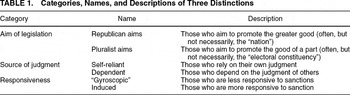
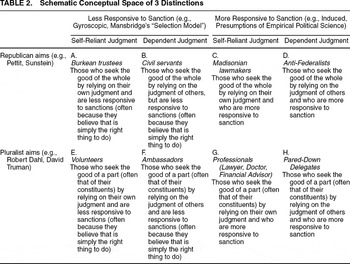



Comments
No Comments have been published for this article.