I. INTRODUCTION
Stabilized austenitic stainless steel, AISI 347 is widely used in high-temperature applications like nuclear reactors, boilers, superheaters and chemical reactors and also in the oil and gas industry, refineries, electric power stations and because of their good resistance to sensitization and intergranular corrosion in many corrosive environments. Reference Guan, Xu, Xu and Wang1–Reference Moura, Kina, Tavares, Lima and Mainier4 The addition of Nb leads to the formation of NbC precipitates, which in turn stabilizes AISI 347 against grain boundary precipitation of M23C6 type of carbides, which would otherwise lead to chromium depletion and loss of corrosion resistance of the material. However, multi-pass welding or exposure to high operating temperatures, would lead to precipitation of chromium carbides at the grain boundaries in AISI 347 and the alloy becomes vulnerable to intergranular corrosion in highly oxidizing acidic media. Reference Chandra, Kain and Tewari5 Although Nb/Ti addition plays a favorable role as stated earlier, these additions also tend to bring about austenite instability due to the formation of intermetallic phases while exposure to high temperature and also during multi-pass welding. Reference Wasnik, Dey, Kain and Samajdar6 It was reported by various researchers that the formation of an intermetallic phase known as σ-phase is a severe problem while using standard austenitic stainless steels at elevated temperatures. It is attested that this σ-phase not only reduces corrosion resistance of the stainless steels by removing chromium and molybdenum from the austenitic matrix, but also deteriorates its mechanical properties. Reference Schwind, Kallqvist and Nilsson7–Reference Wilms, Gadgil, Krougman and Kolster9 Kaishu Guan et al. Reference Guan, Xu, Xu and Wang10 investigated the carbide precipitation of 12 mm thick, manual metal arc welded AISI 347 and AISI 321 samples which were exposed to an aging temperature of 700 °C for 6000 h. It is inferred from this study that the precipitation of carbides was much smaller for AISI 347 over AISI 321. The authors concluded that the σ-phase precipitation in the weld zone could be controlled by employing Nb added filler wire during welding. Further, Lippold and Kotecki Reference Lippold and Kotecki11 attested that the use of filler metals to produce fully austenitic or low-ferrite weld metals is highly effective in reducing the chances of sigma phase embrittlement.
In another study, Hajiannia et al. Reference Hajiannia, Shamanian and Kasiri12 investigated the effect of fillers ER309L and ERNiCr-3 on the impact strength of dissimilar joints of AISI 347 and ASTM A335 low alloy steel obtained by gas tungsten arc welding (GTAW). The authors recommended the use of ERNiCr-3 filler as it offered better impact properties. It is evident from the earlier research works Reference Lippold and Savage13 that Ni rich fillers result in complete austenitic welds, which in turn, are susceptible to hot cracking during welding. Also, it is recommended to have atleast some ferrite content in the fusion zone to combat hot cracking or solidification cracking. In another study, Rutash Mittal and Buta Singh Sidhu Reference Mittal and Sidhu14 performed comparative studies on gas tungsten arc (GTA) and shielded metal arc welding of T91/AISI 347 H dissimilar metals using austenitic stainless steel and Ni rich fillers. The authors recommended the use of GTA welding employing ERNiCr-3 for joining these dissimilar metals.
Lundin et al. Reference Lundin, Lee, Menon and Osorio15 observed that higher ferrite content in the fusion zone of autogeneously welded AISI 347 showed a lower susceptibility to hot cracking than AISI 316NG. Ogawa and Tsunetomi Reference Ogawa and Tsunetomi16 also stated that Nb stabilized austenitic stainless steel (AISI 347) is known to have a high hot-cracking susceptibility inferring that a strict control of Nb and other impurities and also the presence of δ-ferrite would impart high resistance to hot or solidification cracking. Similarly, microsegregation is another important concern during multi-pass welding of stainless steels with nonmatching composition fillers. Due to the limited solubility of Nb, Mo in austenitic phases, these elements segregate preferentially to the liquid and result in Mo, Nb depleted dendritic cores which also favors the formation of Laves phase. Laves phase is believed to be a detrimental phase as it lowers the toughness, ductility, and corrosion resistance of the fusion zone. The precipitation of Laves phase was observed on exposing AISI 347 to a temperature range of 700–900 °C. Reference Padilha, Machado and Plaut17
Pulsed current gas tungsten arc (PCGTA) welding, is a novel, modified form of the GTA welding technique, receiving major attention in the recent past owing to its several advantages which are not limited to grain refinement, controlled heat input but also minimized segregation effects, improved mechanical properties and good corrosion resistance. Reference Farahani, Shamanian and Ashrafizadeh18 It is vivid from the earlier research works Reference Janaki Ram, Venugopal Reddy, Prasad Rao and Madhusudhan Reddy19–Reference Akita, Uematsu, Kakiuchi, Nakajima and Nakamura22 that formation of Laves phase was minimized by selecting appropriate fillers as well as with the aid of current pulsing. However, literature available on the use of PCGTA welding for Nb stabilized austenitic stainless steel, such as AISI 347 was found to be scanty.
As stated earlier, this grade of stainless steel (AISI 347) is widely operated in high-temperature applications which is usually prone to oxidation and hot corrosion. High corrosion rates are experienced in boilers combusting high-chlorine fuels at high material temperatures. Han-Sang Lee et al. Reference Lee, Jung, Kim and Yoo23 reported that austenitic stainless steels such as AISI 347H, AISI 347HFG are widely used in coal-fired power plants as superheater and reheater tubes inside boilers that are exposed to extreme design temperatures (about 570–600 °C). The authors investigated the failure analysis on the reheater tubes of AISI 347H welds obtained from GTAW process. Degradation by high-temperature corrosion is one of the most serious failure modes of components used in the hot sections of gas turbines, boilers, industrial waste incinerators, petrochemical components, etc. Otero et al. Reference Otero, Pardo, Perez, Utrilla and Levi24 reported that molten-salt corrosion attack could likely occur on boiler tubes exposed to high temperatures if low-melting compounds are formed as combustion products, or if eutectic mixtures with low melting points are formed in the deposits. The combination of high temperatures with an environment containing contaminants such as Na, S, V, and other halides requires special attention on the hot corrosion phenomenon. Unlike oxidation, this type of hot corrosion involving molten salts, can consume more material at a rapid rate. Reference Eliaz, Shemesh and Latanision25 Sorell Reference Sorell26 addressed that chlorine-containing compounds are the primary corrosive species in waste incinerators as compared to coal-fired boilers, where sulfur containing compounds intensify corrosion. Uusitalo et al. Reference Uusitalo, Vuoristo and Mantyla27 investigated the high-temperature corrosion behavior of boiler steels and coatings in a synthetic molten salt environment containing 40% Na2SO4–40% K2SO4–10% NaCl–10% KCl mixture at 550 °C. The authors observed that the corrosion was severe in the oxidizing conditions than the reducing conditions. In another study, Deepa Mudgal et al. Reference Mudgal, Singh and Prakash28 investigated the hot corrosion behavior of Ni based superalloys such as Superni 600, Superco 605, and Superni 718 exposed to the aforementioned synthetic molten-salt environment at 900 °C. The authors further reported that the environment of the waste incinerators with very small percentage of chlorine was so aggressive such that it would easily penetrate and degrade the material. They further attested that the parabolic rate constant for Superco 605 was very high showing nonprotective behavior of oxide due to more spallation.
It is evident from literature that studies on AISI 347 welds in an incinerator environment at high temperatures have not been investigated. In the present study, the effect of fillers on the metallurgical and mechanical properties of AISI 347 joints obtained by the PCGTA welding process has been addressed. Further, the fusion zones of these weldments were subjected to a molten-salt environment containing 40% Na2SO4–40% K2SO4–10% NaCl–10% KCl mixture at 650 °C for 50 cycles. This environment has been chosen from the earlier literature studies. Also, a cyclic condition had been selected so as to induce an aggressive condition which would give maximum thermal shocks and stresses on the substrate. Further it was attested that if a material can sustain such severe condition, then it can withstand elsewhere also Deepa Mudgal et al. Reference Mudgal, Singh and Prakash28 The literature available on the outcomes of the study will help in assessing the performance of stabilized austenitic stainless steel in the aggressive environment.
II. EXPERIMENTAL PROCEDURE
A. Base metal and welding
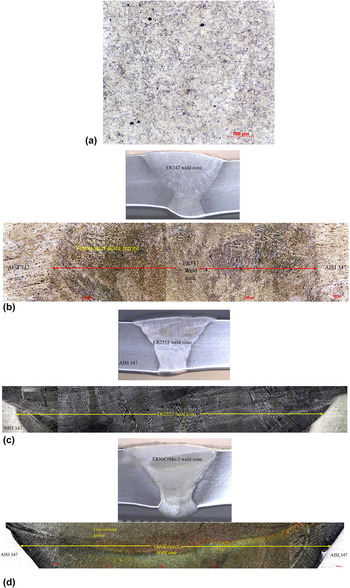
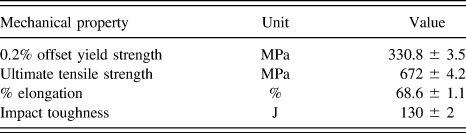
The base metal used in the study was a hot-rolled plate of Nb stabilized austenitic stainless steel, AISI 347 of 6.67 mm thickness. The chemical composition of the base metal was determined using wet spectroscopic methods and is represented in Table I. The microstructure of AISI 347 in the as-received condition shows the presence of fine, austenitic grains along with twin boundaries, indicating the extent of mechanical deformation incurred during processing [Fig. 1(a)]. The mechanical properties including tensile strength and the impact toughness of the base metal have also been investigated and are shown in Table II. Filler metals namely ER347, ER2553, and ERNiCrMo-3 of diameter 1.6 mm were used in joining of AISI 347 plates by PCGTA welding process. The as-received AISI 347 plate was machined to rectangular samples of size 170 × 55 × 6.67 mm using wire-cut electrical discharge machining (WEDM) technique. Acid pickling was done on the samples to remove the grease, dust, and other debris followed by cleaning with acetone.
Chemical composition of the base and filler metals.

(a) Microstructure of the base metal AISI 347 showing the fine austenitic grains (as-received condition); macrostructure of the PCGTA welded AISI 347 employing (b) ER347, (c) ER2553, and (d) ERNiCrMo-3 fillers, respectively.

Average Mechanical properties of base metal AISI 347.

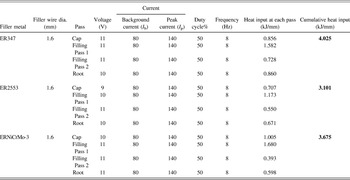
Standard V-butt configurations (single V-groove with a root gap of 2 mm, size land of 1 mm and included angle 60°) were made on the specimens before welding. The butt joints were machined in such a way for good diffusion and to accomplish welding was completed in four passes. The base plates were mechanically clamped in a specially designed welding fixture with a grooved copper back plate to dissipate the heat efficiently. The fixture was designed in such a way that it provides rigidity and adequate grip to avoid distortion and bending during and after welding. Shielding gas used in the study was 99.99% pure argon gas with a flow rate of 15 lpm. Multi-pass fusion welds were carried out on the 6.67 mm thick plates using current pulsing. The heat input developed during every pass of PCGTA welding was calculated using the formula given below:
 $${\rm{Heat\ input}}\left( J \right) = {{V\left( {{I_{\rm{p}}} \times \% \;{\rm{time\ at\ }}{I_{\rm{p}}} + {I_{\rm{b}}} \times \% \;{\rm{time\ at}}\;{I_{\rm{b}}}} \right) \times 60} \over S}\quad ,$$
where V—voltage; I p—peak current (A); I b—background current (A); % time at I p, I b are measured using oscilloscope; and S—travel speed (mm/min).
The process parameters used in the PCGTA welding of AISI 347 using different fillers are represented in Table III. The cumulative heat inputs generated during the PCGTA welding process were determined to be 4.025, 3.101, and 3.675 kJ/mm while employing ER347, ER2553, and ERNiCrMo-3 fillers, respectively. Followed by welding, these joints were subjected to dye penetrant testing (DPT) and gamma ray (γ-ray) non-destructive testing (NDT) techniques to ensure that the welds were defect free. After ascertaining the NDT results, the welded joints were machined to different coupons according to the various standards recommended by ASTM to carry out metallurgical, mechanical, and hot corrosion tests to investigate the effect of fillers on the performance of the PCGTA welds, which are outlined in the subsequent sections.
Process parameters used for PCGTA welding of AISI 347.

B. Metallurgical and mechanical characterization
Microstructure analysis was carried out on the welded samples, which were cut cross-sectionally, keeping weld as the center; the sizes of the samples used for the study were 28 × 10 × 6.67 mm. Standard metallographic procedures were adopted to examine the microstructure of the weldments. Electrolytic etching (10% oxalic acid; current density 1.6 A/cm2 and 6 V DC supply; 30 s) was used for revealing the same. Both optical and scanning electron microscopy (SEM) techniques were used to understand the salient features of the microstructural differences across the passes and the weldments.
Micro-hardness measurements were carried out on the cross-sectionally cut welded coupons of AISI 347, whose sizes were the same as the dimensions of samples used for microstructure analysis. Hardness measurements were taken at different passes vis-à-vis cap, filler and root zones of the weldments using a Vickers micro-hardness tester. A standard load of 500 gf was applied for a dwell time of 10 s to obtain the hardness trend across the weldments and the readings were taken at regular intervals of every 0.25 mm. Tensile studies were performed on the carefully prepared, subsized samples as per ASTM E8/8M standard using an Instron Universal Testing machine (Instron, High Wycombe, United Kingdom) with extensometer attachment. Three trials in each case of the weldments were performed using the machine (Instron, High Wycombe, United Kingdom) with a cross-head velocity of 2 mm/min, which yield a stain rate of 3.3 × 10⁻⁴ s−1. The strain rate was chosen as recommended as per the recommendations by Davis et al. Reference Davis29 for metallic samples. Charpy V-notch impact tests were carried out on sub-sized samples fabricated as per ASTM E23-12c standard and tested the samples in ambient conditions. Notches were made at the weld center in such a way that the impact loading was fully confined to act in the fusion zones of the weldments. Three samples were tested in each case of the weldments both in tensile and impact studies. The fractured surfaces of specimens were examined using SEM after the test for understanding the failure mode.
C. Hot corrosion studies
Cyclic hot corrosion studies were performed on the fusion zones as well as the parent metal coupons of sizes 10 × 10 × 6.67 mm obtained from WEDM. Before the corrosion run, the samples were mirror polished. The physical dimensions of the coupons were measured carefully using the digital vernier caliper having a resolution of 0.01 mm to measure the surface area. Weight measurements were done on the samples as well as the preheated, high-purity alumina boats using a digital weighing balance with an accuracy of 1 mg. Before exposing the samples to the molten-salt hot corrosion environment, the coupons were preheated for 1 h in the furnace at 650 °C. Ensued by this, the preheated coupons were coated with a salt mixture of 40% Na2SO4–40% K2SO4–10% NaCl–10% KCl; this mixture has been applied on the surface of the coupons with a varying coating thickness of 3–5 mg/cm2 using a fine haired paint brush. The salt-coated samples were exposed to 650 °C for 50 cycles in a silicon carbide tubular furnace. Each cycle consists of 1 h of heating and 20 min of cooling at room temperature. Various researchers Reference Mudgal, Singh and Prakash28,Reference Arivazhagan, Surendra, Prakash and Reddy30–Reference Devendranath Ramkumar, Arivazhagan and Narayanan32 attested that a cyclic regime of 50 cycles (cycle of 1 h heating and 20 min cooling) is considered adequate for steady-state oxidation studies as it provides severe conditions corresponding to the actual industrial environments where breakdowns or shutdowns occur frequently. Reference Mudgal, Singh and Prakash28 At the end of every corrosion cycle, weight change measurements as well as the physical changes in the hot corroded samples were recorded. Spalled scales were also included at the time of measurement of the weight changes to determine the total rate of corrosion. Further, a thermogravimetric analysis plot was established using the hot corrosion data. These hot corroded samples were analyzed by field emission SEM (FESEM) and energy dispersive X-ray (EDAX) analysis for surface morphological and compositional analysis.
III. RESULTS & DISCUSSION
A. Macro and microstructure examination
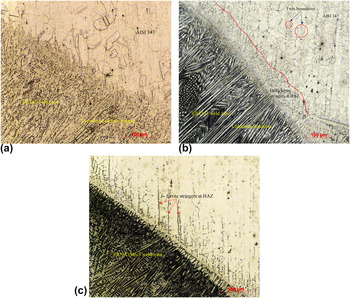
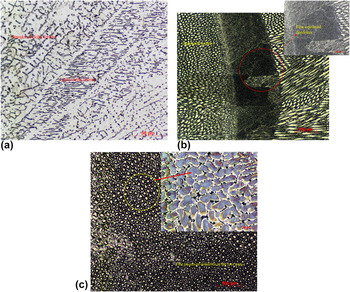
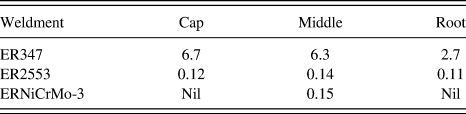
The macrostructure and low magnification microstructures of AISI 347 weldments employing different fillers are shown in Figs. 1(b)–1(d). It is evident from the macrostructures that the use of current pulsing resulted in narrow beads and proper fusion of the filler metals with the parent metal; similarly, the low magnification microstructures attested the different grain growth which occurred during the multi-pass PCGTA welding of AISI 347. Interface microstructures of PCGTA weldments of AISI 347 employing different fillers are shown in Figs. 2(a)–2(c). Formation of delta ferrite stringers was observed at the heat affected zone (HAZ) of AISI 347 while employing ER2553 and ERNiCrMo-3 filler metals. It is to be noted that on welding homogenized, fully austenitic stainless steels, some residual ferrite would be formed at the HAZ that was 100% austenite prior to welding. This would be a result of formation of ferrite during the heating cycle and the incomplete reversion of this ferrite during subsequent cooling. This is well in accordance with Hull. Reference Hull33 There were no signs of HAZ liquation cracking on any of the AISI 347 weldments while using PCGTA welding. As reported by Lippold and Kotecki, Reference Lippold and Kotecki11 the formation of ferrite along HAZ grain boundaries would restrict grain growth and also minimize susceptibility to HAZ liquation cracking. It is valid in the present study to state that the fusion zone of ER347 weldments was observed to have vermicular, lathy as well as skeletal delta ferrite morphologies [Fig. 3(a)] as the pass is increased from filling pass 2 to 3. This type of morphology clearly indicated that the solidification followed was FA (primary ferrite plus austenite) mode. Similar reports have been published elsewhere. Reference Hsieh, Lin, Chen and Wu34 The ferrite count also indicated that both the cap and filling passes resulted in 6.7% and 6.3% of ferrite respectively, which was much higher than the root pass (2.7%). This could be due to the reheating of the fusion zone during multi-pass welding which resulted in the decrease of ferrite content in the root pass. Table IV shows the ferrite percentage in the fusion zone of the AISI 347 weldments. Heat input during welding had a significant influence in the formation of microstructure at the fusion zones. It is inferred that the average heat input developed while employing ER347 filler was found to be 4.025 kJ/mm. It is understood clearly that the formation of vermicular delta ferrite in the fusion zone of ER347 could be attributed to the high-heat inputs and moderate cooling rates developed during the multi-pass welding. Microstructure of the fusion zone of the ER2553 weldments was observed to have different grain growth at different niches, such that, the cap pass contained columnar and equiaxed dendritic growth; whereas the middle was observed to have band of fine equiaxed grains and the root pass had cellular dendrites [Fig. 3(b)]. The formation of centerline band of fine equiaxed dendrites in the fusion zone could be observed in high-energy beam welds or arc welds made at lower welding speeds. Similarly, in both the middle and root passes of ERNiCrMo-3 weldments, equiaxed dendritic growth was observed. Due to the current pulsing, two different currents were used which would lead to the temperature fluctuations. This in turn resulted in continual changes in the weld pool size and favoring for the growth of new grains. In the present study also, the use of current pulsing resulted in fine, equiaxed dendritic structures which improved the hot-cracking resistance of the welds. Reference Farahani, Shamanian and Ashrafizadeh18 It was reported that a finer grain structure, a distorted and equiaxed structure was found to be more resistant to hot cracking. Reference Lampman35 In addition, the fusion zone grain structure has a strong influence on the mechanical properties of the weld. Current pulsing is one of the novel approaches to refining the fusion zone grain structure, to improve both the mechanical behavior and the hot-cracking resistance of weld metal. Figure 3(c) shows the fusion zone microstructure of ERNiCrMo-3 weldment which indicates the segregation effect at the equiaxed dendritic spacings.
Interface microstructure of PCGTA welded AISI 347 employing (a) ER347, (b) ER2553, and (c) ERNiCrMo-3 fillers, respectively.

Fusion zone microstructure of PCGTA welded AISI 347 employing (a) ER347, (b) ER2553, and (c) ERNiCrMo-3 fillers, respectively.

Ferrite percentage.

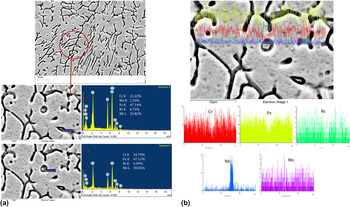
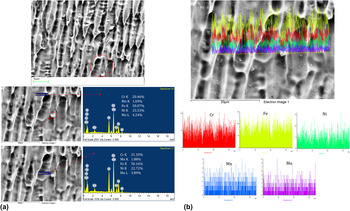
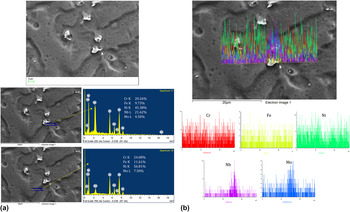
SEM/EDAX analysis carried out at the fusion zones of the AISI 347 weldments employing different fillers are shown in Figs. 4–6. SEM micrograph of ER347 fusion zone clearly showed the presence of skeletal and lathy delta ferrite morphology. It is inferred from the EDAX analysis [Fig. 4(a)], the presence of Nb rich segregates at different niches of the ER347 fusion zone. As Nb could not properly dissolve in the austenitic domain, they formed as segregates. Elemental distribution across the fusion zone of ER347 [Fig. 4(b)] was investigated through EDS line scans. There was no much elemental variations across the ferrite–austenite matrix; however, the amount of Ni, Cr, and Fe in the segregates was found to be lower; whereas Nb dominated in the region by observing the peak values. SEM/EDAX analysis at the fusion zone of ER2553 weldment was observed to have significant amounts of Ni, Cr, Fe; further the matrix was also observed to have Mn, Mo in it [Fig. 5(a)]. Elemental scan in the fusion zone of ER2553 weldment showed some variations in the elemental distribution especially Cr, Fe, and Ni between the dendritic and inter-dendritic regions. Also the tiny precipitates appearing white in color were enriched with Mo content as observed from the peak intensity through line scan [Fig. 5(b)]. Segregation containing enriched amounts of Nb, Mo, Ni, Fe, and Cr is distinctly prominent in the fusion zone of ERNiCrMo-3 weldment [Fig. 6(a)]. The composition of the segregated solutes observed at the inter-dendritic arms was enriched with Nb, Ni, and Mo; whereas the presence of Nb was found to be lesser or almost nil in the dendritic regions as inferred from the line mapping analysis [Fig. 6(b)]. The segregation could be attributed to the chemical composition of both the filler and the parent metal containing substantial amounts of Nb. It is also to be noted that the elements Nb, Mo could not be dissolved in the austenitic field and thus are rejected during solidification, which evolved the Nb rich phase formation. As explored by several researchers, Nb segregation could be prevalent while employing higher heat inputs as well as during multi-pass welding.
(a) SEM/EDAX analysis at the fusion zone of PCGTA weld joints of AISI 347 employing ER347 and (b) EDAX line mapping analysis at the fusion zone of PCGTA weld joints of AISI 347 employing ER347.

(a) SEM/EDAX analysis at the fusion zone of PCGTA weld joints of AISI 347 employing ER2553 and (b) EDAX line mapping analysis at the fusion zone of PCGTA weld joints of AISI 347 employing ER2553.

(a) SEM/EDAX analysis at the fusion zone of PCGTA weld joints of AISI 347 employing ERNiCrMo-3 and (b) EDAX line mapping analysis at the fusion zone of PCGTA weld joints of AISI 347 employing ERNiCrMo-3.

B. Mechanical characterization
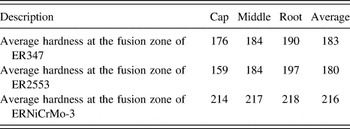
Hardness measurements indicated that the average hardness of the fusion zones employing ER347, ER2553, and ERNiCrMo-3 was found to be 183, 180, and 216 HV, respectively, and that of the parent metal was 190 HV. It is well understood from the profiles that there were not much variations in the average hardness of the fusion zones compared to that of the base metal. A closer observation of the hardness data as represented in Table V indicated that the root pass of AISI 347 weldments in all the cases exhibited slightly higher hardness than the middle or cap passes. This could be inferred from the microstructure examination of the weldments, which clearly attested to the formation of finer grains at the root passes, which enhanced the hardness. The presence of strengthening elements such as Nb, Mo, Ni, and Ti in the ERNiCrMo-3 fusion zone contributed for slightly higher hardness than the parent metal.
Average hardness at the fusion zone of the AISI 347 weldments.

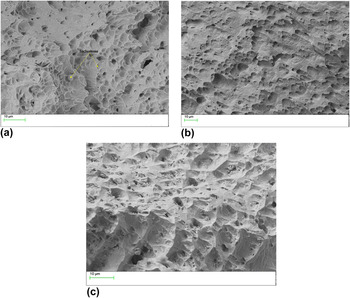
The average tensile properties of the PCGTA welds of AISI 347 employing different fillers are represented in Table VI. It is inferred from the tensile studies that the average tensile strength of ERNiCrMo-3 weldments was found to be 671 MPa and that of ER347 and ER2553 weldments was reported as 632.7 and 621 MPa, respectively. The average tensile strength of ER347 and ER2553 weldments was slightly lower than ERNiCrMo-3 weldments. Moreover, the tensile failures had occurred at the fusion zone for ER347 and ER2553 weldments and in the parent metal for ERNiCrMo-3 weldments. It is opined that the tensile data is well matching with the hardness plots. Tensile fracture did not happen at the fusion zone of ERNiCrMo-3 weldments owing to greater hardness than the base metal. The impoverishment in the tensile strength witnessed in the ER2553 and ER347 weldments may be reasoned to the slightly lower hardness experienced in these fusion zones. As reported by Dean Deng et al., Reference Deng, Murakawa and Liang36 in the multi-pass welds, as the weld metal in different locations experiences different thermal cycle and restraint conditions, the strain-hardening magnitude in each location is also different. The nonhomogenity in the grain structure, composition and presence of residual stresses could affect the hardness and tensile strength of the weldments. Further, SEM fractographs of the tensile tested samples clearly divulged the presence of spherical inclusions of Nb in the ER347 fusion zone [Fig. 7(a)]. The discontinuity in the matrix provided the pathway for crack initiation and propagation and thus experienced failure in the fusion zone. Similarly, the SEM fractography indicated the presence of scarce elongated coarse voids in the ER2553 weldments which inferred a mixed mode of fracture [Fig. 7(b)]. On the other hand, ERNiCrMo-3 weldment [Fig. 7(c)] embodied the presence of micro-voids and dimples, which coalesced to undergo complete ductile fracture. It is also evident that the weldment employing ERNiCrMo-3 experienced higher amount of plastic deformation before rupture.
Average tensile properties of PCGTA welds of AISI 347.

SEM fractographs of the tensile tested PCGTA welds of AISI 347 employing (a) ER347, (b) ER2553, and (c) ERNiCrMo-3 fillers, respectively.

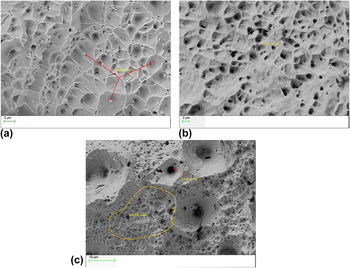
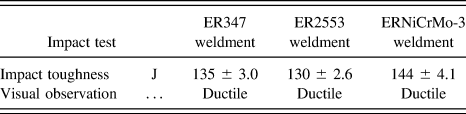
Charpy V-notch impact studies at room temperature attested that the weldments exhibited almost same or greater average impact toughness than the base metal (130 J). The welds employing ERNiCrMo-3 acquainted for better impact toughness (144 J) than the other weldments as well as the parent metal. It could be noticed from the impact studies that the segregates formed at the fusion zone of ERNiCrMo-3 welds as seen in the microstructure examination would not be Laves phase as it is evident that the presence of Laves phase reduces the toughness, ductility, and corrosion resistance. In the present study, it is corroborated that although Nb rich segregates were observed in the fusion zone, they did not have an influence on the impact toughness of the weldments. Also, it is clear from the impact tested samples that the welds had not undergone complete rupture or breakage. All the welds had shown V-notch deformation which indicated that higher energy would be required to undergo complete wreckage. As reported by Liu et al., Reference Liu, Xiao, Feng, Tian, Zhou and Zhou37 the presence of fine equiaxed dendrites in the ERNiCrMo-3 fusion zone and the delta ferrite in ER347 fusion zone contributed for improved toughness. Although fine equiaxed dendrites were witnessed, the cap portion of ER2553 weldments was dominated with long, columnar dendrites that resulted in slightly lower toughness than other weldments. Table VII represents the impact toughness of PCGTA welds of AISI 347. SEM fractographs showed the presence of elongated voids as the fractographic traits for all cases, and it could be inferred that the mode of fracture was ductile in nature [Figs. 8(a)–8(c)]. From the impact studies, it is to be noted that the chosen fillers in the study are appropriate and yielded better notch impact toughness values.
Average impact toughness of PCGTA welds of AISI 347.

SEM fractograph showing the impact tested PCGTA welded AISI 347 employing (a) ER347, (b) ER2553, and (c) ERNiCrMo-3 fillers, respectively.

C. Hot corrosion
1. Physical observation and thermogravimetric analysis
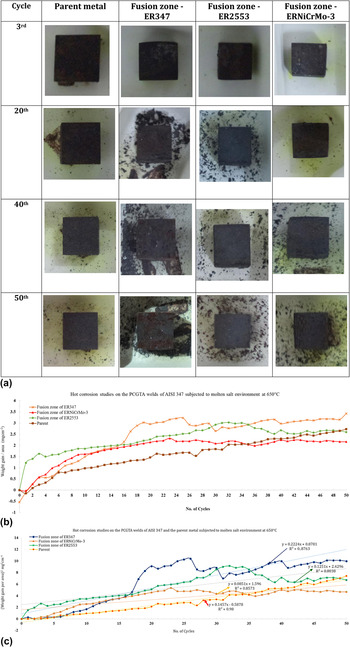
Hot corrosion studies were performed on coupons of the parent metal and the fusion zones of AISI 347 weldments obtained from various fillers, exposing in an aggressive, incinerator, synthetic molten-salt environment comprising of 40% Na2SO4–40% K2SO4–10% NaCl–10% KCl at 650 °C. The physical observation indicated that at the end of 1st cycle, both the parent metal and the fusion zone of ERNiCrMo-3 weldment turned to a slight brownish color and this could be the oxides of Cr; whereas the fusion zones of ER347 and ER2553 were changed to black color with scattered white patches. Whereas, at the end of 3rd cycle, thick, black oxide scales were formed at the fusion zone of ER347 and ER2553 weldments. From 15th cycle onwards, all the fusion zones started degrading primarily due to cracking and leads to spallation of protective scales; whereas the oxide scale became thicker and adhesive in nature in case of the parent metal.
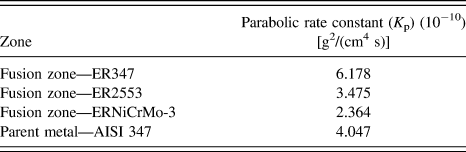
The spallation continued and became more severe in the fusion zones of ER347 and ERNiCrMo-3; parent metal didn’t show any spallation and the weight changes are steady from the beginning to the end of the corrosion cycle [Fig. 9(a)]. As reported by Deepa Mudgal, Reference Mudgal, Singh and Prakash28 spalling shall be attributed to mismatch in the thermal expansion between the oxide and the metal during the time of the cooling cycle. Further, it was noticed that the weight gain of the parent metal at the end of the 50th cycle was found to be 0.0363 g. It could be well inferred from the thermogravimetric analysis [Fig. 9(b)] that all the coupons subjected to the molten-salt, corrosive environment were observed to have weight gain. In specific, the fusion zone of ER347 weldment showed an oscillatory trend. The weight gain square (mg2/cm4) versus time (number of cycles) plots were drawn to establish the rate law for the hot corrosion behavior [Fig. 9(c)]. It was observed from the graph that all the weldments follow nearly parabolic rate laws in the molten-salt environment. The parabolic rate constant K p was calculated by a linear least-square algorithm to a function in the form of (W/A)2, where (W/A)2 = K p t, where W/A is the weight gain per unit surface area (mg/cm2) and t indicates the number of cycles till which the coupons are exposed to the corrosive environment. The parabolic rate constant K p (Table VIII) is calculated from the slope of the linear regression fitted line for the fusion zones of ER347, ER2553, and ERNiCrMo-3 and were found to be 6.178 × 10⁻¹⁰, 3.475 × 10⁻¹⁰, 2.364 × 10⁻¹⁰ g2/(cm4 s) and that of parent metal was 4.047 × 10⁻¹⁰ g2/(cm4 s). From these graphs, it is clear that the fusion zone employing ERNiCrMo-3 exhibited better corrosion resistance compared to other fusion zones as well as the parent metal used in the study. Lower the parabolic rate constant, higher would be the resistance to corrosion.
(a) Photographs showing the hot corroded parent metal and the fusion zones of PCGTA welds of AISI 347 employing different fillers exposed at 650 °C in the molten-salt environment; (b) thermogravimetric analysis of hot corroded coupons of PCGTA welds of AISI 347 exposed in the molten-salt environment of 40% Na2SO4–40% K2SO4–10% NaCl−10% KCl at 650 °C; (c) plot for (cumulative weight gain/area)2 versus number of cycles of PCGTA welds and parent metal of AISI 347 exposed in the molten-salt environment of 40% Na2SO4–40% K2SO4–10% NaCl–10% KCl at 650 °C.

Values of Parabolic rate constant.

2. FESEM/EDAX analysis
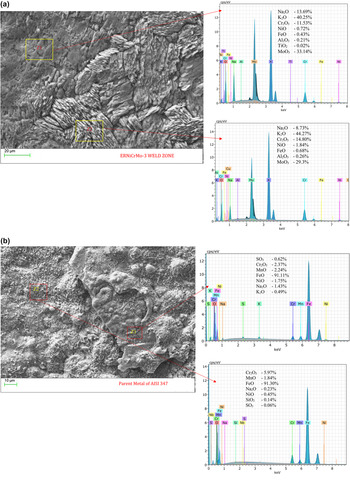
The results of FESEM/EDAX analysis carried out on the hot corroded samples of AISI 347 welds and the parent metal are presented in Figs. 10 and 11. FESEM shows the surface morphology of oxide scales formed on the coupons during hot corrosion while EDAX analysis has been done at specific niches to infer the elemental variations on the scale formed on the surface. SEM morphologies showed the formation of oxide scales, which were observed to be loose, porous, and cracking, with hemispherical lobes throughout the fusion zone of ER347 and ER2553 [Figs. 10(a) and 10(b)]. These fusion zones contain predominant amounts of FeO, Cr2O3, MnO, and NiO; also traces of undissolved molten salts such as Na2O, K2O, and SO3 were also observed. As observed from Figs. 10(a) and 10(b), the oxides formed on the surface of ER347 and ER2553 were porous which may be due to the volatile action of metal chlorides which when formed diffuses outward from the metal/scale interface, leaving behind small local cavities some of which coalesce to from detectable voids. Similar reports have been published elsewhere. Reference Zhang, Yan, Zeng and Weitao38 Further these authors stated that the conversion of the metal chlorides into oxides produces stresses in the scale, which in turn induce cracking and spalling as observed in the SEM morphologies. Moreover, the oxygen potential inside the salt deposit would be high enough to oxidize the metal chlorides, and metal oxides were formed inside the salt deposit. The chloride content of the deposit adjacent to metal surface remained high because of chlorine being released from the oxidation reactions of metal chlorides, and the active oxidation process which continued throughout the exposure. It is a known fact that Cr is a beneficial alloying element for steels to be used in chloridizing–oxidizing atmospheres without salt deposits at high temperatures.
SEM/EDAX analysis on the hot corroded fusion zone of PCGTA welded AISI 347 employing (a) ER347 and (b) ER2553 fillers, respectively.

SEM/EDAX analysis on the hot corroded fusion zone of PCGTA welded AISI 347 employing (a) ERNiCrMo-3 filler and (b) parent metal, AISI 347.

It is evident from the EDAX analysis that the presence of lower amounts of Cr2O3 in the fusion zones of ER347 and ER2553 as well as in the parent metal [Fig. 11(b)]. Further SEM/EDAX analysis results presented that there was no evidence of chlorine in any of the welds as well as in the parent metal. This could be probably due to the evaporation and oxidation of chromium chloride. Accelerated corrosion by deposits containing molten chlorides is supposed to be caused due to the destruction of protective Cr2O3 films through the chemical change of Cr2O3 to CrO4 2−. This is well in accordance with Uusitalo et al. Reference Uusitalo, Vuoristo and Mantyla27 and Ishitsuka and Nose. Reference Ishitsuko and Nose39 Hence it could be deduced from the EDAX analysis that the protective film formed by Cr2O3 was peeled out and this led to high corrosion rate in the incinerator environment.
The fusion zone of ERNiCrMo-3 was observed to have lower amounts of NiO and FeO after 50 cycles. However, the amount of Cr2O3 was found to be more than the fusion zones of ER347 and ER2553. The loss of chromium protective layer was controlled by the additions of Mo. It is evident from the EDAX analysis shown in Fig. 11(a) that the fusion zone of ERNiCrMo-3 was observed to have more amounts of MoO3. Hence the metal loss in the incinerator environment at this fusion zone was found to be lower and thus improved corrosion resistance. This is well in agreement with Ishitsuka and Nose. Reference Ishitsuko and Nose39 According to these authors, the destruction of protective Cr2O3 film could be combated by adding Mo, V, Nb, W etc., which in turn would form oxides on the surface of the alloy, pO2− of molten salt in the deposit would increase and this could be expected to decrease the solubility of Cr2O3. Similarly the presence of NiO, Cr2O3, Al2O3 observed in the fusion zone of ERNiCrMo-3 reasoned for better corrosion resistance of these welds. It is to be noticed that the amount of Mo was higher in ERNiCrMo-3 than ER2553. Similarly the chlorine was not detected in the EDAX analysis in any of the samples. It should be noted that chlorides of iron, chromium etc., are volatile and also the low-melting eutectics such as Na2O–MoO3 and/or Na2MoO4 were expected to volatize at 499 °C. Reference Peters, Whittle and Stringer40 This low melting point oxides were detected to cause the acidic fluxing of the protective scales. It is inferred that the protective scale NiO was found to be in scarce in the fusion zone of ER2553 compared to ERNiCrMo-3. Owing to these reasons, the ER2553 did not show much greater corrosion resistance than ERNiCrMo-3. Wang and Chang Reference Wang and Chang41 reported that in an environment containing NaCl deposits, addition of Al to the alloy would generate a protective Al2O3 scale, which enables an increase in the high-temperature corrosion resistance in a chloride environment. The present study also attested the presence of this oxide in the fusion zone of ERNiCrMo-3 which showed the better corrosion resistance. Furthermore, the prevalence of finer grains as witnessed in the fusion zone microstructures of ER2553 and ERNiCrMo-3 owing to current pulsing reasoned out for the better corrosion resistance. It is also inferred that the enrichment of Mo leads to favorable effects on the selective oxidation of Cr in the case of ERNiCrMo-3 fusion zone; whereas Cr did not favor for selective oxidation of Mo due to less protective oxides in the case of other weldments. Hence the performance of ERNiCrMo-3 weldment was found to be higher corrosion resistance as compared to other weldments. However, X-ray diffraction analysis and cross-section analysis of the corroded samples using back scattered electron imaging would give an in-depth understanding of the corrosion kinetics which is not presented in the current studies.
IV. CONCLUSIONS
This study articulated the role of fillers on the fusion zone microstructure, mechanical properties, and hot corrosion behavior at 650 °C in the incinerator environment of PCGTA welds of AISI 347. Following are the conclusions deduced from the current study.
-
(1) Hot-cracking tendency was completely absent while employing ER347, ER2553, and ERNiCrMo-3.
-
(2) The formation of lathy and vermicular delta ferrite in the fusion zone of ER347 weldment while fine equiaxed dendrites in the fusion zones of ER2553 and ERNiCrMo-3 were observed. Delta ferrite stringers were formed at the HAZ of AISI 347 employing ER2553 and ERNiCrMo-3.
-
(3) Grain refinement effected due to current pulsing and the presence of Nb rich phases, resulted in improved hardness in the fusion zone of ERNiCrMo-3.
-
(4) Tensile studies attested that the failure occurred at the fusion zones of ER347 and ER2553 weldments and on the parent metal of ERNiCrMo-3 weldment. The joint efficiencies of ER347 and ER2553 weldments were found to be 94.4 and 92.7%, respectively.
-
(5) The impact toughness of ERNiCrMo-3, ER347 weldments was found to be 11% and 2% greater than that of the parent metal, respectively.
-
(6) Thermogravimetric analysis demonstrated the weight gain in all the tested coupons when subjected to an incinerator environment containing the molten-salt mixture of 40% Na2SO4–40% K2SO4–10% NaCl–10% KCl at 650 °C.
-
(7) The corrosion loss in the ER347 and ER2553 could be attributed to the breaking of the protective oxide film Cr2O3. However, the presence of Mo in the ERNiCrMo-3 fusion zone decreased the reactivity of oxygen with chromium and thereby improved the corrosion resistance.
-
(8) Based on the tensile, impact strength, and the corrosion studies, ERNiCrMo-3 was found to be the best choice for joining AISI 347 plates using current pulsing amongst the fillers used in the study.