Elections may produce a responsive government by selecting good politicians or by holding them accountable through the possibility of reelection. In political agency models both functions result from voters updating their beliefs about qualities of the incumbent politician based on their performance.Footnote 1 This creates positive selection effects by making good types of politicians more likely to be retained and also incentivizes politicians to perform well in order to signal that they are good types. However, as Fearon (Reference Fearon1999) noted, voters may learn about untried politicians based on “information about the personal character of a politician” that may be available prior to her/his initial election. We refer to these pieces of personal information as traits. Examples of traits include ex ante measures of candidate quality used in empirical political science.Footnote 2
This paper analyzes the role of candidate traits in a simple political agency model. In the model, traits are publicly observable characteristics that correlate with candidate's types. Types are unobservable characteristics of interest such as competence, congruence, or trustworthiness. Good types of politicians are more likely to act in the voter's best interests but the voter's information about incumbent's choices is noisy. The intuitive understanding of traits is that they aid voters in selecting good candidates by helping them make better inferences about politicians' types. Our analysis supports this role of traits but also introduces another: Candidates with good traits may be less accountable to the voter because poor performance in office is not enough to convince the voter to remove the incumbent. In some cases, this effect is large enough to make the voter prefer candidates with bad traits. This effect is most likely when the signal provided by candidate traits is moderately strong, when voters' signals about incumbent performance are quite noisy, and when the pool of candidates for office is poor.
One contribution of this paper is to show how accountability concerns may lead voters to select candidates who are ex ante less likely to be good types. Though my argument is new to the literature some previous work makes similar points. Kartik and Van Weelden (Reference Kartik and Van Weelden2018) show that voters may select politicians who reveal themselves to be bad types because these politicians do not have an incentive to pander. The mechanism in this paper, however, is very different from their result. Kartik and Van Weelden's (Reference Kartik and Van Weelden2018) result is driven by the voters' desire to eliminate signaling incentives in order to avoid pandering. The result of this paper is driven by voters' desire to maximize signaling incentives so that politicians will work hard. An important mechanism driving results in this paper is that the politicians' incentives to exert effort may be reduced when they have a good reputation with the voter. A similar mechanism is also present in an otherwise much different model in Ashworth (Reference Ashworth2005). In that study, politicians reduce effort allocation later in their careers as they become more confident in their reelection prospects. This effect does not lead voters to prefer less competent candidates in that paper. In fact, a key result in that paper is that incumbency advantages arise due to positive selection effects.
1. The model
Consider a three-period model involving a representative voter (V), two initial candidates for office (1 and 2), and a second-period challenger (3). Prior to the first period, nature independently draws the types θ 1 and θ 2 of the initial candidates to be either G (good) or B (bad). The probability that any candidate is a Good type is  $\Pr [\theta _j = G] = p$ for j ∈ {1, 2}. Nature also chooses some observable trait of each candidate j, denoted s j ∈ {g, b} from a type-dependent distribution and reveals that trait to the voter. For simplicity, we assume that
 $\Pr [s_j=g \vert \theta _j=G] = \Pr [s_j = b \vert \theta _j = B] = q \gt {1}/{2}.$ The variable s j can be thought of as one of the usual indicators of candidate quality or competence, such as whether or not that candidate has held the previous office or whether the candidate is endorsed by a local newspaper. When s j = g we say that candidate j has good traits and when s j = b we say that candidate j has bad traits. The voter observes s 1 and s 2 and then selects a candidate to elect to the office for the second period. For the sake of completeness we assume that the voter breaks indifference in the first period by flipping a fair coin.
In the second period, the winning candidate takes office and takes an action x 2 ∈ {0, 1}. We think of x 2 = 1 as the desirable action from the perspective of the voter, which could represent abstaining from corruption, working hard while in office, or choosing policies in the voter's best interests. For both t = 2 and t = 3 we will refer to x t as effort and x t = 1 as high effort. However, the politician's action is not observed by the voter. Instead, the voter observes an outcome y 2 ∈ {0, 1} which is correlated with x 2. To keep things simple, we assume that y 2 = 1 with some positive probability r if x 2 = 1 and otherwise y 2 = 0. The voter observes y 2 and decides whether to retain the incumbent politician for period 3 or instead replace the incumbent with an untried challenger. The challenger is also a Good type with probability p but the voter does not observe any other information about the challenger.Footnote 3
In the third period, the politician selected for office takes an action x 3 ∈ {0, 1} and the third-period outcome y 3 ∈ {0, 1} is realized, where again y 3 = 1 with probability r if x 3 = 1 and y 3 = 0 otherwise. Finally, y 3 is observed by the voter and the game ends.
The payoff of the voter is the sum of the second- and third-period outcomes. Politicians are office motivated by may pay a cost of taking the high action in office. Thus, politician j's payoff in a single period is
 $$u_{\,jt}(y_{t}) = \left\{ {\matrix{ {1-c(x_t,\theta _j)} & {{\rm if } \, j \, \hbox{holds office at time } \, t} \hfill \cr 0 \hfill & {{\rm otherwise}{\rm .}} \hfill \cr } } \right.$$
The politician's total payoff is then u j2(y 2) + u j3(y 3). We assume that taking the high action is costly only for the Low type, so c(1, G) ≤ c(0, G) = c(0, B) = 0 and c(1, B) = k > 0.
We characterize perfect Bayesian equilibria to the game and we focus on weakly undominated strategies. A strategy for the voter is a plan for how to vote in the first period given the public information about both candidates and in the second period given the public information about the incumbent as well as the second-period policy outcome. These strategies are labeled  $\sigma _V^1(s_A, s_B)$ and and
 $\sigma _V^2(s_j, y_2)$ respectively, where j here references the incumbent politician. Given our assumptions about candidate preferences the High type will choose x t = 1 any time that candidate is in office. Furthermore, since there is no election after period 3, actions follow directly from types, with Good types choosing x 3 = 1 and Bad types choosing x 3 = 0. Thus, we will take these actions for granted and consider a politician's strategy only as the probability of choosing x 2 = 1 as a Bad type, which will be a function of s j. Our focus will be on equilibria in which A and B play symmetric strategies so we simply denote this mixed strategy as σL(s).
2. Analysis
We will analyze the game backwards. Since third-period policy choices are already given, we start with the second-period choices and moving to the first-period election choice.
2.1. Second-period game
The second-period game begins with an incumbent with known traits. The incumbent chooses a level of effort but the voter only observes the outcome before deciding whether or not to retain the incumbent. Given a random challenger, the voter retains the incumbent only if she/he believes that the incumbent is a Good type with a probability weakly higher than the prior probability p of a Good type. Good types of incumbents always give high effort and Bad types give high effort only if doing so increases their probability of reelection by more than the cost of effort. Specifically, the Bad type of incumbent j gives high effort only if  $\Pr [{\rm reelected} \vert s_j, x_2=1] - \Pr [{\rm reelected} \vert s_j, x_2=0] \geq k.$
These facts give rise to three types of equilibria, which we label pure selection, partial accountability, and accountability. In a pure selection equilibrium, no Bad type ever gives high effort. In a partial accountability equilibrium, Bad types with bad traits sometimes give high effort but Bad types with good traits never do so. Finally, in an accountability equilibrium, all Bad types give high effort with some probability. Proposition 1 summarizes these equilibria.
PROPOSITION 1:
Consider continuation game beginning with an incumbent in office in the second period. The equilibria to this game are as follows:
• If k > r there is a pure selection equilibrium in which Bad types never give high effort. In this equilibrium, incumbents are retained if y 2 = 1. Incumbents with bad traits are never retained if y 2 = 0 and those with good traits are retained when y 2 = 0 if and only if q ≥ 1/(2 − r).
• If k ≤ r and q ≥ 1/(2 − r) there is a partial accountability equilibrium in bad incumbents with good traits never give high effort and bad incumbents with bad traits give high effort with probability (1 − q)/q. In this equilibrium, incumbents with good traits are always retained. Incumbents with bad traits are retained with probability k/r when y 2 = 1 and are never retained when y 2 = 0.
• If k ≤ r and q < 1/(2 − r) there is an accountability equilibrium. In this equilibrium, strategies following the selection of a candidate with bad traits are the same as the partial accountability equilibrium. Incumbents with good traits give high effort with probability (2 q − rq − 1)/(q − 1) r, are always retained when y 2 = 1, and are retained following y 2 = 0 with probability (r − k)/r.
Pure selection equilibria occur when the cost of effort is too high relative to any electoral benefit to motivate politicians to work hard. Since voters can only condition on outcomes and not directly on effort, the most a politician can increase her/his probability of reelection through effort is r, the probability of good outcomes given high effort. Thus, if k > r then there is never an incentive to give high effort.
If k < r then it is possible to support an equilibrium with some accountability. These equilibria are typically in mixed strategies. The reason for this is as follows. Suppose the voter always rewarded good outcomes by retaining the incumbent and punishes bad outcomes by removing the incumbent. If k < r then giving high effort rather than low effort would increase the incumbent's probability of being retained by exactly r, which means both types would always strictly prefer to give high effort. However, if both types of incumbent always give high effort then outcomes are not informative at all about candidate types. Thus, the voter's best response would be to retain all incumbents with good traits and remove all incumbents with bad traits. Thus, there cannot be a pure strategy equilibrium in which Bad types ever give high effort if k < r.
The nature of a mixed strategy equilibrium with accountability depends on the candidate's traits. If the candidate has bad traits and the observed outcome is also bad (y 2 = 0), the voter has two negative pieces of information about that incumbent and will not retain her/him. Likewise, if the candidate has good traits and the observed outcome is also good (y 2 = 1) then the voter is certain to retain that incumbent. A mixed strategy equilibrium is one in which the incumbent's effort strategy leaves the voter indifferent between retaining and replacing the incumbent in the event that these signals conflict (i.e., y 2 = 1 under an incumbent with bad traits or y 2 = 0 under an incumbent with good traits). In turn, the voter's retention strategy leaves the bad type of incumbent indifferent between giving low and high effort. In Proposition 1, an accountability equilibrium is one in which this mixed strategy profile is played whether the incumbent has good or bad traits. A partial accountability is one in which the mixed strategy equilibrium is played when the incumbent has bad traits and the pure selection profile is played when the incumbent has good traits.
2.2. First-period vote choice: When is bad news good?
The analysis of effort and retention choices sets up a trade-off regarding candidate traits. Candidates with good traits are more likely to be Good types. However, since it is harder for the voter to commit to throwing out incumbents that produce bad outcomes when they have good traits, Bad types who happen to have good traits will be less accountable. This trade-off sometimes causes the voter to prefer candidates with bad traits over those with good traits despite the fact that these candidates are less likely go be Good types. I will refer to this phenomenon as negative selection.
2.2.1. Equilibrium vote choice and negative selection.
Negative selection relates to the trade-off between selection and accountability. Thus, in a pure selection equilibrium there is no trade-off and good traits are always preferred. Otherwise, the voters' preference depends on the relative informativeness of traits versus outcomes as well as the proportion of Good types in the population. The result is stated in Proposition 2 and proven in the appendix. The equilibrium vote choice follows directly from Proposition 2 and the assumption the voter breaks ties by flipping a fair coin.
PROPOSITION 2:
Let  $q^{\ast}_{PA}(p) = ({2 p^2-p+1})/{(1-2 p)^2}-\sqrt {2} \sqrt {{p}/{(1-2 p)^4}}$ and
 $r^{\ast}_{A}(p, q) = ({2 p q-p-q})/({2 p^2 q-p^2-p q-1})$. In a pure selection equilibrium the voter always prefers candidates with good traits. A partial accountability equilibrium exhibits negative selection if and only if q < q*PA(p).. An accountability equilibrium exhibits negative selection if and only if
 $r \lt r^{\ast}_{A}(p, q).$
Proposition 2 establishes that there exist parameters under which the voter prefers the candidate least likely to be a Good type. The intuition behind the result is that the observation that a candidate has good traits has two effects on the voter. The first is a direct effect: candidates with good traits are more likely to be Good types and the voter strictly prefers to elect Good types. The second effect is indirect and negative: a candidate with good traits knows that the voter believes she/he is more likely to be a good type, so Bad types who happen to have good traits will have less of an incentive to act in the best interests of the voter. Proposition 2 tells us that this indirect effect sometimes dominates the direct effect, causing the voter to prefer candidates with bad traits.
2.2.2. Comparative statics.
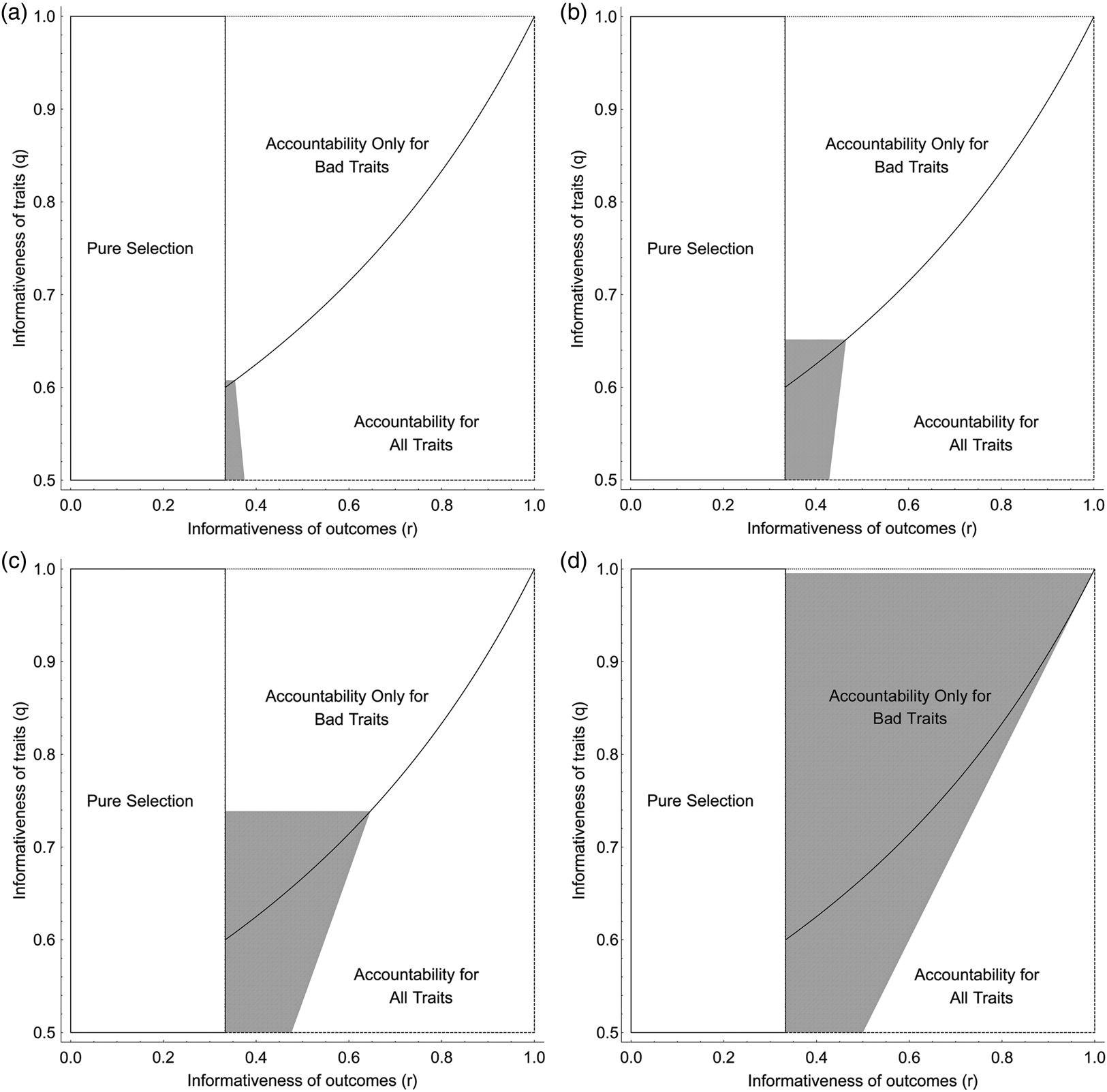
To expand on the empirical implications of Proposition 2 we summarize in Proposition 3 how the incentive for negative selection depends on the primitives of the model. The parameters are the cost of effort (k), the likelihood of observing a good outcome given high effort (r), the informativeness of traits (q), and the prior probability of a good type (p). The results are illustrated in Figure 1.
Visualization of equilibria for selected values of p with k held constant at 1/3. The black lines separate regions with different types of equilibria to the second-period continuation game. The gray region is the region in which negative selection occurs.

The effect of effort costs is straightforward: if k is large enough then Bad types will not give high effort and voters always prefer candidates with Good traits. The informativeness of traits (q) and effort (r) affect negative selection in a more complex way. If r is sufficiently low (i.e., lower than k) then accountability is precluded for all candidates so negative selection is not beneficial. Furthermore, if r is sufficiently large then reelection concerns will lead to effective accountability even for Bad types with good traits, so negative selection is not beneficial. Between those two extremes the voter may expect considerably more accountability for incumbents with bad traits than those with good traits and may therefore opt to select on bad traits. Similarly, if q is close to one half and r is reasonably large then traits do not provide enough information to overshadow the incumbents performance so they do not create enough accountability problems to lead to negative selection. If q is close to one then traits screen candidate types so well that the voter is unconcerned about the rare event that traits give the wrong impression about the candidate's type. However, if q is informative enough to cause accountability problems but not informative enough to lead to efficient screening, the voter may benefit from negative selection.
The final prediction concerns the proportion of Good types in the candidate pool (p). Negative selection is weakly more likely as p decreases, meaning that as the proportion of Bad candidates gets large the voter is weakly more likely to favor candidates more likely to be Bad. Outside of the model this prediction may seem counterintuitive. For instance, it may seem like voters should be even more diligent about screening out corruption when corruption is rampant. However, the prediction is sensible in the context of this model because the voter is concerned both with selection and with accountability. In fact, when most politicians are corrupt, accountability is the more important effect of elections from the voter's perspective. Thus, for small values of p the voter is more focused on the indirect effects of traits on accountability and may therefore benefit from engaging in negative selection.
PROPOSITION 3:
The likelihood of negative selection weakly decreases as k and p increase. Furthermore, the likelihood of negative selection depends nonmonotonically on q and r.
3. Discussion and applications
We have analyzed a simple political agency model to explain how voters may select untried politicians for office on the basis of traits that are correlated with good performance in office. The model illustrates that these traits are not always desirable from the voter's perspective despite their association with good performance. The reason is that traits have an indirect effect on accountability and voters may find it hard to commit to firing incumbents who perform poorly but whose traits signal that they are good politicians. We conclude by discussing two applications that illustrate the potential usefulness of the model.
Corruption
Consider an application in which Bad types are those attracted to corruption opportunities and High effort is interpreted as abstention from corruption, with the rents gained from corruption described by k > 0. Traits refer to characteristics known to be associated with lower corruption. The parameter r may be related to how economic indicators respond to corruption but may also be related to policy variables such as government audits (e.g. Avis et al. Reference Avis, Ferraz and Finan2016) or some other mechanism for providing voters information on incumbents.
Consider two societies that differ only with respect to the proportion of corrupt politicians in the candidate pool. Propositions 2 and 3 imply that the high-corruption society will be more likely to engage in negative selection when selecting among untried challengers but will be harsher on incumbents, more often removing even high performing incumbents. Voters in low-corruption society will be unlikely to engage in negative selection in the first stage but incumbents on average will have an easier time getting reelected. The result shows how the selection of corrupt politicians is reinforced when corruption is perceived to be common: the voters' pessimism may lead them to reject politicians who they believe are less likely to be corrupt.
Judicial elections
Another application of the model is to the literature on judicial elections. In this literature, selection on candidate traits has been taken as a measure of voter attentiveness. For instance Hall and Bonneau (Reference Hall and Bonneau2006) find that candidate quality measures (i.e., previous office experience) affect voters choices in state supreme court elections and conclude that their findings “stand in stark relief to traditional notions that voters are incapable of responding to candidate stimuli beyond incumbency…” (p. 20). In contrast, Streb and Frederick (Reference Streb and Frederick2009) find that candidate quality does a poor job at predicting outcomes in intermediate appellate court elections and conclude that, if the measure of candidate quality is valid, then voters must be unsophisticated or inattentive to these elections (p. 532). The model in this paper points to other explanations for these differences that do not depend on voter attentiveness. For instance, the same measure of candidate quality would have different effects on an attentive and rational electorate depending on the nature of the pool of candidates and the ability of voters to monitor incumbent performance.
Appendix
Proof of Proposition 1.
Pure selection equilibria: Since voters can only condition on outcomes and not directly on effort, the most a politician can increase her/his probability of reelection through effort is r, the probability of good outcomes given high effort. Thus, if k > r, the equilibrium to the second-period game is a pure selection equilibrium. Since Bad types never give high effort in this equilibrium, observing y 2 = 1 is a sure sign that the incumbent is Good so any incumbent is retained in this case. If the incumbent has bad traits and y 2 = 0 then, since all available information points to the conclusion that the incumbent is Bad, the voter prefers to fire the incumbent in this case. Specifically, the voter's posterior belief at this information set is  $\Pr [\theta _j = G \vert s_j = b, y_2 = 0] = {p (1-q) (1-r)}/{p (1-q) (1-r)+(1-p) q}$ which is easily shown to be less than p for all r ∈ (0, 1) and q > 1/2. However, if y 2 = 0 and the incumbent has good traits, the outcome depends on whether traits are more informative to the voter than outcomes. The voter's belief at this information set is
 $$\Pr[\theta_j = G \vert s_j = g, y_2 = 0] = {\displaystyle{\,p q (1 - r)} \over {\,p q (1 - r)+(1 - p) (1 - q)}}. $$
It is easy to show that this belief is greater than the prior belief p when q > 1/(2 − r).
Partial accountability equilibria: The argument in the text shows why an equilibrium must be in mixed strategies. Indifference for Bad types of incumbents with bad traits, given that they will never be retained when y 2 = 0, means that
 $$ r \sigma_V^2(b, 1) - k = 0 $$
which is satisfied by  $\sigma _V^2(b, 1) = {k}/{r}$. The voter is indifferent between retaining and replacing and incumbent with bad traits after observing y 2 = 1 if his posterior belief that the incumbent is a good type is exactly equal to p:
 $$ \Pr[\theta_j = G \vert s_j = b, y_2 = 1] = {\displaystyle{\,p (1-q) r} \over {(1-p) q r \sigma_B(b)+p (1-q) r}} = p $$
which holds if σ B(b) = (1 − q)/q. It follows from the argument for the pure selection equilibrium that the voter will always retain a candidate with good traits and, therefore, that Bad types with good traits will give low effort.
Accountability equilibria: The argument for candidates with bad traits follows from the analysis above. For candidates with good traits, ad type of incumbent with good traits is indifferent between giving high and low effort if
 $$ (1 - r) (\sigma_V^2(g, 0) - k)+(1 - k) r = \sigma_V^2(g, 0) $$
which holds if  $\sigma _V^2(g, 0) = ({r - k})/{r}$. The voter is indifferent over whether to retain or replace an incumbent with good traits after observing y 2 = 0 if
 $$ \Pr [\theta _j = G \vert s_j = g,y_2 = 0] \quad = \displaystyle{{\,pq(1-r)} \over \matrix{(1-p)(1-q)(1-r)\sigma _B(g) + pq(1-r) + (1-p)(1-q)(1-\sigma _B(g)) \hfill} } = p $$
which holds if σ B(g) = (2q − rq − 1)/(q − 1) r.'
Proof of Proposition 2.
First we consider the accountability equilibrium. We define  $U^A_V(\theta _j, s_j)$ to be the voter's value for electing a candidate with type θ j and traits s j in an accountability equilibrium. These are:
 $$\eqalign{U_V^A (G,g) & = (1-r)\left( {\,pr\left( {1-\displaystyle{{r-k} \over r}} \right) + \displaystyle{{r-k} \over r}r + 0} \right) + r(r + 1) \cr U_V^A (B,g) & = \displaystyle{{2q-rq-1} \over {(q-1)r}}\left( {r(1 + 0) + (1-r)\left( {1-\displaystyle{{r-k} \over r}pr} \right)} \right) \cr & \quad + \left( {1-\displaystyle{{2q-rq-1} \over {(q-1)r}}} \right)\left( {1-\displaystyle{{r-k} \over r}pr} \right) \cr U_V^A (G,b) & = r\left( {1 + \left( {1-\displaystyle{k \over r}} \right)pr + \displaystyle{k \over r}r} \right) + (1-r)pr \cr U_V^A (B,b) & = \displaystyle{{1-q} \over q}\left( {r\left( {1 + \left( {1-\displaystyle{k \over r}} \right)pr} \right) + (1-r)pr} \right) + \left( {1-\displaystyle{{1-q} \over q}} \right)pr.} $$
The voter observes characteristics but not types and believes candidates with each set of trait to be Good with probabilities:
 $$\displaylines{\Pr [\theta _j = G \vert s_j = g] = \displaystyle{{\,pq} \over {(1-p)(1-q) + pq}} \cr \Pr [\theta _j = G \vert s_j = b] = \displaystyle{{\,p(1-q)} \over {\,p(1-q) + (1-p)q}}.} $$
Putting this together, the voter's value for selecting a candidate with traits s j, which we will define as  $\overline {U}^A_V(s_j)$, is
 $$\eqalign{\overline{U}_V^{\hskip0.3pt A} (g) & = \displaystyle{{\,pq} \over {(1-p)(1-q) + pq}}U_V^A (G,g) + \left( {1-\displaystyle{{\,pq} \over {(1-p)(1-q) + pq}}} \right)U_V^A (B,g) \cr \overline {U}_V^{\hskip0.3pt A} (b) & = \displaystyle{{\,p(1-q)} \over {\,p(1-q) + (1-p)q}}U_V^A (G,b) + \left( {1-\displaystyle{{\,p(1-q)} \over {\,p(1-q) + (1-p)q}}} \right)U_V^A (B,b).} $$
Solving
 $$ \overline{U}^A_V(b) \gt \overline{U}^A_V(g) $$
for r yields q < (p 2r − p + r)/(2p − 1) (pr − 1).
Second we consider the partial accountability equilibrium. We define the voter's value for each type, denoted  $\overline {U}^{PA}_V(s_j)$ as before. Note that this equilibrium is identical for candidates with bad traits, so
 $\overline {U}^{PA}_V(b) = \overline {U}^{A}_V(b).$ Furthermore, since only the Good types of candidates with good traits ever give high effort, we have:
 $$ \overline{U}^{PA}_V(g) = {\displaystyle{\,p q} \over {(1-p) (1-q)+p q}} ((1-r) (r+0)+r (r+1))). $$
Solving
 $$ \overline{U}^{PA}_V(b) \gt \overline{U}^{PA}_V(g) $$
for r yields r < (2pq − p − q)/(2p 2 q − p 2 − pq − 1).
Finally, consider a pure selection equilibrium. Since only Good types give high effort and those who give high effort are more likely to be retained, it follows from the fact that  $\Pr [\theta _j = G \vert s_j = g] \gt \Pr [\theta _j = G \vert s_j = b]$ that candidates with good traits are preferred. ■
Proof of Proposition 3.
Increasing k can only affect the likelihood of negative selection by inducing a pure selection equilibrium in which negative selection never occurs. Nonmonotoncity in q and r follows from the analysis in the text. To prove that the likelihood of negative selection is weakly decreasing in p note first that second-period equilibrium selection does not depend on p. Thus, the result follows directly from comparative statics on the cutpoints  $q_{PA}^{\ast}(p)$ and
 $r_A^{\ast}(p, q).$
We have
 $$\displaystyle{{\partial r_A^* (\,p,q)} \over {\partial p}} = \displaystyle{{1-{(-2pq + p + q)}^2-2q + 1} \over {{(\,p(-2pq + p + q))}^2}} \lt 0,$$
where the inequality is evident from the fact that 2q > 1. Thus, as p increases we must have smaller values of r to support negative selection in an accountability equilibrium. Furthermore, we have
 $$\displaystyle{{\partial q^{*}_{PA}(\,p)} \over {\partial p}} = -\displaystyle{2 \over {\sqrt p {(2\sqrt p + \sqrt 2 )}^3}} \lt 0,$$
so as p increases we must have smaller values of q to support negative selection in a partial accountability equilibrium. ■