Introduction
A third of elderly patients in medical inpatient settings are affected by delirium (NICE, 2010). Despite the reported high prevalence and adverse effects, most hospital settings do not routinely assess for delirium as part of their assessment protocol (Han et al., Reference Han, Schnelle and Ely2014), due to time constraints and other ward duties taking precedence (Wong et al., Reference Wong, Holroyd-Leduc, Simel and Straus2010). Not surprisingly, therefore, detection rates for delirium are low and under detection ranges from 33% to 71% (Elie et al., Reference Elie, Rousseau, Cole, Primeau, McCusker and Bellavance2000; Kales et al., Reference Kales, Kamholz, Visnic and Blow2003; Siddiqi et al., Reference Siddiqi, House and Holmes2006; Collins et al., Reference Collins, Blanchard and Sampson2010). Given that delirium is preventable (MacLullich and Hall, Reference MacLullich and Hall2011), costly (Young and Inouye, Reference Young and Inouye2007), and negatively impacts on such health outcomes as morbidity, length of stay, and institutionalization (Witlox et al., Reference Witlox, Eurelings, de Jonghe, Kalisvaart, Eikelenboom and van Gool2010), non-detection represents a crucial missed opportunity to improve care and increase efficiencies within hospital settings.
Poor communication among professionals within Multiple Disciplinary Teams (MDT) can contribute to inadequate levels of delirium detection and management within inpatient settings (Teodorczuk et al., Reference Teodorczuk, Corbett, Welfare and Mukaetova Ladinska2013). Non-medical staff, such as healthcare assistants and support workers, often have high levels of patient specific knowledge/contact, which can help contribute to effective delirium practice but can experience organizational or hierarchical barriers to communication (Lloyd et al., Reference Lloyd, Schneider, Scales, Bailey and Jones2011; Teodorczuk et al., Reference Teodorczuk, Mukaetova-Ladinska, Corbett and Welfare2014). Failure to share observations, such as the acute change in cognition, may lead to situations in which patients do not receive thorough screening and appropriate treatment for delirium when required. Furthermore, this important group of professionals may lack basic knowledge and understanding of delirium. Also, ways of working that promote learning about delirium through practice may also be absent for non-medical staff.
Arguably, there exists a need to develop inclusive delirium care processes or protocols that enable sharing of such patient specific knowledge in relation to delirium detection. At present, such tools focused are lacking in routine clinical practice (Teodorczuk et al., Reference Teodorczuk, Reynish and Milisen2012).
In this context, we have developed a novel delirium management system, the Delirium Early Monitoring System (DEMS), which aims to enable non-medical staff to routinely assess patients for the symptoms of delirium and communicate the outcomes to the other professions within an MDT. DEMS has been adapted based on a similar concept to that of the Modified Early Warning system (Subbe et al., Reference Subbe, Kruger and Rutherford2001) though with a focus on cognition as a vital sign to monitor. The principle being to initiate clinical action in accordance to the delirium assessment scores derived. It is ultimately anticipated that by embedding delirium assessment and management into the daily working routines of non-medical staff, it will be possible not only to improve patient and carer outcomes, but help ward staff learn about delirium through practice (Billett, Reference Billett2014).
The first aim of this evaluation was to ascertain the completion rate of DEMS (DEMS-CAM and DEMS-DOSS) and determine feasibility in terms of integration into practice. The second aim of the evaluation was to observe the number of occasions in which the assessment scores derived from the DEMS-CAM and DEMS-DOSS were correctly documented in patient medical records and if this documentation elicited the appropriate action in line with agreed protocols.
Methods
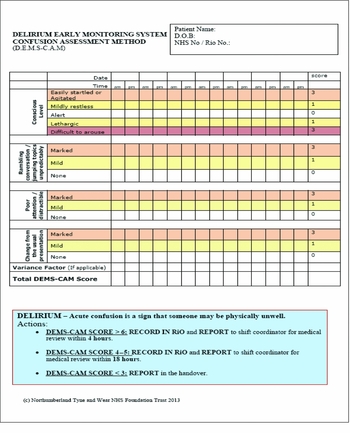
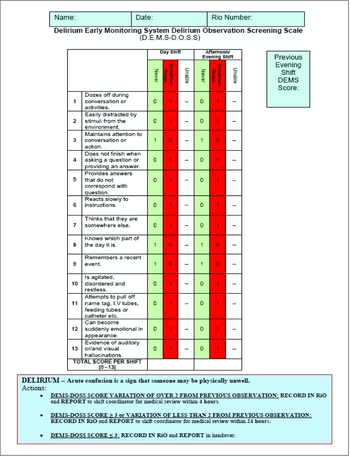
As part of the current evaluation, two versions of the DEMS were developed. The DEMS were based on modified established screening tools, the Confusion Assessment Method (CAM) (Inouye et al., Reference Inouye, van Dyck, Alessi, Balkin, Siegal and Horwitz1990) (Figure 1), and the Delirium Observation Screening Scale (Schuurmans et al., Reference Schuurmans, Shortridge-Baggett and Duursma2003) (Figure 2). Since delirium care may be undermined by a failure to share knowledge about the patient in clinically important decision making processes (Teodorczuk et al., Reference Teodorczuk, Mukaetova-Ladinska, Corbett and Welfare2014), DEMS was strategically designed to encourage non-medical ward staff to conduct routine assessments for symptoms associated with delirium and document the outcomes in patient medical notes in order to elicit medical reviews when required.
The DEMS-CAM assessment sheet.

The DEMS-DOSS assessment sheet.

Design
An observational study was conducted in which categorical data were collected regarding the completion rates of the DEMS-CAM/DEMS-DOSS and the documentation of assessment scores in patients’ medical records/initiation of delirium management protocols. A brief survey was also administered as a means to obtain the opinions of non-medical staff regarding their experience of using the DEMS-CAM and DEMS-DOSS as a routine assessment.
Participants
Healthcare assistants and support workers, working within an acute ward setting for patients with moderate to severe dementia in the North East of England, administered the DEMS-CAM and DEMS-DOSS in accordance to agreed protocols. Data concerning as to whether delirium management protocols were initiated were collected via electronic medical records and hard copies of completed assessment sheets were obtained in cases where patients had provided consent to share anonymized information. Non-medical staff were required to assess all patients, using either the DEMS-CAM and DEMS-DOSS, who were receiving treatment on the ward during the service evaluation. The only exclusion criteria applied was patients who had not agreed to share anonymized information. This study was granted approval as a Service Evaluation Project with the Northumberland, Tyne & Wear NHS Foundation Trust Research & Development department.
Materials
The DEMS-CAM (Figure 1) was utilized in the first phase of this service evaluation. The DEMS-DOSS (Figure 2) was utilized in the second phase of the evaluation.
The scores derived from completing the DEMS-CAM would inform the action to be implemented by non-medical staff as follows:
-
1. DEMS-CAM score of ≥ 6: Record score on patient's electronic medical notes (Rio) and report to shift coordinator for medical review within 4 hours.
-
2. DEMS-CAM score of 4–5: Record score on patient's electronic medical notes and report to shift coordinator for medical review within 18 hours.
-
3. DEMS-CAM score ≥ 3: Record score in patient's electronic medical notes and report in nurse handover.
The scores derived after completing the DEMS-DOSS would inform non-medical staff to implement delirium management actions as follows:
-
1. DEMS-DOSS score variation of over 2 from previous observation: Record score on patient's electronic medical notes and report to shift coordinator for medical review within 4 hours.
-
2. DEMS-DOSS score ≥ 3 or variation of less than 2 from previous observation: Record score on patient's electronic medical notes and report to shift coordinator for medical review within 24 hours.
-
3. DEMS-DOSS score<3: Record score in patient's electronic medical notes and report in nurse handover.
Cross referencing patient medical notes and completed DEMS-DOSS/DEMS-CAM sheets confirmed if assessment scores had been documented accurately. Patient medical records were also scrutinized to ascertain if non-medical staff had initiated the appropriate delirium management action in conjunction with the DEMS-CAM/DEMS-DOSS score.
All of the non-clinical staff who had used the DEMS-CAM and DEMS-DOSS as part of the evaluation were asked to complete an end of study questionnaire which required participants to state if they preferred using the DEMS-CAM or DEMS-DOSS as an assessment tool. Participants were then asked to briefly indicate why they had preferred using either the DEMS-CAM or DEMS-DOSS as part of their daily assessment of patients.
Data analysis
The χ 2 test was used to examine the primary study outcome which was the “patterns of use” of the DEMS-CAM and the DEMS-DOSS. “Patterns of use” was defined by the number of occasions that non-medical staff completed the DEMS-CAM and DEMS-DOSS as part of their daily assessment of patients on the ward.
The χ 2 test was also used to assess the incidences that the “clinical actions” of interest were implemented by non-clinical staff. The term “clinical actions” relates to the number of occasions that the DEMS-CAM/DEMS-DOSS scores were accurately documented in patient records and appropriate delirium management actions were initiated in accordance to the recorded assessment scores.
Procedure
A 1-hour teaching session was provided by a Consultant Psychiatrist (AT) and a Nurse Practitioner (CP) to inform non-medical staff on how to utilize the DEMS-CAM as a means to assess patients for possible symptoms of delirium. The DEMS-CAM was used by non-medical staff as standard practice to screen for delirium for a time frame of 3 weeks. Within this time frame, the DEMS-CAM was completed by non-medical staff twice daily (once in the morning between 10 am and 12 pm and once in the afternoon/evening between 4 pm and 6 pm). After the three-week time frame had ceased, non-medical staff then received additional teaching regarding the utility of the DEMS-DOSS. The DEMS-DOSS was used for a three-week period on a daily basis. Within this time frame, the DEMS-DOSS was completed by ward staff twice daily (once in the morning between 10 am and 12 pm and once in the afternoon/evening between 4 pm and 6 pm). Completed assessment sheets were then collected by a member of the research team (DR). Data concerning as to whether DEMS-CAM/DEMS DOSS scores were accurately recorded and if the appropriate delirium management actions had been initiated, following assessment, was collected through scrutiny of patient medical records. Upon the cessation of the evaluation, members of staff who had used the DEMS-CAM and DEMS-DOSS were asked to complete an end of study questionnaire.
Results
Patterns of use
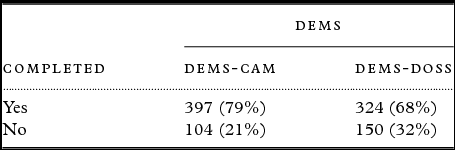
Table 1 provides a summary of the number of occasions that non-clinical staff successfully completed the DEMS-CAM and DEMS-DOSS as part of their daily assessment protocol of patients.
Results of χ 2 test and descriptive statistics for completion rates of the DEMS-CAM and DEMS-DOSS
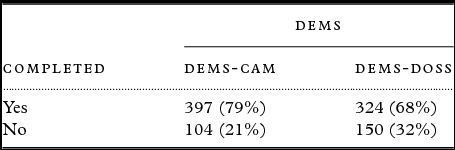
Note. χ 2=14.99, df=1. Numbers in parentheses indicate column percentages.
*p<0.001.
The number of opportunities to conduct assessments, using the DEMS-CAM, was calculated based on the number of patients on the ward during the three-week period, which was 19, multiplied by two assessments per day. The number of opportunities to conduct assessments, using the DEMS-DOSS, was calculated based on the number of patients on the ward during the three-week period, which was 16, multiplied by two assessments per day. There was a significant relationship between the non-completion of the DEMS-CAM and the DEMS-DOSS, χ2 (1)=14.99, p<0.001. This represented that based on the odds ratio; non-medical staff were 1.77 times more likely to not complete the DEMS-DOSS than the DEMS-CAM.
Clinical actions
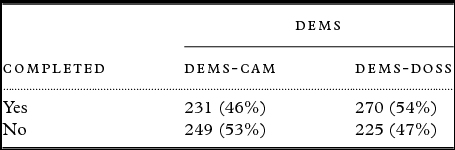
Table 2 summarizes the number of occasions that non-clinical staff successfully recorded the DEMS-CAM/DEMS-DOSS scores in patient medical records and initiated the appropriate clinical action.
Results of χ2 test for completion rates relating to the number of occasions that completion of the DEMS-CAM/DEMS-DOSS led to the appropriate clinical action
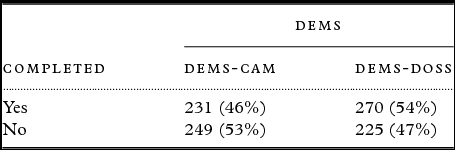
Note. χ 2=4.02, df=1. Numbers in parentheses indicate column percentages.
p>0.05.
There was no significant association between the DEMS-CAM and the DEMS-DOSS in terms of clinical use, χ2 (1)=4.02, p>0.05.
End of study questionnaire
An end of study questionnaire was completed in the subsequent week to cessation of the pilot project by ten of the non-medically trained staff who used both the DEMS-CAM and the DEMS-DOSS throughout the duration of the service evaluation. All respondents stated that they preferred using the DEMS-CAM as part of their daily assessment of patients. The staff were asked to provide some elaboration regarding their preference of the DEMS-CAM.
-
“The items on the DEMS-CAM were easy to understand and quicker to fill out. The DEMS-DOSS was too time consuming and the questions were not as clear to understand”
-
(Respondent 7)
-
“The DEMS-CAM was easier to use and record information on”
-
(Respondent 1)
-
“The items on the DEMS-CAM were easier to understand”
-
(Respondent 3)
Discussion
The purpose of this study was to investigate the application of the DEMS-CAM and DEMS-DOSS by non-clinical staff, within in an inpatient setting, with regards to the assessment, documentation, and communication of patients’ symptoms that could be attributable to delirium. The principle finding being that completion rates of the DEMS-CAM (79.24%) and DEMS-DOSS (68.35%) suggest that on the majority of occasions, non-medical staff could incorporate the DEMS into their daily practice and routinely assess elderly inpatients for the symptoms of delirium. Given that findings from a National Audit indicate in the UK that routine use of delirium screening was undertaken in only 38% of cases our findings suggest that it is possible to improve on this an embed delirium monitoring more effectively in practice (Royal College of Psychiatrists, 2013).
Notably, it was observed that non-medical staff completed the DEMS-CAM at a higher rate than the DEMS-DOSS. There was no difference between the use of DEMS-CAM and the DEMS-DOSS in terms of the documentation of assessment scores in patient medical records and implementing appropriate delirium management actions.
Previous studies have indicated that the CAM, a screening tool rather than monitoring system, can be easily incorporated into the busy work schedules of frontline hospital staff due to its brevity to complete when screening patients for delirium (Wong et al., Reference Wong, Holroyd-Leduc, Simel and Straus2010). This may indicate as to why the DEMS-CAM, which was developed using the CAM as a framework, was completed at a higher rate to that of the DEMS-DOSS in the current evaluation. Time constraints of working within an inpatient setting is often cited as a barrier for ward staff to assess or screen patients for delirium as part of their routine assessment protocol (Han et al., Reference Han, Schnelle and Ely2014). The comments provided by ward staff as part of this evaluation indicated that the DEMS-CAM took less time to complete which facilitated successful completion. Consistent with previous studies (Wong et al., Reference Wong, Holroyd-Leduc, Simel and Straus2010), the findings of this evaluation indicated that assessment tools that take less time to complete are more likely to be incorporated into the daily practice of frontline staff within inpatient settings.
However, as this evaluation did not assess for sensitivity or specificity, it cannot be concluded that the higher completion rate of the DEMS-CAM facilitated non-medical staff to accurately identify or discount the symptoms of delirium. Furthermore, it is known that in the hands of non-specialists, the sensitivity and specificity of CAMS drops and therefore in the real world, limited by the availability of formal practical training in use of CAM, greater completion of CAM may in fact not be indicative of better practice. However, our choice of CAM for DEMS was made based on the fact that within the UK, NICE guidance clearly states that delirium detection should be based on use of CAM (NICE, 2010).
The lower completion rate of the DEMS-DOSS reflects the comments obtained from the ward staff indicating that it was “too time consuming” to administer, which could be attributed to it consisting of nine more items to that of the DEMS-CAM. The anecdotal evidence indicated that “duration of completion” and “comprehension of items” were variables that may have been particularly conducive to the DEMS-CAM being completed on more occasions to that of the DEMS-DOSS. Thus, in order to successfully integrate the routine use of the DEMS-DOSS into elderly inpatient settings, it is suggested that an abbreviated version of the tool, consisting of fewer items, is developed and further evaluated.
The current evaluation indicated that successful completion of the DEMS-CAM/DEMS-DOSS did not always lead to accurate documentation of outcome scores or initiation of the required interdisciplinary response. This is consistent to previous studies which have indicated that completion of such tools as the CAM do not necessarily activate the appropriate response from other professionals within an MDT in terms of either conducting further screening or administering the required treatment for delirium (Andrews et al., Reference Andrews, Silva, Kaplan and Zimbro2015). It was envisaged that providing non-medical staff with a protocol that consisted of documenting the DEMS-CAM/DEMS-DOSS outcomes would enhance communication pathways and ensure that delirium management protocols were initiated. However, the lower completion rates of documentation/actions to that of completed assessments suggested that non-medical staff still experience barriers in sharing their knowledge which may inhibit patients from receiving thorough screening for delirium when required. Thus, it is suggested that future research investigates the individual and organizational barriers that may prevent non-medical staff from documenting the outcomes of delirium assessment tools and communicating the required actions to be implemented by other professionals within an MDT.
There were several limitations to the current evaluation, one being the method in which the training and support were implemented by the study team. First, items within the DEMS-CAM consisted of such terms as “difficult to arouse” and “lethargic” which could have elicited divergent interpretations among the healthcare professionals who used the tool when assessing patients. No formal evaluation as to the extent to which staff were able to correctly understand these concepts was built into the design of our study.
Second, the training and face-to-face contact with members of the study team was only provided to ward staff that worked between the hours of 08:00 and 18:00. It has previously been highlighted that members of staff who work night shift are often at risk of missing educational opportunities and dissemination of information regarding modification of existing working practices (Teodorczuk et al., Reference Teodorczuk, Mukaetova-Ladinska, Corbett and Welfare2014). There were occasions in the current evaluation in which a member of the study team (DR) communicated with members of staff who worked night shift via e-mail regarding the use of the DEMS-CAM and DEMS-DOSS. Thus, documentation of assessment scores and initiation of delirium management actions may have been impacted in the event that such tasks were to be implemented by members of staff who had not attended the training sessions or received face to face support from the study team.
The current evaluation also did not ascertain the sensitivity and the specificity of the DEMS-CAM/DEMS-DOSS, as a means to screen for delirium when administered by non-medical staff. However, the purpose of the study was to determine feasibility and whether this novel tool can be incorporated into practice within a healthcare group who are not routinely involved in delirium care or input into clinical decision making processes. Furthermore, arguably, the ultimate aim of DEMS, other than improving detection of delirium, is to increase learning about delirium through altering practice and raising knowledge of delirium among such professions as healthcare assistants and support workers. However, there is a clear need for further investigations to ascertain the sensitivity/specificity of the DEMS in detecting delirium when administered by non-clinical staff and to evaluate its use against such gold standard measures as the DSM-V criteria for delirium. Such a validation study would form the next step in this program of research.
A strength of this study is that the DEMS-CAM and the DEMS-DOSS were piloted with professionals in a real world organic inpatient setting; thus, ensuring ecological validity of the findings reported from the evaluation. A second strength to this evaluation is that the study team developed two versions of the DEMS that are based on validated screening tools for delirium. This ensured that staff were able to articulate the features of each assessment tool that were particularly beneficial in terms of facilitating routine delirium assessment. Comparing the utility of the two versions of DEMS have helped to inform that such features as the duration of assessment and the terminology used within the items may determine staffs’ adherence to routinely assess patients for the symptoms of delirium.
In summary, the observational study has shown that given the appropriate assessment tools and protocols, it is feasible for non-medical staff to routinely assess patients for the symptoms of delirium. There is also a need to establish and refine protocols that enable healthcare professionals who conduct routine assessments to communicate their findings to medics so that patients receive the appropriate screening and clinical intervention for delirium when required. Future research should also investigate the impact of DEMS on ward culture and developing effective delirium practice within inpatient settings.
Conflicts of interest
None.
Description of authors’ roles
Daniel Rippon designed the service evaluation, conducted a review of the literature, collected the data, carried out statistical analysis, contributed to the writing of the paper, and revised the paper. Andrew Teodorczuk devised the original idea for the study, supervised the design of the study, literature review, collection of data, and also contributed to the writing/revision of the paper. Koen Milisen contributed to the revision of the paper and provided intellectual contribution. Elke Detroyer contributed to the revision of the paper and provided intellectual contribution. Elizabeta Mukaetova-Ladinska contributed to data collection process, the revision of the paper, and provided intellectual contribution. Beth Harrison contributed to the original design for the DEMS. Marieke Schuurmans contributed to the revision of the paper and provided intellectual contribution. Claire Pryor contributed to the revision of the paper and provided intellectual contribution.
Acknowledgments
We thank Professor Sharon K. Inouye of Harvard Medical School for providing permission to revise the Confusion Assessment Method for the purpose of this service evaluation. Confusion Assessment Method. © 1988, 2003, Hospital Elder Life Program. All rights reserved. Adapted from: Inouye SK et al. Ann Intern Med. 1990; 113: 941-8.