There is a growing recognition that the state is not the sole provider of “local public goods” in the developing world. Scholars of comparative politics have highlighted efforts by sectarian organizations, political party affiliates, kinship networks, and nongovernmental organizations to supplement ineffective or absent state services in the Middle East, India, and Sub-Saharan Africa. Footnote 1 Even more prevalent—especially in urban areas—are small-scale entrepreneurs, who have become major providers of education, water, electricity, trash collection, and other basic services. Footnote 2 Yet another category of provision, regulated private provision, grew rapidly under the neoliberal reform wave: many states privatized services such as electricity, telecoms, urban transport, and water, establishing regulatory agencies to monitor firm compliance with contracts and domestic laws. Footnote 3
Political science and economics scholarship on local public goods provision, however, has yet to fully acknowledge the importance of non-state and regulated provision. Studies typically employ theoretical accounts that assume the state to be the sole service provider, yet often rely on access or quality measures that capture both state and non-state provision. For example, a classic study by La Porta et al. of the relationship between ethnic diversity and public goods provision suggests that cross-country variation in infrastructure quality and educational attainment can be explained by varying levels of ethnolinguistic fractionalization, which affects preferences regarding government policy, and thus the ease of governance. Footnote 4 This argument assumes that state policy is responsible for public goods delivery. Yet in many of the countries and sectors included in the analysis by La Porta et al., non-state providers actually contribute to service provision. Meanwhile, their measures of infrastructural quality and educational attainment capture non-state, as well as governmental, service delivery. In analyses like these, theoretical accounts of variation in local public goods provision should be adjusted to reflect the respective contributions of state and non-state providers. Alternatively, scholars should ensure that measures of service access and quality only capture state services.
While recent scholarship on non-state provision identifies different types of non-state providers and their distinctive modes of engagement with the state, Footnote 5 it fails to characterize different system-level configurations of actors and roles involved in local public goods provision. Our contribution here is to offer a descriptive typology Footnote 6 that differentiates between four main types of “hybrid systems” for local public goods provision in the developing world. By hybrid, we refer to systems in which the state and non-state providers both contribute to service delivery. State and non-state actors either deliver services simultaneously, or state agents regulate private service provision, either formally or informally. Footnote 7 The typology is intended to help researchers develop theoretical arguments appropriate to settings where different configurations of actors exist, as well as inform the selection of outcome measures. Our framework thus positions scholars to theorize regarding the politics driving variation in system-wide levels of local public goods provision, as well as to develop appropriate measurement strategies for cross-jurisdictional comparisons.
Hybrid local public goods provision regimes in the developing world, we argue, vary on two key dimensions. One must first consider the type of state involvement. Governments can provide services directly, or instead provide them indirectly by delegating to non-state providers, such as through formal contracts or looking the other way when non-state providers emerge independently and provide services. Second, one must consider the degree of state penetration in the service area. Where services are of poor quality or nonexistent, alternative providers often arise independently to supplement or substitute for state-sanctioned services. Recognizing these two dimensions allows one to distinguish between four distinct regimes of hybrid local public goods provision for services as varied as education, electricity distribution, garbage collection, and water delivery.
We begin by showing the overwhelming emphasis of the political science and economics literature on direct state provision, and the absence of frameworks describing typical configurations of actors and roles in service delivery in the developing world. We then introduce our descriptive typology, explaining how the politics of service provision varies across systems with different configurations of actors and roles. The second half of the paper illustrates the distinct political dynamics of these different modes of local public goods provision in the developing world through analyses of service provision in two key areas: first, water and sanitation and, second, mass transit. The final section of the paper discusses implications for future research, highlighting how greater engagement with ethnographic scholarship in geography, urban studies, and related fields can enrich political science research.
Inattention to Hybrid Provision in the Literature
The political science and economics literatures examining local public services and infrastructure focus predominantly on the state, or on state-coordinated co-production by state and societal actors. While new scholarship identifies different types of non-state providers and examines their distinctive modes of engagement with the state, it does not offer an overarching framework describing typical configurations of actors involved in service provision and their respective roles.
The most prominent literature within political science and economics on this topic examines local services and infrastructure as a problem of “local public goods provision.” Our review of studies in this literature focused on the developing world suggests that most either explicitly or implicitly assume that state agencies provide services. Footnote 8 Table A1 (available in the online appendix) contains the 100 empirical studies of local public goods provision focusing on or including developing countries as part of a broader cross section. Two-thirds assume that the state provides services. Footnote 9 Though not framed as a “public goods” study, Kramon and Posner’s article examining how ethnic favoritism in the allocation of development resources varies across different service areas in four African countries also focuses on state provision. Footnote 10 While some studies do recognize that other actors provide services, the vast majority of these examine co-production between governments and citizens, associations, or traditional authorities, echoing Ostrom’s seminal work. Footnote 11 Miguel and Gugerty, Footnote 12 for example, study parent fundraising for village schools.
The local public goods literature’s dual emphasis on state provision and co-production are problematic for two reasons. First, many studies assuming state provision employ theoretical accounts consistent with state provision, yet use access or quality measures that reflect both state and non-state provision. This is most common in cross-country analyses using countrywide measures for outcomes such as infrastructure access, infrastructure or service quality, and educational attainment. Footnote 13 Second, while co-production is important—especially in rural settings—other, very prevalent types of non-state and hybrid provision have received next to no attention. For example, this literature largely neglects private entrepreneurs that supplement or substitute for state service provision (refer to table A1).
Meanwhile, existing taxonomies from the broader political science and public administration literatures describing ideal typical patterns of local public service delivery focus on state provision or explicit delegation to non-state providers. Feiock’s “Institutional Collective Action” framework considers ways of resolving collective action dilemmas among state institutions involved with service delivery. Footnote 14 The “governance” literature examines the increasing prevalence of policymaking networks and consultative processes in which government is the central actor, and thus highlights important shifts in state provision. Footnote 15 Writers in this tradition also analyze joint service-delivery models, such as public-private partnerships (PPPs), as part of the broader shift from “government” to “governance.” Footnote 16 Meanwhile, the public administration literature offers insights into distinct ways in which states explicitly delegate service provision to private providers. Footnote 17 These frameworks all emphasize the centrality of the state in service delivery or explicit delegation, making them less applicable where the state’s reach is tenuous or nonexistent.
An exciting new literature on non-state service provision in the developing world departs from this emphasis on the state, identifying specific types of non-state providers. This work does not, however, outline typical system-level configurations of actors and their respective roles in service delivery. Path-breaking studies by MacLean, Footnote 18 Brass, Footnote 19 Cammett, Footnote 20 and Thachil, Footnote 21 analyze the politics of welfare provision or local service delivery by informal institutions of reciprocity, NGOs, sectarian organizations, and informal arms of political parties, respectively. But these studies do not provide general conceptual frameworks distinguishing between different types of local public goods delivery systems. Cammett and MacLean Footnote 22 helpfully differentiate between non-state providers based on levels of formality and country of origin and provide a typology predicting that the political consequences of non-state service provision will vary with the respective strength of the provider and the state. The analysis is at the level of the organization rather than the system, however, and does not focus centrally on the politics of producing and allocating public services. Footnote 23 The one effort to identify different overall system types, Gough and Wood Footnote 24 helpfully differentiates between two regimes. “Welfare state regimes,” on the one hand, refer to arrangements in which the state protects citizens from the market; “informal security regimes,” on the other hand, refer to a system in which alternative providers may meet needs. Yet, again, the authors do not specify how the politics of producing local public goods and services varies between these two regimes. Importantly, neither Cammett and MacLean Footnote 25 nor Gough and Wood Footnote 26 distinguish between direct and indirect provision in their frameworks, despite the fact that the politics of production varies dramatically in each case.
In summary, the existing literature has contributed greatly to our understanding of factors driving variation in service delivery by public agencies or public-private partnerships and has identified a range of non-state service providers with varying motivations and political relationships with the state. What is missing, however, is an analytic framework that describes “ideal type” configurations of actors and roles in public goods provision in the developing world, where hybridity is the norm. Such a framework is essential for identifying the contexts in which standard theoretical arguments are most applicable, for distinguishing areas where new theorization is needed, and for choosing appropriate outcome measures.
Hybrid Regimes for Local Public Goods Provision
We offer a “descriptive typology” Footnote 27 identifying typical configurations of actors involved in service delivery in the developing world, as well as their respective roles. The two dimensions of our typology reflect two distinct ways in which systems can be hybrid: the type of state involvement and the degree of state penetration in service provision.
The type of state involvement dimension captures the extent to which states provide services directly as opposed to indirectly. Direct provision refers to service delivery by government entities, while indirect provision entails state delegation of service provision to non-state providers. Under indirect provision, delegation can be formal—involving explicit, written agreements—or informal, when states refrain from providing services and turn the other way when non-state providers emerge. Formal delegation is usually combined with extensive state efforts to police agreements or regulations to ensure that providers largely comply with state requirements. Such explicit delegation can involve concession contracts or franchise agreements for investment in and management of water or transit systems, or simple short-term service agreements with nonprofits to provide social assistance. Certainly, such formal delegation can be conceived of along a continuum involving more and less state day-to-day involvement in direct service delivery (as opposed to involvement through regulation). Footnote 28
Indirect provision can also occur through informal delegation, when states deliberately choose not to provide services and turn a blind eye when non-state providers emerge to cater to citizen needs. Under “spontaneous privatization” Footnote 29 of this sort, the non-state providers that emerge may be firms, such as small informal-sector operations. In other cases, they will be cooperatives, NGOs, or religious organizations. Formal state contact with these providers, such as through licensing systems can be minimal in contexts of weak state capacity, even though state agents often have informal relationships with providers that directly affect provision.
The state penetration dimension reflects the extent to which states effectively operate throughout their physical territory in a given policy area. Penetration thus refers to the state’s presence across space, as well as the quality of the government services or regulation of non-state providers provided. Footnote 30 Under high state penetration, states deliver services sufficiently effective that citizens find little need to turn to private substitutes, or they actively regulate the activities of non-state providers. In contrast, under low state penetration, the state either delivers services so poorly that non-state providers emerge to supplement state provision, or barely regulates non-state providers. This failure to deliver quality services or actively regulate providers could stem either from low state capacity or political calculations. Footnote 31 For simplicity, we distinguish here between systems with high versus low degrees of state penetration, though the dimension reflects a continuum. While each of these two dimensions has received some attention in literatures on particular policy areas, they have not yet been brought together into a common framework. Footnote 32
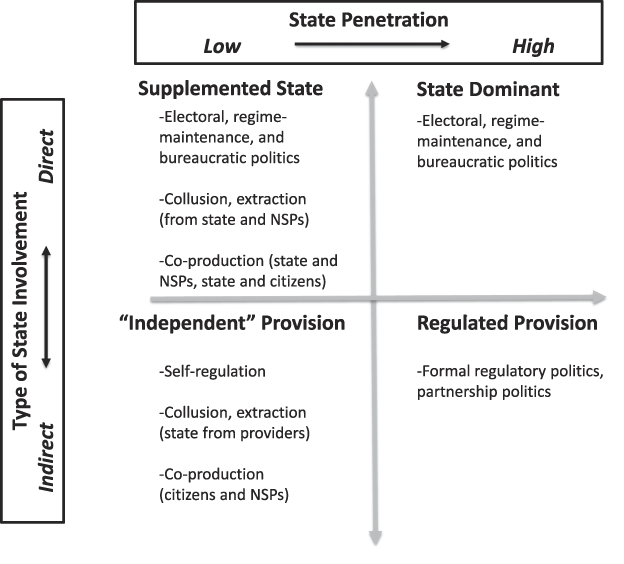
Examining variation along these two dimensions leads us to distinguish between four different hybrid systems of local public goods provision. In “state-dominant” systems (figure 1, upper right), the state provides reasonable quality services directly to a large fraction of the population. Non-state provision is limited to small areas such as some informal settlements, the urban fringe, or remote regions. In such contexts, we can reasonably attribute services to the state. In much of the developing world, however, the state provides services directly, but ineffectively: governmental services are poor and/or fail to reach large fractions of the population. In such cases of direct provision, but low effective penetration, we observe a “supplemented state” (figure 1, upper left): the majority of citizens seek services from alternative sources to supplement or substitute for state provision, and non-state providers—often unsanctioned—arise to meet these demands. When governments choose to provide most services indirectly, such as through contracts with private or nonprofit entities, and actively regulate through state territory, we observe “regulated provision” (figure 1, lower right). Footnote 33 Finally, when states leave service provision almost entirely to non-state providers and provide minimal formal regulation or oversight, we observe “independent provision” (figure 1, lower left).
Principal actors and roles under different hybrid regimes

The politics of producing and distributing local public goods, as well as measures accurately capturing patterns of access and service quality, vary systematically between each of these hybrid regimes. This means research questions and strategies will vary by regime type. Because we can attribute services to the state in “state dominant” systems, the politics of service production and allocation, at least in democracies, is likely to be captured by factors already stressed in the local public goods literature, such as the number of political parties and levels of political competition or decentralization (figure 2, upper right). Given that production often involves coordinating between different governmental actors—especially in politically fragmented metropolitan areas—frameworks focused explicitly on such “institutional collective action problems” will provide theoretical insights. Footnote 34 Likewise, insights from the “governance” literature on the politics of policy networks and consultative processes may be relevant. Footnote 35 Meanwhile, standard measures of service access reported in state data, such as possession of a household connection, usually reflect actual access to state-provided services. Similarly, measures such as standardized test scores or literacy rates reflect the quality of state service provision.
The politics of production and allocation under different hybrid regimes

Under the “supplemented state” (figure 2, upper left), in contrast, theoretical arguments regarding sources of variation across systems should acknowledge the presence of non-state service providers—and informal political interactions between them and state actors—in addition to the electoral, regime preserving, and bureaucratic politics animating state provision. As we will show later, street level bureaucrats and other state agents often informally “regulate” small-scale providers, charging them for unofficial access to state supplies or market access. These relationships can be collusive, or exploitative, either of providers or of the state. Footnote 36 In other cases, relationships involve collaboration and synergy along the lines suggested by the co-production literature. This means scholars should probe the circumstances under which state agents collaborate with, as opposed to exploit, non-state providers. Studying street level “brokers” such as electricity linemen and water valvemen with this aim would constitute an important departure from the clientelism literature’s current emphasis. For theoretical insights regarding these relationships, scholars can draw on recent political science scholarship on specific types of non-state providers (such as sectarian organizations), as well as rich, sector-specific literatures in geography and urban planning. Footnote 37
Measuring the reach and quality of state services, or service provision in the aggregate, is more difficult under a “supplemented state” than a “state dominant” system. First, extra care must be taken to ensure that measures of service reach or quality are in fact accurate, and attributed to the correct provider, particularly if quality and prices vary. For example, it means little to have a state electricity connection if power only arrives occasionally through the state network, and one must rely on private generators. Second, major service quality deficits mean that scholars should not only measure access, but also service predictability, frequency (or prevalence of disruptions), and other aspects of service quality. Scholars can suggest that regular population surveys conducted by government and multi-lateral institutions incorporate questions regarding prices and various dimensions of service quality by provider, while also incorporating more nuanced metrics in their own surveys. Acknowledging supplementation by non-state providers could change the results of prominent studies like Kramon and Posner, referenced earlier. The authors assume that survey responses regarding access to water, electricity, and primary education capture state provision in six countries in Subsaharan Africa (or state favoritism more broadly); yet non-state, and often private, providers often supplement state delivery in Subsaharan Africa in these service areas. Footnote 38
Research on “regulated provision” (figure 2, lower right) where the state actively polices non-state provision should involve careful theorizing regarding how formal regulatory politics drives variation in service outcomes. Such theorization can build on recent work on the politics of regulation in weak institutional environments, Footnote 39 as well as public administration scholarship that distinguishes between different modes of contracting out and other forms of partnering with private providers. Footnote 40 This means investigating how the respective influence of government officials, regulated firms, and the public on service delivery varies with the institutional environment, levels of political competition, policy area, and firm characteristics. Scholars should also study interactions between state-sanctioned providers and the non-sanctioned private providers that operate at system margins, and especially the circumstances under which such relationships are synergistic.
Measurement also presents distinct challenges in regulated systems. Researchers need to be careful to attribute provision to the correct provider. Cross-national studies of variation in local public goods provision frequently examine the quality or reach of infrastructure that is often privatized, like roads or telephone service, yet fail to distinguish in their samples between systems with public and regulated private provision. Footnote 41 This is important because the means by which variables such as ethnic fractionalization and legal system type affect services is likely to vary dramatically. For example, Baldwin and Huber, in an impressive cross-national study of ethnic diversity and public goods provision, examine an aggregate measure of public goods provision incorporating telephone lines per 100 people, percentage of roads that are paved, and percentage of the population with access to improved sanitation—services often delegated to private firms. Footnote 42
Meanwhile, outcome variables in regulated systems should also be measured so as to coincide with the boundaries of service areas allocated to specific non-state providers, which may not align with standard administrative boundaries. Provincial governments may outsource water provision in urban municipalities to a private concessionaire, for example, while retaining responsibilities for rural jurisdictions. Outcome variables may also need to be disaggregated and attributed to the proper entity if only certain industry segments or sectors have been outsourced. For example, if electricity distribution has been privatized, but generation remains in public hands, distributors should be credited with new connections but not be faulted for service disruptions stemming from insufficient electricity supply. Regulatory agencies typically collect such data, as well as maps clarifying the exact geographic remit of non-state providers; the increasing prevalence of freedom of information laws means that it is more straightforward to access such information than in earlier decades. Similarly, multi-lateral agencies such as the World Bank now provide better public access to data on projects they have helped fund, such as infrastructure privatizations and PPPs.
Finally, studies of “independent” provision will require theorization and measurement tailored to contexts where non-state actors provide most services, often while being informally regulated by state agents. In some cases, community leaders attempt to organize citizens to collectively address problems such as drainage or security. Footnote 43 NGOs can also step in to satisfy unmet community needs, such as for health care or primary education. Footnote 44 Particularly common are small, informal sector entrepreneurs who charge for trash collection, minibus rides, or power from generators. In such cases, scholars should ask how within-group interactions between independent providers, as well as informal interactions with state agents, affect service delivery. When citizens collaborate to provide services, or support NGO efforts, the literatures on co-production and ethnic cooperation may apply. Footnote 45 In contrast, case studies from geography and urban studies (reviewed later) suggest that when private entrepreneurs are prevalent, system politics are typically characterized by informal rent extraction and collusion, as well as self-regulation by private providers. State agents often levy informal charges for market access and regulatory evasion. Providers, meanwhile, often organize and regulate group members in order to manage competition and protect themselves against predation. Footnote 46 Acknowledging the prevalence of collusion, extraction, and self-regulation should prompt scholars to revisit classic treatments of the relationship between ethnic diversity and the provision of services like policing and transport. Norms of reciprocity and fears of sanctioning among co-ethnics may be less applicable to relationships between informal sector entrepreneurs and state agents or customers than Habyrimana et al. suggest is the case for collaborative community efforts. Footnote 47
When studying variation in service access and quality under “independent provision,” scholars may need to collect original data to measure service quality or reach, as state governments are unlikely to possess accurate information about services they barely monitor. Alternatively, scholars can work with associations of non-state providers to crowd-source relevant data.
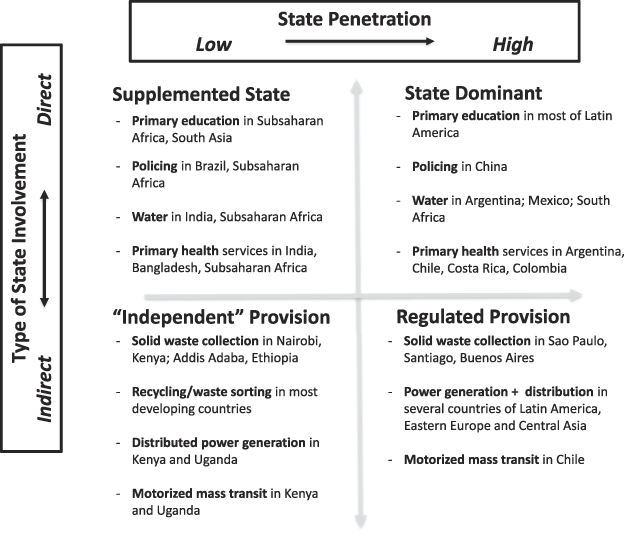
While we provide this descriptive typology to assist scholars with theorization and research design when studying local public goods provision, we also note that the presence of these four different types of systems tends to be associated with the type of local service and underlying levels of state capacity (figure 3). Particular policy areas tend to fall on one or the other side of the direct-indirect dimension in our framework, though this dimension—as we acknowledge earlier—certainly represents a continuum. States often opt to provide services directly in natural monopoly sectors such as water and sanitation. Conversely, “local public goods,” for which private providers can deliver effective substitutes tend to be characterized by less direct governmental provision of services. Where private substitutes are available, governments will feel less compelled to invest in service delivery. This means that within a single city or subnational jurisdiction, states often choose to provide some services directly and others indirectly. For example, municipalities often contract out mass transit, but retain operational responsibilities for primary education. They tend to provide policing and water directly, while contracting out trash collection (figure 3). These tendencies, of course, are not observed in all cases. Preferences for contracting out services to private providers can vary with the ideology of the governing party, as well as recent experiences with public or private provision. This can lead to variation in the mode of service provision over time.
Common services and sites for different hybrid regimes
Note: For a version of this table documenting the placement of country or city cases in each cell, please refer to the online appendix, figure A1.

Meanwhile, lower rates of state penetration are associated with—though not completely determined by—low levels of state capacity, or the state’s ability to administrate effectively throughout its territory. While electoral concerns may occasionally prompt weak states to regulate private operators vigorously, their efforts are likely to be ineffective. This implies that we will not only observe cross-national variation in the prevalence of “supplemented” and “independent” provision; one may also observe variation across subnational jurisdictions, contingent on subnational state capacity. A capital city may possess a “state dominant” water system, for example, while a medium-sized town’s water system may be better characterized as a “supplemented state.”
Illustrations of the Four System Types
While hybrid provision occurs throughout almost all of the policy areas considered by the local public goods provision literature, we focus on two paradigmatic sectors to illustrate the importance of the two dimensions we highlight: water and sanitation (W&S) and mass transit. W&S is typically delivered by the state, with higher levels of supplementation where state capacity is weak, whereas motorized mass transit is typically delivered by the private sector, with varying levels of state regulation. Our analysis draws on studies of both sectors from political science, economics, geography, urban studies, and public policy to illustrate the distinctive politics of production and measurement challenges associated with each type of hybrid system. Footnote 48
“State Dominant” Water and Sanitation Systems
In developing countries with middling and higher levels of state capacity, provincial or local governments tend to provide water and sanitation services directly to the majority of the population, rather than rely on private sector providers. Footnote 49 Services are generally available 24 hours a day and pressure is sufficient to fill household tanks. Footnote 50 The quality of service is typically such that “supplementation” by private entrepreneurs is limited to the provision of bottled drinking water. Non-state, small-scale entrepreneurs and cooperatives typically only service the urban fringe, informal settlements, and fast-growing small towns. Footnote 51 Such water system configurations exist in a variety of middle-income countries, including Argentina, Brazil, Costa Rica, Mexico, South Africa, and Uruguay (refer to table A2 in the online appendix).
In state-dominant W&S systems, theorization and measurement can follow what has been standard practice in the existing literature on local public goods provision. Theorization regarding the political sources of variable performance among different systems can focus on electoral and bureaucratic politics, emphasizing factors such as partisan competition, coalition-building dynamics, and the ease of “governance” under different conditions. Care should be taken to tailor arguments, however, to the exact institutional setting for provision. Government service providers may be somewhat insulated from electoral politics—at least in formal terms—when providers are “corporatized,” or established as legally independent entities. Footnote 52
Researchers can rely on government data on household connections and water pressure levels to measure service reach and quality, though data must be interpreted with caution. Provider-level data may underestimate access due to informal connections and low-level corruption. Coverage figures should to be matched to the utility service area boundaries, because utilities often do not service the entire territory of a given province or municipality.
Water provision in Argentina provides an instructive illustration of a state-dominant system. Provincial governments provide urban water and sanitation services in urban areas, in most cases through “corporatized” state-owned companies. Footnote 53 Most households receive service 24 hours a day, and coverage is high. Footnote 54 Provincial utility services are of sufficient quality that most consumers do not rely on alternative service providers. Small-scale providers, such as user-owned cooperatives or municipal government departments, only service small towns and the urban fringe. Footnote 55 Historically, the politics of user charges and investment in this sector has reflected regime preservation and electoral concerns. State utilities did not raise user rates in line with inflation out of concern for public opinion, and prioritized expenditures on personnel and electorally profitable investments in network expansion over investments in maintenance and system capacity. Footnote 56
The “Supplemented” State in Water and Sanitation
Governments still provide W&S services directly under the “supplemented state,” but do so ineffectively. A largely case study-based literature in urban planning and geography—as well as research reports published by international financial institutions—shows that this encourages households and businesses to turn to alternative providers. Footnote 57 Intermittent service and poor water quality tends to dampen consumer payment rates to state providers, starving them of funds to invest in system maintenance and upgrades, leading to further reductions in service quality. Footnote 58 State providers then have difficulties expanding the geographic reach of services such that the majority of the population must rely on alternative, non-state providers. Footnote 59 Those living outside the reach of the formal network tend to rely on poor-quality wells, tanker trucks, small-scale networks, or small-scale vendors, who often charge more for water than utilities charge those with official household connections. Footnote 60 The literature describes W&S systems characterized by intermittency, poor water quality, and low coverage in many low- or low-to-middle income countries, including Ethiopia, Ghana, Nepal, Nigeria, Tanzania, and Yemen (refer to table A3 in the online appendix).
Scholarship on “supplemented state” systems requires very different theorization and measurement strategies than scholarship on state-dominant systems. Production and allocations within state catchment areas are often driven by electoral, regime maintenance, and bureaucratic politics. These dynamics are accompanied, however, by the informal regulation of small-scale, private providers by state agents best characterized in terms of collusion and extraction. The state typically builds and manages major infrastructure such as water treatment plants and core distribution networks, and small-scale providers usually negotiate formal access to this supply to obtain water to sell informally to households. While the state does little to formally regulate these alternative providers, entrepreneurs often obtain from state agents informal rights to control standpipes or operate tanker services in a given area through payoffs or connections, at times splitting their earnings with state officials. Footnote 61 Also, political actors may discourage expansion of the piped network into informal settlements, so as to continue profiting from such arrangements. Footnote 62
Standard governmental measures of service access, such as household connections, misrepresent service access given that services are intermittent. It is important to collect more fine-grained data regarding service frequency and the ability of households to cope with intermittency through the purchase of overhead tanks or services from alternative vendors. Similarly, one cannot assume that households with connections are supplied by the state; entrepreneurs often distribute bulk water obtained informally from the state through private networks.
The Indian water sector provides an instructive illustration. Nearly half the urban population does not possess a piped water connection. Footnote 63 This leaves a large set of households reliant on alternative providers or wells. Households connected to the water network typically receive 4–5 hours of water per day, though some areas receive services every several days. Footnote 64 While more affluent households can afford overhead storage tanks, low-income households often turn to private vendors drawing on local well water or bulk water obtained from the utility, especially when unexpected disruptions to supply occur. Footnote 65 Meanwhile, water provided by state agencies is often contaminated, Footnote 66 creating a vibrant market for bottled water. Footnote 67 Finally, households that cannot afford to secure a formal utility connection, or those who do not have the necessary legal status to do so, often informally purchase water from connected households, especially where public standpipes do not exist or are operated for private or political gain. Footnote 68
Ethnographic studies suggest that politicians not only influence how water is allocated by state utilities, Footnote 69 but that they actively structure informal markets for access to utility water and alternatives to state services available within and outside of the network. Footnote 70 Cooper, for example, describes politicians’ use of community standpipe projects for vote banking in Mumbai, and their often violent, collusive efforts to maintain local monopolies. Footnote 71 In Bangalore, Ranganathan found that water tankers collude with local politicians and bureaucrats to restrict tap water supply for low-income neighborhoods, and thus increase their sales. Footnote 72 The water valvemen charged with opening and closing water valves for particular neighborhoods also affect the frequency and predictability of household supply. Footnote 73 Outside the reach of utility networks, politicians also profit from granting markets for tanker truck deliveries by “water mafias.” In Mumbai, Graham et al. found that middlemen increased the cost of formal utility connections dramatically in order to pay off municipal officials and the police. Footnote 74
Regulated Provision in Urban Transport
In middle-income countries with middling (or higher) levels of state capacity, our review of the literature suggests that states explicitly delegate service provision to private sector transport companies operating high capacity vehicles. Footnote 75 This is particularly the case for large urban areas. Governments (usually state or local) grant routes to private firms, while financing system infrastructure, such as bus stations. They tend to regulate market entry, pricing, and service characteristics with varying levels of vigor and success. Footnote 76 Regulated service provision has emerged when inefficient state bus companies failed to keep pace with demand, and small-scale, often informal providers secured significant market share. Footnote 77 The literature describes explicit out-sourcing and active regulation of services for the majority of mass transit riders in a variety of middle-income countries, including Argentina, Brazil, Chile, and South Africa (refer to table A4 in the online appendix). In line with our earlier discussion, many of these countries chose to provide water services directly while out-sourcing motorized transport.
Explaining variation in the levels of service provision under “regulated provision” requires theorizing regarding formal regulatory politics rather than standard electoral and bureaucratic influences upon service delivery. Researchers should consider when political or corporate capture of the regulatory process is more likely, and the implications for investment and service access. Meanwhile, measures of service quality and reach must be obtained from regulatory agencies or directly from providers, and should be scrutinized for accuracy. Researchers also need to assess the extent to which smaller-scale or informal service providers are operating, and attribute performance to the correct entity.
Bus regulation in Santiago, Chile, provides an instructive illustration. Starting in the 1990s, the Chilean government began to regulate the private bus services in the capital more actively. Despite its efforts, however, services suffered from safety hazards, pollution, and congestion. Footnote 78 In 2007, the government began implementing “Transantiago,” a new regulatory scheme intended to improve the quality of private bus services, as well as improve coordination with previously unregulated minivans. A limited number of concession contracts were granted for specific “trunk” and “feeder” routes. Transantiago attracted significant political controversy when transit times lengthened dramatically due to reduced bus frequencies and the increase in bus transfers required for most commutes. Footnote 79 Responding to these problems, the government increased its regulatory powers, and in 2011 pushed firms to renegotiate their original contracts to address public concerns. Footnote 80 Renegotiated contracts reflected the respective concerns and leverage of several parties: a government concerned about public opinion in the country’s largest metro area; incumbent bus operators, possessing leverage because they could affect service quality and frequency directly; Footnote 81 and potential investors in new auctions, for whom the government wished to signal an attractive investment environment.
“Independent” Urban Transport Provision
Motorized urban transport in low-income and lower-middle income countries with low state capacity usually constitute “independent” hybrid systems. The vast majority of citizens using motorized mass transit rely on small-scale operators, usually informal, and subject to little if any regulation. Footnote 82 In the 15 Sub-Saharan African cities studied by Godard, Footnote 83 for example, between 68% and 100% of all public transit trips—and usually between 90% and 98%—were conducted via small-scale providers in 1998. Often termed “paratransit,” they range from mini-buses and vans, which serve more central areas, to smaller vehicles such as three-wheelers and motorcycles offering feeder services. Footnote 84 In many post-colonial settings, governments kept fares well below costs so that they were affordable to their relatively poor populations. Footnote 85 This led large-scale bus companies to almost disappear. Footnote 86 Small-scale providers emerged to fill service gaps. The literature describes mass transit systems dominated by such largely unregulated non-state providers in a variety of low- and middle-income countries, including cities in Ethiopia, Georgia, Ghana, Kenya, the Philippines, Senegal, Thailand, and Uganda (refer to table A5 in the online appendix).
Theorization regarding why some cities enjoy higher quality or more accessible transport than others will look very different in “independent” hybrid systems than in the systems previously discussed. Case studies suggest that while route-based paratransit providers may have licenses, they are typically not subject to other types of formal regulation, or can easily evade regulations that exist. Footnote 87 As under the “supplemented state,” state agents instead informally regulate providers. However, the particular state actors involved are likely to differ from the “supplemented state” scenario, since the state does not possess important underlying infrastructure like bulk water supply that can be sold to informal providers. Associations and individual owner-operators instead informally negotiate permission to operate within certain geographic areas with the police and other officials, often in exchange for informal fees. Footnote 88 Relationships thus involve both collusion and extraction. Paratransit operators, in turn, often form associations, which regulate their own members with respect to routes and scheduling and defend their turf. Footnote 89
Measurement of service reach and quality presents particular challenges for researchers in “independent” hybrid systems. State authorities usually have very little systematic information about small-scale or informal operators. Researchers must assemble information regarding providers, networks, and routes from scratch. While Klopp et al. Footnote 90 mapped Nairobi’s minivan routes by sending out research teams with GPS units, such efforts only capture the contours of a fluid system at one point in time. Researchers could work with associations to crowdsource or otherwise obtain data on prices, routes, service frequency, ridership, and routes.
Nairobi’s system of motorized transport, dominated by largely unregulated mini-vans and small buses (14–25 seats) called “matatus,” provides a concrete illustration of the “independent” hybrid systems at hand. While 65% of Nairobi residents walk to work, roughly 32% ride matatus. Footnote 91 The Kenyan government legalized matatus in 1973 after failed attempts to meet demand on its own through public buses, especially in the face of urban growth. Footnote 92 Regulatory oversight is minimal: matatu drivers show little respect for official regulations, traffic laws, and government-defined routes. Footnote 93 The matatu sector is characterized by atomized ownership Footnote 94 with owners self-organized into associations that manage routes and terminals, Footnote 95 as well as relationships with the police and politicians. Footnote 96 The most profitable routes tend to be controlled by former police officers or gangs, and matatus that run these routes are unsurprisingly some of the most flagrant offenders of traffic laws and other regulations. Footnote 97 On the one hand, matutus provide flexible services to a large population. On the other hand, they are characterized by high prices, safety hazards for pedestrians and riders, and occasional bloody battles between the gangs controlling different routes. Footnote 98 Politicians and police benefit from the informality of the system, which allows them to extract bribes from drivers and companies in exchange for foregoing vehicle inspections and even impoundment. Footnote 99
Conclusion
Organizational configurations in the transport and water and sanitation sectors of the developing world suggest the importance of differentiating between key types of hybrid local public goods provision regimes, or systems in which the state and non-state actors both contribute to service provision. There are two distinct modes of hybridity to consider: the type of state involvement and the level of state penetration through territory. State services can be provided directly, or indirectly via regulating private provision. And state-sanctioned service providers can deliver services or regulate effectively throughout territory, or they can fail to do so, thereby encouraging the independent emergence of alternative providers that supplement or substitute for state-sanctioned services. Considering these two dimensions yields four ideal-type hybrid systems, each of which involves distinct politics of production and allocation. Though we have offered depictions of these distinct organizational configurations for just two policy areas, we expect the framework to provide a useful analytic starting point for scholarship on other types of local public goods provision, as noted in figure 3. Surveys of the existing policy literature on each of these services, as well as original empirical research, could establish whether or not these service areas indeed conform to our typology, as well as identify scope conditions. Footnote 100
We suggest that there are important analytic payoffs to distinguishing which of these four organizational configurations best characterizes the set of cases under examination. As we show for W&S and motorized mass transit, doing so will allow for the choice of appropriate measures of outcomes, as well as reasonable conceptualizations of the causal processes linking variables of interest with particular service outcomes. In other words, the political processes driving variation in service quality and reach differ systematically across these system types, something that should be reflected in theorization regarding variation across cases.
Defining common organizational settings for local public goods provision also helps scholars think more systematically about the scope conditions for their findings. Whether one employs qualitative case comparison, analyzes data from a large set of cases, or employs an experimental approach, it is important to think about the set of cases for which particular relationships are likely to hold. For qualitative and experimental researchers, thinking systematically about categories of cases influences the extent to which one views studies from a particular locale or set of locales as reflective of phenomena elsewhere. For scholars analyzing datasets including large numbers of cases, thinking systematically about different types of hybrid systems may encourage reflection regarding which cases belong in a given dataset, or the extent to which analyses should be conducted for particular subsets of a larger dataset because of causal heterogeneity. Such circumspection is particularly important as scholars increasingly try to assess whether patterns of distributive politics and clientelism are observed across multiple service areas or sectors. Footnote 101
Most broadly, this typological exercise illustrates the analytic utility of engaging with scholarship in other disciplines—especially ethnographies by anthropologists and geographers—when conducting political science research. This literature’s depictions of collusive, typically informal relationships between stage agents and non-state service providers in the water and transport sectors not only led us to question the overwhelming emphasis on state provision in the local public goods literature, but also to recognize that “co-production” was often too sanguine a term to capture many typical interactions between state and non-state providers.
Supplemental Materials
Appendix A.
To view supplementary material for this article, please visit https://doi.org/10.1017/S1537592717002109